The more things change…

the more they stay the same.  I’m reading “The Mansion of Happiness” by Jill Lepore, a collection of essays arranged so they comprise a history of life and death which is the book’s subtitle.  Lepore is an historian and essayist.  (We heard her lecture on her newest book about Jane Franklin and my husband came home and ordered all of his books.)  One chapter is titled Mr. Marriage.  In it, Lepore recounts a number of things including the history of marriage counseling and the history of eugenics.  I bet you didn’t know they were connected; I certainly didn’t.

Cover of "Can This Marriage Be Saved?"

Cover of Can This Marriage Be Saved?

When I was a kid, my mother used to subscribe to the Ladies Home Journal and I would read “Can this Marriage Be Saved?”.  I wonder how many of my generation got some of their ideas about marriage from reading this feature.  In any case, Paul Popenoe who wrote the column was the father of marriage counseling.  He was also a leader in the movement to sterilize the “unfit” to prevent them from having children.  Lepore writes, ” He considered marriage counseling the flip side of compulsory vasectomy and tubal ligation:  sterilize the unfit; urge the fit to marry.”  The early eugenicists  were influenced by Darwin and the theory of evolution.  If one could breed better plants and livestock, why not better people?

Lepore writes

…In the United States, what come to be called social Darwinism provided conservatives with an arsenal of arguments in favor of laissez-faire economic policies, against social welfare programs, and in support of Jim Crow. “The Negro”, it was argued, was “nearer to the anthropoid or pre-human ancestry of men” than any other race, a living missing link; only slavery had prevented the extinction of the black American; if not for the peculiar institution, natural selection would have led to the death of the entire race.

I guess they ignored the fact that many, likely most, African-Americans had a white ancestor in the family tree.  No matter, Paul Popenoe thought about 10% of the population should be sterilized.  This would have been determined in part by the IQ test that was relatively new at the time and, of course, by race. In 1918, Popenoe wrote a book with Rosewell Hill Johnson titled “Applied Eugenics”.

Popenoe and Johnson deemed miscegenation “biologically wrong” because “the Negro lacks in his germ-plasm excellence of some qualities which the white races possess. For poverty, Popenoe and Johnson blamed the poor, citing a study reporting that 55 percent of  retarded children belonged to the laboring class.  The solution to want was to sterilize the needy.  Following Terman [Lewis M.], Popenoe and Johnson opposed old-age pensions, minimum-wage legislation, and child-labor laws: by helping the biologically and mentally unfit, these programs perpetuated a poor gene pool, just as slavery had protected blacks from extinction.

Echoes of the eugenicists can be heard in the current efforts of certain members of the Republican party who only wanted to fund programs they liked during the recent government shutdown.  And the intense dislike, maybe hatred isn’t too strong a word, of President Obama perhaps isn’t just because he is black, but because he is the product of a an African father and white mother.  You hear it in the effort to defund the Affordable Heath Care Act.  As my husband pointed out when I was reading Lepore and ranting, Ron Paul stated during a Republican Presidential debate the if someone couldn’t afford care or didn’t have a policy that would be their own responsibility.  (Going back to the transcript, Paul didn’t actually say that person should be left to die, but that nonprofits like churches would help after the hospital provided medical care, that having health insurance should be a private decision, and provision of health care should not be a governmental responsibility.  Actually, given the current state of the economy and the finances of nonprofits these day, it is the equivalent of letting someone die.)

I will listen to the arguments in the upcoming budget fight with great interest and I bet I will hear more echoes of Paul Popenoe.  The more things change…

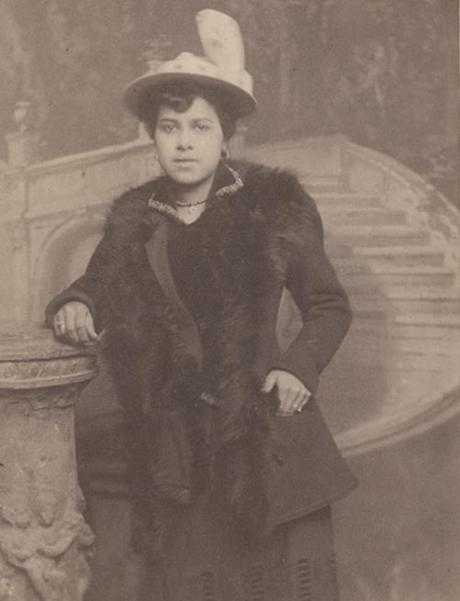
Kittie Knox: Bicycle Racer

Never heard of her?  Me either until this morning when the Boston Globe carried a front page story by Dan Adams about the ceremony putting a headstone on her long forgotten grave at Mount Auburn Cemetery in Cambridge.

Kittie Knox

Kittie Knox

Knox, a seamstress born in 1874 to a free black father and a white mother, became a prominent and accomplished cyclist by the 1890s in Boston. But her mixed racial heritage raised eyebrows, as did her insistence on riding a man’s bike and wearing pantaloons of her own design instead of the long, heavy skirts prescribed by Hopkins and her ilk.

And if that weren’t enough, she excelled at the sport: Knox completed multiple 100-mile rides and placed 12th out of 50 male and female cyclists in a major national race, “far ahead of her lighter-hued sisters,” one magazine reported.

Knox had seemed doomed to obscurity. But six years ago, author Lorenz Finison stumbled across her name while researching a forthcoming book on Boston’s cycling history. Passing references to Knox in cycling books prompted Finison to search local newspaper archives for more information.

“I found an article saying she won a cycling costume contest in Waltham,” said Finison, a teacher at the Boston University School of Public Health and a cofounder of Cycling Through History, which develops bike routes between African-American heritage sites. “I thought, that’s really amazing. Why, given the racial climate of the time, would she have won a contest out there? I thought I should look into it more.”

Kittie Knox faced not only sexism but also racism.

Finison eventually unearthed a trove of stories about Knox. While many articles were preoccupied with her race and appearance — “a beautiful and buxom black bloomerite” was one reference in Referee Magazine — he learned that Knox had been a member of Boston’s only black cycling group, the Riverside Cycle Club, before joining the Boston-based National League of American Wheelman in 1893.

Knox soon found herself at the epicenter of a fight over whether blacks could join the league, he said. After a Southern faction of league leaders successfully politicked in 1894 to make the group for whites only, Knox’s appearance at the league’s 1895 national meet in Asbury Park, N.J., caused an uproar. Trouble began upon her arrival, when, rather than appease critics, “Miss Knox did a few fancy cuts in front of the clubhouse and was requested to desist,” The New York Times reported.

Then, when Knox went to register for the meet and presented her membership card, the credentials were rejected.

“[Knox’s] entrance today, in the parlor of the Asbury Park wheelmen, caused wild consternation among the ladies gathered there,” wrote a San Francisco paper, according to Finison’s manuscript. “She was politely told that she was in the wrong house. To their utter surprise she produced a league membership card and declared that no exception had ever been taken to her color by wheelmen or wheelwomen. After asserting herself to that extent, Miss Knox walked defiantly out with her wheel.”

Even after members of the Massachusetts delegation intervened to ensure her participation, successfully arguing she had been admitted before the color bar, Finison writes that anger persisted: A group of white women cyclists threatened to quit in protest; dozens walked out of a League dance when Knox partnered with a white man; a Southern paper slammed League leaders for permitting “this murky goddess of Beanville” to ride.

Don’t you love it?  “[M]urky goddess of Beanville”.  A dig at Knox’s race and at Boston.   Good for the Massachusetts delegation for standing up for her.

Much of the Globe’s coverage of early Boston cycling clubs, as cited by Finison, betrays blatantly racist and sexist attitudes common in that era. But one Globe report from  the event in 1895 at Asbury Park trumpeted Knox’s abilities, perhaps to point a finger at Southern papers that had decried her participation.

“The leaders tried to lose Knox during the eighteen mile run but she was game, and when the big crowd entered the town on the return trip she was up with the leaders, sailing with the best of them,” the Globe wrote. “She was not to be consigned to the tribe of ‘also rans,’ and today all the League members are anxious to see her. And when she appears in the street she receives more attention than a half dozen star racing men.”

Kittie Knox died in 1900 at the age of 26, but through Finison’s efforts, her family was found and she was honored on Sunday,

Three generations of Kittie Knox’s relatives attended a ceremony dedicating a new headstone at Mount Auburn Cemetery.

Three generations of Kittie Knox’s relatives attended a ceremony dedicating a new headstone at Mount Auburn Cemetery.

Another remarkable woman has been rediscovered.
Photograph:  Jim Davis/Boston Globe

Gay rights and the Supremes

Justice Antonin Scalia has made it clear that he is, at best, uncomfortable with the series of decisions made by the Supreme Court on gay rights.  Soon after the decisions last June on DOMA and Prop 8,  Asawin Suebaeug wrote an article for Mother Jones in which the best and worst parts of his dissents were highlighted. 

Justice Antonin Scalia is not a big fan of gay sex, gay marriage, or gay anything. His dissent to Wednesday’s decision on United States v. Windsor, in which the Supreme Court ruled, 5-4, that legally married same-sex couples should get the same federal benefits as straight ones, shows as much. (The high court’s ruling invalidates a provision of the Defense of Marriage Act that barred same-sex couples from receiving health, tax, and retirement benefits.) In a nutshell, Scalia’s dissent focuses on the court’s prime purpose and power, and he is aghast that the majority assumed the power to shoot down DOMA. (To read the seven worst things Scalia has said or written about homosexuality, click here.)

And Andy Borowitz has made a cottage industry out of zinging him including “Scalia Arrested Trying to Burn Down the Supreme Court”.

WASHINGTON (The Borowitz Report)—In a shocking end to an illustrious legal career, police arrested Justice Antonin Scalia today as he attempted to set the Supreme Court building ablaze.

Justice Scalia, who had seemed calm and composed during the announcement of two major rulings this morning, was spotted by police minutes later outside the building, carrying a book of matches and a gallon of kerosene.

Back at the Supreme Court, Justice Scalia’s colleagues said they hoped he would get the help he needed, except for Justice Clarence Thomas, who said nothing.

Meanwhile  Justice Ruth Bader Ginsburg celebrated the marriage of a long time friend to another man while Justice Anthony Kennedy who wrote the decision on DOMA is being celebrated himself.

Justice Kennedy was a guest at an event in San Francisco featuring the Gay Men’s Chorus and speeches thanking him for his DOMA decision as well as his two previous decisions expanding gay rights.  The New York Times reported

The San Francisco Gay Men’s Chorus sang “Give ’Em Hope” for a revered and in some ways surprising guest who shared a California stage with them last month: Justice Anthony M. Kennedy.

Justice Kennedy was in San Francisco for an American Bar Association meeting, but he was also there to be celebrated by the men on the risers behind him. In remarks from the stage, San Francisco’s mayor, Edwin M. Lee, thanked the justice “for upholding the Constitution and justice for all” in his majority opinion in June in United States v. Windsor, a major gay rights victory.

“Freedom is always a work in progress,” Justice Kennedy said in his own remarks, making clear that there was more work to be done.

Justice Ginsburg performs an historic marriage ceremony.

Justice Ginsburg performs an historic marriage ceremony.

justice Ginsburg became the first Supreme to officiate at a gay wedding.

Ginsburg officiated Saturday at the marriage of Kennedy Center President Michael Kaiser and John Roberts, a government economist.

“Michael Kaiser is a friend and someone I much admire,” Ginsburg said in a written statement Friday. “That is why I am officiating at his wedding.”

“I think it will be one more statement that people who love each other and want to live together should be able to enjoy the blessings and the strife in the marriage relationship,” Ginsburg told The Washington Post in an interview.

“It won’t be long before there will be another” performed by a justice. She has another ceremony planned for September.

Kaiser told The Associated Press that he asked Ginsburg to officiate because she is a longtime friend.

So at least two, and if we take Justice Ginsburg at her word, three Supreme Court Justices moving forward with the times.

Has anyone else noted that one of those getting married was John Roberts?  Wonder what the Chief Justice thinks about that?
Photograph:  Margo Schulman/Kennedy Center

Economic justice and the March on Washington

Correction:  I refer to today as if it were the 28th.  The date I posted this is the 27th.  I seem to not know what day it is!


The official name of the march we celebrate today is the March on Washington for Jobs and Freedom.  Notice what comes first.  Jobs.  And while no one can deny that Martin Luther King, Jr. was a brilliant leader who served as a public face for the civil rights movement, we tend to forget that when he was assassinated in Memphis he was there to support sanitation workers striking for higher wages and employment rights.  Dr. King had moved past the simple movement for integration of public facilities and voting rights to understand that gaining equality meant a great deal more that sitting at a lunch counter or riding in the front of a bus.  Yes, those were monumental achievements, but true equality also means economic justice.

One man to whom we owe the March on Washington 50 years ago today is someone few have heard of:  Asa Philip Randolph.  Jack Curtis celebrated him in last Sunday’s Boston Globe.  The headline and subhead kinda of say it all:

Economic equality: What the March on Washington didn’t win

Fifty years later, why we remember King and not A. Philip Randolph

Rep. Byron Rushing (left) from Roxbury and John Dukakais at the unveiling of the A. Phillip Randolph statue in Boston’s Back Bay Station.

Rep. Byron Rushing (left) from Roxbury and John Dukakais at the unveiling of the A. Phillip Randolph statue in Boston’s Back Bay Station.

Today we can still point to the high unemployment rates, the lack of health care in many places, the failing schools and know that black Americans suffer the most.

The director of the march and its opening speaker, A. (for Asa) Philip Randolph (1889 – 1979) was established by 1963 as the century’s preeminent force on black labor and the dean of American civil rights leaders. Born in Crescent City, Fla., the son of a minister and a seamstress, Randolph moved in 1911 to Harlem, where he became a staunch socialist, a labor organizer, and a renowned soapbox orator. In 1925, Randolph was named the first president of the Brotherhood of Sleeping Car Porters, which he guided for over four decades.

In 1941, Randolph leapt onto the national stage. He and his fellow activist Bayard Rustin initiated what they called the March on Washington Movement, or MOWM, with the goal of staging a massive march to protest racial discrimination in the armed forces and defense industries. An alarmed Franklin Roosevelt summoned Randolph to the White House. Just one week later, Roosevelt issued an order prohibiting workplace discrimination throughout the nation’s defense industries, which led Randolph to call off the scheduled march
MOWM lasted only through 1946. But in the 1960s, as the nation’s African-Americans faced high unemployment and low wages and the country was shocked by violent attacks on civil rights demonstrators in the South, Randolph and Rustin turned to the same organizing tactics. In early 1963, Rustin and three associates addressed a memo to Randolph, then 74, calling for “mass descent” upon Washington, with 100,000 participants protesting “the economic subordination of the American Negro.” They envisioned a groundswell of protest calling for freedom and jobs.  Randolph and Rustin, aided by labor organizers and civil rights activists, organized the march with the dual goals of ending racial segregation and discrimination in the Jim Crow South and achieving economic equality for all Americans.
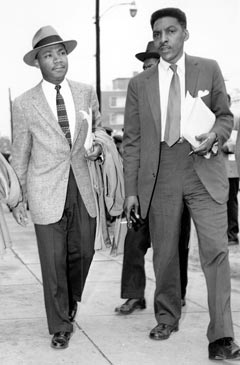
Randolph was a union organizer and Bayard Rustin (someone else you may never have heard of), often called “brother outsider” was a pacifist and gay.  Together they put together the event now best known for Martin Luther King, Jr.’s “I have a dream speech.  Rustin was also a major influence in bringing Dr. King  to embrace non violence.
Bayard Rustin with Martin Luther King, Jr.  in 1956

Bayard Rustin with Martin Luther King, Jr.
in 1956

In February 1956, when Bayard Rustin arrived in Montgomery to assist with the nascent bus boycott, Martin Luther King, Jr. had not personally embraced nonviolence. In fact, there were guns inside King’s house, and armed guards posted at his doors. Rustin persuaded boycott leaders to adopt complete nonviolence, teaching them Gandhian nonviolent direct protest.
Rustin was the speaker who read the list of the marcher’s demands.  You can read or listen to the transcript of Rustin reading the list of the demands in this link from WGBH radio.   They were seen as quite militant and including a living minimum wage. We all recited the pledge that committed ourselves to action.  I think it was in our programs.  (I found my button but so far haven’t located my program.)
As you watch the 50th anniversary coverage, remember A. Phillip Randolph and Bayard Rustin.  Without them, we would not be celebrating this important milestone today,  We can honor them by supporting the continuing fight for economic justice.
Jack Curtis concludes

But King’s emphasis on integration and legal equality gradually came to be seen as the primary impetus for the movement. In the years since, the optimistic and basically patriotic appeal of King’s speech has served to eclipse the march’s agenda and distort the popular understanding of its significant challenge to the status quo. The standard narrative skirts the more controversial, no less patriotic, themes of the march, and the radicalism that was front and center that day.

Randolph’s legacy is not forgotten, including in Boston. In the waiting area of Back Bay Station sits a larger-than life statue of Randolph by sculptor Tina Allen, dedicated in 1988 by Governor Michael Dukakis. Speakers at the dedication ceremony, including state Representative Byron Rushing, hailed the contributions to the railroad industry by porters and waiters from the black community, many of whom had lived in the Roxbury and South End neighborhoods by the station. A quote inscribed in the monument’s base attests to Randolph’s militant stance: “Freedom is never granted; it is won. Justice is never given. It is exacted.”

As we look back over the last 50 years, and look around at a country with rising and racially inflected economic inequality, that revolutionary spirit sits less easily than the hope of King’s “dream speech.” We embrace King’s dream in part because we sense that the country has indeed gone some way down that long road to freedom, and his vision can still set us dreaming and move us forward. But focusing on the demands by Randolph that fell to the wayside, we see even more glaringly that the march’s core aims of economic justice are not close to fruition; even today, we stand at the start of that path. It’s been a long time coming, and it may be a long time yet to come.

Photograph:  Randolph Statue John Tlumacki/Globe staff
Photography:  Rustin and King Associated Press

Voting rights: 2013

This Brian McFadden cartoon seemed appropriate for posting as people are Marching on Washington for Jobs and Freedom once again.

mcfadden voting

Justice Ruth Bader Ginsberg has it right in her dissent from the recent decision:  Why would we want to do away with something that is working?

The burden of domestic violence

The news hit Boston like a bombshell:  Jerry Remy‘s son was arrested for murder.  Jerry Remy is the former Red Sox second baseman and long time Sox television commentator.  He is the President of Red Sox Nation.  We have seen him through cancer, depression and a recent reoccurrence – a minor one he told us.  When he is not broadcasting games, we miss him.  So hearing that Jared Remy had been involved in a domestic violence incident that resulted in the stabbing to death of his girlfriend and mother of his child was shocking.

All the facts are not in, but there was a violent incident two days before that resulted in injury and a court appearance for Jared Remy the next day.  Jennifer Martel, for reasons that we really don’t know, did not appear to ask for a retraining order and, even though Massachusetts law allows for it, the district attorney did not request one.  Jared Remy has a history of violence.  A little over 24 hours later, Martel was dead.  She had been stabbed to death on the patio of their home.  Some neighbors tried to intervene and one of them was also injured.

The DA and the state attorney general are both investigating and looking into changes that might prevent similar incidents in the future.

Everyone is wondering why Martel didn’t just leave, but the question I want to ask is why is it always the woman who has to leave?  I’ve been on task forces, on the board of the Richmond, VA. YWCA, and executive director of a women’s commission.  I have supported shelters and hot line and assisted women to leave home and go to a safe place.  I ran a Clothesline Project.  Everyone in the field knows that the most dangerous time for a woman is when she is getting ready to leave her abuser, but we still expect her to be the one who leaves.  When there are school aged children, they are often put in different schools.  The woman is separated often separated from her friends and support system and so are the children.  She bears the burden, not her abuser.  (And yes, men can also be abused.  Gays and lesbians can abuse their partners and spouses.  But the vast majority of those suffering abuse are women.)  Martel’s family says she was also making plans to leave.

Friends and relatives said Martel, 27, an aspiring teacher who worked at a nearby Market Basket to provide for her daughter, had been trying to extricate herself from what she told them had become an abusive relationship with Remy, the son of famed Boston Red Sox player and broadcaster Jerry Remy.

“I talked to her on Wednesday; she said she was planning her escape,” said Patty Martel, who on Friday was driving from her home in Virginia to Massachusetts. “It started off she was very happy with him, but, as time went on, he showed his true colors, and it got worse and worse.”

Right after the murder of Jennifer Martel, I read a story in the New York Times about a new kind of law.  If someone makes too many calls to 911, the law can require the landlord to evict.

The police had warned Lakisha Briggs: one more altercation at her rented row house here, one more call to 911, and they would force her landlord to evict her.

They could do so under the town’s “nuisance property” ordinance, a law intended to protect neighborhoods from seriously disruptive households. Officials can invoke the measure and pressure landlords to act if the police have been called to a rental home three times within four months.

So she faced a fearful dilemma, Ms. Briggs recalled, when her volatile boyfriend showed up last summer, fresh out of a jail stint for their previous fight, and demanded to move in.

“I had no choice but to let him stay,” said Ms. Briggs, 34, a certified nursing assistant, even though, she said in an interview, she worried about the safety of her 3-year-old daughter as well as her own.

“If I called the police to get him out of my house, I’d get evicted,” she said. “If I physically tried to remove him, somebody would call 911 and I’d be evicted.”

This may be an unintended consequence of a law designed to help landlords with squatter and drug dealers, but the burden often falls on women who are victims of domestic violence.

“These laws threaten citizens’ fundamental right to call on the police for help,” said Matthew Desmond, a sociologist at Harvard.

In a study of citations issued to landlords in Milwaukee, conducted with Nicol Valdez of Columbia University, Mr. Desmond found that domestic violence was involved in nearly one-third of the cases and that rentals in largely black areas were disproportionately singled out.

Legal experts say the laws can give tenants the lasting stain of an eviction record without due process.

In a federal lawsuit being watched by legal aid groups elsewhere, Ms. Briggs has challenged the Norristown ordinance as unconstitutional.

She did so after her fears were realized.

In June 2012, days after her ex-boyfriend, Wilbert Bennett, moved into her house in this struggling town northwest of Philadelphia, he started another drunken, late-night argument. Then came his most violent attack yet: an assault with a broken ashtray that left a gash on her head and a four-inch stab wound in her neck.

Before she passed out, Ms. Briggs begged her neighbor not to call 911 because of the eviction threat, according to the suit, which is being argued by the American Civil Liberties Union.

The neighbor called anyway. Ms. Briggs was taken by helicopter to Philadelphia for emergency treatment. Mr. Bennett is now serving a sentence of one to two years for aggravated assault.

The town says she never got a restraining order.  What if she had gotten one when the boyfriend got out of jail?  In all likelihood he would have come around anyway and she would have had to call 911.

I don’t pretend to know what the answer is, but we need to figure out how to deal with men like Wilbert Bennett and Jared Remy.  Putting them in jail is not the entire answer.  That may well work for a while, but they will get out and often turn up again.   There are a few programs for men, but they are very few.  Some prisons have anger management classes which may work for some.  But as long as we continue to think of ending the abuse as the woman’s responsibility, we will never think of any new solutions.

A death from domestic violence leaves families shattered and children anchorless and what happened with Jennifer Martel and Jared Remy is not an exception.

The 1963 March on Washington for Jobs and Freedom: My memories

Fifty years ago I was a sixteen year old high school student living in New Jersey.  My parents were community activists and very politically involved.  My mother and several of her friends decided to go to Washington for the march and took me and several of my high school friends.  I know there was some discussion about whether the march would turn violent and some calls were made (and long distance was a big deal back then) to my uncle who lived in D.C.  He must have reassured them and said that he had signed up to make sandwiches to give out to people who didn’t bring their own.  I remember being impressed because he was still a bachelor and, as far as I knew, wasn’t much of a cook.

So we kids were allowed to go along.  I remember the bus ride as long and the bathrooms at the Maryland House really horrible.  When we got to Washington, we asked to go off on our own and set off with a thermos jug of ice water (No bottles of water back then, just a jug and paper cups)  and some bags of oranges and peanut butter and jelly (they wouldn’t spoil in the hot weather) and set off.  It was an interesting little group:  me (Japanese American), at least one African American girlfriend, and several white American boys.  We wormed our way toward the front of where the march was to start instead of going to the end.  I remember people shouting and seeing the folks from the famous picture of the front of the march go by.  We fell in behind them.  I later learned that some people had already started marching and the dignitaries were trying to catch up.

Baez and Dylan

Baez and Dylan

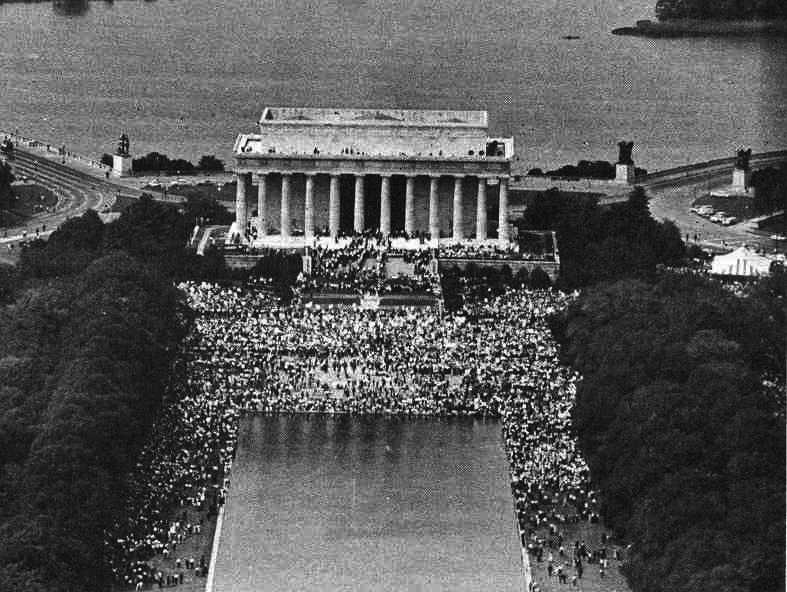
Once we got to the Lincoln Memorial, we first found a spot to sit near some trees, but we soon moved closer to the Reflecting Pool so we could see better.  As it got hotter, and it was very hot,  we joined many by putting our feet in the pool.  We were pretty close to the front, close enough to see Joan Baez and Bob Dylan as well as Marion Anderson and Mahalia Jackson.  We heard rumors that President Kennedy was going to come join us.

I’ll be honest and say that there were a lot, a huge number, of speeches.  I don’t remember very many of them, to be honest.  I know that I was excited to hear and see Myrlie Evers, Rosa Parks and Daisy Bates as part of a tribute to women of the Movement.  But the speech that I remember best was not the famous one given by Martin Luther King, Jr.  The one I remember most clearly was given by John Lewis.   I think that was because he was with the Southern Student Non-Violent Coordinating Committee and I had met SNCC organizers.  Also he was young and had been arrested many times.  I had no idea at the time the speech was given that it had been censored, but it was still the most militant speech given that day.  He ended

To those who have said, “Be patient and wait,” we must say that we  cannot be patient. We do not want our freedom gradually but we want to  be free now.

We are tired. We are tired of being beat by policemen. We are tired of  seeing our people locked up in jail over and over again, and then you  holler “Be patient.” How long can we be patient? We want our freedom and  we want it now.

We do not want to go to jail, but we will go to jail if this is the  price we must pay for love, brotherhood and true peace. I appeal to all  of you to get into this great revolution that is sweeping this nation.  Get in and stay in the streets of every city, every village and hamlet  of this nation until true freedom comes, until a revolution is complete.  We must get in this revolution and complete the revolution. In the Delta  of Mississippi, in Southwest Georgia, in the Black Belt of Alabama, in  Harlem, in Chicago, Detroit, Philadelphia and all over this nation the  black masses are on a march for jobs and freedom.

John Lewis at the Lincoln Memorial, 1963

John Lewis at the Lincoln Memorial, 1963

They’re talking about slow down and stop. We will not stop. All of the  forces of Eastland, Barnett, Wallace, and Thurmond will not stop this  revolution. If we do not get meaningful legislation out of this  Congress, the time will come when we will not confine our march into  Washington. We will march through the South, through the streets of  Jackson, through the streets of Danville, through the streets of  Cambridge, through the streets of Birmingham. But we will march with the  spirit of love and with the spirit of dignity that we have shown here  today.

By the forces of our demands, our determination and our numbers, we  shall send a desegregated South into a thousand pieces, put them  together in the image of God and Democracy. We must say wake up America,  wake up! For we cannot stop, and we will not and cannot be patient.

I still carry that image in my mind.  A young black man thundering, “We want our freedom and we want it now.”   But if he had included words he had wanted to include it is likely that the microphone would have been cut off.  The original text included

I want to know, which side is the federal government on?

The revolution is at hand, and we must free ourselves of the chains of  political and economic slavery. The nonviolent revolution is saying, “We  will not wait for the courts to act, for we have been waiting for  hundreds of years. We will not wait for the President, the Justice  Department, nor Congress, but we will take matters into our own hands  and create a source of power, outside of any national structure, that  could and would assure us a victory.”

At sixteen those words would have sounded so much better than “I have a dream.”

View of the Lincoln Memorial

View of the Lincoln Memorial

I think this was taken relatively early in the day.  My friends and I were at the pool on the left, not too far back and for all I remember, we might already have been there when this was taken.

It was a long ride back to New Jersey and it turned out that I had heat exhaustion, but it was worth it to have been part of history.

There were about 250,000 people there and probably many more will claim that they were there, but I really was.  It was my first large demonstration, but by the time the War in Vietnam was winding down, I was a veteran at these events.  I’m not planning on attending the 50th Anniversary March this year, but I will be there in spirit.

Photograph:  Baez and Dylan uncredited from Wikipedia

Photograph:  John Lewis  Bettmann/ Corbis

Photograph:  Lincoln Memorial  Miles Hodges, Kingsacademy.com

American defectors: life for Edward Snowden in Russia

Now that Edward Snowden has been granted temporary asylum in Russia (I suspect they mostly just wanted him gone from the airport.), it is not so certain he will have an easy life.  No matter how terrible you think surveillance is in the United States, I can guarantee that it is worse there.  And he likely has nothing more to trade to get better treatment.  NPR ran this story a few days ago.

If NSA leaker Edward Snowden is allowed to leave the Moscow airport and enter Russia, as some news reports suggest, he’ll join a fairly small group of Americans who have sought refuge there.

So how did it work out for the others?

In short, not so well. Some became disillusioned and left, like Lee Harvey Oswald. Others were sent to Josef Stalin’s gulags, where they served long sentences or were executed. Some lived out their days in an alcoholic haze.

“There’s little evidence from historical records that [Snowden] has anything good to look forward to,” says Peter Savodnik, a journalist and author of the upcoming book, The Interloper: Lee Harvey Oswald Inside the Soviet Union. “Essentially, nobody from the U.S. who has defected to Russia has gone on to think that’s a smart decision.”

In the 1920s and ’30s, hundreds of American leftists moved to what was then the Soviet Union, motivated by a desire to build socialism.

Alexander Gelver of Oshkosh, Wis., was taken there by his parents. But when the 24-year-old wanted to return to the U.S., he was stopped by Soviet police outside the U.S. Embassy in Moscow. He was arrested and disappeared. Only in the 1990s did his fate become clear: He was executed in 1938, one of Stalin’s many victims.

The Associated Press documented the case of Gelver and 14 other Americans who disappeared in the Soviet Union in the 1930s and ’40s. All were either imprisoned or executed. Dozens, perhaps hundreds of other Americans, met a similar fate during the rule of Stalin, who suspected that foreigners were spies.

A famous case in the Cold War era has parallels to Snowden. William Martin and Bernon Mitchell, cryptologists at the NSA, defected in 1960. But they came to regret their decision and became alcoholics. Martin died in Mexico in 1987. Mitchell died in Russia in 2001.

One defector who did return was Oswald. He left for the Soviet Union in 1959, returned to the U.S. three years later, and became infamous as the assassin of President Kennedy in 1963.

Edward Snowden, the NSA leaker seen here in a photo taken in July, has been granted temporary asylum in Russia. Thursday, he left Moscow's airport for the first time in more than a month.

Let’s hope that Snowden has better luck.  It will be tough not knowing many people and not speaking Russian.  Personally, I don’t think he made a good choice or got good advice.  I have never understood why he couldn’t go directly from Hong Kong to South American someplace.

Photograph:  Tatyana Lokshina/AP

On the opposite sides of the Civil Rights struggle: Lindy Boggs and Robert Byrd, Jr.

This week has brought notice of the death of two political figures from the past:  Lindy Boggs and Harry Byrd, Jr.  Both in their late 90s and had been out of office and out of the news for a number of years.  But it is notable that although of similar age and from the south, they were opposites when it came to civil rights.

Lindy Boggs was the window of House Speaker Hale Boggs who died in a plane crash in Alaska.  I remember when this happened in 1972,  I was moving out of my student movement phase and beginning to take an interest in electoral politics. Boggs ran to replace him following a tradition of widows taking over for their politician husbands.   Boggs, however, was different.  She went on to serve nine terms in Congress (several of them representing a majority black district) and become a champion of women’s rights and civil rights while representing Louisiana.  The New York Times describes some of her legislative efforts.

Mrs. Boggs during her Congressional campaign in 1973

Mrs. Boggs during her Congressional campaign in 1973

The velvet Southern charm she had absorbed growing up on two Louisiana plantations was her not-so-secret weapon.

She displayed it early in her first term when the House banking committee was composing an amendment to a lending bill banning discrimination on the basis of race, age or veteran status. She added the words “sex or marital status,” ran to a copying machine and made a copy for each member.

In her memoir she recalled saying: “Knowing the members composing this committee as well as I do, I’m sure it was just an oversight that we didn’t have ‘sex’ or ‘marital status’ included. I’ve taken care of that, and I trust it meets with the committee’s approval.”

Thus was sex discrimination prohibited by the Equal Credit Opportunity Act of 1974.

I always loved that story.

Mrs. Boggs used her membership on the Appropriations Committee to push for other women’s economic concerns, like equal pay for government jobs and equal access to government business contracts. She became a champion of historic preservation and port development, flood control and housing in her New Orleans district.

Mrs. Boggs championed racial justice at a time when doing so invited the resentment if not hostility of most Southern whites. She saw the growing civil rights movement as necessary to the political reform movement of the 1940s and ’50s.

“You couldn’t want to reverse the injustices of the political system and not include the blacks and the poor; it was just obvious,” she said in 1990.

While her husband was in office, she supported civil rights legislation as well as Head Start and antipoverty programs. As the president of two organizations of Congressional wives, she saw to it that each group was racially integrated.

She has been honored by the House with the naming, in 1991, of the Lindy Claiborne Boggs Congressional Women’s Reading Room.  She was 97 when she died.

At the other end of the civil rights spectrum is Harry Byrd, Jr., the long time Senator from Virginia, and not to be confused with Robert Byrd of West Virginia.  When I moved to Virginia in 1965, Byrd was my Senator.  He had just been appointed to replace his father who had died.  The Byrd Machine ruled Virginia Democratic State politics at the time and both Byrds worked hard to maintain segregation in Virginia schools.  The New York Times writes

Even as a middle-aged man, Mr. Byrd was often called “Little Harry” or “Young Harry.” By the 1920s, his father, Harry F. Byrd Sr., had built a formidable Democratic political machine in Virginia that eventually elected him governor and then to the Senate, where he served from 1933 until his resignation in 1965. (Like his son, Harry Sr. was initially appointed to the Senate to fill a vacancy, after the resignation of Claude A. Swanson.)

The elder Mr. Byrd was a conservative Democrat who served for 11 years as chairman of the Senate Finance Committee. He also supported “massive resistance,” the name given to Virginia’s opposition to public school desegregation in the late 1950s. The son, who was serving in the State Senate at the time, helped develop the policy, which included closing some schools for several years rather than integrate them.

Harry F. Byrd  in 1965, when he was appointed to his father’s seat

Harry F. Byrd in 1965, when he was appointed to his father’s seat

Moorestown, N.J. where I was living as a teenager was one of the northern towns that hosted African-American high school seniors so they would have a chance to get diplomas and go to college.  I went to a number of social activities that were hosted for them, but never, much to my regret, got to know any of them well enough to stay in touch.

Although the Byrd machine began coming apart amid the fractured politics of the 1960s, it held together long enough to get Gov. Albertis S. Harrison Jr., a longtime supporter of the family, to appoint Harry Jr. to his father’s seat in 1965. The following year Mr. Byrd won a special election to complete his father’s term. By 1970, with blacks voting in larger numbers and urban labor unions supporting more liberal candidates, Mr. Byrd faced a potentially challenging Democratic primary in pursuit of his first full term. That March, saying he was unwilling to sign a party oath to support the Democratic nominee in the 1972 presidential election, particularly since the candidate was not yet known, he announced that he would become an independent.

If the decision seemed striking given his family history, it was also prudent. Taking votes from his Democratic and Republican opponents, he won easily that November. Mr. Byrd had dropped his party affiliation but essentially kept his voters, his politics and much of his power.

I don’t think he could have supported either George McGovern or Hubert Humphrey so he made the correct choice.  Byrd, however,  continued to caucus with the Democrats.  There is one more shameful incident I remember.

In the late 1970s, President Jimmy Carter asked Mr. Byrd to form judicial commissions to name black and female candidates for Virginia’s federal courts. In 1980, after Mr. Byrd’s commissions had named only white men, none of whom were judges, President Carter nominated James E. Sheffield, a black state court judge. Mr. Byrd vowed to fight his Senate confirmation and did so successfully.

I remember Judge Sheffield’s rejection well.  The only reason for his failure to be confirmed was race.

Senator Byrd was a bigot throughout his public life.  He did not run for re-election in 1982 by which time I think he would have lost as new young Democrats were winning office like Charles Robb who became governor in then.  And people like me who were taking over the Virginia Democratic Party.  Byrd’s time was thankfully passing.

He was 98 when he died.

Photographs:  United Press International

Fixing FISA

Congress is beginning to have a debate about surveillance, oversight and secrecy – the one good thing to come out of  Edward Snowden’s continuing adventure.  Of course, it is hard to debate when you can’t talk about a lot of things in public or even to your fellow members, so I was very interesting in reading Judge James G. Carr’s op-ed in yesterday’s New York Times.  His suggestion is one that Congress and the Obama Administration should be able to debate and legislate without revealing anything that needs to be kept secret.  Judge Carr is identified as a senior federal judge for the Northern District of Ohio,[who] served on the Foreign Intelligence Surveillance Court from 2002 to 2008.

CONGRESS created the Foreign Intelligence Surveillance Court in 1978 as a check on executive authority. Recent disclosures about vast data-gathering by the government have raised concerns about the legitimacy of the court’s actions. Congress can take a simple step to restore confidence in the court’s impartiality and integrity: authorizing its judges to appoint lawyers to serve the public interest when novel legal issues come before it.

The court is designed to protect individual liberties as the government protects us from foreign dangers. In 1972, the Supreme Court ruled that the Nixon administration had violated the Fourth Amendment by conducting warrantless surveillance on a radical domestic group, the White Panthers, who were suspected of bombing a C.I.A. recruiting office in Ann Arbor, Mich. In 1975 and 1976, the Church Committee, a Senate panel, produced a series of reports about foreign and domestic intelligence operations, including surveillance by the F.B.I. of suspected communists, radicals and other activists — including, notoriously, the Rev. Dr. Martin Luther King Jr.

The Foreign Intelligence Service Act set up the FISA Court in response. To obtain authority to intercept the phone and electronic communications of American citizens and permanent residents, the government must only show probable cause that the target has a connection to a foreign government or entity or a foreign terrorist group. It does not have to show, as with an ordinary search warrant, probable cause that the target is suspected of a crime.

The problem is that the court only hears from one side.  I wrote recently that the real danger to our civil liberties is the FISA Court and I hoped that people will come up with ways to try to fix it.  Judge Carr has one suggestion at which Congress should take a serious look.

Critics note that the court has approved almost all of the government’s surveillance requests. Some say the court is virtually creating a secret new body of law governing privacy, secrecy and surveillance. Others have called for declassified summaries of all of the court’s secret rulings.

James Robertson, a retired federal judge who served with me on the FISA court, recently called for greater transparency of the court’s proceedings. He has proposed the naming of an advocate, with high-level security clearance, to argue against the government’s filings. He suggested that the Privacy and Civil Liberties Oversight Board, which oversees surveillance activities, could also provide a check. I would go even further.

In an ordinary criminal case, the adversarial process assures legal representation of the defendant. Clearly, in top-secret cases involving potential surveillance targets, a lawyer cannot, in the conventional sense, represent the target.

Congress could, however, authorize the FISA judges to appoint, from time to time, independent lawyers with security clearances to serve “pro bono publico” — for the public’s good — to challenge the government when an application for a FISA order raises new legal issues.

Having lawyers challenge novel legal assertions in these secret proceedings would result in better judicial outcomes. Even if the government got its way all or most of the time, the court would have more fully developed its reasons for letting it do so. Of equal importance, the appointed lawyer could appeal a decision in the government’s favor to the Foreign Intelligence Surveillance Court of Review — and then to the Supreme Court. No opportunity for such review exists today, because only the government can appeal a FISA court ruling.

A combination of a people’s advocate and public release of decision summaries would remove some of the mystery and secrecy.

One obvious objection: judges considering whether to issue an ordinary search warrant hear only from the government. Why should this not be the same when the government goes to the Foreign Intelligence Surveillance Court?

My answer: the court is unique among judicial institutions in balancing the right to privacy against the president’s duty to protect the public, and it encounters issues of statutory and constitutional interpretation that no other court does or can.

For an ordinary search warrant, the judge has a large and well-developed body of precedent. When a warrant has been issued and executed, the subject knows immediately. If indicted, he can challenge the warrant. He can also move to have property returned or sue for damages. These protections are not afforded to FISA surveillance targets. Even where a target is indicted, laws like the Classified Information Procedures Act almost always preclude the target from learning about the order or challenging the evidence. This situation puts basic constitutional protections at risk and creates doubts about the legitimacy of the court’s work and the independence and integrity of its judges. To avert these dangers, Congress should amend FISA to give the court’s judges the discretion to appoint lawyers to serve not just the interests of the target and the public — but those of the court as well.

079 Capitol Hill United States Congress 1993

079 Capitol Hill United States Congress 1993 (Photo credit: David Holt London)

We are already deep in uncharted waters and we need to take steps to try to protect ourselves.  It serves no purpose if we lose our civil liberties while protecting them.  I don’t have a great deal of hope that Congress can actually get itself together enough to act, but there has been some glimmer of bipartisanship about this issue.  Let us hope someone writes Judge Carr’s ideas into a bill so it can be introduced.