Ghettoside

We are all thinking this January 2015 about relationship between the minority – in particular, black – communities and the police. Ghettoside by Los Angeles reporter, Jill Leovy, is a timely addition to the conversation.

The homicide rate in Los Angeles, in Watts and in South Central in particular, consists of young black men killing other young black men. The clearance rate for these murders is very low. Because of the difficulties in finding witnesses willing to testify and a culture that put a low premium on their lives, many police resorted to arresting those they knew were guilty of murder but against whom they had insufficient evidence, of “proxy crimes.” These crimes included public drinking, possession of drugs, and parole violations. These arrests did get killers off the streets, but they were often viewed as harassment.

Ghettoside is the story of two murders and of John Skaggs, the white police detective who solved both. Skaggs was the detective who actually cared and he and his partners preserved until both cases resulted in convictions. Leovy chose as victims the son of a black police detective and a tenth grader son of a single mother home health care worker. Neither were gang affiliated. One would expect effort to solve the case concerning a fellow police officer, but given the culture of the L.A. police at the time, not the other. Skaggs worked through police budget cuts and the lack of resources his entire career. He and his first partner and later those they trained cared. They cared about the families, the victims and the witnesses. They solved homicides. Leovy gives us a small glimpse into what makes Skaggs tick, but I never learned enough to understand why he was different, why he was driven to solve these crimes that few others cared about.

The unfolding of the investigations reads like a mystery story. Some may get confused about the multiple characters, but I found it no more confusing than reading Ngaio Marsh or Agatha Christie. I did find that Leovy’s digressions into the roots of both black on black crime and white indifference distracting and, in the end, superficial. Leovy is not an historian or sociologist and the strength of this book is her reporting on the crimes and the investigations. She began a blog for the Los Angeles Times called the “Homicide Report” in 2007. The report chronicles every homicide in the city to the current day. Every city should have a similar blog.

Ghettoside ends with a quote from William J. Stuntz. Stuntz was a Harvard Law School Professor who studied the criminal justice system and died much too young. “Poor black neighborhoods see too little of the kids of policing and criminal punishment that do the most good, and too much of the kinds that do the most harm.” This also sums up Ghettoside.

I highly recommend this book.

This was first published as a review for LibraryThing with an Advanced Readers Copy.  The book will be available on January 27.


Family legacies

It must be difficult to be the son or daughter of a famous person.  We have all read about the child of a Hollywood star who does drugs, goes to jail, and generally is a sad case.  We have also read of children who try to live their own lives out of the public view.  And there are also children who work at preserving the parent’s legacy.  But it can’t be easy.  I’ve been thinking for the last couple of days about the column Adrian Walker wrote in the Boston Globe for MLK Day.  It was titled “King had a dream. His children have an army of lawyers.”

But a far less joyous scene is being played out in a courtroom in Atlanta. Not for the first time, King’s three surviving children are on opposing sides of a lawsuit involving his legacy.

At stake is ownership of King’s 1964 Nobel Peace Prize and his Bible, which President Obama used for his second swearing-in. King’s sons, Martin III and Dexter, apparently want to sell the heirlooms; his daughter, Bernice, has sued to stop them. By court order, both items have been stored in a safe deposit box for nearly a year.

If King had a dream, the King children have a piggy bank. They are one litigious group.

Aside from having previously sued one another, they have sued their father’s closest friends, too. Both former Atlanta mayor Andrew Young and actor/activist Harry Belafonte have been the target of lawsuits about King’s property. Belafonte sued them back in a dispute about ownership of one of King’s most famous speeches, one in which he came out in opposition to the Vietnam War. The parties reached an undisclosed settlement last year.

OLYMPUS DIGITAL CAMERA

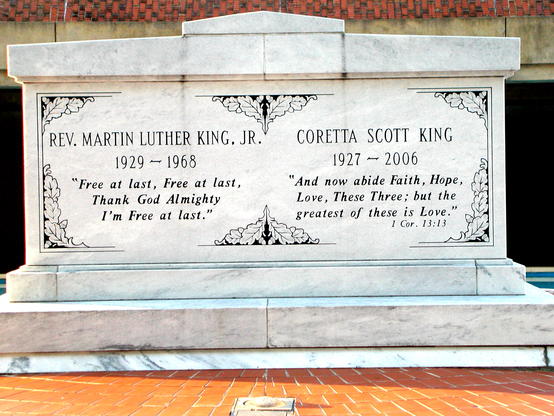
I hate to mention it to the King children, but sometimes a person is bigger than just being a family member.  He – or she – actually belongs to all of us.  Most of us would love to be able to go to Atlanta and see the Nobel Prize metal and the family Bible.  When I was there a few years back, we visited Ebenezer Baptist Church, the family home, and the pool with the tomb containing Martin and Coretta King at the King Center.  It was a very moving experience.  To see the various artifacts would have added a great deal.

The family feuds about money have not tarnished King’s legacy, but they have wasted opportunities to enhance it. At the end of the Selma march, King stood in front of the Alabama capital and gave one of the most deeply moving speeches of his career. But you won’t hear it in “Selma” — it’s paraphrased, painfully — because the filmmakers couldn’t get permission to use it.

There are a lot of stories like that. The Kings sued CNN over airing the “I Have A Dream” speech, essentially taking the video of it out of circulation.

King’s greatest moments are increasingly available only in truncated form. That is not the way to honor his memory.

While it is not clear that the brothers would sell the artifacts should they prevail in court, that is the most likely possibility.  Nobel Peace prizes should not be auctioned off.

Walker ends his piece

King’s career offers so much to celebrate. Like few Americans before or since, he challenged us to live up to our best and truest selves. Though unfinished, the results of the heroic campaign he led can be seen all around us. As much as anything, he stood for the collective good over the glorification of one individual. He certainly wasn’t about money.

Tragically, that lesson never quite made it to his successors.

King taught us about nonviolence, but it seems that his children have yet to learn that violence does not have to be physical.

Photograph:  King Center website http://thekingcenter.org/plan-your-visit

The Supremes, Judge Posner, and gay marriage

The news late last week that the Supreme Court would hear an appeal from the Sixth Circuit ruling upholding bans on same-sex marriage in Ohio, Michigan, Kentucky, and Tennessee brought to mind the Seventh Circuit ruling last fall written by Judge Posner.  Mark Joseph Stern writing in Slate noted that suddenly there was a “race” among judges to …”write the one marriage equality opinion that history will remember.”  But Stern wrote

Thursday’s ruling by 7th Circuit Judge Richard Posner, which struck down Indiana’s and Wisconsin’s gay marriage bans, is a different beast altogether. In his opinion, Posner does not sound like a man aiming to have his words etched in the history books or praised by future generations. Rather, he sounds like a man who has listened to all the arguments against gay marriage, analyzed them cautiously and thoroughly, and found himself absolutely disgusted by their sophistry and rank bigotry. The opinion is a masterpiece of wit and logic that doesn’t call attention to—indeed, doesn’t seem to care about—its own brilliance. Posner is not writing for Justice Anthony Kennedy, or for judges of the future, or even for gay people of the present. He is writing, very clearly, for himself.

Ironically, by writing an opinion so fixated on the facts at hand, Posner may have actually written the one gay marriage ruling that the Supreme Court takes to heart.Other, more legacy-minded judges have attempted to sketch out a revised framework for constitutional marriage equality, granting gay people heightened judicial scrutiny and declaring marriage a fundamental right. But Posner isn’t interested in making new law: The statutes before him are so irrational, so senseless and unreasonable, that they’re noxious to the U.S. Constitution under almost anyinterpretation of the equal protection clause.

I spent time this morning reading Judge Poster’s opinion.  It is readable and understandable even by non-lawyers.  He takes each argument made by Indiana and then Wisconsin against same-sex marriage one at a time and uses precedent, social science, and history to demolish them.  Posner sets out to answer four questions.

Does the challenged practice involve discrimination, rooted in a history of prejudice, against some identifiable group of persons, resulting in unequal treatment harmful to them?

Is the unequal treatment based on some immutable or at least tenacious characteristic of the people discriminated against (biological, such as skin color, or a deep psychological commitment, as religious belief often is, both types being distinct from characteristics that are easy for a person to change, such as the length of his or her fingernails)? The characteristic must be one that isn’t relevant to a person’s ability to participate in society.

Does the discrimination, even if based on an immutable characteristic, nevertheless confer an important offsetting benefit on society as a whole?

Though it does confer an offsetting benefit, is the discriminatory policy overinclusive because the benefit it confers on society could be achieved in a way less harmful to the discriminated-against group, or underinclusive because the government’s purported rationale for the policy implies that it should equally apply to other groups as well?

Throughout his decision, Judge Posner concentrates on children and marriage.  The same persons who argue against same-sex marriage are often the same persons who argue that the state needs to encourage heterosexual marriage to provide stability to children.

Our pair of cases is rich in detail but ultimately straight- forward to decide. The challenged laws discriminate against a minority defined by an immutable characteristic, and the only rationale that the states put forth with any conviction— that same-sex couples and their children don’t need marriage because same-sex couples can’t produce children, intended or unintended—is so full of holes that it cannot be taken seriously. To the extent that children are better off in families in which the parents are married, they are better off whether they are raised by their biological parents or by adoptive parents. The discrimination against same-sex couples is irrational, and therefore unconstitutional even if the discrimination is not subjected to heightened scrutiny, which is why we can largely elide the more complex analysis found in more closely balanced equal-protection cases.

In Indiana a same-sex couple can adopt while in Wisconsin, one member of a same-sex couple can adopt.  So the logical conclusion is that marriage is just as important for same-sex couples with children as for heterosexual couples with families.  And he points out that those who say that same-sex marriage will some how erode or damage heterosexual marriage need only to look at the 10 year history in Massachusetts to see that there is no impact at all.

Judge Posner’s decision is full of “zingers” most aimed with impatience at irrational argument.  But he also takes aim at Justice Scalia citing his dissent in Lawrence v. Texas which struck down laws against sodomy.

…But Justice Scalia, in a dissenting opinion in Lawrence, 539 U.S. at 586, joined by Chief Justice Rehnquist and Justice Thomas, thought not. He wrote that “principle and logic” would require the Court, given its decision in Lawrence, to hold that there is a constitutional right to same-sex marriage. Id. at 605.

In the end, Judge Posner can find no rational argument against same-sex marriage.

Pete Prete with Equality Beyond Gender waved a Marriage Pride flag attached to an American flag outside the Supreme Court in Washington on Friday.

Pete Prete with Equality Beyond Gender waved a Marriage Pride flag attached to an American flag outside the Supreme Court in Washington on Friday.

The Supreme Court will hear arguments on two questions:  The right to marry and the right to have out-of-state marriages recognized.  Because there are four states in the appeal with four different questions, the Supreme Court in accepting the appeals wrote the questions they will try to answer.  Some in the legal community were alarmed, but the New York Times quotes Harvard Law professor, Lawrence Tribe

“The court’s order represents good housekeeping,” said Laurence H. Tribe, a law professor at Harvard.

But Professor Tribe also voiced a small note of caution.

“The rephrased questions,” he said, “technically leave open a middle path along which the court would prevent states from discriminating against same-sex couples lawfully married in their home states without requiring any state to take the affirmative step of issuing its own marriage licenses to same-sex couples.”

I haven’t seen the appeal documents, but if the arguments are anything like those from Indiana and Wisconsin and I assume they are as those are the arguments being made nationally, the Supreme Court need to look no further than Judge Posner’s decision for answers and require the right to marry in all states.  And, after all, Justice Scalia has already concluded that once sodomy laws are found unconstitutional, same-sex marriage must follow.  I predict a 7-2 decision in favor of the right to marry.  We will see in June if I am correct.

Photograph:  Jabin Botsford/The New York Times

Looking at President Obama

The annual Gallup poll of the most admired man has just picked President Obama.  Even among Republicans he tied with Pope Francis.  But to hear some Republican elected officials and pundits, Barack Obama is the devil incarnate.  If he says the sky is a little cloudy, they will say it is clear.  So what is going on?  Are people finally catching on to what he has accomplished?  Are people starting to look beyond the media’s short attention span?  I don’t have any answers, but I know that the President has managed more than one could ever imagine given the Tea Party and solid Republican opposition to everything he proposes. Even people like Paul Krugman, who one would think would be a supporter, was not.  But Krugman has changed his mind and in October wrote a widely circulated defense.

When it comes to Barack Obama, I’ve always been out of sync. Back in 2008, when many liberals were wildly enthusiastic about his candidacy and his press was strongly favorable, I was skeptical. I worried that he was naive, that his talk about transcending the political divide was a dangerous illusion given the unyielding extremism of the modern American right. Furthermore, it seemed clear to me that, far from being the transformational figure his supporters imagined, he was rather conventional-minded: Even before taking office, he showed signs of paying far too much attention to what some of us would later take to calling Very Serious People, people who regarded cutting budget deficits and a willingness to slash Social Security as the very essence of political virtue.

I certainly haven’t agreed with everything Obama has proposed or done, but no one agrees with anyone else 100% of the time.  And there have been some scary moments.  Remember the “Grand Bargain”?  But we can list as accomplishments the Affordable Care Act, Dodd-Frank financial reform (despite the reluctance of Congress to fund the Consumer Protection Bureau and the recent gutting of the prohibitions on banks and derivatives.), the steady improvement of the economy (the only one in the world not on the verge of tanking again) and the ending of our combat roles in the wars in Iraq and Afghanistan.  But I just don’t understand the continuous bashing by everyone.  Plus, I firmly believe that the mid-term elections would not have been quite so bad if the Democrats had had the guts to run on the President’s record.

Krugman writes

But now the shoe is on the other foot: Obama faces trash talk left, right and center – literally – and doesn’t deserve it. Despite bitter opposition, despite having come close to self-inflicted disaster, Obama has emerged as one of the most consequential and, yes, successful presidents in American history. His health reform is imperfect but still a huge step forward – and it’s working better than anyone expected. Financial reform fell far short of what should have happened, but it’s much more effective than you’d think. Economic management has been half-crippled by Republican obstruction, but has nonetheless been much better than in other advanced countries. And environmental policy is starting to look like it could be a major legacy.

I think one of the problems the President has is that he is a canvas on which each person paints the picture of what they want him to be.  Michelle Bachmann sees him as a non-Christian, non-American.  Cornel West thinks he is a ‘counterfeit progressive”, meaning, I guess a conservative in progressive clothing.  The problem is people do not look at facts.  And they certainly don’t understand the character of the man.  I found this description of him on the golf course very apt.

One of the golfers who played with Mr. Obama said the way the president carried himself on the course provided significant insight into his character.

“If you came down from Mars and saw his disposition on the golf course, you would think he would be a pretty good president,” the golfer said. “He’s honest, he keeps his composure through terrible adversity, he’s unruffled, he smiles, and he doesn’t quit.”

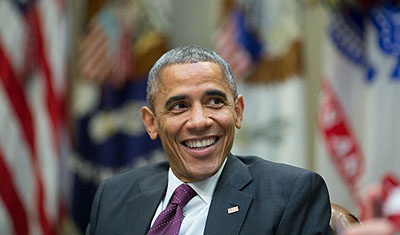
Obama

This is why after the mid-term elections, President Obama was able to have what Kevin Drum writing in Mother Jones magazine was able to call “a Hellava month”.  Drum lists his accomplishments during November and December.  Here are a few from his list.

  • November 11: Concluded a climate deal with China that was not only important in its own right, but has since been widely credited with jumpstarting progress at the Lima talks last week.

  • November 20: Issued an executive order protecting millions of undocumented workers from the threat of deportation.

  • November 26: Signed off on an important new EPA rule significantly limiting ozone emissions.

  • December 17: Announced a historic renormalization of relations with Cuba.

Plus a number of judicial and other nominees were approved by the Senate before they went home for the holidays. Jennifer Bendery explains in the Huffington Post.

If there’s one thing from 2014 that will define President Barack Obama’s legacy after he’s left the White House, it’s the number of lifetime judges he put on the federal bench.

In its final act of the year, the Senate blew through a dozen U.S. district court nominees on Tuesday night. That puts Obama at a whopping 89 district court and circuit court confirmations for the year, and means he’ll wrap up his sixth year in office with a grand total of 305 district court and circuit court confirmations — a tally that puts him well beyond where his predecessors were by this point in their presidencies.

It may be that, in the end, his biggest effect on the judiciary isn’t sheer numbers as much as the diversity of his judges. Forty-two percent of Obama’s confirmed judges are women, 19 percent are black and 11 percent are Hispanic, according to data provided by the White House. Eleven of his confirmed judges are openly gay or lesbian.

Even the 12 nominees confirmed Tuesday night will make a mark: Robert Pitman will be the first openly gay judge to serve in the Fifth Circuit, which includes Texas, Louisiana and Mississippi. Loretta Biggs will be the first black woman to serve as a district judge in North Carolina.

The most interesting part of the nominee confirmation story is that the last were made possible by Senator Ted Cruz who probably had no idea what he was doing.

Democrats spent the final days of the lame duck thanking Sen. Ted Cruz (R-Texas) for inadvertently helping to expedite votes on Obama’s nominees. On Friday, Cruz derailed a plan by party leaders to leave for the weekend and come back Monday in an effort to force a show vote on Obama’s immigration executive action. The stunt kept senators in session all day Saturday, with hours to kill. So, Senate Majority Leader Harry Reid (D-Nev.) used the time to tee up votes for the 12 district court nominees still on the calendar.

With two years to go, I don’t think any of us should write President Obama off as a “lame duck”.  He seems to be freed by not having to run for office again.  We all need to stay tuned to see what he does next.

Photograph:  Uncredited from Mother Jones.


Grand juries, Ferguson, lots of questions and incredible sadness

What do I feel this morning after the grand jury failed to indict Officer Wilson on any charge?  Just incredible sadness and weariness.

I served on a grand jury in Boston.  It was supposed to be a six month gig, but turned out to be over a year because we were following evidence in a case.  We heard maybe 75 or 80 different cases and I can only recall two in which we didn’t indict.  One was a drug deal complete with very bad video and audio.  We decided we just couldn’t see or hear well enough to know what was going on.  There was another case, don’t remember exactly what it involved, where there was also not enough evidence.  If I remember correctly, the prosecutors can find more evidence and present again to a different grand jury.  In both cases where we declined to indict, they came to talk to us about why we didn’t do so.  In my year and a half, we heard many cases of unemployment insurance fraud, one child porn case, several Big Dig contractor fraud cases, and the biggie, a public corruption case.  We were constantly reminded that we were not a jury deciding guilt or innocence, but were just to decide if there was enough that a jury should hear the case.  We were often given the option, as was the Ferguson grand jury, of indicting on one of several charges.  We heard the prosecutor’s case only as the process was designed to determine if the prosecutor had enough evidence to go to trial.  It is an interesting process.

We have no idea what went on inside that grand jury room.  We don’t know if there were jurors who voted to indict and on which charges.  (Grand juries usually need a minimum, but not unanimous, vote.)  This was a special grand jury which heard no other cases.  We do know that in this instance, the grand jury did hear from Darren Wilson the defendant.  According to the New York Times summary of the case

The prosecutor usually chooses the evidence that a grand jury will hear, but in this case, the grand jury was given more latitude in calling witnesses and issuing subpoenas, according to Susan McGraugh, a law professor at the St. Louis University who has followed the case extensively. Grand jurors viewed photographs, forensic evidence and medical reports. Witnesses who testified include people who saw the events and police officers who worked on the investigation. While it is unusual in grand jury proceedings for the defendant to appear, Officer Wilson also gave testimony.

I watched Prosecutor McCulloch give his lengthy and sometimes repetitious statement on why the grand jury decided not to indict and I was left with several nagging questions.  There had been an altercation at Officer Wilson’s car and Officer Wilson was the only one who fired a weapon.  Michael Brown was clearly not armed.  Why was he shot, from the front, twelve times?   Why the press conference at night?  John Cassidy, writing in the New Yorker this morning, has many of the same questions.

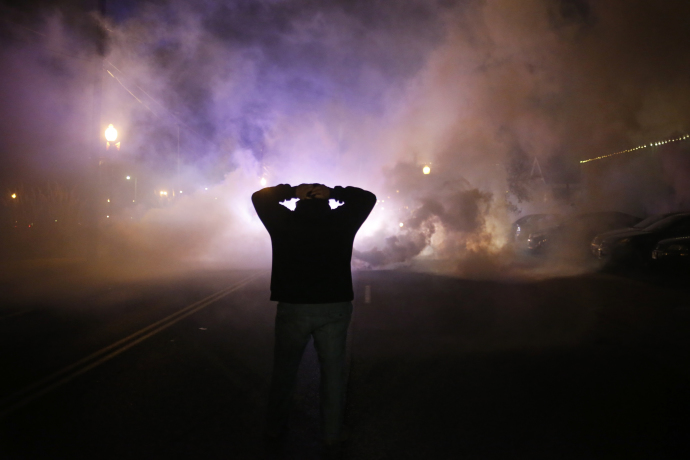
A protester stands with his hands on his head as a cloud of tear gas approaches after a grand jury returned no indictment in the shooting of Michael Brown in Ferguson, Missouri

A preliminary question to ask is why the St. Louis authorities scheduled such an incendiary announcement for after dark, even though the news that the grand jury had reached a decision had become public hours earlier. Surely, it would have been wiser for Robert P. McCulloch, the St. Louis County prosecutor, to have met with reporters earlier in the day.

A more important question, also unanswered in anything but the most general terms, is this: Why did the grand jury decide not to indict the police officer, Darren Wilson? McCulloch’s press conference, when it eventually took place, was notably lacking in detail about the shots that killed Brown.

But we didn’t learn precisely how far away Brown was when Wilson shot him fatally, or what persuaded the police officer that his life was in danger, which is one legal justification in Missouri for shooting someone who is unarmed. According to some accounts, Brown had his arms raised when he was shot for the final time. Other accounts say that he was charging at Wilson. McCulloch, beyond saying that some eyewitnesses provided contradictory statements, didn’t say what evidence the grand jury had relied on in reaching its decision. He did say, though, that the grand jury had met for twenty-five days and heard from more than sixty witnesses.

I’m sure that there will be extensive analysis from legal scholars in the coming days and I look forward to reading them.  I hope someone answers one of my questions which is:  Did hearing from Darren Wilson make the grand jury feel this was a trial where they were to determine guilt or innocence?

Meanwhile, if the grand jury decision makes me sad, the reaction of the fools on the streets makes me even sadder.  I’ve seen this too many times before – when Dr. King was killed, after Rodney King, right after Michael Brown’s death, etc. etc.   John Cassidy writes

Perhaps the grand-jury transcripts, some of which were released late on Monday, will help clear up what actually happened. More likely, the exact sequence of events will remain in dispute, and so will the grand jury’s decision. Americans who believe that the legal system generally works well, and fairly, will be inclined to believe that the members of the grand jury reached the right decision. Those who believe the criminal-justice system is stacked against minorities, particularly against young African-American men, will be inclined to believe that this was another whitewash.

I am among those who can’t understand the grand jury’s decision, but burning police cars and Walgreen’s will not change the racism in the criminal justice system.  There is more than enough blame to go around.  The announcement made after dark and the declaration of martial law and calling out the National Guard before the decision created a confrontational atmosphere and, in the end, didn’t prevent anything.  Prosecutor McCulloch’s long non-explanation explanation.  The rioters who through their actions fulfilled every stereotype.  There are no good guys here.

It just leaves me sad and frustrated.

Photograph:  ADREES LATIF/REUTERS

Anger, fear, and violence

People made fun of President Carter when he spoke of a national malaise.  I’m not sure we were in one back then, but I’d say we are sure in one today.  Everyone seems tired.  The upcoming election is very important, but many can’t get up enough energy to decide to vote.  But added to the tiredness is anger.   You can see it in what is said about the President, in the disrespect shown him and the office.  You can see it in the fear about Ebola.  You can see it in the increased racial tension in Missouri and elsewhere.  You can see it the attempts to restrict voting.  I see the fear of “the other” manifesting as anger.  But you can also see it in the anger against women.

Jessica Valenti had a piece in the Guardian the other day, “Why are Men so Angry?”.  I’ve been thinking about it since I first came across it.  She begins

There’s a Margaret Atwood quote that I can’t get out of my head these days: “Men are afraid that women will laugh at them. Women are afraid that men will kill them.”

Last Friday, a young man from Washington state walked into his high school cafeteria and shot five people, killing one young woman. Early reports from other students indicate that the shooter, who reportedly shot himself, was upset over a girl. In early October, Mary Spears was shot to death in Detroit, allegedly by a man whose advances she rejected at a social club. In April, a Connecticut teen stabbed his classmate to death when she rejected his prom invitation. Turning men down is a risky business.

But the madness doesn’t stop there. From Gamergate to mass shootings todomestic violence and the NFL – the common denominator is male rage. Women are not committing most acts of mass and individual violence, nor are women lobbing out most death threats online or raping most college students. Violence – and the threat of it – remains a decidedly male domain.

But why are men so violently angry?

I believe that it is the same kind of fear that drives the fear of the racially other.  When it comes to women, it is fear of losing some perceived superiority.  Valenti puts it this way

Is it the fear that women’s progress means a loss of all that shiny male privilege? That our society is a zero sum game and power can’t be shared? Maybe some men’s anger stems from good old-fashioned misogyny, which is then stoked by political, social and cultural forces that say there’s nothing lower in this world than a woman so how dare she … well, anything. Or perhaps that anger at women comes from straight-up entitlement: the men who believe that women are meant to be there for them, whether it’s to wash their toilets or warm their beds, and that denying them access to us is an unthinkable affront.

But it’s no coincidence that anti-feminist backlash happens most often when women’s rights are on an upswing. And male anger towards women isn’t going anywhere – if anything, it’s gaining steam. Online forums that provide anonymity are creating spaces for men to say the things they no longer can in “real life”, police and courts that disbelieve and blame women for the violence done to them give men the impression their bad behavior is acceptable and a conservative movement that refuses to let go of traditional gender roles teaches our children that being a man is synonymous with being “tough”, having guns and, yes, being violent.

domestic_violence_awareness_ribbon

I’m old enough to remember when no one talked about violence against women.  We were just beginning to recognize domestic violence and create shelters.  The concepts of sexual harassment and date rape were just being named.  Rape was beginning to be taken seriously.  Now we have special months, ribbons, and rape is generally depicted as a crime of violence.  So it makes me tired to think that after all these decades that we are still trying to figure out how to deal with male violence.  (And before someone complains that women can be violent also, yes they can be.  But the vast majority of violent incidents are perpetrated by men.)

Valenti concludes

If we want to put a dent in male anger and the chaos it creates, we need to stop looking at problems like sexual assault, harassment, domestic violence and even violent threats online and assigning their solutions to feminists. We need to stop calling them “just women’s issues”. We have to address men and men’s behavior together – not just their direct violence against women, but their propensity to protect their own. Not the outcomes of their rage, but the causes. Because, until we do, we’ll continue to be afraid. All of us.

I think she is right, but I worry that the conversation about male violence will be like the national dialog on race which everyone talks about but no one knows how to begin.  I’m not sure I know how to talk to the person who still believes that President Obama is really Kenyan, much less talk to someone to wants to commit violence against me to keep me in my place.


Like a speeding locomotive

That’s the image that comes to mind when I think of how quickly things have moved when it comes to marriage equality.  It has only been 10 years since same-sex marriage became legal in Massachusetts.  And only a few years longer that that since Vermont adopted civil unions.  For a while I was keeping track and blogging every time a state was added, but I just couldn’t keep up – or keep track.  Now Federal benefits are available to all legally married couples regardless of the state in which they reside and the Supreme Court is letting stand Appeals Court decisions ruling prohibitions unconstitutional.

According to a post in the Washington Post’s “The Fix”, most gay Americans now live in states with marriage equality.

As the map of where gay marriage is legal has shifted and changed over the past few years, we’ve tracked a harder-to-measure component of the new laws: How many gay Americans live in states that allow them to marry.

In June, we anticipated that the tipping point was imminent. Based on data from Gallup surveys in 2012, a higher percentage of the country’s gay population already lived in gay-marriage-legal states than the population on the whole. With Monday’s Supreme Court non-decision, the percentage of gay Americans and Americans on the whole living in states where gay marriage is legal topped 50 percent.

Gay Marriage map

I am unclear as to how Gallup determined the percentage of person living in a state who were gay or lesbian, but given the way Gallup polls, I assume it is by self-reporting in response to a question.  According to the Fix, marriage equality has arrived in states with a lower population of gay residents.

So what happens next is anyone’s guess but with the growing numbers of same-sex marriages, I’m not sure how a Supreme Court ruling to the contrary could be implemented without chaos.  A more likely scenario is a decision like the one in Loving v. Virginia.  When the Court finally ruled on interracial marriage, the majority of states already allowed such unions.

This does not mean that the opposition will not fight on.  A story in the New York Times today reported that

Leading opponents of same-sex marriage vowed on Wednesday to push ahead with their legal fight, noting that several federal appeals courts had not yet ruled on the issue and that the Supreme Court could still decide to leave it up to the states.

Even as the list of states authorizing same-sex marriage swells, the opponents noted Justice Anthony M. Kennedy’s order on Wednesday totemporarily block a federal appeals court ruling striking down the marriage restrictions in Idaho. The temporary order came as a surprise to many advocates on both sides of the issue, since the Supreme Court on Monday had allowed similar decisions from three other appeals courts to take effect.

“The marriage battle will continue,” said Jim Campbell, a senior legal counsel at Alliance Defending Freedom, a Christian legal group that has defended marriage restrictions in several states.

Opponents seem determined that each state should have a right to define its marriage laws, but that just doesn’t seem likely to me given the Loving decision as a precedent.

“If the liberals on the court had the votes to declare same-sex marriage a constitutional right, why didn’t they take any of the cases on offer Monday?” asked Brian Brown, the president of the National Organization for Marriage.

“That gives hope that the Supreme Court will not launch another Roe v. Wade,” Mr. Brown said, referring to the 1973 decision legalizing abortion nationwide.

Mr. Brown also rejected the argument that, once same-sex marriages had been allowed in many states, the law could not be rolled back if the voters wanted to do so.

But most legal experts drew the opposite conclusion from Monday’s action.

“We know, from the court’s willingness Monday to allow all these marriages to go forward,” that opponents of same-sex marriage “are virtually guaranteed to lose” before the current Supreme Court, said Michael C. Dorf, a constitutional expert at Cornell Law School.

In the meanwhile, I have friends getting married, both same-sex and opposite sex.  I also have friends in both categories who have or are getting divorced.  All people want is to live their own lives and to have the legal protections due them.  I think the opposition needs to get out of the way of the speeding locomotive.

Map:  The Washington Post


Police departments and racial diversity

Back in the dark ages, that is the early to mid-1980s, I worked on a study for then Virginia Governor Charles Robb.  He wanted to know several things including how we could recruit more African-Americans and women to the State Police and how, once we hired them, they could be retained.  I can’t recall that we came up with anything one wouldn’t have expected including things like more training for command in diversity issues.  I do remember one black trooper I interviewed had an idea on how to recruit people.  He suggested that he be made part of the Governor’s security detail which would provide lots of visibility.  I told the Governor and the next thing I knew, the trooper was thanking me when we ran into each other on the Capitol grounds.  I have no idea if his presence helped recruit more blacks to the ranks or not but it did provide some visibility and I remember that the Capitol Police then hired several black officers.

So my little story took place in 1983.  This morning’s New York Times has some very interesting charts on large Metropolitan police departments and the differences between their racial compositions and those of the towns they serve.

In hundreds of police departments across the country, the percentage of whites on the force is more than 30 percentage points higher than in the communities they serve, according to an analysis of a government survey of police departments. Minorities make up a quarter of police forces, according to the 2007 survey, the most recent comprehensive data available. Experts say that diversity in the police force increases a department’s credibility with its community. “Even if police officers of whatever race enforce the law in relatively the same way, there is a huge image problem with a department that is so out of sync with the racial composition of the local population,” said Ronald Weitzer, a sociologist at George Washington University. Listed below are local police departments from 15 metropolitan areas, sorted so that departments with the largest percentage-point differences of white officers to white residents are at the top.

We clearly have a long way to go.  I wonder if part of the recruitment problem is the sheer number of young black and Hispanic men who have conviction records.  Perhaps we should look into that.

th

I was interested to see that Boston (+18) and Somerville (+15) were doing pretty well.  Those are two of the police departments I’ve worked with in the recent past.  Other departments should take a look at this chart and talk to some of the successful agencies – and I don’t mean towns that have a small gap because the population of the town itself is mostly white – and learn from what they have done.

Incidents like the shooting in Ferguson don’t happen in a vacuum.  Look up a town near you and ask questions if you don’t like what you see.


As a footnote:  While I was looking to a picture to add, I was surprised at the number of stock photographs showing police in riot gear and/or arresting someone, often a black male.  Just another part of the problem.

Photograph:  how2becomeanfbiagent.com

Blaming the victim – and the family

Last August in a Boston suburb, a man stabbed his girlfriend to death in front of their child and other witnesses.  This is an all too familiar occurrence all over the country, all over the world.  What made this especially big news in Boston was that the perpetrator is the son of a former Red Sox second baseman and long time television commentator, Jerry Remy.

Yesterday the son, Jared Remy, pled guilty to first degree murder.  According to the Boston Globe story reported by Eric Moskowitz

Remy’s admission means he will spend life in state prison without the possibility of parole. His plea, entered before Middlesex Superior Court Judge Kathe Tuttman, spares friends and family of Martel and Remy the added anguish of a protracted trial and the airing of even more gruesome details. It also means Remy will forgo what the judge called his possible “partial defense” of anxiety, depression, and steroid and prescription drug use.

“I would like to say, ‘Blame me for this, not my family,’ ” said Remy, the 35-year-old son of Jerry Remy, the celebrated Red Sox infielder-turned-broadcaster.

Rising to speak in handcuffs, Jared Remy delivered in a gravelly voice a two-minute statement in which he called himself a “bad apple” and imagined Martel watching over their daughter from heaven while playing with the couple’s late chihuahua, Buddy.

Though he said he wanted to “take responsibility for what I have done,” he also put some blame on Martel and on his “love for drugs.”

In another part of the proceeding, Remy clearly blamed Jennifer Martel for her own death.

When the prosecutor finished, the judge asked Remy if he understood and admitted to all those facts. “Yes, I do,” he said, before protesting one point. “She had a knife in her hand, and she was threatening me about my daughter,” he said. Authorities have never indicated they had evidence suggesting Martel had a knife.

Yvonne Abraham wrote in her Boston Globe column today

What a bizarre mix of contrition and blame-shifting we saw in Middlesex Superior Court Tuesday. What a spectacle of the depths to which people can sink. What a vividly detailed map of the wasteland brutality leaves behind.

Standing in that low-ceilinged, fluorescent lit courtroom, Jared Remy called Jennifer Martel, the woman he murdered with gruesome force at least partly witnessed by their 4-year-old daughter, “an angel.”

He’s the one at fault for killing her, he said. No share of the blame should go to his parents, who his lawyer said had been unfairly maligned, held partly responsible by some for not doing more to rein in a violent son who had been spiralling blatantly out of control for years.

For a man surrendering to fate, he was maddeningly defiant. He said he murdered Martel after she picked up a knife and violated a clear rule he said he had set.

“I always told Jen she could leave,” he said. “But do not threaten me with my child. That night, Jen had a knife in her hand and threatened me with my daughter, so I killed her. I don’t think it’s right when women use their kids against their fathers.”

Abusers have rules.  We’ve heard about Jared Remy’s need to control Martel just as we’ve heard it countless times about other abusers.  It is one of the primary signs of abuse.  Unfortunately, many women just think it is a sign of “masterfulness” as if we were  living in a novel set Victorian England where women were still property.  Jennifer Martel broke one of Jared Remy’s rules so she had to die.

Jennifer Martel and Arianna Remy

Jennifer Martel and Arianna Remy


But there is also the question of the blame which some think rests on father, Jerry Remy’s, shoulders.  Margery Egan wrote this morning another in a series of columns she has written on the subject  in the Boston Herald.

Jared Remy has spared his daughter Arianna and Jennifer Martel’s family the anguish of a gruesome trial. He has also spared his father Jerry and helped him keep his job behind the NESN microphone broadcasting Red Sox games.

Sox fans are clearly divided over whether the sins of the son should be visited upon the father. But they might feel differently about Jerry Remy’s lighthearted banter if they heard Martel’s murder described in stomach-churning testimony by neighbor Kristina Flickinger Hill.

Hill watched Jennifer Martel crawl across her patio pleading for help. Hill paid for her funeral. And she repeatedly said Phoebe Remy texted Martel the day before the killing begging her not to pursue criminal charges against Jared.

I don’t think anyone disputes the fact that the Remys tried to help their son and to help the mother of their grandchild.  It is a matter of record that two of their other children have also had legal problems.  I have read that the Jerry Remy persona we see on TV is very much at odds with who he is in private.  From things said during broadcasts, I believe he is a loner who has suffered from depression as after his bout with lung cancer. He probably was not an easy parent.

According to Egan and at least one woman who called into the radio show Boston Public Radio yesterday, the Red Sox broadcasts are taking a hit because women in particular, don’t want to hear Jerry.  I personally think they are taking a hit because the Red Sox can’t seem to win and it is painful to watch, but I digress.

Egan continues

No one is blaming Jerry and Phoebe Remy for murder. What I’ve blamed them for is enabling their son to evade responsibility for brutalizing five girlfriends over 18 years. And when I’ve written that Jerry should quit his NESN job, it wasn’t about taking away his right to make a living. It was about facing the tragic reality that his jokes in the Red Sox broadcast booth just don’t work anymore.

Let’s be honest. The enduring loyalty to Jerry Remy in this town is about the double standard enjoyed by beloved sports figures and, to a lesser degree, by fathers.

Jerry’s defenders say he did all he could for his son. I don’t think many would say that if it were Phoebe Remy’s career on the line. If a mother spent thousands of days on the road while all three of her children were having run-ins with the law, they’d say she abandoned her children, cruelly and selfishly, when they needed her most. She’d also lose her job in a nanosecond.

There is a lot to think about here.  The image of an admitted killer still blaming his victim.  A famous father with a job that puts him in the public eye almost every night during the baseball season.  A broadcaster who has built his reputation not only on shrewd analysis but his ability to poke fun at himself, the team and his broadcast partner.  I don’t blame him for his son, and Margery may well be right about the sexism that allows him to keep his job, but for me it was just weird to hear him before Jared pled guilty and now that he has it will just be painful to hear Jerry.

Photograph from BostonHerald.com

 

When spouses are both in politics

I’m not necessarily referring to Bill and Hillary Clinton and whether his actions, both while governing and personally (think Monica) should be fair game if Hillary decides to run.  I’m thinking today about David Barron and his wife, Juliette Kayyem, who is running for the Democratic nomination for Governor of Massachusetts.  I happen to be a Kayyem supporter although she is fighting an uphill battle.  And I wonder if it just got even more uphill.

David Barron was just confirmed to the 1st Circuit Court of Appeals which is New England.  His nomination was held up because he is the author of the infamous “drone” memo.  The New Yorker’s Ryan Lizza had an interesting piece about Barron and the memo today.

On July 16, 2010, David J. Barron, a lawyer at the Department of Justice, sent Eric Holder, the Attorney General, a lengthy memorandum. Barron, who had celebrated his forty-third birthday earlier that month, was a professor at Harvard Law School, on leave for a couple years to work for President Barack Obama. Barron, like many young lawyers who arrived in Washington with the new Administration in 2009, had impeccable liberal credentials. As a Harvard undergraduate on the Crimson, the campus newspaper, he wrote sympathetic pieces about Jesse Jackson’s 1988 Presidential campaign. During the summer of 1993, before his third year at Harvard Law School, he interned with the N.A.A.C.P. in Washington. After graduating, he clerked for Supreme Court Justice John Paul Stevens, a leader of the court’s liberal wing, and then worked in the Clinton Justice Department. During the Bush years, he was a relatively prominent critic of the Administration’s national-security polices, especially its embrace of torture.

In 2006, while Bush’s Justice Department lawyers were tweaking a new legal regime allowing for bulk-collection surveillance and what they called “enhanced interrogation,” Barron helped review the bylaws of the Botanic Gardens Children’s Center. As a professor in Cambridge, he raised money for the campaign of Deval Patrick, who has been governor of Massachusetts since 2007. That same year, 2007, he even attended the YearlyKos convention, a sort of South by Southwest for left-leaning bloggers and activists trying to push the Democratic Party in a more unabashedly progressive direction. During his legal career, he has signed amicus-curiae briefs in several highly political cases, including one defending a living-wage ordinance in Santa Fe, New Mexico, and another defending a major campaign-finance reform law. In 2008, during an NPR interview, he mused that articles of impeachment could be justified against a President who purposely misled the country into war.


Juliette Kayyem

Juliette Kayyem

His wife has similar liberal credentials.  I first met her right after the World Trade Center bombings.  Everyone was in a panic about the possibility of more incidents, about loss of civil liberties, the prospect of some kind of martial law, and whether we were safe.  I can’t remember the exact words she used, but she was reassuring with ideas that one did not have to curtail civil liberties to combat terrorism.  After that I read her column in the Boston Globe and found, for the most part, that she had a pretty commonsense approach to things.  But I know that a number of supporters of other Democratic candidates want to tar her with the David Barron’s memo justifying the drone strike that killed an American citizen living in Yemen and involved in terrorism.

His July, 2010, missive, which was one of the last that he wrote during his eighteen months running O.L.C., was historic and—to many—troubling: yes, Barron argued, the President of the United States could kill an American citizen named Anwar al-Awlaki. And, as a rule, the memo argued, the President could kill any American citizen abroad connected to Al Qaeda or an associated group—without a trial or other legal proceedings—if he deemed that person an imminent threat.

This post is not meant to debate the memo or whether we should have killed Anwar al-Awlaki without a trial, but whether Barron’s memo is fair game for his wife’s political opponents.  None of us know what he wrote or what kind of justification he used:  We only know that al-Awalki is dead.  We don’t know if Kayyem agreed with what he wrote or if she even knows any more about the contents of the memo than the rest of us.  I do know the fact that he wrote has already been raised against her.  It is likely that if she does manage to get the nomination that some part of the progressive community will not work for her.

Boston Magazine has already raised the question.  The article opens

Gubernatorial candidate Juliette Kayyem has run into some trouble with Massachusetts Democrats over what some characterize as hawkish views on the use of tough measures in the cause of national security, her area of expertise. So, with the Democratic state convention less than six weeks away, she probably doesn’t need the trouble that’s stirring up around her husband on the issue—regardless of how irrelevant it may be to her, and how she might run the Commonwealth.

And ends with this.

None of which, of course, should have anything to do with supporting Kayyem for governor. They’re not her memos; it’s not her decision whether to release them; it’s not her nomination. But with her gubernatorial campaign hinging on what those delegates do in mid-June, this is probably a distraction she would rather have behind her.

We need to think about what happens when both spouses are politically involved.  Are they two people or do they only count as one person?  Should we assume that they agree on everything?  Are they responsible for each other’s actions?  I don’t have the answers, but we have to think about these things as we are going to see more political couples like the Clintons and like Juliette Kayyem and David Barron.

Photograph: Boston.com