
The silly season begins in earnest with too many deaths and too many guns

Time to fire up the blog again after a long break.  I’ve found the world just too depressing to write about with violence and war all over the world including police shooting civilians, civilians shooting police, and too many people just shooting each other,   Yes, the major incidents we hear about are racial, but there are just too many that are not.

td160715

This Tom the Dancing Bug cartoon illustrates only too well what kind of society we seem to be rapidly moving toward.  The violence is numbing.  And our Congress seems unable to act.  We can only hope that there is not another arms race with law enforcement adding more tanks and military style equipment, but more emphasis on community policing.  Granted that Brattleboro is a small town, but our police chief started something he calls “Coffee with a Cop” several years ago.  Anyone can go to a local restaurant and talk to an officer.  Larger places can do something similar in precincts and districts.  More talk can lead to more trust.  OK.  Maybe not always, but there will never be trust if everyone is just shooting at each other.

This is the morning of the start of the Republican Convention.  The lead New York Times story begins

The attack on police officers in Baton Rouge, La., cast a grim mood over the opening of the Republican National Convention here, as Donald J. Trump responded to the killings with a stark warning that the country was falling apart.

A string of shootings targeting police officers, as well as the recent killings of two black men by police officers in Minnesota and Louisiana, had already pushed gun violence and social unrest to the center of the presidential campaign. Mr. Trump has campaigned on the theme of “law and order” since the assassination this month of five police officers in Dallas, and he is likely to amplify that message in the coming days.
“Law and Order” unfortunately doesn’t remind me of the great television series, but of Richard Nixon and the 1960s and 1970s.  They were scary times to be a protester for civil rights or against the war in Vietnam.  Unfortunately, Trump’s message is going to resonate among those who feel threatened by the changes taking place.  Changes like more gay rights, the possibility of a woman becoming president (First a black man and now a woman!), and most of all the slow change from a predominately white country to one that is more diverse.
This election is going to be a scary one beginning with the Republican Convention in Cleveland beginning tonight.  The New York Times story goes on

Cleveland has assigned about 500 police officers specifically to handle the convention, and it has brought in thousands more officers to help, from departments as distant as California and Texas.

But some local officials have expressed concern about the possibility of violence owing to Ohio’s open-carry gun laws. Though demonstrators and others in the convention district have been barred from possessing a range of items, including gas masks, there was no prohibition on the brandishing of firearms.

On Sunday, the president of Cleveland’s police union called for additional measures to protect the security of the event, and urged Mr. Kasich to suspend open-carry gun rights. The governor’s office said Mr. Kasich did not have “the power to arbitrarily suspend federal and state constitutional rights or state laws.”

Plus

And the convention was likely to begin with a trumpeting of support for police officers. Convention organizers said on Sunday that the theme of the first day, Monday, would be “Make America Safe Again.”

Jeff Larson, the convention’s chief executive, said in a news conference that a leading speaker would be Rudolph W. Giuliani, whom he described as “the law-and-order mayor of New York.”
Mr. Giuliani has been a forceful critic of the Black Lives Matter movementand has been outspoken in his defense of law enforcement practices over the last few weeks.
I worry that Democratic calls for unity are not good enough in face of Trump and Giuliani bombast.  NPR laid out the contrast nicely.
Following the shooting death of three law enforcement officers Sunday in Baton Rouge, presumptive Republican nominee Donald Trump blasted President Obama on Twitter and Facebook, saying he has “no clue” how to deal with a country that is a “divided crime scene.”
while Hillary Clinton issued a statement

Meanwhile, presumptive Democratic nominee Hillary Clinton called the shooting “devastating” and “an assault on all of us.”

“There is no justification for violence, for hate, for attacks on men and women who put their lives on the line every day in service of our families and communities,” she said.

Clinton also called for unity:

“We must not turn our backs on each other. We must not be indifferent to each other. We must all stand together to reject violence and strengthen our communities. Our thoughts and prayers are with the friends and families of the police officers who were killed and injured today.”


She will be speaking at the NAACP convention today and it will be interesting to hear what she has to say.

For me, the appropriate response is to begin with a ban on sales of large magazines and then move on to banning assault style weapons.  Both the Dallas and Baton Rouge shooters were trained in the military and the idea that they can easily get and use similar weapons after they are discharged is frightening.  We actually need more talk, not more guns.  Let us hope there is no violence in Cleveland.


What is being a feminist all about?

I’ve got credentials.  I was a delegate from Virginia to the First National Women’s Conference held in Houston in 1977.  I shepherded one of the early pay equity cases – a professor at Old Dominion University who was being paid less than her colleague with similar degrees and experience – to a successful conclusion.  I worked to make marital rape a crime and to ratify  the Equal Rights Amendment in the Virginia legislature.  The first successfully, the second not.  I’m the same age as Hillary Clinton.  And I am very disappointed in how her campaign somehow feels entitled to my vote.  Some how I lose my standing as a feminist if I support Bernie Sanders.  She seems to have migrated a long way from her wonderful speech in Beijing.

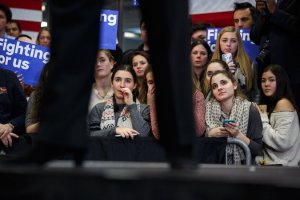
Women listening to Hillary Clinton at a campaign event in New Hampshire

Women listening to Hillary Clinton at a campaign event in New Hampshire

I was trying to figure out how to write about this when I read Frank Bruni’s column this morning in the New York Times.  I think he was hit the nail on the head.  He begins

I’m 51. My health is decent. And while my mother died young, there’s longevity elsewhere in the family tree.

I could live to see an openly gay presidential candidate with a real chance of victory.

Will there be a “special place in hell” for me if I, as a gay man, don’t support him or her?

I can guess Madeleine Albright’s answer. She more or less told women that they’re damned if they’re not on Hillary Clinton’s team.

I’m still trying to get my head around that — and around Gloria Steinem’s breathtakingly demeaning assertion that young women who back Bernie Sanders are in thrall to pheromones, not ideas or idealism, and angling to score dates with the young bucks in the Sanders brigade.

I could substitute Asian American for gay and ask the same question.

There’s a weird strain of thought swirling around Clinton’s campaign: that we should vote for her because she’s a woman. Or that she’s inoculated from certain flaws or accusations by dint of gender. Or that, at the least, there’s an onus on forward-looking people who care about gender inequality to promote her candidacy.

I care about gender inequality, and I don’t buy it. It’s bad logic. It’s even worse strategy. People don’t vote out of shame. They vote out of hope.

Perhaps that was among the lessons of Clinton’s defeat in New Hampshire on Tuesday, where she lost to Sanders among all women by at least seven percentage points, according to exit polling, and among women under 30 by more than 60 points.

Somehow we got from the positive nature of a woman running for President to what must seem like a bunch of old women scolding young ones for supporting – gasp -a man instead.

Clinton’s gender indeed matters. Just as you couldn’t properly evaluate Obama’s arc without factoring in race, you can’t see her accurately without recognizing that she’s a woman of her time, with all the attendant obstacles, hurts, compromises and tenacity.

That informs — and, ideally, illuminates — her perspective. And her presidency would carry a powerful, constructive symbolism that can’t and shouldn’t be ignored.

But those are considerations among many, many others in taking her measure and in casting a vote. To focus only or primarily on them is more reductive than respectful, and to tell women in particular what kind of politics they should practice is the antithesis of feminism, which advocates independence and choices.

We’re all complicated people voting for complicated people. We’re not census subgroups falling in line.

I’ll go to the barricades for that imagined gay candidate if he or she has talents I trust, positions I respect and a character I admire. If not, I’ll probably go elsewhere, because being gay won’t be the sum of that person, just as womanhood isn’t where Clinton begins and ends.

I will be voting for her in November should she be the Democratic nominee, but I will never quite admire either Madeline Albright or Gloria Steinham in quite the same way as I did before.

Photograph:   Richard Perry/The New York Times

Remembering the past

I visited Civil War battle sites on my honeymoon:  Antietam, Harper’s Ferry, Gettysburg.  It was early May and they were beautiful places.  Lush fields, trees, wild flowers – and graves.  Hundreds and hundreds of men had died there fighting for both sides.  I doubt that many were particularly political.  They were recruited into adventure or a sense of honor.  Perhaps someone they admired was building a company from the small town where they lived.  Most New England towns have a Civil War monument.  I’ve seen them in Ohio and Pennsylvania, West Virginia and Virginia.  Oh, certainly the politicians and some of the men at the top – the generals – believed in the cause.  That is their job.  But the ordinary soldiers went because someone asked them or because all their friends were going or they got paid to enlist and the family needed the money.

The current desire in a lot of places, Richmond and New Orleans to name two of them, is to remove the statues of the generals and politicians.  I lived for many years just blocks from Monument Avenue in Richmond.  The large monuments stand in circles that can be difficult to get to depending on the traffic:  Jeb Stuart, Robert E. Lee, Jefferson Davis, Stonewall Jackson.  Plus the explorer Matthew Maury and tennis great and local hero, Arthur Ashe.  (Ashe was added after a great deal of controversy.)  Most Richmonders probably couldn’t name all the statues and likely don’t know who any of these men are.

The Boston Globe had a feature story on July 4th.

Ana Edwards stood on Monument Avenue, one of America’s most elegant boulevards, and stared with disbelief at the inscription on the 67-foot-tall memorial to Jefferson Davis, president of the Confederate government that was based here during the Civil War.

“Exponent of Constitutional Principles,” the inscription said about Davis. “Defender of the Rights of States.” There were no words explaining Davis’s role in the enslavement of hundreds of thousands, no hint that much of the nation’s slave trade was conducted here in Richmond, at a time when black lives plainly didn’t matter to many, except as human chattel to be exploited or sold.

Instead, emblazoned in stone, was Davis’s assertion that he acted “not in hostility to others.”

Edwards had never read the description and I hadn’t either.  And neither had the Mayor of Richmond, Dwight Jones.  But unlike many in Richmond and other places across the South, I don’t think the statues should be moved or put in museums or crowded together in a kind of Confederate History Park.  I believe they need to be used as teaching tools.

Earlier this spring, my husband and I were in Annapolis where there is a prominent statue of Roger Taney on the grounds of the State House.  Taney was the Chief Justice of the United State Supreme Court and wrote the infamous decision in the Dred Scott case declaring slaves were not citizens and couldn’t sue in federal court.  Instead of removing the statue, there are signs that explain who Taney was, who Dred Scott was, and why the decision mattered.  I like this approach much more than taking down the statues and putting someplace where most people will not see them.  Annapolis also has a new memorial to Kunte Kinte (subject of Alex Haley’s Roots) on the City Docks where he landed as a slave.

The controversy over Monument Avenue comes at a time when there is a fight to prevent development in Shockoe Bottom where there were a number of slave jails and auctions.  I wrote about the preservation effort back in April.

dividedrichmond1

Slavery is an ugly part of our past and the men who believed in it, the Jefferson Davis’ and Roger Taneys need to be remembered.  We can’t forget who they were and what they did, any more than we should forget the slave auctions.  Richmond, and other parts of the south have a prime opportunity to educate.  Put up some markers, publish some informational materials.  Make sure that all those bicyclists and spectators at the big race in Richmond in the fall know who Jefferson Davis was and what he did, but leave the statue.  Leave the statue as a reminder of our dark past.  Leave the statue so we don’t forget.  And make sure they, and other visitors to the City know about Shockoe Bottom.

We can’t always be proud of our history, but we do need to remember it.


Spring in Vermont

I’ve been gardening like crazy.  My husband and I have taken out 90% of what the previous owners had planted including the trees and have replaced them with lilacs, blueberry bushes, forsythia, and a serviceberry bush.  We also replaced two maples with a stewartia tree. (I put in a link because you probably never heard of one before. We hadn’t.)  Plus annuals and lots of perennials.  I figure that you can always take stuff out next year that doesn’t work.  All of this has helped take my mind off the mostly bad news that seems to keep coming.

Our young Stewartia tree with flowers.

Our young Stewartia tree with flowers.

Last week we caught a little break.  The Supreme Court made two decisions that, contrary to the dissenters, I think will be positive in the long run.  The first upheld the subsidies for the Affordable Care Act; the second, legalized marriage for everyone in all states.

Marriage equality began here in New England as all the local media have proudly told us.  Vermont legalized civil unions and Massachusetts was the first to sanction marriage.  As one news reader noted, “Today’s decision doesn’t really effect New England as same-sex marriage in already legal in all six states.”  That is a paraphrase, but a fact of which most New Englanders are very proud and contrasts to the defiant words from some of the Republican Presidential candidates.  Reminds me of the governors who wanted to stand in front of the school house door to prevent school integration.  Conservatives are always arguing that marriage leads to more stability so I can’t really understand why they aren’t pleased that more people will be getting married.

On the ACA, I wonder if some of the New England states like Vermont that are struggling with the necessary automation and connections to the federal exchange will just move to the federal exchange all together.  And I also wonder if states that never expanded Medicare will do so now.  But with Congressional leaders and most of the Republican Presidential candidates still hoping to repeal “Obamacare”, that is probably not likely.  In the meanwhile, more people are getting insurance and as they begin to get preventative care, costs should continue to drop.  Insurance companies, like most of us, like stability something the pro-repeal Republican should remember.

As spring slowly turns to summer here in Vermont, I’ve been thinking a lot about race.  As with many things we seem to be taking one step forward and two back.  Who would have predicted in 1964 that in 2015 we would need a new voting rights act?    Or that the unspoken racism of one of the major political parties would lead to a mass shooting in a black church?  Yes, I mean the Republican party with opposition to everything proposed by President Obama.  You can’t convince me that if the current Democratic president were someone like Jerry Brown or Tim Kaine opposition would be as virulent.  Race is at the core.  All those Senate Republicans who want to be president could prove me wrong by supporting the new voting rights legislation.  As the Washington Post pointed out, they once did so.

The Sunday after Charleston my husband and I drove down to Boston to attend church.  We wanted to attend his home church, an historically black church of which he became the first white member over twenty years ago.  The service is still traditionally African-American, but the worshippers are black, white, and Asian.  It was comforting to sit with people I have known for so many years as well as with the newcomers.  The young pastor spoke first about being “sick and tired of being sick and tired” and went on to talk about faith.  We were all given little packets of mustard seed by the children to remind us to keep the faith.  I’m finding that gardening is another way to find a measure of peace and faith that things change.  In the garden one can see the entire cycle:  planting, growth, blooms, death.  And then it begins again next spring.  We just need to keep the faith.

Photograph:  Bob Wyckoff

Some thoughts about product and corporate boycotts

A few days ago the ice cream maker, Ben and Jerry’s, offered free ice cream in exchange for a donation to whatever local charity the particular store had chosen.  I posted the information on Facebook knowing that I had friends who ate Ben and Jerry’s with some regularity.  A good friend (so good my wedding reception was at her house) posted a comment asking that we boycott Ben and Jerry’s because they sold ice cream to the Jewish settlements in the Palestinian Territory.  I’ve been thinking about boycotts since then and this post is my attempt to think “aloud”.

Looking back I can remember two successful boycotts I’ve participated in.  First was the Woolworth’s boycott in sympathy to the student sit-ins.  Second was the Delano Farmworkers Grape Strike.

David Richmond (from left), Franklin McCain, Ezell Blair Jr., and Joseph McNeil leave the Woolworth in Greensboro, N.C., where they initiated a lunch-counter sit-in to protest segregation, Feb. 1, 1960. (No photographers were allowed into the store on the first day of protest.)

David Richmond (from left), Franklin McCain, Ezell Blair Jr., and Joseph McNeil leave the Woolworth in Greensboro, N.C., where they initiated a lunch-counter sit-in to protest segregation, Feb. 1, 1960. (No photographers were allowed into the store on the first day of protest.)

The student sit-ins of lunch counters began in 1960 in Greensboro, North Carolina.  I found this NPR story about Franklin McCain and the sit-ins.

On Feb. 1, 1960, four students from all-black North Carolina Agricultural and Technical College walked into a Woolworth five-and-dime with the intention of ordering lunch.

But the manager of the Greensboro Woolworth had intentions of his own — to maintain the lunch counter’s strict whites-only policy.

Franklin McCain was one of the four young men who shoved history forward by refusing to budge.

McCain remembers the anxiety he felt when he went to the store that Monday afternoon, the plan he and his friends had devised to launch their protest and how he felt when he sat down on that stool.

“Fifteen seconds after … I had the most wonderful feeling. I had a feeling of liberation, restored manhood. I had a natural high. And I truly felt almost invincible. Mind you, [I was] just sitting on a dumb stool and not having asked for service yet,” McCain says.

They were not served, but returned day after day with more and more reinforcements.  Sit-ins at Woolworth’s lunch counters spread across the South.  In New Jersey where I grew up, there was a boycott of the local Woolworth’s in solidarity with the students.  Even after the lunch counters were integrated, it was years before I had lunch at one.  The first time I was in my early thirties.  I still remember I had tomato soup and grilled cheese – the special.

The grape boycott lasted 5 years from 1965 to 1970.  Millions of Americans came to identify with the farmworkers who wanted to unionize so they could improve working conditions and wages.  The United Farm Workers has a history of the strike.

Hundreds of grape strikers traveled across the U.S. and Canada, telling their stories and organizing mass support for the grape boycott. The strikers were joined by thousands of supporters who helped tirelessly organize the boycott.

Cesar [Chavez] and the farm workers believed if consumers in communities throughout North America knew about the suffering of field laborers—and saw the grape strikers struggling nonviolently—they would respond. For Cesar, nonviolence couldn’t be understood in the abstract. It could only be seen in action. He said, “the whole essence of nonviolent action is getting a lot of people involved, vast numbers doing little things.”

He knew most people couldn’t drop what they were doing and dedicate themselves completely to the movement like the grape strikers, most of whom lost their homes, cars and worldly possessions. But Cesar and the farm workers showed ordinary people that by making little sacrifices every day—by not eating grapes—they could directly help the poorest of the poor.

The boycott connected middle-class families in big cities with poor farm worker families in the California vineyards. Millions stopped eating grapes. At dinner tables across the country, parents gave children a simple, powerful lesson in social justice.

In my family we didn’t eat grapes for many years.  My mother had been a California farmer worker and later an organizer on the east coast for the Food, Tobacco, and Agricultural Workers Union.  We started boycotting very early in the strike if my memory is correct.

The Woolworth’s and Farm Worker’s boycotts were successful because they were narrowly focused and concerned an issue with which the average person could identify:  Segregated lunch counters and farm working conditions.  The boycotts that I have been asked to join recently include Monsanto, Nestles, and Ben and Jerry’s.

The first two have, in my opinion, little chance of success not because the cause isn’t clear, but because they lack focus.  I couldn’t even begin to get through the list of Nestles’ products I wasn’t supposed to purchase.  Organizers of the Monsanto boycott should just urge us not to purchase Monsanto’s “Round-Up”.  And as for Nestles and their draining of the California (and other aquifers), people should not be buying water in bottles anyway.  Better to ask people to stop buying bottled water where they can safely do so.  As for the request to boycott Ben and Jerry’s, I am afraid that the issue of Israeli settlements in Palestinian territory, although of concern to me, is too obscure and not of immediate interest to most Americans who will weigh that against the other good that the company does.

To succeed, corporate boycotts need to be focused in what we are asked not to purchase and concern a cause to which a critical mass of consumers can relate.


Photograph:  Jack Moebes/Corbis

Remembering slavery and our history: saving Shockoe Bottom

Many of us don’t want to think about the past, especially the unpleasant and embarrassing parts of the past.  Not wanting to remember also applies to thinking about history.  I was reminded of this the other day when I came across Maurie D. McInnes’ essay in the New York Times “Disunion” series. 

We don’t know exactly when the last sale of enslaved persons occurred in Richmond, Va., known as “the great slave market of the South,” but it must have taken place before April 3, 1865. On the previous day, the order had come to evacuate in advance of the arrival of Union troops who liberated the city.

Amid the chaos, a slave trader named Robert Lumpkin still had a jail full of people he was hoping to sell. According to the journalist Charles Carleton Coffin, who was there to witness the fall of Richmond, after learning of the order to evacuate, Lumpkin “quickly handcuffed his human chattels,” about 50 men, women and children, and marched them four blocks south to the Danville-Richmond Railroad depot on the banks of the James River. He was hoping to whisk them away, and find buyers for them in another city.

When they arrived, however, “there was no room for them on the train which whirled the Confederate Government from the capital. Soldiers with fixed bayonets forced them back. It was the last slave gang seen in this Western world.” Lumpkin was angry, but there was nothing he could do. So, “with oaths and curses loud and deep,” Coffin reported, Lumpkin was forced “to unlock their handcuffs and allow them to go free.” These 50 people were worth about $50,000, according to Coffin, “but on that Sunday morning were of less value than the mule and the wagon which had drawn the slave-trader’s trunk to the station.”

Richmond was a major slave trading hub and Robert Lumpkin, one of the most prominent traders.  His jail and auction house were located in Shockoe Bottom, a low point along the James River.  Abigail Tucker wrote about the archeology of the site and Lumpkin in a 2009 Smithsonian Magazine article, “Digging up the past at a Richmond jail”.  She writes

Lumpkin, a “bully trader” known as a man with a flair for cruelty, fathered five children with a black woman named Mary, who was a former slave and who eventually acted as his wife and took his name. Mary had at least some contact with the unfortunates her husband kept in chains, on one occasion smuggling a hymnal into the prison for an escaped slave named Anthony Burns.

The slave trade was important to the economics of both North and South before the Civil War.  McInnes reminds us

The economic engine of the slave trade helped to fuel America’s prosperity. The profits from the trade in enslaved people flowed to many places. Traders were not the only ones to profit from America’s internal slave trade. Slave owners in the Upper South profited because they received cash for the people they sold. Slave owners in the Lower South profited because the people they purchased were forced to labor in the immensely productive cotton and sugar fields. The merchants who supplied clothing and food to the slave traders profited, as did steamboat, railroad and shipowners who carried enslaved people.

Capitalists in the North profited by investing in banks that handled the exchange of money for people, or in insurance companies that provided insurance for the owners’ investments in enslaved people. So did foreign investors in Southern securities, some of which were issued on mortgaged slaves. The hotbed of American abolitionism — New England — was also the home of America’s cotton textile industry, which grew rich on the backs of the enslaved people forced to pick cotton. The story of America’s domestic slave trade is not just a story about Richmond or New Orleans, but about America.

When I read McInnes’ column the current controversy about preserving the site of Lumpkin’s jail and auction house came immediately to mind.  The National Trust for Historic Preservation explains

Today, Shockoe Bottom is an urban archaeological site imminently threatened by “Revitalize RVA,” the controversial plan to construct a minor league baseball stadium, a Hyatt hotel, a Kroger grocery store, and residential and commercial office space at the site. The ill-considered stadium project, which is heavily promoted by the mayor of Richmond, members of the City Council, and influential real estate developers, threatens to destroy the remarkable archaeological remains which survive below the asphalt.

ShockoeBottom_Douglas_5.24.1866_crPreservationVirginia

The cruelty of slave traders like Robert Lumpkin, the wealth America enjoys, and the stories of the men and women held in the jail and sold at Shockoe Bottom deserve to be remembered.

I can’t remember another time I have used this blog to urge readers to take action, but I hope you will go the the National Trust link and sign on to save Shockoe Bottom.


Reproduction of Douglass note from Preservation Virginia.

Policing is a tricky business

Most of us want to be safe.  Maybe that should be all of us.  But how to feel safe and to be safe are questions with many answers.  If we were to listen to the NRA and other gun rights supporters we can best get to safe with each of us carrying a loaded weapon all the time.  Most of us, however, depend on the police.

We recruit young men and women, give them some training, arm them, and send them out to face dangerous situations.  I can’t imagine doing a traffic stop at night, alone.  I’ve heard stories from my State Trooper stepson that are really frightening.  And we also expect them to act within the boundaries society has established:  no excessive force and no stops without cause.  I think that most black men know that “cause” is a slippery thing.  Driving while black is a common reason to be stopped.  I remember my mother telling me about an African American minister who always drove at least once to any place he had to go in a white neighborhood during daylight.  He did this so when he went to a meeting at night, he would know where he was going and wouldn’t be wandering around lost.  He feared being stopped.  Then there is the story of my husband who was stopped while driving four black churchwomen back from a class.  The excuse?  His rear license plate was crooked.  The real reason?  I think they suspected he was a white pimp driving his “girls” someplace.  I guess the trooper realized after he stopped them and looked at the women that they were all middle aged or older and not at all what he had thought.  Was this profiling?  You bet.

So cause can sometimes be difficult to determine.  If see someone driving very fast and weaving in and out of traffic, you have cause for a stop.  If someone is speeding on a two lane road in the rain, you have cause for a stop.  And if you get a report of shots fired in a neighborhood known for gang activity, most of us would think that is cause for a stop.  That seems to be what happened last Friday night in Boston.  According to the story in the Boston Globe

Friday’s incident began at 6:40 p.m. when gang unit officers investigating a report of shots fired stopped a vehicle on Humboldt Avenue near Crawford Street to interview its three male occupants, authorities said Friday night.

The suspect stepped out and began to flee while firing his gun, said David Procopio, a spokesman for the State Police, which works alongside Boston police to address gang violence.

The suspect wounded Moynihan [a police officer] under the right eye, Evans said.

A law enforcement official also said the suspect, who was not identified, had several previous gun-related charges.

Evans [Boston Police Commissioner William] said that the stop was initially routine and that the suspect had fired at police “before they had time to react,” but the officers quickly returned fire, killing the suspect.

Gunfire also struck “a middle-aged woman” who suffered a flesh wound, possibly in her right arm, Evans said.

“I think she got caught up in the crossfire,” he said.

Officer John Moynihan is a veteran Boston policeman who is expected to survive.

So what exactly are we to make of this incident?  Was this a stop with cause?  The report was of shots fired.  Kevin Cullen wrote about the incident and the immediate aftermath for the Globe.

Angelo West wasn’t going back to prison.

That’s what this was about. Pure and simple.

When members of the Boston police gang unit stopped the car he was driving on Humboldt Avenue on Friday evening, he knew that the .357 Magnum he was carrying was a ticket back to Cedar Junction in Walpole, and he wasn’t going out like that.

So he came out of the car, without a word, put his gun to the face of John Moynihan, and pulled the trigger. Then he ran off, turning back to fire at Moynihan’s colleagues.

Did he really think he would get away?

There was an extraordinary scene as police officers combed the area for spent shell casings and other evidence as Moynihan underwent surgery at Boston Medical Center. Some people got in their faces, calling them pigs, screaming about another black man shot to death by police.

I wonder.  Did any of them know the victim?  Did they understand that he shot first and that he was a three time loser facing life?

The Boston Police and the Suffolk County District Attorney then made an extraordinary decision.  Dante Ramos explains

The Rev. Jeffrey Brown finds the surveillance video persuasive, so much so that he gets up from where we’re sitting and pantomimes what happens in it: Boston Police Officer John T. Moynihan approaches a stopped vehicle last Friday, stands by the driver’s door, and taps on the edge of the roof to tell him to come out. As the driver, Angelo West, emerges, Moynihan shifts on his feet — and suddenly rears back as West shoots him in the face. Then, in Brown’s rendition, West leans over the fallen officer, as if to shoot him again. Another officer interrupts by firing at West, who flees while discharging his weapon.

The confrontation on Humboldt Street in Roxbury ended with West dead and Moynihan badly injured. People who’ve seen the video, taken by cameras mounted at a nearby business, say it makes West’s culpability plain.

The footage from Roxbury bears a time stamp of 6:46 p.m. Friday, and interactions between police and spectators on the scene soon became edgy. Supporters of the Black Lives Matter movement, which has protested the deaths of African-American men under dubious circumstances in Ferguson, Mo., and elsewhere, raised the possibility that West’s death was part of that pattern.

In past cases involving so-called officer-involved deaths in Boston, video evidence came out only at the end of a long investigation. Authorities waited a year after the 2013 shooting of Darryl Dookhran by Boston police to release footage that supported officers’ account of the event. Yet by around noon Saturday, police were showing the video from Humboldt Avenue to a group that included Brown, the Rev. Miniard Culpepper, state Representative Russell Holmes, civil rights attorney Rahsaan Hall, and others.

Releasing the video sets a precedent that may be difficult to live up to in the future.  In other cases, there may be witnesses visible that need protection or the video may be more ambiguous and need to have a jury interpret it.  But in this case it was the right thing to do and a good decision by Commissioner Evans and DA Conley.  People may still question whether the stop itself was justified, but clearly the shooting of Angelo West was the only thing that police could have done.

Yes, black lives matter – all lives matter.  But we need to ask if they all matter equally.  Don’t people like Angelo West terrorize the very community in which many of the protesters live?  Don’t get me wrong.  I would rather see West in prison for life than dead, but in the end Angelo West is dead.  John Moynihan will survive.  I think justice was served.


The Republican obsession with women’s bodies and sex

Haven’t posted for quite a while now.  Maybe it is the end of winter doldrums (I can almost say I survived my first Vermont winter which wasn’t nearly as bad as winter in the Boston I left behind.) or maybe I’m just discouraged by the general  state of politics.   I’m becoming increasingly fearful about what will happen if the Republicans take over the Presidency next year.  But I have been aroused from my lethargy by a story and editorial in today’s Brattleboro Reformer.

I’m not sure how it works in other parts of the country, but New England has a tradition of school children asking a legislator to introduce a bill for them.  I wrote a few weeks ago about the young woman who wanted Vermont to have a Latin motto.  Another group would like the Gilfeather turnip to become the Vermont state vegetable.  The children have to do their research and come and testify before the appropriate committee of the state legislature.  Their bills sometimes pass and sometimes get postponed for a year, but along the way they learn about politics and how bills become laws.  So a group in New Hampshire wants to make the red-tailed hawk the state raptor.  The Reformer editorial compares their reception to that given to the Gilfeather turnip lobbyists.

On March 17, a dozen students from Wardsboro Elementary School traveled to Montpelier to lobby for designating the Gilfeather turnip as the state vegetable. Wardsboro was home to John Gilfeather who is credited with developing the turnip that bears his name.

Rep. Emily Long, a Democrat from Newfane and a co-sponsor of the turnip bill, said she was “absolutely thrilled to see the kids here. I heard they were really good, I saw one of their teachers, and she was glowing!”

The students were told by Rep. Carolyn Partridge, a Democrat from Windham, that the bill would not pass this year, but she said many members of the committee supported it. In fact, Partridge said Gilfeather turnips had a celebrity status at her family’s Thanksgiving and Christmas tables growing up, and she said she would make a soup from them and bring it to the committee so they can taste the gnarly root vegetable for themselves.

Members of the committee were given wool-felted Gilfeather turnip pins, one of many items handcrafted and sold as part of fundraisers for the annual festival, which benefits the town’s library.

But what happened in New Hampshire?

Now let’s compare the reception the Wardsboro students received to the reception a handful of fourth-grade students received when they went to Concord to lobby to name the red-tailed hawk the state bird. What was the reaction they got? Incredibly, one legislator likened the bill to abortion.

State Rep. Warren Groen, from Rochester (need we really name his party?) said the red-tailed hawk “mostly likes field mice and small rodents. It grasps them with its talons and then uses its razor sharp beak to rip its victims to shreds and then basically tear it apart, limb from limb. And I guess the shame about making this the state bird is it would make a much better mascot for Planned Parenthood.”

Yes, Groen took the opportunity to push his anti-choice agenda at the expense of a group of 9 and 10-year-old students from Hampton Falls.

We’ve all seen video and read stories about male Republicans at all levels of government getting tangled up in trying to figure out birth control, rape, and abortion.  Remember back when Newt Gingrich said women can’t be soldiers because they get a “disease” every month?  Or Rush Limbaugh thinking one had to take a birth control pill with every act of intercourse?  Or the guy who said women could hold an aspirin (I think it was an aspirin.) between their knees to prevent rape.  And most recently the state legislator who thought maybe one could swallow a tiny camera so a doctor could see how old the fetus was before an abortion was performed.  The list is endless.  But NH Rep. Groen really shows the totality of their obsession by introducing the anti-choice agenda during a hearing about raptors.  When the inappropriateness of his comments was pointed out and he was asked by leadership to apologize, Groen made the whole thing into a free speech issue.

What was Groen’s reaction to criticism of his comment? “Every time we’re in session the gallery is open, and there are children in the gallery. So, I don’t know, should we limit free speech or should we limit who goes in the gallery?”

Maybe the answer, Rep. Groen, is that on a day when birth control, abortion rights, or Planned Parenthood are being debated it is up to parents to decide if their children should be in the gallery.  But not when we are talking about red-tailed hawks.

Red-Tailed Hawk

Red-Tailed Hawk

And while we are on the topic may I ask why Congressional Republican have to add an amendment about abortion to every single piece of legislation?  Today I’m talking about the bill concerning trafficking of women, the bill that is holding up the confirmation of Loretta Lynch to be Attorney General.  Can we drop that language and pass the bill and confirm Ms. Lynch, please?


Photograph:  Cornell Lab of Ornithology.  Taken by Betty Lemley, New Jersey, February 2008

Judge Moore and Justice Thomas and marriage equality in Alabama

I guess that Alabama Supreme Court Chief Justice Roy Moore is taking his cues from Supreme Court Justice Clarence Thomas’ dissent instead of from the actual ruling in which the majority of the United States Supreme Court refused to stay a District Court ruling that allowed the state to become the 37th state to allow same – sex marriages.  According to the Washington Post story, Justice Thomas wanted a stay.

The court is months away from hearing arguments in a landmark case about whether states are free to ban such unions. But Thomas said a majority of the justices may have already made up their minds, as reflected by the court’s “indecorous” decision Monday morning allowing same-sex marriages to proceed in Alabama.

“This acquiescence may well be seen as a signal of the Court’s intended resolution of that question,” Thomas wrote in a dissent from the court’s order refusing to stay the weddings. “This is not the proper way to discharge our . . . responsibilities.”

Thomas and his pal, Justice Scalia voted for a stay.  And I think he is probably right.  The more states that allow marriage equality and the more couples that marry, the harder it will be to overturn any lower court rulings.  It may turnout that the Supreme Court will “compromise” by letting the few states in which the Appeals Court has overturned lower court rulings that not allowing marriage equality violates either the state or U.S. Constitution, but I think they are headed for a Loving v. Virginia kind of decision.

However, Judge Moore appears to have decided that he’d rather go with Thomas than the actual ruling.  Judge Moore ordered Alabama probate judges not to issue marriage licenses to same-sex couples.  According to the Washington Post

Much of the legal uncertainty in Alabama over same-sex marriage centers on Roy Moore, chief justice of the state’s Supreme Court. On Sunday night,Moore told Alabama’s probate judges not to issue marriage licenses, defying a federal judge. This is not the first time Moore has refused to follow a federal judge’s ruling.

We all remember when Judge Moore refuse to remove that large stone Ten Commandments monument from the courthouse.  The Post explains

Until this week, Moore’s claim to fame was being the “Ten Commandments judge.” The controversy that led to Moore being ousted from the bench involved a large monument to the Ten Commandments that had been installed in the Alabama Judicial Building in Montgomery.

This two-and-a-half-ton monument, and Moore’s fight to keep it in place, served as a cultural flash point. Civil liberties groups argued that it violated the church-state separation, while conservative and religious supporters of Moore defended his actions.

The Southern Poverty Law Center, the American Civil Liberties Union and Americans United for the Separation of Church and State filed a lawsuitarguing that the monument violated the constitutional prohibition against religious endorsement. The U.S. Court of Appeals for the 11th Circuit agreed, ordering Moore to remove the monument.

He was then removed from his judgeship by the state ethics panel, but was reelected in 2012.

2300alabama-ssm-0209

So as a result of Judge Moore deciding the Thomas dissent was better than the refusal to grant a stay, Alabama is in chaos.  There are now counties where no marriage licenses are being issued at all, some that are just refusing same-sex couples, and others who are complying with the district court.

There will be more lawsuits as people are denied the right to marry.  I wonder what Justice Thomas will do when the next appeal from Alabama reaches the Supreme Court, but I think the Alabama ethics panel will be having another hearing with Judge Moore.

Dean Smith and Carolina basketball

My mother, Marii Hasegawa, loved Atlantic Coast Basketball, but she really loved the Tar Heels the best.  Even after my sister got her Masters degree from Duke, my mother refused to root for them when they played North Carolina.  I have only been to one Final Four, but it was in 1982 and I got to see North Carolina win it all.

Dean Smith, the North Carolina basketball coach, after the Tar Heels defeated Georgetown for the N.C.A.A. championship in 1982

Dean Smith, the North Carolina basketball coach, after the Tar Heels defeated Georgetown for the N.C.A.A. championship in 1982

My mother was happy; my aunt who favored Georgetown, was not.

Richard Goldstein writing the obituary in the New York Times points out that while Dean Smith was a legendary basketball coach he should be remembered for a great deal more.

Smith’s 879 victories rank him No. 4 among major college men’s basketball coaches, and his teams won two national championships. He turned out a host of all-Americans, most notably Michael Jordan, perhaps basketball’s greatest player, but he emphasized unselfish team play. He was a member of the Basketball Hall of Fame and a four-time national coach of the year.

Like most successful coaches, Smith was adept at diagraming plays on a blackboard. But unlike many, he ran a program that was never accused of N.C.A.A. violations, and some 97 percent of his players graduated.

President Obama awarded Smith the Presidential Medal of Freedom, the nation’s highest civilian award, in November 2013, presenting it to his wife, Linnea, who represented him at a White House ceremony.

In addition to citing Smith’s achievements on the court, Mr. Obama praised his “courage in helping to change our country” through his progressive views on race relations.

He drew on a moral code implanted by his parents in Depression-era Kansas to break racial barriers in a changing South. He challenged segregation and recruited Charlie Scott, who became the first starring black basketball player in the Atlantic Coast Conference.

“My father said, ‘Value each human being,’ ” Smith recalled in “A Coach’s Life” (1999), written with John Kilgo and Sally Jenkins. “Racial justice wasn’t preached around the house, but there was a fundamental understanding that you treated each person with dignity.”

Smith’s parents instilled a sense of racial tolerance in him, in a highly segregated state, long before the modern civil rights movement. His father [a high school basketball coach] put a black player named Paul Terry on his 1933-34 team, which won the state championship, though Terry was barred from playing in the state tournament by Kansas sports officials.

I remember hearing a lot of players say they made decisions well into adulthood only after consulting with Coach Smith.  I remember when Michael Jordan wanted to leave UNC early some of the announcers saying that Jordan was leaving only after promising his mother and Coach Smith he would get his degree.  He did.

The Charlotte Observer has this anecdote.

Smith the innovator also was Smith the motivator. But he didn’t give rah-rah pep talks. He typically explained what they needed to do to win and the significance of the moment.

Once at Maryland, however, he did promise to sing “Amen” – the Terps’ late-game theme song – if the Tar Heels beat Lefty Driesell’s club. Carolina won and Smith fulfilled his vocal promise, but according to reports, he would not have won the “American Idol” title.

“He was not much as a singer,’’ recalled guard Ged Doughton.

Many will write about Dean Smith’s contributions to the game of basketball.  For example, his “Four Corners” offense made the shot clock necessary.  But I want to remember him for his views off the court also.  In an article from 2013, Barry Jacobs wrote

Smith was periodically approached about running for the U.S. Senate from North Carolina as a Democrat. But the publicity-shy coach disdained the glad-handing involved in soliciting votes and raising money. Besides, he said, “I’d never get elected if people in North Carolina realized how liberal I am.”

He was probably right. Over the years Smith spoke in favor of a nuclear freeze and for gay rights. He opposed capital punishment. He joined a Chapel Hill street protest against the war in Vietnam. When President George H.W. Bush sent American troops into Iraq in 1991, Smith asked: “Why can’t the United States band together for some other good thing like (fighting) poverty? If you want to kill somebody, then everybody’s for it.”

 My mother loved Carolina basketball and she admired Dean Smith.  If they had ever met I think they would have had a lot to say to each other.

Photograph:  Pete Leabo/Associated Press