Let’s Define Hypocrisy

Best summary of what is up with the Republicans and Benghazi, including a reminder from Steve Lynch of MA that the Republicans all voted to cut the embassy security budger.

h2dog's avatarDesert Dogmeh

Republicans remind us not to politicize something that they have been, and are currently, hell-bent on politicizing.

Seems fair.

Republicans lead a witch hunt on Benghazi

By Eugene Robinson,

May 09, 2013 11:31 PM EDT

The Washington Post

Those who are trying to make the Benghazi tragedy into a scandal for the Obama administration really ought to decide what story line they want to sell.

Actually, by “those” I mean Republicans, and by “the Obama administration” I mean Hillary Clinton. The only coherent purpose I can discern in all of this is to sully Clinton’s record as secretary of state in case she runs for president in 2016.

Did Clinton’s State Department fail to provide adequate security for the U.S. Consulate in Benghazi? In retrospect, obviously so. But the three diplomats who testified at the hearing gave no evidence that this failure sprang from anything other than the need to…

View original post 797 more words

A question for the Chief Justice

So, Mr. Chief Justice, where did you say you went to law school?  That’s what I want to ask Mr. Roberts after yesterday’s hearing on The Defense of Marriage Act or DOMA.

Here is the relevant exchange as reported by the New York Times.

He expressed irritation that the case was before the court, saying President Obama’s approach — to enforce the law but not defend it — was a contradiction.

“I don’t see why he doesn’t have the courage of his convictions,” the chief justice said. He said Mr. Obama should have stopped enforcing a statute he viewed as unconstitutional “rather than saying, ‘Oh, we’ll wait till the Supreme Court tells us we have no choice.’ ”

The White House took umbrage at the remark and said the president was upholding his constitutional duty to execute the laws until the Supreme Court rules otherwise. “There is a responsibility that the administration has to enforce laws that are on the books,” said Josh Earnest, a deputy White House press secretary. “And we’ll do that even for laws that we disagree with, including the Defense of Marriage Act.”

The Chief Justice should know that the President has to enforce laws until they are declared unconstitutional by a court.  Thus my question.

The situation, however, is a little bit more complicated.  NPR explains it this way.

Has the Obama administration abrogated its responsibility by continuing to enforce DOMA, while refusing to defend it in court?

Justice Antonin Scalia: “And I’m wondering if we’re living in this new world where the attorney general can simply decide, ‘Yeah, it’s unconstitutional, but it’s not so unconstitutional that I’m not willing to enforce it.’ If we’re in this new world, I — I don’t want these cases like this to come before this court all the time. And I think they will come all the time if that’s … the new regime in the Justice Department that we’re dealing with.”

Deputy U.S. Solicitor General Sri Srinivasan: “Justice Scalia, one recognized situation in which an act of Congress won’t be defended in court is when the president makes a determination that the act is unconstitutional. That’s what happened here. The president made an accountable legal determination that this act of Congress is unconstitutional.”

Paul Clement, lawyer for GOP House leadership in defense of DOMA: “The House’s single most important prerogative, which is to pass legislation and have that legislation, if it’s going to be repealed, only be repealed through a process where the House gets to fully participate.”

Justice Kennedy: “Suppose that constitutional scholars have grave doubts about the practice of the president signing a bill but saying that he thinks it’s unconstitutional — what do you call it, signing statements or something like that? It seems to me that if we adopt your position that that would ratify and confirm and encourage that questionable practice because if the president thinks the law is unconstitutional, he shouldn’t sign it, according to some view. And that’s a lot like what you’re arguing here. It’s very troubling.”

Deputy U.S. Solicitor General Sri Srinivasan: “But my point is simply that when the president makes a determination that a statute is unconstitutional, it can follow that the Department of Justice won’t defend it in litigation.”

What should a President do in a situation like this one?  Does he just continue to enforce the law while trying to get Congress to repeal it as Paul Clement seems to argue.  Or does he do what he did:  say he thought the law was unconstitutional while both appealing and enforcing it.  I suppose that he could have issued an executive order to the IRS to accept joint tax returns from all legally married couples but that would have created an even bigger uproar that going to the Supreme Court.

My point, Mr. Chief Justice, is that yes, this may be an unprecedented situation, but the job of the Supreme Court and therefore your job is to make the ultimate decision on Constitutionality.  So just do your job.  And by the way, where did you go to law school?

Edith Windsor, the plaintiff in the DOMA case,

Edith Windsor, the plaintiff in the DOMA case.

Photograph Christopher Gregory/The New York Times


Infrastructure, infrastructure, infrastructure

One  of my favorite promotional advertisements is an old one.  Rachel Maddow is standing in front of a pile of dirt which could be the beginning of a new highway or of a dam or a bridge abutment.  She points out that the country needs infrastructure and that the private sector does not build it.  And then Elizabeth Warren famously said (quote from Michael Smerconsish on the Huffington Post.)

“There is nobody in this country who got rich on his own. Nobody.” And then she hit her stride:

“You built a factory out there? Good for you,” she says. “But I want to be clear: You moved your goods to market on the roads the rest of us paid for; you hired workers the rest of us paid to educate; you were safe in your factory because of police forces and fire forces that the rest of us paid for. You didn’t have to worry that marauding bands would come and seize everything at your factory, and hire someone to protect against this, because of the work the rest of us did.”

As for the tax implications, Warren said, “Now look, you built a factory and it turned into something terrific, or a great idea? God bless. Keep a big hunk of it. But part of the underlying social contract is, you take a hunk of that and pay forward for the next kid who comes along.” The crowd enthusiastically applauded.

Of course that morphed into the out of context quote used against President Obama:  “You didn’t build it.”

What puzzles me is why the Republicans are so afraid of spending for infrastructure.  And why their fear is making so many Democrats cautious.  Juliette Kayyem tries in her column in today’s Boston Globe to make the link between national security, which every politician is for, and infrastructure.

The United States now concedes that the security of nations is “being affected by weather conditions outside of historical norms, including more frequent and extreme floods, droughts, wildfires, tornadoes, coastal high water, and heat waves.” These have had an impact on food supplies and demographic trends. The global population is expected to hit 8.3 billion by 2030. About 60 percent (up from the current 50 percent) of people will live in cities, putting greater pressure on agriculture, energy, transportation, and water supplies.

We are not alone in our concerns. The American Security Project, a bipartisan think tank, analyzed military assessments worldwide. From China to Rwanda, Belarus to Brazil, over 70 percent of nations view climate change as a top threat to their national security.

The United States now concedes that the security of nations is “being affected by weather conditions outside of historical norms, including more frequent and extreme floods, droughts, wildfires, tornadoes, coastal high water, and heat waves.” These have had an impact on food supplies and demographic trends. The global population is expected to hit 8.3 billion by 2030. About 60 percent (up from the current 50 percent) of people will live in cities, putting greater pressure on agriculture, energy, transportation, and water supplies.

We are not alone in our concerns. The American Security Project, a bipartisan think tank, analyzed military assessments worldwide. From China to Rwanda, Belarus to Brazil, over 70 percent of nations view climate change as a top threat to their national security.

Protecting against it isn’t just a matter of preserving natural resources; it is about adapting everyday activities to the threat. We are in competition with other nations in this regard: Global investments are linked to cities that can function in bad weather, airports that can lure commerce, ports that can deliver goods. When storms are powerful enough to wipe out electrical grids, our nation’s ability to project power is limited by our powerlessness.

She goes on to say that much of the infrastructure fight is a local one.

And we still must become a more resilient society, one whose basic building blocks cannot be knocked out by threats that are utterly predictable. This effort to construct a society with climate challenges in mind isn’t necessarily new, but it comes at a time when the limits of America’s infrastructure are abundantly clear and entirely visible: We all feel them as we drive to work, head to school, or use the subways.

Local governments are already invested in these national security efforts, whether they know it or not. Such efforts range from a mayor’s desire to fix potholes on residential streets to a governor’s promise to modernize public transportation. More than a lack of commitment or resources, it’s actually our hodge-podge of governance structures — New York City has control over its building codes, while Boston’s are often at the mercy of state approval — that too often become impediments to local ingenuity in preparing for oncoming storms.

At the same time as our intelligence agencies were reminding us that the climate poses as much of a threat as Iran or North Korea, the American Society of Civil Engineers last week gave American infrastructure a pathetic “D+” grade (up from a D!). Delayed maintenance investments and the failure to commit to modernization projects undermine economic progress, global competitiveness, and the sense that we live in a well-functioning society.

Boston Public Works Department employees Aroll Victor and Julio Echemendia clear rocks from a pothole in South Boston on March 12.

Boston Public Works Department employees Aroll Victor and Julio Echemendia clear rocks from a pothole in South Boston on March 12.

So back to my question:  Why are Republicans (and many Democrats) so unwilling to invest in infrastructure?  Until we figure this out, our bridges will crumble, our power grids are subject to blackouts, and many people will be like us and spend thousands on front end work due to driving on crumbling highways.  Wouldn’t the money I am going to spend this spring on my car be better spent paying taxes that will fix the roads and put some people back to work?    Just asking.

Impasse?! We should look at the Progressive Caucus Budget

President Obama met with the Republicans in the House yesterday.  I think Politico had the best take on the meeting.

After years of pining for more face time with the president, House Republicans  found out Wednesday that Barack Obama looks and sounds the same behind closed  doors as he does on TV.

President Obama meets with Congress. AP Photograph

President Obama meets with Congress. AP Photograph

I think they are finally learning what many of us have known for a while:  what you see is what you get with Barack Obama.  Michelle has been trying to tell everyone this for years.  So he has his line and the Republicans led by Paul Ryan have theirs.  But where does that leave the rest of  us?  How to deal in a meaningful way with the sequester and the budget?  I see two paths:  One, those affected by the cuts start putting on the pressure and two, we begin looking at alternatives to either the Republican or White House budget proposals.

On the first, the lobbying has begun.  The New York Times reports

Construction companies are lobbying the government to spare their projects from across-the-board cuts. Drug companies are pleading with the White House to use all the fees they pay to speed the approval of new medicines.

And supporters of Israel have begun a campaign to make sure the Jewish state receives the full amount of military assistance promised by the United States.

A frenzy of lobbying has been touched off by President Obama’s order to slice spending this year by $85 billion, divided equally between military and civilian programs. The cuts have created new alliances and strange bedfellows.

Hunter R. Rawlings III, a historian of ancient Greece who is the president of the Association of American Universities, joined Wesley G. Bush, the chief executive of Northrop Grumman, the maker of surveillance drones and B-2 bombers, in a news conference in which they denounced the automatic cuts known as sequestration.

Health care and education groups, advocates for poor people, and state and local officials who fought in the past for bigger budgets are now trying to minimize the pain.

How much money do you think will be spent on lobbying?  I don’t even want to begin to add it up.  What a waste of money.  But I guess some people will still have jobs.

For an alternate budget we can look at the Congressional Progressive Caucus budget proposal.    The Economic Policy Institute assisted in putting the budget together and scoring it.  Dean Baker from the Center for Economic and Policy Research calls it “A Serious Budget That the Serious People Won’t Take Seriously”.  The Progressive Caucus has been proposing budgets for a number of years now and takes the position that if their proposals had been adopted, we wouldn’t be in the mess we are in now.

So what exactly are they proposing?

Direct hire programs that create a School Improvement Corps, a Park Improvement Corps, and a Student Jobs Corps, among others.

Targeted tax incentives that spur clean energy, manufacturing, and cutting-edge technological investments in the private sector.

Widespread domestic investments including an infrastructure bank, a $556 billion surface transportation bill, and approximately $2.1 trillion in widespread domestic investment.

Ends tax cuts for the top 2% of Americans on schedule at year’s end

Extends tax relief for middle class households and the vast majority of Americans

Creates new tax brackets for millionaires and billionaires

Eliminates the tax code’s preferential treatment of capital gains and dividends

Abolishes corporate welfare for oil, gas, and coal companies

Eliminates loopholes that allow businesses to dodge their true tax liability

Calls for the adoption of the “Buffett Rule”

Creates a publicly funded federal election system that gets corporate money out of politics for good.

Provides a Making Work Pay tax credit for families struggling with high gas and food cost 2013-2015

Extends Earned Income Tax Credit, and the Child and Dependent Care Credit

Invests in programs to stave off further foreclosures to keep families in their homes

Invests in our children’s education by increasing Education, Training, and Social Services

It would also end the war in Afghanistan and do selective, not blanket cuts to the military budget.  It basically spends money to put people back to work and stabilize the economy.  This assumes that people who work pay taxes and put money back into the economy.  It also achieves deficit reduction.  All through government spending.  As Dean Baker poinst out

For those upset that the budget debate is getting ever further removed from the real world problems of an economy that is suffering from a deficit of 9 million jobs, there is good news. The Congressional Progressive Caucus (CPC) has produced a budget that is intended to make the unemployment situation better rather than worse.

The story of course is that we are still in a situation where we need the government as a source of demand in the economy. This is independent of how much we like the government or the private sector. The private sector does not expand and create jobs just because governments want it to, as is being discovered now by leaders in the United Kingdom, Greece, Italy, Spain and everywhere else where deficit reduction is now in vogue. In the current economic situation, loss of demand from the government is a loss of demand to the economy. That is why recent steps to reduce the deficit, such as the ending of the payroll tax cut (which put money in consumers’ pockets) and the sequester, will lead to slower growth and higher unemployment.

Would this happen with the adoption of the progressive budget?  I don’t know, but I know that what is going on now isn’t working either.  And what is worse, people are tuning out and shrugging their shoulders assuming nothing can be done.

Gail Collins has this fantasy.

White smoke poured from the Capitol today and crowds of onlookers broke into shouts of jubilation, crying: “We have a budget!”

Inside, where the nation’s legislators had been walled off in seclusion, the newly chosen tax-and-spending plan was garbed in the traditional brass staples for its first public appearance. Insiders said it planned to take the name of Budget for Fiscal Year 2014.

I guess that is alternative number three.  Maybe we should try sequestering Congress.

Star Trek or Star Wars

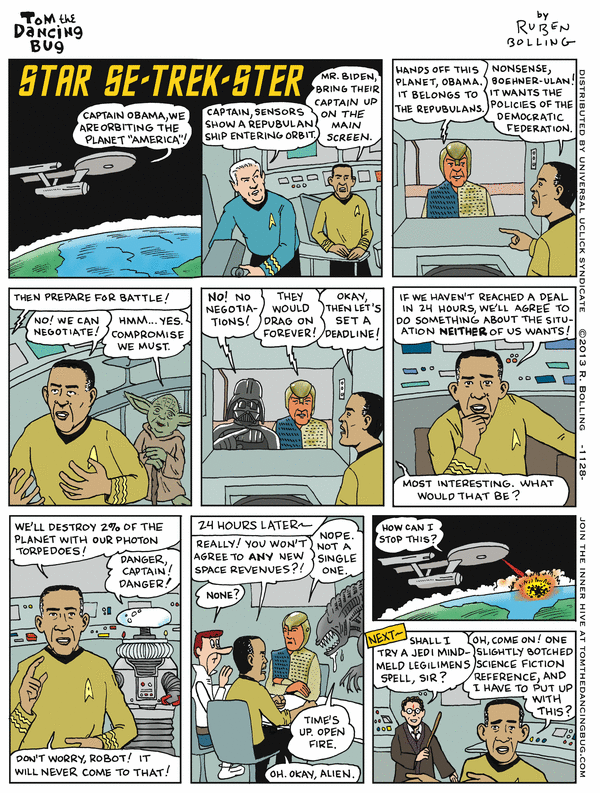
I’m a fan of the original Star Trek and of the first Star Wars trilogy.  I guess I dropped out after that, maybe moved on or something.  But putting that aside, I love this Ruben Bolling.  Sums up the cultural reference controversy and the sequester all in one.

tom 3-13-2013

OK. No one cares about the sequester

No one cares about the sequester.  Or maybe, no one knows about it.  Or maybe everyone is just tired of Congress.

Here is Mike Luckovich today with a history of our recent financial crises.

Gee.  I don't know why you think all this is my fault.

Gee. I don’t know why you think all this is my fault.

No wonder the general public doesn’t care right now.  And they probably won’t care until cuts start to hurt them.  Let’s face it:  both sides are using those old techniques of  putting forward the arguments that make the best case for their point of view.  The Republicans are right in that it won’t hurt for a little while – maybe a month or so.  And the Democrats are right that this whole exercise is unnecessary and, in the long run not helpful to recovery.

Thomas Mann and Norman Ornstein who wrote the excellent book, “It’s Even Worse Than It Looks”, have an excellent piece in today’s Washington Post titled “Five myths about the sequester”.

1. Blame Obama — the sequester was his White House’s idea.

Identifying the origins of the sequester has become a major Washington fight. Bob Woodward weighed in recently with a Washington Post op-ed making the case that the idea began in the White House. He’s right in a narrow sense, mainly because he focuses on the middle of the 2011 negotiations between Obama and Republican lawmakers. If you look before and after, a different picture emerges.

In our view, what happened is quite straightforward: In 2011, House Republican leaders used their new majority to force their priorities on the Democratically controlled Senate and the president by holding the debt limit hostage to demands for deep and immediate spending cuts. After negotiations between Obama and House Speaker John A. Boehner failed (Eric Cantor recently took credit for scuttling a deal), the parties at the eleventh hour settled on a two-part solution: immediate discretionary spending caps that would result in cuts of almost $1 trillion over 10 years; and the creation of a “supercommittee” tasked with reducing the 2012-2021 deficit by another $1.2 trillion to $1.5 trillion. If the supercommittee didn’t broker a deal, automatic spending cuts of $1.2 trillion over the next decade — the sequester — would go into effect. The sequester was designed to be so potentially destructive that the supercommittee would surely reach a deal to avert it.

The sequester’s origins can’t be blamed on one person — or one party. Republicans insisted on a trigger for automatic cuts; Jack Lew, then the White House budget director, suggested the specifics, modeled after a sequester-like mechanism Congress used in the 1980s, but with automatic tax increases added. Republicans rejected the latter but, at the time, took credit for the rest. Obama took the deal to get a debt-ceiling increase. But the president never accepted the prospect that the sequester would occur, nor did he ever agree to take tax increases off the table.

And of course no deal has been reached yet.

2. At least the automatic cuts will reduce runaway spending and begin to control the deficit.

What runaway spending? The $787 billion stimulus was a one-time expenditure that has come and gone. Under current law not including the sequester, non-defense discretionary spending as a share of the economy will shrink to a level not seen in 50 years. Defense spending grew substantially over the past decade, but that pattern has slowed and will soon end. Additional reductions must be achieved intelligently, tied to legitimate national security needs.

The annual budget deficit is projected to fall by almost 50 percent in 2013 compared with the height of the recession. Reducing the deficit over the long term requires going where the money is — boosting economic growth, controlling health-care costs and increasing revenue to handle the expense of an aging population. Deeper discretionary-spending cuts are counterproductive; immediate cuts, as Europe has made recently, could lead to a recession and bigger deficits.

I guess the Republicans want us to be like Greece after all.

And finally, one for the Democrats.

4. The cuts are so large, they will be catastrophic.

The administration has released state-by-state estimates of the sequester and highlighted the cutbacks most likely to harm or inconvenience the public. The reality is not so immediate or dramatic. The damage will accumulate in less visible ways, as irrational reductions in public spending impede economic growth and job creation; reduce investments in education, infrastructure and scientific research; and further disrupt the routines of a modern democracy. The longer the sequester remains in place, the more harm is inflicted.

So it may take a while to feel the cuts.  Maybe long enough for the Obama Administration to submit a sensible budget that everyone can agree on.  And no, I’m not smoking anything.  Just counting on mayors and governors to continue to put the pressure on Congress.

Maybe we should increase the minimum wage

Massachusetts has a minimum wage of $8/hour.  This is fifth highest among states, sixth if you count the District of Columbia.  According to the Boston Globe

Five years have elapsed since the minimum wage in Massachusetts increased in January 2008 to $8 an hour, still one of the highest wage floors in the country.

The Legislature has not voted on a minimum wage increase since 2006, when it phased in the increase over two years and overrode a veto by Governor Mitt Romney to do so.

Since then, four states, includ­ing Connecticut and ­Vermont and the District of ­Columbia have surpassed Massa­chusetts. Nevada requires employers to pay workers $8.25 an hour if they do not receive health benefits, but if health insurance is provided the minimum wage rate falls to $7.25.

California continues to pay workers a minimum of $8 an hour, and Washington has the highest minimum wage in the country at $9.19. Businesses in Connecticut must pay at least $8.25 an hour, and Vermont workers earn at least $8.60 an hour.

If Congress increases the minimum wage to $9, Massachusetts will automatically go to $9.10.  Better, but not a livable wage if you live in Boston, where rents are high.

Even with an increase we will still need the Minimum Wage Awards.

Thank you Brian McFadden.

PS.  Did you happen to notice who vetoed the Massachusetts Minimum Wage increase?

Still more on sequestration

This morning The Fix by Chris Cillizza included this interesting post by Aaron Blake.  Blake posted four great graphics explaining the impact of the sequester.  I am going to copy 2 of them here, but you should look at the entire post.

Blake explains

First up is Pew’s illustration of the year-by-year spending cuts that are included in the sequester. As you can see, the cuts start out relatively small — less than $75 billion in 2013 — but they grow to more than twice that size by 2021, for a total of more than $1 trillion.

The biggest growth in cuts over that time occurs in the interest payments, but everything except for mandatory spending cuts grow steadily over time.

And then there is this depressing news.  Sequester will not have that big of a positive impact.

There has to be a better way.  Maybe spend some money to put people back to work and let them pay taxes thus increasing revenue?  And we do have to fix the tax code so Facebook executives actually pay taxes.  And maybe we can cut programs and defense more selectively.  This won’t be as dramatic, and it might be slower, but it will hurt fewer people.

Meanwhile, members of Congress of both parties are doing their best to keep funding for their own districts.  Politico quotes Senator Lindsey Graham, an opponent of the sequester

I’m almost relishing the moment all these tough-talking guys say: ‘Can you  help me with my base?’” Sen. Lindsey Graham (R-S.C.), one of the most vocal  critics of the sequester, told POLITICO.

“When it’s somebody else’s base and district, it’s good government. When it’s  in your state or your backyard, it’s devastating,” he added.

Of course Graham’s solution is to do away with the Affordable Care Act or Obama care.  Is the momentum swinging toward a rational budget and solution?  Probably not.

What’s up with sequestration? Or we should have issued war bonds.

When I looked up sequestration in Merriam Webster, the closest meaning I could find to what is going on with the federal budget is

2
a: a legal writ authorizing a sheriff or commissioner to take into custody the property of a defendant who is in contempt until the orders of a court are complied with
b: a deposit whereby a neutral depositary agrees to hold property in litigation and to restore it to the party to whom it is adjudged to belong
So our tax dollars are being put aside until we pay down the debt or is it cut the deficit?  Back in 2004, the Treasury Department explained the difference this way.

What is the difference between the public debt and the deficit?

The deficit is the difference between the money Government takes in, called receipts, and what the Government spends, called outlays, each year.  Receipts include the money the Government takes in from income, excise and social insurance taxes as well as fees and other income.  Outlays include all Federal spending including social security and Medicare benefits along with all other spending ranging from medical research to interest payments on the debt.  When there is a deficit, Treasury must borrow the money needed for the government to pay its bills.

We borrow the money by selling Treasury securities like T-bills, notes, Treasury Inflation-Protected securities and savings bonds to the public. Additionally, the Government Trust Funds are required by law to invest accumulated surpluses in Treasury securities. The Treasury securities issued to the public and to the Government Trust Funds (intragovernmental holdings) then become part of the total debt.

One way to think about the debt is as accumulated deficits.

So back when Bill Clinton balanced the budget, we did not run a deficit and did not accumulate more debt.

While some on the right would argue that Clinton really didn’t reduce the deficit and he ruined the economy by raising taxes, I seem to remember that things were going pretty well for the average person during the Clinton years.

When George W. came into office he said he wanted to give us taxpayers back our surplus which probably would have been OK if he hadn’t then started 2 wars which we didn’t raise taxes of any kind to pay for.  No war bonds, no special tax assessment (used by state and local governments to pay for things), no general tax increase.  Thus the red ink on the chart above.  Then came what everyone is now calling the Great Recession.  Barack Obama really had no choice but to spend money to get the economy moving again.  We can argue about some of the spending – like saving some of the banks – but much of it work out pretty well, I think.

So now we have the sequester.  This was a deal made in 2011 to keep everything from coming to a halt.  I don’t think that anyone thought at the time that there wouldn’t be another budget deal to keep the cuts from going into effect, but so far no dice.  The New York Times ran an editorial on Sunday which is the best explanation of what the cuts would mean that I have seen.  For example:

NATIONAL SECURITY Two-week furloughs for most law-enforcement personnel will reduce Coast Guard operations, including drug interdictions and aid to navigation, by 25 percent. Cutbacks in Customs agents and airport security checkpoints will “substantially increase passenger wait times,” the Homeland Security Department said, creating delays of as much as an hour at busy airports. The Border Patrol will have to reduce work hours by the equivalent of 5,000 agents a year.

AIR TRAFFIC About 10 percent of the Federal Aviation Administration’s work force of 47,000 employees will be on furlough each day, including air traffic controllers, to meet a $600 million cut. The agency says it will be forced to reduce air traffic across the country, resulting in delays and disruptions, particularly at peak travel times.

CRIMINAL JUSTICE Every F.B.I. employee will be furloughed for nearly three weeks over the course of the year, the equivalent of 7,000 employees not working each day. The cut to the F.B.I. of $550 million will reduce the number of background checks on gun buyers that the bureau can perform, and reduce response times on cyberintrusion and counterterrorism investigations.

A three-week furlough of all food safety employees will produce a shortage of meat, poultry and eggs, pushing prices higher and harming restaurants and grocers. The Agriculture Department warns that public health could be affected by the inevitable black-market sales of uninspected food.

RECREATION National parks will have shorter hours, and some will have to close camping and hiking areas. Firefighting and law enforcement will be cut back.

DEFENSE PERSONNEL Enlisted personnel are exempt from sequester reductions this year, but furloughs lasting up to 22 days will be imposed for civilian employees, who do jobs like guarding military bases, handle budgets and teach the children of service members. More than 40 percent of those employees are veterans.

The military’s health insurance program, Tricare, could have a shortfall of up to $3 billion, which could lead to denial of elective medical care for retirees and dependents of active-duty service members.

And the list goes on.

The editorial concludes

Last week, Senate Democrats produced a much better plan to replace these cuts with a mix of new tax revenues and targeted reductions. About $55 billion would be raised by imposing a minimum tax on incomes of $1 million or more and ending some business deductions, while an equal amount of spending would be reduced from targeted cuts to defense and farm subsidies.

Republicans immediately rejected the idea; the Senate minority leader, Mitch McConnell, called it “a political stunt.” Their proposal is to eliminate the defense cuts and double the ones on the domestic side, heedless of the suffering that even the existing reductions will inflict. Their refusal to consider new revenues means that on March 1, Americans will begin learning how austerity really feels.

Remember the definition of sequestration I began with?  It is a temporary thing.  The money is supposed to come back to us.  If the sequestration cuts really happen, I can bet you they won’t be temporary.  We are reaping the cost of wars most of us didn’t want and any rational solution will be held up by the same folks who did want to go to war.  We should have had war bonds.

THE VICTORY FUND COMMITTEE CAN HELP YOUR MONEY...

THE VICTORY FUND COMMITTEE CAN HELP YOUR MONEY WIN THIS WAR THROUGH INVESTMENT IN U.S. TREASURY SECURITIES SUITED TO… – NARA – 515674 (Photo credit: Wikipedia)

Marco and Barack and the State of the Union

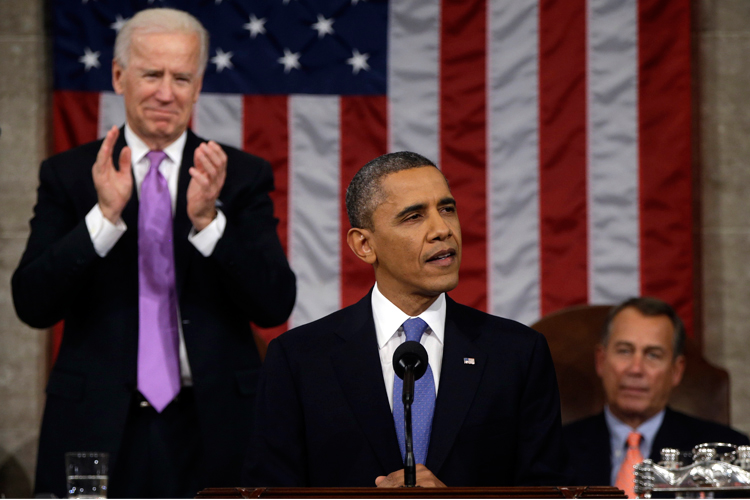
The President did not awkwardly reach for a bottle of water during his speech.  In fact, I don’t remember him drinking at all.  John Boehner, however, seemed to be sipping from his glass often.  When he wasn’t looking dour, that is.  I’ll write more about substance later, but this post is about impressions.

The best description of the Speaker is from Joan Walsh in Salon

But Boehner’s disdain was unrivaled. He also managed not to rise even for a shout-out to “wounded warriors,” or 102-year-old Deseline Victor, who waited seven hours to vote in Miami on Election Day. It was sometimes hilarious to watch him next to Vice President Joe Biden, who looked like a happy Easter Bunny with his white hair, lavender tie, pink-tinted glasses and green Newtown ribbon. Biden seemed to occasionally enjoy standing up, clapping while looking down at Boehner sulking in his chair.

This is what she means.

When John Boehner just sat there

And then we can move on to Maureen Dowd on Marco Rubio.

The ubiquitous 41-year-old — who’s on the cover of Time as “The Republican Savior” — looked as if he needed some saving himself Tuesday night as he delivered the party’s response to the State of the Union address in English (and Spanish). He seemed parched, shaky and sweaty, rubbing his face and at one point lunging off-camera to grab a bottle of water.

Oh, that water lunge.  How it will haunt poor Marco!

John Cassidy writing for the New Yorker, calls him “Water Boy”.

To be fair to Rubio, with a combination of eye contact and vigorous hand  gestures, he was doing a decent job with the tough task of delivering a lengthy  speech to a camera in an empty room. But then, for some reason—and it must have  seemed like an urgent one to him—he decided to reach for a small plastic bottle  on a nearby table and take a swig, thereby almost ducking out of the camera shot  and sending the Twitterverse into hysterics. “Uh-oh. Water gulp—really bad TV  optics,” Larry Sabato, a political science professor at the University of  Virginia, tweeted. “SNL, Colbert, Stewart…here they come.” After that  diversion, Rubio appeared to realize his error, and he looked a bit shaken. For  some reason, the camera closed in on his face, which didn’t improve things. As  the Democratic pundit Paul Begala cruelly noted on Twitter, the Senator was sporting a sheen  of sweat that inspired memories of Richard Nixon.

Meanwhile, the President looked confident and sometimes very passionate as when he mentioned the need for Congress to vote on gun safety legislation.

The Republicans looked more like their leader.

That is Paul Ryan in the center.

For right now, the President has the upper hand.  Neither Marco Rubio nor Rand Paul advanced any ideas beyond those from the last election – which they lost.  Plus they presented a bad image all around.  Maybe the Republicans are right in saying the President offered nothing new, nothing really that he didn’t talk about during the campaign, but there is a big difference:  Barack Obama won based in large measure on those ideas.  No wonder they look like four year olds being told they can’t have desert.  And poor Marco.  Only time will tell if he can overcome his reach for water.

Photographs AP/Charles Dharapak, Bill O’Leary/Post, Melina Mara/Post