Winners and losers

Not talking about baseball today but about  the 16 day drive toward the fiscal cliff.   One of my favorite commentators, Ana Marie Cox, has compiled a list that you can see in its entirety here in the Guardian.  You can agree with her or not about her choices, but she gives us some things to think about.  Here are my favorites among Cox’s choices.

Winners

Ted Cruz

Ted Cruz. The punchline for a thousand Twitter humorists and the lead for most of the many stories about GOP dysfunction, Cruz is laughing in that whiny way of his all the way to the campaign war chest. He raised over $1m in the third quarter that ended 1 October, before the shutdown, half of it through the new “Ted Cruz Victory Committee” formed last year specifically to benefit from Cruz’s “defund Obamacare” petition. Cruz’s floor speech before the Senate vote seemed to imply that the fundraising was continuing at that pace; he referred to the “millions of millions [sic] of American people rising up across this country, over two million people signing a national petition to defund Obamacare”. The online petition is also an email harvesting gambit from the Senate Conservative Fund, the PAC that helped bring Cruz to Washington in the first place.

Harry Reid

Harry Reid. The former pugilist only won a technical knockout, but that’s probably the way the Senate majority leader likes it. That Reid’s compact and focused rage held Democrats together and in chorus was obvious from the outside. Senator Dick Durbin’s insinuation that we will “never know, you will never know, how much he put in to accomplish this” only ups the suspicions about the incredible power Reid wields.

Speaker Pelosi

Nancy Pelosi. Drudge called it, naming the Democratic congresswoman from California the once and future Speaker of the House. In other words, Matt Drudge thinks the Democrats have a serious chance of winning back the House of Representatives in the 2014 midterms. Or, you know, he could have been trolling us.

John McCain

John McCain. The septuagenarian’s bipolar relationship with the media started on the upswing with his early ridicule of Cruz (though now Cruz wears “wackobird” as a badge of honor). With the threat of a shutdown, the love affair really flared back up. McCain gave both earnest indictments of the strategy and exasperated quips. He dusted off the chestnut that congressional popularity is down to “paid staffers and blood relatives” and declared sarcastically of the GOP, “We’re livin’ the dream.”

And now the

Losers

majority rule

Majority rule. While the fundamental principle of democracy seems to have survived the 16-day crisis, the fact of the shutdown and the tiny minority of congressmen that created it, the Tea Party Republicans of the House have nonetheless managed to poke serious holes in the constitution they hold so dear. Presumably, the second amendment was left unscathed.

economic principles

Economic principles. People who didn’t even know what the debt limit was last month now think it’s some kind of conspiracy. Even as the US dodged a bullet this time – though suffering the collateral damage of further credit-rating downgrades – one can’t help feeling that we haven’t heard the last of the GOP’s new caucus of “debt default skeptics”.

apples and oranges

“False equivalence” reporting. James Fallows at the Atlantic documented some of the worst offenders and as “it’s everybody’s fault” became a Republican talking point, many media critics joined him in denouncing the faux-even-handedness as actually putting a finger on the scale. The “serious people” trope (as in, “serious people are above partisan bickering”) popularized by op-ed writers such as Michael Kinsley and Ron Fournier became especially ridiculous as the crisis wore on. Kinsley’s column beseeching Obama to “give in” to Republicans “for the sake of the country” (“media will no doubt call Obama weak”!) should be taught as a cautionary example against this desire to be “taken seriously”.

gop logo

The GOP. I mean, really.

This effort has only cost us an estimated 24 Billion dollars (and counting) and there is no saying that it won’t happen again in January.  It drives me nuts that the President is blamed by many while Ted Cruz used me – and everyone else who pays taxes and needs government services – to raise money for his 2016 Presidential bid.  But the silver lining is that if the Democrats get to work, it looks like they can hold on to the Senate and take back the House.  And then John Boehner will really have something to cry about.

Moving toward the cliff

Yesterday I had lunch with a friend, a federal employee, who is not working because of the shutdown.  She can’t check her work email or phone messages and fears the backlog of problems that awaits her when she does get back to work.  She said the only way she was fortunate was that she was not one of the essential employees who had to work anyway.  We speculated on how people will get to work if October moves to November and people’s monthly transit passes run out.  Will they be expected to shell out money they don’t have to get to a job they aren’t paid for?  All her friends can do is to buy her lunch.  Fast forward 24 hours and we still have no deal.  Even if the Senate comes up with a solution it is not clear if 1) the House will even vote on it and 2) if they do, if this is just another short term postponement.  All my friend hopes is that the next deadline is past the holidays and that there is back pay.

I was trying to find some humor in the whole situation, but find that I actually feel very sorry for John Boehner.  John Cassidy posted this for the New Yorker.

Give the Republicans on Capitol Hill one thing: they don’t leave a job half done. Evidently disturbed by polls showing Congress with a single-digit approval rating, they appear intent on driving it to zero.

What other explanation can there be for Tuesday’s farcical maneuvers, which saw the House Republican leadership try and fail to seize the initiative in the debt-ceiling standoff from the Senate, in the process humiliating Speaker Boehner yet again. By the end of the day, facing renewed opposition from some of his own members, Boehner had dropped his efforts to pass a bill that would have ended the shutdown and raised the debt ceiling until February, but one with more riders than an agreement that Mitch McConnell, the Republican leader in the Senate, and Harry Reid, the Democratic leader, have been working on.

From the point of view of the country, that’s good news. Overnight, officials representing McConnell and Reid were rushing to complete their negotiations, which were called off on Tuesday after Boehner’s unwise intervention. As it stands now, the Senate agreement would reportedly fund the government until January 15th and raise the debt ceiling until February 7th, with the only concession from the Democrats being an agreement to toughen up the policing of eligibility requirements for obtaining federal subsidies to buy health insurance under the Affordable Care Act.

Boehner is in a box.  He can’t control his own party caucus and can’t turn to Democratic votes because then he would lose his Speakership.  If the country goes into default, he will likely lose it anyway.

Once the Senate passes a bill and sends it to the House, the Speaker will face the unenviable choice of allowing it to pass with Democratic support or exercising the nuclear option of forcing a default. Having already ruled out this second option in public comments, there were reports on Tuesday night that Boehner was prepared to bring the Senate bill to the floor, which would probably insure its passage. That wouldn’t end the budget crisis—it’s never-ending—but it would put off the next showdown until the new year, whilst ensuring that the Republican ultras had gained almost precisely nothing for their willingness to shut down the government and raise the prospect of a debt default. (In another development on Tuesday, Fitch, one of the big ratings agencies, placed U.S. government debt on watch for a potential downgrade, saying that “the prolonged negotiations over raising the debt ceiling (following the episode in August 2011), risks undermining confidence in the role of the U.S. dollar as the preeminent global reserve currency by casting doubt over the full faith and credit of the U.S.”)

From the point of view of the Republican Party, things have been going from bad to worse. With the party divided, its poll ratings tanking fast, and its leadership unwilling to risk an actual default, it has been clear for some time that it was in a losing position. The discussions in the past few days have been about the terms of surrender, with the White House and Reid pressing for something close to an unconditional capitulation.

So here are a few cartoons to weep at as we proceed at a Senate’s slow pace, to the edge.

From Tony Auth

From Tony Auth

Tom Toles

Tom Toles

Signe Wilkerson

Signe Wilkerson

And Wilkerson, again.

Wilkinson2

Can we hope that there are still some adults who won’t drive us over the edge?

Can we send David Ortiz to the budget negotiations?

It has been a discouraging last few days with the only real bright spot being Friday (and then we went back Saturday) at Symphony Hall with the Boston Symphony Orchestra. We wanted to hear Thomas Ades, Polaris a second time and Friday night the BSO did not do Franck’s Symphony in D Minor which my husband loves.   But we came home Saturday night to no budget/debt ceiling deal and the Red Sox striking out, also.  I often tune in to some of the Sunday news shows, but couldn’t stand to hear any more Republican Congresspersons who have no clue about what the debt ceiling is much less understand any thing about the economy.  One of my friends posted this on Facebook the other day

Despite their lofty status in managing American affairs, it appears to me that few Congresspersons have any meaningful understanding of how their chronic politicization of economic policies substantially degrades, perhaps permanently, the dollar’s status as the global reserve currency. Evidence of the dollar’s decline to a commodity status is increasingly apparent. In time, every American will feel a crippling pain that no amount of political negotiating can cure.

Given this state of things, I retreated to a game of Civilization V where I could control, more or less, my own universe until after Sunday dinner when the Red Sox could take over.  But, after watching strike out after strike out with Clay Buchholz pitching sooo very slowly while getting slammed around in the sixth, I retreated.  I woke up just before 6 am this morning having just had a dream that I woke up and the Sox had come back.  I turned on the radio, I found that is was true!

Peter Abraham explains

In what has been a season full of memorable late-inning victories at Fenway Park, the Red Sox saved the best for when they needed it the most in Game 2 of the American League Championship Series Sunday night.

Trailing by four runs against the Detroit Tigers, the Sox tied the game on a grand slam by David Ortiz in the eighth inning then won it, 6-5, when Jarrod Saltalamacchia singled to drive in Jonny Gomes in the ninth.

The remarkable victory had the players chasing Saltalamacchia across the outfield and the sellout crowd of 38,029 chanting “Let’s Go Red Sox!” as they left Fenway.

“When you back us into a wall, you either do two things: cave or fight. We’re gonna fight,” Dustin Pedroia said.

That wall was hard to get over. The Sox had scored one run through the 16 innings in the series, going 3 for 51 at the plate with 30 strikeouts. Detroit starter Max Scherzer allowed one run on two hits over seven innings and struck out 13.

And then.

Will Middlebrooks doubled to left field off Jose Veras to start the rally. Then Jacoby Ellsbury drew a walk off Drew Smyly.

Al Albuquerque was next out of the Detroit bullpen. He struck out Shane Victorino for the second out, but Pedroia singled to right. Third base coach Brian Butterfield held Middlebrooks, wanting to make sure Ortiz got his chance.

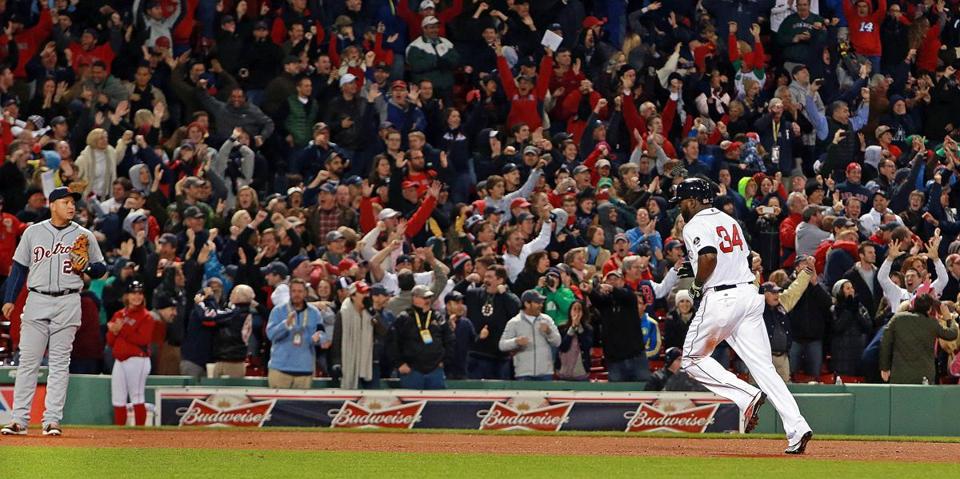
Ortiz swung at the first pitch, a changeup away, and was strong enough to pull it into the Red Sox bullpen in right field for his first career postseason grand slam and the fourth in Red Sox history.

Right fielder Torii Hunter tumbled over the wall trying to make a catch as Boston police officer Steve Horgan raised his arms in joy. Bullpen catcher Mani Martinez, who was warming up Koji Uehara, casually turned and caught the ball.

It was bedlam at Fenway and the crowd kept cheering until Ortiz emerged from the dugout and tipped his helmet to them.

“My idea wasn’t to go out and hit a grand slam,” Ortiz said. “If I was telling you about thinking about hitting a grand slam, I’d be lying to you now.”

A hero of postseasons past, David Ortiz rounds third base — as the Tigers’ Miguel Cabrera looks on — to a standing ovation after his grand slam in the eighth inning tied Game 2 at 5.

A hero of postseasons past, David Ortiz rounds third base — as the Tigers’ Miguel Cabrera looks on — to a standing ovation after his grand slam in the eighth inning tied Game 2 at 5.

Gotta love David.

There was still a game to win. After Uehara retired the Tigers in order, Gomes was again the catalyst.

He reached on an infield single off Rick Porcello and took second on a throwing error by shortstop Jose Iglesias, the former Sox player known for his defensive skills.

“No is not an option for this team,” Gomes said. “Once I got on second, I was going to do anything I could to score.”

Gomes advanced on a wild pitch and scored when Saltalamacchia singled to left field.

“I felt good,” Saltalamacchia said. “Trying to hit the ball up the middle and take your chance.”

It was the 12th walkoff win of the season for the Red Sox.

So now we have something to watch on the highlight reels other than strike out after strike out.  There is joy in Mudville after all.  The Red Sox head for Detroit to face Justin Verlander, still another one of the Tigers’ great pitchers.  Let’s end this with something to ponder.  My husband heard Verlander ask this question:  If a pitch grazes a Red Sox’s beard, did he get hit by the pitch?

Now if only someone would hit a grand slam on the budget and knock out Ted Cruz and his friends.

Photograph:  Jim Davis/Globe Staff

The Senate Chaplain Speaks

Maybe you didn’t realize that the Senate and the House each have a chaplain.  If you are a C-SPAN junky you might have seen them open each daily session.  The Senate website has a brief description of the office and history.

Throughout the years, the United States Senate has honored the historic separation of Church and State, but not the separation of God and State. The first Senate, meeting in New York City on April 25, 1789, elected the Right Reverend Samuel Provost, the Episcopal Bishop of New York, as its first Chaplain. During the past two hundred and seven years, all sessions of the Senate have been opened with prayer, strongly affirming the Senate’s faith in God as Sovereign Lord of our Nation. The role of the Chaplain as spiritual advisor and counselor has expanded over the years from a part-time position to a full-time job as one of the Officers of the Senate.  The Office of the Chaplain is nonpartisan, nonpolitical, and nonsectarian.

But the current Senate Chaplain, Barry C. Black, has begun to make news with what the New York Times called “our daily Senate scolding.”

The disapproval comes from angry constituents, baffled party elders and colleagues on the other side of the Capitol. But nowhere have senators found criticism more personal or immediate than right inside their own chamber every morning when the chaplain delivers the opening prayer.

“Save us from the madness,” the chaplain, a Seventh-day Adventist, former Navy rear admiral and collector of brightly colored bow ties named Barry C. Black, said one day late last week as he warmed up into what became an epic ministerial scolding.

“We acknowledge our transgressions, our shortcomings, our smugness, our selfishness and our pride,” he went on, his baritone voice filling the room. “Deliver us from the hypocrisy of attempting to sound reasonable while being unreasonable.”

In case you were wondering, Chaplain Black was selected in 2003 by then Majority Leader, Republican Bill Frist.  He says of his politics

“I use a biblical perspective to decide my beliefs about various issues,” Mr. Black said in an interview in his office suite on the third floor of the Capitol. “Let’s just say I’m liberal on some and conservative on others. But it’s obvious the Bible condemns some things in a very forceful and overt way, and I would go along with that condemnation.”

But back to some of his recent prayers.

During his prayer on Friday, the day after officers from the United States Capitol Police shot and killed a woman who had used her car as a battering ram, Mr. Black noted that the officers were not being paid because of the government shutdown.

Then he turned his attention back to the senators. “Remove from them that stubborn pride which imagines itself to be above and beyond criticism,” he said. “Forgive them the blunders they have committed.”

Senator Harry Reid, the pugnacious majority leader who has called his Republican adversaries anarchists, rumps and hostage takers, took note. As Mr. Black spoke, Mr. Reid, whose head was bowed low in prayer, broke his concentration and looked straight up at the chaplain.

“Following the suggestion in the prayer of Admiral Black,” the majority leader said after the invocation, seeming genuinely contrite, “I think we’ve all here in the Senate kind of lost the aura of Robert Byrd,” one of the historical giants of the Senate, who prized gentility and compromise.

Senate Chaplain Barry Black

Senate Chaplain Barry Black

Chaplain Black is a federal employee who is not being paid during the shutdown.  He is also one of the few adults in the Senate chamber.

Mr. Black, who is the first black Senate chaplain as well as its first Seventh-day Adventist, grew up in public housing in Baltimore, an experience he draws on in his sermons and writings, including a 2006 autobiography, “From the Hood to the Hill.”

In his role as chaplain, a position that has existed since 1789, he acts as a sounding board, spiritual adviser and ethical counselor to members of the Senate. When he prays each day, he said, he recites the names of all 100 senators and their spouses, reading them from a laminated index card.

It is not uncommon for him to have 125 people at his Bible study gatherings or 20 to 30 senators at his weekly prayer breakfast. He officiates weddings for Senate staff members. He performs hospital visitations. And he has been at the side of senators when they have died, most recently Daniel K. Inouye of Hawaii in December.

The Senate is lucky to have him and maybe they need to pay more attention to what he is saying.

“I remember once talking about self-inflicted wounds — that captured the imagination of some of our lawmakers,” he said. “Remember, my prayer is the first thing they hear every day. I have the opportunity, really, to frame the day in a special way.”

His words lately may be pointed, but his tone is always steady and calm.

“May they remember that all that is necessary for unintended catastrophic consequences is for good people to do nothing,” he said the day of the shutdown deadline.

“Unless you empower our lawmakers,” he prayed another day, “they can comprehend their duty but not perform it.”

Senators, hear Chaplain Black.  Be adults.

Photograph:  Drew Angerer for The New York Times

The government shutdown: a letter from Congressman Capuano

I am posting the entire weekly email newsletter I just got from my Congressman, Mike Capuano.    I am proud to say that he was my boss for several years when he was the Mayor of Somerville.

Dear Friends,

The government shutdown is in its fourth day. Speaker Boehner still refuses to bring up a clean Continuing Resolution (CR), even though it would pass Congress and be signed by the President, reopening the government.

The House has spent most of this week considering bills to partially fund the government. This process is more about appearances than responsible legislating. That’s why you’ve seen attempts to fund the National Park Service so tourist attractions can reopen but not the Transportation Department. The Senate and President have both rejected this path. I’m not sure where or when this all ends. It’s certainly true that this battle is about the Affordable Care Act (ACA) and the obsession many Republicans have with sabotaging it. I think there’s more to it though.

This is also about one of the fundamental principles of our government, the idea of majority rule. The importance of that principle is vividly on display here and it’s one worth protecting.

The ACA was signed into law in 2010 after months and months of substantive and at times contentious debate. Since Republicans regained control of the House in 2010, there have been 42 attempts to repeal, defund or gut the law. Each time the effort has accomplished essentially nothing. As I noted earlier this week, Mitt Romney ran on a promise to repeal “Obamacare”. He lost the election. House Democrats got more votes than House Republicans and Democrats retained control of the Senate. The ACA was even declared constitutional by the Supreme Court.

Despite all of that, a small percentage of the House Republican Caucus refuses to accept the will of the majority, democratically expressed. They shut the government down because they can’t accept it. The ACA is the law of the land, affirmed by the results of a national election and a Supreme Court ruling. More and more moderate Republicans are speaking out on the need for a clean CR. Unfortunately there aren’t enough of those moderate voices and the extremists in the House continue to drown them out.

Imagine what our government would look like if more Members refused to respect the principle of majority rule and insisted on getting their way without regard for the consequences. It wouldn’t be 17 years between government shutdowns, that’s for sure.

I believe that this battle is also about the role that government should play in our lives. Do we want to provide some help to those less fortunate in the form of nutrition assistance or home heating aid? Do we want to help our states build world class roads, bridges and subway systems? Do we want to attract cutting edge research that results in medical advances? All of that takes an investment of federal dollars.

What has been happening over the past couple years is a steady and steep reduction in federal spending. That often gets lost in the din but numbers don’t lie. In two years, a total deficit reduction of almost $2.4 trillion has been achieved. In 2011, the Budget Control Act placed a cap on discretionary spending at $1.066 trillion for fiscal year 2014. That cap has been ignored by the House, with much deeper cuts going into effect as a result of sequestration.

Here are just a couple examples of how those cuts have impacted some important programs. In the past year, funding for the National Institutes of Health has been cut by $1.6 billion. Funding for Head Start has been cut by $400 million.

Earlier this year, the Senate passed a budget that proposed spending $1.058 trillion for fiscal year 2014. Under the clean CR proposed in the Senate in order to reopen the government, that spending is cut to $986 billion. This is much closer to the Republican proposal than the Senate’s.

In terms of cutting spending, Republicans don’t seem to recognize that they are gaining significant ground. The CR that many of them say they won’t support includes deep cuts to discretionary programming.

More votes are expected in the House tomorrow and the schedule for next week is unclear. Thanks for your calls and emails of support. I appreciate all of them.

Best,

Mike

English: Official Congressional portrait for C...

English: Official Congressional portrait for Congressman Mike Capuano. (Photo credit: Wikipedia)

Cartoonists view the government shutdown

We need to keep a sense of humor about things so we can survive this Republican tantrum.  Here is my contribution.

Dan Wasserman from the Boston Glove.

101toon_wasserman


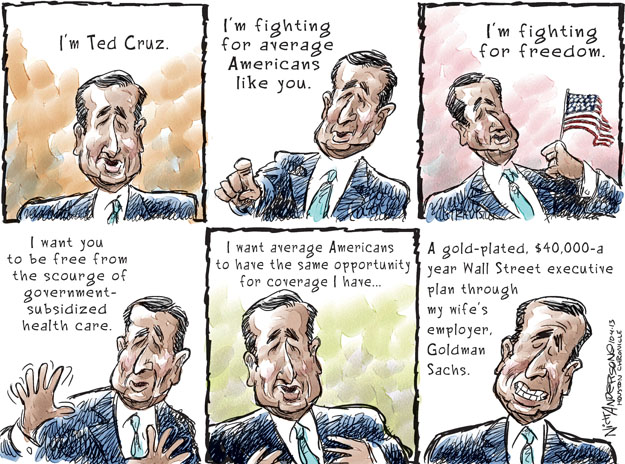
Nick Anderson on Ted Cruz.

Anderson on Cruz


Carlson on Infant nutrition.

Carlson


The new axis of evil?

luckovich

Trying to made sense of it all

I think I may be ready to retreat to my cocoon to read trashy books and watch baseball and reruns of NCIS before my head explodes from trying to make sense of what is going on out there.

Yesterday, Boston Globe columnist Adrian Walker had a little anecdote from my Congressperson, Mike Capuano.

…Capuano said he was in an airport last weekend flying home from Washington when a TSA screener stopped him and said, “You really need to cut our taxes!” Capuano was incredulous to hear that from a federal employee, though he probably shouldn’t have been.

“I asked him, ‘Do you know taxes pay your salary?’ ” Capuano said with a laugh.

I wish I knew what the silly TSA screener said then.  It is an example of how divorced from reality so many people are.  Maybe we should expand the shut down to include furloughs for half of the screeners.  This would cut flights so many of the members of Congress would have trouble getting home.  I don’t think this would be a bad thing.  Maybe if they stayed in Washington more, they would figure out how to talk to each other informally over a beer.  That could only help.  Maybe some of them would get a grip on reality.

As I was getting ready to write this, I Googled  both “Republican Alternate Reality” and “Republican Alternate Universe”.  Turns out people have been writing about the topic for a number of years now.  It is one thing to talk sans facts, but another to act.  And what is happening now is the action that they have all wanted:  a government shutdown.  I think they are hoping that a few weeks without government will show people they can live without it.  Maybe a good plan except that there are already Republicans complaining that monuments in Washington are closed so veterans can’t visit them.  Duh!

Back in August 2012 (2012 not 2013), Michael Cohen wrote a piece in the Guardian about the Presidential campaign.  If you recall, they had a slogan “You didn’t build that”.

On 17 July, President Barack Obama spoke at a campaign rally in Roanoke, Virginia. It was a typical event for an incumbent president who is seeking a second term. In his remarks, he offered his vision of government’s role in spurring entrepreneurship and creating jobs in the United States:

“If you were successful, somebody along the line gave you some help. There was a great teacher somewhere in your life. Somebody helped to create this unbelievable American system that we have that allowed you to thrive. Somebody invested in roads and bridges. If you’ve got a business – you didn’t build that. Somebody else made that happen. The internet didn’t get invented on its own. Government research created the internet so that all the companies could make money off the internet.”

This is all fairly boilerplate rhetoric – a basic recitation of how Democrats view the role of government and its interplay with the private sector. But in this statement, there was one phrase that Republicans have grabbed on to like a famished dog with a new bone:

“You didn’t build that.”

That single phrase, taken out of context by Republicans, has become the GOP’s symbol of Obama’s supposed contempt for the free market and entrepreneurship, and for his socialist assault on America.

The Affordable Care Act is a prime example of government overreach and socialism even though it is built on private insurance companies.

“You didn’t build that” became “We built that”

And so, the Republicans made “We built that” the theme of Tuesday’s convention proceedings. Speaker after speaker hammered on this theme, accusing Obama of disrespecting small business. But they did so with almost a wilful sense of hypocrisy. For example, Delaware lieutenant governor candidate Sher Valenzuela attacked Obama for the line despite the fact that, just a few months ago, she gave a detailed speech to a business group about how they could do a better job getting government contracts.

Cohen goes on to detail a number of instances where the speakers at the Republican Convention ignored facts and concludes

But all of this is at pace with a conservative worldview that considers government to be nothing more than malevolent interference with the smooth operation of the private sector – except when it’s not. “Jobs don’t come from government,” said Texas Senate candidate Ted Cruz last night, a view that basically sums up GOP economic thinking. But if you listened to Republican governors on Tuesday, you might have found yourself surprised to discover that, in their states, the government has played an oddly integral role in spurring job creation. If you listened to Mary Fallin, governor of Oklahoma, extol the virtues of the energy industry in her state and bemoan “more government, bigger spending and more regulation”, you might never know that the oil and gas industry is deeply reliant on – and spends millions lobbying for – tax breaks from the federal government.

One can believe that government should play a less direct role in the workings of the private economy – clearly, this is a defensible notion. But to listen to Republicans harping on Obama’s “you didn’t build that” line is to hear a party that views “government” in the most simplistic imaginable terms. This isn’t a governing philosophy; it’s a caricature of how the economy actually works.

To be sure, it’s hardly unusual for political rhetoric to take liberties with the truth, or to stretch an argument to breaking-point, but with Republicans today, the issues runs much deeper. Very simply, the way they talk about what the federal government does or should do, and about the role of spending, taxation and regulation, is more than just a compendium of lies: it describes an alternate reality.

In the GOP’s defense: at least they can argue they built that.

So now they have shutdown the federal government which was a goal all along.  They built it.  And in their alternate universe, President Obama and the Democratic congressional leadership should negotiate with them.  Nancy Pelosi has tried to explain what she calls “regular order”:  The Senate passes a bill.  Then the House passes one.  Then there is a conference committee.  Budget bills were passed back in March, but the House declined to appoint members to a conference committee.  Contrary to what some members of Congress seem to believe there are rules and conventions as to how to proceed.

Gail Collins has a response in the New York Times.

On Wednesday, House Republicans pushed to refund bits and pieces of the government that the members particularly like, such as veterans and the National Guard. Also anything that lends itself to a dramatic press conference, such as national parks and cancer treatment for children. Since the House proposals are never going anywhere in the Senate, there’s a limit to what you want to know about what went on during the debate. Let’s summarize:

Democrats: “Meaningless political theater!”

Republicans: “Come to the table!”

Coming to the table has now replaced strangling Obamacare as the most popular G.O.P. war cry. There is a longstanding political rule that when all else fails, you demand more talking. If you’re running for office against a guy who’s got 70 percent in the polls, it’s time to call for a debate. If you’re already having four debates, it’s time to call for six.

“Why don’t we sit down and have a conference committee about how we’re going to fund the federal government?” demanded Representative Ander Crenshaw of Florida. Republicans have posed this question a lot, and it would be an excellent one if they were not the same folks who have spent the last half-year refusing to sit down and have a conference committee about the federal budget.
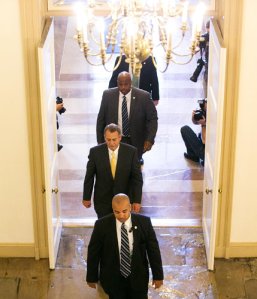
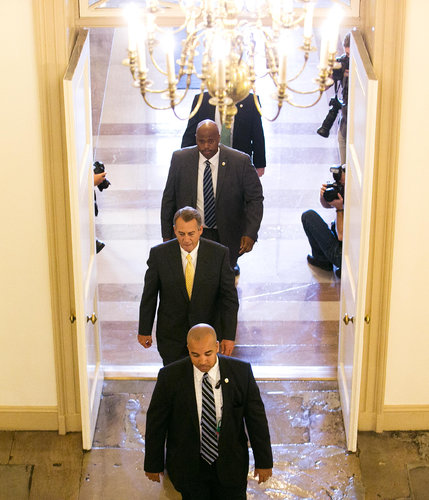
Representative John A. Boehner, the House speaker, arrived at the Capitol on Thursday with his security personnel on the third day of the government shutdown.

Representative John A. Boehner, the House speaker, arrived at the Capitol on Thursday with his security personnel on the third day of the government shutdown.

I’ll give the final word on reality to Elizabeth Kolbert in her New Yorker posted this morning.

…Shuttering the government is a dumb idea under pretty much any circumstances. Still, the objections that Republicans in Congress raise to the health-care law might be worth considering if they bore any relationship to the law in question. Rarely do they.

Some lawmakers’ comments have been so off the wall that they defy parody. A few months ago, for example, Representative Michele Bachmann announced on the House floor that Obamacare needed to be repealed “before it literally kills women, kills children, kills senior citizens.”

“Let’s not do that,” she added helpfully. “Let’s love people.”

“All of this would be funny,” President Obama noted the other day, after bringing up the Bachmann line, “if it weren’t so crazy.”

The crazy list goes on and on. As the economist Paul Krugman has repeatedly pointed out in his Times column, congressional Republicans these days seem to think that they can override not just the laws of physics but also the rules of arithmetic. They insist that the federal budget is so bloated it could easily be cut by hundreds of billions of dollars. But when a transportation bill was drafted this summer that would have actually reduced spending, they refused to vote for it. (The bill had to be pulled from the floor.) It’s hard to cut the federal budget if you’re not willing to reduce the amount of money the government spends. “What Republicans really want to do,” Krugman wrote recently, is “repeal reality.”

It’s been so long since reality has made much of a difference on Capitol Hill that it sometimes seems it genuinely has been repealed. But the thing you can always count on with reality is that it has staying power.

I hope I can hold out until reality and fact make a comeback.

Photograph: Doug Mills/The New York Times

President Obama and leadership

Like many of his supporters I am frustrated at times by what appears to be indecision on the President’s part.  You have to admit that he can take a long time to make a decision while speculation dominates the media and the blogs as to what he will do.  Look at the still to be announced appointment to be Chair of the Federal Reserve.  But when I get frustrated I tell myself that he is playing a long game.  Farah Stockman had an interesting op-ed in the Boston Globe today explaining better than I could the Obama style of leadership.

I am going to quote most of it because I can’t figure out where to cut it (and because one can’t read it from the link without a Globe subscription) and it isn’t that long..

Before we start hand-wringing over the gridlock in our domestic affairs, let’s savor the good news on the international front: Last week, after years of paralysis, the UN Security Council mandated the destruction of chemical weapons in Syria and endorsed a political transition plan that might finally sweep Syrian President Bashar Assad aside.

And after years of Iran’s refusal to talk seriously about its nuclear program, Iran’s new president, Hassan Rouhani, announced that he wants to resolve the issue in 12 months. He and President Obama even spoke on the phone, the first such contact since the 1970s.

Of course, we’re still a long way from solving those two problems. But we’re on a far better path than we were three weeks ago. Back then, we were on the verge of launching a unilateral military strike that would have inflamed the situation in Syria and hurt our chances of getting a nuclear deal with Iran. So how did that no-win situation in Syria turn into something positive? And what does this bizarre chapter in US diplomacy tell us about the nature of leadership itself?

Recall that Obama announced that he had made a decision to strike. Then he asked Congress to give its blessing. Those moves allowed time for Americans to debate, with the whole world watching. Moscow, Tehran, and Damascus were forced to contemplate the possibility of a US strike. The uncertainty of what would happen next weighed on them more heavily than a knee-jerk cruise missile. In the end, the threat of US military action proved more powerful than the action itself. Our adversaries finally agreed to a diplomatic solution that they had refused in the past.

Of course, Obama got called a lot of names for the delay that made that outcome possible: “weakling,” “ditherer-in-chief,” and— nastiest of all, in some corners —  “community organizer.” I must admit that I thought he was crazy for going to Congress, which often seems more eager to tar and feather him than to approve of anything he wants.

But political theorist Dennis Thompson, co-author of the book “Why Deliberative Democracy?” says Obama’s moves mirrored a style of leadership Thompson taught at Harvard. Thompson believes that, in a true democracy, a leader ought to explain the reasoning behind the course of action he or she wants to take. But in the end, wherever possible, the group itself should debate it and have the final word.

It stands to reason that a country that believes in democracy should have faith that a decision debated openly by a group will usually produce a better outcome than a decision one man makes alone. So, why then were some Americans so infuriated that Obama took the issue to Congress?

“It is as if we expect decisions of war and peace to be made by the president rather than society as a whole,” said Archon Fung, another Harvard professor who has studied the virtues of “deliberative democracy.” “Decisions about when to use military force . . . involve killing as a state act. If any decision should be made democratically, it’s this one.”

Peter Levine, a professor at Tufts University, sees the public reaction as a sign of the times. Americans have grown less interested in the public deliberations that that make democracies work. Participation on juries and PTA meetings are at an all-time low, he said. Voters expect their elected leaders to solve their problems. Debates over the best way to go about it are seen as a sign of failure or weakness.

“Our system is supposed to be deliberative,” Levine said. “But we live in a profoundly anti-deliberative moment.”

So maybe this episode says as much about us as it does about our leader. We like John Wayne presidents, saviors who rescue us with their quick trigger fingers. We don’t like leaders who admit uncertainty, who ask us to help choose between imperfect options. But, at the end of the day, the Syria debate taught us that when Americans deliberate as a people, we can come up with a better outcome. It’s a lesson we shouldn’t forget.

President Obama is certainly not John Wayne, but he is the leader of a democracy.  We need to remember this when we get frustrated.

Boston’s Ward 11, Precinct 1 and the next Mayor

I haven’t posted for a while for a couple of reasons:  first I was depressed by the sameness of the news and second, I had to travel to a memorial service for an uncle who passed away at 91.  But before I left town, I voted in the preliminary election for the next mayor of Boston.  Unfortunately, my preferred candidate, Charlotte Golar Richie, finished third.  The top two who will face off in November are both Irish men leading some to lament that Boston has made no progress even though it is a majority minority city.  That is true, but both Marty Walsh and John Connolly are good progressives so it isn’t all bad.  The issue for both of them will be to expand out of their normal voter bases.  This may be easier for Connolly who had votes from more parts of the City.

The Boston Sunday Globe ran an interesting story on the front page this morning about my precinct.  I know it well having represented it on the Democratic Ward Committee for a number of years and having, over the last 19 years, canvassed every house at one time or another.  11/1 is an example of a precinct in which neither Walsh or Connolly did very well

Tucked away in a quiet corner of Roxbury, the Highland Park section of Fort Hill is lined with stately brownstones, rambling gardens, and campaign signs showing political allegiances as diverse as the neighborhood’s population. Fences and yard signs still advertise support for an array of unsuccessful mayoral candidates, including Charlotte Golar Richie, John Barros, and City Councilors Mike Ross and Felix G. Arroyo.

What united voters here in last week’s preliminary election was not a shared loyalty to one candidate, but a collective aversion to two — the eventual winners. Eighty-eight percent of voters in this progressive precinct backed someone other than state Representative Martin J. Walsh or Councilor at Large John R. Connolly. Located within the broad swath of Boston’s inner city where neither finalist claimed victory, Fort Hill is among the voting precincts where they had their weakest showings. Of 261 votes cast for mayor in this precinct last week, only four went to Walsh.

There are 5 adults living in my building and we had 3 yard signs:  Rob Consalvo, Charles Yancey and Charlotte Golar Richie.

Voters in Ward 11/1

Voters in Ward 11/1

Ward 11 is a pretty well racially integrated neighborhood with a high rate of owner occupancy even in the 2 family homes with rental units.

A white female neighbor, who declined to give her name, said she had voted for Golar Richie, the only woman in the race, who would have been the city’s first female mayor and first black mayor. Now, she said, “I have to decide who’s less offensive.”

That attitude itself is offensive to voters like Valerie Madden, a Connolly volunteer who had tried to get her neighbors here to rally around Connolly’s campaign.

“People would tell me frankly, ‘I like him. He’s a good candidate. But I’m not going to vote for him because he’s white,’ ” Madden said.

Madden, who is white, and whose husband is biracial, said she didn’t have the “bandwidth to chide my neighbors because I know that where they’re coming from is a place of good intentions.”

I read this as wanting to elect a mayor who is not white, not as not wanting for vote for someone white.  The precinct votes overwhelmingly for our congressman who is white, for Senators Warren and Markey and voted in large numbers for the current Mayor who is also white.  But I do understand Valerie’s frustration.  She started working for Connolly before Mayor Menino announced his retirement.

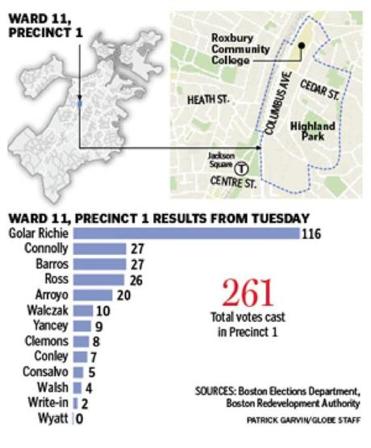
Looking at the vote totals, Charlotte took the precinct by a wide margin while finishing third overall.  It will be interesting to see who, if anyone she endorses.  If I were Connolly or Walsh, I would be seeking her help.  I’m disappointed, but console myself with the thought that we are in a time of transition.  With Tom Menino having been mayor for 20 years, who knows if the next mayor will be long tenured or serve a single term as the City gets accustomed to a mayor not named Menino.

Vote distribution in 11/1.

Vote distribution in 11/1.

The war in Syria: a confused state of affairs

English: The United Nations Security Council C...

English: The United Nations Security Council Chamber in New York, also known as the Norwegian Room Français: La Salle de réunion du Conseil de sécurité des Nations Unies à New York Nederlands: De Zaal van de Veiligheidsraad van de Verenigde Naties in New York (Photo credit: Wikipedia)

I’m probably like most Americans: confused.  On one hand, I look at the pictures of the victims in Syria, not only the dead and injured from the chemical weapons attack, but also those in refugee camps or living in caves and wonder why the world can’t do anything to help.  On the other hand, there is a seemingly intractable diplomatic stalemate and no one wants “boot on the ground”.  So what to do.

The British drafted a resolution that was discussed by the United Nations Security Council condemning use of chemical weapons but it didn’t get anywhere because of the threat of a Russian veto.  This morning, the Guardian reports on President Putin’s reaction

Vladimir Putin has rejected US intelligence claims that Bashar al-Assad’s regime used chemical weapons in Syria, saying it would be “utter nonsense” for government troops to use such tactics in a war it was already winning.

“That is why I am convinced that [the chemical attack] is nothing more than a provocation by those who want to drag other countries into the Syrian conflict, and who want to win the support of powerful members of the international arena, especially the United States,” Putin told journalists in Vladivostok.

The Russian president also challenged the US to present its case for military intervention to the UN security council, after suggesting that if Barack Obama was worthy of his Nobel peace prize, he should think about the possible victims of any intervention by foreign forces.

Is this a signal that the United States should wait to take action?  Is Putin ready to compromise – or at least to talk?

Meanwhile John Kerry, the hero of the anti-Vietnam War movement, is sounding more and more like Donald Rumsfeld – or maybe Colin Powell at the UN.  The New York Times reports

Again and again, some 24 times in all, he used the phrase “we know” as he described the intelligence that Syria’s government massacred more than 1,400 people with chemical weapons. And then, while saying no decision had been made, he left no doubt that the United States would respond with military power.

“We know that after a decade of conflict, the American people are tired of war — believe me, I am, too,” said Mr. Kerry, who opposed the Iraq war in his failed presidential bid in 2004. “But fatigue does not absolve us of our responsibility. Just longing for peace does not necessarily bring it about. And history would judge us all extraordinarily harshly if we turned a blind eye to a dictator’s wanton use of weapons of mass destruction against all warnings, against all common understanding of decency.”

Just seven months after being sworn in as secretary of state, Mr. Kerry has become President Obama’s frontman in the public argument for a military strike against the Syrian government. While the president sounds restrained in his language and even perhaps personally ambivalent about the operation he seems likely to order, Mr. Kerry came across on Friday as an unstinting advocate for action against what he called “a despot’s brutal and flagrant use of chemical weapons.”

The problem is that we were lied to once, told that there was intelligence that proved there were weapons of mass destruction in Iraq and even though some of us may want to trust Kerry, it is hard to do so even with the level of specificity in the summary report he released.

As to allies, the British Parliament has voted not to participate in any military action and French public opinion is also against.  The Arab League has said that while they think Assad used chemical weapons, they can’t support any military action.  The public here is lukewarm at best.

This is not Libya.  In Libya there was a recognized opposition which had actually established a shadow government with diplomats working with the European Union, Arab League and the United States.  We know that when she was Secretary of State, Hillary Clinton tried hard to get the opposition in Syria to form a similar government but was unable to do so.  The situation is that someone, most likely the Syrian government or someone fighting with the government, has used chemical weapons on the civilian population.  (I think we can trust Doctors Without Borders when they say they were used.)  This use goes against what 99% of the world’s people believe is right.

A large, but so far not a majority, of members of Congress think there should be a debate and resolution under the War Powers Act.  I know that Kerry and the President both believe they have already followed the Act by consulting with Congress.  It is up to John Boehner and Harry Reid to call Congress back for a debate and not just a consultation.  The question now is whether Obama will act before they can do so.  The summit for the G20 is next week.  Will the missiles fly before then?  The UN inspectors have left Syria.  Have they been told an attack is imminent?

I’m not sure that I agree with Bob Dreyfuss who called the President a “schoolyard bully” but there is a great deal of irony in seeing two men who made their reputations opposing war now trying to justify military action.

Let’s say the President waits a week.   He can talk to folks at the summit.  The UN Security Council can talk some more.  Congress gets back into town and holds a debate.  I don’t see that anything is lost.  The Syrians have all ready evacuated areas and moved military assets so maybe we don’t need an actual strike with the potential for civilian casulties.  Plus we don’t really know all the consequences of a strike.  More acts of terrorism in the United States?  More chemical attacks on civilians?  A wider conflict?  An excuse for the Republicans to try to impeach him?

There are a lot of negatives and unknowns to military action, but I haven’t heard a credible alternative either.  I can only hope that the President, who says he hasn’t made up his mind yet, thinks about this a bit longer.  Maybe he is actually like the rest of us – wanting to do something, but not sure what the something should be.  All the more reason to wait.