About the Republican request for a balanced approach

Ezra Klein posted this today

This is a very sharp point by Josh Barro:

The Republicans’ main problem in this negotiation is that they know President Barack Obama will not agree to cut in the area they want to cut: aid to the poor. The signal Obama has sent is that he is willing to make a deal that cuts old-age entitlements, meaning Medicare and Social Security, and Republicans are internally conflicted over those programs.

He’s right. Think back to Mitt Romney’s proposed budget. Medicare and Social Security were held harmless for at least 10 years. Defense spending got a lift. PBS and the National Endowment for the Arts were on the table, but they cost so little it hardly mattered.

And there is the Ryan budget problem which remains the basic Republican budget outline.  It is what they ran on.

These are, however, classes of cuts the White House won’t even consider. A year ago, they were open to modest cuts in Medicaid, but after the Supreme Court’s health-care decision, even that door has shut. As for discretionary spending cuts, so many of those were made in 2011, there’s just not much left to do.

That leaves Medicare and Social Security. It’s possible that the negotiators will enact a backdoor, but significant, cut to Social Security by changing the government’s measure of inflation. But they’re not going to come at Social Security from the front. It’s too politically potent. Even Ryan’s budget left Social Security alone.

As for Medicare, as Barro says, if “Republicans ask for near-term Medicare cuts, that will mean reversing a position that is popular with a core constituency (old white people) and giving up a cudgel that they feel they have used effectively to beat up the president since 2009.” It’s a pickle.

In addition, as Steve Benen on the Rachel Maddow blog reminds us, the President has already offered spending cuts, of about 1.7 trillion over 10 years.

The White House keeps saying it wants a ‘balanced approach’ but this offer is completely unbalanced and unrealistic,” a Capitol Hill Republican said yesterday. “It calls for $1.6 trillion in tax hikes — all of that upfront — in exchange for only $400 billion in spending cuts that come later.”

Let’s put aside, for now, the irony of hearing Republicans talking about “balanced” debt-reduction plans. Instead, the importance of complaints like these is that they overlook everything that happened a year ago. Jonathan Cohn had a good piece on this.

…As part of the 2011 Budget Control Act, Obama agreed to spending  reductions of about $1.5 trillion over the next ten years. If you count  the interest, the savings is actually $1.7 trillion. Boehner should have  no problem remembering the details of that deal: As Greg Sargent points out, Boehner at the time actually gloated about the fact that the deal was “all spending cuts.”

And now, with this latest offer, Obama is proposing yet more spending  reductions, to the tune of several hundred billion dollars. Add it up  and it’s more than $2 trillion in spending cuts Obama has either signed  into law or is endorsing now. That’s obviously greater than the $1.6 trillion in new tax revenue he’s seeking. (And that doesn’t even take into account automatic cuts  from the 2011 budget sequester, which Obama has proposed to defer, or  savings from ending the wars in Afghanistan and Iraq.)

I can understand the temptation to block 2011 from memory, but what transpired is clearly relevant to the current debate. Obama wanted a “balanced” approach last year — some cuts, some new revenue — but didn’t get it. Instead, faced with the prospect of Republicans crashing the economy on purpose, the president accepted a deal with a whole lot of spending cuts.

How much new tax revenue came as the result of last year’s deal? Zero. The entire package came in the form of spending reductions and savings.

So with the new tax revenues and the already proposed budget cuts, President Obama is offering exactly what the Republicans keep asking for:  a balanced approach.  I’m not sure what they are waiting for.  Senator Harry Reid is mystified and so am I.

We need a comprehensive solution that lasts for a couple of years at a minimum because this non-economist doesn’t think the economy will improve as long as we seem to be in a continuous a budget or debt ceiling crisis.

Walmart and Labor

I have never shopped in a Walmart store.  I admit I shop in other big box stores that are probably just as bad on a smaller scale.  It is important that we remember that what happens at Walmart will influence what happens at other stores.  The issue was not just working on Thanksgiving or Black Friday, it was about benefits and low wages.  The Nation reported

For about twenty-four hours, Walmart workers, union members and a slew of other activists pulled off the largest-ever US strike against the largest employer in the world. According to organizers, strikes hit a hundred US cities, with hundreds of retail workers walking off the job (last month‘s strikes drew 160). Organizers say they also hit their goal of a thousand total protests, with all but four states holding at least one. In the process, they notched a further escalation against the corporation that’s done more than any other to frustrate the ambitions and undermine the achievements of organized labor in the United States.

Even though many state governments and particularly Republican governors are doing their best to kill unions, workers will still organize.

The Black Friday strike came a year and a half after retail workers announced the founding of the new employee group OUR Walmart, five months after guest workers struck a Walmart seafood supplier and seven weeks after the country’s first-ever coordinated Walmart store strikes. Walmart striker Cindy Murray, a veteran of the last decade’s unsuccessful union-backed campaign against Walmart, said that after the 2008 election, “I was like, we have to do something different.” (Strikes at Walmart certainly qualify.) Murray said OUR Walmart has had greater success because workers saw it “as our organization,” as so they “finally said, maybe we can be saved. Maybe we can speak out.”

Retaliation was an ever-present theme of the day: an outrage that drove some workers to strike, a threat that led many more to stay at work, a focus of workers’ demands, and a question hanging over next week. Allegations of illegal retaliation provided workers greater potential legal protection to strike; puncturing any sense of safety about striking may have been the motivation for Walmart’s Labor Board charge alleging that the strikes were themselves illegal. And Walmart’s tactics over the past week may have taken a toll: organizers said that 100 DC-area Walmart store workers struck this week, but maybe no more than a dozen on Black Friday itself (they chalked this up to workers’ desire to cause more disruption earlier in the week while products were still being unloaded). Paramount, California, striker Maria Elena Jefferson said that some of her co-workers wouldn’t strike because “they think we’ll never win” and “they didn’t want to lose their jobs.” She said she hoped today’s actions–including a rally of well over 1,000 supporters in Paramount–would change their minds.

And there was this tweet posted on the Daily Kos.

Wal-Mart’s poverty wages force employees to rely on $2.66 billion in government help every year, or about $420,000 per store.
@ClintonMath via web

Think about how much better it would be if the workers got a living wage and benefits and paid taxes instead of getting government assistance.

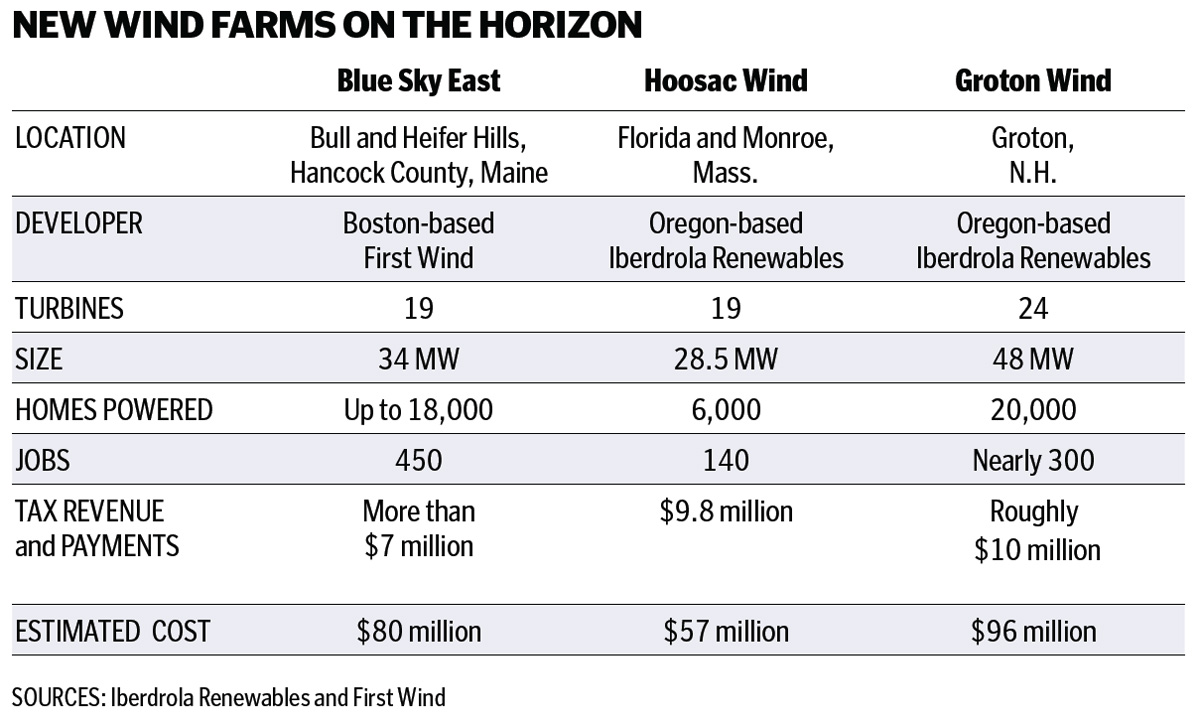
The benefits of Massachusetts wind farms

I’m hoping that with the election over we can get back to talking about energy independence in a way that includes alternate kinds of energy.  This chart which as in the Boston Globe the other day caught my eye.  As you can see,  they do create jobs and tax revenue for the local government.

Boomers and the job numbers

What does the retirement of the baby boom generation have to do with the job numbers you might ask.  I never thought of my retirement impacting the unemployment rate but reading Paul Krugman in the New York Times this morning, I realize that in a strange way I am helping the economy.  Yes, I’ve read all  the stories about how we didn’t save enough, how our homes (the big retirement plan for many) have lost value, how interest rates are hurting retirees, how the numbers are going to make Medicare and Social Security go broke and on and on.  But it never occurred to me that maybe the estimated 10.000 people a day who retire might actually be good for the economy.  Think about it.  Each person who retires has the potential to open up a job for someone else.  The bottom line is there is still work that needs to be done and at some point someone will be hired to do it.


AARP Social Security for Dummies Book Jacket


Krugman writes

 …the methods the bureau uses are public — and anyone familiar with the data understands that they are “noisy,” that especially good (or bad) months will be reported now and then as a simple consequence of statistical randomness. And that in turn means that you shouldn’t put much weight on any one month’s report.

In that case, however, what is the somewhat longer-term trend? Is the U.S. employment picture getting better? Yes, it is.

Some background: the monthly employment report is based on two surveys. One asks a random sample of employers how many people are on their payroll. The other asks a random sample of households whether their members are working or looking for work. And if you look at the trend over the past year or so, both surveys suggest a labor market that is gradually on the mend, with job creation consistently exceeding growth in the working-age population.

On the employer side, the current numbers say that over the past year the economy added 150,000 jobs a month, and revisions will probably push that number up significantly. That’s well above the 90,000 or so added jobs per month that we need to keep up with population. (This number used to be higher, but underlying work force growth has dropped off sharply now that many baby boomers are reaching retirement age.)

Meanwhile, the household survey produces estimates of both the number of Americans employed and the number unemployed, defined as people who are seeking work but don’t currently have a job. The eye-popping number from Friday’s report was a sudden drop in the unemployment rate to 7.8 percent from 8.1 percent, but as I said, you shouldn’t put too much emphasis on one month’s number. The more important point is that unemployment has been on a sustained downward trend.

But isn’t that just because people have given up looking for work, and hence no longer count as unemployed? Actually, no. It’s true that the employment-population ratio — the percentage of adults with jobs — has been more or less flat for the past year. But remember those aging baby boomers: the fraction of American adults who are in their prime working years is falling fast. Once you take the effects of an aging population into account, the numbers show a substantial improvement in the employment picture since the summer of 2011.

unemployment

unemployment (Photo credit: Sean MacEntee)


So the job growth and unemployment figures are slowly improving.  The overall trend is up for growth and down for unemployment.  I think one of the most shocking reactions to the numbers was the notion that they were somehow being manipulated and the things were actually much worse.  Do some like Jack Welsh actually want things to either get worse or at least to stay bad?  They just can’t bring themselves to admit that President Obama may be succeeding – despite Congress and the Republicans and turning things around.  Do they really need to win that badly?

Krugman says it better

…The U.S. economy is still far short of where it should be, and the job market has a long way to go before it makes up the ground lost in the Great Recession. But the employment data do suggest an economy that is slowly healing, an economy in which declining consumer debt burdens and a housing revival have finally put us on the road back to full employment.

And that’s the truth that the right can’t handle. The furor over Friday’s report revealed a political movement that is rooting for American failure, so obsessed with taking down Mr. Obama that good news for the nation’s long-suffering workers drives its members into a blind rage. It also revealed a movement that lives in an intellectual bubble, dealing with uncomfortable reality — whether that reality involves polls or economic data — not just by denying the facts, but by spinning wild conspiracy theories.

It is, quite simply, frightening to think that a movement this deranged wields so much political power.

Explaining the new jobs numbers

The number of jobs added grew again in September reflecting the slow but steady growth and unemployment dropped below 8% for the first time since January 2009, the month President Obama took office.  Republicans, including Jack Welsh the former CEO of General Electric, are going to argue that the Bureau of Labor Statistics somehow cooked the numbers to help the President. Ezra Klein explains why this couldn’t be the case.

We’ve hit that moment in the election when people begin to lose their minds. Case in point, within minutes of the jobs report, Twitter filled with Republicans claiming the books were somehow cooked, the numbers aren’t real, etc.

Let’s take a deep breath. Jobs reports are about the economy, not about the election. Confusing the two leads to very bad analysis.

This is a good jobs report in a still-weak economy. The 114,000 jobs we added in September aren’t very impressive. The revisions to the last two months, which added 86,000 jobs to the total, were much more impressive. Those revisions also suggest that September’s jobs could get revised up — or, of course, down. So be careful about reading too much into that number. Still, these are, at best, good, not great, numbers.

The chart shows the number of jobs added pretty consistent with previous numbers.  So where is the controversy?

The controversy, if it’s worth using that word, is over the unemployment rate, which dropped from 8.1 percent to 7.8 percent. That’s three-tenths of one percent. That’s what all the fuss is about.

Let’s get one thing out of the way: The data was not, as Jack Welch suggested in a now-infamous tweet, manipulated. The Bureau of Labor Statistics is set up to ensure the White House has no ability to influence it. As labor economist Betsey Stevenson wrote, “anyone who thinks that political folks can manipulate the unemployment data are completely ignorant of how the BLS works and how the data are compiled.” Plus, if the White House somehow was manipulating the data, don’t you think they would have made the payroll number look a bit better than 114,000? No one would have batted an eye at 160,000.

The fact is that there’s not much that needs to be explained here. We’ve seen drops like this — and even drops bigger than this — before. Between July and August the unemployment rate dropped from 8.3 percent to 8.1 percent — two-tenths of one percent. November-December of 2011 also saw a .2 percent drop. November-December of 2010 saw a .4 percent drop. This isn’t some incredible aberration. The fact that the unemployment rate broke under the psychologically important 8 percent line is making this number feel bigger to people than it really is.

Wonkblog posted this chart soon after the numbers were released.


The explanation

…the unemployment rate is a function of two things: the number of people
employed, and the number of people in the labor force. But the proportion of
people in the labor force actually went up, suggesting the fall in the
unemployment rate reflects a real improvement, rather than people stopping their
work search…

The Bureau of Labor Statistics looks at the unemployment rate in several ways as Klein explains.

Which leads to another argument: That U6, the broadest measure of labor-market pain, didn’t move, which should make us skeptical of the fact that U3, the normal unemployment rate, did move. That’s just misunderstanding what U6 is.

U6 is not an unemployment measure. It includes part-time workers who want full-time work. So it doesn’t count the increase in part-time work. But every measure of actual unemployment — U1, U2, U3, U4, and U5 — went down. You can see them all here. Again, there’s no mystery.

Klein concludes

This is an encouraging report. What it tells us is that the labor market has been a bit better over the last few months than we thought, and that the recovery hasn’t slowed in the ways we feared. What the response to it tells us is that the election is driving people a little bit crazy.

You can see more charts by clicking the various links.

Polls and tonight’s debate

Governor Christie of New Jersey thinks Mitt Romney will ace the debate tonight and turn the race upside down.  Let’s see.  Romney has had other game changing opportunities over course of the campaign the biggest being the Republican Convention.  What happened there?  His biographical film wasn’t done during prime time coverage.  Clint Eastwood talked to an empty chair and went over his allotted time.  Romney’s speech did not mention Afghanistan or American troops and, overall, was not very inspiring.

Tonight Romney will get another turn at bat.  The polls are still relatively close (more on them in a minute), but can the debate actually move the polls?

Ezra Klein writes in his Wonkbook this morning

Wonkbook’s number of the day: 0. That’s the number of recent elections that we can confidently say were decided by debates.

Gallup, for instance, reviewed their polls going back to 1960 and concluded they “reveal few instances in which the debates may have had a substantive impact on election outcomes.” Robert Erikson and Christopher Wlezien, in “The Timeline of Presidential Elections,” looked at a much broader array of polls and concluded that there was “there is no case where we can trace a substantial shift to the debates.” Political scientist John Sides, summarizing a careful study by James Stimson, writes that there’s “little evidence of [debate] game changers in the presidential campaigns between 1960 and 2000.

That’s not to say debates can’t matter, or that these debates won’t matter. The race remains close, and there are examples — 1960, 2000 and 2004, for instance — where  debates made a race more competitive, even if they didn’t clearly change the outcome. Simply closing the gap a bit would be a big win for Mitt Romney, if for no other reason than it would keep Republican donors invested in his chances going into the campaign’s final weeks.

One caveat to keep in mind, though: It’s not necessarily “the debates” that matter. It’s the debates plus the way the debates get spun in the media. There’s good evidence, in  fact, that the media’s spin is actually more important than the debates themselves. For more on that, read this article by Dylan Matthews, which is the best primer you’ll find on what we do and don’t know about what matters in presidential debates. The graphs are great, too

So going into the debate tonight (I’m writing this at about 7:30 am) where do the polls say we are?

Last night Nate Silver’s FiveThirtyEight blog posted these numbers for November 6:

Odds of Obama winning:  84.7%

Electoral Votes:  318.6

Popular Vate:  Obama 51.4 to Romney 47.5

Silver wrote

There were nine national polls published on Monday, which are listed in the table below. On average, they showed Mr. Obama with a 3.5 percentage point lead over Mr. Romney.

That’s smaller than the leads we were seeing in national polls last week, which seemed to be concentrated more in the range of a five- or six-point lead for Mr. Obama. It also suggests a smaller lead than recent state-by-state polls seem to imply.

So has the race already shifted back toward Mr. Romney some? Perhaps, but this is less apparent from the trendlines within these polls.

If you compare the nine surveys released on Monday against the last time they were published (in all cases, the comparison poll postdates the Democratic conventions), only four showed a shift toward Mr. Romney. An equal number, four, showed Mr. Obama gaining ground instead, while one poll remained unchanged.

In all cases but one, the shift was extremely modest — within one percentage point in one direction or the other. The exception was a new CNN national poll, which had Mr. Romney closing his deficit from six points to three points.

On average, however, the polls showed only a 0.2 percentage point gain for Mr. Romney — not a meaningful shift in either a statistical or a practical sense.

That is what I had when I went to bed last night.  I woke up to the NPR poll results.  The headline says

On Eve Of First Debate, NPR Poll Shows Romney Within Striking Distance

but the text says

The latest poll by NPR and its bipartisan polling team [pdf] shows President Obama with a 7-point lead among likely voters nationally and a nearly identical lead of 6 points in the dozen battleground states where both campaigns are spending most of their time and money.

However

More than 80 percent of respondents said they planned to watch the first televised clash Wednesday and one in four said the debate could influence their vote.

If you are a Romney supporter that may give you hope.  But remember, Governor Christie, he hasn’t come up to snuff at any big moments yet.  Maybe that means the debate is the time.

But for me, the most interesting thing to emerge from the NPR polling was this question.

On The Economy:

Now, thinking about the nation’s economy, do you believe the economy…

On The Economy

Source: NPR/Democracy Corps/Resurgent Republic

Credit: Padmananda Rama and Alyson Hurt / NPR

Almost half of those surveyed think the economy has bottomed and is starting to improve.  The economy was supposed to be Romney’s issue.

I’ll let Nate Silver have the last word.

But let me leave you with two themes that are at least reasonably well in line with the consensus of the evidence.

First, although it’s unclear whether Mr. Obama’s polls have already begun to decline, it’s more likely than not that they will tighten some between now and the election. The Nov. 6 forecast prices in some tightening while the “now-cast” does not, so sometimes they’ll have a different take on the polls.

Second, you should continue to watch the divergence between state polls and national polls.

As of Monday’s forecast, Mr. Obama was projected to win 22 states totaling 275 electoral votes by a margin of at least 4.7 percentage points — larger than his 4.1 percentage point projection in the national popular vote.

That speaks to a potential Electoral College advantage for him. But it’s important to watch the states that are just on the brink of this threshold, like Nevada and Ohio, or those where the polling has been varied, like New Hampshire.

Without Nevada, for instance, but with the other 21 states, Mr. Obama would be projected to a 269-269 in the Electoral College — which he would probably lose in the House of Representatives.

And his odds there will be a tie:  0.5%.

If you are an Obama voter you can be cautiously optimistic going into the debate tonight.

Why the poor are like Romney: they don’t pay taxes

We don’t really know how much income tax Mitt Romney actually paid over the years because he hasn’t released many tax returns.  We know that Harry Reid thinks he didn’t pay any.  But what we do know is that he pays a pretty low tax rate of around 12 or 13 percent.  In a recently released videotape of remarks made at a fundraiser this spring, Romeny said

There are 47 percent of the people who will vote for the president no matter what. All right, there are 47 percent who are with him, who are dependent upon government, who believe that they are victims, who believe the government has a responsibility to care for them, who believe that they are entitled to health care, to food, to housing, to you-name-it. That that’s an entitlement. And the government should give it to them. And they will vote for this president no matter what…These are people who pay no income tax.”

Neither Romney or his campaign deny his saying this.  Romney only wishes he had put it better.

A lot of the chatter has been about Obama supporters being called dependent victims, but what about the no tases part?  The Tax Policy Center of the Urban Institute and Brookings Instituion has an 11 page document explaining why 47% of us pay little or no income tax.  There are very interesting charts that explain a great deal about our tax policy.  And, last summer, Roberton Williams posted on the Tax Policy Center’s blog in response to controversey about there report.

He explains

The large percentage of people not paying income tax is often blamed on tax breaks that zero out many households’ income tax bills and can even result in net payments from the government. While that’s the case for many households, a new TPC paper shows that about half of people who don’t owe income tax are off the rolls not because they take advantage of tax breaks but rather because they have low incomes. For example, a couple with two children earning less than $26,400 will pay no federal income tax this year because their $11,600 standard deduction and four exemptions of $3,700 each reduce their taxable income to zero. The basic structure of the income tax simply exempts subsistence levels of income from tax.

The conclusion: Three-fourths of those households pay no income tax because of provisions that benefit senior citizens and low-income working families with children. Those provisions include the exclusion of some Social Security benefits from taxable income, the tax credit and extra standard deduction for the elderly, and the child, earned income, and childcare tax credits that primarily help low-income workers with children (see graph). Extending the example offered above, the couple could earn an additional $19,375 without paying income tax because their pre-credit tax liability of $2,056 would be wiped out by a $2,000 child tax credit and $57 of EITC.

Those provisions matter most for households with income under $50,000, who make up nearly 90 percent of those made nontaxable by tax expenditures. Higher-income households pay no tax because of other provisions. Itemized deductions and credits for children and education are a bigger factor for households with income between $50,000 and $100,000. The relatively few nontaxable households with income over $100,000 benefit most from above-the-line and itemized deductions and reduced tax rates on capital gains and dividends.

So our tax code is structured so those with less income pay less and those with the most income can take advantage of various ways of investing and reporting income to also pay less tax. 

David Brooks writing in today’s  New York Times called Romney “Thurston Howell” Romney after the millionaire guy in Gilligan’s Island.  After citing the Romney quote, Brooks comments

This comment suggests a few things. First, it suggests that he really doesn’t know much about the country he inhabits. Who are these freeloaders? Is it the Iraq war veteran who goes to the V.A.? Is it the student getting a loan to go to college? Is it the retiree on Social Security or Medicare?

It suggests that Romney doesn’t know much about the culture of America. Yes, the entitlement state has expanded, but America remains one of the hardest-working nations on earth. Americans work longer hours than just about anyone else. Americans believe in work more than almost any other people. Ninety-two percent say that hard work is the key to success, according to a 2009 Pew Research Survey.

It says that Romney doesn’t know much about the political culture. Americans haven’t become childlike worshipers of big government. On the contrary, trust in government has declined. The number of people who think government spending promotes social mobility has fallen.

The people who receive the disproportionate share of government spending are not big-government lovers. They are Republicans. They are senior citizens. They are white men with high school degrees. As Bill Galston of the Brookings Institution has noted, the people who have benefited from the entitlements explosion are middle-class workers, more so than the dependent poor.

I don’t often agree with Brooks, but I do agree with 80% – at least- of what he wrote today.

Of course, the voters have a long history of voting against self interest so as an Obama supporter I have to be cautious about the impact of Romney’s statement.  Still, it provides insight into how the man thinks.  I know Romney is trying to pass this off as a discussio of campaign strategy, but that strategy disses almost half of us who Romeny calls victims.

The National Debt and the GDP

Being a little behind in reading my email, I just saw this from Ezra Klein.  He suggests you keep this in mind while you watch the Republicans try to push the debt onto the President and the Democrats.

Notice that you can barely see TARP.  It is that dark blue streak that is separating the other two blue parts of the graph.  Even the stimulus is pretty small.

The deficit is pretty easy to understand when you look at it in a graph.  If you reduced the Bush tax cuts for income over &250,000 and worked on the costs of the wars – and didn’t start any new ones – you can really begin to reduce the debt.  Maybe the huge number of people who think the tax breaks for the wealthy should be eliminated understand this better than Mitt and Paul and the rest of their gang.  Certainly they understand this better than Grover Nordquist.

So when you are watching the Republicans in Tampa, remember this chart and thank Ezra Klein.

Paul Ryan’s Proposals in a Nutshell

The Boston Globe columnist, Scott Lehigh wrote what I think is one of the best summaries of Paul Ryan’s budget proposal compared to President Obama’s proposals.  And whether Mitt Romney likes it or not, he is tied to the Ryan budget which he once described as “marvelous”.

Lehigh describes the Ryan budget this way

There will be a fierce fight to frame the argument, but Romney and Ryan will have a tougher challenge persuading the relatively small percentage of undecided voters. With Ryan as his running mate, Romney will no longer be able to hide behind strategic ambiguity about his budget and tax cut plans. To date, a lack of key details has made those proposals hard to analyze, which has obviously been intentional. Nor does the Republicans’ presumptive nominee want to be pinned to the details of Ryan’s Medicare plan, which would shift thousands in health care costs onto the backs of future generations of seniors; one of the talking points the campaign distributed to help Republicans discuss Ryan’s selection is that, as president, Romney will have his own Medicare proposal. But absent necessary details about Romney’s proposal, Ryan’s plan will and should stand as a fair campaign proxy.

Second, the reality is that you simply can’t accomplish what Romney and Ryan hope to — that is, a large, new across-the-board tax cut while tackling the long-term federal budget deficit — without hitting both middle-class and moderate earners. A recent analysis by the nonpartisan, well-regarded Tax Policy Center illustrated that very point. It showed that Romney’s vague assertion that he could pay for his new tax cut by closing loopholes and deductions, but without targeting those important to the middle class, was undoable. If Romney hews to his resolution to pay for his tax cut through loophole closings, the elimination of deductions would be so extensive that the average middle class family would see a tax hike, according to the center’s analysis.

Of course we already know that Romney considers the Tax Policy Center to be a Democratic front.  The difference in approaches?

Now, with the baby boomers retiring and increasingly drawing on Medicare, Medicaid, and Social Security, the nation faces a large gap between future spending commitments and future revenues. But though tax cuts helped create the problem, Romney and Ryan insist it must all be solved through spending cuts. That flies in the face of several recent bipartisan deficit commissions, which have said that policy makers should rely on both spending cuts and new revenues.

President Obama, by contrast, wants tax breaks for upper earners to expire, which would mean more revenue, and thus lighter cuts in future spending. Because Obama wants to keeps the tax breaks for families making less than $250,000, substantial spending cuts will still be required, including reductions in entitlements. Obama has left many of those details for the future. But that failing is less egregious than Romney’s. Obama, after all, would recapture $750 billion or more (over 10 years) by ending the Bush tax cuts. And the president isn’t proposing a large new tax cut.

We can only hope that the Democrats can define Paul Ryan as successfully as they were able to define Mitt Romney.

Mitt Romney will no longer be able to hide behind strategic ambiguity about his budget and tax cut plans with Paul Ryan as his running mate.

Photograph by SHANNON STAPLETON/REUTERS

Paying a Fair Share or the Buffett Rule

I’ve gotten several email recently from the President, from Elizabeth Warren and from other progressive organizations about the Senate vote on the Buffett rule.  Since I’m pretty sure that Senator John Kerry will vote for the bill and Senator Scott Brown will vote against it, I haven’t called, emailed or written either of them about it.

I have, however,  wondered what the bill actually does.  So thank you to Ezra Klein’s Wonkblog in the Washington Post this morning for his explanation.  The big vote everyone is talking about is actually a bill introduced by Senator Sheldon Whitehouse from Rhode Island.  He explained the bill to Ezra who explains it to us.

In other words: The “Paying a Fair Share Act” doesn’t mean someone making $1,500,000 will pay at least the same percentage of his income in taxes as the average middle-class family. It means he would pay a somewhat higher marginal rate on the income he earns over $1 million — in this case, on the excess $500,000.

Moreover, that higher marginal rate would only reach 30 percent on income over $2 million. Between $1 million and $2 million, the Buffett rule phases in so as to avoid a sharp “tax cliff” at the million-dollar mark.

But would it still raise money to help ease the deficit?

Another misconception: The proposal doesn’t raise $47 billion over 10 years. Or, rather, it does, but only if you use the “current law baseline” that assumes the full expiration of the Bush tax cuts. No one really uses that baseline. If you look at Paul Ryan’s budget, for instance, its appendix tables use a “current policy baseline,” which assumes, among other things, that the Bush tax cuts are extended.

Compared with that baseline, the Paying a Fair Share Act actually raises about $160 billion. Still not enough to solve our deficit problems on its own, but nothing to sneeze at.

So as usual it is a little more complicated than the President makes it sound, but still a good thing to support.