The new mortgage rules

In case you missed this story in today’s New York Times, it was reported that Wells Fargo has started requiring a an essay for mortgage applicants. 

[OK this is an old logo but I like it]

When Linda Falcão applied for a mortgage from Wells Fargo, she didn’t realize she would be required to write the type of essay that’s more commonly included with a college application.

So she and her husband, Kemuel Ronis, were taken by surprise when Wells Fargo asked the couple, both 50, to pen a “motivational letter” explaining why they were moving. What they found even more shocking, however, were some of the themes that Wells required them to include in their statement, specifically, their plans regarding an “increase/decrease in family” or property size.

Ok.  I used to work in Fair Housing and I think that questions about family or pregnacy, how ever cleverly asked (Did you catch the “increase/decrease”?] are illegal.  I understand that Ms. Falcao and Mr. Ronis have filed a complaint.  In addition to questions about family plans and size, Wells Fargo asked them other questions that are just strange.

Besides asking for information about their family plans, which was paired with questions about plans to change the “property size,” Wells Fargo also requested that the letter include information that supported the fact that the property, in Glen Mills, Pa., would be their primary residence. The bank also asked them to include their commuting distances to work, as well as other properties that they may own in the area. The request for the so-called motivational letter was included in the bank’s mortgage commitment letter, which offered to approve their loan if they answered the bank’s questions and provided other documentation.

A Wells Fargo spokesman said that motivation letters were generally requested when the loan underwriter had more questions about a borrower’s “occupancy intentions.” For instance, he said the company might request such a letter when a family’s existing home is not yet sold and it wants the buyer to show that the new home will indeed serve as the primary residence.

The spokesman did not say why the bank would request information about a prospective borrower’s family plans, but said that “under no circumstances would any information about family status be used by Wells Fargo as the basis for a decision on a loan application.”

So why ask?  And what do you do with the information?

I find this all disappointing as I have had good experiences with the local office of Wells Fargo when helping some homeowners avoid foreclosure.  But the bottom line:  Think twice before trying to get a loan from Wells Fargo.  I think it is past time for that new Bureau of Consumer Financial Protection that the financial reform bill set up.  Where is Elizabeth Warren when we need her?

Prop 8 is ruled illegal

In a ruling my husband said he could have made, Judge Vaughn Walker held this afternoon that the Califorina voter approved proposition is unconstitutional.  The Prop 8 Suporters are expected to appeal and to argue that Judge Walker is gay and therefore biased..  I call this grasping at straws.

The Washington Post quoted Governor Schwarzenegger who as Govenor was the noninal defendant.

In a statement, California Gov. Arnold Schwarzenegger (R) said, “For the hundreds of thousands of Californians in gay and lesbian households who are managing their day-to-day lives, this decision affirms the full legal protections and safeguards I believe everyone deserves.”

You may recall that the case was aruged by what has been described as the legal “odd couple”.  The New York Times put it this way

…the plaintiffs’ case was argued by David Boies and Theodore Olson, ideological opposites who once famously sparred in the 2000 Supreme Court battle beween George W. Bush and Al Gore over the Florida recount and the presidency. The lawyers brought the case — Perry v. Schwarzenegger — in May 2009 on behalf of two gay couples who said that Proposition 8 impinged on their Constitutional rights to equal protection and due process.

The San Franciso Chronicle reported

Within minutes of the ruling, Maria Ydil, 31, and Vanessa Judicta, 32, headed to City Hall to apply for a marriage license. It was not immediately clear if they would get a license or be allowed immediately to marry.

A crowd trailed behind singing, “The Chapel of Love.”

While they were allowed to fill out paperwork, they were denied a license because the judge issued a stay on enforcement of the ruling pending further hearings on the issue, a city official said.

From the Times

“Being gay is about forming an adult family relationship with a person of a same sex, so denying us equality within the family system is to deny respect for the essence of who we are as gay people,” said Jennifer Pizer, the marriage project director for Lambda Legal in Los Angeles, who filed two briefs in favor of the plaintiffs. “And we believe that equality in marriage would help reduce discrimination in other settings because the government invites disrespect of us when it denies us equality.”

Between this decision making its way though the appeals process and the Massachusetts decision on the Defense of Marriage Act, the Supreme Court is going to have a pivitol role in the next step toward equal rights.   I will be posting more on this in coming days, as I digest the ruling, but I think that the Loving v. Virginia decision is finally going to be extended to same sex marriage as well. 


Thinking about the Supreme Court

I’m not going to speculate (at least in this post) on who President Obama will nominate in a few weeks, but I am going to talk about  two pieces discussing the Court itself and how decisions are made. The first by Geoffrey R. Stone in the New York Times, the second posted by William Forbath  this weekend on Politico’s Arena in response to Stone.
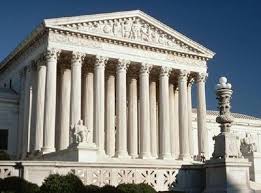
Stone begins

AS the Senate awaits the nomination of a new Supreme Court justice, a frank discussion is needed on the proper role of judges in our constitutional system. For 30 years, conservative commentators have persuaded the public that conservative judges apply the law, whereas liberal judges make up the law. According to Chief Justice John Roberts, his job is just to “call balls and strikes.” According to Justice Antonin Scalia, conservative jurists merely carry out the “original meaning” of the framers. These are appealing but wholly disingenuous descriptions of what judges — liberal or conservative — actually do.

As both Stone and Forbath remind us, the Constitution is an 18th Century document.  I believe that the vague yet sweeping language is why the Constitution is still a living and useful document.  The question addressed by Stone and Forbath is how one interprets it to meet the modern age. Neither thinks much of the way the current conservative majority uses the constitution.

Stone

Rulings by conservative justices in the past decade make it perfectly clear that they do not “apply the law” in a neutral and detached manner. Consider, for example, their decisions holding that corporations have the same right of free speech as individuals, that commercial advertising receives robust protection under the First Amendment, that the Second Amendment prohibits the regulation of guns, that affirmative action is unconstitutional, that the equal protection clause mandated the election of George W. Bush and that the Boy Scouts have a First Amendment right to exclude gay scoutmasters.

Whatever one thinks of these decisions, it should be apparent that conservative judges do not disinterestedly call balls and strikes. Rather, fueled by their own political and ideological convictions, they make value judgments, often in an aggressively activist manner that goes well beyond anything the framers themselves envisioned. There is nothing simple, neutral, objective or restrained about such decisions. For too long, conservatives have set the terms of the debate about judges, and they have done so in a highly misleading way. Americans should see conservative constitutional jurisprudence for what it really is. And liberals must stand up for their vision of the judiciary.

Forbath

… Conservative judges use history to claim that when they strike down a law, they are merely applying the “original understanding” or “intentions” of the framers of the Constitution. This is bunk. But it is reassuring. It enables conservatives on and off the Court to claim that what liberal judges do is something different and illegitimate. Liberals are “judicial activists.” When liberal judges strike down a law, they are “making up” new law. They are “betraying” the Founding Fathers. This is also bunk. Conservative and liberal judges alike bring their own present-day values and convictions to bear on interpreting and applying the Constitution. Conservatives are wrong to deny it. But they are right that appealing to history and “keeping faith with the past” is an indispensable part of our constitutional tradition – and one that helps mobilize popular support behind the constitutional commitments a judge, lawmaker, or citizen may prize. So, liberals need to get a better handle on the way to use history.

So what should the role of history be?  And how can liberal justices use it more to their advantage?  Stone points out that

So, how should judges interpret the Constitution? To answer that question, we need to consider why we give courts the power of judicial review — the power to hold laws unconstitutional — in the first place. Although the framers thought democracy to be the best system of government, they recognized that it was imperfect. One flaw that troubled them was the risk that prejudice or intolerance on the part of the majority might threaten the liberties of a minority. As James Madison observed, in a democratic society “the real power lies in the majority of the community, and the invasion of private rights is chiefly to be apprehended … from acts in which the government is the mere instrument of the major number of the constituents.” It was therefore essential, Madison concluded, for judges, whose life tenure insulates them from the demands of the majority, to serve as the guardians of our liberties and as “an impenetrable bulwark” against every encroachment upon our most cherished freedoms.

Conservative judges often stand this idea on its head. As the list of rulings above shows, they tend to exercise the power of judicial review to invalidate laws that disadvantage corporations, business interests, the wealthy and other powerful interests in society. They employ judicial review to protect the powerful rather than the powerless.

Liberal judges, on the other hand, have tended to exercise the power of judicial review to invalidate laws that disadvantage racial and religious minorities, political dissenters, people accused of crimes and others who are unlikely to have their interests fully and fairly considered by the majority. Liberal judges have ended racial segregation, recognized the principle of “one person, one vote,” prohibited censorship of the Pentagon Papers and upheld the right to due process, even at Guantanamo Bay. This approach to judicial review fits much more naturally with the concerns and intentions of people like Madison who forged the American constitutional system.

Where Forbath disagrees is with Stone’s reliance on James Madison and original intent.  He points out

So, judges today must attend to the text the framers gave us, the general principles it enshrines, the Amendments Americans have added, and the meaning and range of applications generations of judges, lawmakers and citizens have poured into them. And judges must consult their own conscience and experience as they sift through these materials that history provides and decide how best to keep faith with the past.

As long as they hew to this honest approach to history, liberals often draw compelling lessons from it. But lately, liberals are being drawn into the fictions and falsities of the “framers’ intentions” in order to sound just as “true” to the Founding Fathers as our conservative foes. When we liberals play the “framers’ intentions” game, however, we end up sounding silly and disingenuous.

Take for example constitutional scholar Geoffrey Stone’s important op-ed piece in last Wednesday’s New York Times. Looking ahead to President Obama’s soon-to-be-announced nomination of a new Supreme Court Justice, Stone urges “a frank discussion .on the proper role of judges in our constitutional system.” He laments that for thirty years or so, conservatives have dominated the national conversation about the Constitution and the Court, and he rightly points out that they have done so “in a highly misleading way” by claiming that conservative judges just “apply” the Constitution by enforcing the “framers’ intentions.” Stone goes on to contrast the kinds of laws that liberal judges strike down – laws that burden racial minorities, the poor and the powerless, with laws that conservative judges strike down – laws that “disadvantage corporations, business interests, the wealthy and other powerful interests in society.” And he suggests that liberal judges surely have a wiser vision of the role of judges in a constitutional democracy, since they wield the power of judicial review to safeguard people most at risk of being shortchanged in the ordinary political process, while the conservative judges conjure up new safeguards for those who already enjoy ample sway in the political arena.

So far so good. But along the way, Stone proves unable to resist the siren song of “framers’ intentions.” He tries to turn the table on the conservatives. He goes to some lengths trying to cloak liberal constitutional values and commitments in the mantle of James Madison’s “intentions.” Stone has dressed up James Madison as a Great Society liberal. Says Stone, the “intentions of people like Madison who forged the American constitutional system” was to safeguard minorities like African-Americans, undocumented immigrants and the Guantanamo detainees against the tyranny of the majority. That is what liberal judges do. Conservatives, Stone declares, stand Madison’s “idea on its head.” They wield judicial review to overturn affirmative action, gun control, and restrictions on corporate speech; they “tend to exercise. judicial review to invalidate laws that disadvantage corporations, business interests, the wealthy and other powerful interests in society.”

Stone’s James Madison is bunk too. The real James Madison was largely hostile to any kind of judicial review. More important: while Madison did craft the Constitution to safeguard minority rights against the tyranny of the majority, and while Madison, the wealthy slaveholder, was concerned about protecting religious minorities, he had no concern for the rights of “racial minorities,” and it was mainly the rights of the wealthy over against the majority of Americans of modest means that Madison hoped to protect! Thus, the conservatives on today’s Court have about as good a claim to Madison’s mantle as we liberals do.

I think Forbath is right about history and original intent.  As long as we argue about which view of original intent is correct, liberals will never prevail.  We need to move on to take into about all the history since 1787.  Forbath writes

History is on our side; but that has much less to do with James Madison and much more to do with the bloodshed of the Civil War and the Civil War and Reconstruction Amendments that made the Constitution a charter of equal rights for all Americans, including the former slaves. It was the Republicans of the Reconstruction Era, the New Dealers, the Civil Rights Movement, and the twentieth-century Court who gradually enlarged Madison’s original conception of minority rights and majority tyranny to make it a safeguard for the poor and vulnerable.

We do need “a frank discussion” on the Constitution and the proper role of judges, and we can’t be half-frank about it. There are good arguments why the liberals’ account is better. Stone offers a few. But wrapping ourselves in the mantle of the 18th century framers’ intentions as he tries to do is not one. Our constitutional commitments have emerged over two centuries of tumultuous change. The arc of constitutional history generally has bent toward a more inclusive and generous vision of rights-bearing membership in We, the People. Conservatives are bending it back. The 18th century framers might have agreed with them; but the Civil War, the Reconstruction Amendments, and much else have intervened in the mean time; and, in any case, the choice – about how to keep faith with our constitutional past – is ours.

We need a Supreme Court with Justices that are willing to grow, to learn and to change with the times.  President Obama could do worse that nominate someone in the Earl Warren or Justice Powell or Justice Brennan mold.  Those were men who learned to consider cases on their merits, who understood the need to connect decisions to real ordinary people.  They were men with empathy.

SNCC Celebrates 50 Years

The Student Nonviolent Coordinating Committee is celebrating its 50th Anniversary this weekend in Raleigh, North Carolina.  SNCC’s founding conference was held April 18-18, 1060 also in Raleigh convened by Ella Baker of the South Christian Leadership Conference.  According to Claybourne Carson in his history of SNCC,  In the Struggle (Harvard University Press, 1981), Baker was the one who realize the student need for autonomy and encourage the founding of a separate student group.  Many founders and early workers are now legendary.  John Lewis, Robert Moses, Jane Stembridge, Marion Barry, Diane Nash, James Lawson, Ruby Doris Robinson, Stokely Carmichael, Willie Peacock,  Julian Bond, Bob Zellner, Charles Sherrod, the list could go on and on.  It is wonderful that they are all being celebrated.

SNCC 50th Anniversary Logo

According to the conference website

The Student Non-Violent Coordinating Committee or SNCC (pronounced “Snick”) emerged from the student sit-ins that erupted on February 1, 1960 in Greensboro, North Carolina. Although just four students launched these sit-ins, within two months thousands of students across the south were engaged in similar protests against racial segregation. On April 15, 1960, some 200 of these campus-based activists began meeting in Raleigh, North Carolina on the campus of what is now Shaw University and formed SNCC. In 1961, a handful of these activists committed to full-time work in the southern civil rights struggle; some of them postponing their college plans. SNCC became an organization of grassroots organizers.

Historians characterize SNCC as the movement’s “cutting edge”. Its “field secretaries” worked in the most dangerous parts of the south seeking to both cultivate and reinforce local leadership. Its uncompromising style of non-violent direct action confronted racial injustice throughout the South and contributed to the elimination of racial segregation. And SNCC’s unique “from-the-bottom-up” approach to organizing led to the emergence of powerful grassroots organizations.

 With “One Man, One Vote” voter registration campaigns SNCC paved the way for a new generation of black elected officials across the south. By breaking the grip of “Dixiecrats” on southern politics they changed forever politics in America. It is this work that laid the foundation for the election of America’s first African-American President, Barack Obama.

NRP also had a story on Weekend Edition this morning.

The Student Non-Violent Coordinating Committee has its 50th reunion this weekend. The civil rights group dates back to the first lunch counter demonstrations in Greensboro, N.C., that quickly spread across the South. One of the goals of the reunion is to get young people involved in tackling social, political and economic issues.

The story of Elwin Wilson’s apology to John Lewis was broadcast on NRP on April 16 as part of the coverage of SNCC’s 50th Anniversary.

Bunt Gill wipes raw egg off his clothing during a civil rights protest in 1960 in Rock Hill, S.C.

Bunt Gill wipes raw egg off his clothing during a civil rights protest in February 1960 in downtown Rock Hill, S.C. Among the hecklers in the crowd is a young Elwin Wilson (center, wearing a football jersey). Wilson later admitted attacking John Lewis, now a Georgia Congressman, in May 1961. He has since apologized.

These photographs from the anniversary website were taken by Danny Lyon who was a photographer for SNCC and had an exhibit at the conference.

Photo Exhibit

Of course times were very complicated and there were divisions between black and white students, between northern and southern student groups and eventually between movement men and movement women.  I was too young to go south for Mississippi Summer, so I had to content myself with boycotting Woolworth’s and going to concerts by the Freedom Singers.  By the time I was in college in 1965, I joined an SDS group and was very briefly an organizer for the Southern Student Organizing  Committee (SOCC) in Virginia.   SOCC was a southern “affiliate” of SDS and was founded at the time that SNCC was becoming a more militant, black organization.  SOCC disbanded in 1969.

So it makes me happy to see that SNCC has come full circle and is welcoming an integrated  group of third grade students from Oakland, CA as future civil rights leaders.

Future Activists

Future Activists

Happy Birthday, SNCC!

Still fighting the Civil War

I’ve heard people chuckle in amazement at factions in other countries who still feud over “ancient” injuries, but we have our own on-going civil war.  It appears that for many, the Confederacy was never defeated and the South can rise again.  Two smart women, Melissa Harris-Lacewell and Gail Collins have written about this phenomenon each using the Virginia Confederate History Month as a starting point.

Harris-Lacewell writes of the “Two Virginias” in the Nation

Governor Robert McDonnell declared April Confederate History Month in Virginia. In his declaration Governor McDonnell called for Virginians to “understand the sacrifices of the Confederate leaders, soldiers and citizens during the period of the Civil War.”

In his original declaration, McDonnell made no mention of slavery as a root cause for the Civil War. His insistence on remembering only “leaders, soldiers, and citizens” refuses to acknowledge the existence of black people in the South. There were some black soldiers who fought in the Confederate army, but the vast majority of African Americans contributed to the Confederate effort through the violently coerced, unpaid labor that was part and parcel of the their dehumanizing, totalizing, intergenerational, chattel bondage. McDonnell seems to believe that this reality is unworthy of remembrance.

It’s taken me nearly two days to respond to the Governor’s declaration of Confederate History Month and his flip erasure of black life, suffering, and struggle because this particular news story is profoundly personal.

On my father’s side we traced our family tree as far as we could follow it and discovered we are descended from an African woman sold into slavery on a corner in Richmond, Virginia.

Harris-Lacewell continues

My father and his siblings grew up in the Church Hill neighborhood in Richmond. They attended racially segregated schools. Despite being nearly starved for school resources by the state, my father and his twin brother became the first in the family to attend college. Both became college professors. My uncle had a distinguished career as a student at the University of Virginia. My father went on to become the first Dean of African American Affairs at the University of Virginia in 1976.I grew up in Virginia. I had social studies teachers who referred to the Civil War as “the war between the states” or “the war of Northern aggression.” My interracial family experienced harassment and abuse during the two decades we made our home in the Commonwealth. But Virginia is also the place where I made lifelong friends, found spiritual communities and was educated by many tough and loving teachers. I came to political consciousness in Virginia and distinctly remember listening to every word of Douglass Wilder’s inauguration address as the first black governor. I cheered on election night 2008 when Virginia turned blue just moments before Barack Obama’s presidential win was announced.

I share this personal history because it is not exceptional. Black Americans are, by and large, Southerners. Our roots, our stories, our lives, our struggles, our joys have a distinctly Southern flavor. Slavery and Jim Crow are part of our experience, but so are church picnics, HBCU football games and jazz music. There is no Black American history that is not deeply intertwined with Southern history. It is extraordinarily painful to watch an elected official in the 21st century engage in an act of willful and racist historical erasure of our very selves.

I also lived in Virginia for many years.  My first job with the Commonwealth of Virginia was enforcing Executive Order Number One issued by a former segregationist governor, Mills E. Godwin.  E.O. 1 which was issued by every governor until Bob McDonnell forbids discrimination in state employment.  I had the day off for Lee-Jackson Day every January.  (That’s Robert E. and Stonewall.)  When Martin Luther King’s birthday was made a national holiday, the day became Lee-Jackson-King Day.  Virginia has always been different, but McDonnell seems determined to really turn back time.

Harris-Lacewell concludes

Without a hint of irony McDonnell suggested that he hopes to profit from Confederate inspired tourism. Clearly he hopes that the racial anxieties brewing in America will serve as a tourist boon for the former Confederate capital. Having profited for centuries from the forced labor of enslaved black Americans, Virginia seeks to further commodify black suffering in the 21st century. McDonnell is welcoming Rebel flag waving whites from rural Pennsylvania, downstate Illinois, and Southern California to come spend their money and steep themselves in Virginia past when white citizens, determined to keep black people as non-humans, fought back against the federal government.

Virginia has other histories that we can use to resist this false and frightening narrative. We must insist on remembering Jefferson’s Virginia that called us to be better than ourselves, to defend freedom, and to hold together our union. We must remember the histories of all the black families like my own whose struggle and strength cannot be erased from Southern history.

I have visited all the Civil War battle sites in Virginia.  I spent my honeymoon visiting the Shenandoah sites, Harper’s Ferry and Gettysburg and most of the national parks try to recognize the role of blacks, free and slave, mostly on the side of the Union.  If the Governor really wants to promote tourism there are a lot better ways to do so.

Gail Collins writes in her New York Times column

April is the cruelest month. Or, if you live in Virginia, Confederate History Month.

The state is buzzing over Gov. Bob McDonnell’s proclamation urging citizens to spend the month recalling Virginia’s days as a member of the Confederate States of America. Although since McDonnell had previously turned April over to child abuse prevention, organ donation and financial literacy, perhaps it was O.K. to just pick your favorite.

The original Confederate History proclamation was a miracle of obfuscation. It did not even mention slavery. On Wednesday, the governor apologized for that and said that slavery “has left a stain on the soul of this state and nation.”

People, what’s our bottom line here. The governor of Virginia has decided to bring slavery into his overview of the history of the Confederacy. Good news, or is this setting the bar a wee bit too low?

The love affair with all things Confederate is way more worrisome. Once again, it’s in to talk secession. The Republican attorneys general are lining up to try to nullify the health care bill.

“Many issues of the Civil War are still being debated today,” said Brag Bowling of the Sons of Confederate Veterans, which led the push to get that proclamation in Virginia. That seems extremely depressing, as if we were Serbs stewing about what the Turks did at the Plain of Blackbirds in 1389.

Actually, a national discussion of Civil War history sounds fine — as long as we could start by agreeing that the whole leaving-the-union thing was a terrible idea. In the proclamations, it generally sounds as if everything went swimmingly until the part where the South lost and grudgingly rejoined the country.

I have been accused by at least one commentator on this blog of seeing everything in racial terms.  I think just the opposite is true.  People like Governor McDonnell and Representative Joe Wilson and, in fact, the entire “just say no” to anything proposed by President Obama is based on the President’s race.  We need to have a serious discussion about race.  I don’t know how that can happen as President Clinton tried to initiate one and failed and President Obama can’t initiate it.  Maybe Clinton tries again.  Maybe Clinton and President Carter together.  But no matter how much the McDonnell and Republicans want to go backward, the fact remains:  We have elected a black man as President and the population of the United States will soon have a majority population of people of color and there isn’t much they can do about those two things.

The Justice of the Peace Who Breaks the Law

I first read this story in the Boston Globe yesterday and was struck speechless with astonishment.  According to the AP story

 A Louisiana justice of the peace said he refused to issue a marriage license to an interracial couple out of concern for any children the couple might have. Keith Bardwell, justice of the peace in Tangipahoa Parish, says it is his experience that most interracial marriages do not last long.

“I’m not a racist. I just don’t believe in mixing the races that way,” Bardwell told the Associated Press on Thursday. “I have piles and piles of black friends. They come to my home, I marry them, they use my bathroom. I treat them just like everyone else.”

Bardwell said he asks everyone who calls about marriage if they are a mixed race couple. If they are, he does not marry them, he said.

Which part of the story is most racist?  The refusal to marry interracial couples or the fact that he thinks he isn’t a racist because he lets black people use his bathroom – and is proud of both.  Bardwell is convinced that interracial marriages don’t last and they hurt the kids.

In 2007, MSNBC ran a story about interracial marriage that disproves most of what Bardwell believes. 

The charisma king of the 2008 presidential field. The world’s best golfer. The captain of the New York Yankees. Besides superstardom, Barack Obama, Tiger Woods and Derek Jeter have another common bond: Each is the child of an interracial marriage.For most of U.S. history, in most communities, such unions were taboo.

It was only 40 years ago — on June 12, 1967 — that the U.S. Supreme Court knocked down a Virginia statute barring whites from marrying nonwhites. The decision also overturned similar bans in 15 other states.

That case was Loving v. Virginia.  The couple in question had grown up in a small rural community in Virginia where the black and white children often associated with each other and were friends.  The Lovings had known each other since childhood. And despite all the frustrations and obstacles, their marriage lasted through their lifetimes.

Factoring in all racial combinations, Stanford University sociologist Michael Rosenfeld calculates that more than 7 percent of America’s 59 million married couples in 2005 were interracial, compared to less than 2 percent in 1970.Coupled with a steady flow of immigrants from all parts of the world, the surge of interracial marriages and multiracial children is producing a 21st century America more diverse than ever, with the potential to become less stratified by race.

Interracial marriage is not always an easy path.  My grandmothers both recognized that it was unlikely that either of their granddaughters would marry other Japanese  Americans and they were right.  Others of their generation went to great lengths to get their daughters to “marry in the race”, often without success.  One family I knew as a child moved from Philadelphia to California where there were more Japanese American men for their daughter to meet; she married a white sailor she met in San Diego.

What Justice of the Peace Bardwell does is not only unconstitutional, but according to Louisiana laws he is required to any couple who meets the requirements.

According to the clerk of court’s office, application for a marriage license must be made three days before the ceremony because there is a 72-hour waiting period. The applicants are asked if they have previously been married. If so, they must show how the marriage ended, such as divorce.

Other than that, all they need is a birth certificate and Social Security card
The license fee is $35, and the license must be signed by a Louisiana minister, justice of the peace or judge. The original is returned to the clerk’s office.

He claims to have denied only a few couples and when he does so refers them to another Justice of the Peace.  This is supposed to make it all right.

The couple who were denied, Beth Humphrey and Terence McKay, intend to file a discrimination complaint.  May they prevail and have a long and happy marriage.  May Justice of the Peace Bardwell retire very  soon.

Obama reversal on Defense of Marriage Act?

I have written about several of the lawsuits filed asking for repeal of the Defense of Marriage Act or DOMA.  One was filed by Massachusetts Attorney General Martha Coakley.  Then Bill Clinton came out and said it was time for repeal.  Now it appears that the Obama administration is taking some positive steps toward repeal. 

According to stories by Josh Gerstein for Politico.com and the Washington Post, the newest brief filed by the Obama Justice Department contains language that makes opposition explicit.

President Obama made clear Monday that he favors the repeal of the Defense of Marriage Act, and intends to ask Congress to repeal the 13-year-old law that denies benefits to domestic partners of federal employees and allows states to reject same-sex marriages performed in other states.

Obama has long opposed the law, which he has called discriminatory. But his Justice Department has angered the gay community, which favored Obama by a wide margin in last year’s election, by defending the law in court. The administration has said it is standard practice for the Justice Department to do so, even for laws that it does not agree with.

The Justice Department did so again Monday in its response in Smelt v. United States, a case before a U.S. District Court in California. But, for the first time, the filing itself made clear that the administration “does not support DOMA as a matter of policy, believes that it is discriminatory, and supports its repeal.”

According to Gerstein

In a brief filed Monday morning in a lawsuit challenging the validity of DOMA, the Justice Department put on the record that the administration favors repeal of the statute — a position that was omitted from a controversial legal filing the department made in June. DOJ also explicitly rejected arguments put forward by conservative groups that the importance of marriage for child rearing is a legitimate justification for DOMA’s ban on federal recognition of same-sex unions.

On the child-rearing issue, Simpson wrote:

The government does not contend that there are legitimate government interests in “creating a legal structure that promotes the raising of children by both of their biological parents” or that the government’s interest in “responsible procreation” justifies Congress’s decision to define marriage as a union between one man and one woman. … Since DOMA was enacted, the American Academy of Pediatrics, the American Psychological Association, the American Academy of Child and Adolescent Psychiatry, the American Medical Association, and the Child Welfare League of America have issued policies opposing restrictions on lesbian and gay parenting because they concluded, based on numerous studies, that children raised by gay and lesbian parents are as likely to be well-adjusted as children raised by heterosexual parents. … The United States does not believe that DOMA is rationally related to any legitimate government interests in procreation and child-rearing and is therefore not relying upon any such interests to  defend DOMA’s constitutionality 

This is a great development.  I hope that Obama does not wait too long for Congress to act before he issues a repeal by Executive Order.

What Affirmative Action Means in Real Life

Sonia Sotomayor is now officially Justice Sotomayor.  She took the oath administered by Chief Justice John Robert a few minutes ago.

On Thursday afternoon when the Senate voted to confirm her, the newest Senator, Al Franken the former comedian from Minnesota, was presiding and announced the vote.  Is this a great country or what?

Anita Hill has a very interesting Op-Ed in today’s Boston Globe discussing the role of what she calls “educational democracy” played in Justice Sotomayor’s elevation to the Supreme Court.

A LATINA from a Bronx housing project is probably not what Woodrow Wilson envisioned when he called for “educational democracy’’ as president of Princeton University in 1910. Yet decades later, when Sonia Sotomayor ascended to the top of her class, his idea of an open and accessible university system was on its way to coming to fruition. In Wilson’s day, Princeton admitted no women and Wilson himself is said to have looked with disfavor on the admission of men of color. Nevertheless, educational reform was a springboard for his larger aims of social and political reform and his fight against “the rule of materialism in our national life.’’

Indeed, Wilson would have needed a high-definition crystal ball to foresee Sotomayor’s “incredible journey’’ to become an African-American president’s nominee to the Supreme Court. Yet, as a critical chapter in our country’s pursuit of educational equality, her story of hard work and high achievement is an extension of Wilson’s idea. She represents the positive change that can occur when social institutions – law and education in particular – shed their roles as tools for exclusion and open their doors to those previously barred. It took nearly 220 years for the first Latina justice to be appointed to the Supreme Court, but, in a country constitutionally committed to equal opportunity, it was inevitable.

It was under President Wilson that women gained the right to vote – a reward for suspending demonstrations for suffrage during World War I.  And I’ve always thought that Edith Wilson had influence here also even though I don’t believe that any historical facts have ever surfaced to proved this.

Hill goes on

Sotomayor is poised to prove that the social experiment of the 1970s built on the idea of educational democracy has, thus far, worked. For its full realization, President Obama must correct the documented shortcomings of public schools that weigh most heavily on poor and minority community schools. We can’t be satisfied with one Sonia Sotomayor when we have the potential for so many more. For now, with her confirmation as the first Latina and third woman on the Supreme Court, Obama has reminded us of what egalitarian ideals and the will to pursue them can accomplish.

I think Hill is right.  Educational democracy leads to a critical mass of women, African Americans, or other ethnic minorities ready to take on jobs and challenges that have not been open to them in the past.  This leads to a cascade of changes in our society such as the election of the first African American President. 

I think it is the loss of this exclusivity that has the white Republican men on the Senate Judiciary Committee so frightened.  Perhaps they have seen all along where affirmative action or educational democracy was going to lead and why they have been so opposed to change.  But that is probably giving them too much credit and they are just frightened of change that puts them in a position where they are no longer superior.  One where they have to share power and priviledge.

Congratuations, Justice Sotomayor!  And may the President’s next appointment be someone as wise as you.  Perhaps a wise Asian American man or woman or a wise African American woman.  Mary Frances Berry, anyone?

Doing the Beer Run

Yesterday, amid all the release of the 911 tape, the radio chatter, and the arrest report (which appeared to show that the arrest report may not have been 100% accurate) came the big news :  The profiler, the profiled and the President will be having a beer and a chat at the White House on Thursday night.  I think this is an excellent thing and maybe some greater good will come out of it, if not for the country as a whole, but  for the City of Cambridge.  Perhaps Mayor Simmons can get Crowley and Gates to lead the public forum she is planning.

And according to Robert Gibbs’ discussion with a reporter at his briefing yesterday, he and the reporter will be doing the beer run.  This exchange reported in Politico.com

The planned reunion was the subject of light-hearted banter at Gibbs’ briefing on Monday:

Q: Okay. And another subject, Officer Crowley is drinking Blue Moon, we hear Professor Gates is drinking Red Stripe or Becks — what’s the President drinking?

 MR. GIBBS: The President had a Budweiser at the All-Star Game, so — why are you looking at me like that? That’s what he drank.

 Q: We’re talking Blue Moon, Red Stripe, Becks —

 MR. GIBBS: What’s wrong with Budweiser? Why do you hate Budweiser? (Laughter.)

 Q: Well, he could get —

 MR. GIBBS: Why do you hate Budweiser, Wendell? (Laughter.) Wendell, how about this — how about you and I, we’ll go pick out the beer, we’ll do the beer run. Uh-oh, hold, please. (Laughter.)

 Q: I’m happy to do that.

All joking aside, I think this is an important meeting and, as someone, maybe the President himself, said a teachable moment.

I’ll be having either a Harp or a Red Stripe.

Lessons from the Sotomayor Hearings

Over the weekend two very interesting pieces appeared.  One was Frank Rich’s column  in the New York Times, the other Melissa Harris Lacewell in the Nation.  Both approach the subject of Senatorial attitude toward a Latina woman.  One writer is a middle aged white male and former New York Times theater critic, the other a young, African American professor at Princeton. 

Here is Rich

Yet the Sotomayor show was still rich in historical significance. Someday we may regard it as we do those final, frozen tableaus of Pompeii. It offered a vivid snapshot of what Washington looked like when clueless ancien-régime conservatives were feebly clinging to their last levers of power, blissfully oblivious to the new America that was crashing down on their heads and reducing their antics to a sideshow as ridiculous as it was obsolescent.

The hearings were pure “Alice in Wonderland.” Reality was turned upside down. Southern senators who relate every question to race, ethnicity and gender just assumed that their unreconstructed obsessions are America’s and that the country would find them riveting. Instead the country yawned. The Sotomayor questioners also assumed a Hispanic woman, simply for being a Hispanic woman, could be portrayed as The Other and patronized like a greenhorn unfamiliar with How We Do Things Around Here. The senators seemed to have no idea they were describing themselves when they tried to caricature Sotomayor as an overemotional, biased ideologue.

And here Harris-Lacewell

The hearing was a performance of a broader set of social rules that govern race and gender interactions in American politics. Women, and most especially black and brown women, have to prove their fitness for public life by demonstrating the ability to endure harsh brutality without openly fighting back. The ability to bear up under public degradation is a test of worth. America’s favorite black woman heroine is Rosa Parks, a woman who is remembered as silently enduring the humiliation of being ejected from a public bus for refusing to comply with segregated seating.

Sotomayor passed the test. She met the Senators’ questioning with thoughtful responses. Her voice did not quiver. Her face did not scowl. Many women of all races feel inspired by her. But I wonder about this lesson that continues to teach women that we can only have space in the public realm as long as we control all emotion.

They are both describing what Harris-Lacewell calls “the politics of public humiliation.”  The practice of this kind of politics in the year 2009 says more about the Republicans than about Sotomayor – or the current status of women of color.

Rich ties the Republicans to the Class of  1994, the Class of the Contract with America, the Newt Gingrich class.

That the class of ’94 failed on almost every count is a matter of history, no matter how hard it has retroactively tried to blame its disastrous record on George W. Bush. Its incompetence may even have been greater than its world-class hypocrisy. Its only memorable achievements were to shut down the government in a fit of pique and to impeach Bill Clinton in a tsunami of moral outrage.

…Today the G.O.P.’s token black is its party chairman, Michael Steele, who last week unveiled his latest strategy for recruiting minority voters. “My plan is to say, ‘Y’all come!’ ” he explained, adding “I got the fried chicken and potato salad!”Among Sotomayor’s questioners, both Coburn and Lindsey Graham are class of ’94. They — along with Jeff Sessions, a former Alabama attorney general best known for his unsuccessful prosecutions of civil rights activists — set the Republicans’ tone last week. In one of his many cringe-inducing moments, Graham suggested to Sotomayor that she had “a temperament problem” and advised that “maybe these hearings are a time for self-reflection.” That’s the crux of the ’94 spirit, even more than its constant, whiny refrain of white victimization: Hold others to a standard that you would not think of enforcing on yourself or your peers. Self-reflection may be mandatory for Sotomayor, but it certainly isn’t for Graham.

Harris-Lacewell puts it this way

All Supreme Court nominees endure tough, ideologically driven questioning. It’s as true for white male conservative justices as for Sotomayor. But this public display took on different meaning as white men repeatedly asserted that Sotomayor was capable of making legal judgments based only on her personal experience and ethnic identity.

I was proud of Sotomayor’s restraint, but I also wanted her to counter attack, to punch back, to show anger. She couldn’t do so in part because she is bound by the rules of judicial decorum. She also couldn’t do so because of the racialized, gender rules of political engagement that allow white men, from senators to firemen, to express outrage, indignation, and emotion, but disallow those same expressions from women of color.

So what have we learned?  We have learned that maybe Lacewell-Harris is right when she compares Sonia Sotomayor to Little Rock Nine student, Elizabeth Eckford.

One of the most enduring images of the Civil Rights Movement is of Elizabeth Eckford. She is being harassed and taunted by a group of white students, parents, and police on her way to desegregate Central High School in Little Rock, Arkansas. On that morning Eckford missed connecting with the eight other African American students of the Little Rock Nine and their NAACP leader, Daisy Bates. Eckford was alone when the angry crowd surrounded and confronted her

Only now the mob is the composed of white, mostly southern, Republican Senators.

We have learned that women, regardless of race, regardless of how successful they may be,  still have to behave differently than men, that there is still a double standard.

We have learned, again, that the Republican Party is mostly clueless when it comes to race.  And I believe that their fear and dislike of Barack Obama will drive most of their behavior over the next eight years.