The curious story of Mary Paine

Mary Paine died in 1713 at 15 months.  Hardly the making of a life story, but there she was on the front page of the Metro section of the Boston Globe this morning.

It seems that in 1955, a 20 year old sailor, Roland McCandlish found Mary’s tombstone in a Copp’s Hill Burying Ground shed.  He took it with him back to his ship at the Charlestown Navy Yard.

From there, the vessel visited exotic ports of call, from Greenland to Haiti to Puerto Rico. When he returned home to California for good, he used the stone as a small but cherished ­table.

“I never thought of it as a tombstone; I thought of it as Mary,” McCandlish, now 79, said by phone Thursday. “She had, through me, the life she never­ had. She was a part of my life.”

McCandlish mailed it back to Boston.

McCandlish, in declining health and thinking about a headstone of his own, decided it was time to send the headstone back. He packaged it up, along with a photo of himself as a young sailor holding the stone, and a letter explaining the tale of its travels.

And I think this is my favorite part of the story.

McCandlish said parting with the relic was not easy. They’d made memories together.

He recalled when his Navy captain found the headstone stashed in a filing cabinet on the ship and called McCandlish into his office to explain.The captain laughed at his story.

“He reacted differently than others might,” McCandlish said. “He put it in the bottom drawer of the filing cabinet and said, ‘We’ll call it our dead file.’ ”

So the headstone will be reset next to the grave of her mother in the next few months and her travels will come to an end.

The headstone of Mary Paine, who died Dec. 31, 1713, at 15 months old, was discovered by Roland McCandlish during a 1955 tour of Copp’s Hill Burying Ground in the North End of Boston.

The headstone of Mary Paine, who died Dec. 31, 1713, at 15 months old, was discovered by Roland McCandlish during a 1955 tour of Copp’s Hill Burying Ground in the North End of Boston.

Photograph credited to Old North Church.

Rebuilding the Longfellow Bridge, Part 2

In 2010, I wrote about the potential redesign of the historic Longfellow Bridge between Boston and Cambridge to make it more pedestrian and bicycle friendly.  This week, the Massachusetts Department of Transportation announced they were ready to being rebuilding.  Renovation will begin this summer and take three years if all goes according to schedule.  According to the Boston Globe

Through the duration of the three-year construction project, the bridge will only accommodate cars traveling from Cambridge into Boston. Traffic headed north will be diverted to the Craigie Bridge, adjacent to the Museum of Science. The road leading to Cambridge will be narrowed to one lane to allow for bicycle traffic. David L. Ryan/Globe Staff/File 2010 The road leading to Cambridge will be narrowed to one lane to allow for bicycle traffic.

For 25 weekends, the Red Line will not traverse the bridge, and commuters will instead be shuttled via bus. The T will continue to run on weekdays, on temporary tracks on the road while workers perform maintenance on the permanent rails.

The traffic flow will look something like this.

Traffic flow from Summer 2013 to Winter 2015

Traffic flow from Summer 2013 to Winter 2014/2015

As you can see, no traffic will come over the bridge from Cambridge.  The alternate route will go over a drawbridge near the Museum of Science which should make for a lot of fun during rush hour.  At least one can take the train on weekdays.

Then some time during the winter of 2014/2015, the closed lane will move to the other side of the bridge, but traffic will still only go from Boston to Cambridge.  There will be more buses to shuttle passengers while the train is shutdown.

Will all of this be worth the disruption?  Something had to happen with the Longfellow – that was clear.  The bridge which was built in 1906 badly needs repairs.  Everyone wanted more accommodation for walkers and bikers.  And the unique salt and pepper shakers had to be preserved so there would be no widening. The towers will be dismantled and rebuilt around a new frame.  The compromise redesign looks like this.

Redesign with one lane traffic to Cambridge.

Redesign with one lane traffic to Cambridge.

No one is 100% happy with this, but as has been pointed out, traffic has dropped since the Zakim Bridge on the interstate opened.

According to the Boston Globe story from last February

The state pulled back on its Longfellow plans in 2010 and convened a 36-member task force that included bike, pedestrian, and environmental advocates, neighbors, and civic and business leaders, whose input contributed to the new design.

“One of the breakthroughs of the task force was to treat the inbound side of the bridge and the outbound side of the bridge differently,’’ said state Representative Martha M. Walz,  a Democrat whose district includes the bridge’s Boston approach and part of its Cambridge approach.

Fellow task force member Richard A. Dimino  said the plan addresses contemporary needs while respecting the history of the bridge. “They’ve made exceptional efforts to ensure that the historic character of the bridge will be preserved, and obviously it’s a landmark bridge,’’ said Dimino, president and chief executive of A Better City, which represents hospitals, universities, financial firms, and other major employers on regional transportation planning.

You can see some of the design proposals and read more about the history of the bridge on my original post.  I will be watching the Longfellow as construction begins.

The Museum of Science, Boston. On the Charles ...

The Museum of Science, Boston. On the Charles River with a view of the Leonard P. Zakim Bridge behind it (Photo credit: Wikipedia)

Snowed in

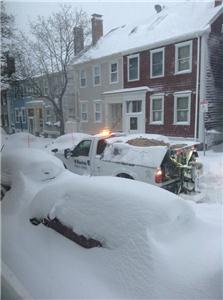
The blizzard of 2013 is what we are calling it here in Boston.  And it is still snowing.  No cars allowed on the streets and highways, no public transportation.  Because of the blowing snow it is hard to figure exactly how much has fallen, but it is currently in excess of 20 inches and another 5 to 8 may accumulate before it is all finished.  Luckily we didn’t lose power but we are snowed in.  It is also cold currently 20 degrees.

From Boston.com (The paper is not being delivered today.  Also no mail.)

Hundreds of thousands of Massachusetts residents have lost power because of the mammoth blizzard that lashed Massachusetts with hurricane-force winds and dumped more than two feet of snow in some areas overnight.

The state is at a standstill, with residents hunkering down at home under a rare travel ban imposed by the governor on Friday, and the MBTA saying it will not be able to restore service today. Snowplows are out in force struggling to clear the roads, but the storm is expected to continue dumping snow into midday.

National Guard troops are heading to coastal communities to assist in possible evacuations due to giant waves whipped up by the storm that are expected to batter the beaches at high tide at 10 a.m., potentially devouring beaches and homes.

State emergency management officials said there were no reports of major injuries due to the storm, even though there were two truck rollovers and about 30 stranded motorists had to be rescued from the roads.

According to New England Cable News (NECN) the Governor had this to say

Governor Patrick says he’s impressed with the fact there have not been any serious injuries yet as a result of this storm.

“When you consider the scope of the storm and the severity of it, it’s really a minor triumph that we haven’t had serious injuries,” Governor Patrick said. “We had a couple people out last night, I guess, defying the ban and taking their chances, and we had vehicles driving the wrong way on the Pike, on Storrow Drive … but no serious injuries.”

I guess it takes all kinds!

This picture was just posted on Boston.com

This is in the Charlestown section of Boston.

This is in the Charlestown section of Boston.

We have cousins who live in this area of town.  Like where we live, the streets are narrow and winding.

So why was the storm so bad?  Like Hurricane Sandy, two fronts converged over New England.  According to the Boston Globe

The fierce nor’easter that began walloping New England on Friday was the product of two storms that merged, causing a rapidly strengthening storm known in weather jargon as a “meteorological bomb.”

“We just have the right setup,” said Lance Franck, a National Weather Service meteorologist in Taunton. “It really is just a classic snowstorm.”

Forecasters said Friday night the storm remained on track to produce prodigious amounts of snow. But, in many ways, it reflects an utterly typical winter weather pattern, meteorologists said. Its path just happens to be dead-on, landing at a meteorological sweet spot to produce substantial snowfall in New England.

The jet stream that flows from west to east, 18,000 feet above the surface of the Earth, has two branches: a polar stream that takes a northerly route and a second, more southerly stream. When those branches converge, which is a pretty routine event during winter, snow is a possibility, as the frigid air from the north mingles with the humid air from the south.

“This winter has been interesting because the two streams have been largely separate,” Franck said.‘But the process of this happening isn’t unusual, it happens almost every winter.’

Until Friday.

This time, separate storms were brewing in each branch of the jet stream. The storm in the northern branch had deposited light snow in the upper Midwest. The storm in the southern branch had spawned rain in the mid-Atlantic, Franck said.

They separately swept toward New England, and by Friday night, meteorologists were saying the storms appeared destined to combine — very near a spot meteorologists call the “benchmark” because it is a pivotal spot for understanding how storms are likely to behave.

“The intersection point where the storms will ultimately become one . . . just south of Block Island, in that area — that’s just the perfect location,” said David Epstein, a meteorologist whose forecasts appear on Boston.com.

The bottom line is that the two fronts merged at the sweet spot to produce our blizzard.

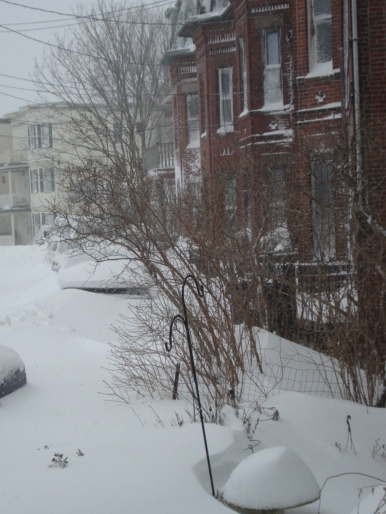
Here are some pictures I took from the house this morning.

my street

my street

The park across the street

The park across the street

Dealing with the housing crisis: The Hong Lok example

The housing crisis in the United States is more than home sales, lending rules and interest rates.  Yes, these are important to the economy, but so is the inability of people to find safe, affordable rental housing in a place they feel comfortable.  One of the things that has happened with all the federal budget cut-backs is the reduction of federal funds to help develop affordable housing.

One of the last projects I helped get off the ground before I retired was the Hong Lok House development in Boston’s Chinatown and I was overjoyed to see it featured in today’s Boston Globe business section.

The $35 million project accomplishes the rare feat of expanding affordable housing in Chinatown at a time when luxury high-rises are popping up across the neighborhood, bringing an influx of wealthier renters.

Completion of the first phase next month will create 32 units for low-income elderly residents, who will move from the old Hong Lok building to a new one next door. The original building, which has fallen into disrepair, will be demolished to make way for another 42 units by spring 2014.

Perhaps more noteworthy than the project’s recent progress is the decadelong struggle to get it financed, which underscores the extreme difficulty of keeping housing in city neighborhoods affordable to a diverse population.

Behind the struggle is a dramatic drop in federal funding for new affordable housing.

Over the past decade, Boston’s allocation of community development block grant money has plummeted nearly 40 percent, to $15.3 million this year, and so-called Home funding has dropped 60 percent, to just $3.55 million, according to city records.

A separate US Housing and Urban Development program for low-income seniors has also been slashed about 50 percent.

That forces developers of affordable housing to rely more heavily on private lending and gifts from institutions.

Jamie Seagle, who would be the first to admit that he and I butted heads more than once, deserves the lion’s share of the credit for making this happen.  It was not only the funding that was an issue, but also building in an historic district with historic structures.   I think the agreement we were able to reach that preserved the historic facades and built units behind them were consistent with the character of the neighborhood worked for everyone.  Yes, it wasn’t easy:  many architects, federal agencies, state agencies, the neighborhood, and at least 3 City of Boston agencies had to agree.  But the fact that we could shows that the process can work.

“To create a site in Boston where you can maintain affordable housing is almost an impossibility today,” said James Seagle, president of Rogerson Communities, Hong Lok’s nonprofit developer. “What’s happening for people of lesser means is that the rents are going up, and the properties where they can obtain housing are steadily going away.”

He said the project involved a decade of legal and financial engineering that generated a three-foot sheaf of closing papers; in contrast, Rogerson’s first project 30 years ago, the 75-unit Farnsworth House in Jamaica Plain, took only 18 months and produced a slim 1½-inch binder for the closing papers.

When I retired last August our first banker’s storage box was full.

When thinking about President Obama’s Second Inaugual speech defending the role of government, one need to look no futher than project like Hong Lok which are happening all around the country.  These are public/private partnerships.

In the case of Hong Lok, developers tapped a complex patchwork of 23 funding sources, including a $17 million loan from Boston Private Bank & Trust Co., a $2 million gift from State Street Corp., and $1.4 million from the Charles H. Farnsworth Trust.

That was on top of millions of dollars provided by the state Department of Housing and Community Development and multiple city agencies.

“It used to be that you’d have three or four sources of funding; now it’s 10 or 12 and sometimes even more than that,” said Boston Mayor Thomas M. Menino. “Too many people are being forced to leave Chinatown, and this housing will create more possibilities for people who want to stay there.”

So as we head into budget negotiations, Congress and the President need to think about rental housing and how to fund it.  Yes, people like Jamie Seagle can make the current climate work and I don’t think anyone is advocating for the days when a huge percentage of any affordable housing project is federally funded, but more cuts will only hurt the people on Ruth Moy’s waiting list.

But that program alone is unable to keep up with the demand. When Hong Lok opens, for example, it will have a three- to five-year backlog of applications from people trying to get a unit. The complex will have an attractive mix of comforts, including a rooftop garden, a community center for seniors, and an expanded adult day health program.

“I don’t even want to think about it,” Ruth Moy, executive director of the Greater Boston Chinese Golden Age Center, said when asked about the demand. “We have a very long waiting list of people who want to stay in this neighborhood. But how long can they wait for affordable housing?”

Three facades conceal a building that houses newly built Hong Lok housing units

Three facades conceal a building that houses newly built Hong Lok housing units

Photograph JOSH REYNOLDS FOR THE BOSTON GLOBE

Dovekie in Roxbury (Corrected)

[This post has been edited to correct the Laura Ingalls Wilder reference (I had the wrong book) and to expand with some quotes from The Long Winter.]

The dovekie is an Arctic bird that plays off the coast of New England near Georges’ Bank in the winter but I don’t think one has ever been found in my neighborhood before.  The Boston Globe had the story  and picture on last Friday. 

The dovekie, called a little auk in Europe, was dropped off at the Boston Rescue 2 firehouse on Columbus Avenue in Egleston Square on Thursday night, said Greg Conlan, a firefighter with Rescue 2.

Conlan said the small bird was brought into the station at 7 p.m. by three 10-year-old children.

The bird, which was in a box, looked plump but exhausted, he said.

“It looked tired. It definitely wasn’t going anywhere, but it wasn’t on its last leg or anything,” he said.

Firefighters named the dovekie Olive, the name given to every animal that comes through the firehouse, Conlan said. There is a cat and a turtle living at the station, both with the name Olive.

Here is Olive in her box.

Dovekie

The bird was transported to the New England Wildlife Center in South Weymouth, Boston Fire Department spokesman Steve MacDonald said.

Wayne Petersen, director of the Important Bird Areas program for the Massachusetts Audubon Society, received a call from the wildlife center this morning asking for advice about where to release the bird, he said.

“The bird was obviously blown into the city by the big storm on Thursday,” Petersen said. “It’s a species that once it’s on the ground, they have great difficulty taking off.”

He advised the caretakers to release Olive in waters not heavily populated by gulls, because the small bird could be prey for larger species.

The nice thing about the story is that 3 10 year old boys were thoughtful enough to try to take care of the dovekie by trying to feed it crackers [I’m sure they feed pigeon being city kids.] and then bringing it to the fire station.

In Laura Ingalls Wilder’s book, The Long Winter, a little auk lands near their house and the family releases it off Silver Lake.  “They had never seen a bird like it.  It was small, but it looked exactly like the picture of the great auk in Pa’s big green book, ‘The Wonders of The Animal World’.”  The little auk had been found in a haystack.  The next day Pa, Laura, and Mary go to release the bird.

He squatted down by the thin white ice at the lake’s edge and reaching far out he tipped the little bird from his hand into the blue water.  For the briefest instant, there it was, and then it wasn’t there.  Our amoung the ice cakes it was streaking, a black speck.

“It gets up speed, with those webbed feet,” said Pa, “to lift it from the….There it goes!”

This is the only other time I can remember hearing about them in unusual places.

No word yet on a successful release here in Boston, but we have been having a snow/rain and now wind storm for the last 24 hours so probably no one has tried yet.

Little auks when not in Egleston Square.

Little Auks

Little Auks (Photo credit: Alastair Rae)

Why Mitt Romney will never be Tom Menino

Yesterday Joanna Weiss wrote a column in the Boston Globe in which she asked her readers to imagine Mitt Romney as Mayor of Boston.  After I stopped laughing, I began to think of all the reasons why this was not only a bad idea, but why Mittens would never make as good a mayor as Thomas M. Menino.

Weiss said

The beauty of a mayorship, as far as Romney goes, is that it’s less an ideological job than a technocratic one. Without the desire to use his office as a stepping stone, Romney would be free to problem-solve, to do the kind of work that made him an appealing public servant in the first place.

She goes on to cite several examples like the new flyover to Cape Cod which fixed the Sagamore Bridge problem and Massachusetts Health Reform (which was a largely Democratic idea) of examples of his technocratic skill at work when he pretended to be governor of Massachusetts.  Weiss seems to be under the impression that Mitt could be another Michael Bloomburg.  Somehow I don’t think so.  Can you see Mittens taking the Orange Line to work from his new mansion in Jamaica Plain?  Or the Red Line from Savin Hill?

So what if he never did well with the little folks? Mayor Mitt wouldn’t have to go to every ribbon-cutting or community meeting. That’s Menino’s thing. Mitt could be the fixer, the big-picture guy, ensuring that Boston keeps wielding an outsized influence on American life.

Right, Joanna.  A large part of what makes TMM a success is that everyone who lives in Boston has met him.  At least it seems that way.  And he cares about the 47%, a large number of whom make up the Boston population.  This is why a new idea was unveiled today.

Starting Wednesday, residents can pay parking tickets and tax bills, get a library card and dog license, even register to vote, at a van dubbed “City Hall To Go.” A newly refurbished bomb squad van, the vehicle was made to resemble a food truck, but is essentially a rolling office, outfitted with laptop computers, wireless access, and the necessary paperwork from a host of city departments.

City officials say the program is the first of its kind nationally, and they hope it proves a convenient alternative for residents who do not use the Internet or rarely get downtown.

The interior of the City Hall To Go truck has laptop computers and wireless Internet access.

The interior of the City Hall To Go truck has laptop computers and wireless Internet access.

Staff in the mayor’s office say the rolling City Hall provides “one-stop shopping, where residents can take care of several tasks at once.” Workers can provide information from school registration forms and summer camp guides for parents to tax exemption forms for the elderly.

The idea for the moving service sprang from meetings in City Hall this summer and was later proposed by several residents as a suggestion for The Mayors Challenge, a national competition designed to spur ideas to improve cities.

Menino, known for his atten­tion to neighborhood concerns and quality-of-life issues, quickly lent his support.

In a statement, Menino said the pilot program will show that “government can change” to become more flexible and convenient.

“City Hall To Go builds on our mission to shake up the status quo in municipal services and offer a new way for Boston residents to get information and engage with the city on a whole host of services we offer,” he said.

I do hope that Weiss was trying for humor in her promotion of Mitt for Mayor, because somehow I doubt that at idea like City Hall to Go would have been either solicited as an idea or implement by him.

Given his age and health, it may be time for Mayor Menino to retire gracefully from the picture, but there are many homegrown candidates who could be mayor.  Men and women who know where Hyde Park and Mattapan are and care about our neighborhoods.

Sandy from Boston: the day after

A little after 4 am this morning I was awakened by the full moon shining in my window. The winds had calmed, the rain ended and the clouds had parted at least momentarily.  The Old Farmer’s Almanac calls this the Full Hunter’s moon.  Now we have alternating sun and clouds.  (And a brief shower when I went out to buy Halloween candy.)

Boston and Massachusetts, except for the south coast, were as the Boston Globe put it in the headline to the Metro section, “still walloped” even far from the center.  After a while I just couldn’t watch television coverage as they showed Seaside Heights on the Jersey Shore basically under water.  I can only imagine what Long Beach Island where I often summered as a child looks like.  And Manhattan and the Red Hook neighborhood of Brooklyn.  Yes, Boston was lucky.

But we were not without damage which shows the size and strength of the storm.  That size and strength was magnified by that beautiful Hunter’s moon outside my window.  Here is how it works.  This is from the EarthSky News.

Of course, we all know the moon is primarily responsible for the rising and falling of ocean tides.  In most places, but not everywhere, there are two high tides and two low tides a day.  That’s true of the U.S. East Coast, where Sandy is having its effect.  That effect can’t be predicted precisely because – for any particular spot on Earth’s surface – the height of the tides and their fluctuation in time depends not only on the moon, but also on the sun – and also on the shape of the specific beach, the larger coastline, the angle of the seabed leading up to land, and the prevailing ocean currents and winds.

The difference in height between high and low waters varies as the moon waxes and wanes from new to full and back to new again.  The higher tides are called spring tides (nothing to do with season of spring).  The lower tides are called neap tides.  It’s a spring tides that’s happening around this weekend, as Sandy is sweeping closer to U.S. shores.

Around each new moon and full moon – when the sun, Earth, and moon are located more or less on a line in space – the range between high and low tides is greatest.  These are called spring tides.  Image via physicalgeography.net

Spring tides.  Full moon this month comes on October 29 at 19:49 Universal Time (or 2:49 p.m. Central Daylight Time in North America).  Around each new moon and full moon, the sun, Earth, and moon arrange themselves more or less along a line in space. Then the moon’s pull on the tides increases, because the gravity of the sun reinforces the moon’s gravity.  In fact, the height of the average solar tide is about 50% the average lunar tide.  Thus, at new moon or full moon, the tide’s range is at its maximum.  This is the spring tide: the highest (and lowest) tide.  Spring tides are not named for the season.  This is spring in the sense of jump, burst forth, rise.  So spring tides bring the most extreme high and low tides every month, and they happen around full and new moon.

It’s when a spring tide coincides with a time of heavy winds and rain – flooding due to a weather extreme – that the most extreme flooding occurs.  That’s the case this weekend.  There is one small bit of luck.  That is, the moon is not near perigee, or closest to Earth for the month.  In fact, the moon will be at apogee- farthest from Earth for the month – on November 1.  A full moon at perigee during a destructive hurricane would be bad news indeed.  A full moon at apogee is slightly less bad, but still bad.

So, yes the full moon didn’t help, but I guess it could have been worse.

This is from Quincy, MA just south of Boston.

Hurricane Sandy in Quincy, Mass. -- Photo couresty: Dawn Gaffney

Photograph by Dawn Gaffney

Hurricane Sandy from Boston

It is just past 3 pm when I began to write.  The morning was pretty calm.  Nothing we haven’t seen before and I wondered if Mayor Menino had made the right decision to close City Hall and the Boston Public Schools.  But the trains and subway shutdown at 2 and kids would have been dismissed early.

We live on the top two floors of a post-Civil War house on top of one of the hills in Boston and the house has weathered a lot of storms.  But we can now feel the house shaking.  About an hour or so ago things really picked up with rain and wind lashing the east and north facing windows.  And we are hundreds of miles from the eye of the storm!  I have been watching scenes from the Jersey shore where I spent many summers of the childhood and can only imagine the devastation on Long Beach Island.

The main impact is due between 5 and midnight.  Midnight is when Boston Harbor has high tide.  But already people are posting pictures of damage.

This is from Belmont, just outside of Boston and where Mitt Romney lives.

And this is from South Boston not sure of the exact location but I’m sure near the Boston Harbor Walk and Castle Island where I often walk.

Hurricane Sandy in South Boston, Mass. -- Photo courtesy: @Brooke_Marlowe

More updates as things progress.

South Boston Photograph from @Brooke_Marlow.  Belmont photograph from Liz.

Warren Buffet and Boston Speed Dog

There is someone in this universe who doesn’t know who Warren Buffet is.  That someone is Greg Dale the owner of Speed Dog, the Boston food truck.

According to the Boston Globe

The billionaire investor was in Boston this week for a meeting with execs at Yale Electric. Afterward, we’re told, Buffett, his burly bodyguard, and a few folks from the Dorchester-based home appliance store headed over to Boston Speed Dog, the food truck in Roxbury that sells the most scrumptious hot dogs. Not surprisingly, Buffett loved the dog and joked that he wanted to buy the truck. When we asked Speed Dog co-owner Greg Gale about his brush with fame, he was confused. “Really? He was here? I didn’t even know,” Gale said. “I love his music.” No, we explained, it was Warren Buffett, not Jimmy Buffett. He’s an older guy with grey hair and glasses, we said. “Oh yeah,” replied Gale. “Now that you mention it, I did talk to him. He said he wanted to buy the place, and I told him, ‘You don’t have enough money.’”

Recording artist Jimmy Buffett looks up to spe...

Image via Wikipedia


Warren Buffett speaking to a group of students...

Image via Wikipedia


There is some resemblance.  I wonder if Warren can sing.


Truth v. Fiction: Fireworks in Boston

We have Michele Bachmann and Sarah Palin making up history.  We have reality shows that are edited for maximum entertainment.  And now we have the CBS showing fake, impossible views of the July 4th fireworks in Boston. This was the headline story in the Boston Globe this morning and what greeted me when I picked up the paper.

Those who watched Boston’s revered Fourth of July celebration Monday night on CBS were treated to spectacular views of fireworks exploding behind the State House, Quincy Market, and home plate at Fenway Park, among other places – great views, until you consider that they were physically impossible.

But most disturbing was organizer David Mugar’s reaction.

Mugar said the added images were above board because the show was entertainment and not news. He said it was no different than TV drama producer David E. Kelley using scenes from his native Boston in his show “Boston Legal’’ but shooting the bulk of each episode on a studio set in Hollywood.

“Absolutely, we’re proud to show scenes from our city,’’ Mugar said. “It’s often only shown in film or in sporting matches. We were able to highlight great places in Boston, historical places with direct ties to the Fourth. So we think it was a good thing.’’

A CBS Television spokesman declined comment about whether the network was aware of, or approved of, the fireworks show being digitally altered.

So, it is OK to shoot landmarks separately and then add them to a live fireworks display.  I don’t think so.  There is a difference between a fictional show like “Boston Legal” and a live broadcast.  It would be like the Red Sox adding footage of David Ortiz hitting one out of the park during batting practice and calling it part of the game.  Or the Celtics adding footage of  Ray Allen hitting a three pointer.  Live entertainment is just that: live.  You don’t know exactly what is going to happen and that is part of the reason we watch things live.

And what do we do about the tourists who come next year to see the fireworks behind the State House and find out they can’t see them?

Eric Deggans, a Florida-based media critic and regular panelist on CNN’s media critique show “Reliable Sources,’’ said the altered video presents a potential credibility problem for CBS.

“It is an ethical issue, and to say it’s not because the show was aired through CBS Entertainment is to imply that the entertainment side of CBS has no ethics,’’ Deggans said. “I think – especially in today’s media environment – the most important commandment for media is to not mislead the viewer. . . . If you’re a viewer who doesn’t know Boston, you’re getting a picture of the layout of the city that doesn’t exist.’’

Asked about Mugar’s argument that the show was entertainment so the usual rules did not apply, Clodfelter, the commenter from Brighton, said if that’s the case “why not superimpose Neil Armstrong on the moon?’’

Exactly.  No wonder there are people who believe that the moon landings are staged in Arizona.  Mugar has done a wonderful organizing and sponsoring the fireworks for many years, but he is absolutely wrong about this.