Digging in Boston

Nothing new here you might think.  Someone is always digging up a street, a hole for a foundation, or for planting in the park across my street.  But I’m talking about a different kind of digging.  Think Indiana Jones.  Boston City Archeologists have been digging in a backyard in the North End of Boston this summer.  Think Old North Church, Paul Revere, and lanterns.

The dig followed a decision by the Old North Church, which owns the Clough House, to build a new public walkway to the rear of the home. Under its deed, the patch of land must be studied by archeologists before work can proceed.

The city offered to do the dig for free, Bagley [City archeologist, Joseph] said, in a section of church property where archeologists had never dug before. “We knew we would find stuff back here, but we never expected to find so much stuff from the 1700s,” Bagley said.

I first learned about the dig a couple of weeks ago in an email newsletter from the City.  And I found out that archeology program has a Facebook page where they have been posting nice pictures of pottery shards.  The Boston Globe ran a story yesterday explaining more about the dig.

“This whole backyard was a trash dump,” city archeologist Joseph Bagley said, smiling as he walked gingerly around the site. “And back in the day, I think the backyard would have been just disgusting.”

In other words, perfect.

During two weeks of digging, Bagley and a crew of volunteers collected tens of thousands of items from the 1700s. The haul included long-ago leftovers of everyday life: animal bones, doll parts, and uncounted chips and fragments of dishes and cups that archeologists hope will reveal more about how Bostonians lived as a bustling city sprang up around them.

North End map

If you have ever visited the North End, you know that every square inch seems to be developed so an undisturbed backyard is very unusual.

The household debris came from a home built around 1715 by master mason Ebenezer Clough, who bought open land down the slope from Copp’s Hill. Clough also helped construct the Old North Church, which opened only steps away in 1723.

“He wasn’t hurting, but he wasn’t rich,” Bagley said of the mason.

The home, originally two stories, was passed down through the family and later used by a merchant, then a mariner, and finally a glazier before being expanded to three stories and converted into a tenement about 1808.

So far no Ark of the Covenant has been uncovered, but we will learn a great deal about life in Boston in the 18th Century.

This beautiful piece of pink-bodied tin glazed ceramic was just washed. It dates to the 18th century and was found 70-80 cm down during the Clough House dig

This beautiful piece of pink-bodied tin glazed ceramic was just washed. It dates to the 18th century and was found 70-80 cm down during the Clough House dig

Photograph:  City of Boston Archeology Program

Urban sprawl, transportation, and poverty

I’ve been thinking since I read Paul Krugman’s column “Stranded by Sprawl” about successful urban areas and public transportation.  I lived for a number of years in Richmond, VA and for part of that time I didn’t drive or have a car.  After I acquired a car, I realized how limited my world was without one.  There were many places I couldn’t get to without driving and even if there was a bus, service was often erratic and infrequent.  I don’t know if thing have changed since I left twenty years ago, but I know that the counties surrounding the City of Richmond were where the new office parks and shopping malls were springing up.  I was lucky because I did live within easy walking distance of a nice shopping area with restaurants and some stores so I could leave the car behind when I met friends for breakfast or dinner.  But I didn’t live near any of the “projects” or poor areas which were pretty segregated back then.

One of my first memories of my Boston move was one of my new neighbors lamenting that the view from the back of the houses on our street was marred by looking down at the roofs of a large public housing project.  In fact, there are actually four projects within easy walking distance.  After I went to work for the Housing Authority I learned that public housing developments were scattered through the city neighborhoods.  The BHA takes pains in trying to maintain the grounds of each (with limited resources) so they don’t become a blight on the neighborhoods and several have been totally redesigned and no longer have the dead end streets which only serve to isolate residents.  Contrast this with the Atlanta described by Krugman

When the researchers looked for factors that correlate with low or high social mobility, they found, perhaps surprisingly, little direct role for race, one obvious candidate. They did find a significant correlation with the existing level of inequality: “areas with a smaller middle class had lower rates of upward mobility.” This matches what we find in international comparisons, where relatively equal societies like Sweden have much higher mobility than highly unequal America. But they also found a significant negative correlation between residential segregation — different social classes living far apart — and the ability of the poor to rise.

And in Atlanta poor and rich neighborhoods are far apart because, basically, everything is far apart; Atlanta is the Sultan of Sprawl, even more spread out than other major Sun Belt cities. This would make an effective public transportation system nearly impossible to operate even if politicians were willing to pay for it, which they aren’t. As a result, disadvantaged workers often find themselves stranded; there may be jobs available somewhere, but they literally can’t get there.

Is Detroit in trouble because its land area is too big?  I don’t know.  Detroit is 138 square miles with a population today of around 700,000 people.  Boston is 48 square miles with a population about 50,000 people smaller. In Boston, we gripe about the public transportation all the time and worry that some neighborhoods that are more affluent have better service, but we are always working on it.  I haven’t read anything about public transportation in Detroit:  It is the Motor City.

Boton T

Back to Krugman

The apparent inverse relationship between sprawl and social mobility obviously reinforces the case for “smart growth” urban strategies, which try to promote compact centers with access to public transit. But it also bears on a larger debate about what is happening to American society. I know I’m not the only person who read the Times article on the new study and immediately thought, “William Julius Wilson.”

A quarter-century ago Mr. Wilson, a distinguished sociologist, famously argued that the postwar movement of employment out of city centers to the suburbs dealt African-American families, concentrated in those city centers, a heavy blow, removing economic opportunity just as the civil rights movement was finally ending explicit discrimination. And he further argued that social phenomena such as the prevalence of single mothers, often cited as causes of lagging black performance, were actually effects — that is, the family was being undermined by the absence of good jobs.

My worry about Boston is that it will become more and more like Manhattan where only the well-off and the very poor can afford to live.  Jobs, particularly tech jobs, are moving back into the city and near suburbs from further out along the outer ring highways.  Will we end up with a shrinking middle?

These days, you hear less than you used to about alleged African-American social dysfunction, because traditional families have become much weaker among working-class whites, too. Why? Well, rising inequality and the general hollowing out of the job market are probably the main culprits. But the new research on social mobility suggests that sprawl — not just the movement of jobs out of the city, but their movement out of reach of many less-affluent residents of the suburbs, too — is also playing a role.

What’s to be done?  More investment in infrastructure in places like Atlanta and Los Angeles.  More investment in light rail systems.  More investment in maintenance of what we have for cities like Boston, Chicago and New York.  Unfortunately this is another thing in which the House Republicans are not interested.

The USS Constitution: The nation’s oldest commissioned warship

Did you know that the Frigate Constitution is a fully commissioned ship in the United States Navy?  According to the official website

USS CONSTITUTION was developed and built in response to the threat of Barbary corsairs, which threatened American merchant shipping off northern coast of Africa. Following the American Revolution, the United States’ Continental Navy and disbanded, leaving the new nation without a credible seapower to defend its interests abroad. Signed into law on March 27, 1794 by President George Washington, the Naval Armament Act called for the construction of six frigates, to be built at shipyards along the eastern seaboard. The 44-gun USS CONSTITUTION, built in Boston, was launched on Oct. 21, 1797.

You can also use the link to read about some of her famous victories.  But I wanted to write about the ceremony that takes place every couple of years, most recently yesterday.  That is the transfer of command.

Commander Sean D. Kearns (left) and the USS Constitution’s outgoing commanding officer, Matthew J. Bonner, saluted attendees after Kearns officially took over as the ship’s new leader.

Commander Sean D. Kearns (left) and the USS Constitution’s outgoing commanding officer, Matthew J. Bonner, saluted attendees after Kearns officially took over as the ship’s new leader.

Since he was a child visiting relatives in Braintree, Sean D. Kearns has always been drawn to the USS Constitution and its storied legacy.

He collected models and posters and studied the ship’s legendary commanders. It was on the deck of Old Ironsides where the Hampden, Maine, native became a Navy officer in 1994.

On Friday morning, under overcast skies and light rain, the 44-year-old stood in Charlestown Navy Yard, clad in the classic 1813 commanding officer’s uniform, and was sworn in as the latest skipper of the 215-year-old warship.

During an emotional ceremony, Kearns approached Matthew J. Bonner, the ship’s 72d commander, and presented him with his orders. The two tucked their bicorn hats under their arms as more than 150 friends, family, former commanders, and the ship’s crew looked on.

“Sir,” Kearns announced, “I relieve you.”

“I stand relieved,” Bonner said.

With that, Kearns became the ship’s 73d commander, joining the ranks of such naval legends as Captain Isaac Hull, the Constitution’s commander when it laid waste to the British frigate HMS Guerriere in the War of 1812.

That is what I love about history:  There is always some thread of continuity.  I have visited the Constitution, but have never seen a turnaround in Boston Harbor.

One of Constitution’s most complicated events is a turnaround, the short round trip the ship makes out to Castle Island and back, docking on its return faced in the opposite direction. The ship generally makes about a half-dozen turnarounds a year. Although the maneuver, aided by tugboats, is necessary to evenly expose the ship to prevailing tidal pressure, a turnaround is always an event. That was the case when the ship staged a turnaround voyage to honor the 70th anniversary of the Battle of Midway and members of the Wounded Warrior Project, which serves injured members of the US Armed Forces.

English: Navy photo of USS Constitution under ...

English: Navy photo of USS Constitution under sail for the first time in over a century Español: El US Constitution, buque insignia de la Armada Americana. (Photo credit: Wikipedia)

The last one was on July 4 when it was just too hot to go stand out on Castle Island and watch.  And she generally doesn’t go under sail.  This was in 2012 to celebrate the 200th Anniversary of her victory over the Guerriere,  Maybe this fall.

The Constitution is a regular and must sought after Naval assignment.

Photograph: JOSH REYNOLDS FOR THE GLOBE

Burying the dead

Tamerlan Tsarnaev hijacked a car and kidnapped the owner but did not kill him.  He died in a shootout with police – maybe from gunshots, maybe from his younger brother running over him.  These are facts.  It is likely he set off at least two explosive devices near the finish line of the Boston Marathon.  Either he or his brother shot a MIT police officer in cold blood.  Does this mean he does not deserve to be buried in his adopted hometown of Cambridge?  Or barring that, somewhere in the Boston area.

We have a long history of abusing the bodies of our enemies.  Antigone wants to bury of the body of her brother, Polyneices.  At the beginning of the play named for her, she tells her sister

…they say he [Creon] has proclaimed to the whole town

that none may bury him and none bewail,

but leave him unwept, untombed, a rich sweet sight

for the hungry birds’ beholding.

Antigone is trying to persuade her sister they should commit what we would call civil disobedience and bury Polyneices anyway.

Achilles dragged the body of Hector behind his chariot for days after the Trojan had killed his best friend, Patroclus.  Achilles finally relents to Hector’s father.  We are told that the gods had kept the body from showing signs of abuse.

Adam Lanza, the Newtown shooter, and Albert DeSalvo perhaps the Boston Strangler, were both buried in private cemeteries.  So was Lee Harvey Oswald.

Massachusetts law gives a cemetery the right to refuse burial, but I haven’t seen any stories that discuss how often this right is invoked.  A number of funeral home directors have spoken out saying that the protests outside the funeral home are not right.  The most interesting comment came from a North Carolina Republican who sponsored legislation to limit protests by groups like Westboro Church.

“The family can have peace and say goodbye to their loved ones without hearing screaming and noise,” says North Carolina Republican state Rep. John Szoka, who sponsored a bill this year to strengthen that state’s ban.

Most Americans find the Westboro protests outrageous because they believe deeply in the right of a family to bury their dead and not be challenged about it, Sloane [David C. Sloane, author of The Last Great Necessity: Cemeteries in American History] says.

That’s what makes the protests in Worcester unusual. Tradition dictates that bodies of even the most heinous criminals be given over to the families to deal with in their private grief.

Regardless of his actions, though, a funeral home is not the appropriate place for such public expression of anger, says Szoka, the North Carolina legislator.

“I’m not really in favor of protesting outside funeral homes, no matter how disgusting the individual or whatever he did,” Szoka says. “There are other venues for that.”

Cemeteries in Massachusetts may have the legal right to refuse, but they should think more about why they exist and what their mission is.  The problem they are thinking of is future vandalism.  Another act that most of those protesting would normally find outrageous.

Protesters outside the funeral home.

Protesters outside the funeral home.

As I understand it, Muslim dead, like Jewish dead need to be buried as soon as possible.  They cannot be cremated.  Quite honestly, I think the statements of all the Massachusetts politicians who have spoken including Representative and Senate candidate Ed Markey, Senate candidate Gabriel Gomez, Mayor Thomas Menino and Governor Deval Patrick have been less than worthy of them.  They are behaving like so many Creons.  The Worcester funeral home director, Peter A. Stefan and the Worcester Police Chief Gary Gemme seem to be the only ones actively and constuctively working toward a solution.

Whether Tamerlan Tsarnaev’s body is buried in another state or sent back to Russia, what is going on is not worthy of Massachusetts.  It is not worthy of “OneBoston.”  We are better than this.

Photograph:  AP

Translation of Antigone: Richmond Lattimore

Change comes to South Boston

If you know anything about South Boston it is probably from the busing crisis of the 1970s when images flashed across the country and no one could believe they were from Boston and not Mississippi or Georgia.  Images like these.

sb1sb2sb4

Or maybe it is from reading “Common Ground”, the Pulizer Prize winner by J. Anthony Lukas which followed families through the crisis.  If this is what you remember, it has all just changed.

Yesterday, May 1, 2013, we all woke up to the reality that the next state senator from the district that includes South Boston will be Linda Dorcena Forry.  The “Southie Seat” has moved into a new era.  Boston has changed.

Linda Dorcena Forry held her daughter Madeline Forry, 2, as she celebrated a possible close victory at Phillips Freeport Tavern in Dorchester. (taken before Nick Collins conceded.)

Linda Dorcena Forry held her daughter Madeline Forry, 2, as she celebrated a possible close victory at Phillips Freeport Tavern in Dorchester. (taken before Nick Collins conceded.)

Linda is Haitian-American married to Bill Forry the Irish American publisher of the Dorchester (MA) Reporter.  South Boston, like it or not, is represented by a woman of color from a mixed marriage.  My fearless prediction: they will come to love her.  I have yet to meet anyone who can resist her enthusiasm and energy – or any of her four children.  I first met her nine years ago, before she ran for office, and have followed her career ever since.  She will win over those Collins (and Dahill) voters from Southie.  The Globe story this morning points out

The race was no easy win for Forry. The Wednesday morning hugs and handshakes among her, Collins, and Dahill came as the candidates were processing an Election Day fraught with mishaps. Voting day began with incorrect ballots distributed at some South Boston polling locations. Then, as votes were being counted that evening, the Associated Press erroneously ­declared Collins the winner, ­only for the final tally to show Forry with a 378-vote lead.

Forry’s path to victory was carved in Dorchester, Hyde Park, and Mattapan, and despite her poor showing in South Boston.

She will have the support of Collins (no word on Dahill) and of former Mayor, Ray Flynn.

For decades, men from South Boston have held the First Suffolk seat, which also includes Mattapan and a portion of Hyde Park.

Jack Hart Jr., who resigned the seat in January to take a job with a law firm, has held it since 2002, when he was elected to replace US Representative Stephen Lynch, a native of South boston. Before Lynch, the seat was held for 25 years by William Bulger.

“I never refer to it as the Southie seat,” Hart said in an interview Wednesday. “The reason South Boston has historically held that seat is because they’ve had higher turnout.”

Now, Hart and other members of South Boston’s political old guard insist that residents will unite behind any leader, from any part of the district, who listens to their needs. That includes Forry, a Haitian-
American, who finished a distant third among South Boston voter.

I know Linda and she will be out there with her family and the South Boston residents she meets will fall in love the way the rest of us who know her have.  Times have changed.

“I thought Collins should have won it,” said Bill Barrett, a 65-year-old South Boston resident, as he sat on the park benches on Castle ­Island, where people gather to catch a sea breeze and gossip. “It’s been a long time since that seat has left South Boston, but [Forry] seems like a nice lady.”

Barrett said that the neighborhood and district are different from those he remembers as a young man, but that change is not always bad.

“Change can be good,” said ­Barrett, who is retired. “There are a lot of young people moving into South Boston, but I think ­Dorchester also wanted a voice, too.”

She still has to win the special general election but her opponent, Dorchester native Joseph Anthony Ureneck, has already all but conceded.  It will be fun to see Linda inject some life into the annual St. Patrick’s Day breakfast next year.

Photograph of Forry Jessica Rinaldi for The Boston Globe

Photographs of busing from democratandchronicle.com, civilrights.wikispaces and busingproject.blogspot.com

One year in Boston

OK.  So maybe we are a little self-absorbed right now what with congratulating each other on how well we survived and how much money we have raised for the victims.  The police are at all the events (Sox, Bruins, etc.) being honored.  And maybe everyone is laughing at us for letting the entire City be locked down for an entire day, but it worked for us.  I can’t imagine it happening in New York or LA or Philly.  Maybe San Francisco.  But Boston is pretty connected and compact and if you shut down the public transit, it gets difficult for many people to move around.  I’m sure someone will do a study on why Bostonians pretty universally listened to Governor Deval Patrick.  I wasn’t even in town and I got an alert voice mail.  Maybe it went on too long, but that’s a judgement call and after the fact.  I have read that the “shelter in place” order was lifted on suggestion from President Obama – which might be true, but I’m not sure at this point.  There are still a lot of rumors flying around and as with Newtown, Sandy, and all the other horrific events, we will know the real story months and even years from now.

I was happy to see Brian McFadden’s take on the situation.

12 Months of Boston

12 Months of Boston

Yes, we are getting back to normal and there will be another Boston Marathon in 2014.  And we will learn the truth about what went on that horrible week.  But for now, the Sox are on a roll, the Bruins are in the playoffs and the Celtics stayed alive for another game.

Local Terrorism: the third wave

It is early days yet for both the investigation and the legal process but we are beginning to know bits and pieces about two brothers, graduates of Cambridge Rindge and Latin, the same school that produced Matt Damon and Ben Affleck, who decided to bomb the finish line of the Boston Marathon.  Farah Stockman had a very thoughtful column in the Boston Globe this morning.  She begins with a book written in 2008 by Mark Sageman, a former CIA psychiatrist, who predicted “The threat is no longer ‘foreign fanatics,’ but people who grew up in the West.”   His book is “Leaderless Jihad”  Stockman continues

We still don’t know how much support the Boston Marathon bombers had from overseas. Chechnya’s main militant group, Caucasus Emirate, denies any link to the brothers. Instead, the Marathon bombing appears to be the work of what Sageman describes as the “Third Wave” of terrorism. The Third Wave isn’t about Al Qaeda grooming recruits and dispatching them to do its bidding. It’s about young men who surf the Internet and decide on their own to write their names in history with a bomb. They get inspiration from Al Qaeda. In some cases, they even get training. But they are the ones that seek it out.

“Like Harvard, Al Qaeda did not have to recruit,” Sageman wrote. Young men came in droves, begging for an affiliation.

Sageman says the average recruit at Al Qaeda Central in the 1990s was nearly 30 years old. The average Third Waver is in his early 20s. The majority of Al Qaeda Central grew up in religious homes. About 75 percent of the Third Wavers had fairly secular childhoods.

So why would they turn to building bomb and other acts of terrorism.

For some, it was out of a warped romanticism for a homeland they barely knew; an act of rebellion against hardworking immigrant parents who brought them to the West for “a better life.” Others were US-born converts to Islam who found in terrorism a sense of camaraderie and purpose that had eluded them all their lives. A few became terrorists after years of gang-banging and drug dealing. It was an ideology that transformed their violent tendencies into something heroic. It made them feel they were on the side of the angels.

Both Tsarnaev Brothers were heavy smokers of marijuana and local police are now looking at a connection between them and the murder of the man Tamerlan once said was his only American friend.  Brendan Mess was one of the victims of a triple homicide.  The murders have never been solved.

Third Wavers “are basically trying to find out who they are,” Sageman said. “Their identities are very different from their parents. What they imagine their parents’ country to be never really was.”

That rings true of the Tsarnaev brothers, whose parents immigrated to the Boston area in 2002. The older brother, who dropped out of community college and was once accused of assaulting a girlfriend, might have been casting about for something to believe in. Searching the Internet for information about his troubled homeland in Chechnya would have yielded a trove of jihadi websites full of rhetoric about America’s “war against Islam.’’ As he became more radical, he may have dragged his more outgoing and successful younger  brother down with him.

We will know much more in the days and months ahead, but I think that Sageman and Stockman are right:  the time of terror from outside is over.  Dzhokhar Tsarnaev is not the first local to be tried in Boston.  Tarek Mehanna, from nearby wealthy suburb  Sudbury  was convicted in 2011 of conspiring to support Al Qaeda. He was sentenced in April 2012 to 17½ years in federal prison.  His actions also surprised everyone who knew him.

These crimes may have been inspired by outside forces, but they are crimes in an ordinary sense and the voices, mostly Republican, clamoring for miliary tribunals and an end to immigration have it all wrong.  I think part of the venom is because Boston is a symbol of what the right calls “liberal” America.  And maybe we are.  But Dzhokhar Tsarnaev is an American citizen and deserves to be tried as one.  He is not an “enemy combatant”.   And if Sageman is right, and he appears to be, we can expect to see more of these incidents and trials in our future.  And as the right complains about unanswered questions, we have to remember that some information will be kept for trial and some questions we won’t know the answers to for a long time.

The moment of silence at 2:50 pm April 22, 2013.  Copley Square.

The moment of silence at 2:50 pm April 22, 2013. Copley Square.

The miracle for Boston is that there were only four people killed and close to 300 now reported as injured.  All of the injured are now expected to live.

The Boston Marathon bombing

I was checking into a hotel in Philadelphia minutes after the bombs went off near the finish line of the Boston Marathon and learned what had happened from the desk clerk.  For the next week, we followed the story mostly by reading the paper in the morning and sometimes catching a few snippets on television.  I had made the decision not to do email or any social media while I was gone.  I did have my cell phone on, mostly in case of a cat emergency at home or a Philly friend calling.  It was strange to be away from home and hearing about familiar places.

Things got particularly weird  for me late Thursday afternoon.  The authorities had just released the video of the suspects and in the tape was a person walking who resembled me.  I started getting text messages and calls from friends in Boston who wondered if it was me and if I were OK.  It wasn’t, but when we turned on the TV and watched the endless loop, the other “me” was easy to spot.  Blue jacket, ball cap, grey purse strap across the back.  A short woman, a little stocky.  As one of my friends said even after being reassured, “It really does look like you.”

I got home to a pile of papers and more information on the incident.  It was interesting to see what people got wrong in the early days and it should get more interesting as the investigation continues.  My husband and I were thinking that bombing like this are regular occurrences in other countries and in many ways we are lucky that our law enforcement can actually track the two kids who planted the bombs.  We will bring the survivor to trial eventually, but as someone, I think it was Senator Elizabeth Warren, said these are the early days of the investigation and this is not NCIS where crimes get solved in an hour.

James Carroll wrote this morning in the Boston Globe about the Boston Marathon, the votes in Washington against any regulation of guns, and democracy.  Here is some of what he said.

In 490 BC, the legendary runner brought urgent news to Athens of the Greek victory in Marathon over the armies of the Persian Empire. The Battle of Marathon secured a peace that ushered in the Athenian Golden Age, during which a vibrant democracy finally found the balance between the exercise of force and the fulfillment of human needs. Last week, as an American commemoration of the Battle of Marathon unfolded in Boston, that same democratic balance was dangerously stretched amid the Doric columns of Washington, where the Senate cast a tragic vote for violence.

Yet even our definition of “tragic” goes back to Athens, to the spacious imagination that flourished there — especially in the plays of Sophocles, who lived from about 497 to 406 BC. He taught us that every choice has its consequence, that character is destiny, that the exercise of power must always be measured by the health of the whole community. He also taught us that tragedy, when faced directly and bravely, leaves humans not diminished, but ennobled.

The traumas of Boston last week, culminating in the killing and pursuit of the men suspected of planting the bombs, were heartbreaking and repugnant, but they left the city whole. With all citizens commanded to “shelter in place” Friday while responsible officials conducted the manhunt, Boston was itself a character in the extraordinary drama. A vast ad hoc web of Internet users to whom law enforcement had appealed gave new meaning to the term “community policing.” The fugitives knew that an entire commonwealth had become their antagonist. This surely forced the drama’s denouement. There were no bystanders in Boston.

From Homer on, Greek culture honored competition (“agon” in Greek, which gives us the word “agony”). But in Athens, the philosopher Alasdair MacIntyre has explained, this spirit of contest was balanced by the politics of cooperation. The virtues of the first (discipline, bravery, self-actualization) meshed with the virtues of the second (empathy, humility, selflessness). Athenian democracy was the reconciliation of these opposites. Strength was joined to tenderness.

The Boston Marathon wonderfully embodies this balanced moral order, too: Every year the fiercely determined runners strive to be best (or for their personal best), while surrounded by multitudes whose cooperation makes the race so radically inclusive.

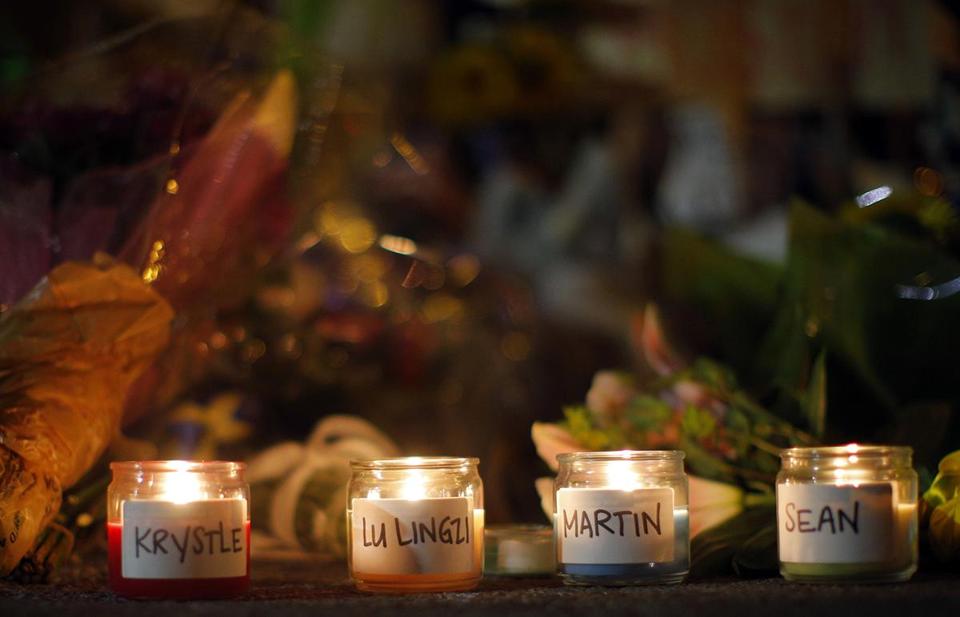
But death changes everything — a jolting transformation to which Greek tragedy itself gave first expression. “In the face of death,” as MacIntyre puts it, “winning and losing no longer divide.” Instead, competition drops away, and cooperation becomes the absolute mandate. That is precisely what happened in Boston, as the city held Martin Richard, Krystle Campbell, Lu Lingzi, and later Sean Collier in its heart.

Last week, a separate drama unfolded in Washington. “It’s almost like you can see the finish line, but you just can’t get there.” These words could have been spoken by thousands of Boston runners, but were said by the father of a shooting victim who witnessed the Senate vote on gun control.

We will, once again, show the world that we can have an investigation and fair trial.  And we will one day enact some sensible gun safety measures.  Watching the events unfold from a distance, I was proud of my fellow Bostonians, law enforcement and  public officials particularly Mayor Menino and Governor Patrick.

Candles for the victims.

Candles for the victims.

Sheep in the city

I live across the street from a city park and often say it is my front yard.  But sometimes the lawn mowing gets to me, and even worse are those horrid leaf blowers which just blow dirt around.  And small stones.  I need to get working on a campaign to ban them in Boston.  Maybe that will be my next retirement project.  But on to the sheep.

In case you missed the story, Paris is experimenting with sheep to mow lawns.  This short story from the Boston Globe caught my eye the other day.

PARIS — Will tourists soon see flocks of baahing sheep at the Eiffel Tower and bleating ewes by Notre Dame cathedral?

That could be the case, since Paris City Hall this week installed a small flock of sheep to mow the lawn at the city’s gardens, replacing gas-guzzling mowers. Four ewes — shipped in from an island off the Brittany coast — are munching the grass surrounding Paris Archives building.

‘‘I can imagine this very easily in London and New York . . . even Tokyo,’’ said ­Fabienne Giboudeaux, City Hall’s director of green spaces. ‘‘And why not have them at the Eiffel Tower?’’

Last year, two goats mowed the lawn at Tuileries, the city’s grand 17th-century gardens. A similar experiment outside Paris found that sheep droppings brought swallows back to the area. ‘‘It might sound funny, but animal lawnmowers are ecological as no gasoline is required, and cost half the price of a machine,’’ said Marcel Collet, Paris farm director. ‘‘And they’re so cute.’’

One of the Paris sheep.

One of the Paris sheep.

I read this and wondered how they keep the sheep from wandering off.  According to the Atlantic, they use an electric fence.  I guess they would have to move it around to different grazing areas as they can’t keep the entire space blocked off.  I think they should hire shepherds and a few dogs.  Give some people jobs.  They can use a portable pen at night.

As the Atlantic points out

It’s honestly a pretty sensible idea. For centuries, if not millennia, grazing animals like sheep and cows have been used both to trim and to fertilize fields. In fact, many of the oldest urban parks were originally populated by farm animals, sometimes just during the day when their owners went into to town to do business. A funny if only marginally related story about in-town grazing comes from Cambridge, Massachusetts, a former suburb of Boston that’s now very much a part of the city. Back in the early days of Harvard College, one of the perks of being a professor was that you were allowed to graze your cow in Harvard Yard. Back in 2009, retiring professor Harvey Cox actually exercised this privilege when he brought his cow Faith to school.

Actually, there shouldn’t be a lot of odor as sheep don’t do big patties like cows.  And if they hire a shepherd she can rake it up – not with a leaf blower.

I hope this catches on.  I like the thought of a couple of sheep with a shepherd on Fort Hill.  Plus it lowers noise pollution and helps with climate change and could create some jobs.

Photograph from Reuters

The Mayor retires

He is 70 years old and has had health problems, but the big reason he is leaving is because he can’t get out and meet people the way he always has.  The New York Times put it this way

At an emotional announcement Thursday inside Faneuil Hall, Mr. Menino slowly navigated his way up the center aisle with his wife, Angela, to the thunderous applause from official Boston as well as city workers and admirers from the neighborhoods. Over the loudspeaker, Frank Sinatra crooned his defiant anthem, “My Way.”

“I am here with the people I love, to tell the city I love, that I will leave the job that I love,” Mr. Menino, 70, the city’s longest-serving mayor, told the standing-room-only crowd of well-wishers. He said essentially that he was not up to the job, at least not the way he wanted to do it. After illnesses last year that left him hospitalized for two months, he said he could not keep up his schedule of attending every ribbon-cutting, every dinner for a new homeowner, every school play — the small events that filled his days and threaded him to the city’s residents.

Thomas M. Menino says has met over 50% of the residents in Boston, a city of over 625,000 at last census.  No one will argue with that.  He’s been Mayor for 20 years.  Kevin Cullen has a slightly different take on this in today’s Boston Globe.

He talked about how he’s met half the people who live in Boston. That’s a great line, too, but it is misleading if you’re trying to figure out Tom Menino’s ability to hang onto a job for 20 years in a tough, unforgiving game. He may have met half the people who live in the city, but he’s met all the people who vote.

Eveyone has their favorite Menino moment.  I worked for the City of Boston for about 14 years.  I wrote talking points for him, letters for his signature, served on committees years before I started working for the city.  We would get the word that TMM needed something and knew it was the signal to drop everything else.  But my favorite Menino moment has little to do with my work.  Oh, I was at the event because of work, yes, but that isn’t the important part.

Thomas M. Menino spoke some comforting words to a Mattapan’s Edrei Olivero during a neighborhood walkthough.

Thomas M. Menino spoke some comforting words to a Mattapan’s Edrei Olivero during a neighborhood walkthough.

I was working at the Boston Housing Authority and everyone on executive staff had to attend some communities days.  Community days were when the residents of a public housing complex got together to socialize, picnic, and have fun.  They began as part of the push to make integration go more smoothly and to ease racial tension.  I did my share.  At one, I was helping a little girl of about 4 get an ice cream cone.  After standing in line, she got her cone.  We we walking back to where her mother was waiting and the ice cream plopped out of her cone onto the ground.  We were right in front of the Mayor.  Of course, the little girl started to cry.  Mayor Menino bent down and took her by the hand saying, “Don’t worry.  I’ll get you another one.”  And being the Mayor, he got right in front of the line and got her another cone.  We then walked  her back to her mother.  Maybe that little girl remembers the man who got her an ice cream but even if she doesn’t, I remember.  It remains my favorite Menino moment.

Kevin Cullen again

About 10 years ago, the mayor walked into a seminar at the Kennedy School of Government at Harvard. He searched for familiar faces, and he settled on mine and we laughed at the odds of a couple of knuckleheads like us being in the same room at Hahvahd.

An earnest young graduate student sheepishly interrupted our conversation and asked the mayor to explain his political success.

“I’m a Boston guy,” Tommy Menino told the kid, shrugging. “I’m just a Boston guy.”

His genius is making everyone feel they are from Boston, no matter where they came from.

Photograph Yoon S. Byun/Globe Staff/file 2010