Energy, Keystone and climate change

Now that everyone in the world is striving to own a car, a television, at least one computer, air conditioners, electric lighting and other energy using devices we need to develop more, cheaper and better sources of energy.  President Obama says we need to move away from carbon based fuel sources but still may approve the Keystone XL pipeline project.

I used to be opposed to the pipeline because of the environmental damage caused by the actual building through the midwest, through farms and endangered dunes and prairies.
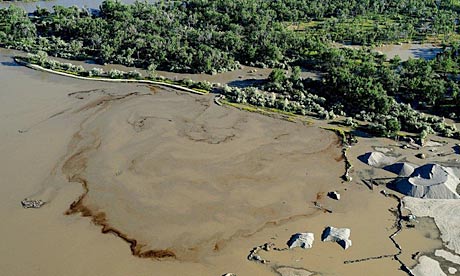
Oil swirls in the Yellowstone river after an Exxon Mobil pipeline ruptured near Billings, Montana.

Oil swirls in the Yellowstone river after an Exxon Mobil pipeline ruptured near Billings, Montana.

And then came the various ruptures of the existing pipeline in the Yellowstone River in 2011 and recently in an Arkansas neighborhood.  The New York Times reported

On Tuesday [April 2], vacuum trucks and crews were still working to clean up the accident, which the Environmental Protection Agency called a “major spill.” While it was unclear how much oil had leaked, Exxon Mobil said it had recovered thousands of gallons of oil mixed with water and had prepared for a spill as large as 420,000 gallons, though it said it believed that the amount released was smaller.

“Our focus is on the safety of the people in the community and restoring the environment as soon as we possibly can,” said Alan Jeffers, an Exxon Mobil spokesman. “We’re committed to the cleanup and will stay until it’s done.”

The spill appears to be the largest accident involving heavy crude since an Enbridge Energy pipeline spill in 2010 that dumped more than 840,000 gallons near Marshall, Mich., soiling a 39-mile stretch of the Kalamazoo River.

Somehow I can’t imagine what the interiors of the homes smell like.  The odor of the oil can permeate everything including furniture, rugs and bedding.

In addition to pipeline safety, I am learning more about the process of extracting the oil from the sand in Alberta.  Extraction of the oil releases CO2, uses water and by some estimates uses more energy to extract the oil than the oil produces.  So if our ultimate objective is to reduce dependence on fossil fuels and reduce green house emissions, extracting oil from the tar sands does not seem to be the answer.  The Scientific American has a long and interesting article on the subject.

TAR SANDS: At least 170 billion barrels of oil could be extracted from Alberta's oil sands deposits with today's technology. Image: © David Biello

TAR SANDS: At least 170 billion barrels of oil could be extracted from Alberta’s oil sands deposits with today’s technology. Image: © David Biello

If I understand the article, carbon is emitted twice:  once during the extraction and then, a will all oil, during the refining process which turns the oil into gas or heating oil.

The greenhouse gas emissions of mining and upgrading tar sands is roughly 79 kilograms per barrel of oil presently, whereas melting out the bitumen in place requires burning a lot of natural gas—boosting emissions to more than 116 kilograms per barrel, according to oil industry consultants IHS Cambridge Energy Research Associates. All told, producing and processing tar sands oil results in roughly 14 percent more greenhouse gas emissions than the average oil used in the U.S. And greenhouse gas emissions per barrel have stopped improving and started increasing slightly, thanks to increasing development of greenhouse gas–intensive melting-in-place projects. “Emissions have doubled since 1990 and will double again by 2020,” says Jennifer Grant, director of oil sands research at environmental group Pembina Institute in Canada.

In the U.S. State Department’s review of the potential environmental impacts of the Keystone project, consultants EnSys Energy suggested that building the pipeline would not have “any significant impact” on greenhouse gas emissions, largely because Canada’s tar sands would likely be developed anyway. But the Keystone pipeline represents the ability to carry away an additional 830,000 barrels per day—and the Albertan tar sands are already bumping up against constraints in the ability to move their product. That has led some to begin shipping the oil by train, truck and barge—further increasing the greenhouse gas emissions—and there is a proposal to build a new rail line, capable of carrying five million barrels of oil per year from Fort McMurray to Alaska’s Valdez oil terminal.

Then there’s the carbon hidden in the bitumen itself. Either near oil sands mines in the mini-refineries known as upgraders or farther south after the bitumen has reached Midwestern or Gulf Coast refineries, its long, tarry hydrocarbon chains are cracked into the shorter, lighter hydrocarbons used as gasoline, diesel and jet fuel. The residue of this process is a nearly pure black carbon known as petroleum (pet) coke that, if it builds up, has to be blasted loose, as if mining for coal in industrial equipment. The coke is, in fact, a kind of coal and is often burned in the dirtiest fossil fuel’s stead. Canadian tar sands upgraders produce roughly 10 million metric tons of the stuff annually, whereas U.S. refineries pump out more than 61 million metric tons per year.

Scientific American continues

In other words, tar sands are just a part of the fossil-fuel addiction—but still an important part. Projects either approved or under construction would expand tar sands production to over five million barrels per day by 2030. “Any expansion of an energy system that relies on the atmosphere to be its waste dump is bad news, whereas expansion of safe, affordable and environmentally acceptable energy technologies is good news,” Carnegie’s Caldeira says.

There’s a lot of bad news these days then, from fracking shale for gas and oil in the U.S. to new coal mines in China. Oxford’s Allen calculates that the world needs to begin reducing emissions by roughly 2.5 percent per year, starting now, in order to hit the trillion metric ton target by 2050. Instead emissions hit a new record this past year, increasing 3 percent to 34.7 billion metric tons of CO2 and other greenhouse gases.

If we are serious about climate change and serious about carbon emissions, we will not build the pipeline.  We can’t do much about what is going on in Canada, but we can not build terminals in Washington State and Alaska and stop pumping tar sands crude though existing pipelines.  It will be argued that gas at the pump is too expensive.  That is costs too much to heat one’s home in the winter and run air conditioning in the summer, but price is not determined solely by availability in the United States.  Energy is now a worldwide demand.  I hope President Obama does the right thing.

Photograph of the Yellowstone Larry Mayer/AP

Snowed in

The blizzard of 2013 is what we are calling it here in Boston.  And it is still snowing.  No cars allowed on the streets and highways, no public transportation.  Because of the blowing snow it is hard to figure exactly how much has fallen, but it is currently in excess of 20 inches and another 5 to 8 may accumulate before it is all finished.  Luckily we didn’t lose power but we are snowed in.  It is also cold currently 20 degrees.

From Boston.com (The paper is not being delivered today.  Also no mail.)

Hundreds of thousands of Massachusetts residents have lost power because of the mammoth blizzard that lashed Massachusetts with hurricane-force winds and dumped more than two feet of snow in some areas overnight.

The state is at a standstill, with residents hunkering down at home under a rare travel ban imposed by the governor on Friday, and the MBTA saying it will not be able to restore service today. Snowplows are out in force struggling to clear the roads, but the storm is expected to continue dumping snow into midday.

National Guard troops are heading to coastal communities to assist in possible evacuations due to giant waves whipped up by the storm that are expected to batter the beaches at high tide at 10 a.m., potentially devouring beaches and homes.

State emergency management officials said there were no reports of major injuries due to the storm, even though there were two truck rollovers and about 30 stranded motorists had to be rescued from the roads.

According to New England Cable News (NECN) the Governor had this to say

Governor Patrick says he’s impressed with the fact there have not been any serious injuries yet as a result of this storm.

“When you consider the scope of the storm and the severity of it, it’s really a minor triumph that we haven’t had serious injuries,” Governor Patrick said. “We had a couple people out last night, I guess, defying the ban and taking their chances, and we had vehicles driving the wrong way on the Pike, on Storrow Drive … but no serious injuries.”

I guess it takes all kinds!

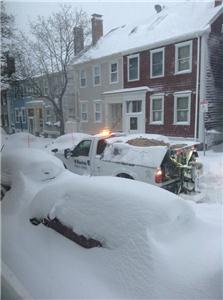
This picture was just posted on Boston.com

This is in the Charlestown section of Boston.

This is in the Charlestown section of Boston.

We have cousins who live in this area of town.  Like where we live, the streets are narrow and winding.

So why was the storm so bad?  Like Hurricane Sandy, two fronts converged over New England.  According to the Boston Globe

The fierce nor’easter that began walloping New England on Friday was the product of two storms that merged, causing a rapidly strengthening storm known in weather jargon as a “meteorological bomb.”

“We just have the right setup,” said Lance Franck, a National Weather Service meteorologist in Taunton. “It really is just a classic snowstorm.”

Forecasters said Friday night the storm remained on track to produce prodigious amounts of snow. But, in many ways, it reflects an utterly typical winter weather pattern, meteorologists said. Its path just happens to be dead-on, landing at a meteorological sweet spot to produce substantial snowfall in New England.

The jet stream that flows from west to east, 18,000 feet above the surface of the Earth, has two branches: a polar stream that takes a northerly route and a second, more southerly stream. When those branches converge, which is a pretty routine event during winter, snow is a possibility, as the frigid air from the north mingles with the humid air from the south.

“This winter has been interesting because the two streams have been largely separate,” Franck said.‘But the process of this happening isn’t unusual, it happens almost every winter.’

Until Friday.

This time, separate storms were brewing in each branch of the jet stream. The storm in the northern branch had deposited light snow in the upper Midwest. The storm in the southern branch had spawned rain in the mid-Atlantic, Franck said.

They separately swept toward New England, and by Friday night, meteorologists were saying the storms appeared destined to combine — very near a spot meteorologists call the “benchmark” because it is a pivotal spot for understanding how storms are likely to behave.

“The intersection point where the storms will ultimately become one . . . just south of Block Island, in that area — that’s just the perfect location,” said David Epstein, a meteorologist whose forecasts appear on Boston.com.

The bottom line is that the two fronts merged at the sweet spot to produce our blizzard.

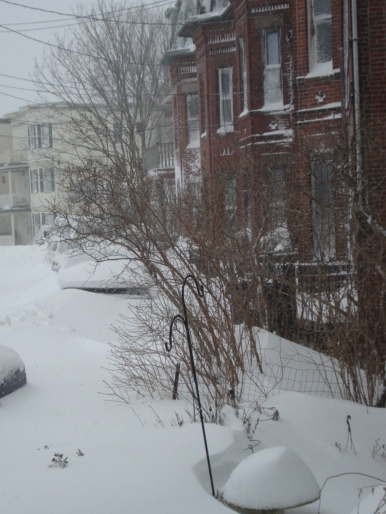
Here are some pictures I took from the house this morning.

my street

my street

The park across the street

The park across the street

Richard the Third the last Plantagenet

Richard III was, according to Shakespeare, one of the worst villans to rule England.  On the other hand, there were many, including Josephine Tey who believed otherwise.  And now, his bones have been found and identified.

The bones as discovered.

Greyfriars car park, Leicester, where the remains of King Richard III were found

Grey Friars car park, Leicester, where the remains of King Richard III were found.

According to the BBC

A skeleton found beneath a Leicester car park has been confirmed as that of English king Richard III.

Experts from the University of Leicester said DNA from the bones matched that of descendants of the monarch’s family.

Lead archaeologist Richard Buckley, from the University of Leicester, told a press conference to applause: “Beyond reasonable doubt it’s Richard.”

Richard, killed in battle in 1485, will be reinterred in Leicester Cathedral.

The Guardian detailed the careful science behind the declaration.

There were cheers when Richard Buckley, lead archaeologist on the hunt for the king’s body, finally announced that the university team was convinced “beyond reasonable doubt” that it had found the last Plantagenet king, bent by scoliosis of the spine, and twisted further to fit into a hastily dug hole in Grey Friars church, which was slightly too small to hold his body.

But by then it was clear the evidence was overwhelming, as the scientists who carried out the DNA tests, those who created the computer-imaging technology to peer on to and into the bones in raking detail, the genealogists who found a distant descendant with matching DNA, and the academics who scoured contemporary texts for accounts of the king’s death and burial, outlined their findings.

The skeleton’s injuries were consistent with accounts of Richard’s death.

Richard died at Bosworth on 22 August 1485, the last English king to fall in battle, and the researchers revealed how for the first time. There was an audible intake of breath as a slide came up showing the base of his skull sliced off by one terrible blow, believed to be from a halberd, a fearsome medieval battle weapon with a razor-sharp iron axe blade weighing about two kilos, mounted on a wooden pole, which was swung at Richard at very close range. The blade probably penetrated several centimetres into his brain and, said the human bones expert Jo Appleby, he would have been unconscious at once and dead almost as soon.

The injury appears to confirm contemporary accounts that he died in close combat in the thick of the battle and unhorsed – as in the great despairing cry Shakespeare gives him: “A horse! A horse! My kingdom for a horse!”

Another sword slash, which also went through the bone and into the brain, would also have proved fatal. But many of the other injuries were after death, suggesting a gruesome ritual on the battlefield and as the king’s body was brought back to Leicester, as he was stripped, mocked and mutilated – which would have revealed for the first time to any but his closest intimates the twisted back, a condition from an unknown cause, which began to contort his body from the age of about 10. By the time he died he would have stood inches shorter than his true height of 5′ 8″, tall for a medieval man. The bones were those of an unusually slight, delicately built man – Appleby described him as having an “almost feminine” build – which also matches contemporary descriptions.

According to the Boston Globe story

Richard III ruled England between 1483 and 1485, during the decades-long tussle over the throne known as the Wars of the Roses. His brief reign saw liberal reforms, including introduction of the right to bail and the lifting of restrictions on books and printing presses.

The discovery of Richard’s bones will not resolve the controversy surrounding him, however.  Most believe in the Shakespearean image of him as a the evil hunchbacked killer of two young princes in the Tower of London.

After I read Richard III in high school, my mother introduced me to Josephine Tey’s The Daughter of Time.  Her detective character, Alan Grant, takes up the case while in the hospital with the help of a young researcher who does the leg work.  The Wikipedia article about the book has a good summary of what Grant concluded and Tey believed.

The main arguments presented in the book in defence of King Richard:

  • There was no political advantage for Richard III in killing the young princes. He was legitimately made king.
  • There is no evidence that the princes were missing from the Tower when Henry VII took over.
  • Although a Bill of Attainder was brought by Henry VII against Richard it made no mention of the princes. There never was any formal accusation, much less a verdict of guilt.
  • Henry never produced the bodies of the dead princes for public mourning and a state funeral.
  • The mother of the Princes, Elizabeth Woodville, remained on good terms with Richard.
  • The Princes were more of a threat to Henry VII as the foundation of his claim to the crown was significantly more remote than theirs.

Grant and his American collaborator argue that there is little evidence of resistance to Richard’s rule (ignoring Buckingham’s rebellion). They allow that there were rumours of his murdering the princes during his lifetime, but they decide that the rumours had little circulation, and attribute them to the Croyland Chronicle and to the Lord Chancellor of France, and ultimately to Tudor sympathiser John Morton. They also propose that Morton was the actual author of Thomas More‘s biography of Richard, suggesting that the incomplete manuscript found after More’s death was an unfinished copy by More of Morton’s lost original. They conclude that the princes probably remained alive throughout Richard’s reign and were later killed by Henry.

The Richard III Society which sponsored discovery and will have his bones reinterred will still have work to do to clear his name.  Where are the alleged bones of the princes and can we now do DNA on them?

Photograph of car park Darren Staples/Reuters

Dovekie in Roxbury (Corrected)

[This post has been edited to correct the Laura Ingalls Wilder reference (I had the wrong book) and to expand with some quotes from The Long Winter.]

The dovekie is an Arctic bird that plays off the coast of New England near Georges’ Bank in the winter but I don’t think one has ever been found in my neighborhood before.  The Boston Globe had the story  and picture on last Friday. 

The dovekie, called a little auk in Europe, was dropped off at the Boston Rescue 2 firehouse on Columbus Avenue in Egleston Square on Thursday night, said Greg Conlan, a firefighter with Rescue 2.

Conlan said the small bird was brought into the station at 7 p.m. by three 10-year-old children.

The bird, which was in a box, looked plump but exhausted, he said.

“It looked tired. It definitely wasn’t going anywhere, but it wasn’t on its last leg or anything,” he said.

Firefighters named the dovekie Olive, the name given to every animal that comes through the firehouse, Conlan said. There is a cat and a turtle living at the station, both with the name Olive.

Here is Olive in her box.

Dovekie

The bird was transported to the New England Wildlife Center in South Weymouth, Boston Fire Department spokesman Steve MacDonald said.

Wayne Petersen, director of the Important Bird Areas program for the Massachusetts Audubon Society, received a call from the wildlife center this morning asking for advice about where to release the bird, he said.

“The bird was obviously blown into the city by the big storm on Thursday,” Petersen said. “It’s a species that once it’s on the ground, they have great difficulty taking off.”

He advised the caretakers to release Olive in waters not heavily populated by gulls, because the small bird could be prey for larger species.

The nice thing about the story is that 3 10 year old boys were thoughtful enough to try to take care of the dovekie by trying to feed it crackers [I’m sure they feed pigeon being city kids.] and then bringing it to the fire station.

In Laura Ingalls Wilder’s book, The Long Winter, a little auk lands near their house and the family releases it off Silver Lake.  “They had never seen a bird like it.  It was small, but it looked exactly like the picture of the great auk in Pa’s big green book, ‘The Wonders of The Animal World’.”  The little auk had been found in a haystack.  The next day Pa, Laura, and Mary go to release the bird.

He squatted down by the thin white ice at the lake’s edge and reaching far out he tipped the little bird from his hand into the blue water.  For the briefest instant, there it was, and then it wasn’t there.  Our amoung the ice cakes it was streaking, a black speck.

“It gets up speed, with those webbed feet,” said Pa, “to lift it from the….There it goes!”

This is the only other time I can remember hearing about them in unusual places.

No word yet on a successful release here in Boston, but we have been having a snow/rain and now wind storm for the last 24 hours so probably no one has tried yet.

Little auks when not in Egleston Square.

Little Auks

Little Auks (Photo credit: Alastair Rae)

Talking full moon

I woke up about 4:30 this morning with the moon shining through my window.  I hadn’t expected to see it as it had been cloudy when I went to bed.  This was an important full moon for several reasons.  First there was a partial penumbral eclipse and second, it was the smallest full moon of the year.

This full moon is called the Beaver moon by some native Americans and is also known as the Frosty moon.  This from the Washington Post

The U.S. Naval Observatory’s Geoff Chester offers the reasoning behind the name: “[The] name comes from Native American skylore reminding trappers to set their final traps for the season before the beaver ponds freeze up for the winter,” Chester writes.

Chester notes this moon is sometimes also referred to as the “Frosty Moon.”

So what is a penumbral eclipse anyway?  EarthSky explains

What can you expect to see during the November 28, 2012 penumbral lunar eclipse?  First, here’s what you will not see.  You won’t see a dark bite taken out of the moon by Earth’s shadow.  And you won’t see the moon turn blood red as during a total eclipse of the moon.  A penumbral eclipse is more subtle than either of these.  At the central part of the eclipse, you’ll see a dusky shading covering about 90% of the moon’s face.  By the way, that brilliant planet near tonight’s moon is the king planet Jupiter. The moon and Jupiter will be even closer together tomorrow night.

So, before you set your alarm clocks, consider yourself forewarned.  A penumbral lunar eclipse is not nearly as stark and obvious as an umbral eclipse of the moon. During an umbral lunar eclipse, the moon passes through the umbra– the Earth’s dark, cone-shaped shadow. During a penumbral eclipse, the moon passes through the light penumbral shadow surrounding the umbra. (See feature diagram at top.) Your best chance of noticing any penumbral shadow on the moon’s surface is at mid-eclipse (greatest eclipse) in a dark sky not obscured by dusk or dawn.

But the eclipse was not visible in Boston so all I saw was the smallest full moon of the year.  This was the smallest and least bright because the moon was at apogee or at the furthest point from the earth.  It might have been the smallest and least bright but it was still enough to wake me up.

This photograph is by Duke Marsh and was posted on EarthSky today.  The little dot at 10 o’clock is Jupiter.

The benefits of Massachusetts wind farms

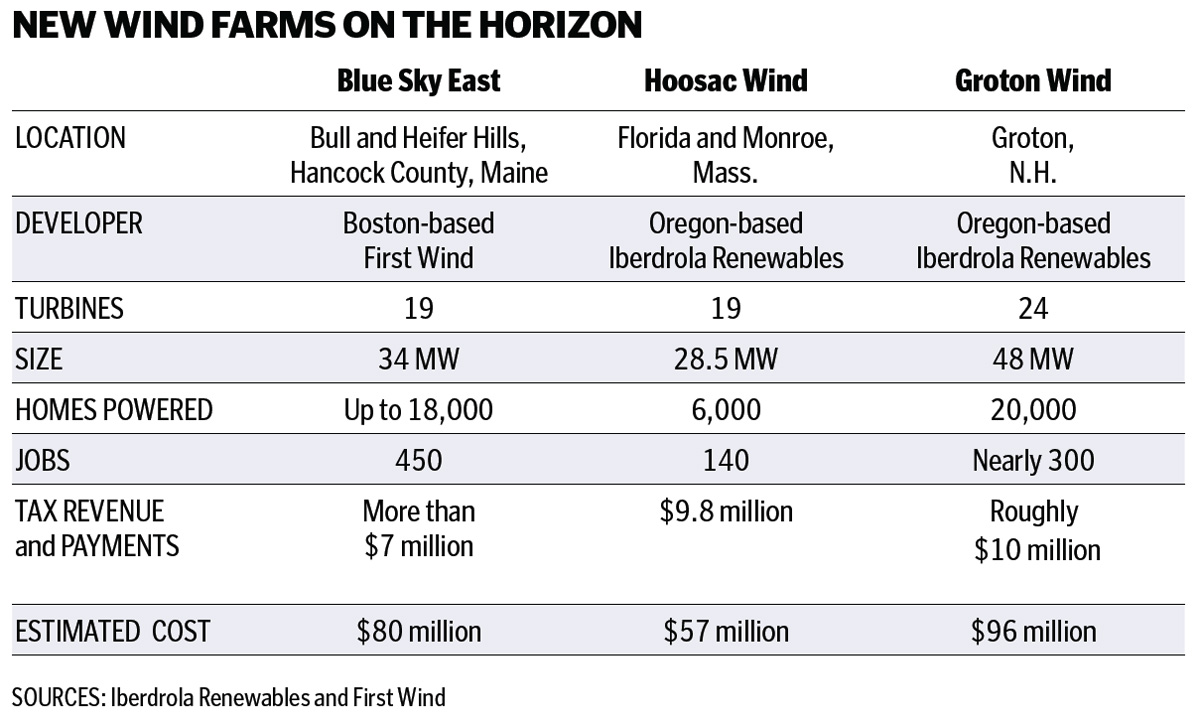
I’m hoping that with the election over we can get back to talking about energy independence in a way that includes alternate kinds of energy.  This chart which as in the Boston Globe the other day caught my eye.  As you can see,  they do create jobs and tax revenue for the local government.

Sandy from Boston: the day after

A little after 4 am this morning I was awakened by the full moon shining in my window. The winds had calmed, the rain ended and the clouds had parted at least momentarily.  The Old Farmer’s Almanac calls this the Full Hunter’s moon.  Now we have alternating sun and clouds.  (And a brief shower when I went out to buy Halloween candy.)

Boston and Massachusetts, except for the south coast, were as the Boston Globe put it in the headline to the Metro section, “still walloped” even far from the center.  After a while I just couldn’t watch television coverage as they showed Seaside Heights on the Jersey Shore basically under water.  I can only imagine what Long Beach Island where I often summered as a child looks like.  And Manhattan and the Red Hook neighborhood of Brooklyn.  Yes, Boston was lucky.

But we were not without damage which shows the size and strength of the storm.  That size and strength was magnified by that beautiful Hunter’s moon outside my window.  Here is how it works.  This is from the EarthSky News.

Of course, we all know the moon is primarily responsible for the rising and falling of ocean tides.  In most places, but not everywhere, there are two high tides and two low tides a day.  That’s true of the U.S. East Coast, where Sandy is having its effect.  That effect can’t be predicted precisely because – for any particular spot on Earth’s surface – the height of the tides and their fluctuation in time depends not only on the moon, but also on the sun – and also on the shape of the specific beach, the larger coastline, the angle of the seabed leading up to land, and the prevailing ocean currents and winds.

The difference in height between high and low waters varies as the moon waxes and wanes from new to full and back to new again.  The higher tides are called spring tides (nothing to do with season of spring).  The lower tides are called neap tides.  It’s a spring tides that’s happening around this weekend, as Sandy is sweeping closer to U.S. shores.

Around each new moon and full moon – when the sun, Earth, and moon are located more or less on a line in space – the range between high and low tides is greatest.  These are called spring tides.  Image via physicalgeography.net

Spring tides.  Full moon this month comes on October 29 at 19:49 Universal Time (or 2:49 p.m. Central Daylight Time in North America).  Around each new moon and full moon, the sun, Earth, and moon arrange themselves more or less along a line in space. Then the moon’s pull on the tides increases, because the gravity of the sun reinforces the moon’s gravity.  In fact, the height of the average solar tide is about 50% the average lunar tide.  Thus, at new moon or full moon, the tide’s range is at its maximum.  This is the spring tide: the highest (and lowest) tide.  Spring tides are not named for the season.  This is spring in the sense of jump, burst forth, rise.  So spring tides bring the most extreme high and low tides every month, and they happen around full and new moon.

It’s when a spring tide coincides with a time of heavy winds and rain – flooding due to a weather extreme – that the most extreme flooding occurs.  That’s the case this weekend.  There is one small bit of luck.  That is, the moon is not near perigee, or closest to Earth for the month.  In fact, the moon will be at apogee- farthest from Earth for the month – on November 1.  A full moon at perigee during a destructive hurricane would be bad news indeed.  A full moon at apogee is slightly less bad, but still bad.

So, yes the full moon didn’t help, but I guess it could have been worse.

This is from Quincy, MA just south of Boston.

Hurricane Sandy in Quincy, Mass. -- Photo couresty: Dawn Gaffney

Photograph by Dawn Gaffney

Leap Seconds

The rotation of the earth is slowing down and so we add a second to our clocks every once in a while.  The last time this happened was in 2008.  Another will be added this June 30.

A leap second is time added or subtracted to the atomic clock.

A leap second is a second, as measured by an atomic clock, added to or subtracted from Coordinated Universal Time (UTC) to make it agree with astronomical time to within 0.9 second. It compensates for the slowing in the Earth’s rotation and is added during the end of June or December. It is important to look at how seconds are used in relation to modern time keeping to gain an understanding of the concept of the leap second and why it is used.

The International Earth Rotation and Reference System Service (IERS) observes the Earth’s rotation and nearly six months in advance (January and July) a “Bulletin C” message is sent out, which reports whether or not to add a leap second in the end of June and December.

IERS schedules a leap second as needed to keep the time difference between atomic clocks and Earth’s rotation to below 0.9 seconds.


Leap Second Lives On, at Least Another Week


Seems pretty simple.  But somehow it has become controversial.  According to the New York Times

Opponents of leap seconds, led by the United States, say the sporadic addition of these timekeeping hiccups is a potential nightmare for computer networks that depend on precise time to coordinate communications.

But nations like Britain that wish to keep the current system say that eliminating leap seconds might create bigger problems.

They also oppose the uncoupling of time from the notion that the length of a day is tied to the motion of Earth and Sun. Because Earth’s rotation is gradually slowing, days are lengthening. Without leap seconds, noon on the clock would slide earlier and earlier in the morning.

This is a fight between nature and technology.  The decision about adding another leap second has been put off for three years but the leap second will be still be added in June.  This is how this will happen.

UTC Date UTC Time Local time world-wide
2012-06-30 23:59:57 Corresponding times
2012-06-30 23:59:58 Corresponding times
2012-06-30 23:59:59 Corresponding times
2012-06-30 23:59:60 Leap second added
2012-07-01 00:00:00 Corresponding times
2012-07-01 00:00:01 Corresponding times
2012-07-01 00:00:02 Corresponding times


How cats drink

This was supposed to be the only post (before I heard Dave Barry, that is) for today because with four cats anything and everything about them is fascinating.  We have one cat who plays with water and will drink from any place.  Mr. Bunter, like a dog, has been known to try to drink out of the toilet.  He also drinks out of the fish tank.  He used to drag the water bowl (a large heavy bowl glued to an old dinner plate) around the pantry.  Then we got a fancy waterfall drinking fountain and he tries to move that also.  The other three are more normal.

But now we have the physics of how cats drink.  Delicately without wetting the whiskers.  I went to get my glasses adjusted today at lunch and the optician, who also has cats, asked me if I had seen the story.  So cat lovers everywhere are talking about this discovery.  I always assumed it had something to do with the roughness of the tongue, but that would be wrong.

Cats, both big and little, are so much classier, according to new research by Pedro M. Reis and Roman Stocker of the Massachusetts Institute of Technology, joined by Sunghwan Jung of the Virginia Polytechnic Institute and Jeffrey M. Aristoff of Princeton.

Writing in the Thursday issue of Science, the four engineers report that the cat’s lapping method depends on its instinctive ability to calculate the point at which gravitational force would overcome inertia and cause the water to fall.

What happens is that the cat darts its tongue, curving the upper side downward so that the tip lightly touches the surface of the water.

The tongue is then pulled upward at high speed, drawing a column of water behind it.

Just at the moment that gravity finally overcomes the rush of the water and starts to pull the column down — snap! The cat’s jaws have closed over the jet of water and swallowed it.

The best part of the story is how they calculated the lapping speed based on cat size.  Who knew?  But then, who knew anything about how cats drink before this week?