
The Health Care Debate – mid-August

Everyone is talking about health care.  Sarah Palin thinks one of the House bills would lead a death panel.  Stephen Hawking defends the British system from attack by Americans.  Howard Dean thinks Palin is making things up.  And Christopher Hayes mocks us all proving that the Left has a sense of humor.

Sarah has retired as Governor of Alaska but she’s still posting on her facebook page.  CNN quotes her

In her post, the former Republican vice presidential candidate said President Obama’s health care plan would create a “death panel” that would weigh whether her parents or son Trig were “worthy of health care.”

This phrase, “Death Panel”, is now resonanting all around the country.  President Obama addressed it at his town hall meeting in New Hampshire.  Howard Dean tried to refute it

Former Democratic National Committee Chairman Howard Dean told CNN Sunday that former Alaska Gov. Sarah Palin had deliberately made up charges that the Obama administration’s health care bill would lead to euthanasia.“About euthanasia, they’re just totally erroneous. She just made that up,” he said. “Just like the ‘Bridge to Nowhere’ that she supposedly didn’t support.

“There’s nothing like euthanasia in the bill. I practiced medicine for a long time, and of course you have to have end of life discussions — the patients want that. There’s nothing… euthanasia’s not in this bill.”

In the past few years, I have been party to several end of life discussions most directly with my parents and more indirectly with my in-laws.  All have been conducted with the patient, family, and doctors.  Don’t we want our insurance, including Medicare, to pay the doctor for his or her time and encourage those discussions?

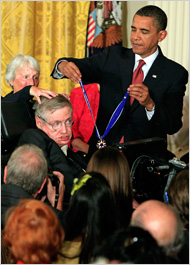
And now the British are weighing in also.  Yesterday, Stephen Hawking received his Presidential Medal of Freedom and jumped in with a response to the Investor’s Business Daily – which in it’s zeal appears to have forgotten that Mr. Hawking is British and under National Health.  The best summary is in the New York Times ,

The physicist Stephen Hawking is defending Britain’s National Health Service after an editorial in Investor’s Business Daily said Mr. Hawking “wouldn’t have a chance in the U.K.,” where the health service would have deemed his life “essentially worthless.”

The publication’s mistake, which came in an editorial titled “How House Bill Runs Over Grandma,” has since been corrected. But on a larger level, the snafu also shows how quickly rationing, particularly at the end of life, has become a focus of the health care reform debate.

Mr. Hawking — who received the Presidential Medal of Freedom at the White House on Wednesday — responded to the editorial this week, telling The Guardian newspaper, “I wouldn’t be here today if it were not for the N.H.S. I have received a large amount of high-quality treatment without which I would not have survived.”
DESCRIPTION

At this point, I fear for any type of health care reform.  New polls seem to show that older Americans oppose reform. The medical industry is threatening to pull support if legislation call for anything more that the co-op model.  Chris Matthews interviewed a man carrying a gun outside of the President’s New Hampshire town hall meeting.   I wonder if when they get back to Washington, there will be anyone left, Democratic or Republican, who wants to vote for health care reform.  Maybe they would prefer to just left the system explode or maybe implode.  Or we can be like Chris Hayes and try to laugh at the situation.

Here are parts of Hayes’  “Your Questions About Health Care Reform Answered”

Ok, so there’s been a lot of misinformation about proposals to reform the health insurance industry and provide (near) universal coverage. Understandable! It’s complicated stuff. Herewith, I’ll try to answer some questions

1) Is it true that all of the bills currently proposed would end the practice of “rescission,” whereby health insurance providers refuse to treat customers who’ve paid their premiums simply because they’ve become ill?

No! That’s a common misunderstanding. Actually, all of the bills would ban incisions, that is, they would legally bar surgeons from performing surgery until a panel of twelve gay illegal immigrant government bureaucrats unanimously signed off on the procedure.

2) Is it true that health care reform would ban insurers from refusing to insure people because of pre-existing conditions?

Wrong again. To get rid of health inequality, the bills actually mandate that every American be given a pre-existing condition. A National Illness Commission, with academics appointed from Harvard, Reed College and Berkeley, will evaluate each citizen, and based on their demographic profile, choose their malady. Each disease or syndrome is scored on a scale of 1 to 10, with 10 being the most severe. White christian men will receive pre-existing conditions of 8 or higher. Black people, “wise latinas,” and ACORN members will be exempted.

5) Will the current bills plug the “donut hole” in the Medicare prescription drug benefit so seniors don’t have to pay exorbitant out of pocket expenses for their medication?

Absolutely not. The legislation will ban donuts.

If you don’t laugh, you’ll have to cry.

The times they are a-changin’

(with apologies to Bob Dylan)

I spent a lot of years in Virginia as those of you who follow my blog may remember and I still try to follow the politics there as best I can from a distance.  This morning I ran across an interesting story in today’s Washington Post about Creigh Deeds.  So I went to the local Richmond paper and could find nothing to confirm the Post story, but did find some new poll numbers which may help explain the new Deeds tactic.

In an August 5th story, my old friend Jeff Schapiro wrote for the Richmond Times-Dispatch

For the second time in as many weeks, a published poll is showing Republican Bob McDonnell with a double-digit lead for governor over Democrat R. Creigh Deeds.

Public Policy Polling yesterday put McDonnell ahead of Deeds, 51 percent to 37 percent. Four weeks ago, the Raleigh, N.C.-based survey group reported McDonnell leading Deeds, 49 percent to 43 percent.

The poll suggests that McDonnell, a former state attorney general, is getting a lift from pushback among Virginians to President Barack Obama. Though he carried the state last year, his popularity is falling, apparently because of skittishness over the economy.

Jeff goes on to quote another old friends (and dissertation advisor), Bob Holsworth

Regardless, the new poll could stir concerns among Democrats — even in the depths of summer, when many voters aren’t focusing on politics — that Deeds, a state senator from Bath County, is in trouble, said analyst Robert D. Holsworth.

“At the moment, Republicans are far more enthusiastic about this elections than Democrats,” Holsworth wrote yesterday on his blog, VirginiaTomorrow. com.

“I still think there is plenty of time for the Dems to recover. But pulling the covers over your head and pretending that it’s still yesterday rarely works. The Democrats will have to recognize that the climate this year is vastly different than 2001, 2005 and even 2008.”

There are issues with the way the polls were conducted using the telephone push one if you are for McDonnell, two for Deeds method, but putting that aside it is what Creigh Deeds is doing to catch up that is most interesting.  According to the Post

Virginia Democratic gubernatorial candidate R. Creigh Deeds will launch a campaign this week to portray his opponent’s longtime efforts to restrict abortion as out of the mainstream, a potentially risky strategy for a Democrat in the once solidly conservative state.

Deeds (Bath), a state senator who supports abortion rights, said he will join female supporters in Annandale on Monday for the first of three events across the state where he will argue that Republican Robert F. McDonnell devoted too much of his 17 years in public office working to limit access to abortions. McDonnell has said he is against abortion in every instance, including rape and incest, except when the life of the mother is in danger.

There was a time when the politcally correct thing to say about abortion rights if you were a Virginia Democrat was that abortion was legal and the decision was a personal one to be made between the woman, her family and her doctor.

The early statewide pitch by Deeds is a bold gamble that the demographics and politics of Virginia have shifted so quickly and decisively that raising a divisive issue such as abortion, which Republicans attempted to use to their advantage for much of this decade, is now favorable to Democrats. Although advocates on both sides of the issue rank Virginia as one of the more restrictive states on abortion, a Washington Post poll in September found that 60 percent of Virginia voters said abortion should be legal in all or most cases, a number that has not changed significantly in recent years.

Deeds’s strategy is a departure from the approach that worked for the state’s past two Democratic governors, who generally played down touchy social issues and focused instead on the issues they said voters cared about more: traffic, schools and other quality-of-life issues.

Deeds said it’s important for voters to be aware of McDonnell’s deep commitment to antiabortion causes. As an example, he pointed to a speech McDonnell delivered to the National Right to Life Committee in Arlington County last year, in which the then-attorney general saluted “all you pro-life warriors for Virginia for all you’ve done to turn Virginia around and make it a pro-life state.”

I hope this works to motivate Democrats and women to vote.  As Bob Holsworth says there is plenty of time.  The economy is turning around and this gamble may do the trick for Deeds.

What Affirmative Action Means in Real Life

Sonia Sotomayor is now officially Justice Sotomayor.  She took the oath administered by Chief Justice John Robert a few minutes ago.

On Thursday afternoon when the Senate voted to confirm her, the newest Senator, Al Franken the former comedian from Minnesota, was presiding and announced the vote.  Is this a great country or what?

Anita Hill has a very interesting Op-Ed in today’s Boston Globe discussing the role of what she calls “educational democracy” played in Justice Sotomayor’s elevation to the Supreme Court.

A LATINA from a Bronx housing project is probably not what Woodrow Wilson envisioned when he called for “educational democracy’’ as president of Princeton University in 1910. Yet decades later, when Sonia Sotomayor ascended to the top of her class, his idea of an open and accessible university system was on its way to coming to fruition. In Wilson’s day, Princeton admitted no women and Wilson himself is said to have looked with disfavor on the admission of men of color. Nevertheless, educational reform was a springboard for his larger aims of social and political reform and his fight against “the rule of materialism in our national life.’’

Indeed, Wilson would have needed a high-definition crystal ball to foresee Sotomayor’s “incredible journey’’ to become an African-American president’s nominee to the Supreme Court. Yet, as a critical chapter in our country’s pursuit of educational equality, her story of hard work and high achievement is an extension of Wilson’s idea. She represents the positive change that can occur when social institutions – law and education in particular – shed their roles as tools for exclusion and open their doors to those previously barred. It took nearly 220 years for the first Latina justice to be appointed to the Supreme Court, but, in a country constitutionally committed to equal opportunity, it was inevitable.

It was under President Wilson that women gained the right to vote – a reward for suspending demonstrations for suffrage during World War I.  And I’ve always thought that Edith Wilson had influence here also even though I don’t believe that any historical facts have ever surfaced to proved this.

Hill goes on

Sotomayor is poised to prove that the social experiment of the 1970s built on the idea of educational democracy has, thus far, worked. For its full realization, President Obama must correct the documented shortcomings of public schools that weigh most heavily on poor and minority community schools. We can’t be satisfied with one Sonia Sotomayor when we have the potential for so many more. For now, with her confirmation as the first Latina and third woman on the Supreme Court, Obama has reminded us of what egalitarian ideals and the will to pursue them can accomplish.

I think Hill is right.  Educational democracy leads to a critical mass of women, African Americans, or other ethnic minorities ready to take on jobs and challenges that have not been open to them in the past.  This leads to a cascade of changes in our society such as the election of the first African American President. 

I think it is the loss of this exclusivity that has the white Republican men on the Senate Judiciary Committee so frightened.  Perhaps they have seen all along where affirmative action or educational democracy was going to lead and why they have been so opposed to change.  But that is probably giving them too much credit and they are just frightened of change that puts them in a position where they are no longer superior.  One where they have to share power and priviledge.

Congratuations, Justice Sotomayor!  And may the President’s next appointment be someone as wise as you.  Perhaps a wise Asian American man or woman or a wise African American woman.  Mary Frances Berry, anyone?

Liar, Liar

Interesting story on NPR tonight.  A group called PoliFact is following the health care debate.

Bill Adair, editor of PolitiFact and the Washington bureau chief for the St. Petersburg Times, tells Melissa Block that one group that opposes an overhaul says the health care bill allows illegal immigrants to get free medicine.

“We gave that our lowest rating on our Truth-O-Meter: a pants on fire,” he says. “To the contrary, there’s language [in the bill] that says that undocumented aliens would not be eligible for the credit under this plan.”

The claim came from a chain e-mail that included many other assertions, including one that said a “health choices commissioner” would decide health benefits and that individual consumers would have no choices. This claim, too, got a “pants on fire” from PolitiFact.

“This chain e-mail is very persuasive in many ways because it has specific language, page numbers from the bill, but when you look at what it uses to back up a claim like that, it’s just not true,” Adair says. “There is a health commissioner that would be responsible for running the exchange under the main bills that have been discussed, but it’s not like that person would say you couldn’t get coverage or you could. That person would just be responsible to administer what the general standards were for the programs.”

Bogus claims aren’t just coming from those who oppose an overhaul. Democratic Rep. Russ Carnahan of Missouri recently claimed that the Congressional Budget Office estimated the current plan would create a $6 billion surplus over 10 years. Adair’s group has rated that as false.

“That really was a little bit of budget trickery there,” he says. “He is wrong that the CBO said this. The CBO said that the health care plan would post a deficit of something like $239 billion, something like that.

“What he’s doing is including some other numbers to try to erase that and actually make it look like a $6 billion surplus, but that’s not what the CBO says.”

Very interesting.

Where are the Republican Ideas?

The Democrats have large majorities in the House and Senate.  The President is a Democrat.  I believe the majority of governors are also now Democrats.  And being Democrats, they are bickering among themselves about the details of things they all agree need to be done.  It seems to me this would be a perfect opportunity for the Republicans to offer a substantial plan on, say health care.  Instead, we have the birther movement.  Newsweek has published the President’t birthcertificate to celebrate his birthday.

But the birthers are sure this is fake.

Back to health care.  Congress is back home this month and holding town meetings.  Instead of offering alternative and maybe asking some reasonable questions, the Republican strategy is to scream and disrupt these meetings.  In fairness to them, this is not a tactic they invented (as much as Dick Armey’s lobbying firm might want to think they did).  Chris Hayes  in his blog in the Nation looks at the situation this way

I’m on a team in American politics: I’m proudly, vigorously on the left. So there’s no need to bend over backwards to be formally consistent. That said, intellectual honesty requires one to separate out one’s formal objections from substantive ones and I’ve been given pause by the remarks of some right-wing activists like Jon Henke. He and others have been saying: wait a sec, when the left shows up and makes noise somewhere it’s activism, but when the right does it it’s thuggery and mob rule?

So after discussing the issue on Maddow last night, I’ve been asking myself, aside from the deep substantive opposition I have to the tea-baggers’ ideological agenda (and the insane hypocrisy of people on Medicare screaming about the dangers of government-run health care), what, exactly, my beef is?

I don’t think there’s anything “wrong” with the tactics of those people who, with the facilitation of large monied interests, are organizing and shouting down their opponents at town hall meetings. But one thing should be clear: these are the tactics of a small, motivated, enraged and engaged minority. The footage of recent town hall scrums remind me, actually, of ACT-UP actions back in NYC when I was growing up. ACT-UP, the AIDS and gay rights group that flourished in the 1980s and 1990s, was impassioned and angry and used dramatic confrontational action to great public effect. They were a vanguard. They were a small, tightly coordinated impassioned minority. And they were fundamentally on the right side of history.

What frustrates me, however, is that no one in the press confused ACT-UP with broader public opinion. No pundits said “the public is clearly feeling rising unease about government inaction on AIDS, as evidenced by the latest ACT-UP protest.” Why? Because they were gay, and they had AIDS and they didn’t look like “average citizens” or “heartland” voters.

At their root, the town hall protests are a very similar phenomenon. I think these people, unlike ACT-UP, are wrong. Deeply wrong. (They’re also not literally fighting for their lives because of a homophobic and indifferent government, but that’s neither here nor there). But they’re a small, tightly coordinated, enraged minority. They want to scream and fuss, it’s a free country, as they say.

The problem is the overwhelming instinct on the part of pundits and the MSM to look, and see old white men in overalls and Legionnaire hats and think they are watching someone give voice to the sentiments of broad swaths of the electorate. And it’s just not true. What we’re seeing at these events are the voices of radicals, extremists and zealots.

Harold Myerson writing in the Washington Post points out that the protesters are overwhemingly not people of color.

Last weekend, right-wing Republicans stormed a number of such meetings across the country, shouting down members of the House and, in Philadelphia, Sen. Arlen Specter and Health and Human Services Secretary Kathleen Sebelius. In Austin, protesters blocked Democratic Rep. Lloyd Doggett’s car and made it impossible for him to talk to constituents about such matters as appointments to military academies.

What’s particularly curious about these two protests is that they took place on very liberal turf — Philadelphia and Austin — yet the local liberals and people of color seemed absent. Philadelphia is a heavily African American city, yet one strains to see any blacks among the protesters on the YouTube clips. The activists who have been whipped into a frenzy, and who have dominated the recess meetings so far, appear to be conservative whites.

The question, as Meyerson goes on to ask, is why aren’t people of color, the young folks who worked for Obama, the progressives and the liberals turning out for the town hall meetings?   Meyerson again

When future historians look back at this passage in our nation’s history, I suspect they’ll conclude that this Obama-isn’t-American nuttiness refracted the insecurities and, in some cases, the hatred that a portion of conservative white America felt about having a black president and about the transformation of what many thought of as their white nation into a genuinely multiracial republic. But whatever the reasons, a mobilized minority is making a very plausible play to thwart a demobilized majority.

So we have a black President that one whole segment of the population (77% of Americans think he is a citizen but only 42% of Republicans think he is)  thinks is not really not President trying to reverse the slide into economic inequality and to promote racial equality at the same time.  This is a time when we should be having great debates about ideas not screaming at each other about where the President was born.

A genuine debate about ideas would help create better legislation and make the Democrats sharpen their ideas.  Maybe it would get those of us who support health care reform out to town hall meetings to talk about ideas.  But, unfortunately, the Republican party seems to be out of ideas.

Beer, Politics and Race

I ‘m going with Eric Asimov  from the New York Times on this one.  Today in his blog “The Pour” he wrote

I’ll tell you what I would have done if I were President Obama. First of all, I wouldn’t give anybody a choice. I’d throw political symbolism out the door. Then, I’d import a keg of Guinness Stout directly from Dublin, because the kegs from Ireland are simply superior to anything out of a bottle or can. Then I’d import a Dublin publican to serve the Guinness because drawing a proper pint is an art that requires vast experience.

Then, I’d sit ’em down at a bar (because I’d bring in the actual pub – this is the White House, it can do anything). “Gates, you, over there. Crowley, you, here. Sit. Publican, draw us some pints!’’

And as that smooth, deep, dark stout begins to pour forth, and the publican perhaps tells a few stories in his rich Irish brogue, a feeling of calm brotherhood settles over the room. You cannot fight over the first Guinness. Add in 10 more pints and a rugby match and you’ve got a riot. But a pint of Guinness in a Dublin bar at the White House? Skip? Jim? I think this is the beginning of a beautiful friendship.

In the end, the two of them will be doing ads for Guinness.

A possible site of the gathering between President Obama, Henry Louis Gates, Jr., and Sgt. James Crowley.

No, Gates and Crowley won’t be doing Guinness ads but I see a PBS special on racial profiling in their future.  Crowley is, as evidenced by his press conference after the event, is an articulate guy.

And what I really want to know if why no one offered to take Professor Gates’ and Sergeant Crowley’s jackets.  It is July in Washington.

By the way, I had a Harp – out of the bottle.

So what’s up with the Democrats and Health Care

Will the Blue Dogs kill Heath Care reform or can Nancy Pelosi, Ted Kennedy, and the President prevail?

Here is a blog entry by Christopher Hayes from July 28 titled “What the Hell Is Max Baucus thinking!?!”

The following comes from a reader and frequent correspondent. This is not someone with particularly progressive politics. In fact, he only very recently has come to identify as a Democrat. No radical lefty, he.

 I don’t get the democrats on this one. Even if Charles Grassley and Olympia Snowe vote for this deal, the Republicans will still run against it as the Obama/Pelosi plan. Why not stick to your guns, treat the problem from a parliamentary perspective, and put through a plan that you actually think is optimal. The current attempt won’t protect their downside at all and may limit the upside. Very frustrating.

 More than frustrating. Enraging.

That’s it, the entire entry.  A lot of us are asking the same question.

Then there is my health care guy, Howard Dean.

Howard Dean guest hosted Countdown with Keith Olbermann at an opportune time last night, following reports that the Senate Finance Committee–helmed by Montana Democrat Max Baucus–is preparing to exclude a public option from its long-awaited healthcare bill.

“What if the Senate Finance Committee has already done the Republicans’ dirty work for them?” Dean asked rhetorically at the beginning of show.

Dean has just authored a book on healthcare reform–detailing why America needs a public option–and knows quite a bit about the subject from his years as a doctor and governor of Vermont. He called Baucus’s reported bill the “so-called compromise.”

Dean asked Chris Van Hollen, chairman of the Democratic Congressional Campaign Committee, why Baucus would “give away something something so fundamental to healthcare reform as a public option?”

“We‘ve got to have a public option in the plan that we send to the president‘s desk,” Van Hollen responded. “We‘re all still hoping that the Senate Finance Committee bill will have a public option.”

Dean noted that 72 percent of Americans, according to a New York Times poll, support a public option. “Is what Americans want already dead in the Senate?” Dean asked.

“No,” Van Hollen answered. “I certainly hope not. It‘s certainly not dead with respect to the bill that we‘ll send to the president‘s desk.” But it isn’t clear what kind of leverage House Democrats have with the likes of Baucus, nor do we know yet whether they’ll be able to keep their own Blue Dog conservatives in line.

“Voters were promised change they can believe in,” Dean told Van Hollen. “Are you concerned about what may happen to our party in 2010 or 2012 if we don‘t get any change at all?”

I’m not quite sure why the Blue Dogs and the Republicans are so afraid of the public option.  Health care for veterans which works pretty well is public as is Medicare.  So back to Chris Hayes and his post from today.

This has got me thinking: Republicans opposed Medicare when it was created. They hate socialized medicine, government-run health care and the public option now. So why don’t they put their money with their mouths are and propose scrapping Medicare? Any bills like this been introduced? If not, why not? I seriously think every single conservative and Republican caught railing against government run healthcare needs to be asked if they support disbanding Medicare.

Doing the Beer Run

Yesterday, amid all the release of the 911 tape, the radio chatter, and the arrest report (which appeared to show that the arrest report may not have been 100% accurate) came the big news :  The profiler, the profiled and the President will be having a beer and a chat at the White House on Thursday night.  I think this is an excellent thing and maybe some greater good will come out of it, if not for the country as a whole, but  for the City of Cambridge.  Perhaps Mayor Simmons can get Crowley and Gates to lead the public forum she is planning.

And according to Robert Gibbs’ discussion with a reporter at his briefing yesterday, he and the reporter will be doing the beer run.  This exchange reported in Politico.com

The planned reunion was the subject of light-hearted banter at Gibbs’ briefing on Monday:

Q: Okay. And another subject, Officer Crowley is drinking Blue Moon, we hear Professor Gates is drinking Red Stripe or Becks — what’s the President drinking?

 MR. GIBBS: The President had a Budweiser at the All-Star Game, so — why are you looking at me like that? That’s what he drank.

 Q: We’re talking Blue Moon, Red Stripe, Becks —

 MR. GIBBS: What’s wrong with Budweiser? Why do you hate Budweiser? (Laughter.)

 Q: Well, he could get —

 MR. GIBBS: Why do you hate Budweiser, Wendell? (Laughter.) Wendell, how about this — how about you and I, we’ll go pick out the beer, we’ll do the beer run. Uh-oh, hold, please. (Laughter.)

 Q: I’m happy to do that.

All joking aside, I think this is an important meeting and, as someone, maybe the President himself, said a teachable moment.

I’ll be having either a Harp or a Red Stripe.

The Police, Henry Louis Gates, Jr. and Racial Profiling

I know the controversy is just beginning.  Volumes will be written about the incident in Cambridge.  Both sides will defend themselves and blame the other side.  Everyone will play the race card.  People who already mistrust President Obama because of his skin color will use his remarks as proof they are right.

The best commentary I’ve seen on the incident so far is from Joan Vennochi writing this morning in the Boston Globe.  In her regular op-ed column Vennochi wrote

The arrest of Henry Louis Gates Jr. by a Cambridge police officer is playing out along racial lines. But it’s also about power and machismo – on both sides.

Machismo.  That’s the key.  Gates, whether true or not, felt he was being treated differently than a white man would be in his own home.  Years of disparate treatment combined with the ego that comes from being an important and respected person in your field, caused him to lose his temper.  The police sergeant, James Crowley, faced with a potential break-in and a tired angry man reacted, not by backing down, but by arresting him.

Gates was in his own home when a Cambridge police officer responded to a call about a possible break-in at that address. The professor had just returned home from filming a documentary in China. His front door was stuck shut and his taxi driver helped him pry it open. Then, Sergeant James Crowley appeared at his door and demanded to see identification. Gates provided it, although some facts about how and when are in dispute.

The police report states that Gates was arrested after exhibiting “loud and tumultuous behavior, in a public place, directed at a uniformed police officer who was investigating a report of a crime in progress.’’ Gates disputes some information provided in the police report, but does acknowledge that he responded with anger.

Human beings of all races have a tendency to react as Gates did, especially when they are tired, frustrated, and privileged. Police officers usually don’t like it. The question is whether this police officer responded more harshly because of skin color.

The answer isn’t obvious, but both men could use some sensitivity training. Gates shouldn’t have yelled at the police officer; still, what he did was irritating, not criminal. Once the officer determined Gates did live in the house, he should have left, no matter what the professor was shouting.

Harvey Silverglate, a criminal defense lawyer, civil liberties defender, and Harvard Law School graduate, believes Gates’s arrest should be investigated, but not only because of its racial implications: Was Gates arrested and held as a way to teach him a lesson? If so, asks Silverglate, “Is this acceptable, regardless of whether the citizen is white or black?’’

In an ideal world, no. When it happens to a black man, racism may be the easy explanation, but that doesn’t make it the only explanation. Life and power in 21st-century America are more complicated than that.

President Obama at his July 22 press conference offered this

Wednesday night’s press conference seemed to be a different deal as the president leaped into a highly charged controversy that has ignited passions across talk radio, the blogosphere and the old-fashioned water cooler.

But in fact, racial profiling was a major issue for Mr. Obama when he was in the Illinois legislature. He was the chief sponsor of a bill, which became law, that requires police to record the race, age and gender of all drivers they stop for traffic violations and for those records to be analyzed for evidence of racial profiling.

Mr. Obama, asked Wednesday what the incident said about race relations in America, noted up front that Professor Gates is a friend and that his comments might be biased. He said “words” had been exchanged and added:

“Now, I don’t know, not having been there and not seeing all the facts, what role race played in that, but I think it’s fair to say, number one, any of us would be pretty angry; number two, that the Cambridge police acted stupidly in arresting somebody when there was already proof that they were in their own home; and, number three, what I think we know, separate and apart from this incident, is that there is a long history in this country of African-Americans and Latinos being stopped by law enforcement disproportionately. And that’s just a fact.” He added later that the incident was “a sign of how race remains a factor in this society.”

He also used biting humor, grinning broadly as he imagined being in Professor Gates’s seemingly preposterous circumstance of being arrested after trying to get into his own home.

“Here, I’d get shot,” Mr. Obama said, referring to his new address of 1600 Pennsylvania Avenue.

The whole racial profiling question becomes curiouser and curiouser as we learn that the officer involved spent time at the police academy teaching racial profiling.

I heard a discussion this morning on MSNBC’s Morning Joe in which Joe Scarborough talked about the serious question of racial profiling and admitted that he would have probably had a similar reaction to Dr. Gates’ and likely would not have been arrested.  Perhaps what we need is a discussion of racial profiling and we can begin with a civil dialogue between Sergeat Crowley and Dr. Gates – an expert police profiler and one who has been profiled.  They both need to lose their machismo and have a serious talk.  No one would have to lose face and no one needs to apologize. Oh and yes, as Joan Vennochi suggested let’s throw in some sensitivity training.