The President and Joe Wilson

Another President plagued by another Joe Wilson.  This is not President George W. Bush and the Ambassador Joe Wilson who exposed part of the rational for the Iraq War and then had his undercover CIA operative wife, Valerie Plame, outed.  This is President Barack Obama heckled by a Republican Congressman Joe Wilson during a speech to a joint session of Congress.  And who is Congressman Wilson?  Aldele Stan has posted “14 Things You Need to Know About Obama Hecker, Joe Wilson” on Alternet.  So here are a few.

1. Like his ideological counterpart known as Mr. The Plumber, his real name is not Joe. It’s Addison. His middle name is Graves. That makes him Addison Graves Wilson.

3. Wilson served as an aide to the late segregationist Senator Strom Thurmond, who is credited with conducting the longest filibuster in Senate history — against the 1957 civil rights bill.

5. A large percentage of Wilson’s campaign contributions come from the health sector, according to OpenSecrets.org. Over the course of his eight-year congressional career, Wilson has collected $414,000 from the health sector, topped only by contribution from what OpenSecrets calls the “finance, insurance & real estate” sector, from which he has gleaned $455,000.

7. Wilson is an adamant opponent of health care reform. As reported by The Hill, his last Tweet before his heckling performance at Obama’s speech read, “Happy Labor Day! Wonderful parade at Chapin, many people called out to oppose Obamacare which I assured them would be relayed tomorrow to DC.” (Wilson is currently the top trending topic on Twitter, and has nearly doubled his number of followers since his outburst.)

8. A military veteran whose health-care coverage is set for life, even after he retires from Congress, Wilson has “voted 11 times against health care for veterans in eight years, even as he voted ‘aye’ for the Iraq War…, ” according to Adam Weinstein, an uninsured Iraq-war veteran, writing at Newsweek’s The Gaggle. “He voted to cut veterans’ benefits─not his own─to make room for President George W. Bush’s tax cuts,” Weinstein says. “He repeatedly voted for budgets that slashed funding to the Veterans Administration and TRICARE. And perhaps most bizarrely, he refused — repeatedly — to approve Democratic-led initiatives that would have extended TRICARE coverage to all reservists and National Guard members, even though a disproportionate number of them have served multiple tours in Iraq and Afghanistan — and many lost access to their civilian work benefits when they did so.”

10. Wilson served in the Reagan administration as deputy counsel in the energy department.

Unfortunately, South Carolinians seem to like him and agree with him.  The New York Times reports

“Yeah, it was rude, but somebody needed to say it,” said Susan Wahl, 41, a homemaker in this town of 800 outside Columbia. “Ordinary people can’t just get up and tell Obama he lied. He said something we all wanted to say.”

Maybe Ms. Wahl wanted to say it.  I wanted to say rude things as I watched Representative Eric Cantor pay attention to nothing but his Blackberry or iPhone or what ever he was playing with.  And I did cheer when President Obama called out opponents of health care reform asking them to talk rationally about ideas and not spread myths about the contents of the legislation.  But, Ms. Wahl and I were watching at home and Representative Wilson was on the floor of the Congress where, I believe, calling anyone a liar is outside the bounds of established decorum.  Here is more from the Times

Some Republicans noted that President George W. Bush drew derisive hoots from Democrats when he made his case for Social Security changes during his 2005 State of the Union address. But Mr. Wilson’s Republican colleagues overwhelmingly took the position that he had exceeded the bounds of Congressional decorum and that he took the right step by quickly admitting it.

“His behavior was inappropriate,” said Representative John A. Boehner of Ohio, the House Republican leader.

Other Republicans said the outburst was also counterproductive, providing a political bonanza for Democrats, feeding the party’s story line that the August uproar over the health proposals was fed by boorish Republicans and orchestrated attacks.

It is difficult to see how this will play out in the long run.  Those of us outside of South Carolina can contribute to Rob Miller, the Democrat who is running against Mr. Wilson – and people can contribute to Wilson.  Miller has a tough road to victory.  As for the fate of health care reform, that is a wait and see also.

Facts for the Health Care Debate

Anyone who reads this blog regularly already knows that I am in favor of reform all the way to single payer.  However, with single payer not an option, I have been sending email and writing everyone , including President Obama, that we need to keep the public option.  I don’t believe anything will really change without it.  But the debate has really degeneated.  Things are being presented as “fact” that are not true, but once said take on a life of their own.

This week Newsweek presented a two-page spread by Sharon Begley titled “The Five Biggest Lies in the Health Care Debate”.  But I think there are actually 6.  The quotes are from Begley; the comments are mine.

1) There will be electric funds transfers out of your bank account that you will not control.

 Take the claim in one chain e-mail that the government will have electronic access to everyone’s bank account, implying that the Feds will rob you blind. The 1,017-page bill passed by the House Ways and Means Committee does call for electronic fund transfers—but from insurers to doctors and other providers. There is zero provision to include patients in any such system.

2) You’ll have no choice in what health benefits you receive.

In fact, the House bill sets up a health-care exchange—essentially a list of private insurers and one government plan—where people who do not have health insurance through their employer or some other source (including small businesses) can shop for a plan, much as seniors shop for a drug plan under Medicare part D. The government will indeed require that participating plans not refuse people with preexisting conditions and offer at least minimum coverage, just as it does now with employer-provided insurance plans and part D. The requirements will be floors, not ceilings, however, in that the feds will have no say in how generous private insurance can be.

3) Older patients and the very sick will not get treatment.  This is related to the Stephen Hawking myth.  The one that he would be dead now if he were getting benefits under the British health care system.  Only he is under the British National Health and as of this morning is alive and still doing his work.

The House bill does not use the word “ration.” Nor does it call for cost-effectiveness research, much less implementation—the idea that “it isn’t cost-effective to give a 90-year-old a hip replacement.”The general claim that care will be rationed under health-care reform is less a lie and more of a non-disprovable projection (as is Howard Dean’s assertion that health-care reform will not lead to rationing, ever). What we can say is that there is de facto rationing under the current system, by both Medicare and private insurance. No plan covers everything, but coverage decisions “are now made in opaque ways by insurance companies,” says Dr. Donald Berwick of the Institute for Healthcare Improvement.

What I don’t understand is why wouldn’t we want to know what is most effective so we can all be treated in the best, most cost effective and beneficial way.

4) Illegal Immigrants will get free health care.  I think they already do when they go to emergency rooms and our insurance premiums reflect that cost.

Will they be eligible for subsidies to buy health insurance? The House bill says that “individuals who are not lawfully present in the United States” will not be allowed to receive subsidies.

Can we say that none of the estimated 11.9 million illegal immigrants will ever wangle insurance subsidies through identity fraud, pretending to be a citizen? You can’t prove a negative, but experts say that Medicare—the closest thing to the proposals in the House bill—has no such problem.

5) There will be death panels making decisions about who gets treatment.   Related to #)3, this has been debunked all over but still lives particularly in the minds of Betsey McCaughy and Sarah Palin.

This lie springs from a provision in the House bill to have Medicare cover optional counseling on end-of-life care for any senior who requests it. This means that any patient, terminally ill or not, can request a special consultation with his or her physician about ventilators, feeding tubes, and other measures. Thus the House bill expands Medicare coverage, but without forcing anyone into end-of-life counseling.

I’ve had a lot of older relatives who have had end of life discussions with their doctors to decide on the level of treatment desired.  Everyone found them comforting and helpful to have decisions made.

6)  The government will set doctor’s wages.  I believe that one way to control costs is to put doctor’s on salary rather than fee for service which often ends up in many extra tests as the doctor and his or her practice tries to pay for equipment and up the billing.  However the proposed bills do not do this.

This, too, seems to have originated on the Flecksoflife blog on July 19. But while page 127 of the House bill says that physicians who choose to accept patients in the public insurance plan would receive 5 percent more than Medicare pays for a given service, doctors can refuse to accept such patients, and, even if they participate in a public plan, they are not salaried employees of it any more than your doctor today is an employee of, say, Aetna. “Nobody is saying we want the doctors working for the government; that’s completely false,” says Amitabh Chandra, professor of public policy at Harvard’s Kennedy School of Government.

I close with the picture Newsweek chose to accompany this story.

Town Hall Face:   An unsightly condition caused by unsanitary health-care politics

Joe Scarborough: convert to single payer?

Congressman Anthony Weiner appeared on Morning Joe last week to talk about health care reform.   Weiner, from New York, is a leader of the progressive caucus.  I find Scarborough an interesting character.  He is a former congressman from Florida who is a conservative, but in my opinion is more of an old fashioned Republican than most in Congress today.  He often scolds his fellow Republicans.  On the rare occasions I get to watch Morning Joe, I have found it very interesting.  But back to Weiner’s appearance last week.  The summary is from Leslie Savan’s account in the Nation which contains a link to the video.

Weiner, who recently warned that President Obama could lose as many as 100 votes on a health bill if a public option is not included, really wants single payer–Medicare for all Americans is his goal. What a crazy, way-out, reckless notion, Joe went into their encounter believing. But Weiner asked some simple, direct questions that no politician, much less Obama or HHS Secretary Kathleen Sebelius, has managed to pose:

What is an insurance company? They don’t do a single check-up. They don’t do a single exam, they don’t perform an operation. Medicare has a 4 percent overhead rate. The real question is why do we have a private plan?

“It sounds like you’re saying you think there is no need for us to have private insurance in healthcare,” Joe asked at one point.

Weiner replied: “I’ve asked you three times. What is their value? What are they bringing to the deal?”

And then Joe sees the light

He even repeated Weiner’s points clearly: The goverment would take over only the “paying mechanism” of healthcare, not the doctors or their medical decisions themselves. His ears perked up every time Weiner mentioned that the nonprofit Medicare spends 4 percent on overhead, while private insurers spend 30 percent.

And Joe, who has been criticizing mob rule at town halls, seemed to appreciate the way Weiner counters the fearmongering over Medicare: After decades of railing against the program’s wasteful, “runaway” spending, Republicans have done a 180 and are now trying to scare seniors that the Democrats’ proposed Medicare cuts will come directly from their medical care and not, as is actually proposed, from wasteful, stupid practices in the system–like, as Weiner mentions, putting people into a $700-a-night hospital bed when all they really need, and often prefer, is a visit by a homecare attendant in the two-digit-a-day range.

And here is my favorite part

Maybe the real turning point came when Weiner asked, “How does Wal-mart offer $4 prescriptions?” Joe and co-host Mika Brzezinski looked as if they’d been thwacked by a hardback copy of Atlas Shrugged, and sat back to let the congressman explain it all to them:

They go to the pharmaceutical companies and say, “Listen, we have a giant buying pool here. You’re going to give us a great deal.”

Who’s bigger than Wal-Mart? We are, the taxpayers. Do we do that? No. Because we have outsourced this to insurance companies who don’t have necessarily as much incentive to keep those costs down because, frankly, they are getting a piece of the action.

Progressives tend to understand this stuff, but many conservatives won’t trust such logic, especially in the abstract, which is how most Dems have been communicating. But Weiner, aware that if you can’t visualize something it ain’t going to stick, argued with a specific, familiar visual–that of a successful, supercapitalist, and, as Mika might say, “real American” company. And suddenly, as the mote dropped from the MJ crew’s eyes, Weiner went from “scaring American citizens,” in Joe’s words, to instant celeb.

“That was SO great!” said Mika, as she and Joe asked Anthony to please, please come back soon, this week if possible!.

So let this be a lesson to all us who favor reform, President Obama included:  be concrete and be succinct

Rethinking budget priorities

In a recent op-ed column in the New York Times, Nicholas Kristof asks a simple question:  Prisons or Health Care?  We could expand that to ask the states, education or prisons?

At a time when there is no state that is not having trouble balancing its budget and cuts are being made to things like physical education and after school programs while class sizes are increasing, I haven’t heard anyone talk about cost we pay for incarceration.  And our prisons are also overcrowded.  There was a recent distrubance in the Middlesex County jail during which water pipes were destroyed leaving the prison uninhabitable.  We taxpayers will pay to reconstruct the jail, of course.

Why is no one talking about reducing the prison population as a way to save money?  We’ve known for a long time that the three strikes rule is great in baseball, but not so great when it comes to criminal justice, but I haven’t heard of anyone who has repealed their law.

To quote Kristof

It’s time for a fundamental re-evaluation of the criminal justice system, as legislation sponsored by Senator Jim Webb has called for, so that we’re no longer squandering money that would be far better spent on education or health. Consider a few facts:

¶The United States incarcerates people at nearly five times the world average. Of those sentenced to state prisons, 82 percent were convicted of nonviolent crimes, according to one study.

¶California spends $216,000 annually on each inmate in the juvenile justice system. In contrast, it spends only $8,000 on each child attending the troubled Oakland public school system, according to the Urban Strategies Council.

¶For most of American history, we had incarceration rates similar to those in other countries. Then with the “war on drugs” and the focus on law and order in the 1970s, incarceration rates soared.

¶One in 10 black men ages 25 to 29 were imprisoned last year, partly because possession of crack cocaine (disproportionately used in black communities) draws sentences equivalent to having 100 times as much powder cocaine. Black men in the United States have a 32 percent chance of serving time in prison at some point in their lives, according to the Sentencing Project.

I think Jim Webb is becoming one of my favorite Senators.

Senator Webb has introduced legislation that would create a national commission to investigate criminal justice issues — for such a commission may be the best way to depoliticize the issue and give feckless politicians the cover they need to institute changes.

“There are only two possibilities here,” Mr. Webb said in introducing his bill, noting that America imprisons so many more people than other countries. “Either we have the most evil people on earth living in the United States, or we are doing something dramatically wrong in terms of how we approach the issue of criminal justice.”

Opponents of universal health care and early childhood education say we can’t afford them. Granted, deficits are a real constraint and we can’t do everything, and prison reform won’t come near to fully financing health care reform. Still, would we rather use scarce resources to educate children and heal the sick, or to imprison people because they used drugs or stole a pair of socks?

The Health Care Debate – mid-August

Everyone is talking about health care.  Sarah Palin thinks one of the House bills would lead a death panel.  Stephen Hawking defends the British system from attack by Americans.  Howard Dean thinks Palin is making things up.  And Christopher Hayes mocks us all proving that the Left has a sense of humor.

Sarah has retired as Governor of Alaska but she’s still posting on her facebook page.  CNN quotes her

In her post, the former Republican vice presidential candidate said President Obama’s health care plan would create a “death panel” that would weigh whether her parents or son Trig were “worthy of health care.”

This phrase, “Death Panel”, is now resonanting all around the country.  President Obama addressed it at his town hall meeting in New Hampshire.  Howard Dean tried to refute it

Former Democratic National Committee Chairman Howard Dean told CNN Sunday that former Alaska Gov. Sarah Palin had deliberately made up charges that the Obama administration’s health care bill would lead to euthanasia.“About euthanasia, they’re just totally erroneous. She just made that up,” he said. “Just like the ‘Bridge to Nowhere’ that she supposedly didn’t support.

“There’s nothing like euthanasia in the bill. I practiced medicine for a long time, and of course you have to have end of life discussions — the patients want that. There’s nothing… euthanasia’s not in this bill.”

In the past few years, I have been party to several end of life discussions most directly with my parents and more indirectly with my in-laws.  All have been conducted with the patient, family, and doctors.  Don’t we want our insurance, including Medicare, to pay the doctor for his or her time and encourage those discussions?

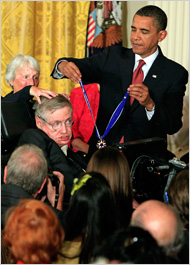
And now the British are weighing in also.  Yesterday, Stephen Hawking received his Presidential Medal of Freedom and jumped in with a response to the Investor’s Business Daily – which in it’s zeal appears to have forgotten that Mr. Hawking is British and under National Health.  The best summary is in the New York Times ,

The physicist Stephen Hawking is defending Britain’s National Health Service after an editorial in Investor’s Business Daily said Mr. Hawking “wouldn’t have a chance in the U.K.,” where the health service would have deemed his life “essentially worthless.”

The publication’s mistake, which came in an editorial titled “How House Bill Runs Over Grandma,” has since been corrected. But on a larger level, the snafu also shows how quickly rationing, particularly at the end of life, has become a focus of the health care reform debate.

Mr. Hawking — who received the Presidential Medal of Freedom at the White House on Wednesday — responded to the editorial this week, telling The Guardian newspaper, “I wouldn’t be here today if it were not for the N.H.S. I have received a large amount of high-quality treatment without which I would not have survived.”

DESCRIPTION

At this point, I fear for any type of health care reform.  New polls seem to show that older Americans oppose reform. The medical industry is threatening to pull support if legislation call for anything more that the co-op model.  Chris Matthews interviewed a man carrying a gun outside of the President’s New Hampshire town hall meeting.   I wonder if when they get back to Washington, there will be anyone left, Democratic or Republican, who wants to vote for health care reform.  Maybe they would prefer to just left the system explode or maybe implode.  Or we can be like Chris Hayes and try to laugh at the situation.

Here are parts of Hayes’  “Your Questions About Health Care Reform Answered”

Ok, so there’s been a lot of misinformation about proposals to reform the health insurance industry and provide (near) universal coverage. Understandable! It’s complicated stuff. Herewith, I’ll try to answer some questions

1) Is it true that all of the bills currently proposed would end the practice of “rescission,” whereby health insurance providers refuse to treat customers who’ve paid their premiums simply because they’ve become ill?

No! That’s a common misunderstanding. Actually, all of the bills would ban incisions, that is, they would legally bar surgeons from performing surgery until a panel of twelve gay illegal immigrant government bureaucrats unanimously signed off on the procedure.

2) Is it true that health care reform would ban insurers from refusing to insure people because of pre-existing conditions?

Wrong again. To get rid of health inequality, the bills actually mandate that every American be given a pre-existing condition. A National Illness Commission, with academics appointed from Harvard, Reed College and Berkeley, will evaluate each citizen, and based on their demographic profile, choose their malady. Each disease or syndrome is scored on a scale of 1 to 10, with 10 being the most severe. White christian men will receive pre-existing conditions of 8 or higher. Black people, “wise latinas,” and ACORN members will be exempted.

5) Will the current bills plug the “donut hole” in the Medicare prescription drug benefit so seniors don’t have to pay exorbitant out of pocket expenses for their medication?

Absolutely not. The legislation will ban donuts.

If you don’t laugh, you’ll have to cry.