More Budget Talk: The Deficit

After I posted yesterday, I started thinking about the deficit that the Republican’s are always yammering on about.  I found this chart.


This analysis is from the Center on Budget and Policy Priorities based on information from the Congressional Budget Office.

 So even if we don’t stop spending the the Wars, if we end the Bush tax cuts, we could fund all kinds of new stimulus programs (like COPS and education programs) that could help prevent more layoffs in the public sector,  fix medicare and social security and still begin to pay off the debt.  We might even extend umemployment benefits and fund programs to help unemployed homeowners save their property from foreclosure. 

The question for 2012 is how to convince people that the Ryan budget, endorsed by all the Republican candidates and most Republican members of Congress, will actually increase the projected defict by maintaining the tax cuts.

2012 Budget Talk

There are three budget proposals on the table that have been made public:  The President’s, Paul Ryan’s, and the Progressive Caucus.  So far all the talk is on Ryan’s cutting of Medicare.  It has defined the Republican politics.  Newt Gingrich found that out.  As I understand the President’s proposal it uses the 2008 budget as a baseline – a baseline we are already below. But no one is talking much about the Progressive budget.

The Progressive and Ryan budgets are good symbols of the world views currently held by many on the two sides.  The Democrats being democrats are not as monolithic and many will object to the severe defense cuts in the Progressive budget, but it seems to me that these proposals can be the end points that let everyone meet in the middle.

The National Priorities Project compares the two proposals.

  Congressional Progressive Caucus People’s Budget Rep. Ryan’s The Path to Prosperity
     
Underlying Philosophy Strengthens role of government in reducing income inequality and providing social safety net. Reduces deficit through combination of increased revenues and reductions in spending Relies on private sector to spur economic growth and employment using a trickle down approach. Reduces deficit solely through spending cuts
     
Revenues Shifts tax burden towards higher income earners and corporations Decreases taxes for wealthy and corporations
Individual Taxes Allows for the expiration of Bush era tax cuts Maintains the Bush era tax cuts
  Reverts highest individual tax brackets to 36% and 39.6% from 33% and 35% Cuts the top individual tax rate to 25% from 35%
  Enacts new tax brackets for high income earners (45%-49% for $1 million – $1 billion range Consolidates the current six tax brackets
  Taxes capital gains and dividends as ordinary income Eliminates $800 billion in tax increases imposed by the Patient Protection and Affordable Care Act
  Limits tax benefit of itemized deductions to 28%  
  Enacts progressive estate tax in which larger estates pay higher tax rates  
Corporate Taxes Imposes financial transaction tax on derivatives and speculative financial products Reduces corporate tax rate to 25% from 35%
  Repeals tax deductions and preferences for oil, natural gas and coal producers Eliminates loopholes and deductions that allow some corporations to pay no tax
  Taxes US corporate foreign income as it is earned instead of as dividend  
  Imposes tax equal to 0.15% of covered liabilities for banks with more than $50 billion in assets  
     
Investment Emphasizes public investment as engine for job creation and economic growth Believes that public investment crowds out private investment
  Rebuilds infrastructure – highways, railways, National Infrastructure Bank  
  Funds highway construction through increase in Gasoline Tax of 25 cents  
     
Health Care and Social Safety Net Maintains government role in providing vital public services and programs Limits government provision of social programs
  Maintains Medicare reimbursement rates for doctors Privatizes Medicare starting in 2022 for new beneficiaries
  Establishes public health care option in health care exchanges starting in 2014 Repeals Patient Protection and Affordable Care Act
  Negotiates drug prices with pharmaceutical companies Raises age of Medicare eligibility to 67 from 65
  Increases Social Security benefits based on higher employee contributions Converts Medicaid into block grants to the states
  Raises Social Security contribution limits, including employer contributions for high earners Converts SNAP (food stamps) into block grant to the states. Requires recipients to work or get job training
    Reduces Pell grants to 2008 levels
    Imposes time limits and work requirements for recipients of federal housing assistance (Section 8)
     
Defense Makes significant cuts in annual defense spending and ends the wars in Iraq and Afghanistan in FY2012 Largely exempts the military from spending cuts
Funding for Security Generates $2.3 trillion in savings compared to the CBO baseline over the FY2012-2021 period Provides real growth for “security” in each year through 2021, totaling $214 billion in new spending
Annual Pentagon Spending Reduces DoD baseline budget by $692.2 billion over 10 years compared to CBO, or $816.7 billion compared to the Obama Pentagon spending plan Reduces DoD waste by $178 billion. Reinvests $100 billion of this into key combat capabilities and uses $78 billion to reduce the deficit
Overseas Contingency Operations (Iraq & Afghanistan) Provides $161.4 billion for “Overseas Contingency Operations” (OCO) in FY2012 and withdraws U.S. forces from Iraq and Afghanistan. Provides no funding for OCO starting in FY2013, saving $1.6 trillion between 2013-2021 compared to the CBO baseline Continues Iraq and Afghanistan wars and provides $117.8 billion in FY2012. Anticipates over $1 trillion in savings from reduced costs of the “Global War on Terror” over the next decade by using the Pentagon’s $50 billion annual “placeholder” for OCO costs
     
Government Maintains size and role of government Reduces size and scope of government
  Provides percentage increases for discretionary programs Reduces size of government to 20% of GDP by 2015 and 15% of GDP by 2050
    Reduces non-security discretionary spending to pre-2008 levels
    Reduces public sector employment by 10% through attrition by 2014
    Institutes government pay freeze through 2015
    Increases federal employee contributions to retirement
    Privatizes Fannie Mae and Freddie Mac
    Decreases regulation of the energy industry
    Establishes a binding cap on total spending as a percentage of the economy
    Requires any increase in debt levels to be accompanied by spending reductions

I couldn’t find a chart that adds the President’s budget proposal, but here is a short summary.

Key Budget Facts

  • The Budget includes more than $1 trillion in deficit reduction – two-thirds of it from cuts — and puts the nation on a path toward fiscal sustainability so that by the middle of the decade, the government will be paying for what it spends and debt will no longer be increasing as a share of the economy.
  • The President meets his pledge to cut the deficit he inherited in half by the end of his first term.
  • Five-year non-security discretionary spending freeze will reduce the deficit by over $400 billion over the next decade and bring this spending to the lowest level since President Eisenhower sat in the Oval Office.
  • 10-year Deficit Reduction:  $1.1 trillion, excluding war savings and not extending 2001 and 2003 tax cuts for high-income earners. Two-thirds are from spending cuts.
  • 2011 Projected Deficit: $1.645 trillion, 10.9 percent of GDP; 2012 Projected Deficit: $1.101 trillion, 7.0 percent of GDP; 2015 Projected Deficit: $607 billion, 3.2 percent of GDP; 2017 Projected Deficit: $627 billion, 3.0 percent of GDP

The budget itself is composed of proposals made by federal agencies under guidelines from the White House budget folks, but it seems to be a timid version of the Progressive Budget.

The choices are pretty clear.  And the news this week – increased unemployment and no job creation – has everyone saying it is bad news for the President.  But with the layoffs of public employees is it surprising that unemployment is rising?  Wasn’t keeping the Bush tax cuts supposed to create jobs?  Where exactly are all these jobs?  The Republicans are all about not raising taxes on anyone and cutting the size of government and government benefits.  They don’t care about the widening gap between rich and poor but seem to be perfectly happy to accept tax payer paid benefits.   Like Congressman Woodall. (R- GA) who thinks we should all be self reliant except for him.

The bottom line:  We have two visions of American and the one that wins will determine our future.

Many Questions

I have not done a good job of keeping my new year resolution to post at least once a week, but life is busy and exhausting – which is all an excuse.  So as spring fades to summer here in New England I am trying to revive by resolution.

So here are the questions I’ve been saving up.  I will likely write about some of them in time.

Will the Democrats lose control of the Senate because the Republicans have made it dysfunctional?  I mean how can they not confirm a Nobel Prize winning economist?

How in the world can Anthony Weiner think that no one thought he was lying all along?  And his credibility is shot not because of what he did, but because he lied about it.

Anthony Weiner leaves his New York press conference on Monday. | AP Photo

How can historians really defend Sarah Palin’s story of Paul Revere?  OK, we weren’t American’s back then, we were British and we were trying to protect our cache of arms, but Paul Revere rang no bells and he and the other riders told people the regulars were coming.  This had nothing to do with gun control or the 2nd amendment which hadn’t even been written.

When will people wake up and realize that Barack Obama has an extraordinary first two years as President?

Along the same lines:  Will the Democrats blow their Medicare advantage?  And will people realize that we can’t keep cutting stuff without raising taxes on those making over $300,000 or even $500,000 a year.  We extended those tax cuts once and I don’t see the private sector creating lots and lots of new jobs.

How can people believe that laying off all those public employees does not impact the rise in unemployment?

Will the Red Sox find consistency on the upcoming road trip playing the AL East contenders and at a minimum stay in contention?

Sox updates from Yankee Stadium

Can the Mavericks beat the Heat?  And how about Nadal?

I’ve broken the ice now and there will be more posts to come.

Martin Luther King, Jr., Barack Obama and the State of the Union

At the 41st Annual Martin Luther King, Jr. Memorial Breakfast in Boston, Melissa Harris-Perry asked us to remember the picture of King with President Lyndon Johnson and to superimpose President Obama on one of the men.  After a brief pause to let us think about it, she said that if we had made King Obama we had picked the wrong person, that Obama was President just as Johnson had been. 

President Lyndon B. Johnson and Rev. Dr. Marti...

Image via Wikipedia

While, as Harris-Perry pointed out there are a number of parallels that can be drawn between King and Obama.   “Both men are brilliant orators, both had a unique ability to capture the American political imagination … and both endured harsh criticism.”  And I will add, both are Nobel Peace Prize winners.

Using King’s book Where Do We Go From Here: Chaos or Community, she pointed out

It was a period of backlash,” she said. “We were being told it was all moving too fast.

It is easy to behave as if Martin King was beloved in a bipartisan manner across races and communities — but that is not the reality of Dr. King..

But the primary difference is the King was an activist seeking change from the outside while Obama is the President who has to govern the country as a whole while still trying to move us toward a more progressive society and trying stay above the chaos.

Meanwhile we have the shootings in Arizona, Michelle Bachman giving a Tea Party response to the State of the Union Address (in addition to the Republican resonse), and new Tea Party Republicans pushing the more moderate Republicans in Congress into taking up legislation that I feel certain that Speaker Boehner does not view as in the parties best interest.  We can only hope that the chaos remains in the Republican Party and that incidents like Arizona do not spread.  Maybe the Republicans will lose the Tea Party Republicans to a third party.  Wouldn’t that be interesting?

Nate Silver posted a response to the recent polls the other day on Fivethirtyeight,

With the Democrats still in control of the Senate and Barack Obama in the White House, there is little that the new Republican majority in the House of Representatives can do before 2013 to enact legislation. The health care overhaul will not be repealed, and social welfare programs will not be cut — at least, not unless Mr. Obama wants them to be, or until a Republican occupies the White House.

What the Republicans can do now, though, is use their leverage over the budget process. On spending matters, Congress is compelled to act every year merely to maintain the status quo. Sooner or later — perhaps over raising the federal debt ceiling, perhaps over authorizing funds to put Mr. Obama’s health care overhaul into effect — there is likely to be a showdown between the House Republican leaders and the president.

The most recent precedent is a favorable one for Mr. Obama: the 1995 government shutdown. The public largely blamed Republicans for the mess rather than Bill Clinton, whose standing rose as a result; he went on to win re-election the following year.

He goes on the point out the parallels in the polls while remaining cautious about 2012.

Mr. Obama’s approval rating has risen a few points in recent weeks, and is now at roughly 50 percent in the average poll. Mr. Clinton’s approval rating was at 54 percent in November 1995, just before the shutdown began, according to both Gallup and Washington Post surveys.

A Pew poll conducted in October 1995, meanwhile, found that 36 percent of respondents approved of the job that Republican leaders in Congress were doing. The figure right now is the same, according to an AP-GfK poll, or a bit lower at 30 percent, according to Quinnipiac; both surveys were released last week.

Surveys conducted before the 1995 shutdown found that the public largely viewed Mr. Clinton as capable of compromise, but not the Republicans. Similarly, in this week’s NBC/Wall Street Journal poll, 55 percent said they expected the Republicans to be too inflexible in negotiations with President Obama, but only 26 percent said they expected that of Mr. Obama.

We have to remember, however, that President Obama is not Bill Clinton.  While we may have chacterized President Clinton as “the first Black President”, he was still a white man.  His alleged crimes were sexual, not racial.  We have to remember that a segment of the country will never accept Barack Obama as president because of his skin color.

President Obama’s recent moves have been toward the center, toward business, with the hope of creating enough jobs to win re-election.  I understand why he is not pushing more of a social agenda right now.  I think he did that, and did it well during the recent lame duck session.  He needs to put himself and the Democratic Party in a position to keep the Senate and the Presidency and to take back the House.  We need to remember, as Melissa Harris-Perry reminded us that the man in the picture is the President and not the activist.

Congresswoman Giffords, violence, rhetoric and other thoughts

Happy 2011!  I had made a resolution to post at least once a week this year and am already behind.  I have had a difficult fall with lots of energy sapping family and work issues.  It also didn’t help that for someone like me, the political news was depressing.  There were a number of bright spots including the Massachusetts election, the repeal of Don’t Ask, Don’t tell, and ratification of START.  But overall it was pretty bleak.

But watching the first week of the new House was most entertaining.  At least it was until Saturday.

Bob and I were driving back from western Mass after a day of packing up my mother’s old apartment and when we got to Worcester, I turned on the NPR station to see if there were any news.  That was how we heard about Congresswoman Giffords, Judge Roll and the others who were shot and wounded.  I think that the assassination or attempted assassination of any political figure regardless of party or political philosophy is horrendous.  But this shooting is the culmination of the violence advocated by the radical right of the Republican party and the Tea Party Movement.

The first official to put the blame squarely where it belongs was Clarence W. Dupnik, the Pima County sheriff.  Sheriff Dupnik was blunt.  He was quoted in the Washington Post

There’s reason to believe that this individual may have a mental issue. And I think people who are unbalanced are especially susceptible to vitriol,” he said during his televised remarks. “People tend to pooh-pooh this business about all the vitriol we hear inflaming the American public by people who make a living off of doing that. That may be free speech, but it’s not without consequences.

He went on to say

It’s not unusual for all public officials to get threats constantly, myself included,” Sheriff Dupnik said. “That’s the sad thing about what’s going on in America: pretty soon we’re not going to be able to find reasonable, decent people willing to subject themselves to serve in public office.

So let’s look at some actual facts since the Republicans and the Tea Party appear to be painting themselves as victims of the liberal media and claim no responsibility of what happened.

First it is a fact that Sarah Palin posted a map with cross-hairs over the Congressional Districts of 20 Democratic Congresspersons including Giffiords.  She remarked on the fact last year.

Ms. Giffords was also among a group of Democratic House candidates featured on the Web site of Sarah Palin’s political action committee with cross hairs over their districts, a fact that disturbed Ms. Giffords at the time.

“We’re on Sarah Palin’s targeted list,” Ms. Giffords said last March. “But the thing is the way that she has it depicted has the cross hairs of a gun sight over our district. When people do that, they’ve got to realize there’s consequences to that.”

The image is no longer on the Web site, and Ms. Palin posted a statement saying “my sincere condolences are offered to the family of Representative Gabrielle Giffords and the other victims of today’s tragic shooting in Arizona. On behalf of Todd and my family, we all pray for the victims and their families, and for peace and justice.” (Late Saturday, the map was still on Ms. Palin’s Facebook page.)

Second, her office in Tuscon was vandalized after her vote in favor of Health Care Reform.  And both she and Judge Roll received threats. 

Third, her opponent in last November’s Congressional race held an event.  This information is from the blog, Firedoglake.

Kelly’s website has apparently scrubbed the event , but here is the account from the Arizona Daily Star:

Jesse Kelly, meanwhile, doesn’t seem to be bothered in the least by the Sarah Palin controversy earlier this year, when she released a list of targeted races in crosshairs, urging followers to “reload” and “aim” for Democrats. Critics said she was inciting violence.

He seems to be embracing his fellow tea partier’s idea. Kelly’s campaign event website has a stern-looking photo of the former Marine in military garb holding his weapon. It includes the headline: “Get on Target for Victory in November. Help remove Gabrielle Giffords from office. Shoot a fully automatic M16 with Jesse Kelly.”

The event costs $50

I’m sure I will have much more to say on all of this as time goes on but I want to end with this from Paul Krugman’s column today.

It’s important to be clear here about the nature of our sickness. It’s not a general lack of “civility,” the favorite term of pundits who want to wish away fundamental policy disagreements. Politeness may be a virtue, but there’s a big difference between bad manners and calls, explicit or implicit, for violence; insults aren’t the same as incitement.

The point is that there’s room in a democracy for people who ridicule and denounce those who disagree with them; there isn’t any place for eliminationist rhetoric, for suggestions that those on the other side of a debate must be removed from that debate by whatever means necessary.

And it’s the saturation of our political discourse — and especially our airwaves — with eliminationist rhetoric that lies behind the rising tide of violence.

Where’s that toxic rhetoric coming from? Let’s not make a false pretense of balance: it’s coming, overwhelmingly, from the right. It’s hard to imagine a Democratic member of Congress urging constituents to be “armed and dangerous” without being ostracized; but Representative Michele Bachmann, who did just that, is a rising star in the G.O.P.

And there’s a huge contrast in the media. Listen to Rachel Maddow or Keith Olbermann, and you’ll hear a lot of caustic remarks and mockery aimed at Republicans. But you won’t hear jokes about shooting government officials or beheading a journalist at The Washington Post. Listen to Glenn Beck or Bill O’Reilly, and you will.

Of course, the likes of Mr. Beck and Mr. O’Reilly are responding to popular demand. Citizens of other democracies may marvel at the American psyche, at the way efforts by mildly liberal presidents to expand health coverage are met with cries of tyranny and talk of armed resistance. Still, that’s what happens whenever a Democrat occupies the White House, and there’s a market for anyone willing to stoke that anger.

But even if hate is what many want to hear, that doesn’t excuse those who pander to that desire. They should be shunned by all decent people.

Unfortunately, that hasn’t been happening: the purveyors of hate have been treated with respect, even deference, by the G.O.P. establishment. As David Frum, the former Bush speechwriter, has put it, “Republicans originally thought that Fox worked for us and now we’re discovering we work for Fox.”

And this sums it all up.

Dan Wasserman

About November 2nd

Actually the election was better than I thought it would be.  Here in Massachusetts the Democrats swept the Constitutional offices and proved that there was no enthusiasm gap – or if there was one it was on the Republican side.  The Democrats proved that old fashioned shoe leather is still the way to get out the vote.  The turnout was very good for a mid-term election in my precinct where Charlie Baker got all of 19 votes out of 433 voters.  Equally significant the two most important propositions got voted down.  We kept affordable housing laws on the books and didn’t reduce the sales tax.  But remember we also voted for George McGovern.

I have mixed emotions about the scene nationally.  On one hand, it probably means nothing will get done legislatively until after the 2012 Presidential election is over.  We can only hope that Congress musters the votes for a continuing resolution on the budget.  On the hand, it will be very entertaining to watch the Republicans try to deal with dissent in their party as the election of Rand Paul and others means the end to the lockstep voting of Republicans in Congress.  And given what is happening in recent European elections, particularly the Conservative take-over in England (and while we are talking, can someone please explain to me why the Liberal Dems there are in a coalition with them?) we shouldn’t be surprised that the Republican-Tea Party coalition won.  But how bad is it really?

There was a 60 vote swing in the House.  But remember that before the election the Democrats held 255 seats.  After the election the Republicans hold 239.  Even if all 8 still undecided races break Republican, they will hold 247 seats.  So yes, there was a huge swing, the biggest since, I believe since the Truman mid-terms, but even so, the new Republican majority is not as large as the Democratic one before the election.  And I was very sorry to see my old friend, Rick Boucher, lose in Virginia as part of the wave.  

The pre-election talk was a 9 seat pick-up in the Senate for the Republicans.  Pundits on both sides were saying that the Republicans would have had the 10 seats to take over if not for Christine O’Donnell getting the Delaware nomination.  But the gain is only 6 with Alaska still undecided.  The Democrats still hold 53 seats in the Senate.  Maybe Harry Reid can figure out a way to change the Senate rules to a majority instead of 60 votes.

Joshua Holland has a great piece posted on AlterNet titled “It’s Not the End of the World — 7 Things Progressives Need to Keep in Mind about Last Night’s GOP ‘Wave”.

Here are a few of those 7 things.

2. The electorate is hopping mad, but they still dislike Republicans. A month before an election that has swept some rather extreme GOPers into Congress, an Associated Press-GfK Poll found that “60 percent disapprove of the job congressional Democrats are doing — yet 68 percent frown on how Republicans are performing.”

A New York Times/CBS News poll last week found that while a majority of Americans voted GOP yesterday, the electorate “continues to have a more favorable opinion of the Democratic Party than of the Republican Party, with 46 percent favoring Democrats and 41 favoring Republicans.”

This will be the third consecutive year in which the party out of power wins. That’s not a measure of the country’s ideological leanings, it’s a sign that people are hurting and are mad as hell about it (in case one needed such a sign).

3. Blue Dogs took the brunt of it. The loss of Wisconsin’s liberal lion, Russ Feingold, is a blow to the progressive movement. Alan Grayson’s defeat in Florida hurts. Other good lawmakers were booted out of office last night as well. But in many cases, what we saw were conservatives with Ds next to their names replaced with conservatives with Rs.

That’s to be expected after two big Democratic victories in 2006 and 2008. They won in a lot of conservative districts, but as many observers noted at the time, many of those Dems winning in marginally “red” districts were the bluest of dogs, who have not exactly helped advance a progressive agenda.

In his new book, Ari Berman argues that a smaller, more ideologically coherent Democratic party would in fact be good for progressives. Whether or not one agrees, it’s hard to see a bunch of the most corporate-friendly Dems losing their seats as a tragedy for American progressivism.

5.  A wave of low-information voters says more about our media and education system than our politics. In late July, a much discussed poll revealed that only 42 percent of Republican primary voters were confident President Obama was born in the United States. Compare that to 77 percent of the electorate at large.

It’s important to remember that many Tea Partiers are voting in an alternative universe where the decidedly centrist Dems are stealthily pushing the nation toward socialism, trying to enact Sharia law, taking over broad swaths of the economy, setting up “death panels” to decide if grandma lives or dies and plotting to join the United States with Canada and Mexico.

Given those beliefs, it’s really no surprise they’re so animated to “take their country back.” But all of that is a testament to the power of the Right’s mighty Wurlitzer, and says little about the state of our political beliefs.

So right now, I’m going to sit back and watch the Republican Party try to reign in Michele Bachmann and Rand Paul and the expectations of the people who voted for them that the world will now run their way while I hope that the President and the Democrats stick to their principles and don’t compromise them away.  We don’t need them to become the equivalent of the English Liberal Dems.

Misinformation and the disappearance of moderate Republican

Long title without an obvious connection.  I was reading John Nichols in the Nation about Australian politics and their equivalent of the old moderate Republican which he calls an endangered species followed by an opinion piece in Politico about the disinformation age by Neal Gabler.  Thinking about it I realized that the two were related.  The demise of the moderate Republican has destroyed the ability of Democrats and Republicans to have a conversation in a civil facts and it now threatens the ability of either party to govern.

Nichols writes

Growing up in Middle West in the latter half of the 20th century, I was surrounded by moderate Republicans of the old “Main Street” school—former Ilowa Congressman Jim Leach, former Minnesota Governor Arne Carlson, former Illinois Senator Chuck Percy and former Illinois Congressman John Anderson, former Wisconsin Governor Warren Knowles and former Wisconsin Congressman Bill Steiger—all of whom embraced environmental, civil rights and clean government principles that made them worthy competitors with the Democrats at election time and worthy governing partners when the voting was done.

The suggestion that Leach, Steiger, Percy or Anderson might find a place in today’s Republican Party would provoke laughter in anyone familiar with the contemporary definition of the term “tea party.” Like the great modern Republicans of the recent past: former President Dwight Eisenhower, former Vice President Nelson Rockefeller, former New York City Mayor John Lindsay, former Massachusetts Senator Ed Brooke, former Connecticut Senator Lowell Weicker and dozens of other national leaders, the Midwest’s moderate Republicans would be about as likely to secure a Republican nomination these days as Barack Obama. (In point of fact, Obama’s governing style, with its emphasis on compromise and seeking private-sector solutions rather than classic governmental fixes, owes more to the moderate Republican tradition than to the liberal Democratic model of a Franklin Roosevelt.) 

He contrasts the situation with Australia.

In Australia, I’ve appeared with Malcolm Bligh Turnbull, the former leader of the conservative opposition party that’s roughly equivalent to the American Republicans. (They’re called “Liberals.” But that’s a reference to the traditional European term for fans of free markets and limited regulation.)

Turnbull, a former journalist who made millions in business, is enthusiastic about the private sector and more than willing to score government bureaucracy. But he is not a cookie-cutter conservative. A genuine “republican,” he wants to cut Australia’s last ties to the British Commonwealth and make the country a republic. A convert to Catholicism, he breaks with the church to support reproductive rights and stem cell research. He backs gay and lesbian rights. He’s concerned about climate change. A tech-savvy blogger who reads the ancient Greeks on his Kindle, he’s in the thick of Australia’s debate about how to build a state-of-the-art national broadband system.

Nichols points out that Turnbull is in the same mold as David Cameron, the new prime minister of England who is partnering with the Liberal Party.  I thought it a strange coalition, but is it different from Everett Dirksen working with Lyndon Johnson to pass legislation?  Probably not.

[I think Dirksen is the man in glasses to the right of Johnson in the picture]

 So how have we lost the ability to have a civil dialogue?  The internet and blogs like this one.  Fox News and MSNBC.  The fall of the non-partisan television news program.  The decline in newspaper readership.  Or all of the above.

Gabler writes

The recent Pew Research Center poll revealed that 18 percent of respondents believe President Barack Obama is a Muslim, and a whopping 43 percent are unsure exactly what religion he practices. This is disheartening on many levels — not least that it illustrates an astonishing degree of ignorance.

It is unlikely, however, that Americans are dumber now than they were, say, 25 years ago. With more of us attending college, we might even be smarter. But higher education rates and easier access to information have been undermined by what amounts to a vast and insidious revolutionary force — a kind of anti-Enlightenment in which facts yield to rumor, reason to uninformed opinion and objectivity to proudly declared subjectivity.

We swim in a limitless sea of misinformation, even disinformation, without much inclination to separate truth from fiction.

Is this a flaw in the American character, this inability to recognize the truth?  Gabler reaches back to de Tocqueville and his observation that Americans believe that they are all equal.  Some how truth has become a tool of the elite.

Daniel Moynihan famously said that everyone is entitled to his own opinion but not his own facts. Well, Moynihan spoke too soon. From the political shoutfests on TV and radio to the endless drone of sports radio callers to the millions of vanity blogs, opinion has rapidly become fact.

The idea that there is such a thing as verifiable truth — such as Obama being a Christian — is increasingly seen as elitist. It’s as if truth were yet another scheme by the powerful to impose their will on everyone else.

This overzealous sense of democracy has been encouraged by the right-wing, which has a stake in taking on science and evidence because these things are often likely to betray the tenets of their beliefs. Senate Minority Leader Mitch McConnell (R-Ky.) offered one example of informational demagoguery on NBC’s “Meet the Press” Sunday, saying “I take the president at his word” that he is a Christian.

So why is the Republican leadership so anxious to appear unintelligent and unable to stand up to the facts?  Is that why the moderate Republican is an endangered species?  Gabler believes that we are entering a post-Enlightenment era.

Steven Colbert has jokingly snarled that facts are liberal. The problem for the right is that facts are stubborn, so when you disagree with them — whether it is global warming or evolution or the effect of tax cuts on economic growth — you want to substitute your own “facts” for the allegedly objective ones.

Indeed, of the multitude of ways that President George W. Bush changed America, this may have been the most important. He helped legitimize the idea of individual truth. In doing so, he became the first president to challenge the old Enlightenment foundation on which this country was established.

Nichols points out

What makes Turnbull most like the American moderate Republicans of old is his style. When we shared the platform at the Walkley Foundation’s forum on election coverage, he was confident, not arrogant. His wit was quick and cutting. He refused to dumb things down and he knew how to charm an audience that might not have liked his party but did like him.

“He refused to dumb things down….”  And that is still another issue.  When you have your own facts, you don’t have to think too hard or work to uncover the truth.  You don’t have to plow though any real investigative reporting or read anything that isn’t on your favorite internet site (one that agrees with you, of course).  You can reduce complex issues to slogans.

It is a rainy night here in Boston and I’m feeling pessimistic, but sometimes it is very hard to think we aren’t entering a dark age when along comes this breaking news:   Former moderate Republican Senator Chuck Hagel has endorsed the liberal Democratic Senate candidate in Pennsylvania, Joe Sestak.  Do you suppose that the moderate Republicans might just save the Democratic party since they don’t seem to have a place in the Republican Party?


The case for ending tax cuts

This week Kenneth Feinberg announced the list of banks that took tax payer money while paying our huge bonuses.  On NPR, John Ydstie reported that

In the fall of 2008, with the financial system on the verge of collapse, 17 large banks that were being propped up by taxpayers doled out $1.6 billion in bonuses.

On Friday, the Obama administration’s pay czar, Kenneth Feinberg, passed judgment.

According to Feinberg, “…many were over $10 million per individual.”

And what exactly have these individuals done with their bonuses?  Have they created jobs?  I don’t think so.

Which brings me to the tax cut which is looming as the next hot potato for the Democrats and for President Obama.  We all remember the conversation the President had with Joe the Plumber during the campaign during which Obama, who clearly thought he was talking with someone rational, tried to explain that he was not going to raise taxes on the middle class.

The New York Times reports

Democratic leaders, including Mr. Obama, say they are intent on letting the tax cuts for the wealthy expire as scheduled at the end of this year. But they have pledged to continue the lower tax rates for individuals earning less than $200,000 and families earning less than $250,000 — what Democrats call the middle class.

Most Republicans want to extend the tax cuts for everyone, and some Democrats agree, saying it would be unwise to raise taxes on anyone while the economy remains weak. If no action is taken, taxes on income, dividends, capital gains and estates would all rise.

We do not buy into the theory that because the economy is still recovering, extending tax cuts for the highest earners is a necessary or effective policy response,” said Gene Sperling, counselor to Mr. Geithner.

“While we are supporting measures like small-business lending and tax cuts to spark growth,” Mr. Sperling added, “it is also important to show the world that we are following through on our commitment to long-term fiscal discipline.”

Senator Bernie Sanders of Vermont makes the case for the change in the Nation.

The American people are hurting. As a result of the greed, recklessness and illegal behavior on Wall Street, millions of Americans have lost their jobs, homes, life savings and their ability to get a higher education. Today, some 22 percent of our children live in poverty, and millions more have become dependent on food stamps for their food.

And while the Great Wall Street Recession has devastated the middle class, the truth is that working families have been experiencing a decline for decades. During the Bush years alone, from 2000-2008, median family income dropped by nearly $2,200 and millions lost their health insurance. Today, because of stagnating wages and higher costs for basic necessities, the average two-wage-earner family has less disposable income than a one-wage-earner family did a generation ago. The average American today is underpaid, overworked and stressed out as to what the future will bring for his or her children. For many, the American dream has become a nightmare.

 But, not everybody is hurting. While the middle class disappears and poverty increases the wealthiest people in our country are not only doing extremely well, they are using their wealth and political power to protect and expand their very privileged status at the expense of everyone else. This upper-crust of extremely wealthy families are hell-bent on destroying the democratic vision of a strong middle-class which has made the United States the envy of the world. In its place they are determined to create an oligarchy in which a small number of families control the economic and political life of our country.

The New York Times story points out how difficult changing the tax policy will be as it will involve many different element.

Congress must also wrestle with the estate tax, which lapsed last year but will automatically be reinstated effectively at a 55 percent rate on Jan. 1 for estates larger than $1 million. Lawmakers must also deal with an array of other provisions, including tax rates on dividends and capital gains, and the Alternative Minimum Tax, which has been adjusted annually to prevent millions of middle-class families from paying higher tax bills. The child tax credit would also be reduced.

So what should the strategy be?

Negotiations are expected to start in the Senate, where it is hardest for Democrats to advance legislation because of Republican filibusters. But some Democrats say a fallback plan would be to have their larger majority in the House approve a continuation of the lower rates just for the middle class right before the election, almost daring Republicans to oppose them.

In that case, Democrats say, Republicans who opposed the bill would be blocking a tax cut for more than 95 percent of Americans to defend tax cuts for a relatively few wealthy households. Republicans are readying an arsenal of economic data to portray the Democrats as endangering the precarious recovery and harming small-business owners, some of whom are taxed at the top personal income tax rates.

But some lawmakers, including Mr. Wyden, [Senator from Oregon] say the deficit concerns and the attention on the debt commission could help forge a deal: a short-term continuation of the tax cuts for the middle class, and perhaps some new tax breaks for businesses, that would buy lawmakers time to undertake a broad overhaul of the tax code in the next Congress.

It will be interesting to see if a change for the middle class can be made before the election and even more interesting to see what the National Commission on Fiscal Responsibility and Reform reports in December.

I am not an economist, but won’t the revenue generated by increasing taxes on wealthy individuals and corporations making over a certain amount – or that off shore their jobs-  help the deficit?   And I wonder if some are not actually paying more on their unemployment than those bankers are on their bonuses?

The Frank-Dodd Financial Reform Bill

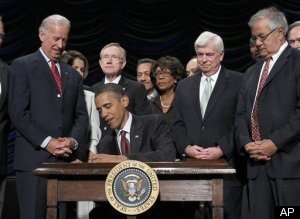
Helene Cooper writes in the New York Times this afternoon

 President Obama signed into law on Wednesday a sweeping expansion of federal financial regulation, marking another — and perhaps last — major legislative victory before the midterm elections in November, which could recast the Congressional landscape.

The signature achievement — a response to the 2008 financial crisis that fundamentally alters the relationship between Wall Street and the federal officials charged with regulating it — is a culmination of two years of fierce lobbying and intense debate over how to deal with the financial excesses that tipped the nation into the worst recession since the Great Depression.

The law subjects more financial companies to federal oversight, regulates many derivatives contracts and creates a panel to detect risks as well as a consumer protection regulator. A number of the details have been left for regulators to work out, inevitably setting off complicated tangles down the road that could last for years.

Obama Financial Reform

Mr. Obama took pains to try to show how the complex legislation, with is dense pages on derivatives practices, will protect ordinary Americans.

“If you’ve ever applied for a credit card, a student loan, or a mortgage, you know the feeling of signing your name to pages of barely understandable fine print,” Mr. Obama said. “But what often happens as a result, is that many Americans are caught by hidden fees and penalties, or saddled with loans they can’t afford.”

He said the law would crack down on abusive practices in the mortgage industry, simplifying contracts and ending hidden fees and penalties, “so folks know what they’re signing.”

So what exactly is in the bill?  According to a summary in the Christian Science Monitor

A bill summary by Capitol Hill staff members includes 100 points. Here’s a shorter take, 10 points, focusing on less-publicized elements as well as some core provisions:

• A first-ever federal office focused on the insurance industry will monitor the insurance industry for systemic risk. The industry will remain regulated largely at the state level.

• FDIC deposit insurance for account-holders at banks, thrift institutions, and credit unions will be raised to $250,000 (from $100,000) retroactive to Jan. 1, 2008.

• The State Department would have to submit an “illicit minerals trade strategy” for the Congo region. Manufacturers that use minerals originating in the Democratic Republic of Congo would have to disclose measures taken to exercise due diligence on the source and chain of custody of the materials. The provision, sponsored by Sen. Sam Brownback (R) of Kansas, could affect high-tech firms like Intel and Apple.

• The bill beefs up the powers of the Securities and Exchange Commission, including extra funds for enforcement. The SEC would get new power to impose fiduriary responsibility on investment brokers. That means the brokers would have to offer advice based on the best interest of clients, not broker fees. Consumer advocates say the bill should have mandated this change, not allowed the SEC to consider it.

• New disclosure rules would apply to credit-rating firms, along with new penalties if the firms are irresponsible. In a nod to an amendment backed by Sen. Al Franken (D) of Minnesota, the bill seeks to end “shopping for ratings” by calling for the SEC to propose ways to prevent issuers of asset-backed securities from picking the firm they think will give the highest rating.

• Shareholders would get a “say on pay,” with the right to a nonbinding vote on executive pay and golden parachutes. Standards for listing on an exchange would require that compensation committees include only independent directors.

• Reforms would reshape Federal Reserve powers, including a ban on Fed bailouts targeted at specific firms (like AIG) in the future. The presidents of regional Fed banks would be selected entirely by directors representing the public, and not partly by directors representing banks that the Fed regulates.

• The bill creates a new Consumer Financial Protection Bureau to consoldiate duties now charged to various federal agencies. It would have a consumer hot line, for questions on things like mortgages, and a new office of financial literacy.

• A Financial Stability Oversight Council of top economic regulators will monitor systemwide risks. The bill summary says this group will ask the Federal Reserve to adopt “increasingly strict rules for capital, leverage, liquidity, risk management and other requirements as companies grow in size and complexity.”

• An “orderly liquidation” mechanism would allow the Federal Deposit Insurance Corp. (FDIC) to dismantle large financial companies that are on the brink of failure. Shareholders and unsecured creditors would bear losses, to end taxpayer bailouts. But the bill also allows the FDIC to shelter solvent banks from having to bear losses if there is a threat to overall US financial stability

Thank you to Barney Frank, Chris Dodd, Olympia Snowe, Susan Collins and Scott Brown and all the Democrats except Ben Nelson we have a start and reining in the runway, unregulated financial system.

Talking jobs and unemployment

Today I went to a graduation for 58 men and women – almost all over 3o – who went to a program at the local YMCA to sharpen skills and make them more competitive in the job market.  I shared an intern with several others in my agency.  It was announced that 8 or 9 had found jobs.  Not bad in this market, but not good either. 

Last week the Boston Globe ran a story about the report by the National Skills Coalition. 

The report projects that by 2016, Massachusetts will have nearly 400,000 job openings that require more than a high school diploma, but less than a four-year college degree. The report says “middle-skill” jobs will account for 38 percent of all openings.

Ranging from licensed practical nurses to computer support specialists, the jobs have median annual incomes of about $50,000 to $55,000.

The report says the state faces challenges in meeting the demand for middle-skilled workers, with only 32 percent of current employees having the credentials.

The graduation I attended was designed to train people for these middle-skill jobs.  But until the jobs are created, the graduates still need to pay the rent, the mortgage, buy food and clothes.  These are men and women who are doing the rights things and are still finding it tough to find a job.  Some of them were unemployed before entering the program and some will be unemployed after graduation.  Some may be eligible for unemployment benefits, but may have exhausted their time.  Which brings me to the unemployment benefits issue.

Let’s start with Paul Krugman.

There was a time when everyone took it for granted that unemployment insurance, which normally terminates after 26 weeks, would be extended in times of persistent joblessness. It was, most people agreed, the decent thing to do.

But that was then. Today, American workers face the worst job market since the Great Depression, with five job seekers for every job opening, with the average spell of unemployment now at 35 weeks. Yet the Senate went home for the holiday weekend without extending benefits. How was that possible?

The answer is that we’re facing a coalition of the heartless, the clueless and the confused. Nothing can be done about the first group, and probably not much about the second. But maybe it’s possible to clear up some of the confusion.

So who are the heartless?  They are Republicans and some Democrats a tiny number of whom may be acting out of principle.  They hide behind the deficit and statements from the clueless.

By the clueless I mean people like Sharron Angle, the Republican candidate for senator from Nevada, who has repeatedly insisted that the unemployed are deliberately choosing to stay jobless, so that they can keep collecting benefits. A sample remark: “You can make more money on unemployment than you can going down and getting one of those jobs that is an honest job but it doesn’t pay as much. We’ve put in so much entitlement into our government that we really have spoiled our citizenry.”

Now, I don’t have the impression that unemployed Americans are spoiled; desperate seems more like it. One doubts, however, that any amount of evidence could change Ms. Angle’s view of the world — and there are, unfortunately, a lot of people in our political class just like her.

And then Krugman tackles the misinformed.

But there are also, one hopes, at least a few political players who are honestly misinformed about what unemployment benefits do — who believe, for example, that Senator Jon Kyl, Republican of Arizona, was making sense when he declared that extending benefits would make unemployment worse, because “continuing to pay people unemployment compensation is a disincentive for them to seek new work.” So let’s talk about why that belief is dead wrong.

Do unemployment benefits reduce the incentive to seek work? Yes: workers receiving unemployment benefits aren’t quite as desperate as workers without benefits, and are likely to be slightly more choosy about accepting new jobs. The operative word here is “slightly”: recent economic research suggests that the effect of unemployment benefits on worker behavior is much weaker than was previously believed. Still, it’s a real effect when the economy is doing well.

But it’s an effect that is completely irrelevant to our current situation. When the economy is booming, and lack of sufficient willing workers is limiting growth, generous unemployment benefits may keep employment lower than it would have been otherwise. But as you may have noticed, right now the economy isn’t booming — again, there are five unemployed workers for every job opening. Cutting off benefits to the unemployed will make them even more desperate for work — but they can’t take jobs that aren’t there.

Will extending benefit add the to deficit?  Krugman tackles this one also.

But won’t extending unemployment benefits worsen the budget deficit? Yes, slightly — but as I and others have been arguing at length, penny-pinching in the midst of a severely depressed economy is no way to deal with our long-run budget problems. And penny-pinching at the expense of the unemployed is cruel as well as misguided.

But is being against extending benefits a political plus?  Not according to two new polls out today.  According to the New York Times story in the Caucus both a CBS News and a ABC News/Washington Post poll found the majority of those surveyed believed that Congress should extend benefits.

In the CBS News survey, 52 percent of respondents said Congress should extend unemployment benefits for people currently out of work, even if it meant increasing the budget deficit. Thirty-nine percent disagreed, and the rest said “it depends” or gave no opinion.

Broken down by party affiliation, about 7 in 10 Democrats said they supported an extension, while most Republicans said they opposed it. Independents were more evenly divided, with 47 percent in favor and 42 percent opposed.

The ABC News/Washington Post poll asked the question a little differently, and found even more support for an extension of unemployment benefits. The question noted that Congress had previously extended benefits because of the economic downturn, and was considering extending them again. It also presented capsules of each side of the debate, noting that supporters of the extension say it “will help those who can’t find work” while opponents say it “adds too much to the federal budget deficit.”

The result: 62 percent of respondents said Congress should approve another extension, while 36 percent said it should not. Those in favor included 80 percent of Democrats and 59 percent of independents, as well as 43 percent of Republicans.

So there doesn’t seem to be a lot of gain in opposition.

Standing with three Americans who have struggled to find work, President Obama spoke in the Rose Garden about the need to extend unemployment benefits.

The last word goes to the President.

Under pressure in an election year to reduce the unemployment rate, now at 9.5 percent, Mr. Obama also urged the Senate to approve a package of tax cuts and an expansion of lending to small businesses. “We all have to continue our efforts to do everything in our power to spur growth and hiring,” Mr. Obama said at the White House.

Mr. Obama, appearing before reporters in the Rose Garden flanked by three Americans who have had difficulty finding work, took aim at that argument. “That attitude reflects a lack of faith in the American people,” Mr. Obama said. “They’re not looking for a handout. They desperately want to work.”

Mr. Obama sharply criticized Republicans who have several times in the past month voted against bringing an unemployment extension bill to the Senate floor.

“After years of championing policies that turned a record surplus into a massive deficit, the same people who didn’t have any problem spending hundreds of billions of dollars on tax breaks for the wealthiest Americans are now saying we shouldn’t offer relief to middle-class Americans like Jim or Leslie or Denise, who really need help,” Mr. Obama said, referring to the three people who stood with him in the Rose Garden, brought to Washington by the White House to help illustrate the president’s point.

The Bill will pass this week, probably without Republican support, after we get the new temporary Senator from West Virginia, Carte Goodwin.