Extremists and history

Last week I caught a snippet of news about a state legislator in Oklahoma who wanted to redo the Advance Placement History syllabus to emphasize the speeches of Ronald Reagan.  I gather he was also not interested in any multicultural aspects of our history.  And he also didn’t understand that changing AP history would keep students from getting college credit for the class – one of the reasons kids take AP classes.  According to CNN, Oklahoma is only one state that doesn’t like the new framework for history under the Common Core.  I don’t think that everyone will ever agree on what should be included in our history class.  For example, the internment of the Japanese Americans into camps during World War II was never taught in my high school history class.  I took care of that by doing a report on my grandparents.  History is such a huge subject and these classes are designed to touch on a few highlights.  And a framework is just that, a framework.  Students and teachers can hang a lot of information within that framework.

What frightens me is that some of the same people who think they know better than historians what should be taught in high school history are the same people who are also religious fundamentalists.  Many in our fundamentalist Christian movement want to make Christianity the state religion.  Forget that the U.S. Constitution prohibits establishment of a state religion. These folks like to carry around pocket-sized copies of the Constitution, but I don’t think they have actually read it.  Will their next fight be to teach only about Christianity and not other religions and cultures?
Destruction

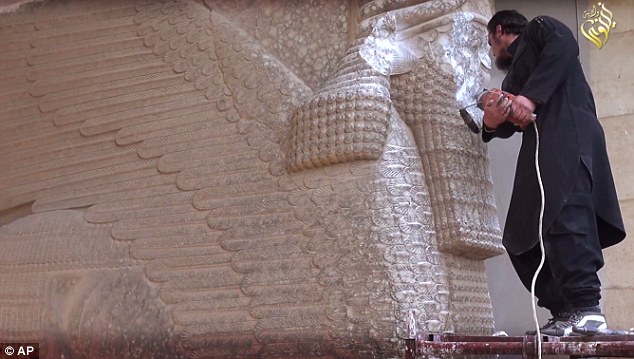
There is sickening news out of Iraq and Syria.  This is the part of the world that we learned about in world history class as the “Cradle of Civilization”.  Yes, it was mostly Western Civ, but the Mesopotamian influence was far-reaching.  I was watching MSNBC when they ran the video of men taking sledge hammers and drills to 7th century B.C. statues destroying them forever.  The New York Times wrote this

The limestone sculptures, statues and reliefs smashed by militants in northern Iraq provided valuable historical insights into kingdoms that flourished thousands of years ago and were crucial in the formation of early Arab identity, experts say. The destruction took place in Mosul, in one of the most important museums in the Middle East.

On Friday, archaeologists and historians in Iraq and around the world studied a video posted by the Islamic State showing millenniums-old artifacts being smashed by sledgehammers, seeking to come to terms with what artistic and historical riches had been lost in an exercise clearly meant to promote the militants’ extreme beliefs and project their power.

As with all news programs and video, the pictures ran again and again.  I could only watch once.

The World Post (from the Huffington Post) quotes one of the destroyers

The region under IS control in Iraq has nearly 1,800 of Iraq’s 12,000 registered archaeological sites and the militants appear to be out to cleanse it of any non-Islamic ideas, including library books, archaeological relics, and even Islamic sites considered idolatrous.

“Oh Muslims, these artifacts that are behind me were idols and gods worshipped by people who lived centuries ago instead of Allah,” a bearded man tells the camera as he stands in front of the partially demolished winged-bull.

“The so-called Assyrians and Akkadians and others looked to gods for war, agriculture and rain to whom they offered sacrifices,” he added, referring to groups that that left their mark on Mesopotamia for more than 5,000 years in what is now Iraq, eastern Syria and southern Turkey.

“Our prophet ordered us to remove all these statues as his followers did when they conquered nations,” the man in the video adds. The video bore the logo of the IS group’s media arm and was posted on a Twitter account used by the group.

But this is only the most recent destruction of history.

In January, Islamic State militants ransacked the Central Library of Mosul, smashing the locks and taking around 2,000 books — leaving only Islamic texts. Days later, militants broke into University of Mosul’s library. They made a bonfire out of hundreds of books on science and culture, destroying them in front of students.

The day after Baghdad fell to U.S. troops in April 2003, looters burst into the Iraqi National Museum in the Iraqi capital, making off with scores of priceless artifacts and leaving the floor littered with shattered pottery. The U.S. was widely criticized at the time for failing to protect the site.

Yes, we are also complicit in failing to protect world heritage.

But it is the ransacking of the library and the burning of the books that leads me to a comparison to the fundamentalist Christians in this country.  They have in common with ISIS a tunnel vision that allow only for one point of view.  One religion.  One way of thinking.  It seems to me that all fundamentalists have a common root:  To destroy that which is other or different.  I am not comparing that Oklahoma legislator to an ISIS terrorist, let me be clear about that.  What I am saying is that while the manifestation of their beliefs may be different, they share a desire to make everyone adhere to what they know is best.  It is done through terror and killing in Syria, Iraq, and Africa and stupid legislation in the United States, but the end goals seem to me to be the same.

Photograph:  AP

A eulogy for Karen

I was, in the way children count age, 2 years and 3 months old when Karen was born so I always used to tell her I knew her when she was born.  That wasn’t really true as I don’t remember the event although I have a memory of her older brother showing her to me.  And maybe that isn’t a true memory but something that one of our mothers told us when we were older.  In any event she was my oldest girlfriend.  Our mothers were best friends from college and so we grew up together – like having two Moms and two Dads.  In fact, her parents introduced my parents, but that is another story.

When we were young, we lived pretty close to each other and spent a lot of time playing together.  But at least once I must have gone off to do something with her brother and another friend and told her she couldn’t come because she was too young.  I don’t remember the incident but she never forgot it!  When we got older and her family moved to California, we started writing letters between occasional visits.  We wrote through high school and college maybe not regularly but several times a year.  The only time I remember losing touch a little was after she got married, but that separation didn’t last long.  We would also talk on the phone when one of us could afford the long distance call (Yes, it used to cost money.) or had something really important to convey.

By the mid 1990s, long distance became much less expensive and we began monthly calls.  I had a bad habit of forgetting the time difference between east and west coast and, more than once, called too early.  She tolerated my early wake-ups.  We talked though her return to college to get her degree and then her Master’s.  She talked me through my dissertation.  We talked about her divorce and my marriage.  We talked about her son’s marriage and our grandchildren.  We discussed the tribulations of being adjunct faculty. We talked politics and family and baseball.  And we always remembered each other’s birthdays with cards.

I think it was in 2010 when I realized that something was wrong.  She repeated herself a lot and barely let me say anything.  It was the first time I had to make excuses to get off the phone or she would have continued to talk.  And then I didn’t get a card for my birthday.  I found out from her brother that she had been diagnosed with a form of dementia and was going into a group living situation.   She moved into an assisted living facility where she died at the end of last month.

I’m sad to say that I never made it out to see her after she got sick and that I didn’t send her cards and pictures as often as I should have.  I appreciated all the reports from her family and friends on her special page on Facebook.  But I never forgot her and miss our phone calls to this day.  Just before I learned of her death, I was thinking how much she would appreciate all the snow around our house.

I won’t be at her memorial tomorrow, but I wanted to write a eulogy anyway.  I think she would appreciate it.

Dean Smith and Carolina basketball

My mother, Marii Hasegawa, loved Atlantic Coast Basketball, but she really loved the Tar Heels the best.  Even after my sister got her Masters degree from Duke, my mother refused to root for them when they played North Carolina.  I have only been to one Final Four, but it was in 1982 and I got to see North Carolina win it all.

Dean Smith, the North Carolina basketball coach, after the Tar Heels defeated Georgetown for the N.C.A.A. championship in 1982

Dean Smith, the North Carolina basketball coach, after the Tar Heels defeated Georgetown for the N.C.A.A. championship in 1982

My mother was happy; my aunt who favored Georgetown, was not.

Richard Goldstein writing the obituary in the New York Times points out that while Dean Smith was a legendary basketball coach he should be remembered for a great deal more.

Smith’s 879 victories rank him No. 4 among major college men’s basketball coaches, and his teams won two national championships. He turned out a host of all-Americans, most notably Michael Jordan, perhaps basketball’s greatest player, but he emphasized unselfish team play. He was a member of the Basketball Hall of Fame and a four-time national coach of the year.

Like most successful coaches, Smith was adept at diagraming plays on a blackboard. But unlike many, he ran a program that was never accused of N.C.A.A. violations, and some 97 percent of his players graduated.

President Obama awarded Smith the Presidential Medal of Freedom, the nation’s highest civilian award, in November 2013, presenting it to his wife, Linnea, who represented him at a White House ceremony.

In addition to citing Smith’s achievements on the court, Mr. Obama praised his “courage in helping to change our country” through his progressive views on race relations.

He drew on a moral code implanted by his parents in Depression-era Kansas to break racial barriers in a changing South. He challenged segregation and recruited Charlie Scott, who became the first starring black basketball player in the Atlantic Coast Conference.

“My father said, ‘Value each human being,’ ” Smith recalled in “A Coach’s Life” (1999), written with John Kilgo and Sally Jenkins. “Racial justice wasn’t preached around the house, but there was a fundamental understanding that you treated each person with dignity.”

Smith’s parents instilled a sense of racial tolerance in him, in a highly segregated state, long before the modern civil rights movement. His father [a high school basketball coach] put a black player named Paul Terry on his 1933-34 team, which won the state championship, though Terry was barred from playing in the state tournament by Kansas sports officials.

I remember hearing a lot of players say they made decisions well into adulthood only after consulting with Coach Smith.  I remember when Michael Jordan wanted to leave UNC early some of the announcers saying that Jordan was leaving only after promising his mother and Coach Smith he would get his degree.  He did.

The Charlotte Observer has this anecdote.

Smith the innovator also was Smith the motivator. But he didn’t give rah-rah pep talks. He typically explained what they needed to do to win and the significance of the moment.

Once at Maryland, however, he did promise to sing “Amen” – the Terps’ late-game theme song – if the Tar Heels beat Lefty Driesell’s club. Carolina won and Smith fulfilled his vocal promise, but according to reports, he would not have won the “American Idol” title.

“He was not much as a singer,’’ recalled guard Ged Doughton.

Many will write about Dean Smith’s contributions to the game of basketball.  For example, his “Four Corners” offense made the shot clock necessary.  But I want to remember him for his views off the court also.  In an article from 2013, Barry Jacobs wrote

Smith was periodically approached about running for the U.S. Senate from North Carolina as a Democrat. But the publicity-shy coach disdained the glad-handing involved in soliciting votes and raising money. Besides, he said, “I’d never get elected if people in North Carolina realized how liberal I am.”

He was probably right. Over the years Smith spoke in favor of a nuclear freeze and for gay rights. He opposed capital punishment. He joined a Chapel Hill street protest against the war in Vietnam. When President George H.W. Bush sent American troops into Iraq in 1991, Smith asked: “Why can’t the United States band together for some other good thing like (fighting) poverty? If you want to kill somebody, then everybody’s for it.”

 My mother loved Carolina basketball and she admired Dean Smith.  If they had ever met I think they would have had a lot to say to each other.

Photograph:  Pete Leabo/Associated Press


Ghettoside

We are all thinking this January 2015 about relationship between the minority – in particular, black – communities and the police. Ghettoside by Los Angeles reporter, Jill Leovy, is a timely addition to the conversation.

The homicide rate in Los Angeles, in Watts and in South Central in particular, consists of young black men killing other young black men. The clearance rate for these murders is very low. Because of the difficulties in finding witnesses willing to testify and a culture that put a low premium on their lives, many police resorted to arresting those they knew were guilty of murder but against whom they had insufficient evidence, of “proxy crimes.” These crimes included public drinking, possession of drugs, and parole violations. These arrests did get killers off the streets, but they were often viewed as harassment.

Ghettoside is the story of two murders and of John Skaggs, the white police detective who solved both. Skaggs was the detective who actually cared and he and his partners preserved until both cases resulted in convictions. Leovy chose as victims the son of a black police detective and a tenth grader son of a single mother home health care worker. Neither were gang affiliated. One would expect effort to solve the case concerning a fellow police officer, but given the culture of the L.A. police at the time, not the other. Skaggs worked through police budget cuts and the lack of resources his entire career. He and his first partner and later those they trained cared. They cared about the families, the victims and the witnesses. They solved homicides. Leovy gives us a small glimpse into what makes Skaggs tick, but I never learned enough to understand why he was different, why he was driven to solve these crimes that few others cared about.

The unfolding of the investigations reads like a mystery story. Some may get confused about the multiple characters, but I found it no more confusing than reading Ngaio Marsh or Agatha Christie. I did find that Leovy’s digressions into the roots of both black on black crime and white indifference distracting and, in the end, superficial. Leovy is not an historian or sociologist and the strength of this book is her reporting on the crimes and the investigations. She began a blog for the Los Angeles Times called the “Homicide Report” in 2007. The report chronicles every homicide in the city to the current day. Every city should have a similar blog.

Ghettoside ends with a quote from William J. Stuntz. Stuntz was a Harvard Law School Professor who studied the criminal justice system and died much too young. “Poor black neighborhoods see too little of the kids of policing and criminal punishment that do the most good, and too much of the kinds that do the most harm.” This also sums up Ghettoside.

I highly recommend this book.

This was first published as a review for LibraryThing with an Advanced Readers Copy.  The book will be available on January 27.


Family legacies

It must be difficult to be the son or daughter of a famous person.  We have all read about the child of a Hollywood star who does drugs, goes to jail, and generally is a sad case.  We have also read of children who try to live their own lives out of the public view.  And there are also children who work at preserving the parent’s legacy.  But it can’t be easy.  I’ve been thinking for the last couple of days about the column Adrian Walker wrote in the Boston Globe for MLK Day.  It was titled “King had a dream. His children have an army of lawyers.”

But a far less joyous scene is being played out in a courtroom in Atlanta. Not for the first time, King’s three surviving children are on opposing sides of a lawsuit involving his legacy.

At stake is ownership of King’s 1964 Nobel Peace Prize and his Bible, which President Obama used for his second swearing-in. King’s sons, Martin III and Dexter, apparently want to sell the heirlooms; his daughter, Bernice, has sued to stop them. By court order, both items have been stored in a safe deposit box for nearly a year.

If King had a dream, the King children have a piggy bank. They are one litigious group.

Aside from having previously sued one another, they have sued their father’s closest friends, too. Both former Atlanta mayor Andrew Young and actor/activist Harry Belafonte have been the target of lawsuits about King’s property. Belafonte sued them back in a dispute about ownership of one of King’s most famous speeches, one in which he came out in opposition to the Vietnam War. The parties reached an undisclosed settlement last year.

OLYMPUS DIGITAL CAMERA

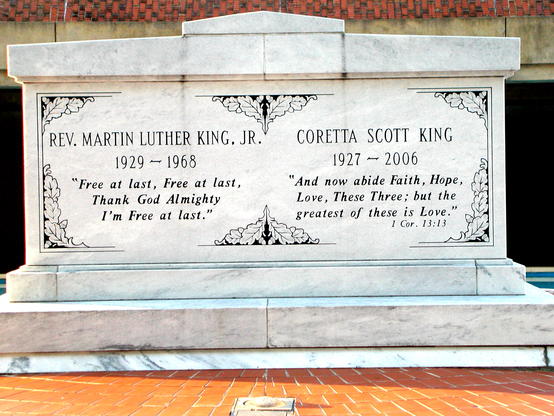
I hate to mention it to the King children, but sometimes a person is bigger than just being a family member.  He – or she – actually belongs to all of us.  Most of us would love to be able to go to Atlanta and see the Nobel Prize metal and the family Bible.  When I was there a few years back, we visited Ebenezer Baptist Church, the family home, and the pool with the tomb containing Martin and Coretta King at the King Center.  It was a very moving experience.  To see the various artifacts would have added a great deal.

The family feuds about money have not tarnished King’s legacy, but they have wasted opportunities to enhance it. At the end of the Selma march, King stood in front of the Alabama capital and gave one of the most deeply moving speeches of his career. But you won’t hear it in “Selma” — it’s paraphrased, painfully — because the filmmakers couldn’t get permission to use it.

There are a lot of stories like that. The Kings sued CNN over airing the “I Have A Dream” speech, essentially taking the video of it out of circulation.

King’s greatest moments are increasingly available only in truncated form. That is not the way to honor his memory.

While it is not clear that the brothers would sell the artifacts should they prevail in court, that is the most likely possibility.  Nobel Peace prizes should not be auctioned off.

Walker ends his piece

King’s career offers so much to celebrate. Like few Americans before or since, he challenged us to live up to our best and truest selves. Though unfinished, the results of the heroic campaign he led can be seen all around us. As much as anything, he stood for the collective good over the glorification of one individual. He certainly wasn’t about money.

Tragically, that lesson never quite made it to his successors.

King taught us about nonviolence, but it seems that his children have yet to learn that violence does not have to be physical.

Photograph:  King Center website http://thekingcenter.org/plan-your-visit

Science and magic

When I was a child, my father took me up on the roof of the chicken coop on our small New Jersey farm to watch Sputnik whiz by.   I couldn’t believe that it was so small and so fast.  It was, to be honest, a little anti-climactic to my 10 year old mind.  Still, I was amazed by the concept that something could be put on a rocket and sent into space for us to see.  It was like magic.  Science often seems magical.  In her essay, “Retrograde Beliefs” in the Sunday’s New York Times Magazine, Kristen Dombek, an essayist and teacher at Princeton, writes about this connection.

Magical beliefs include astrology.

On Jan. 21, at 10:54 a.m. Eastern Time, Mercury will begin its first pass by Earth of the new year. For about three weeks, it will appear to move backward across our sky and will, according to astrologers, disrupt technology, communication and human concord. Facebook and Twitter will clog with reports of appointments missed, important email sent to the spam folder, wars between nations, cars crashed and iPhones dropped in toilets, all followed by some version of the hashtag “#mercuryretrograde.” Advice from astrology blogs will arrive in unison: Back up your computer, expect miscommunications, don’t make agreements or important decisions and don’t sign contracts — and hide.

The sun and plants.  Arrow points to Mercury.

The sun and plants. Arrow points to Mercury.

There is, of course a scientific explanation for Mercury’s movements.

The story of Mercury is a cautionary tale too, about thinking there is a connection between how things work on Earth and how they work in the heavens. Every time Mercury orbits the sun, it ends up a bit ahead of where it began, so that the planet traces in space not a steady ellipsis but a pattern of flower petals. Called precession, some of this jumping ahead is explainable by Newton’s laws. But some isn’t. The difference between where Mercury should end up, according to the law of gravity that works on Earth, and where it actually ends up, is minuscule — 43 arc seconds per century — but it was enough to puzzle astronomers for years, even leading to speculation about a phantom planet, Vulcan, that might influence Mercury’s orbit.

What it took, in the end, to explain Mercury’s precession was Albert Einstein’s theory of general relativity; Mercury flies close enough to the sun that it travels through a part of space-time so bent by the sun’s mass that the planet is dragged a bit farther along each time. The fact that things work so differently in space than they do on Earth, not to mention at the quantum level, has physicists conjuring ideas even stranger than any malevolent planet — string theory, multiple universes — to connect it all together again.

The really scary thing about astrology, however, is not that so many will be worried about their technology as well as their lives, but that

The belief that the movements of celestial bodies govern our lives is more popular in the United States than it has been in two decades, according to a recent National Science Foundation report. In a 2012 survey, a third of Americans viewed astrology as “sort of scientific” and another 10 percent as “very scientific.” Belief is most prevalent among 18-to-24-year-olds but has markedly increased among 35-to-44-year-olds in recent years. To put this in perspective: More Americans believe in astrology, or “sort of” believe in astrology, than believe that climate change is influenced by the burning of fossil fuels.

Think of that.  More Americans believe in astrology than believe there is a human element to climate change!  This is part of the current trend to distrust science and facts.  Everything is magic.  The moon landings and most certainly the recent landing on a comet were staged.  There can’t be climate change because winters are so cold.  The increase in the number of earthquakes in places where there is fracking is just a coincidence.  We have forgotten about facts because it is more convenient to ignore them when they don’t fit a particular belief system.

Like Kristen Dombek, I love Madeline L’Engle’s “A Wrinkle in Time”.  Dombek writes

There was something about this story that married a love of quantum physics and astrophysical theory to a witchy sense of cosmic magic; it sent me not away from science, but toward it, suggesting that my relentless research, in my parents’ library and in the woods and streams of our farm, might matter, even though I was a girl.

I am not a scientist, but I read science articles, follow space exploration, and think that mapping the brain is fascinating.  Real science that discovers facts is even more magical than all those science deniers could ever imagine.  All they need to do is look.

Illustration: 3horoscopes.com

Looking at President Obama

The annual Gallup poll of the most admired man has just picked President Obama.  Even among Republicans he tied with Pope Francis.  But to hear some Republican elected officials and pundits, Barack Obama is the devil incarnate.  If he says the sky is a little cloudy, they will say it is clear.  So what is going on?  Are people finally catching on to what he has accomplished?  Are people starting to look beyond the media’s short attention span?  I don’t have any answers, but I know that the President has managed more than one could ever imagine given the Tea Party and solid Republican opposition to everything he proposes. Even people like Paul Krugman, who one would think would be a supporter, was not.  But Krugman has changed his mind and in October wrote a widely circulated defense.

When it comes to Barack Obama, I’ve always been out of sync. Back in 2008, when many liberals were wildly enthusiastic about his candidacy and his press was strongly favorable, I was skeptical. I worried that he was naive, that his talk about transcending the political divide was a dangerous illusion given the unyielding extremism of the modern American right. Furthermore, it seemed clear to me that, far from being the transformational figure his supporters imagined, he was rather conventional-minded: Even before taking office, he showed signs of paying far too much attention to what some of us would later take to calling Very Serious People, people who regarded cutting budget deficits and a willingness to slash Social Security as the very essence of political virtue.

I certainly haven’t agreed with everything Obama has proposed or done, but no one agrees with anyone else 100% of the time.  And there have been some scary moments.  Remember the “Grand Bargain”?  But we can list as accomplishments the Affordable Care Act, Dodd-Frank financial reform (despite the reluctance of Congress to fund the Consumer Protection Bureau and the recent gutting of the prohibitions on banks and derivatives.), the steady improvement of the economy (the only one in the world not on the verge of tanking again) and the ending of our combat roles in the wars in Iraq and Afghanistan.  But I just don’t understand the continuous bashing by everyone.  Plus, I firmly believe that the mid-term elections would not have been quite so bad if the Democrats had had the guts to run on the President’s record.

Krugman writes

But now the shoe is on the other foot: Obama faces trash talk left, right and center – literally – and doesn’t deserve it. Despite bitter opposition, despite having come close to self-inflicted disaster, Obama has emerged as one of the most consequential and, yes, successful presidents in American history. His health reform is imperfect but still a huge step forward – and it’s working better than anyone expected. Financial reform fell far short of what should have happened, but it’s much more effective than you’d think. Economic management has been half-crippled by Republican obstruction, but has nonetheless been much better than in other advanced countries. And environmental policy is starting to look like it could be a major legacy.

I think one of the problems the President has is that he is a canvas on which each person paints the picture of what they want him to be.  Michelle Bachmann sees him as a non-Christian, non-American.  Cornel West thinks he is a ‘counterfeit progressive”, meaning, I guess a conservative in progressive clothing.  The problem is people do not look at facts.  And they certainly don’t understand the character of the man.  I found this description of him on the golf course very apt.

One of the golfers who played with Mr. Obama said the way the president carried himself on the course provided significant insight into his character.

“If you came down from Mars and saw his disposition on the golf course, you would think he would be a pretty good president,” the golfer said. “He’s honest, he keeps his composure through terrible adversity, he’s unruffled, he smiles, and he doesn’t quit.”

Obama

This is why after the mid-term elections, President Obama was able to have what Kevin Drum writing in Mother Jones magazine was able to call “a Hellava month”.  Drum lists his accomplishments during November and December.  Here are a few from his list.

  • November 11: Concluded a climate deal with China that was not only important in its own right, but has since been widely credited with jumpstarting progress at the Lima talks last week.

  • November 20: Issued an executive order protecting millions of undocumented workers from the threat of deportation.

  • November 26: Signed off on an important new EPA rule significantly limiting ozone emissions.

  • December 17: Announced a historic renormalization of relations with Cuba.

Plus a number of judicial and other nominees were approved by the Senate before they went home for the holidays. Jennifer Bendery explains in the Huffington Post.

If there’s one thing from 2014 that will define President Barack Obama’s legacy after he’s left the White House, it’s the number of lifetime judges he put on the federal bench.

In its final act of the year, the Senate blew through a dozen U.S. district court nominees on Tuesday night. That puts Obama at a whopping 89 district court and circuit court confirmations for the year, and means he’ll wrap up his sixth year in office with a grand total of 305 district court and circuit court confirmations — a tally that puts him well beyond where his predecessors were by this point in their presidencies.

It may be that, in the end, his biggest effect on the judiciary isn’t sheer numbers as much as the diversity of his judges. Forty-two percent of Obama’s confirmed judges are women, 19 percent are black and 11 percent are Hispanic, according to data provided by the White House. Eleven of his confirmed judges are openly gay or lesbian.

Even the 12 nominees confirmed Tuesday night will make a mark: Robert Pitman will be the first openly gay judge to serve in the Fifth Circuit, which includes Texas, Louisiana and Mississippi. Loretta Biggs will be the first black woman to serve as a district judge in North Carolina.

The most interesting part of the nominee confirmation story is that the last were made possible by Senator Ted Cruz who probably had no idea what he was doing.

Democrats spent the final days of the lame duck thanking Sen. Ted Cruz (R-Texas) for inadvertently helping to expedite votes on Obama’s nominees. On Friday, Cruz derailed a plan by party leaders to leave for the weekend and come back Monday in an effort to force a show vote on Obama’s immigration executive action. The stunt kept senators in session all day Saturday, with hours to kill. So, Senate Majority Leader Harry Reid (D-Nev.) used the time to tee up votes for the 12 district court nominees still on the calendar.

With two years to go, I don’t think any of us should write President Obama off as a “lame duck”.  He seems to be freed by not having to run for office again.  We all need to stay tuned to see what he does next.

Photograph:  Uncredited from Mother Jones.


The importance of place

Amy Davidson has written  a piece for the New Yorker summarizing the last year using seven addresses.  It must have been on my mind after I read it last night because early this morning in that time when you are not quite awake and yet not asleep, I tried to name the street and visualize all the places I’ve lived.  I don’t, of course, remember the first place I went after I was born except from a vague memory of visiting as a very young child.  I do remember with some effort the other places.  Some of them – particularly early rentals as a young adult – were actually pretty awful.  I even remember a couple of the landlords.  But the last, almost 40 years, I’ve only lived at three addresses.  All of them were/are wonderful in their own way.  The seven addresses Davidson picked to remember 2014 evoke feelings from horrifying and sad to wonderment.

Davidson begins with West Florissant Avenue, Ferguson, Missouri and Bay Street, Staten Island, New York where Michael Brown and Eric Garner died at the hands of the police, events which have the potential to change policing as well as the way we talk about race.  Her next set of addresses are where Thomas Eric Duncan was exposed to Ebola and where he first became ill:  72nd Samuel K. Doe Boulevard, Paynesville, Liberia and The Ivy Apartments, Fair Oaks Avenue, Dallas.  Duncan’s illness set off an extraordinary and irrational panic here.  An epidemic never materialized and so, in the American way, we have mostly forgotten that people are still dying in West Africa.  One consequence is that people there no longer seek medical help for problems that have cures because they fear medical facilities and Ebola causing the number of deaths from ordinary medical problems to rise also.

A memorial for Eric Garner at the site where he died, on Staten Island.

A memorial for Eric Garner at the site where he died, on Staten Island.

Have you heard of this next address?

Nathan Road [Hong Kong], which is six lanes wide and cuts through the central Mong Kok district, was closed for weeks this fall, as students and others assembled to protest what they saw as Beijing’s broken promises about free elections. It, along with other gleaming thoroughfares, was the scene of standoffs whose contrasts—crowds holding up umbrellas amid teargassing near destination boutiques and offices—embodied some trade-offs that have accompanied China’s economic rise in graphic, or geographic, terms. (Traffic or democracy?) The barricades on Nathan Avenue were mostly cleared away in a major police action at the end of November. Cars are passing through again, but the story is not complete, for either side.

We hear almost nothing about the students and their supporters these days unless one listens to the BBC.  Right now, no one is sure where the protests are headed and protesters themselves are divided about whether to continue or to rethink tactics.

I had never heard of this next address:  Naem Roundabout, Raqqa, Syria.

The rise of the Islamic State in Iraq and al-Sham, also known as ISIS, has been geographically disorienting: it has made sudden, sweeping moves into Northern Iraq, threatened the Turkish border, and put out videos, shot in indeterminate stretches of desert, in which hostages are mocked and killed. But there are moments when the group’s brutality and degraded character can be given an exact address, as when, in Raqqa, the Syrian town that serves as its base, prisoners were beheaded and their remains put on display along the Naem Roundabout. (Naem, in Arabic, means “bliss.”)

Davidson ends with the wonderful address of Comet 67/P Churyumov-Gerasimenko.

The Rosetta spacecraft’s trip to this address took a decade and covered four billion miles. On November 12th, after a couple of bouncy knocks, Rosetta’s Philae module landed on the comet’s surface—the first such visit in human history. The lander settled in a shady spot and then, over a frantic fifty-seven hours, scientists at the European Space Agency performed all the experiments they could before its solar-powered batteries shut down. Philae is sleeping on the comet now, but it may wake up again next summer, when the comet next turns toward the sun.

Thinking about the world and one’s own life through place is a fascinating thing to do.  Try thinking about all of your addresses and how they shaped your life and how they will shape your future.  Think about places you have been.  And I can’t wait to see if Philae wakes up next summer.

Photograph:  MARK PETERSON/REDUX


Anne Perry: crime and punishment

A few years ago, a good friend suggested I try reading a book by Anne Perry.  She knew I enjoyed Victorian mysteries.  She also told me that when Perry was a teenager, she had been convicted as an accessory to a matricide by her good friend, served time, and now wrote mysteries.  I thought it curious that someone who had committed such a serious crime now wrote so well about crime, but I read my first Thomas and Charlotte Pitt book and was hooked.  After I retired, I went back and read all of them in order.  I’ve also read some of her William Monk books, but I find the Pitts very compelling.  I had forgotten about Perry’s criminal past until I read this past week’s column by Rebecca Balint in the Brattleboro Reformer. [link to be added when column is posted online,]

Becca is my neighbor and newly elected State Senator whose weekly column my husband and I always find interesting.  She had not known until recently that Anne Perry had committed murder.  Her column explores how she feels about Perry after finding out.

…Details of their delusions can be found in Parker’s [Perry’s friend] adolescent journal.  But the question persists for me:  Do I believe in rehabilitation and redemption?  If I do, as I have always claimed, then why do I view Anne Perry differently now that I know of her troubled past?  I’ve read her Victorian mysteries for years and always enjoyed them as inconsequential breathers from the dense non-fiction I read.  I’ve joked about some of her writing tropes but still find her characters compelling.  Yet, I feel undeniably uneasy about a convicted murderer as an author.

The first Thomas and Charlotte Pitt novel.

The first Thomas and Charlotte Pitt novel.

I read this and wondered why I had reacted so differently.  I went back and located the interview I had read years earlier in the Guardian.

In 1954, Hulme felt as if she had been pushed to the limit. Three days before she took part in the killing of Honora Parker on June 22, her parents announced that they were to divorce – triggered by Hulme having found her mother, Hilda, in bed with a lover. At the same time, her father lost his job and she was to be sent to South Africa to stay with an aunt. The shock to Hulme – who had not been at school because of tuberculosis, from which she had suffered since the age of 13 – was cataclysmic.

She turned to her close friend, Parker, a working-class girl from a humble background. Some felt it was a curious friendship for Hulme, whose family were well to do, her mother glamorous and clever. The two friends believed they could stay together if Pauline’s mother would let her leave New Zealand. Her refusal triggered Parker’s murderous rage and Hulme believed she owed it to her friend to help lure Mrs Parker to a Christchurch park and cosh her with a brick in a stocking.

“I felt I had a debt to repay,” says Perry. “Pauline was the only one who had written to me when I was in hospital, and she threatened to kill herself if I didn’t help. She was vomiting after every meal and losing weight all the time. I am sure now she was bulimic. I really believed she would take her life and I couldn’t face it.”

Hulme served five years at Mt Eden women’s prison in Auckland – “supposedly the toughest in the southern hemisphere,” she says with what sounds like pride.

Yet Perry now calls her time in prison “the best thing that could have happened”. “It was there that I went down on my knees and repented,” she says. “That is how I survived my time while others cracked up. I seemed to be the only one saying, I am guilty and I am where I should be.”

In an interview with Ian Rankin, Perry explains further.

IR: I wondered: at what point does redemption come do you think, I mean at some point during incarceration?

AP: That is a very spiritual question, to which I can only give you my own estimate of the answer. The redemption comes when you no longer wish to be that kind of person. When you understand that… when you see it as ugly, and you understand why it is not what you want to be. Not what you should be, not what you want to be. And that’s the difference. Not because somebody outside is telling you: this is not what you do. But because you, yourself, say: this is not who I want to be.

IR: How do you feel about the fact that society requires people to be locked up, especially at such a young age, that we require what seems to be not redemption so much as a kind of vengeance.

AP: I suppose society does require a certain level of vengeance. It needs to be not only done but seen to be done because it is supposed to be enough to prevent other people wanting to do the same. I think it would have been the worst thing that could ever have happened to me in my life if somehow they had said: “Well, look. You know, you were under medical treatment. These are mind altering drugs. I am sure you are not really wicked. You go ahead and forget about it.” I think that would have been totally destructive to me.

IR: How important was the punishment to you?

AP: I feel it is vital. I think until you feel that you have settled the debt, you cannot move on. It is a bit like trying to walk with an open parachute open behind you. By paying, you cut the strings and then you can move on. You can allow yourself to move on. I can say it and look you in the eye, because I can say: Yes, I have dealt with it. I believe that I have paid. I believe that I have been forgiven where it matters. And it now for me no longer exists. I can move on and be the best person I am capable of being. But I think that is true of everybody. As long as you don’t say: “somehow it wasn’t really me, it was that person and somehow it didn’t matter and I don’t need to pay.”

I think this explains why she writes novels about crime and punishment.  I can read Perry’s books without thinking of her past because it is her past that allows her to write.


History and war

I have to admit that my knowledge of the Second World War in Europe is limited to what I know from high school history class, some novels and movies.  I can name some of the famous battles and tell you that the all Japanese American 442nd fought in Italy, but my ignorance is pretty shocking.  So I have started reading the Rick Atkinson Liberation Trilogy starting with “An Army at Dawn” about North Africa.

But it seems that I am not the only one with a need to know some history.  Sunday’s New York Times had a long story about young Japanese students going to Guadalcanal to look for remains and learn history.

Using a trowel to dig into the shadowy floor of the rain forest, pausing only to wipe away sweat and malaria-carrying mosquitoes, Atsushi Maeda holds up what he has traveled so far, to this South Pacific island, to find: a human bone, turned orange-brown with age.

Mr. Maeda, 21, was looking for the remains of missing Japanese soldiers at the site of one of World War II’s most ferocious battles. Others have done this work before him, mostly aging veterans or bereaved relatives. But he was with a group of mostly university students and young professionals, nearly all of them under 40 and without a direct connection to the soldiers killed here.

A Japanese vessel was partly submerged off Guadalcanal in 1942 after being hit by American forces. The battle helped turn the Pacific war in favor of the United States and its allies. Some 7,000 Japanese were reported missing on Guadalcanal

A Japanese vessel was partly submerged off Guadalcanal in 1942 after being hit by American forces. The battle helped turn the Pacific war in favor of the United States and its allies. Some 7,000 Japanese were reported missing on Guadalcanal

As I understand it, the Japanese talk even less about WWII than Americans.  I had two uncles who were in Japan with the American occupying forces but it wasn’t until a few years before they both died that I knew anything about what they actually did. Ostensibly translators, they worked in support roles for the American army – mostly in supply.  My uncles didn’t talk much about the war because, like many vets, they were raised to accept the experience and move on.  In Japan, however, it has been almost national policy not to talk about the war they lost.

As the 70th anniversary of the end of World War II approaches, there has been a surge in interest among young Japanese about the disastrous war that their nation has long tried to forget.

It is a phenomenon that crosses political lines, encompassing progressives who preach the futility of war as well as conservatives who question the historical record of Japan’s wartime atrocities. What these young people have in common is an urgent sense that they learned too little about the war, both from school, where classes focus on earlier Japanese history, and from tight-lipped family members, who prefer not to revisit a painful time remains strong in Japan.

I found it interesting that most of the Japanese students are several generations younger than I am but that we are both driven by the need to know more.  200 pages into Atkinson’s story of North Africa, I keep reading about familiar names:  Tunis, Casablanca,  Marrakesh, Algeria – names of places that have been romanticized but where hundreds died.  North Africa is where there is an on-going struggle for democracy complicated by terrorism and tribalism.  (Think Benghazi)  We American invaders during WWII didn’t understand the local population or make a lot of effort to do so.  A mistake we still make today.

Kankoh Sakitsu, 42, the head priest of a Buddhist temple in Tokyo who organizes expeditions to Guadalcanal, has seen interest among young people grow after his first trip here in 2008. Since then, he has arranged three other journeys for groups of Japanese, including this one in September.

Mr. Sakitsu originally went to Guadalcanal to pray at the battle sites out of a sense of contrition because he feels Japanese Buddhism failed to oppose the war in the 1930s and 1940s, and so shares responsibility for it.

The story ends with a note of caution from a Japanese Guadalcanal veteran.

Mr. Sakitsu, the leader, said the September group was special because it was joined for the first time by one of the last surviving Japanese veterans from the battle, Junshiro Kanaizumi. Mr. Kanaizumi, 95, was an army engineer who helped build roads in the jungle. Now bent and frail with age, shuffling to the edge of the jungle with the help of a walking stick, Mr. Kanaizumi wore the same khaki jumpsuit with a Japanese flag on one shoulder as the other members.

Peering into one of the leaf-wrapped bundles, Mr. Kanaizumi said it was possible he once knew the man now reduced to a pile of crumbling bones.

“I hope they learn the miserable reality of war,” he said. “Once I am gone, who will be around to tell them that the only lesson from war is to never do it again?”

I think when I finish reading about Europe, I’ll have to move to the Pacific theater.

Photograph:   US Navy/Getty Images