Race and Gender in the Trump Cabinet

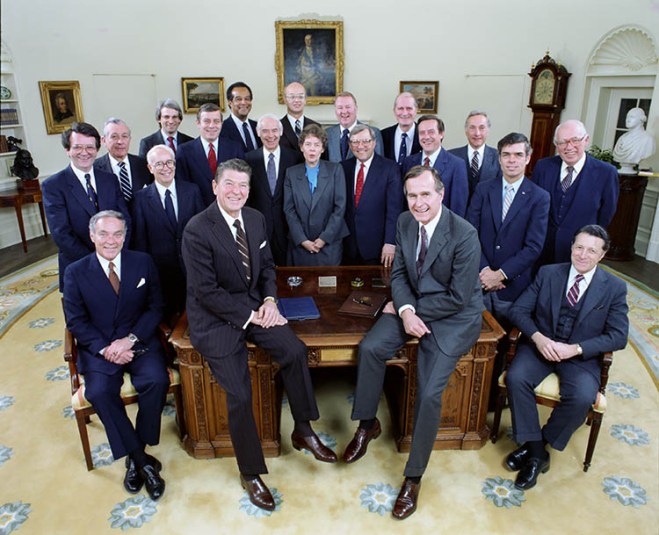
Many of us are paying a lot of attention to important things about the Trump nominees:  Do they believe in Climate Change?  Support torture?  Want to cozy up to Putin?  Create a Muslim Registry?  Know anything about the job they to which they are being appointed?  Important things.  That is why this analysis is so interesting.  It was the headline that caught my eye “Trump’s Cabinet So Far Is More White and Male Than Any First Cabinet Since Reagan.”  Written by Jasmine C. Lee the New York Times story is full of charts and pictures.

If Mr. Trump’s nominees are confirmed, women and nonwhites will hold five of 21 cabinet or cabinet-level positions. He has not yet named nominees for two additional positions.

Those five members will also be in some of the lowest-ranking positions. None of them are in the so-called inner cabinet, the four positions in place since George Washington’s presidency: the attorney general and the secretaries of state, Treasury and defense (formerly called the secretary of war).

Barack Obama had 14. Bill Clinton 12, and George W. Bush 9.  Trump is doing a little better than Reagan who only had two:  Jeanne Kirkpatrick at the United Nations and Samuel Pierce at HUD.

C487-2

The cabinet of President Ronald Reagan in February 1981.

The first cabinets of George W. Bush and Mr. Obama were both noted for their diversity. In Mr. Bush’s initial administration, 45 percent of the cabinet and cabinet-level officials were women or nonwhite men. In Mr. Obama’s first cabinet, that figure was 64 percent.

What does it mean that the clock is being turned back on diversity?  I think that diversity and inclusion are bad words to the President-elect.  They certainly are to his supporters.  But I think a great deal is lost when there aren’t persons from different backgrounds, genders, and races at the table.  If everyone is a super-rich white man, who represents the rest of us?  And who represents the Trump voter?

Official White House photo of Obama Cabinet

The cabinet of President Obama in September 2009.

Photograph of Reagan Cabinet from the Reagan Library

Photograph of the Obama Cabinet from the White House

Senate in a hurry

The Senate, that body that couldn’t seem to muster enough energy to do very much since 2010 except hold endless hearings about Hillary Clinton, has suddenly gotten busy.  Last night – or rather early this morning – they took the first steps toward repealing the Affordable Care Act.  The New York Times reporters wrote

The approval of the budget blueprint, coming even before President-elect Donald J. Trump is inaugurated, shows the speed with which Republican leaders are moving to fulfill their promise to repeal President Obama’s signature domestic policy achievement — a goal they believe can now be accomplished after Mr. Trump’s election.

The action by the Senate is essentially procedural, setting the stage for a special kind of legislation called a reconciliation bill. Such a bill can be used to repeal significant parts of the health law and, critically, is immune from being filibustered. Congress appears to be at least weeks away from voting on legislation repealing the law.

631419962-3438

Senate Minority Leader Sen. Charles E. Schumer (D-N.Y.) is leading the charge to make Hill Republicans own the Obamacare repeal process.

The Democrats staged a protest on the floor, taking turns speaking even while being ruled out of order.  The vote was 51 to 48.  So, what can someone who is opposed to repeal do at this point?  I found a New York Times Op-Ed Seven Questions About Health Reform to be a useful guide to the questions we should be asking any Senator or Congressperson who supports repeal.  The piece by Harold Pollack and Timothy S. Jost should be read in full, but here are what I think are the most important of the seven questions. (The numbering is mine not theirs. And they are not in the order of importance.}

First, “How many millions of Americans will lose coverage?”  Among the issues pointed out is

Proposals by Tom Price, Mr. Trump’s choice to run Health and Human Services, and by the House speaker, Paul D. Ryan, would repeal the expansion of Medicaid and replace the A.C.A.’s income-based subsidies with less generous tax credits. Another plan from the House Republican Study Committee would offer deductions. We particularly need to know how this would affect low-income Americans, to whom tax deductions are nearly worthless, and who would generally not be able to afford coverage under these plans.

Second, “Will people over 55 pay higher health premiums for the same coverage?”  If the repeal is paired with cuts to Medicare, all of us over 55 will be in trouble.  And younger folks who may not have saved much for retirement yet will find it impossible to save enough.

Third, “… how much more will those with costly illnesses or injuries have to pay in out-of-pocket costs?”

Critics of the A.C.A. often argue that the law has made health care unaffordable. But many Americans would pay much more without it. The A.C.A. capped out-of-pocket spending at $7,150 for individuals and $14,300 for families for 2017. Republican proposals appear to offer no protection from high deductibles and other cost-sharing.

This could be devastating to millions, including older Americans who often develop chronic illnesses.

Fourth on my list. “Will the new plan let insurers charge women higher premiums than men while offering them less coverage?”

Before the A.C.A. banned gender-based premiums, insurers in many states charged women more than men of the same age — some as much as 50 percent more. The A.C.A. also required all insurers to cover preventive health services without co-payments; for women, this includes birth control, Pap smears, mammograms and a host of other crucial services. Maternity care is fully covered as well. Republican replacement plans offer no such protection. And many Republicans want to defund Planned Parenthood, too, which would deprive women not just of coverage but also of care.

And, as we have learned, many men, particularly Republican men, have no idea of how a woman’s anatomy works.  For those opposed to choice on abortion, this could have the effect of increasing the number of abortions – legal and illegal.

I think there is time while President Trump argues with Congress and Congress argues with itself about what should be in any new law.  If your Senator and/or Congressperson favors repeal, call or write or visit and ask some of the seven questions.  And express your support for those that oppose wholesale repeal.  Should you agree with what is happening, leave me a message explaining why you think this is OK.

Photograph:  Alex Wong/Getty Images

Agatha Goes on a Little Trip

When I was shopping for Christmas books, I picked up what looked like an interesting book on the sale table.  I just finished reading The Grand Tour by Agatha Christie.  In February 1922 Christie, her husband, Archie, and others left on what we would call a trade mission.  They went to South Africa, Australia, New Zealand, and Canada with a vacation stop in Hawaii.  They got back to England on December 1st.  Christie wrote letters home as a kind of diary.  Her grandson, Mathew Prichard, put them together with photographs (largely taken by Christie) interspersed with excerpts from her autobiography.

agatha

The Grand Tour provides the reader with a glimpse of the British empire in the days when change was just starting in the colonies.  People are judged by how “British” they are; natives are treated as exotic.  There are tensions between the members of the mission.  There are injuries and illnesses.  I found her descriptions of the landscapes the most interesting.  For example her description of Wellington harbor:

Great mountains all around coming down to the water’s edge – the far off ones with snow on them.  Blue sky and deep blue water and Wellington itself nestling on the side of the mountain.

But the best part was learning about Agatha Christie as a young woman.  I don’t know about you, but I think of her as either Miss Marple or the older woman in many of her pictures, a little stout and stern.

older-agatha

But on the trip she thinks nothing of going off on an 11 mile hike, she golfs, and, most surprising, she learns to surf.  My image of her will never be the same.

If you have ever read any Christie mysteries and you like travel stories, you would enjoy reading The Grand Tour.


Photograph from Prezi.com


Repealing the Affordable Care Act

The Republicans have made a mantra out of repealing the ACA aka Obamacare.  I’ve lost track of how many times they have voted to repeal it, but close to 60, I think.  The surprising thing is how unprepared they really are to “repeal and replace”.  They seem to have the repeal part down, but in all the years it has been since the law was enacted, they haven’t come up with a replacement plan.  I think that even supporters of the ACA know that some things need fixing but no Republicans were willing to work with Democrats and President Obama to do so.

They could just repeal it.  This would create chaos in the health care system and upset millions.  I don’t think they want to deal with loss of support right away.  I’m not sure that voters who say they don’t like the ACA understand that things like free vaccinations, physical exams, and mammograms are part of the Act.  On the other hand, Republicans cannot seem to agree on a plan to replace the ACA.  There are a lot of ideas, but no plan and not even a framework for a plan as far as I can tell.

In the January 4 edition of the New York Times, Robert Pear had an interesting and informative article, Republicans’ 4-Step Plan to Repeal the Affordable Care Act.  In it he outlines the things that have to happen before Repeal.

05health-master768

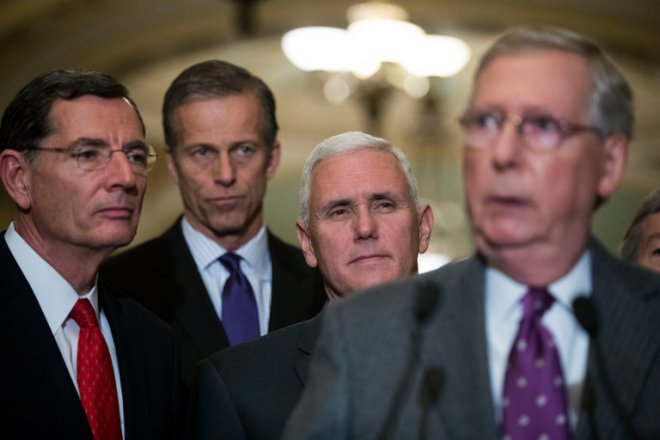
Vice President-elect Mike Pence, second from right, listened as the Senate majority leader, Mitch McConnell, spoke after a Republican luncheon on Wednesday.

Step One is to pass a budget resolution that is filibuster proof in the Senate.

The Senate intends to pass a budget resolution next week that would shield repeal legislation from a Democratic filibuster. If the Senate completes its action, House Republican leaders hope that they, too, can approve a version of the budget resolution next week. Whether they can meet that goal is unclear.

Step Two would add details.

Republicans say they will delay the effective date of their repeal bill to avoid disrupting coverage and to provide time for them to develop alternatives to Mr. Obama’s law. They disagree over how long the delay should last, with two to four years being mentioned as possibilities.

Step Three adds in ideas from President Trump.

Within days of taking office, President-elect Donald J. Trump plans to announce executive actions on health care. Some may undo Obama administration policies. Others will be meant to stabilize health insurance markets and prevent them from collapsing in a vast sea of uncertainty.

“We are working on a series of executive orders that the president-elect will put into effect to ensure that there is an orderly transition, during the period after we repeal Obamacare, to a market-based health care economy,” Mr. Pence said at the Capitol on Wednesday.

Step Four is replacement.  For which there is no consensus.

Meanwhile Democrats are also taking action.

In the Senate next week, Democrats will demand votes intended to put Republicans on record against proposals that could protect consumers. Defenders of the law also hope to mobilize groups like the American Cancer Society and the American Heart Association to speak up for patients.

This process is far from over.  Even Republicans put implementation of a new health care law a minimum of 2 years out – just in time for mid-terms- and more likely, 4 years away – just in time for the next Presidential election.

Photograph:  Doug Mills/The New York Times

Facing a new year and a new era

All of the kerfuffle about the electoral college and recounts is over and we face reality:  Donald Trump will be the next President of the United States.  I have a number of resolutions for this new era.

First, bear witness.  For me this means a bit more blogging than in the past couple of years when I have slacked off considerably.  More shorter pieces will be my mantra.

Second, try to maintain a sense of humor.  I have friends to help me including Robert Waldo Brunelle, Jr. who explains things.

mr-brunelle-1-4

Third, work for good local and statewide candidates.  Remember that in two years there is a midterm election.

Fourth, distract myself from 24 hour politics.  There are the Red Sox and bird watching for example.  There are many, many books to be read.

Keep reminding myself that life does go on.

The End of the American Experiment?

After the stunning results of the election on November 8, I was slowly coming to terms with Donald Trump as President of the United States and trying to figure out how best to resist the tide.  But things kept happening.  First, there was news of the Jill Stein recount and the remote possibility that Hillary Clinton could win three more states and thus the election.  Then, there are the so-called Hamilton Electors.  Finally we have the CIA confirming that Russian operatives interfered in the election to make Trump President.

I can understand the Stein recount; I can’t understand why Trump is so opposed.  I thought he was alleging massive voter fraud, especially in Pennsylvania one of the states being recounted so maybe this fraud will be uncovered.  I don’t have a lot of hope that all three states, Wisconsin, Michigan, and Pennsylvania will flip, but even one would eat at his margin in the Electoral College.

Which brings us to the Hamilton Electors.  I heard someone talking about them and had to look up what/who they were.  According to Matthew Rozsa in Salon

With just days to go until the real election of 2016 — the Electoral College — the rogue faction known as the Hamilton Electors is making one last-ditch effort to save America from Donald Trump by denying him the 270 votes he’ll need to be officially named president.

But can the Hamilton Electors convince enough of their fellows in the Electoral College to view Gov. John Kasich of Ohio as our era’s George Washington?

Their leaders, who named their group after Federalist Paper No. 68, say it’s still possible that they’ll succeed.

These so-called Hamilton Electors are, interestingly, led by Democrats.

Remember way back before the Democratic National Convention when the chair of the party was Debbie Wasserman Schultz?  Remember that she was removed after her email showing that she was a Clinton partisan and not neutral as a party chair should have been was leaked.  In a long article in Esquire published in October, Thomas Rid wrote

According to Reuters, the FBI first contacted the DNC in the fall of 2015, obliquely warning the Democrats to examine their network. It wasn’t until May, however, that the DNC asked for help from a cybersecurity company called CrowdStrike, which had experience identifying digital espionage operations by nation-states. CrowdStrike immediately discovered two sophisticated groups of spies that were stealing documents from the Democrats by the thousands.

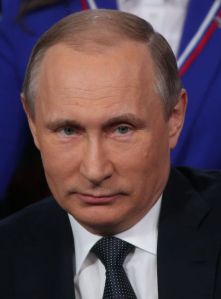
CrowdStrike was soon able to reconstruct the hacks and identify the hackers. One of the groups, known to the firm as Cozy Bear, had been rummaging around the DNC since the previous summer. The other, known as Fancy Bear, had broken in not long before Putin’s appearance at the St. Petersburg forum. Surprisingly, given that security researchers had long suspected that both groups were directed by the Russian government, each of the attackers seemed unaware of what the other was doing.
Vladimir Putin

Vladimir Putin

So while Trump and his advisors may be right in saying they have no reason to believe the CIA, the group that told us Iraq had weapons of mass destruction, a lot of people have known for a long time that Russia was hacking the DNC.  Plus it is now suspected that the Republicans were also hacked but the results never leaked.

Will the revelation of the Russian interference make more electors consider becoming Hamilton electors?  Would this be a good thing?  My long-time friend, Garrett Epps, doesn’t think so.  In his recent column for the Atlantic, he writes

As far as I am concerned, a system in which electors pretend to support one candidate and then go shopping their votes after the fact is dangerous. If you doubt that, consider the frank admission by former Republican vice-presidential nominee Bob Dole that, had the 1976 election been slightly closer, his party was “shopping—not shopping, excuse me. Looking around for electors … We needed to pick up three or four after Ohio.” Turning the post-election pre-vote period into a bidding war would be the one thing most calculated to make the electoral-vote system more of a disaster than it is.

On the other hand, there’s also nothing wrong with saying that on December 19, the electors chosen in November will be responsible for choosing the next president.  Not the voters of their states, not the leaders of their parties.

They themselves. Their individual votes will determine the result.

And each of them must make his or her own choice.

The electors for New Hampshire for example who are all Democrats and all voting for Clinton, have asked for an intelligence briefing before they vote.  Would an intelligence briefing for electors change some Republican minds?  (If you are a Democrat, you really don’t want to be voting for John Kasich, do you?)  I don’t know.  Maybe.

So, as Garrett urges, think about what you would do if you were an elector.

Imagine you were an elector. Imagine you had promised to support a candidate whose platform was American greatness. And imagine before your vote—the vote that would count for history, the vote that could never be recounted or taken back—you received evidence suggesting that the candidate was unfit for the office that he seeks?

And imagine that he wouldn’t do anything to dispel suspicion or refute the evidence.

Don’t look at the popular-vote tracker. Don’t look at the “Founding Fathers.” This is a new problem, and the only place to look is your own conscience.

This is a real crisis for American Democracy:  One candidate won the popular vote by almost three million votes; the other got to the magic 270 in the Electoral College.  Should enough electors decide that in good conscience they can’t vote for Donald Trump because of foreign interference in the election in addition to a growing realization that perhaps he is unfit for the office, what happens next?

Photograph of Putin:  Getty



Going around the world without leaving home

I belong to a mystery book group, Malice on Main.  It is sponsored by a wonderful bookstore, Mystery on Main, in Brattleboro, VT.  Each year we pick a theme and the bookstore owner, David, picks the books.  2016 was international mysteries.  We read eleven books (we don’t meet in January) and I enjoyed all but one which I didn’t finish.  Looking back, I think each member had at least one they didn’t care for; sometimes they finished it any way but sometimes not.  Here is the list annotated with my comments.

China:  Death of a Red Heroine (Xiaolong Qui)  A fascinating glimpse of life and police work in present day China.  I really enjoyed this one.

Japan:  The Devotion of Suspect X (Keigo Higashima)  We had quite a discussion about the writer’s treatment of the women in the book and whether the sexism was cultural or just him or just the detective.  I read the a second book by him, Malice, and the woman was more realistically drawn and much more interesting leading me to conclude that the women in Devotion were written the way they were as part of the story.  One day I will have to read it again and see if this is correct.

Venice:  Death at La Fenice (Donna Leon)  This is Leon’s first and, having read everything she’s written, still one of my favorites.  We see her detective Guido Brunnetti as she is just starting to develop him as a character.  Plus it is an interesting death that he investigates.

Cuba:  Havana Red (Leonardo Paura)  More interesting for the picture of Cuba than the mystery.

missing-servant

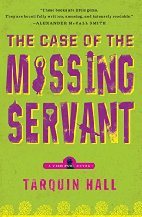
India:  Case of the Missing Servant (Tarquin Hall)  A lot of fun.

Ghana:  Wife of the Gods (Kwei Quartey)  Detective Darko Dawson is sent to investigate a murder with supernatural implications and solves both the murder and his mother’s mysterious disappearance over twenty years ago.

Austria:  The Truth and Other Lies (Sascha Arango)  What happens when a death causes a life built on pretense to crumble.


Turkey:  Istanbul Passage (Joseph Kannon)  This is more of a spy thriller than a mystery.  Set in 1946 or 1947, the story is wrapped around the Jewish exodus from Europe to Palestine.  I really liked this book.

Ireland:  Elegy for April (Benjamin Black)  The search for April who disappears.  Full of interesting characters including the eccentric Quirke who undertakes to find her.

France:  How’s the Pain (Pascal Garnier)  The one book I couldn’t finish.  I found the two main characters totally unappealing.  One of my fellow book group members thought it was very existential, like a Camus novel.

crack

Argentina:  A Crack in the Wall (Claudia Pineiro)  Totally absorbing with an ending I would never have predicted.  Because it centers around architecture, one can Google the buildings she talks about.

Except for The Truth and Other Lies which could be set almost anywhere, each of these books provides a glimpse of place and culture.  One of the reasons I’m attracted to mystery stories is that a good author includes lots of descriptions.  I often think that much of what I know about England, I learned from reading mysteries.  These eleven books took me to new places and taught me new things.  But I also learned that being a police detective – or an amateur crime solver – is pretty much the same no matter where you are.

Citizen Science

The incoming administration has not shown a great deal of interest in climate change or in science generally so it is up to those of us who care to do our part.  We can contribute to worthy organizations.  We can participate in protests against fracking and building more pipelines.  And we can submit observations to organizations that depend on Citizen Science.

I think we have all heard of the canary in the coal mine, but patterns of bird migration are also signs of change.  This will be the 4th winter my husband and I have participated in Feeder Watch.  Before that, we reported for the Christmas Day Count and other particular days.  If you live in the United States or in Canada and have at least one bird feeder, you can sign up for a modest cost and report the birds that come visit.  It is pretty simple.  Sign-up and you get a packet that explains what to do and how to report. Pick two consecutive days a week and report through the winter.

A Tufted Titmouse at one of our feeder a few winters ago.

A Tufted Titmouse at one of our feeder a few winters ago.

But what if you don’t have a feeder or live in the US or Canada?  Regardless of where you live you can report what you see on eBird.  I report birds we see on walks and when we travel as well as bird during Feeder Watch.  When we started, I could tell Blue Jays and Cardinals from House Sparrows, but saw many birds I couldn’t identify.   Gradually, you can learn who almost everyone is – even the same individual who comes often to the feeder.  Feeder Watch provides a helpful chart of common birds and Cornell University has a great online ID program.

If you are like me and feeling depressed about the results of the recent election, take some positive action and sign up for Feeder Watch.


A response to protest that makes sense

I have yet to hear any practical solutions to the problem of violence and conflict between the African-American and other minority groups and the police from Donald Trump.  Here is a response that can be made by local police all over the country.

Here is the complete text of a letter from the Brattleboro, VT chief of police published today in the Reformer.

I wanted to take this opportunity to make a few comments about the recent Black Lives Matter March that was held in Brattleboro on July 13.

There is a culture of mistrust towards law enforcement that currently exists in our country. Recent events have catapulted that mistrust to levels that exceed those of recent memory. Police interactions with citizens have been called into question resulting in anger, disbelief and frustration. These feelings have manifested themselves into protests, rallies and marches throughout the country. Some have been peaceful, others have not.

There was a march in Brattleboro that should be recognized. Unfortunately there were no national news agencies on hand to help report this story. The participants in this rally were there to express their frustration towards social injustice and police excessive use of force.

From the start I noticed members from across the spectrum of our community and many new faces. They spoke about the injustices towards minorities and police brutality but they also discussed solutions to rectify those injustices and ways of better policing.

This march was interesting to me as it not only addressed the problem but suggested ideas towards the solution. It was peaceful, respectful and informative. To sum it up in one word – positive.

I spoke to many non-participants along the route and their feelings were the same. The conduct of those demonstrating in Brattleboro drew people to them, not away. People wanted to join them, to be a part of this movement. In my opinion, that is how to make a change. Negative actions rarely produce positive outcomes.

To the organizers and to all those who participated, I would like to commend you on the overwhelmingly positive difference you made through your peaceful demonstration. It was a model for the rest of the country to emulate.

People expect the police to respond to a wide variety of situations with thoughtfulness, compassion, respect and empathy. I can assure you that every Brattleboro Police officer wishes to achieve that same goal. Many of you know our local officers personally by name and know of our desire to police in a fair and approachable way. We are engaged with the community from the officer on the street up to the chief, but we are not perfect and will always be able to learn and improve the ways we serve. For that to occur we need you, our community, to let us know how you feel.

Please call, email or stop by to talk to me about your concerns. In these challenging times, the Brattleboro Police Department remains steadfast in the commitment to the safety of all in our community.

Michael R. Fitzgerald is the chief of Brattleboro Police Department. He can be contacted at Michael.Fitzgerald@vermont.gov.

From a story in The Commons "To protect and - serve lunch!"

From a story in The Commons “To protect and – serve lunch!”

I mentioned the good community policing happening in Brattleboro in my post earlier today.  Here is more proof.  I hope more police departments adopt Chief Fitzgerald’s approach rather than going into a totally defensive mode.  As I said earlier, we need more talk and less violence on both sides.


The silly season begins in earnest with too many deaths and too many guns

Time to fire up the blog again after a long break.  I’ve found the world just too depressing to write about with violence and war all over the world including police shooting civilians, civilians shooting police, and too many people just shooting each other,   Yes, the major incidents we hear about are racial, but there are just too many that are not.

td160715

This Tom the Dancing Bug cartoon illustrates only too well what kind of society we seem to be rapidly moving toward.  The violence is numbing.  And our Congress seems unable to act.  We can only hope that there is not another arms race with law enforcement adding more tanks and military style equipment, but more emphasis on community policing.  Granted that Brattleboro is a small town, but our police chief started something he calls “Coffee with a Cop” several years ago.  Anyone can go to a local restaurant and talk to an officer.  Larger places can do something similar in precincts and districts.  More talk can lead to more trust.  OK.  Maybe not always, but there will never be trust if everyone is just shooting at each other.

This is the morning of the start of the Republican Convention.  The lead New York Times story begins

The attack on police officers in Baton Rouge, La., cast a grim mood over the opening of the Republican National Convention here, as Donald J. Trump responded to the killings with a stark warning that the country was falling apart.

A string of shootings targeting police officers, as well as the recent killings of two black men by police officers in Minnesota and Louisiana, had already pushed gun violence and social unrest to the center of the presidential campaign. Mr. Trump has campaigned on the theme of “law and order” since the assassination this month of five police officers in Dallas, and he is likely to amplify that message in the coming days.
“Law and Order” unfortunately doesn’t remind me of the great television series, but of Richard Nixon and the 1960s and 1970s.  They were scary times to be a protester for civil rights or against the war in Vietnam.  Unfortunately, Trump’s message is going to resonate among those who feel threatened by the changes taking place.  Changes like more gay rights, the possibility of a woman becoming president (First a black man and now a woman!), and most of all the slow change from a predominately white country to one that is more diverse.
This election is going to be a scary one beginning with the Republican Convention in Cleveland beginning tonight.  The New York Times story goes on

Cleveland has assigned about 500 police officers specifically to handle the convention, and it has brought in thousands more officers to help, from departments as distant as California and Texas.

But some local officials have expressed concern about the possibility of violence owing to Ohio’s open-carry gun laws. Though demonstrators and others in the convention district have been barred from possessing a range of items, including gas masks, there was no prohibition on the brandishing of firearms.

On Sunday, the president of Cleveland’s police union called for additional measures to protect the security of the event, and urged Mr. Kasich to suspend open-carry gun rights. The governor’s office said Mr. Kasich did not have “the power to arbitrarily suspend federal and state constitutional rights or state laws.”

Plus

And the convention was likely to begin with a trumpeting of support for police officers. Convention organizers said on Sunday that the theme of the first day, Monday, would be “Make America Safe Again.”

Jeff Larson, the convention’s chief executive, said in a news conference that a leading speaker would be Rudolph W. Giuliani, whom he described as “the law-and-order mayor of New York.”
Mr. Giuliani has been a forceful critic of the Black Lives Matter movementand has been outspoken in his defense of law enforcement practices over the last few weeks.
I worry that Democratic calls for unity are not good enough in face of Trump and Giuliani bombast.  NPR laid out the contrast nicely.
Following the shooting death of three law enforcement officers Sunday in Baton Rouge, presumptive Republican nominee Donald Trump blasted President Obama on Twitter and Facebook, saying he has “no clue” how to deal with a country that is a “divided crime scene.”
while Hillary Clinton issued a statement

Meanwhile, presumptive Democratic nominee Hillary Clinton called the shooting “devastating” and “an assault on all of us.”

“There is no justification for violence, for hate, for attacks on men and women who put their lives on the line every day in service of our families and communities,” she said.

Clinton also called for unity:

“We must not turn our backs on each other. We must not be indifferent to each other. We must all stand together to reject violence and strengthen our communities. Our thoughts and prayers are with the friends and families of the police officers who were killed and injured today.”


She will be speaking at the NAACP convention today and it will be interesting to hear what she has to say.

For me, the appropriate response is to begin with a ban on sales of large magazines and then move on to banning assault style weapons.  Both the Dallas and Baton Rouge shooters were trained in the military and the idea that they can easily get and use similar weapons after they are discharged is frightening.  We actually need more talk, not more guns.  Let us hope there is no violence in Cleveland.