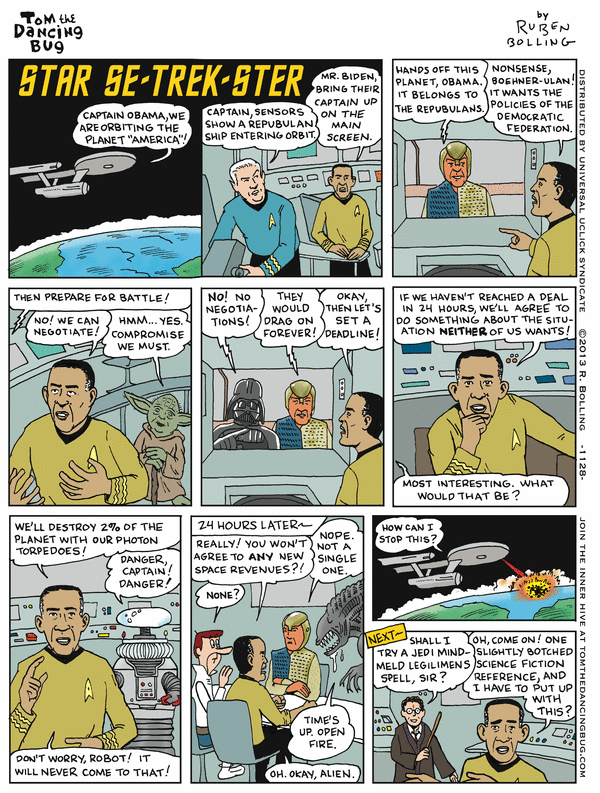
I’m a fan of the original Star Trek and of the first Star Wars trilogy. I guess I dropped out after that, maybe moved on or something. But putting that aside, I love this Ruben Bolling. Sums up the cultural reference controversy and the sequester all in one.
Culture
Chief Justice Roberts, voting rights and statistics
During the oral arguments for Shelby County v. Holder, Chief Justice John Roberts quoted some statistics that, according to his interpretation, showed the turnout ratio of minority voters to white voters was worse in Massachusetts than in any other state. This prompted a quick response from the Massachusetts election officials and a more measured one from Nate Silver on FiveThirtyEight. As the Chief Justice may be learning, statistics are tricky things.
The day after the remarks by the Chief Justice the Globe headline was
Chief justice blasted over Mass. voting ‘cheap shot’
Talk about feeling insulted! The nerve to compare us to Mississippi!
“Do you know which state has the worst ratio of white voter turnout to African-American voter turnout?” Roberts asked Donald Verrilli Jr., solicitor general for the Department of Justice, during Wednesday’s arguments.
“I do not know that,” Verrilli answered.
“Massachusetts,” Roberts responded, adding that even Mississippi has a narrower gap.
Roberts later asked if Verrilli knew which state has the greatest disparity in registration. Again, Roberts said it was Massachusetts.
The problem is, Roberts is woefully wrong on those points, according to Massachusetts Secretary of State William F. Galvin, who on Thursday branded Roberts’s assertion a slur and made a declaration of his own. “I’m calling him out,” Galvin said.
Galvin was not alone in his view. Academics and Massachusetts politicians said that Roberts appeared to be misguided. A Supreme Court spokeswoman declined to offer supporting evidence of Roberts’s view, referring a reporter to the court transcript.
On Thursday, Galvin tried to set the record straight. “We have one of the highest voter registrations in the country,” he said, “so this whole effort to make a cheap-shot point at Massachusetts is deceptive.”
So what’s going on here? Trust Nate Silver to explain.
Section 5 of the Voting Rights Act, which is being challenged by Shelby County, Ala., in the case before the court, requires that certain states, counties and townships with a history of racial discrimination get approval (or “pre-clearance”) from the Department of Justice before making changes to their voting laws. But Chief Justice Roberts said that Mississippi, which is covered by Section 5, has the best ratio of African-American to white turnout, while Massachusetts, which is not covered, has the worst, he said.
Chief Justice Roberts’s statistics appear to come from data compiled in 2004 by the Census Bureau, which polls Americans about their voting behavior as part of its Current Population Survey. In 2004, according to the Census Bureau’s survey, the turnout rate among white voting-aged citizens was 60.2 percent in Mississippi, while the turnout rate among African-Americans was higher, 66.8 percent. In Massachusetts, conversely, the Census Bureau reported the white turnout rate at 72.0 percent but the black turnout rate at just 46.5 percent.
As much as it pleases me to see statistical data introduced in the Supreme Court, the act of citing statistical factoids is not the same thing as drawing sound inferences from them. If I were the lawyer defending the Voting Rights Act, I would have responded with two queries to Chief Justice Roberts. First, are Mississippi and Massachusetts representative of a broader trend: do states covered by Section 5 in fact have higher rates of black turnout on a consistent basis? And second, what if anything does this demonstrate about the efficacy of the Voting Rights Act?
Turns out that the Current Population Survey has a very high margin of error.
One reason to be suspicious of the representativeness of Mississippi and Massachusetts is the high margin of error associated with these calculations, as noted by Nina Totenberg of NPR.
Like other polls, the Current Population Survey is subject to sampling error, a result of collecting data among a random subsample of the population rather than everyone in the state. In states like Massachusetts that have low African-American populations, the margin of error can be especially high: it was plus-or-minus 9.6 percentage points in estimating the black turnout rate in 2004, according to the Census Bureau. Even in Mississippi, which has a larger black population, the margin of error was 5.2 percentage points.
The other problem is that the Chief Justice was using 2004 figures when the 2010 numbers had a lower margin of error. So what, if any thing can we conclude.
In the chart below, I have aggregated the 2004 turnout data into two groups of states, based on whether or not they are covered by Section 5. (I ignore states like New York where some counties are subject to Section 5 but others are not.) In the states covered by Section 5, the black turnout rate was 59.2 percent in 2004, while it was 60.8 percent in the states that are not subject to it. The ratio of white-to-black was 1.09 in the states covered by Section 5, but 1.12 in the states that are not covered by it. These differences are not large enough to be meaningful in either a statistical or a practical sense.
So did Chief Justice Roberts misconstrue the data? If he meant to suggest that states covered by Section 5 consistently have better black turnout rates than those that aren’t covered by the statute, then his claim is especially dubious. However, the evidence does support the more modest claim that black turnout is no worse in states covered by Section 5. There don’t seem to be consistent differences in turnout rates based on whether states are covered by Section 5 or not.
The bigger potential flaw with Chief Justice Roberts’s argument is not with the statistics he cites but with the conclusion he draws from them.
And here what Silver thinks we should be asking.
…the fact that black turnout rates are now roughly as high in states covered by Section 5 might be taken as evidence that the Voting Rights Act has been effective. There were huge regional differences in black turnout rates in the early 1960s, before the Voting Rights Act was passed. (In the 1964 election, for example, nonwhite turnout was about 45 percent in the South, but close to 70 percent elsewhere in the country.) These differences have largely evaporated now.
How much of this is because of the Voting Rights Act, as opposed to other voter protections that have been adopted since that time, or other societal changes? And even if the Voting Rights Act has been important in facilitating the changes, how many of the gains might be lost if the Section 5 requirements were dropped now?
To put it nicely, the Chief Justice is using correct statistics to come to not only the incorrect conclusion, but also to ask the wrong questions. Silver concludes
These are difficult questions that the Supreme Court faces. They are questions of causality – and as any good lawyer knows, establishing a chain of causality is often the most difficult chore in a case.
Statistical analysis can inform the answers if applied thoughtfully. But statistics can obscure the truth when they become divorced from the historical, legal and logical context of a case.
We can only hope that some law clerk at the Supreme Court reads FiveThirtyEight and talks to enough Justices. Given all the shenanigans going on in Section 5 covered and not covered states on voting rules, now is not the time to over turn this modest brake insuring voting rights.
Related articles
- Massachusetts 1, John Roberts 0 (maddowblog.msnbc.com)
- Galvin: On Mass. Racial Voting Gap, Chief Justice Roberts Is Wrong (wbur.org)
- Mass. official jabs Roberts’ comments (politico.com)
- Chief Justice John Roberts Used An ‘Old Slur’ Against Massachusetts, Official Says (businessinsider.com)
- Racial Turnout Figures Cited by Roberts Are Disputed (blogs.wsj.com)
- Chief Justice Misconstrued Census Data (politicalwire.com)
The curious story of Mary Paine
Mary Paine died in 1713 at 15 months. Hardly the making of a life story, but there she was on the front page of the Metro section of the Boston Globe this morning.
It seems that in 1955, a 20 year old sailor, Roland McCandlish found Mary’s tombstone in a Copp’s Hill Burying Ground shed. He took it with him back to his ship at the Charlestown Navy Yard.
From there, the vessel visited exotic ports of call, from Greenland to Haiti to Puerto Rico. When he returned home to California for good, he used the stone as a small but cherished table.
“I never thought of it as a tombstone; I thought of it as Mary,” McCandlish, now 79, said by phone Thursday. “She had, through me, the life she never had. She was a part of my life.”
McCandlish mailed it back to Boston.
McCandlish, in declining health and thinking about a headstone of his own, decided it was time to send the headstone back. He packaged it up, along with a photo of himself as a young sailor holding the stone, and a letter explaining the tale of its travels.
And I think this is my favorite part of the story.
McCandlish said parting with the relic was not easy. They’d made memories together.
He recalled when his Navy captain found the headstone stashed in a filing cabinet on the ship and called McCandlish into his office to explain.The captain laughed at his story.
“He reacted differently than others might,” McCandlish said. “He put it in the bottom drawer of the filing cabinet and said, ‘We’ll call it our dead file.’ ”
So the headstone will be reset next to the grave of her mother in the next few months and her travels will come to an end.

The headstone of Mary Paine, who died Dec. 31, 1713, at 15 months old, was discovered by Roland McCandlish during a 1955 tour of Copp’s Hill Burying Ground in the North End of Boston.
Photograph credited to Old North Church.
Related articles
The end-of-life decision
I’m sure that everyone has heard the tape of the 911 call or read the transcript. An unidentified nurse at an independent living facility refused to do CRP on a resident who had collapsed. The resident. 87 year old, Lorraine Bayless, collapsed in a dining room. The New York Times published the transcript of part of the call
“She’s going to die if we don’t get this started. Do you understand?” the 911 dispatcher asked.
“I understand,” the nurse said. “But I cannot have our other citizens who don’t know CPR do it.”
“Is there anyone that’s willing to help this lady and not let her die?” the exasperated dispatcher said a bit later.
“Um, not at this time,” the nurse replied.
For me the most shocking part of this story is not that no CPR was performed, but that the nurse in question evidently thought she was following company policy. The Boston Globe story elaborates
During the dramatic 7-minute, 16-second call, dispatcher Tracey Halvorson urged the nurse, who has not been identified, to start CPR. The nurse declined, citing company policy.
‘‘I understand if your boss is telling you, you can’t do it,’’ the dispatcher said. ‘‘But . . . as a human being . . . you know, is there anybody that’s willing to help this lady and not let her die?’’
‘‘Not at this time,’’ the nurse answered.
Halvorson assured the nurse that Glenwood couldn’t be sued if anything went wrong in attempts to resuscitate the resident, saying the local emergency medical system ‘‘takes the liability for this call.’’
Later in the call, Halvorson asked, ‘‘Is there a gardener? Any staff, anyone who doesn’t work for you? Anywhere? Can we flag someone down in the street and get them to help this lady? Can we flag a stranger down? I bet a stranger would help her.’’
Now comes the firestorm and many, many questions. Did Ms. Bayless have a DNR on file and did staff know about it? Even if the independent living facility was “just housing”, don’t people just have an ordinary responsibility to each other to help and not just let someone die? What was the policy really? And were there other residents there who saw all this happening?
Like many people of my age, I am very familiar with this type of facility since my mother lived in one for many years. Yes, she owned her own unit for most of those years and had a kitchen but she also was required to pay for one meal a day in a common dining room. This is a common practice to help prevent isolation. The facility also provided recreational activities including exercise classes, trips, a bus to go shopping and a nurse on site. My mother had a DNR, but I’m not sure who knew about it until she moved into the assisted living section of the facility. There all the staff knew. Somehow I cannot begin to imagine that one of the staff in the dining room would not have started CPR if someone collapsed and started breathing. My mother once choked and a wait staff member did the Heimlich on her. And I saw other medical emergencies in which staff intervened even while waiting for the EMT’s to arrive.
So what went wrong here? The NYT article points out the CPR can hurt frail elders more than it can help them.
In one study conducted in King County, Wash., where a surveillance system tracks every out-of-hospital cardiac arrest, University of Washington researchers found that only 9.4 percent of octogenarians and 4.4 percent of nonagenarians survived after CPR, compared with 19.4 percent of younger patients.
In another study of 2,600 out-of-hospital cardiac arrests over four and a half years in Oakland County, Mich., only 3.3 percent of patients over age 80 who received CPR survived to discharge from the hospital.
Even when older people survive CPR, the consequences can be deleterious: broken ribs and fractured sternums, punctures of the lungs or liver, vomit in the lungs and significant pain. Those who argue for CPR in the elderly say these complications, while serious, are preferable to death. Others say quality of life can be, and often is, terribly degraded.
Ms. Bayless’ family has expressed peace of mind with the decision saying that their mother wanted to go quickly, without intervention and given the potential consequences, I can understand their point of view. But given that fact, why was there no DNR order on file?
Meanwhile everyone is investigating the need for clearer policies, the need for possible legislation and even the possibility of a criminal case. According to the Globe
…the case has alarmed police, lawmakers, and advocates for the elderly. The Assisted Living Federation of America, the nation’s largest trade group for such centers, said Tuesday that even if facilities have policies saying employees don’t perform CPR, they should cooperate if asked by 911 dispatchers.
‘‘It was a complete tragedy,’’ said Maribeth Bersani, senior vice president of the trade group. “Our members are now looking at their policies to make sure they are clear.’’
Bakersfield police were trying to determine whether a crime was committed when the nurse refused to assist the 911 dispatcher.
And lawmakers are pledging an investigation.
‘‘This is a wakeup call,’’ said Assemblywoman Mariko Yamada, chair of the California Assembly Aging and Long-term Care Committee. ‘‘I’m sorry it took a tragedy like this to bring it to our attention.’’
For me the bottom line is this from the New York Times
There is another lesson here as well, much broader in scope, about what people owe each other in emergencies of this kind. Whether or not we have medical training, “all of us have a duty to respond to people in life-threatening situations,” said Dale Jamieson, director of the Center for Bioethics at New York University. “This is a general ethical commitment we have to each other as part of living in society.”

The main gate of Glenwood Gardens, a retirement community in Bakersfield, Calif., where an elderly woman died after a nurse refused to perform CPR
What develops from this incident will impact all of us boomers as we age. And for younger people, this might be your parent.
Related articles
- Lorraine Bayless’ family back nurse who did not intervene to save their mother’s life (dailymail.co.uk)
- Spokesman says woman who refused to give CPR to dying 87-year-old wasn’t a nurse (foxnews.com)
- Family: CA woman denied CPR wanted no intervention (cbsnews.com)
- California nurse refuses to give CPR to dying woman (guardian.co.uk)
- DSHS: Independent living nurses not required to give CPR (komonews.com)
Some facts to think about and to know about background checks when you are talking with friends.
Related articles
- Gun background checks in January were second highest ever, FBI data shows (news.blogs.cnn.com)
- Bill requiring fee for gun background check onto next committee (denverpost.com)
- FBI Performs 2 Million Background Checks Four Months in a Row (guns.com)
Texas, the death penalty and science
Hard to know where the fault lies: with Governor Perry who seems to like to execute people without seeming to inquire too much about the circumstances or with the anti-scientific cultural bias that seems to inhabit the state. Both are at play with the pending execution of Larry Swearingen for a murder he may not have committed.
Jordan Smith (a reporter for the Austin Chronicle) writes for the Nation
Just over a year ago, in January 2012, Texas Governor Rick Perry marked a gruesome milestone: with 239 executions under his belt, he had officially overseen half of all executions carried out in that state since the reinstatement of the death penalty. Since then, Texas has killed fourteen inmates, solidifying Perry’s position as the governor who has presided over the most executions in history. To date, 492 prisoners have been put to death since the state’s death chamber roared back to life in 1982. By the time this issue of The Nation hits newsstands, the number will likely be 493.
Amid so much state-sanctioned killing there is scant official acknowledgment that the state’s capital punishment system is fraught with problems. As the body count rises, nagging evidence points to the possibility that Texas has executed at least one innocent person, and may be poised to kill more. The arson-murder case of Cameron Todd Willingham, killed in 2004, is the best known, but there are many other cases that raise serious questions about the guilt of people on Texas’ death row.
As it moves down the roster of executions scheduled for this year, the state is perilously close to adding another name to its list of potential innocents: Larry Swearingen, whose case highlights a growing tension in Texas between science and the law. Add to that conflict the all-too-familiar problems of prosecutorial bias and tough-on-crime politics, and you’ve got a recipe for wrongful conviction that, when death is involved, can’t ever be remedied.
I’ve written twice about Cameron Todd Willingham, once in 2009 and again in 2010. Most people who know about the Willingham case believe that this was a case where an man known to be innocent was executed. According to Smith, it may well happen again. Interestingly, both cases hinge on science.
In Swearingen’s case, the courts have demonstrated little tolerance for scientific questions that are not only central to his guilt or innocence, but that have implications for every single death investigation in the state. Until Texas courts— particularly the state’s highest criminal court, the Court of Criminal Appeals (CCA)—accept that understanding science is key to doing justice, the risk that innocent men and women will be locked up, or worse, is inevitable. And in the absence of such a eureka moment, Swearingen, whose latest execution date was February 27, will die despite serious unresolved questions about his guilt.
According to the story in the Texas Observer
When a dead body is discovered, investigators can work out the likely time of death in a number of ways. The first clue is the bugs. It can take no time at all for blowflies and house flies to home in, searching for open wounds and orifices in which to lay their eggs. Between 12 and 24 hours later, when the body is cold to the core, those eggs hatch and the larvae feed on the flesh. The insects offer important clues for forensic pathologists, but it’s also important that they note what the outside temperature was in the days and weeks preceding the body’s discovery. That’s because the higher the temperature, the faster the insects will develop and once entomologists have identified the species, they can determine when they hatched and therefore how long that body has been there.
By day four, bacteria have started to break down the tissues and cells, releasing fluids into the body cavities that produce gases and cause the body to bloat. In summer, a human cadaver in an exposed location can be reduced to bones in just nine days—particularly if there are wild animals around.
Decomposition science is morbid but it can help solve heinous crimes. And it could be the key to figuring out if a man sitting on Texas’ death row was the killer in the gruesome 1998 murder of 19-year-old Melissa Trotter.
In February, nine forensic experts took the stand at an evidentiary hearing for convicted murderer Larry Swearingen to explain that precisely because of this decomposition science, they were sure that Trotter hadn’t been dead very long when her body was discovered— as little as a day; as long as 14. Either way, Swearingen couldn’t have killed her, they said, because at the time of her death he was in jail.
Smith concludes his piece in the Nation
Had Melissa Trotter been killed today, it is hard to imagine that Swearingen would be facing execution without the alleged murder weapon or other evidence first being subjected to DNA testing. The use of science, and DNA in particular, in criminal cases has advanced greatly since 1999. “This is evidence that would routinely be tested if the case was investigated today, and any one of these pieces of evidence could produce a DNA profile that could lead to another perpetrator,” says Bryce Benjet, who is working with the Innocence Project on Swearingen’s behalf. “Regardless of where you stand on the death penalty, I think we can all agree that we should be absolutely certain of guilt before putting someone to death.”
Of course, Texas’ efficient death machinery doesn’t necessarily discriminate between the certainly guilty and the probably or even possibly so. Finality of conviction has long been the force driving justice in Texas, especially as practiced from the bench of the CCA. But DNA has already exonerated forty-seven inmates in Texas—one of them on death row—and inspired efforts to ensure better certainty in convictions, in the state and beyond. Whether the court will accept and apply such science in Swearingen’s case—or in the cases of any of the twelve other inmates scheduled for execution in 2013—remains an open question.
Larry Swearingen’s execution has been stayed until evidence can be reexamined. Let’s hope this happens before the courts and the state get impatient. Let’s hope the science is accepted before he is put to death, not after as with Willingham.
Photograph Alex Hannaford
Related articles
- Innocence Project ask for DNA-Testing for Larry Swearingen (DR) (inprisonedwomen.wordpress.com)
- Judge withdraws execution date in college slaying (star-telegram.com)
- Wrongful convictions a lasting scar on Texas justice system (star-telegram.com)
Rebuilding the Longfellow Bridge, Part 2
In 2010, I wrote about the potential redesign of the historic Longfellow Bridge between Boston and Cambridge to make it more pedestrian and bicycle friendly. This week, the Massachusetts Department of Transportation announced they were ready to being rebuilding. Renovation will begin this summer and take three years if all goes according to schedule. According to the Boston Globe
Through the duration of the three-year construction project, the bridge will only accommodate cars traveling from Cambridge into Boston. Traffic headed north will be diverted to the Craigie Bridge, adjacent to the Museum of Science. The road leading to Cambridge will be narrowed to one lane to allow for bicycle traffic. David L. Ryan/Globe Staff/File 2010 The road leading to Cambridge will be narrowed to one lane to allow for bicycle traffic.
For 25 weekends, the Red Line will not traverse the bridge, and commuters will instead be shuttled via bus. The T will continue to run on weekdays, on temporary tracks on the road while workers perform maintenance on the permanent rails.
The traffic flow will look something like this.
As you can see, no traffic will come over the bridge from Cambridge. The alternate route will go over a drawbridge near the Museum of Science which should make for a lot of fun during rush hour. At least one can take the train on weekdays.
Then some time during the winter of 2014/2015, the closed lane will move to the other side of the bridge, but traffic will still only go from Boston to Cambridge. There will be more buses to shuttle passengers while the train is shutdown.
Will all of this be worth the disruption? Something had to happen with the Longfellow – that was clear. The bridge which was built in 1906 badly needs repairs. Everyone wanted more accommodation for walkers and bikers. And the unique salt and pepper shakers had to be preserved so there would be no widening. The towers will be dismantled and rebuilt around a new frame. The compromise redesign looks like this.
No one is 100% happy with this, but as has been pointed out, traffic has dropped since the Zakim Bridge on the interstate opened.
According to the Boston Globe story from last February
The state pulled back on its Longfellow plans in 2010 and convened a 36-member task force that included bike, pedestrian, and environmental advocates, neighbors, and civic and business leaders, whose input contributed to the new design.
“One of the breakthroughs of the task force was to treat the inbound side of the bridge and the outbound side of the bridge differently,’’ said state Representative Martha M. Walz, a Democrat whose district includes the bridge’s Boston approach and part of its Cambridge approach.
Fellow task force member Richard A. Dimino said the plan addresses contemporary needs while respecting the history of the bridge. “They’ve made exceptional efforts to ensure that the historic character of the bridge will be preserved, and obviously it’s a landmark bridge,’’ said Dimino, president and chief executive of A Better City, which represents hospitals, universities, financial firms, and other major employers on regional transportation planning.
You can see some of the design proposals and read more about the history of the bridge on my original post. I will be watching the Longfellow as construction begins.
The Museum of Science, Boston. On the Charles River with a view of the Leonard P. Zakim Bridge behind it (Photo credit: Wikipedia)
Design drawings JAVIER ZARRACINA, PATRICK GARVIN/GLOBE STAFF
Related articles
- Longfellow Bridge Repairs Will Close Lanes Heading From Boston To Cambridge (wbur.org)
- Half of Longfellow Bridge to close from Summer 2013 to Fall 2016 (tech.mit.edu)
- Mass. board awards contracts for 2 major bridges (bostonherald.com)
Are you affected by gun violence?
I had never thought much about the impact of gun violence on my own life until I read Alex Kotlowitz’s piece in the New York Times Sunday Review. The story is about Chicago right now the worst urban area for gun violence, but what he describes could apply to anyone, any place. We talk a lot about the post traumatic stress of those who were in the movie theater in Aurora or the citizens of Newtown, but we don’t talk about the victims of the violence that happens every day one or two or three people at a time. And we certainly don’t talk about what happens to the rest of us.
I live in a neighborhood that is considered to be highly desirable. Rents have increased as houses have been renovated. Three families have been condoed. There are stories in the paper about the sales price of homes. But 20 years ago, there was a gang gun fight in front of our house. The bullet hole is still in one of the vestibule windows. A couple of years ago, a boy playing on one of the basketball courts, 4 or 5 blocks down the hill from us was shot and killed. I have friends who have lost children to violence. One can’t escape. All of this is somewhere in the back of my mind when I walk or drive in our relatively safe, desirable neighborhood. If I stop for a moment to think about violence, I think about my own neighborhood. And if I am affected in a relatively minor way, what about the children? This is the question that Kotlowitz asks.
EVERY year, the Chicago Police Department issues a report with the macabre title “Chicago Murder Analysis.” It’s a short but eye-opening document. Do the calculations and you realize that in the past 15 years, 8,083 people have been killed, most of them in a concentrated part of the city. There’s one particularly startling revelation that gets little notice: in 2011, more than four-fifths of all murders happened in a public place, a park, an alleyway, on the street, in a restaurant or at a gas station.
When Hadiya Pendleton, the 15-year-old public school student and band majorette who just a week earlier had performed at President Obama’s inauguration, was killed on Jan. 29, she was standing under an awning in a park with a dozen friends. They all saw or heard it when she was shot in the back. One of them, in fact, was wounded by the gunfire. Which brings me to what’s not in the “Chicago Murder Analysis”: Over the past 15 years, according to the University of Chicago Crime Lab, an estimated 36,000 people were shot and wounded. It’s a staggering number.
We report on the killers and the killed, but we ignore those who have been wounded or who have witnessed the shootings. What is the effect on individuals — especially kids — who have been privy to the violence in our cities’ streets?
The answer: post traumatic stress. Kotlowitz continues
I ask this somewhat rhetorically because in many ways we know the answer. We’ve seen what exposure to the brutality of war does to combat veterans. It can lead to outbursts of rage, an inability to sleep, flashbacks, a profound sense of being alone, a growing distrust of everyone around you, a heightened state of vigilance, a debilitating sense of guilt. In an interview I heard recently on the radio, the novelist and Vietnam veteran Tim O’Brien talked about how the atrocities and nastiness of battle get in your bones. The same can be said for kids growing up in Hadiya’s neighborhood.
The ugliness and inexplicability of the violence in our cities comes to define you and everyone around you. With just one act of violence, the ground shifts beneath you, your knees buckle and all you can do is try the best you can to maintain your balance. But it’s hard.
…
In December, the Department of Justice released a little-noticed report that suggested that children exposed to community violence might turn to violence themselves as “a source of power, prestige, security, or even belongingness.” The report went on to recommend that these children should be treated by professionals. At Hadiya Pendleton’s school, the principal said that over the Christmas holidays two students were shot and injured. If their experiences were at all typical, they were undoubtedly treated at a hospital emergency room and then released without any referral for counseling.
In Philadelphia, there’s a remarkable, albeit small, program, Healing Hurt People, a collaboration of Drexel University’s College of Medicine and School of Public Health, which scours two emergency rooms in the city for young men and teens who have been shot and pulls them in for counseling. When the program’s founder, Ted Corbin, was an emergency room doctor in Washington, D.C., he saw how shooting victims were treated and then sent back out on the streets, where, if they didn’t do injury to themselves, they’d most likely injure someone else. “If you don’t peel back some of the layers,” Mr. Corbin told me, “you don’t know how to stop that recycling of people.”
When the NRA talks about increasing mental health services instead of measures which might begin to stem the flood of guns, legal and illegally owned, washing over us, I don’t think they mean poor inner city kids. I don’t think they mean funding for more programs like Dr. Corbin’s. If they do, now is the time to speak out.
The young boy who was shot on the basketball court down the hill from us was an honor student attending one of the best middle schools in Boston. Jaewon Martin died in 2010. According to the Boston Globe
A popular honor roll student, Martin would have graduated from the eighth grade at the James P. Timilty Middle School in Roxbury at the end of the school year.
Martin was well-liked and well-known by students and staff alike, and his family was very involved in the school, said Boston Public Schools spokesman Matthew Wilder.
“It’s a really tough day for the school community,” Wilder said.
Grief counselors will be on hand at the school to help students and faculty members cope with Martin’s death.
Was there any additional follow up after the initial counseling? What has happened to the other students in Martin’s class at Timilty or to others who knew him? Is there PTSD? Do we care?
I think this is the point of Kotlowitz’s story. We need to care.
As Tim O’Brien says, it gets in your bones. In the wake of Hadiya Pendleton’s shooting, we’ve talked about stiffer gun control laws, about better policing, about providing mentoring and after-school programs, all of which are essential. But missing from this conversation is any acknowledgment that the violence eats away at one’s soul — whether you’re a direct victim, a witness or, like Anita Stewart, simply a friend of the deceased. Most suffer silently. By themselves. Somewhere along the way, we need to focus on those left behind in our cities whose very character and sense of future have been altered by what they’ve experienced on the streets.
The answer to my title question is yes you are. If you don’t live somewhere violence happens with regularity, you are still affected because your future will be in some measure determined by these victims of violence.
Related articles
- ‘This American Life’ Looks at a High School Marooned in Violence (mediadecoder.blogs.nytimes.com)
- Chicago teen fatally shot hours after sister attended Obama’s speech on gun violence (tv.msnbc.com)
- Gun Nuts and Facts (slog.thestranger.com)
- GOP Sen. Seeks to Name Gun Bill after Hadiya Pendleton (blackamericaweb.com)
- Pain Is ‘Deep,’ ‘Indescribable’ For Gun Victim Pendleton’s Mother (npr.org)
- Hadiya Pendleton: Gang Member Confesses to Slaying of Chicago Teen (nation.time.com)
- For Discussion: Don’t Let Hadiya Pendleton’s Death Be In Vain, How Do We Stop Chicago Violence Now? (bossip.com)
Maybe we should increase the minimum wage
Massachusetts has a minimum wage of $8/hour. This is fifth highest among states, sixth if you count the District of Columbia. According to the Boston Globe
Five years have elapsed since the minimum wage in Massachusetts increased in January 2008 to $8 an hour, still one of the highest wage floors in the country.
The Legislature has not voted on a minimum wage increase since 2006, when it phased in the increase over two years and overrode a veto by Governor Mitt Romney to do so.
Since then, four states, including Connecticut and Vermont and the District of Columbia have surpassed Massachusetts. Nevada requires employers to pay workers $8.25 an hour if they do not receive health benefits, but if health insurance is provided the minimum wage rate falls to $7.25.
California continues to pay workers a minimum of $8 an hour, and Washington has the highest minimum wage in the country at $9.19. Businesses in Connecticut must pay at least $8.25 an hour, and Vermont workers earn at least $8.60 an hour.
If Congress increases the minimum wage to $9, Massachusetts will automatically go to $9.10. Better, but not a livable wage if you live in Boston, where rents are high.
Even with an increase we will still need the Minimum Wage Awards.
PS. Did you happen to notice who vetoed the Massachusetts Minimum Wage increase?
Related articles
- Steve Chapman on the Minimum Wage (txwclp.org)
- H-Y-P-O-C-R-I-T-E: 65 Republicans Supported Increasing The Minimum Wage When Bush Was President (elect2care.com)
- The Minimum Wage Would Be $21.72 An Hour If It Rose With Productivity Since 1968 (beavercountyblue.org)
- Minimum Wage: Beggaring Workers does not Help Employment (Infographics) | Informed Comment (don-overton.newsvine.com)
- US wages and productivity 1968 – 2012 (minimum, average and The 1%) (rwer.wordpress.com)
Responses to the State of the Union Address: being picked isn’t always a good thing
Quick. Name the four responders to President Obama’s State of the Union/Joint addresses to Congress. (The first one is not considered to be formal State of the Union.) Give up? I could only remember Bobby Jindal and Bob McDonnell so I had to look them up.
2009 – Bobby Jindal in an address remembered for his Kenneth the Page imitation. If he ever decides to run for President, this will haunt him.
English: Governor Bobby Jindal at the Republican Leadership Conference in New Orleans, Louisiana. (Photo credit: Wikipedia)
2010 – Bob McDonnell the governor of Virginia who tried to rectify Jindal’s mistakes by giving his speech in the Virginia State House before a live hand-picked audience. And then he became known as Governor Ultrasound and his Presidential chances disappeared.
2011 – Paul Ryan. Representative Ryan did run for higher office tied to Mitt and, as we know, they lost. He is young and maybe can run again someday if the Tea Party ever gains firm control over the Republican Party.
2012 – Mich Daniels, governor of Indiana. This was supposed to be a stepping stone to the Presidential nomination. Didn’t happen.
So this year we have Marco Rubio giving the response in English and in Spanish (so we are told). He is trying to position himself as the young, fresh face for a 2016 run for the Presidency. I have alread heard some Republican consultants saying he’s young and Joe Biden and Hillary Clinton are old and that is good for the Republicans. But State of the Union responders don’t have a very good track record, so we shall see.
Go to this link to see a short video of memorable moments.
Related articles
- Who is Bobby Jindal, really? (tv.msnbc.com)
- The Republican response to the State of the Union: Boon or bane? (cbsnews.com)
- Forbes, Kaine to sit together at State of the Union (wtvr.com)
- So much for shedding the ‘stupid party’ label (maddowblog.msnbc.com)
- Does Television Really Need to Cover Two Responses To the State Of The Union? (daily-download.com)
- Morning Joe Previews State Of The Union With Look At How ‘Tone Deaf’ GOP Makes ‘People Feel Unwelcome’ (mediaite.com)