A sort of apology

I generally don’t have a lot to say about international politics, but I am interested in education, especially education for girls.  This story was in the Guardian.

A senior member of the Pakistani Taliban has written an open letter to Malala Yousafzai – the teenager shot in the head as she rode home on a school bus – expressing regret that he didn’t warn her before the attack, but claiming that she was targeted for maligning the insurgents.

Adnan Rasheed, who was convicted for his role in a 2003 assassination attempt on the country’s then-president Pervez Musharraf, did not apologise for the attack, which left Malala gravely wounded, but said he found it shocking.

“I wished it would never happened [sic] and I had advised you before,” he wrote.

Malala was 15 when she and two classmates were targeted by a masked gunman who picked them out on a school bus as they went home from school in Pakistan‘s northwest Swat valley last October.

Last week, she celebrated her 16th birthday by delivering a defiant speech at the United Nations in New York, in which she called on world leaders to provide free schooling for all children.

In the letter, Rasheed claimed that Malala was not targeted for her efforts to promote education, but because the Taliban believed she was running a “smearing campaign” against it.

“You have said in your speech yesterday that pen is mightier than sword,” Rasheed wrote, referring to Malala’s UN speech, “so they attacked you for your sword not for your books or school.”

Malala Yousafzai speaking at the United Nations

Malala Yousafzai speaking at the United Nations

I think most of us know that what the Taliban was interpreting as a “smear campaign” was her advocacy of education.  An educated person, and an educated woman in particular, is a threat to any kind of fundamentalism.  (Ask Rick Perry.)

The letter doesn’t make a lot of sense:  “they attacked you for your sword not for your books or school”.  Huh?  Do you think he considers education a sword?  Or maybe talking about education.

He admitted that the Taliban are “blowing up” schools, but justified the attacks on the grounds that the Pakistani army and the paramilitary Frontier Corps use schools as hideouts.

Hundreds of schools have been targeted in Pakistan’s north-west: activists say some had been used by the military, but many attacks were motivated by the Taliban’s opposition to girls’ education.

The Taliban commander also justified recent attacks in Pakistan on health workers vaccinating children against polio by claiming the west was trying to sterilise Muslims.

The letter is clearly intended to influence opinion in Pakistan: although in much of the world Malala has been hailed as a symbol of courage, at home she has been the subject of intense criticism and vilification. Online commentators have described her as a “drama queen” and even accused her of spying for the CIA.

Rasheed contrasted international support for Malala with the lack of coverage given to those killed in US drone attacks – a source of intense grievance in Pakistan.

I understand the anger about civilian deaths from drone attacks since I don’t think they can simply be excused as collateral damage, but I think that may be the only part I do understand.

Rasheed wants Malala to return to Pakistan and attend a female seminary so she can advocate for Islam.  I think that her advocacy for women and for education generally can do a lot to show people in the West who think of Muslims as only terrorists another side of Islam.  She IS an advocate,  Rasheed.

Photograph:   Rick Bajornas/UN Photo/PA

Florida’s strange gun laws

I’ve been thinking a great deal about the verdict in the Trayvon Martin/George Zimmerman case and have concluded that one reason for the verdict is Florida law.  I’ve read the jury instructions and while they were confusing, they had to follow the law which led to acquittal.

The best piece I’ve read on Florida gun laws is an OpEd by Farah Stockman in the Boston Globe.  Stockman writes about Florida gun laws generally and cites 4 currently incarcerated people as examples:  Marissa Alexander, Ronald Thompson, Orville Lee Wollard and Erik Weyant.    All but Alexander are white men, all including Alexander fired a gun to frighten and not to kill.  All are currently serving 20 year minimum sentences.

IF IT BOGGLES your mind that George Zimmerman, a 29-year-old with a gun, could be acquitted after pursuing — and killing — an unarmed 17-year-old, here’s another brain teaser: How could Marissa Alexander, a 31-year-old mother of three, receive a 20-year prison sentence for firing a bullet into a wall near her abusive ex-husband, even though no one was harmed?

It’s true. Florida is one of the worst places to fire a gun into the air, even as it appears to be one of the best places to actually shoot at a person.

Marissa Alexander of Florida received a 20-year prison sentence for firing a warning shot at her abusive ex-husband.

Marissa Alexander of Florida received a 20-year prison sentence for firing a warning shot at her abusive ex-husband.

She goes on to explain.

Alexander, whose ex-husband admitted that she was afraid of his abuse, is not the only one in prison for shooting at nothing.

Ronald Thompson, 62, a disabled veteran, fired two shots into the ground to protect an elderly woman from her violent 17-year-old grandson. State Attorney Angela Corey — the same prosecutor in the Zimmerman case — charged him with four counts of aggravated assault. Thompson was sentenced to 20 years in prison,  a punishment that the judge in the case called a “crime in itself.”  (He is currently awaiting a new trial.)

Orville Lee Wollard, a former auxiliary police force member, shot a bullet into the wall to scare away his daughter’s abusive boyfriend. Prosecutors offered him probation. But he wanted to be exonerated at trial. Now he’s serving 20 years.

Erik Weyant, 22, fired shots in the air to disperse a group of drunk men who accosted him in a parking lot outside a bar and blocked his car. No one was hurt. But he’s in for 20 years.

In many cases, the fact that they chose to fire a warning shot, instead of aiming to kill, was used as evidence against them at trial, said Greg Newburn of Families Against Mandatory Minimums. If you were truly in fear of your life, the logic goes, you would aim at the chest, not the wall.

Florida lawmakers, in their infinite wisdom, began to notice that a lot of people were getting severely punished simply for defending themselves. But instead of repealing the Draconian measure, they passed another one: the “stand your ground” law.

Somehow, both of the laws are not working.  George Zimmerman who killed Trayvon Martin is free, the four named above are in prison.

…And had Alexander shot and killed her abusive ex-husband, would she have had a better chance of getting immunity with a “stand your ground” defense?

“I think so,” said her attorney Michael Dowd.

So in the sick logic of Florida’s gun laws, the message is clear: If you are going to shoot, shoot to kill. You stand a better chance of walking free.

What is happening in Florida is just another reason we need to take a careful look at all of our gun laws.  Florida’s gun laws have little to do with race and as pressure mounts to help Alexander, let us not forget everyone else.

Photograph:  Bob Self/The Florida Times-Union

Will books – and bookstores – survive?

I am surrounded by books.  I’ve always kept my books, carting them from place to place, but things began to get out of control when I bought my first house in Virginia and I had the room to have bookshelves.  Then 19 years ago I married another collector.  Luckily we live in a large space because we not only combined libraries, but we continue to acquire books at an alarming rate.  We started cataloging our books on LibraryThing.com a year ago and are still less than half way done at 2,100 books.  We get our books from many sources:  online used book dealers, yard and library sales, used book stores, independent stores wherever we vacation, Barnes and Noble and our local independent for new books.  So I was happy to see this story in the Washington Post this morning.

On Monday, Barnes and Noble announced that the chain’s CEO, William Lynch, was stepping down.

It’s never a good sign for a company when its CEO resigns, leaving it provisionally leaderless. In the case of a struggling chain like Barnes & Noble, it’s enough to make people wonder how long it’ll be until it declares bankruptcy. But headlines, in this case, are deceptive. Lynch’s resignation doesn’t show Barnes and Noble is doomed in the age of Amazon. It shows how Barnes and Noble can survive — as long as it doesn’t try to compete with Amazon.

Ah, the Nook.  I had a coworker with two teenagers that read a lot.  She got them Nooks for Christmas one year.  One of them loved it, the other wanted real books.  I understand there might be times when reading a book electronically might be convenient, but for me that convenience is outweighed by a physical, print book.

If you’ve got a teleological conception of new technology as something that eventually drives the old into oblivion, Barnes & Noble is doomed. It sells physical things in a digital world, and other companies are better at selling digital things than it will ever be. Blockbuster and Tower Records essentially disappeared from the face of the earth, after all, and we should have no illusions that Barnes & Noble won’t go the same way.

Here’s the thing: Bookstores, more so than movie rental and record stores, are oases in the middle of cities (and even in suburban malls). We go there to kill time, expose ourselves to new stuff, look for a gift without something specific in mind, and maybe pick up something on impulse while we’re there. Even Borders’ disorganized warehouses left holes in the urban fabric when they disappeared, and Barnes and Nobles would do the same–they’re a kind of public good, at a time when the public is getting less good at supporting libraries.

So, is there a way for Barnes & Noble to survive? The answer is yes–in a vastly different form.

There’s a happy storyline buried in Barnes and Noble’s overall revenue picture. The Nook disaster clouds the fact that the physical stores actually aren’t doing that badly, generating a comfortable $374 million profit last quarter. The chain got a significant bump when Borders closed 399 stores, and it’s now the only national bookstore chain in the country. It’s been shedding unprofitable real estate, letting expensive leases expire, and consolidating into the spaces that actually generate revenue.

“When you look at the financials on the retail stores, it’s basically a pretty good business,” says Al Greco, a professor of marketing at Fordham University School of Business.

It’s also got a hidden weapon: The academic market. Barnes and Noble now manages some 700 university bookstores, which are essentially monopolies over high-priced textbooks as well as collegiate merchandise. They’ve been moving into textbook rental and e-books there as well, and the millions of students on financial aid that includes textbooks are more willing to shop local rather than scour the internet for deals.

Finally, they’ve got an important friend: The publishers, who hate the idea of an all-Amazon world. To help keep the only large physical retailer alive, they might be willing to do things like offer some inventory on consignment, so that the bookstore doesn’t have to eat the cost of unsold books. They could even help offer e-books with the paper version at cut-rate prices on the Nook, whoever ends up owning it, or open-platform tablets like the Nexus.

The company’s management has noticed. Len Riggio, who started the chain and is now back running it, is interested in splitting off the retail stores and taking them private. Without the Nook, the business would get hammered by the markets anyway, so it’s best to avoid them. Absent the pressure of quarterly earnings statements, he might be able to try some radical new ideas, like drastically shrinking their square footage and offering a smaller selection of books curated by a knowledgeable and passionate staff.

bmail_topper042913

The Brookline Booksmith which is the other store where I buy books has a wonderful staff  – and they send out a great weekly email newsletter.  Not that the BN folks where I go aren’t helpful, just that it can be more difficult to find one of them.  I have to admit that I use BN online a lot especially when I know what I want.  But there is nothing like roaming around a bookstore:  one never knows what treasure one will find.

And besides, print may be one of those things that never vaporizes entirely, just as newspapers still put out daily editions because they pay the bills. People like giving books as objects, having shelves full of them as decoration, traveling with them and not worrying about them getting stolen. Even in a smaller form, Barnes & Noble could be there to serve them.

“Will it survive? Yes it will,” says Greco. “We will still be buying and selling printed books in the U.S. in the year 2020. There will be a decline, but print is not going to disappear.”

Is 2020 supposed to be comforting?  That’s not very far away.  I’m hoping for way longer than that.  And will continue to do my part by buying books.

Photograph:  Brookline Booksmith

Singing the Anthem

I’ve always thought that the Star Spangled Banner was a poor choice for our national song.  It is very militaristic for one thing.  For another, it is very difficult to sing.  I would much prefer America. But since I don’t think there will be a change in my lifetime, I have fun by watching the rendition before ball games and other events and seeing how it is done and whether the singer makes it all the way through it without an error.  Or adding horrible extra notes.  (And I don’t blame Beyoncé for lip-synching at the Inauguration.  She was singing outdoors with the band on a totally different level of the platform.  Besides, she totally nailed it live at the Super Bowl.)  But watching and listening is a spot in itself.

We went to the Brockton Rox opening game a few weeks ago.  (They play in a Futures League.)  An elementary school band played and were terrific.  But we’ve also seen some clinkers.  When it is a kid, you want to give them an “A” for trying.  An adult, not so much.  The New York Times had a recent story singing at ballparks.

It is a notoriously difficult song to sing, a musical high-wire act, with an octave-and-a-half range and a devilishly spaced melody. You usually sing it a cappella in a stadium where the echo hits your ear a half-beat behind the melody, and the lyrics are so familiar and fraught with meaning that every fan in the stands can hear the slightest mistake or botched note.

“It’s certainly nerve-racking,” said David Cook, the pop singer and “American Idol” winner who will sing the anthem on the Fourth of July in Kansas City, Mo., just before the Royals take on the Cleveland Indians. “For every person who wants to talk about Whitney Houston killing it years ago, 10 people want to talk about Roseanne Barr butchering it, so there is always that fear that ‘I better not forget the words to this song.’”

And most people like it done straight.  No Jimi Hendrix.   Me, I like his version.

Not all baseball anthems are done traditionally. Pop musicians who are ardent baseball fans often jump at the chance to do the honors. Kirk Hammett, the lead guitarist of the band Metallica, who grew up in San Francisco, and James Hetfield, the band’s lead singer, opened a game for the San Francisco Giants with a distorted guitar duet of the anthem in May this year. Steven Tyler and James Taylor have done the anthem in their own inimitable styles for their home team, the Red Sox, at Fenway Park in Boston.

Mr. Steinberg, a senior adviser to the Red Sox who has worked as an executive for the Dodgers and the Orioles, said it has become common for rock stars to try their hands at the anthem ever since Joan Jett had success singing it for her beloved Orioles in the late 1980s. Boston being the cradle of the Revolution, however, the Red Sox tend to go with a military theme on the Fourth of July, Mr. Steinberg said, so the team has asked Musician Second Class Nina Church, a vocalist with the Navy Band Northeast in Newport, R.I. to do the honors in her dress whites.

Petty Officer Church, 29, said that as a member of the Navy band, “you could call me a professional at singing the national anthem.” The key to pulling it off, she said, is to start on the right note. “The range of the piece is an octave plus a fifth,” she explained. “A lot of people start a little too high.”

But even Petty Officer Church stumbled a little, but recovered well.  I wonder if the Dropkick Murphy’s have done the Anthem at Fenway?  Don’t think so.  That might be interesting.  Or I read someplace that Justin Verlander, the pitcher for the Detroit Tigers can sing.  Maybe he can start a new trend:  Players who sing the Anthem.

Clockwise from top left: STEVEN TYLER at Fenway Park in 2002; CHAKA KHAN in 2008 at Dodger Stadium; JAMES HETFIELD in San Francisco in May; ROSEANNE BARR at a San Diego Padres game in 1990; MARC ANTHONY at Shea Stadium in 2001; and TAYLOR SWIFT at Dodger Stadium in 2007.

Clockwise from top left: STEVEN TYLER at Fenway Park in 2002; CHAKA KHAN in 2008 at Dodger Stadium; JAMES HETFIELD in San Francisco in May; ROSEANNE BARR at a San Diego Padres game in 1990; MARC ANTHONY at Shea Stadium in 2001; and TAYLOR SWIFT at Dodger Stadium in 2007.

Photographs: Clockwise from top left: Elise Amendola/AP; Stephen Dunn/Getty; Jason O. Watson/Getty; Andy Hayt/AP; Ray Stubblebine/Reuters; Kevork Djansezian/AP

Social media: Is it the new coffeehouse?

Last Sunday Tom Standage had an opinion piece in the Review section of the New York Times in which he posits blogging, Twitter, Facebook, etc. as the modern equivalent of the 17th century coffeehouse.  An interesting comparison, but the two are not really the same.  I think that the coffeehouse was more conducive to the development of ideas through dialogue.  Face to face is often better than typing by yourself on a keyboard or phone or however you post.  Let’s look at what Standage says.

SOCIAL networks stand accused of being enemies of productivity. According to one popular (if questionable) infographic circulating online, the use of Facebook, Twitter and other such sites at work costs the American economy $650 billion each year. Our attention spans are atrophying, our test scores declining, all because of these “weapons of mass distraction.”

Yet such worries have arisen before. In England in the late 1600s, very similar concerns were expressed about another new media-sharing environment, the allure of which seemed to be undermining young people’s ability to concentrate on their studies or their work: the coffeehouse. It was the social-networking site of its day.

Like coffee itself, coffeehouses were an import from the Arab world. England’s first coffeehouse opened in Oxford in the early 1650s, and hundreds of similar establishments sprang up in London and other cities in the following years. People went to coffeehouses not just to drink coffee, but to read and discuss the latest pamphlets and news-sheets and to catch up on rumor and gossip.

Coffeehouses were also used as post offices. Patrons would visit their favorite coffeehouses several times a day to check for new mail, catch up on the news and talk to other coffee drinkers, both friends and strangers. Some coffeehouses specialized in discussion of particular topics, like science, politics, literature or shipping. As customers moved from one to the other, information circulated with them.

And he gives some examples.

But what was the actual impact of coffeehouses on productivity, education and innovation? Rather than enemies of industry, coffeehouses were in fact crucibles of creativity, because of the way in which they facilitated the mixing of both people and ideas. Members of the Royal Society, England’s pioneering scientific society, frequently retired to coffeehouses to extend their discussions. Scientists often conducted experiments and gave lectures in coffeehouses, and because admission cost just a penny (the price of a single cup), coffeehouses were sometimes referred to as “penny universities.” It was a coffeehouse argument among several fellow scientists that spurred Isaac Newton to write his “Principia Mathematica,” one of the foundational works of modern science.

Coffeehouses were platforms for innovation in the world of business, too. Merchants used coffeehouses as meeting rooms, which gave rise to new companies and new business models. A London coffeehouse called Jonathan’s, where merchants kept particular tables at which they would transact their business, turned into the London Stock Exchange. Edward Lloyd’s coffeehouse, a popular meeting place for ship captains, shipowners and traders, became the famous insurance market Lloyd’s.

And the economist Adam Smith wrote much of his masterpiece “The Wealth of Nations” in the British Coffee House, a popular meeting place for Scottish intellectuals, among whom he circulated early drafts of his book for discussion.

It seems to me that this is fundamentally different from a Tweet which is often sent out into cyberspace usually without response or any real conversation.  It may or not be read.  The object is to be clever or to publicize something longer one might have written, but, again, one has no way of knowing if that link has been clicked.  Facebook, among my relatively small circle of friends, is a place to share picture, family news, and what you think of things.  I don’t “friend” anyone I don’t actually know.  (My blog posts are also on Facebook.)  More often than with Twitter, there are comments and occasionally an interesting discussion which I have often wished we could be having in person.  And this blog of many years is primarily a means of self-expression:  It’s history of what was catching my fancy at a particular moment.  FortLeft has, in rare moments, inspired some discussion and I have commented and had some discussions with other bloggers, but none of us have written the equivalent of the “Wealth of Nations” based on what we have written on our blogs – at least not the ones I follow.  (And, yes, I know that several of you have written books and if you circulated drafts through you posts, I’d be interested to know how that worked out.)

First page from Wealth of Nations, 1776 London...

First page from Wealth of Nations, 1776 London edition (Photo credit: Wikipedia)

What is comes down to, I guess,  is that I was educated at St. John’s College (Annapolis) where a great deal of what we did was talk.  In the coffee shop, on the quad, in seminar, in class, in the dorms.  As in the coffeehouses Standage describes a lot of our talk was of trivia and gossip, but we did talk seriously and express our opinions and had opinions expressed back at us.  It is easier to refine an opinion when you are talking to someone in person and you have to explain it and defend it than it is writing stuff on Facebook.

Current Johnnies still talk.

Current Johnnies still talk.

What I do love about Facebook, Twitter, and live blogging is the speed at which one can get information, not that they create meaningful discussion.  That may change.  Standage points out

The use of social media in education, meanwhile, is backed by studies showing that students learn more effectively when they interact with other learners. OpenWorm, a pioneering computational biology project started from a single tweet, now involves collaborators around the world who meet via Google Hangouts. Who knows what other innovations are brewing in the Internet’s global coffeehouse?

There is always an adjustment period when new technologies appear. During this transitional phase, which can take several years, technologies are often criticized for disrupting existing ways of doing things. But the lesson of the coffeehouse is that modern fears about the dangers of social networking are overdone. This kind of media, in fact, has a long history: Martin Luther’s use of pamphlets in the Reformation casts new light on the role of social media in the Arab Spring, for example, and there are parallels between the gossipy poems that circulated in pre-Revolutionary France and the uses of microblogging in modern China.

As we grapple with the issues raised by new technologies, there is much we can learn from the past.

Who knows where technology will lead us?  But we still need to talk – face to face.  I’m not sure that digital interaction via any form of social media can talk the place of sitting with someone with a cup of coffee, glass of wine, over a meal or in a real classroom.

Photograph:  Students at seminar from the St. John’s College Website.

The BSO and the Red Sox

I loved Seiji Ozawa when he was the music director of the Boston Symphony Orchestra and part of what I loved was that he was a regular part of Boston life, including going regularly to Red Sox games.  The new music director, Andris Nelsons has indicated that he would like to see a Bruins game – being from Latvia I would guess that ice hockey would be his thing – but one can’t say he isn’t game.

27namespedro1 Nelsons who said he had only seen a few baseball games threw out the first pitch Tuesday night.

The first pitch at Fenway capped a full day for Nelsons.  The Globe story had the details

As night fell, Nelsons headed into Gate C at Fenway for perhaps his most difficult assignment.

Early in the morning, over breakfast, he told Volpe he had watched some baseball but was concerned. He didn’t know how he was going to throw a pitch past a batter. Volpe explained that nobody would be at the plate except a catcher.

Later, while chatting with BSO concertmaster Malcolm Lowe, Nelsons made two different throwing motions, one sidearm, one more overhand.

“It is this way or this way?” Nelsons asked as he made a pair of throwing motions.

At Fenway, after getting a uniform with number 15, Nelsons ran into Red Sox great Pedro Martinez, who offered advice.

“Just don’t bounce it,” he said, smiling.

Nelsons didn’t. A few minutes later, on the mound and in uniform, the maestro let the ball go hard. It sailed through the air, arcing a good 25 feet over the catcher and into the hands of a photographer.

“At least he didn’t bounce it,” Red Sox executive vice president Charles Steinberg chuckled as fans cheered, another signal the Nelsons era had begun.

I suppose we have strange rituals here in Boston where our symphony music directors are initiated by throwing out the first pitch at Fenway, but Andris Nelsons seems to be adapting.  I haven’t seen him conduct yet, but as a BSO subscriber I’m sure I will soon.  And I love the fact that Pedro is back with the Sox.  I wonder if he can still pitch and fill in for Clay Buchholz.

Photograph: Stu Rosner

Someone has always been watching

The June 24th issue of the New Yorker has an excellent short history of privacy and surveillance by Jill Lepore.  You should try to read the entire article either online (I can’t remember what rules the New Yorker has about access) or get a copy of the magazine.  For my purposes today, I am going to concentrate on the story of Giuseppe Mazzini.  Never heard of him before?  Me either, but his story is instructive.

An extraordinary fuss about eavesdropping started in the spring of 1844, when Giuseppe Mazzini, an Italian exile in London, became convinced that the British government was opening his mail. Mazzini, a revolutionary who’d been thrown in jail in Genoa, imprisoned in Savona, sentenced to death in absentia, and arrested in Paris, was plotting the unification of the kingdoms of Italy and the founding of an Italian republic. He suspected that, in London, he’d been the victim of what he called “post-office espionage”: he believed that the Home Secretary, Sir James Graham, had ordered his mail to be opened, at the request of the Austrian Ambassador, who, like many people, feared what Mazzini hoped—that an insurrection in Italy would spark a series of revolutions across Europe. Mazzini knew how to find out: he put poppy seeds, strands of hair, and grains of sand into envelopes, sealed the envelopes with wax, and sent them, by post, to himself. When the letters arrived—still sealed—they contained no poppy seeds, no hair, and no grains of sand. Mazzini then had his friend Thomas Duncombe, a Member of Parliament, submit a petition to the House of Commons. Duncombe wanted to know if Graham really had ordered the opening of Mazzini’s mail. Was the British government in the business of prying into people’s private correspondence? Graham said the answer to that question was a secret.

Sound familiar?

Questions raised this month about surveillance conducted by the National Security Agency have been met, so far, with much the same response that Duncombe got from Graham in 1844: the program is classified. (This, a secret secret, is known as a double secret.) Luckily, old secrets aren’t secret; old secrets are history. The Mazzini affair, as the historian David Vincent argued in “The Culture of Secrecy,” led to “the first modern attack on official secrecy.” It stirred a public uproar, and eventually the House of Commons appointed a Committee of Secrecy “to inquire into the State of the Law in respect of the Detaining and Opening of Letters at the General Post-office, and into the Mode under which the Authority given for such Detaining and Opening has been exercised.” In August of 1844, the committee issued a hundred-and-sixteen-page report on the goings on at the post office. Fascinating to historians, it must have bored Parliament silly. It includes a history of the delivery of the mail, back to the sixteenth century. (The committee members had “showed so much antiquarian research,” Lord John Russell remarked, that he was surprised they hadn’t gone all the way back to “the case of Hamlet, Prince of Denmark, who opened the letters which had been committed to his charge, and got Rosencrantz and Guildenstern put to death instead of himself.”)

The report revealed that Mazzini’s mail had indeed been opened and that there existed something called the Secret Department of the Post Office. Warrants had been issued for reading the mail of the king’s subjects for centuries. Before Mazzini and the poppy seeds, the practice was scarcely questioned. It was not, however, widespread. “The general average of Warrants issued during the present century, does not much exceed 8 a-year,” the investigation revealed. “This number would comprehend, on an average, the Letters of about 16 persons annually.” The Committee of Secrecy was relieved to report that rumors that the Secret Department of the Post Office had, at times, sent “entire mail-bags” to the Home Office were false: “None but separate Letters or Packets are ever sent.”

“Secresy is an instrument of conspiracy,” Jeremy Bentham argued, in an essay called “Of Publicity,” first published in 1843, a year before the Mazzini affair. “It ought not, therefore, to be the system of a regular government.” By “publicity,” Bentham meant what is now usually called transparency, or openness. “Without publicity, no good is permanent: under the auspices of publicity, no evil can continue.”

In 1844, during the parliamentary debate that followed the report issued by the Committee of Secrecy, some members, believing, with Bentham, that publicity is the enemy of secrecy, suggested that it was fine for the government to open people’s mail, as long as the recipients of the mail were notified that it had been read. (Disraeli said that he would be only too happy to hand over his mail to the Home Office: “They may open all my letters, provided they answer them.”) In “Letter-Opening at the Post-Office,” Mazzini revealed just how much the debate had been informed by Bentham’s arguments about publicity. Diplomats might have their secrets, he granted, but postmen? “Why, who are these men who treat as enemies their fellow subjects of the realm?” he asked. “For public servants, we want responsibility and responsibility cannot be obtained without publicity. Secrecy is but another word for fear. MYSTERY was the name of the beast in the revelations. The great monster by which was typified all the civil and ecclesiastical corruptions of the earth, had on its forehead a name written and that name was MYSTERY.”

There is a delicate balance between privacy and surveillance.  Is it  OK for the government to collect all the metadata but not look at content without a warrant so long as we know that is what is happening?  And who keeps an eye on the FISA court?

In 1890, two Boston lawyers, Samuel Warren and Louis Brandeis, published an article in the Harvard Law Review called “The Right to Privacy.” Warren was a Boston Brahmin, but Brandeis’s parents were Eastern Europeans who had supported a failed uprising in Austria in 1848—the very revolution that, four years before, had been anticipated by the Austrian Ambassador who persuaded the British Home Secretary to read Giuseppe Mazzini’s mail. The suppression of the uprising had been followed by a wave of anti-Semitism, leading to the Brandeis family’s decision to emigrate to the United States. Louis Brandeis was born in Kentucky in 1856. In the eighteen-seventies, he and Warren were classmates at Harvard Law School (Brandeis helped found the Harvard Law Review); after graduation, they opened a law firm together. Warren married Mabel Bayard, a senator’s daughter, in 1883. As the legal scholar Amy Gajda has shown, nearly sixty articles of gossip about the Warren-Bayard family appeared in newspapers between 1882 and 1890—including front-page stories, two weeks apart, about the funerals of Mrs. Warren’s mother and sister. Warren was infuriated. His household had been violated; his family’s privacy, like a letter, had been purloined. (A great many ideas about privacy have to do with hiding women and families.)

In “The Right to Privacy,” Warren and Brandeis argued that there exists a legal right to be let alone—a right that had never been defined before. Their essay lies at the heart of every legal decision that has been made about privacy ever since. The right to privacy, as they understood it, is a function of history, a consequence of modernity. Privacy, they argued, hadn’t always been necessary; it had become necessary—because of the shifting meaning and nature of publicity. By the end of the nineteenth century, publicity, which for Bentham had meant transparency (the opposite of secrecy), had come to mean the attention of the press (the opposite of privacy). Making public the deliberations of Congress was a public good; making public the names of mourners at Mrs. Warren’s mother’s funeral was not. (The same distinction informed the debate that resulted, in the eighteen-eighties and nineties, in the adoption of the secret ballot. Citizens vote in private; legislative votes are public.)

But with blogs, Facebook, Twitter and other new media, those of us who post and tweet want people to read what we say and when we do so we should be aware that we are being public.  Email, however, is the new version of writing a letter and the government reading email is like reading Mazzini’s mail.  There is a very fine line between collecting email records and looking at content and many wonder if we can actually trust the government to honor the distinction.  With cell phones and GPS, our whereabouts can also be tracked. (I’m a fan of NCIS and love the way McGee can locate the bad guys – and sometimes the good ones – using a cell phone number.)  It seems that we are beginning, if we haven’t already, accepted that a lot of our private lives are now public because we put them out there.  We are not like the Warren family who did not want a list of the mourners at a funeral made public.

It is likely that someone has always been watching and it is clear that we still haven’t figured out that troublesome line between public and private.

Here is an old New Yorker cartoon from around 1973.

Bugging

What’s on your money?

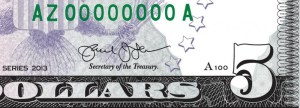
Back in January I wrote about the new Treasury Secretary nominee’s signature.  Today, the Treasury unveiled Jack Lew’s new Hancock.

Here it is thanks to the Wonkblog on the Washington Post.

Lew sig on bill

Remember his original signature looked like this.

lew-sig old

He did promise President Obama that at least one letter would be legible and the “J” for Jacob is readable so he kept his promise.  I can’t wait until the money starts being issued.

Syria? Really?

The President, probably never believing that Assad would use chemical weapons, drew a red line.  He’s been stalling around saying he needs verification, but now he has it.  The question is what should we do now.  I think Obama is stuck.

130612_barack_obama_ap_605

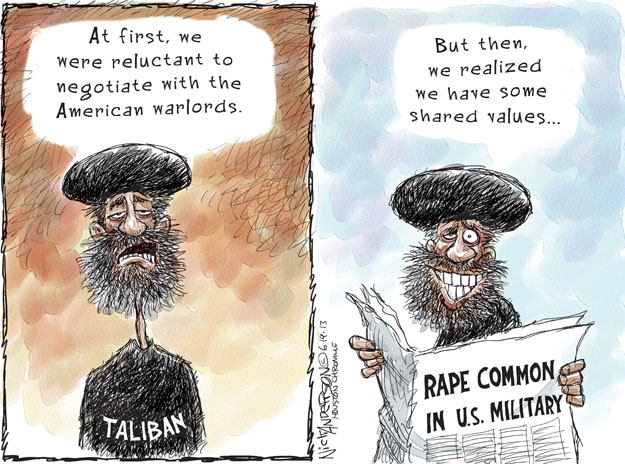
The United States has a long history of failed interventions.  Vietnam was basically a civil war.  We armed the Taliban when they were our “friends”.  We actually started a civil war in Iraq by stupidly dismissing all the Baathists saying they can’t be part of any new Iraqi government.  Now we are again taking sides against the Baathist who currently rule Syria.  My big fear is that the region will explode into a Sunni v. Shia conflict and we will be seen as taking sides.

Andrew Sullivan wrote this morning

My strong view, vented last night as I absorbed this stunning collapse of nerve, is that we shouldn’t fight at all. We are damn lucky to have gotten every GI out of Iraq, and the notion of being sucked back into that region again – and to join sides in a sectarian conflict – is a betrayal of everything this president has said and stood for. It’s a slap in the face for everyone who backed him because he said he wouldn’t be another Bush or McCain or Clinton. If he intervenes in Syria, he will have no credibility left with those of us who have supported his largely sane and prudent foreign policy so far. Libya was bad enough – and look at the consequences. But Syria? And the entire Middle East? Is he out of his mind?

And can you think of a dumber war than this one?

The man who said he would never engage in a dumb war is apparently preparing to join the dumbest war since … well, Iraq.

My only hope right now is that we can somehow use our threat of intervention to maneuver some type of international peace keeping force while we try to bring both sides to a negotiating table.  And let us hope that President Obama knows to get Congress involved, gets a UN resolution and the Arab League to agree before we take any action.

Sullivan concludes

One reason I supported Obama so passionately in 2008 and 2012 was because I thought he understood this and had the spine to stand up to drama queens like McCain and armchair generals like William Jefferson Clinton. But it is beginning to appear that this president isn’t actually that strong. We voted for him … and he’s giving us Clinton’s and McCain’s foreign policy. If Cameron and Hollande want to pull another Suez, for Pete’s sake be Eisenhower – not Kennedy.

My cri de coeur is here. Don’t do it, Mr President. And don’t you dare involve us in another war without a full Congressional vote and national debate. That wouldn’t just be a mistake; it would be a betrayal.

Photograph:  AP