The joys of aging

Having been retired now for almost 18 months, I can say  after the getting through adjustments of the first few months – getting into a new routine, figuring out which of the many projects I had always said I would do when I retired, and adjusting to living with another retired person – that retirement has been a joy.  As people before me have said, “I wonder how I ever had time to work.”  But the last few months have reminded me that getting older is not all fun.

This is my first post since mid-November when I was diagnosed with tendonitis in one of my wrists.  I pretty much stayed away from the computer for a couple of weeks and have cautiously approached email.  I am trying very hard to limit my time at the keyboard to 15-20 minute stretches which means I haven’t really been on Facebook or Twitter both of which can be super addictive and could lead me to pass my time limit without knowing it.

And now I have another challenge.  Cataract surgery.  I think cataracts may be genetic on my mother’s side of the family, at least the relatively early need for surgery  has been the rule for my mother, my sister (who is 5 years younger) and me.  I’ve known the day would come sooner rather than later for several years as my doctor and I waited until they got bad enough to warrant surgery.  So a week ago, I had the operation on my right eye.  Very little pain, just a little discomfort.   Which brings us to the challenging phase.  That is what my sister labeled the period between the two surgeries.  Your old glasses don’t work too well because the prescription is very wrong for the implanted lens.  So your choices are to live with really blurry vision in that eye and mostly use the other eye and to periodically take off your glasses when you are looking far away (I had a distance lens implanted.) or, as my doctor suggested, take out the right lens.

I had an old pair of glasses with a prescription that wasn’t too bad for the left eye.  My husband took the right lens out after we went on the internet to learn how.  I did that for a couple of days, but it got tiresome not being able to really see well out of either eye.  Since I knew that none of my glasses were ever going to work for me again, we took the right lens out of my most recent glasses  last night.  That works well, as long as you make adjustments for whether you are looking away or reading.  Middle distance is still a challenge which involves moving my head around until I find a decent focus.  I think this works for people who can adjust to having each eye see differently.  Depth perception is almost non-existent for me at this point although it is better than it was two days ago.  And the right eye is still healing and adjusting so sometimes I think my vision is changing by the minute!

English: A pair of reading glasses with LaCost...

English: A pair of reading glasses with LaCoste frames. (Photo credit: Wikipedia)

Tomorrow is the day I can fully resume all normal activities (like bending over and taking a shower and washing my hair without worrying about getting water in my eye) but the challenging phase will remain until I have the cataract removed from the left eye in early January.  Then I’ll have the new challenge of reading glasses for a month or so while both eyes heal and I can get proper glasses.  But even now I can wake up and see more clearly without glasses than I have since I was in my teens.  It will be wonderful to not have to reach  for my glasses the minute I open my eyes!

The World Series: beards and music

Superstitious, I guess.  I didn’t want to write about the Red Sox in the World Series for fear of jinxing them.  Not that I have any such power, but with the baseball gods one never knows.  But now each team has had one horrid game – the Cardinals were worse than the Sox – and the Series is tied.  The Sox need to win at least one game in St. Louis to get back home team advantage.  This is beginning to feel like the games with Detroit that got them where they are.  That turned out OK, so we can still have hope.  All we need is for Jake Peavy to live up to his hype and for some combination of Clay Buchholtz/Felix Dubrount to pitch well and there is a chance for two wins.  And then we get Lester again.  So I’m feeling OK about the situation.  I feel badly for John Lackey who has had a great pitching year, but can’t seem to catch a break when it comes to run support and wins.

The player who did his job last night was Koji Uehara the accidental closer.  Once more.  3 outs on 10 pitches.  The beardless one.  I think we all assumed he didn’t have a beard because he couldn’t grow one.  We were wrong.  A few days ago, this story was in the New York Times.

Long, bushy beards have become the unifying trademark of the 2013 Boston Red Sox, but the most valuable player of their American League Championship Series victory stands out for more than his pitching.

The series M.V.P., the cleanshaven closer Koji Uehara, was given a pass on the team’s unofficial pro-beard policy because most of his teammates thought he was incapable of growing one.

But that is hardly the case. Well before the Red Sox’ shaggy faces entered the national consciousness, Uehara was a longstanding member of the antirazor brigade.

Until January, when he shaved it off on Japanese national television, Uehara had one of the most famous beards in Japan: light, Fu Manchu-style scruff with a wraparound beard connecting to his sideburns. It was considered ugly and brutish by many of his friends and countrymen, but he wore it defiantly for several years after coming to the United States in 2009.

Koji in Baltimore

People must have known.  I watched him pitch when he was with Baltimore, but I guess the beard never registered.  He also had a beard with the Rangers.

“I just didn’t know where I was going with that beard,” Uehara, 38, said through an interpreter Saturday afternoon before the final game of the A.L.C.S. “So I thought it was best to shave it off. It was a good time to do it, and I think many people were happy. They said I looked younger.”

Without facial hair, Uehara posted a career-low 1.09 E.R.A. in the regular season and had 21 saves after taking over as Boston’s full-time closer June 26. In the playoffs, he has been just as good, allowing one run in nine innings over eight games. He has five saves this postseason: two in a division series against the Tampa Bay Rays and three in the A.L.C.S. against the Detroit Tigers, including the save that clinched the pennant Saturday night.

But has shaving made him a better postseason pitcher?

“I don’t know,” he said, shrugging. “I am not sure about that.”

Whatever.  If being beardless got him MVP for the ALCS, then it is good for him and for us.

In one way, it makes sense that Uehara is now clean shaven in the midst of players who look like desert-island castaways. He originally grew his beard to stand apart from his teammates in Japan and from Japanese players in the majors, many of whom did not have facial hair.

Now that he is with a rowdy band of bearded Red Sox, he is distinguished in a different way.

“If I had a beard now,” he said, “I would not stand out.”

Meanwhile the symphony orchestras in Boston and St. Louis are getting in the act.  Even if you don’t root for either team this clip is wonderful.  I have to concede that the brass from St. Louis are better trash talkers, but the BSO has Seiji Ozawa.  http://www.youtube.com/watch?v=-_k8oICRBH4&feature=youtu.be

By the way, Boston in six.  With ZZ Top on our side, how can we lose?

Photograph: Mark Duncan/Associated Press

The more things change…

the more they stay the same.  I’m reading “The Mansion of Happiness” by Jill Lepore, a collection of essays arranged so they comprise a history of life and death which is the book’s subtitle.  Lepore is an historian and essayist.  (We heard her lecture on her newest book about Jane Franklin and my husband came home and ordered all of his books.)  One chapter is titled Mr. Marriage.  In it, Lepore recounts a number of things including the history of marriage counseling and the history of eugenics.  I bet you didn’t know they were connected; I certainly didn’t.

Cover of "Can This Marriage Be Saved?"

Cover of Can This Marriage Be Saved?

When I was a kid, my mother used to subscribe to the Ladies Home Journal and I would read “Can this Marriage Be Saved?”.  I wonder how many of my generation got some of their ideas about marriage from reading this feature.  In any case, Paul Popenoe who wrote the column was the father of marriage counseling.  He was also a leader in the movement to sterilize the “unfit” to prevent them from having children.  Lepore writes, ” He considered marriage counseling the flip side of compulsory vasectomy and tubal ligation:  sterilize the unfit; urge the fit to marry.”  The early eugenicists  were influenced by Darwin and the theory of evolution.  If one could breed better plants and livestock, why not better people?

Lepore writes

…In the United States, what come to be called social Darwinism provided conservatives with an arsenal of arguments in favor of laissez-faire economic policies, against social welfare programs, and in support of Jim Crow. “The Negro”, it was argued, was “nearer to the anthropoid or pre-human ancestry of men” than any other race, a living missing link; only slavery had prevented the extinction of the black American; if not for the peculiar institution, natural selection would have led to the death of the entire race.

I guess they ignored the fact that many, likely most, African-Americans had a white ancestor in the family tree.  No matter, Paul Popenoe thought about 10% of the population should be sterilized.  This would have been determined in part by the IQ test that was relatively new at the time and, of course, by race. In 1918, Popenoe wrote a book with Rosewell Hill Johnson titled “Applied Eugenics”.

Popenoe and Johnson deemed miscegenation “biologically wrong” because “the Negro lacks in his germ-plasm excellence of some qualities which the white races possess. For poverty, Popenoe and Johnson blamed the poor, citing a study reporting that 55 percent of  retarded children belonged to the laboring class.  The solution to want was to sterilize the needy.  Following Terman [Lewis M.], Popenoe and Johnson opposed old-age pensions, minimum-wage legislation, and child-labor laws: by helping the biologically and mentally unfit, these programs perpetuated a poor gene pool, just as slavery had protected blacks from extinction.

Echoes of the eugenicists can be heard in the current efforts of certain members of the Republican party who only wanted to fund programs they liked during the recent government shutdown.  And the intense dislike, maybe hatred isn’t too strong a word, of President Obama perhaps isn’t just because he is black, but because he is the product of a an African father and white mother.  You hear it in the effort to defund the Affordable Heath Care Act.  As my husband pointed out when I was reading Lepore and ranting, Ron Paul stated during a Republican Presidential debate the if someone couldn’t afford care or didn’t have a policy that would be their own responsibility.  (Going back to the transcript, Paul didn’t actually say that person should be left to die, but that nonprofits like churches would help after the hospital provided medical care, that having health insurance should be a private decision, and provision of health care should not be a governmental responsibility.  Actually, given the current state of the economy and the finances of nonprofits these day, it is the equivalent of letting someone die.)

I will listen to the arguments in the upcoming budget fight with great interest and I bet I will hear more echoes of Paul Popenoe.  The more things change…

Winners and losers

Not talking about baseball today but about  the 16 day drive toward the fiscal cliff.   One of my favorite commentators, Ana Marie Cox, has compiled a list that you can see in its entirety here in the Guardian.  You can agree with her or not about her choices, but she gives us some things to think about.  Here are my favorites among Cox’s choices.

Winners

Ted Cruz

Ted Cruz. The punchline for a thousand Twitter humorists and the lead for most of the many stories about GOP dysfunction, Cruz is laughing in that whiny way of his all the way to the campaign war chest. He raised over $1m in the third quarter that ended 1 October, before the shutdown, half of it through the new “Ted Cruz Victory Committee” formed last year specifically to benefit from Cruz’s “defund Obamacare” petition. Cruz’s floor speech before the Senate vote seemed to imply that the fundraising was continuing at that pace; he referred to the “millions of millions [sic] of American people rising up across this country, over two million people signing a national petition to defund Obamacare”. The online petition is also an email harvesting gambit from the Senate Conservative Fund, the PAC that helped bring Cruz to Washington in the first place.

Harry Reid

Harry Reid. The former pugilist only won a technical knockout, but that’s probably the way the Senate majority leader likes it. That Reid’s compact and focused rage held Democrats together and in chorus was obvious from the outside. Senator Dick Durbin’s insinuation that we will “never know, you will never know, how much he put in to accomplish this” only ups the suspicions about the incredible power Reid wields.

Speaker Pelosi

Nancy Pelosi. Drudge called it, naming the Democratic congresswoman from California the once and future Speaker of the House. In other words, Matt Drudge thinks the Democrats have a serious chance of winning back the House of Representatives in the 2014 midterms. Or, you know, he could have been trolling us.

John McCain

John McCain. The septuagenarian’s bipolar relationship with the media started on the upswing with his early ridicule of Cruz (though now Cruz wears “wackobird” as a badge of honor). With the threat of a shutdown, the love affair really flared back up. McCain gave both earnest indictments of the strategy and exasperated quips. He dusted off the chestnut that congressional popularity is down to “paid staffers and blood relatives” and declared sarcastically of the GOP, “We’re livin’ the dream.”

And now the

Losers

majority rule

Majority rule. While the fundamental principle of democracy seems to have survived the 16-day crisis, the fact of the shutdown and the tiny minority of congressmen that created it, the Tea Party Republicans of the House have nonetheless managed to poke serious holes in the constitution they hold so dear. Presumably, the second amendment was left unscathed.

economic principles

Economic principles. People who didn’t even know what the debt limit was last month now think it’s some kind of conspiracy. Even as the US dodged a bullet this time – though suffering the collateral damage of further credit-rating downgrades – one can’t help feeling that we haven’t heard the last of the GOP’s new caucus of “debt default skeptics”.

apples and oranges

“False equivalence” reporting. James Fallows at the Atlantic documented some of the worst offenders and as “it’s everybody’s fault” became a Republican talking point, many media critics joined him in denouncing the faux-even-handedness as actually putting a finger on the scale. The “serious people” trope (as in, “serious people are above partisan bickering”) popularized by op-ed writers such as Michael Kinsley and Ron Fournier became especially ridiculous as the crisis wore on. Kinsley’s column beseeching Obama to “give in” to Republicans “for the sake of the country” (“media will no doubt call Obama weak”!) should be taught as a cautionary example against this desire to be “taken seriously”.

gop logo

The GOP. I mean, really.

This effort has only cost us an estimated 24 Billion dollars (and counting) and there is no saying that it won’t happen again in January.  It drives me nuts that the President is blamed by many while Ted Cruz used me – and everyone else who pays taxes and needs government services – to raise money for his 2016 Presidential bid.  But the silver lining is that if the Democrats get to work, it looks like they can hold on to the Senate and take back the House.  And then John Boehner will really have something to cry about.

Moving toward the cliff

Yesterday I had lunch with a friend, a federal employee, who is not working because of the shutdown.  She can’t check her work email or phone messages and fears the backlog of problems that awaits her when she does get back to work.  She said the only way she was fortunate was that she was not one of the essential employees who had to work anyway.  We speculated on how people will get to work if October moves to November and people’s monthly transit passes run out.  Will they be expected to shell out money they don’t have to get to a job they aren’t paid for?  All her friends can do is to buy her lunch.  Fast forward 24 hours and we still have no deal.  Even if the Senate comes up with a solution it is not clear if 1) the House will even vote on it and 2) if they do, if this is just another short term postponement.  All my friend hopes is that the next deadline is past the holidays and that there is back pay.

I was trying to find some humor in the whole situation, but find that I actually feel very sorry for John Boehner.  John Cassidy posted this for the New Yorker.

Give the Republicans on Capitol Hill one thing: they don’t leave a job half done. Evidently disturbed by polls showing Congress with a single-digit approval rating, they appear intent on driving it to zero.

What other explanation can there be for Tuesday’s farcical maneuvers, which saw the House Republican leadership try and fail to seize the initiative in the debt-ceiling standoff from the Senate, in the process humiliating Speaker Boehner yet again. By the end of the day, facing renewed opposition from some of his own members, Boehner had dropped his efforts to pass a bill that would have ended the shutdown and raised the debt ceiling until February, but one with more riders than an agreement that Mitch McConnell, the Republican leader in the Senate, and Harry Reid, the Democratic leader, have been working on.

From the point of view of the country, that’s good news. Overnight, officials representing McConnell and Reid were rushing to complete their negotiations, which were called off on Tuesday after Boehner’s unwise intervention. As it stands now, the Senate agreement would reportedly fund the government until January 15th and raise the debt ceiling until February 7th, with the only concession from the Democrats being an agreement to toughen up the policing of eligibility requirements for obtaining federal subsidies to buy health insurance under the Affordable Care Act.

Boehner is in a box.  He can’t control his own party caucus and can’t turn to Democratic votes because then he would lose his Speakership.  If the country goes into default, he will likely lose it anyway.

Once the Senate passes a bill and sends it to the House, the Speaker will face the unenviable choice of allowing it to pass with Democratic support or exercising the nuclear option of forcing a default. Having already ruled out this second option in public comments, there were reports on Tuesday night that Boehner was prepared to bring the Senate bill to the floor, which would probably insure its passage. That wouldn’t end the budget crisis—it’s never-ending—but it would put off the next showdown until the new year, whilst ensuring that the Republican ultras had gained almost precisely nothing for their willingness to shut down the government and raise the prospect of a debt default. (In another development on Tuesday, Fitch, one of the big ratings agencies, placed U.S. government debt on watch for a potential downgrade, saying that “the prolonged negotiations over raising the debt ceiling (following the episode in August 2011), risks undermining confidence in the role of the U.S. dollar as the preeminent global reserve currency by casting doubt over the full faith and credit of the U.S.”)

From the point of view of the Republican Party, things have been going from bad to worse. With the party divided, its poll ratings tanking fast, and its leadership unwilling to risk an actual default, it has been clear for some time that it was in a losing position. The discussions in the past few days have been about the terms of surrender, with the White House and Reid pressing for something close to an unconditional capitulation.

So here are a few cartoons to weep at as we proceed at a Senate’s slow pace, to the edge.

From Tony Auth

From Tony Auth

Tom Toles

Tom Toles

Signe Wilkerson

Signe Wilkerson

And Wilkerson, again.

Wilkinson2

Can we hope that there are still some adults who won’t drive us over the edge?

The Senate Chaplain Speaks

Maybe you didn’t realize that the Senate and the House each have a chaplain.  If you are a C-SPAN junky you might have seen them open each daily session.  The Senate website has a brief description of the office and history.

Throughout the years, the United States Senate has honored the historic separation of Church and State, but not the separation of God and State. The first Senate, meeting in New York City on April 25, 1789, elected the Right Reverend Samuel Provost, the Episcopal Bishop of New York, as its first Chaplain. During the past two hundred and seven years, all sessions of the Senate have been opened with prayer, strongly affirming the Senate’s faith in God as Sovereign Lord of our Nation. The role of the Chaplain as spiritual advisor and counselor has expanded over the years from a part-time position to a full-time job as one of the Officers of the Senate.  The Office of the Chaplain is nonpartisan, nonpolitical, and nonsectarian.

But the current Senate Chaplain, Barry C. Black, has begun to make news with what the New York Times called “our daily Senate scolding.”

The disapproval comes from angry constituents, baffled party elders and colleagues on the other side of the Capitol. But nowhere have senators found criticism more personal or immediate than right inside their own chamber every morning when the chaplain delivers the opening prayer.

“Save us from the madness,” the chaplain, a Seventh-day Adventist, former Navy rear admiral and collector of brightly colored bow ties named Barry C. Black, said one day late last week as he warmed up into what became an epic ministerial scolding.

“We acknowledge our transgressions, our shortcomings, our smugness, our selfishness and our pride,” he went on, his baritone voice filling the room. “Deliver us from the hypocrisy of attempting to sound reasonable while being unreasonable.”

In case you were wondering, Chaplain Black was selected in 2003 by then Majority Leader, Republican Bill Frist.  He says of his politics

“I use a biblical perspective to decide my beliefs about various issues,” Mr. Black said in an interview in his office suite on the third floor of the Capitol. “Let’s just say I’m liberal on some and conservative on others. But it’s obvious the Bible condemns some things in a very forceful and overt way, and I would go along with that condemnation.”

But back to some of his recent prayers.

During his prayer on Friday, the day after officers from the United States Capitol Police shot and killed a woman who had used her car as a battering ram, Mr. Black noted that the officers were not being paid because of the government shutdown.

Then he turned his attention back to the senators. “Remove from them that stubborn pride which imagines itself to be above and beyond criticism,” he said. “Forgive them the blunders they have committed.”

Senator Harry Reid, the pugnacious majority leader who has called his Republican adversaries anarchists, rumps and hostage takers, took note. As Mr. Black spoke, Mr. Reid, whose head was bowed low in prayer, broke his concentration and looked straight up at the chaplain.

“Following the suggestion in the prayer of Admiral Black,” the majority leader said after the invocation, seeming genuinely contrite, “I think we’ve all here in the Senate kind of lost the aura of Robert Byrd,” one of the historical giants of the Senate, who prized gentility and compromise.

Senate Chaplain Barry Black

Senate Chaplain Barry Black

Chaplain Black is a federal employee who is not being paid during the shutdown.  He is also one of the few adults in the Senate chamber.

Mr. Black, who is the first black Senate chaplain as well as its first Seventh-day Adventist, grew up in public housing in Baltimore, an experience he draws on in his sermons and writings, including a 2006 autobiography, “From the Hood to the Hill.”

In his role as chaplain, a position that has existed since 1789, he acts as a sounding board, spiritual adviser and ethical counselor to members of the Senate. When he prays each day, he said, he recites the names of all 100 senators and their spouses, reading them from a laminated index card.

It is not uncommon for him to have 125 people at his Bible study gatherings or 20 to 30 senators at his weekly prayer breakfast. He officiates weddings for Senate staff members. He performs hospital visitations. And he has been at the side of senators when they have died, most recently Daniel K. Inouye of Hawaii in December.

The Senate is lucky to have him and maybe they need to pay more attention to what he is saying.

“I remember once talking about self-inflicted wounds — that captured the imagination of some of our lawmakers,” he said. “Remember, my prayer is the first thing they hear every day. I have the opportunity, really, to frame the day in a special way.”

His words lately may be pointed, but his tone is always steady and calm.

“May they remember that all that is necessary for unintended catastrophic consequences is for good people to do nothing,” he said the day of the shutdown deadline.

“Unless you empower our lawmakers,” he prayed another day, “they can comprehend their duty but not perform it.”

Senators, hear Chaplain Black.  Be adults.

Photograph:  Drew Angerer for The New York Times

Cartoonists view the government shutdown

We need to keep a sense of humor about things so we can survive this Republican tantrum.  Here is my contribution.

Dan Wasserman from the Boston Glove.

101toon_wasserman


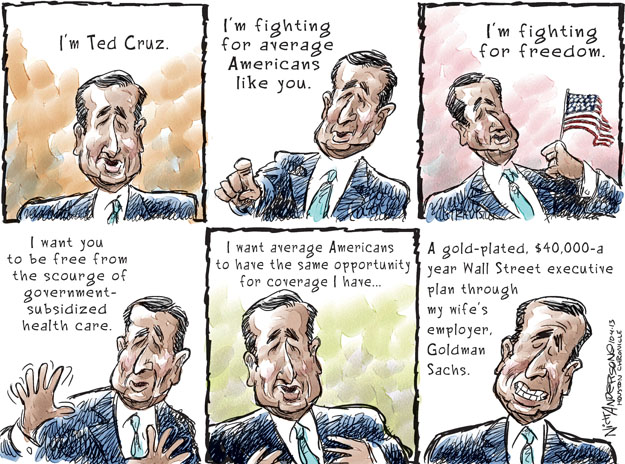
Nick Anderson on Ted Cruz.

Anderson on Cruz


Carlson on Infant nutrition.

Carlson


The new axis of evil?

luckovich

President Obama and leadership

Like many of his supporters I am frustrated at times by what appears to be indecision on the President’s part.  You have to admit that he can take a long time to make a decision while speculation dominates the media and the blogs as to what he will do.  Look at the still to be announced appointment to be Chair of the Federal Reserve.  But when I get frustrated I tell myself that he is playing a long game.  Farah Stockman had an interesting op-ed in the Boston Globe today explaining better than I could the Obama style of leadership.

I am going to quote most of it because I can’t figure out where to cut it (and because one can’t read it from the link without a Globe subscription) and it isn’t that long..

Before we start hand-wringing over the gridlock in our domestic affairs, let’s savor the good news on the international front: Last week, after years of paralysis, the UN Security Council mandated the destruction of chemical weapons in Syria and endorsed a political transition plan that might finally sweep Syrian President Bashar Assad aside.

And after years of Iran’s refusal to talk seriously about its nuclear program, Iran’s new president, Hassan Rouhani, announced that he wants to resolve the issue in 12 months. He and President Obama even spoke on the phone, the first such contact since the 1970s.

Of course, we’re still a long way from solving those two problems. But we’re on a far better path than we were three weeks ago. Back then, we were on the verge of launching a unilateral military strike that would have inflamed the situation in Syria and hurt our chances of getting a nuclear deal with Iran. So how did that no-win situation in Syria turn into something positive? And what does this bizarre chapter in US diplomacy tell us about the nature of leadership itself?

Recall that Obama announced that he had made a decision to strike. Then he asked Congress to give its blessing. Those moves allowed time for Americans to debate, with the whole world watching. Moscow, Tehran, and Damascus were forced to contemplate the possibility of a US strike. The uncertainty of what would happen next weighed on them more heavily than a knee-jerk cruise missile. In the end, the threat of US military action proved more powerful than the action itself. Our adversaries finally agreed to a diplomatic solution that they had refused in the past.

Of course, Obama got called a lot of names for the delay that made that outcome possible: “weakling,” “ditherer-in-chief,” and— nastiest of all, in some corners —  “community organizer.” I must admit that I thought he was crazy for going to Congress, which often seems more eager to tar and feather him than to approve of anything he wants.

But political theorist Dennis Thompson, co-author of the book “Why Deliberative Democracy?” says Obama’s moves mirrored a style of leadership Thompson taught at Harvard. Thompson believes that, in a true democracy, a leader ought to explain the reasoning behind the course of action he or she wants to take. But in the end, wherever possible, the group itself should debate it and have the final word.

It stands to reason that a country that believes in democracy should have faith that a decision debated openly by a group will usually produce a better outcome than a decision one man makes alone. So, why then were some Americans so infuriated that Obama took the issue to Congress?

“It is as if we expect decisions of war and peace to be made by the president rather than society as a whole,” said Archon Fung, another Harvard professor who has studied the virtues of “deliberative democracy.” “Decisions about when to use military force . . . involve killing as a state act. If any decision should be made democratically, it’s this one.”

Peter Levine, a professor at Tufts University, sees the public reaction as a sign of the times. Americans have grown less interested in the public deliberations that that make democracies work. Participation on juries and PTA meetings are at an all-time low, he said. Voters expect their elected leaders to solve their problems. Debates over the best way to go about it are seen as a sign of failure or weakness.

“Our system is supposed to be deliberative,” Levine said. “But we live in a profoundly anti-deliberative moment.”

So maybe this episode says as much about us as it does about our leader. We like John Wayne presidents, saviors who rescue us with their quick trigger fingers. We don’t like leaders who admit uncertainty, who ask us to help choose between imperfect options. But, at the end of the day, the Syria debate taught us that when Americans deliberate as a people, we can come up with a better outcome. It’s a lesson we shouldn’t forget.

President Obama is certainly not John Wayne, but he is the leader of a democracy.  We need to remember this when we get frustrated.

Kittie Knox: Bicycle Racer

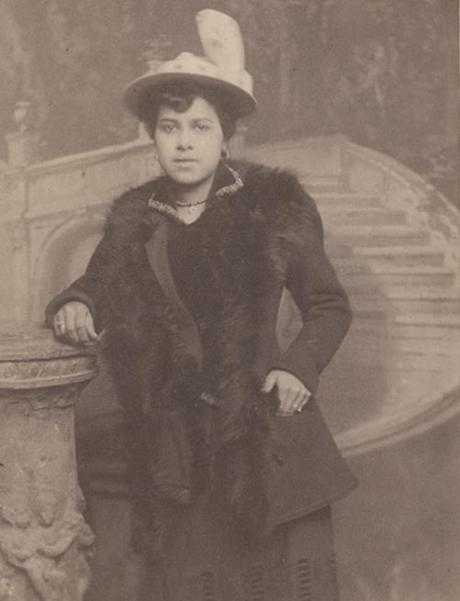
Never heard of her?  Me either until this morning when the Boston Globe carried a front page story by Dan Adams about the ceremony putting a headstone on her long forgotten grave at Mount Auburn Cemetery in Cambridge.

Kittie Knox

Kittie Knox

Knox, a seamstress born in 1874 to a free black father and a white mother, became a prominent and accomplished cyclist by the 1890s in Boston. But her mixed racial heritage raised eyebrows, as did her insistence on riding a man’s bike and wearing pantaloons of her own design instead of the long, heavy skirts prescribed by Hopkins and her ilk.

And if that weren’t enough, she excelled at the sport: Knox completed multiple 100-mile rides and placed 12th out of 50 male and female cyclists in a major national race, “far ahead of her lighter-hued sisters,” one magazine reported.

Knox had seemed doomed to obscurity. But six years ago, author Lorenz Finison stumbled across her name while researching a forthcoming book on Boston’s cycling history. Passing references to Knox in cycling books prompted Finison to search local newspaper archives for more information.

“I found an article saying she won a cycling costume contest in Waltham,” said Finison, a teacher at the Boston University School of Public Health and a cofounder of Cycling Through History, which develops bike routes between African-American heritage sites. “I thought, that’s really amazing. Why, given the racial climate of the time, would she have won a contest out there? I thought I should look into it more.”

Kittie Knox faced not only sexism but also racism.

Finison eventually unearthed a trove of stories about Knox. While many articles were preoccupied with her race and appearance — “a beautiful and buxom black bloomerite” was one reference in Referee Magazine — he learned that Knox had been a member of Boston’s only black cycling group, the Riverside Cycle Club, before joining the Boston-based National League of American Wheelman in 1893.

Knox soon found herself at the epicenter of a fight over whether blacks could join the league, he said. After a Southern faction of league leaders successfully politicked in 1894 to make the group for whites only, Knox’s appearance at the league’s 1895 national meet in Asbury Park, N.J., caused an uproar. Trouble began upon her arrival, when, rather than appease critics, “Miss Knox did a few fancy cuts in front of the clubhouse and was requested to desist,” The New York Times reported.

Then, when Knox went to register for the meet and presented her membership card, the credentials were rejected.

“[Knox’s] entrance today, in the parlor of the Asbury Park wheelmen, caused wild consternation among the ladies gathered there,” wrote a San Francisco paper, according to Finison’s manuscript. “She was politely told that she was in the wrong house. To their utter surprise she produced a league membership card and declared that no exception had ever been taken to her color by wheelmen or wheelwomen. After asserting herself to that extent, Miss Knox walked defiantly out with her wheel.”

Even after members of the Massachusetts delegation intervened to ensure her participation, successfully arguing she had been admitted before the color bar, Finison writes that anger persisted: A group of white women cyclists threatened to quit in protest; dozens walked out of a League dance when Knox partnered with a white man; a Southern paper slammed League leaders for permitting “this murky goddess of Beanville” to ride.

Don’t you love it?  “[M]urky goddess of Beanville”.  A dig at Knox’s race and at Boston.   Good for the Massachusetts delegation for standing up for her.

Much of the Globe’s coverage of early Boston cycling clubs, as cited by Finison, betrays blatantly racist and sexist attitudes common in that era. But one Globe report from  the event in 1895 at Asbury Park trumpeted Knox’s abilities, perhaps to point a finger at Southern papers that had decried her participation.

“The leaders tried to lose Knox during the eighteen mile run but she was game, and when the big crowd entered the town on the return trip she was up with the leaders, sailing with the best of them,” the Globe wrote. “She was not to be consigned to the tribe of ‘also rans,’ and today all the League members are anxious to see her. And when she appears in the street she receives more attention than a half dozen star racing men.”

Kittie Knox died in 1900 at the age of 26, but through Finison’s efforts, her family was found and she was honored on Sunday,

Three generations of Kittie Knox’s relatives attended a ceremony dedicating a new headstone at Mount Auburn Cemetery.

Three generations of Kittie Knox’s relatives attended a ceremony dedicating a new headstone at Mount Auburn Cemetery.

Another remarkable woman has been rediscovered.
Photograph:  Jim Davis/Boston Globe

Dorothy in Iraq…or is it Afganistan? Or maybe Syria or Lybia?

It may work out that because he needed to save face, President Putin is going to end up saving President Obama and the Congress from a collision that neither can win – and saving us from another war as a bonus.  As I write this, it appears that Putin’s proposal to put Syria’s chemical weapons under international control will be coming before the Security Council.  Our Congress is very good at stalling so waiting for the Security Council to act should not be a problem and we may actually get a peaceful resolution.

While we wait, we can enjoy Tom Tomorrow’s updated Dorothy back from Oz.

Tom and Dorothy

Thank you, Ruben Bolling.

(Click picture to enlarge.)