The Baby Cambridge

I’ve heard that Americans might actually be more interested in the British Royals than the English.  But who can help but admire Queen Elizabeth for her starring role at the Olympics.  We are flying the Union Jack from the porch which over looks the site of an American Revolutionary War fort. (George Washington might be swallowing his false teeth about now.)  But we are excited on this side of the pond, also.

The fountains in Trafalgar Square are illuminated in blue to mark the birth of a royal baby boy.

The fountains in Trafalgar Square are illuminated in blue to mark the birth of a royal baby boy.

Earlier this summer I read Alison Weir’s biography of Elizabeth I so I was interested in the royal lineage laid out in the Guardian today.

Baby Cambridge will be the 43rd monarch since William the Conqueror obtained the English crown in 1066, but is also 41st in direct line of descent from Egbert, King of Wessex, who ruled from 802 to 839.

Through the paternal line, William and Kate’s first born is destined to be the great-great-great-great-great-grandchild of Queen Victoria. And, once grandfather Prince Charles and William have served their time on the throne, he/she will become the eighth British monarch to descend from Victoria and Albert, whose descendants have populated many a European throne.

The Queen’s longevity means it is the first time in nearly 120 years that a still-serving sovereign has met a great-grandchild born in direct succession to the crown. Edward VIII was born in 1894, seven years before the death of Victoria. The infant’s royal lineage stretches back, on the throne of England, to the Anglo-Saxons through the Normans, Angevins, Plantagenets, Lancastrians, Yorkists and Tudors. Until 1603, English and Scottish crowns were separate, but following the accession of King James VI of Scotland (James I of England) to the English throne, a single monarch has reigned in the UK.

And assuming that Scotland doesn’t vote to become independent (which I understand would make many things very messy – like having to have their own currency and applying to be part of the EU)

The newborn will be the 20th monarch to do so since James VI of Scotland and James I of England (reigned 1603-1625), the son of Mary, Queen of Scots.

James took over after the death of Elizabeth I.

Moving on to more recent history

But it is through the House of Hanover that the new baby traces its direct lineage. When the Stuarts died out, the Hanovers came to power through James I’s granddaughter, Sophia, who married Ernst Augustus Elector of Hanover, and gave birth to George I, who would rule from 1714 to 1727. Hanoverian succession was a pretty straightforward affair for a while. George II (1725-1760), eldest son of George I and Sophie of Celle, married Caroline of Ansbach. Their grandson, George III (1760-1820), married Charlotte of Mecklenburg-Strelitz .

Their eldest son George IV (1820-1830) married his cousin, Caroline of Brunswick, and succeeded the throne after serving as prince regent during his father’s final mental illness.

George III was king during the American Revolution.

…George IV was succeeded by another brother, who reigned as William IV (1830-37). At the time of his death, William had no legitimate children, however, he was survived by eight of the 10 illegitimate children he had had by the actor Dorothea Jordan, with whom he cohabited for 20 years.

It was his niece, Victoria (1837-1901), the daughter of his younger brother, Edward, Duke of Kent, to whom the crown fell. The house of Saxe-Coburg-Gotha was established with Victoria’s marriage to Prince Albert. Their eldest son, Edward VII (1901-1910) succeeded and his marriage to Alexandra of Denmark produced five children. The eldest, Albert, Duke of Clarence, was expected to succeed, but shortly after his engagement to Princess Mary of Teck in 1891, he died during a flu pandemic. Instead his brother, George V, inherited both the crown and his fiancee  and ruled from 1910 to 1936. It was George V who, given rife wartime anti-German sentiment, decided that Windsor was a preferable royal household name to Saxe-Coburg-Gotha. And so Edward VIII would be Edward Windsor, until he became Duke of Windsor on his abdication less than a year into his 1936 reign. That abdication, and the fact Edward had no children, led to the present Queen’s father, George VI (1936-52), becoming monarch with Elizabeth Bowes-Lyon at his side. Their eldest daughter, Princess Elizabeth Alexandra Mary, became the present Queen on his premature death.

I hope Queen Elizabeth lives on to enjoy her great-grandson for many years.

Photograph:  Bogdan Maran/EPA

Social media: Is it the new coffeehouse?

Last Sunday Tom Standage had an opinion piece in the Review section of the New York Times in which he posits blogging, Twitter, Facebook, etc. as the modern equivalent of the 17th century coffeehouse.  An interesting comparison, but the two are not really the same.  I think that the coffeehouse was more conducive to the development of ideas through dialogue.  Face to face is often better than typing by yourself on a keyboard or phone or however you post.  Let’s look at what Standage says.

SOCIAL networks stand accused of being enemies of productivity. According to one popular (if questionable) infographic circulating online, the use of Facebook, Twitter and other such sites at work costs the American economy $650 billion each year. Our attention spans are atrophying, our test scores declining, all because of these “weapons of mass distraction.”

Yet such worries have arisen before. In England in the late 1600s, very similar concerns were expressed about another new media-sharing environment, the allure of which seemed to be undermining young people’s ability to concentrate on their studies or their work: the coffeehouse. It was the social-networking site of its day.

Like coffee itself, coffeehouses were an import from the Arab world. England’s first coffeehouse opened in Oxford in the early 1650s, and hundreds of similar establishments sprang up in London and other cities in the following years. People went to coffeehouses not just to drink coffee, but to read and discuss the latest pamphlets and news-sheets and to catch up on rumor and gossip.

Coffeehouses were also used as post offices. Patrons would visit their favorite coffeehouses several times a day to check for new mail, catch up on the news and talk to other coffee drinkers, both friends and strangers. Some coffeehouses specialized in discussion of particular topics, like science, politics, literature or shipping. As customers moved from one to the other, information circulated with them.

And he gives some examples.

But what was the actual impact of coffeehouses on productivity, education and innovation? Rather than enemies of industry, coffeehouses were in fact crucibles of creativity, because of the way in which they facilitated the mixing of both people and ideas. Members of the Royal Society, England’s pioneering scientific society, frequently retired to coffeehouses to extend their discussions. Scientists often conducted experiments and gave lectures in coffeehouses, and because admission cost just a penny (the price of a single cup), coffeehouses were sometimes referred to as “penny universities.” It was a coffeehouse argument among several fellow scientists that spurred Isaac Newton to write his “Principia Mathematica,” one of the foundational works of modern science.

Coffeehouses were platforms for innovation in the world of business, too. Merchants used coffeehouses as meeting rooms, which gave rise to new companies and new business models. A London coffeehouse called Jonathan’s, where merchants kept particular tables at which they would transact their business, turned into the London Stock Exchange. Edward Lloyd’s coffeehouse, a popular meeting place for ship captains, shipowners and traders, became the famous insurance market Lloyd’s.

And the economist Adam Smith wrote much of his masterpiece “The Wealth of Nations” in the British Coffee House, a popular meeting place for Scottish intellectuals, among whom he circulated early drafts of his book for discussion.

It seems to me that this is fundamentally different from a Tweet which is often sent out into cyberspace usually without response or any real conversation.  It may or not be read.  The object is to be clever or to publicize something longer one might have written, but, again, one has no way of knowing if that link has been clicked.  Facebook, among my relatively small circle of friends, is a place to share picture, family news, and what you think of things.  I don’t “friend” anyone I don’t actually know.  (My blog posts are also on Facebook.)  More often than with Twitter, there are comments and occasionally an interesting discussion which I have often wished we could be having in person.  And this blog of many years is primarily a means of self-expression:  It’s history of what was catching my fancy at a particular moment.  FortLeft has, in rare moments, inspired some discussion and I have commented and had some discussions with other bloggers, but none of us have written the equivalent of the “Wealth of Nations” based on what we have written on our blogs – at least not the ones I follow.  (And, yes, I know that several of you have written books and if you circulated drafts through you posts, I’d be interested to know how that worked out.)

First page from Wealth of Nations, 1776 London...

First page from Wealth of Nations, 1776 London edition (Photo credit: Wikipedia)

What is comes down to, I guess,  is that I was educated at St. John’s College (Annapolis) where a great deal of what we did was talk.  In the coffee shop, on the quad, in seminar, in class, in the dorms.  As in the coffeehouses Standage describes a lot of our talk was of trivia and gossip, but we did talk seriously and express our opinions and had opinions expressed back at us.  It is easier to refine an opinion when you are talking to someone in person and you have to explain it and defend it than it is writing stuff on Facebook.

Current Johnnies still talk.

Current Johnnies still talk.

What I do love about Facebook, Twitter, and live blogging is the speed at which one can get information, not that they create meaningful discussion.  That may change.  Standage points out

The use of social media in education, meanwhile, is backed by studies showing that students learn more effectively when they interact with other learners. OpenWorm, a pioneering computational biology project started from a single tweet, now involves collaborators around the world who meet via Google Hangouts. Who knows what other innovations are brewing in the Internet’s global coffeehouse?

There is always an adjustment period when new technologies appear. During this transitional phase, which can take several years, technologies are often criticized for disrupting existing ways of doing things. But the lesson of the coffeehouse is that modern fears about the dangers of social networking are overdone. This kind of media, in fact, has a long history: Martin Luther’s use of pamphlets in the Reformation casts new light on the role of social media in the Arab Spring, for example, and there are parallels between the gossipy poems that circulated in pre-Revolutionary France and the uses of microblogging in modern China.

As we grapple with the issues raised by new technologies, there is much we can learn from the past.

Who knows where technology will lead us?  But we still need to talk – face to face.  I’m not sure that digital interaction via any form of social media can talk the place of sitting with someone with a cup of coffee, glass of wine, over a meal or in a real classroom.

Photograph:  Students at seminar from the St. John’s College Website.

Someone has always been watching

The June 24th issue of the New Yorker has an excellent short history of privacy and surveillance by Jill Lepore.  You should try to read the entire article either online (I can’t remember what rules the New Yorker has about access) or get a copy of the magazine.  For my purposes today, I am going to concentrate on the story of Giuseppe Mazzini.  Never heard of him before?  Me either, but his story is instructive.

An extraordinary fuss about eavesdropping started in the spring of 1844, when Giuseppe Mazzini, an Italian exile in London, became convinced that the British government was opening his mail. Mazzini, a revolutionary who’d been thrown in jail in Genoa, imprisoned in Savona, sentenced to death in absentia, and arrested in Paris, was plotting the unification of the kingdoms of Italy and the founding of an Italian republic. He suspected that, in London, he’d been the victim of what he called “post-office espionage”: he believed that the Home Secretary, Sir James Graham, had ordered his mail to be opened, at the request of the Austrian Ambassador, who, like many people, feared what Mazzini hoped—that an insurrection in Italy would spark a series of revolutions across Europe. Mazzini knew how to find out: he put poppy seeds, strands of hair, and grains of sand into envelopes, sealed the envelopes with wax, and sent them, by post, to himself. When the letters arrived—still sealed—they contained no poppy seeds, no hair, and no grains of sand. Mazzini then had his friend Thomas Duncombe, a Member of Parliament, submit a petition to the House of Commons. Duncombe wanted to know if Graham really had ordered the opening of Mazzini’s mail. Was the British government in the business of prying into people’s private correspondence? Graham said the answer to that question was a secret.

Sound familiar?

Questions raised this month about surveillance conducted by the National Security Agency have been met, so far, with much the same response that Duncombe got from Graham in 1844: the program is classified. (This, a secret secret, is known as a double secret.) Luckily, old secrets aren’t secret; old secrets are history. The Mazzini affair, as the historian David Vincent argued in “The Culture of Secrecy,” led to “the first modern attack on official secrecy.” It stirred a public uproar, and eventually the House of Commons appointed a Committee of Secrecy “to inquire into the State of the Law in respect of the Detaining and Opening of Letters at the General Post-office, and into the Mode under which the Authority given for such Detaining and Opening has been exercised.” In August of 1844, the committee issued a hundred-and-sixteen-page report on the goings on at the post office. Fascinating to historians, it must have bored Parliament silly. It includes a history of the delivery of the mail, back to the sixteenth century. (The committee members had “showed so much antiquarian research,” Lord John Russell remarked, that he was surprised they hadn’t gone all the way back to “the case of Hamlet, Prince of Denmark, who opened the letters which had been committed to his charge, and got Rosencrantz and Guildenstern put to death instead of himself.”)

The report revealed that Mazzini’s mail had indeed been opened and that there existed something called the Secret Department of the Post Office. Warrants had been issued for reading the mail of the king’s subjects for centuries. Before Mazzini and the poppy seeds, the practice was scarcely questioned. It was not, however, widespread. “The general average of Warrants issued during the present century, does not much exceed 8 a-year,” the investigation revealed. “This number would comprehend, on an average, the Letters of about 16 persons annually.” The Committee of Secrecy was relieved to report that rumors that the Secret Department of the Post Office had, at times, sent “entire mail-bags” to the Home Office were false: “None but separate Letters or Packets are ever sent.”

“Secresy is an instrument of conspiracy,” Jeremy Bentham argued, in an essay called “Of Publicity,” first published in 1843, a year before the Mazzini affair. “It ought not, therefore, to be the system of a regular government.” By “publicity,” Bentham meant what is now usually called transparency, or openness. “Without publicity, no good is permanent: under the auspices of publicity, no evil can continue.”

In 1844, during the parliamentary debate that followed the report issued by the Committee of Secrecy, some members, believing, with Bentham, that publicity is the enemy of secrecy, suggested that it was fine for the government to open people’s mail, as long as the recipients of the mail were notified that it had been read. (Disraeli said that he would be only too happy to hand over his mail to the Home Office: “They may open all my letters, provided they answer them.”) In “Letter-Opening at the Post-Office,” Mazzini revealed just how much the debate had been informed by Bentham’s arguments about publicity. Diplomats might have their secrets, he granted, but postmen? “Why, who are these men who treat as enemies their fellow subjects of the realm?” he asked. “For public servants, we want responsibility and responsibility cannot be obtained without publicity. Secrecy is but another word for fear. MYSTERY was the name of the beast in the revelations. The great monster by which was typified all the civil and ecclesiastical corruptions of the earth, had on its forehead a name written and that name was MYSTERY.”

There is a delicate balance between privacy and surveillance.  Is it  OK for the government to collect all the metadata but not look at content without a warrant so long as we know that is what is happening?  And who keeps an eye on the FISA court?

In 1890, two Boston lawyers, Samuel Warren and Louis Brandeis, published an article in the Harvard Law Review called “The Right to Privacy.” Warren was a Boston Brahmin, but Brandeis’s parents were Eastern Europeans who had supported a failed uprising in Austria in 1848—the very revolution that, four years before, had been anticipated by the Austrian Ambassador who persuaded the British Home Secretary to read Giuseppe Mazzini’s mail. The suppression of the uprising had been followed by a wave of anti-Semitism, leading to the Brandeis family’s decision to emigrate to the United States. Louis Brandeis was born in Kentucky in 1856. In the eighteen-seventies, he and Warren were classmates at Harvard Law School (Brandeis helped found the Harvard Law Review); after graduation, they opened a law firm together. Warren married Mabel Bayard, a senator’s daughter, in 1883. As the legal scholar Amy Gajda has shown, nearly sixty articles of gossip about the Warren-Bayard family appeared in newspapers between 1882 and 1890—including front-page stories, two weeks apart, about the funerals of Mrs. Warren’s mother and sister. Warren was infuriated. His household had been violated; his family’s privacy, like a letter, had been purloined. (A great many ideas about privacy have to do with hiding women and families.)

In “The Right to Privacy,” Warren and Brandeis argued that there exists a legal right to be let alone—a right that had never been defined before. Their essay lies at the heart of every legal decision that has been made about privacy ever since. The right to privacy, as they understood it, is a function of history, a consequence of modernity. Privacy, they argued, hadn’t always been necessary; it had become necessary—because of the shifting meaning and nature of publicity. By the end of the nineteenth century, publicity, which for Bentham had meant transparency (the opposite of secrecy), had come to mean the attention of the press (the opposite of privacy). Making public the deliberations of Congress was a public good; making public the names of mourners at Mrs. Warren’s mother’s funeral was not. (The same distinction informed the debate that resulted, in the eighteen-eighties and nineties, in the adoption of the secret ballot. Citizens vote in private; legislative votes are public.)

But with blogs, Facebook, Twitter and other new media, those of us who post and tweet want people to read what we say and when we do so we should be aware that we are being public.  Email, however, is the new version of writing a letter and the government reading email is like reading Mazzini’s mail.  There is a very fine line between collecting email records and looking at content and many wonder if we can actually trust the government to honor the distinction.  With cell phones and GPS, our whereabouts can also be tracked. (I’m a fan of NCIS and love the way McGee can locate the bad guys – and sometimes the good ones – using a cell phone number.)  It seems that we are beginning, if we haven’t already, accepted that a lot of our private lives are now public because we put them out there.  We are not like the Warren family who did not want a list of the mourners at a funeral made public.

It is likely that someone has always been watching and it is clear that we still haven’t figured out that troublesome line between public and private.

Here is an old New Yorker cartoon from around 1973.

Bugging

Syria? Really?

The President, probably never believing that Assad would use chemical weapons, drew a red line.  He’s been stalling around saying he needs verification, but now he has it.  The question is what should we do now.  I think Obama is stuck.

130612_barack_obama_ap_605

The United States has a long history of failed interventions.  Vietnam was basically a civil war.  We armed the Taliban when they were our “friends”.  We actually started a civil war in Iraq by stupidly dismissing all the Baathists saying they can’t be part of any new Iraqi government.  Now we are again taking sides against the Baathist who currently rule Syria.  My big fear is that the region will explode into a Sunni v. Shia conflict and we will be seen as taking sides.

Andrew Sullivan wrote this morning

My strong view, vented last night as I absorbed this stunning collapse of nerve, is that we shouldn’t fight at all. We are damn lucky to have gotten every GI out of Iraq, and the notion of being sucked back into that region again – and to join sides in a sectarian conflict – is a betrayal of everything this president has said and stood for. It’s a slap in the face for everyone who backed him because he said he wouldn’t be another Bush or McCain or Clinton. If he intervenes in Syria, he will have no credibility left with those of us who have supported his largely sane and prudent foreign policy so far. Libya was bad enough – and look at the consequences. But Syria? And the entire Middle East? Is he out of his mind?

And can you think of a dumber war than this one?

The man who said he would never engage in a dumb war is apparently preparing to join the dumbest war since … well, Iraq.

My only hope right now is that we can somehow use our threat of intervention to maneuver some type of international peace keeping force while we try to bring both sides to a negotiating table.  And let us hope that President Obama knows to get Congress involved, gets a UN resolution and the Arab League to agree before we take any action.

Sullivan concludes

One reason I supported Obama so passionately in 2008 and 2012 was because I thought he understood this and had the spine to stand up to drama queens like McCain and armchair generals like William Jefferson Clinton. But it is beginning to appear that this president isn’t actually that strong. We voted for him … and he’s giving us Clinton’s and McCain’s foreign policy. If Cameron and Hollande want to pull another Suez, for Pete’s sake be Eisenhower – not Kennedy.

My cri de coeur is here. Don’t do it, Mr President. And don’t you dare involve us in another war without a full Congressional vote and national debate. That wouldn’t just be a mistake; it would be a betrayal.

Photograph:  AP

A Nobel Prize Winner and questions about Nagasaki

There was a very interesting profile in the New York Times Science section this week about Osamu Shimomura the Nobel Prize winning chemist.  Never heard of him?  Me either.  It was his life, not his science I found most interesting.  My mother’s family is from a small town near Hiroshima and I grew up knowing about Hiroshima and Nagasaki.

Sixty-eight years ago, Osamu Shimomura was a 16-year-old high school student working in a factory seven and a half miles from Nagasaki, Japan. Sitting down to work, a light flashed, briefly blinding him, and the pressure wave from an explosion came rolling through.

On his walk home from the factory, he was drenched with a black rain. His grandmother immediately had him bathe, most likely saving him from radiation-related illness.

Dr. Shimomura has said that he mostly doesn’t think about the bomb dropped on Nagasaki, but he recently delivered a lecture at the Los Alamos National Laboratory.  Los Alamos is the home of the Manhattan Project and the birthplace of the atomic bombs dropped on Hiroshima and Nagasaki.  The bomb was not the topic of Dr. Shimonura’s lecture.

Instead, he recounted the discovery and development of one of the most significant tools for modern biotechnology: the green fluorescent protein, or G.F.P., used widely in cell and molecular biology as a visual tracer. The discovery, which has deepened the understanding of a wide range of fundamental biological processes, brought him the Nobel Prize in Chemistry in 2008, along with Martin Chalfie and Roger Y. Tsien.

Together with my father who returned briefly from Manchuria in 1939. Front row from left: my mother Yukie, grandmother Tsuki, grandfather Kosaburo, father Chikara, younger brother Sadamu, and myself behind Sadamu, together with my uncle Eijiro Sata's family in back row.

Together with my father who returned briefly from Manchuria in 1939. Front row from left: my mother Yukie, grandmother Tsuki, grandfather Kosaburo, father Chikara, younger brother Sadamu, and myself behind Sadamu, together with my uncle Eijiro Sata’s family in back row.

In his autobiography accompanying his Nobel information, Dr. Shimomura did talk about Nagasaki.

On August 6, 1945, news reports informed us that the city of Hiroshima had been completely destroyed by a new type of bomb; we didn’t know what kind. Three days later, shortly before 11 AM, a siren sounded at the Isahaya factory, notifying us of an air raid. As usual, rather than going into a bunker, I went to the top of a nearby hill with a couple of friends and looked at the sky. We saw a single B-29 going from north to south towards Nagasaki, about 15 km away. I thought that its course was unusual. The B-29 dropped two or three parachutes and I heard sporadic gunshots. Watching carefully, I saw no people attached to the parachutes. Within a few minutes, another B-29 followed the first one, and a siren sounded the “all clear” signal. We returned to our factory building.

At the moment I sat down on my work stool, a powerful flash of light came through the small windows. We were blinded for about 30 seconds. Then, about 40 seconds after the flash, a loud sound and sudden change of air pressure followed. We were sure there was a huge explosion somewhere, but we didn’t know where. The sky was rapidly filling with dark clouds, and when I left the factory to walk home, about three miles away, a drizzling rain started. It was black rain. By the time I arrived home, my white shirt had turned gray. My grandmother quickly readied a bath for me. That bath might have saved me from the ill effects of the strong radiation that presumably existed in the black rain.    The next morning, a technical officer told us that the parachutes we had seen the day before contained measurement instruments and a transmitter. He also mentioned that there was serious damage in Nagasaki, but the details were unknown. The chief of the factory organized a rescue party. We tried to enter Nagasaki, but could not because the roads and the railroad were impassable. Later that afternoon, the railroad was opened to Michinoo, near Nagasaki station, and rescuers began to transport injured people to Isahaya and other cities.

On August 15, in a radio broadcast, Emperor Hirohito declared unconditional surrender. This was the first time that most Japanese citizens had heard the emperor’s voice. I think there was a widespread feeling of relief, and also fear for an uncertain future.    Many years passed before we had detailed information about the atomic bombs that were dropped on Hiroshima and Nagasaki. The Nagasaki bomb was a different type and far more powerful than the Hiroshima bomb. Even if the use of the Hiroshima bomb was justifiable in order to precipitate an end to the war, the bomb dropped on Nagasaki three days later was clearly a test of new arms. It cannot be justified.

It cannot be justified.  I have always had questions about Nagasaki.  Why didn’t the Emperor call for surrender immediately?  Why didn’t we wait a few more days before dropping the second bomb?

The Times story recounts others at the Los Alamos dinner raising the subject.

At a dinner, Bette Korber, a theoretical biologist at the Los Alamos National Laboratory, told of how her father had been on a troop ship preparing for the invasion of Japan. For years, she said, he had credited the decision to drop the bombs with sparing his life. Years later, however, when declassified documents reopened questions about whether the Nagasaki bomb had been necessary to end the war, he was in despair, she said.

Gary Doolen, a physicist who had been a weapon designer at the lab, said there was evidence that the second bomb had been dropped as a demonstration of American power to Russians, who were then massing troops in East Asia.

Dr. Shimomura, tall and stooped, mostly listened.

The next day he and his wife returned to the museum.

…Moments before the Nagasaki bombing, Dr. Shimomura had seen a B-29 bomber drop three parachutes. The drop had puzzled him. He would later learn that they carried instruments for data transmission and measurement.

He asked John E. Pearson, the Los Alamos physicist who had invited him to lecture, about the instruments. After some hunting they found models of the original parachute payloads.

“Some guy came up and started explaining what we were looking at,” said Dr. Pearson. “Osamu said, ‘Yes. I watched them falling.’ I don’t think I’ve ever seen anyone quite as stunned as that guy.”

I wonder what those instruments recorded.  I wonder if the information would be useful as we try to deal with other nuclear disasters.  I wonder if they were destroyed by the bomb.

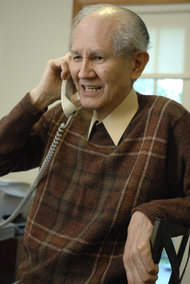
Shimomura

Photograph of the family from Shimomura’s Nobel Autobiography

Photograph of Shimomura Josh Reynolds/Associated Press

50 years since the submarine Thresher was lost

The Boston Globe had a story this morning about the Thresher submarine sinking off Cape Cod fifty years ago and it called to mind the Phil Ochs song on the subject.

For anyone who doesn’t remember the incident or is maybe too young, the Globe describes it this way.

The morning of April 10, 1963, was expected to be another round of rigorous but routine sea trials for the pride of the nation’s sub fleet. But what happened would jolt the nation: the worst submarine disaster in US history; the loss of all 129 crew, officers, and civilians on board; and a stinging blow to the American military at the hair-trigger height of the Cold War.

As the 278-foot-long Thresher began its descent that morning, only six months after the Cuban Missile Crisis, the unthinkable happened.

A pipe burst, electrical circuits shorted, nuclear propulsion shut down, and sailors on the USS Skylark, a trailing Navy ship, received these words from below: “Exceeding test depth.”

They heard little else from the crew, and the Thresher plunged more than a mile to the bottom of the North Atlantic. The Skylark, however, did hear the submarine’s death rattle: ominous hissing and groaning that preceded a devastating implosion that killed everyone on board within seconds.

The submaine Thresher the day before the dive.

The submarine Thresher the day before the dive.

There will be 50 year memorial service for the 129 men that were lost on April 10, 1063 at which at 129 foot flag pole, one foot for each man, will be dedicated at the Portsmouth Navel Ship yard in Kittery, Maine.  (A note of geography:  Kittery is across the Piscataqua River from Portsmouth, NH)

I doubt if anyone will sing the Phil Ochs song, which was an anti-war protest song.

In Portsmouth town on the eastern shore
Where many a fine ship was born.
The Thresher was built
And the Thresher was launched
And the crew of the Thresher was sworn.

She was shaped like a tear
She was built like a shark
She was made to run fast and free.
And the builders shook their hands
And the builders shared their wine,
And thought that they had mastered the sea.
Yes, she’ll always run silent
And she’ll always run deep
Though the ocean has no pity

Though the waves will never weep
They’ll never weep.
And they marvelled at her speed
marvelled at her depth
marvelled at her deadly design.
And they sailed to every land
And they sailed to every port
Just to see what faults they could find.
Then they put her on the land
For nine months to stand
And they worked on her from stem to stern.
But they could never see
It was their coffin to be
For the sea was waiting for their return.

Yes, she’ll always run silent
And she’ll always run deep
Though the ocean has no pity
And the waves will never weep
They’ll never weep.

On a cold Wednesday morn
They put her her out to sea
When the waves they were nine feet high.
And they dove beneath the waves
And they dove to their graves
And they never said a last goodbye.
And its deeper and deeper
And deeper they dove
Just to see what their ship could stand.
But the hull gave a moan
And the hull gave a groan
And they plunged to the deepest darkest sand.

Now she lies in the depths
Of the darkened ocean floor
Covered by the waters cold and still.
Oh can’t you see the wrong
She was a death ship all along
Died before she had a chance to kill.

And she´ll never run silent,
And she´ll never run deep,
For the ocean had no pity
And the waves, they never weep,
They never weep.

[Alternate final verse from an early Broadside tape]

And it’s 8000 fathoms of the water above
And over 100 men below
And sealed in their tomb
Is the cause of their doom
That only the sea will ever know

The Thresher’s remains were actually found in 1985 by oceanographer, Robert Ballard.

Chief Justice Roberts, voting rights and statistics

During the oral arguments for Shelby County v. Holder, Chief Justice John Roberts quoted some statistics that, according to his interpretation, showed the turnout ratio of minority voters to white voters was worse in Massachusetts than in any other state.  This prompted a quick response from the Massachusetts election officials and a more measured one from Nate Silver on FiveThirtyEight.  As the Chief Justice may be learning, statistics are tricky things.

The day after the remarks by the Chief Justice the Globe headline was

Chief justice blasted over Mass. voting ‘cheap shot’

Talk about feeling insulted!  The nerve to compare us to Mississippi!

“Do you know which state has the worst ratio of white voter turnout to African-American voter turnout?” Roberts asked Donald Verrilli Jr., solicitor general for the Department of Justice, during Wednesday’s arguments.

“I do not know that,” Verrilli answered.

“Massachusetts,” Roberts responded, adding that even Mississippi has a narrower gap.

Roberts later asked if Verrilli knew which state has the greatest disparity in registration. Again, Roberts said it was Massachusetts.

The problem is, Roberts is woefully wrong on those points, according to Massachusetts Secretary of State William F. Galvin, who on Thursday branded Roberts’s assertion a slur and made a declaration of his own. “I’m calling him out,” Galvin said.

Galvin was not alone in his view. Academics and Massachusetts politicians said that Roberts appeared to be misguided. A Supreme Court spokeswoman declined to offer supporting evidence of ­Roberts’s view, referring a ­reporter to the court transcript.

On Thursday,  Galvin tried to set the record straight. “We have one of the highest voter registrations in the country,” he said, “so this whole effort to make a cheap-shot point at Massachusetts is deceptive.”

Map of Section 5 Covered Jurisdictions

Map of Section 5 Covered Jurisdictions (Photo credit: Wikipedia)

So what’s going on here?  Trust Nate Silver to explain.

Section 5 of the Voting Rights Act, which is being challenged by Shelby County, Ala., in the case before the court, requires that certain states, counties and townships with a history of racial discrimination get approval (or “pre-clearance”) from the Department of Justice before making changes to their voting laws. But Chief Justice Roberts said that Mississippi, which is covered by Section 5, has the best ratio of African-American to white turnout, while Massachusetts, which is not covered, has the worst, he said.

Chief Justice Roberts’s statistics appear to come from data compiled in 2004 by the Census Bureau, which polls Americans about their voting behavior as part of its Current Population Survey. In 2004, according to the Census Bureau’s survey, the turnout rate among white voting-aged citizens was 60.2 percent in Mississippi, while the turnout rate among African-Americans was higher, 66.8 percent. In Massachusetts, conversely, the Census Bureau reported the white turnout rate at 72.0 percent but the black turnout rate at just 46.5 percent.

As much as it pleases me to see statistical data introduced in the Supreme Court, the act of citing statistical factoids is not the same thing as drawing sound inferences from them. If I were the lawyer defending the Voting Rights Act, I would have responded with two queries to Chief Justice Roberts. First, are Mississippi and Massachusetts representative of a broader trend: do states covered by Section 5 in fact have higher rates of black turnout on a consistent basis? And second, what if anything does this demonstrate about the efficacy of the Voting Rights Act?

Turns out that the Current Population Survey has a very high margin of error.

One reason to be suspicious of the representativeness of Mississippi and Massachusetts is the high margin of error associated with these calculations, as noted by Nina Totenberg of NPR.

Like other polls, the Current Population Survey is subject to sampling error, a result of collecting data among a random subsample of the population rather than everyone in the state. In states like Massachusetts that have low African-American populations, the margin of error can be especially high: it was plus-or-minus 9.6 percentage points in estimating the black turnout rate in 2004, according to the Census Bureau. Even in Mississippi, which has a larger black population, the margin of error was 5.2 percentage points.

The other problem is that the Chief Justice was using 2004 figures when the 2010 numbers had a lower margin of error.  So what, if any thing can we conclude.

In the chart below, I have aggregated the 2004 turnout data into two groups of states, based on whether or not they are covered by Section 5. (I ignore states like New York where some counties are subject to Section 5 but others are not.) In the states covered by Section 5, the black turnout rate was 59.2 percent in 2004, while it was 60.8 percent in the states that are not subject to it. The ratio of white-to-black was 1.09 in the states covered by Section 5, but 1.12 in the states that are not covered by it. These differences are not large enough to be meaningful in either a statistical or a practical sense.

So did Chief Justice Roberts misconstrue the data? If he meant to suggest that states covered by Section 5 consistently have better black turnout rates than those that aren’t covered by the statute, then his claim is especially dubious. However, the evidence does support the more modest claim that black turnout is no worse in states covered by Section 5. There don’t seem to be consistent differences in turnout rates based on whether states are covered by Section 5 or not.

The bigger potential flaw with Chief Justice Roberts’s argument is not with the statistics he cites but with the conclusion he draws from them.

And here what Silver thinks we should be asking.

…the fact that black turnout rates are now roughly as high in states covered by Section 5 might be taken as evidence that the Voting Rights Act has been effective. There were huge regional differences in black turnout rates in the early 1960s, before the Voting Rights Act was passed. (In the 1964 election, for example, nonwhite turnout was about 45 percent in the South, but close to 70 percent elsewhere in the country.) These differences have largely evaporated now.

How much of this is because of the Voting Rights Act, as opposed to other voter protections that have been adopted since that time, or other societal changes? And even if the Voting Rights Act has been important in facilitating the changes, how many of the gains might be lost if the Section 5 requirements were dropped now?

To put it nicely, the Chief Justice is using correct statistics to come to not only the incorrect conclusion, but also to ask the wrong questions.  Silver concludes

These are difficult questions that the Supreme Court faces. They are questions of causality – and as any good lawyer knows, establishing a chain of causality is often the most difficult chore in a case.

Statistical analysis can inform the answers if applied thoughtfully. But statistics can obscure the truth when they become divorced from the historical, legal and logical context of a case.

We can only hope that some law clerk at the Supreme Court reads FiveThirtyEight and talks to enough Justices.  Given all the shenanigans going on in Section 5 covered and not covered states on voting rules, now is not the time to over turn this modest brake insuring voting rights.

Official 2005 photo of Chief Justice John G. R...

Official 2005 photo of Chief Justice John G. Roberts (Photo credit: Wikipedia)

The curious story of Mary Paine

Mary Paine died in 1713 at 15 months.  Hardly the making of a life story, but there she was on the front page of the Metro section of the Boston Globe this morning.

It seems that in 1955, a 20 year old sailor, Roland McCandlish found Mary’s tombstone in a Copp’s Hill Burying Ground shed.  He took it with him back to his ship at the Charlestown Navy Yard.

From there, the vessel visited exotic ports of call, from Greenland to Haiti to Puerto Rico. When he returned home to California for good, he used the stone as a small but cherished ­table.

“I never thought of it as a tombstone; I thought of it as Mary,” McCandlish, now 79, said by phone Thursday. “She had, through me, the life she never­ had. She was a part of my life.”

McCandlish mailed it back to Boston.

McCandlish, in declining health and thinking about a headstone of his own, decided it was time to send the headstone back. He packaged it up, along with a photo of himself as a young sailor holding the stone, and a letter explaining the tale of its travels.

And I think this is my favorite part of the story.

McCandlish said parting with the relic was not easy. They’d made memories together.

He recalled when his Navy captain found the headstone stashed in a filing cabinet on the ship and called McCandlish into his office to explain.The captain laughed at his story.

“He reacted differently than others might,” McCandlish said. “He put it in the bottom drawer of the filing cabinet and said, ‘We’ll call it our dead file.’ ”

So the headstone will be reset next to the grave of her mother in the next few months and her travels will come to an end.

The headstone of Mary Paine, who died Dec. 31, 1713, at 15 months old, was discovered by Roland McCandlish during a 1955 tour of Copp’s Hill Burying Ground in the North End of Boston.

The headstone of Mary Paine, who died Dec. 31, 1713, at 15 months old, was discovered by Roland McCandlish during a 1955 tour of Copp’s Hill Burying Ground in the North End of Boston.

Photograph credited to Old North Church.

Responses to the State of the Union Address: being picked isn’t always a good thing

Quick.  Name the four responders to President Obama’s State of the Union/Joint addresses to Congress.  (The first one is not considered to be formal State of the Union.)  Give up?  I could only remember Bobby Jindal and Bob McDonnell so I had to look them up.

2009 – Bobby Jindal in an address remembered for his Kenneth the Page imitation.  If he ever decides to run for President, this will haunt him.

English: Governor Bobby Jindal at the Republic...

English: Governor Bobby Jindal at the Republican Leadership Conference in New Orleans, Louisiana. (Photo credit: Wikipedia)

2010 – Bob McDonnell the governor of Virginia who tried to rectify Jindal’s mistakes by giving his speech in the Virginia State House before a live hand-picked audience.  And then he became known as Governor Ultrasound and his Presidential chances disappeared.

2011 – Paul Ryan.  Representative Ryan did run for higher office tied to Mitt and, as we know, they lost.  He is young and maybe can run again someday if the Tea Party ever gains firm control over the Republican Party.

2012 – Mich Daniels, governor of Indiana.  This was supposed to be a stepping stone to the Presidential nomination.  Didn’t happen.

So this year we have Marco Rubio giving the response in English and in Spanish (so we are told).  He is trying to position himself as the young, fresh face for a 2016 run for the Presidency.  I have alread heard some Republican consultants saying  he’s young and Joe Biden and Hillary Clinton are old and that is good for the Republicans.  But State of the Union responders don’t have a very good track record, so we shall see.

English: Official portrait of US Senator Marco...

English: Official portrait of US Senator Marco Rubio of Florida. (Photo credit: Wikipedia)

Go to this link to see a short video of memorable moments.

Richard the Third the last Plantagenet

Richard III was, according to Shakespeare, one of the worst villans to rule England.  On the other hand, there were many, including Josephine Tey who believed otherwise.  And now, his bones have been found and identified.

The bones as discovered.

Greyfriars car park, Leicester, where the remains of King Richard III were found

Grey Friars car park, Leicester, where the remains of King Richard III were found.

According to the BBC

A skeleton found beneath a Leicester car park has been confirmed as that of English king Richard III.

Experts from the University of Leicester said DNA from the bones matched that of descendants of the monarch’s family.

Lead archaeologist Richard Buckley, from the University of Leicester, told a press conference to applause: “Beyond reasonable doubt it’s Richard.”

Richard, killed in battle in 1485, will be reinterred in Leicester Cathedral.

The Guardian detailed the careful science behind the declaration.

There were cheers when Richard Buckley, lead archaeologist on the hunt for the king’s body, finally announced that the university team was convinced “beyond reasonable doubt” that it had found the last Plantagenet king, bent by scoliosis of the spine, and twisted further to fit into a hastily dug hole in Grey Friars church, which was slightly too small to hold his body.

But by then it was clear the evidence was overwhelming, as the scientists who carried out the DNA tests, those who created the computer-imaging technology to peer on to and into the bones in raking detail, the genealogists who found a distant descendant with matching DNA, and the academics who scoured contemporary texts for accounts of the king’s death and burial, outlined their findings.

The skeleton’s injuries were consistent with accounts of Richard’s death.

Richard died at Bosworth on 22 August 1485, the last English king to fall in battle, and the researchers revealed how for the first time. There was an audible intake of breath as a slide came up showing the base of his skull sliced off by one terrible blow, believed to be from a halberd, a fearsome medieval battle weapon with a razor-sharp iron axe blade weighing about two kilos, mounted on a wooden pole, which was swung at Richard at very close range. The blade probably penetrated several centimetres into his brain and, said the human bones expert Jo Appleby, he would have been unconscious at once and dead almost as soon.

The injury appears to confirm contemporary accounts that he died in close combat in the thick of the battle and unhorsed – as in the great despairing cry Shakespeare gives him: “A horse! A horse! My kingdom for a horse!”

Another sword slash, which also went through the bone and into the brain, would also have proved fatal. But many of the other injuries were after death, suggesting a gruesome ritual on the battlefield and as the king’s body was brought back to Leicester, as he was stripped, mocked and mutilated – which would have revealed for the first time to any but his closest intimates the twisted back, a condition from an unknown cause, which began to contort his body from the age of about 10. By the time he died he would have stood inches shorter than his true height of 5′ 8″, tall for a medieval man. The bones were those of an unusually slight, delicately built man – Appleby described him as having an “almost feminine” build – which also matches contemporary descriptions.

According to the Boston Globe story

Richard III ruled England between 1483 and 1485, during the decades-long tussle over the throne known as the Wars of the Roses. His brief reign saw liberal reforms, including introduction of the right to bail and the lifting of restrictions on books and printing presses.

The discovery of Richard’s bones will not resolve the controversy surrounding him, however.  Most believe in the Shakespearean image of him as a the evil hunchbacked killer of two young princes in the Tower of London.

After I read Richard III in high school, my mother introduced me to Josephine Tey’s The Daughter of Time.  Her detective character, Alan Grant, takes up the case while in the hospital with the help of a young researcher who does the leg work.  The Wikipedia article about the book has a good summary of what Grant concluded and Tey believed.

The main arguments presented in the book in defence of King Richard:

  • There was no political advantage for Richard III in killing the young princes. He was legitimately made king.
  • There is no evidence that the princes were missing from the Tower when Henry VII took over.
  • Although a Bill of Attainder was brought by Henry VII against Richard it made no mention of the princes. There never was any formal accusation, much less a verdict of guilt.
  • Henry never produced the bodies of the dead princes for public mourning and a state funeral.
  • The mother of the Princes, Elizabeth Woodville, remained on good terms with Richard.
  • The Princes were more of a threat to Henry VII as the foundation of his claim to the crown was significantly more remote than theirs.

Grant and his American collaborator argue that there is little evidence of resistance to Richard’s rule (ignoring Buckingham’s rebellion). They allow that there were rumours of his murdering the princes during his lifetime, but they decide that the rumours had little circulation, and attribute them to the Croyland Chronicle and to the Lord Chancellor of France, and ultimately to Tudor sympathiser John Morton. They also propose that Morton was the actual author of Thomas More‘s biography of Richard, suggesting that the incomplete manuscript found after More’s death was an unfinished copy by More of Morton’s lost original. They conclude that the princes probably remained alive throughout Richard’s reign and were later killed by Henry.

The Richard III Society which sponsored discovery and will have his bones reinterred will still have work to do to clear his name.  Where are the alleged bones of the princes and can we now do DNA on them?

Photograph of car park Darren Staples/Reuters