Surveillance and President Obama

I look forward to my weekly email from my Congressman, Mike Capuano.  Of course, I once worked for him when he was mayor of the City of Somerville (a near Boston city) so I am used to Mike’s saying what he means and I almost always agree with him.  I am copying the entire first part of his email into this post.

mike_225x315

“U.S. Rep. Michael Capuano (D-Somerville), who voted against the Patriot Act, rallied protesters by calling the law the worst attack on freedom since the 1798 Alien and Sedition Acts.”

                                                                                                                Boston Herald

                                                                                                                September 10, 2003


The Patriot Act and Verizon


I am sure you are aware that Verizon has reportedly been ordered by the top-secret Foreign Intelligence Surveillance Court (FISA court) to turn over, “on an ongoing daily basis”, information about every customer telephone number, including landline, cell and business numbers. That information reportedly includes all numbers dialed and all calls received within the United States as well as between the United States and other countries.

As I write this newsletter, the news is filled with reports that a similar program called PRISM is in place for every major internet and email provider. The government claims they have not accessed the content of phone calls, but it seems they ARE accessing the content of emails such as videos, websites visited and more. According to reports, the PRISM program is not at this time being used on U.S. citizens.

Even if you can accept the government collecting the number and length of every call you make, are you really comfortable with them having the ability to catalogue all the YouTube videos you watch, the Netflix movies you download, or the web pages you visit? It seems that our own government has access to every phone call, email and internet search for all Americans at every minute of every day.

Like most Americans, I am absolutely outraged. But, if you’re a long time subscriber to these newsletters, you probably already knew that. You also probably know that I voted against passage of the so-called “Patriot Act” and every reauthorization since it first passed in 2001.

Before I go any further, I feel compelled to remind you that I was an early and strong supporter of President Obama.  I am still amongst the strongest Obama supporters in the House of Representatives.  Nonetheless, I cannot remain silent out of some sort of misplaced loyalty to President or party when I believe that basic American rights have been intentionally trampled.

I know we live in a dangerous world and there is work to do to prevent terrorists from harming us. But we must find a balance between giving law enforcement the tools they need to track and identify terrorists and protecting the very liberties upon which our great country was founded.

This data collection has reportedly been going on for 7 years. The length of time that this has been going on and the staggering amount of data collected on every Verizon customer amounts to an incredible overreach. Even if you’re not a Verizon customer, there is clearly reason for concern. Who really believes that Verizon is the only telecommunications company required to turn over this data?

I have always believed that we must give law enforcement the tools they need to pursue criminals. However, we can do that and still protect civil liberties.

It is time for those of us who support President Obama to speak up.  I believe he is a good man and has been a good President.  However, I think his Administration has allowed their concern for our safety to lead them down the wrong path.  If we remain silent, those who have always wished him to fail on every point stand a better chance of winning the hearts and minds of America and we will all be worse off for it.  It is possible to support President Obama and yet disagree with him on certain issues – this is one of those times.

The President has said he is glad this is out in the open and he welcomes discussion.  Instead of reacting in horror – or wishing more information would be collected, we need to talk.   I’m not sure I know where the balance is, but one thing that I learned at St. John’s College (Annapolis) is that dialog can lead to greater clarity and understanding.  So let’s talk:  To each other and to the President and your member of Congress.

Photograph from Capuano website.

Red Sox, Celtics and Pride Week in Boston

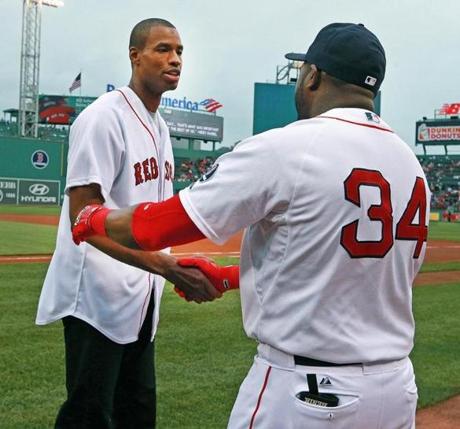
Jason Collins spent time last season with the Boston Celtics (and he might be back next season) before he came out in a now famous Sports Illustrated story.  Last night Collins helped the Red Sox celebrate Pride Night by throwing out the first pitch to Manager John Farrell.  It should be noted that managers rarely do this.

The Boston Globe ran this story from the Associate Press

The 7-foot center was greeted with a nice applause when the PA announcer read the opening of the SI article: ‘‘I’m a 34-year-old NBA center. I’m black. And I’m gay.’’

Wearing a Red Sox jersey with the No. 98 on the back, Collins threw out the first pitch to Red Sox manager John Farrell.

Red Sox slugger David Ortiz feels everyone should support each other based on how they act.

‘‘Nobody knows what is perfect and what is not,’’ Ortiz said, sitting at his locker about three hours before the game. ‘‘If you are respectful and you do what you’re supposed to do, it doesn’t matter what you are and what you come from, people should respect you and love you the same way.’’

Collins wears 98 on his jerseys to honor Matthew Shepard who was killed in 1998, a decision welcomed by Shepard’s parents.

2015 Pride Night at Fenway

2015 Pride Night at Fenway

Hey Danny and Doc, bring him back to the Celtics!

By the way, the Sox won on a walk-off 3 run homer by – David Ortiz.

Photograph Jim Davis/Globe Staff

Republican suicide in Virginia?

Having lived in Virginia for many years, I take more than a passing interest in the political scene there and this fall’s election will be a doozy!  Not quite sure what Virginia Republicans think they are doing, but unless everyone in Virginia has totally lost it, Terry McAuliffe should be the next governor.

This morning, the Washington Post has a story with 3 earlier related ones.  Here are the headlines with links:

E.W. Jackson a wild card in Va. GOP campaign  This is the main profile and biography.

Va. GOP’s E.W. Jackson: So far right he has said Democrats have ‘Antichrist’ agenda

E.W. Jackson complicates Cuccinelli bid

Va. GOP picks conservatives for fall ticket; black minister is lieutenant governor choice

So what exactly is going on in Virginia?   On May 18, the Post described the ticket this way

Thousands of Virginia Republicans on Saturday picked a slate of statewide candidates who vowed to stay true to conservative principles, resisting calls to remake the GOP message after losses in 2012.

At the top of the ticket is gubernatorial hopeful Ken Cuccinelli II, the attorney general. Known for high-profile battles against “Obamacare,” abortion and a university climate scientist, Cuccinelli stood by what detractors have called an out-of-the-mainstream agenda.

E.W. Jackson, a minister from Chesapeake, won the nomination for lieutenant governor with a full-throated appeal for limited government, traditional families and gun rights. “We will not only win an election in November, we will open the hearts and minds of our people and save this commonwealth and save this country,” said Jackson, the first African American nominated by the Virginia GOP for statewide office since 1988. [That was Doug Wilder, who won.]

For attorney general, the party nominated state Sen. Mark D. Obenshain (R-Harrisonburg), who this year successfully pushed tougher voter ID rules. “Are you ready to stop Obamacare in its tracks?” he asked the crowd in his acceptance speech, eliciting cheers.

Republican nominee for governor Ken Cuccinelli, right, is joined onstage with the other members of the ticket, including E. W. Jacksonon, second from left.

Republican nominee for governor Ken Cuccinelli, right, is joined onstage with the other members of the ticket, including E. W. Jackson, second from left.

It is as if the election last year never happened.  Mitt Romney didn’t lose.  Barack Obama never won.

But the candidate in the spotlight is Jackson.

Jackson’s improbable rise, one that has astonished Republicans far and wide, is the latest of a number of incarnations, including foster child, Marine, Harvard law school graduate and even Democrat. But the minister who is now GOP gubernatorial nominee Ken Cuccinelli II’s running mate has long used his booming voice to endear himself to conservatives.

Still, Jackson’s words — sometimes eloquent, sometimes raw, often impassioned — are causing anxiety for many Republicans as the resurfacing of his past statements about homosexuality and abortion have threatened to disrupt the campaign.

Instead of promoting their new ticket, Republicans have answered for Jackson’s once calling gays “perverted” and “sick” and saying Planned Parenthood has been “far more lethal” to blacks “than the KKK.”

Jackson has ties to Massachusetts which I didn’t know.

After a tour with the Marines, Jackson graduated with honors in 1975 from the University of Massachusetts, where he majored in philosophy. Then he graduated from Harvard Law School in 1978. He spent more than 20 years in Boston, practicing law, pastoring at New Cornerstone Exodus Church, serving as a chaplain to the Boston Fire Department, and hosting radio shows, including one called “Earl Jackson Across America.”

At one point, he was a Democrat, and he was elected to the party’s Massachusetts State Committee, where he distinguished himself with his conservative views. “I thought, ‘Wow, here’s a great potential leader,’ ” said James Roosevelt, who is a grandson of Franklin D. Roosevelt and who was then and is now legal counsel to the state Democratic organization. “Then I learned of his views, and I thought: ‘What’s he doing? This is not a leader of the Democratic Party.’ ”

Jackson became a Republican in the early 1980s, explaining that Democrats’ embrace of the gay rights movement violated his religious beliefs. In 1989, he joined the opposition to a proposal to ban discrimination against gays and lesbians in Massachusetts. “We intend to blow this bill to smithereens,” he told reporters then. “We intend to defeat this legislation and bury it so deep no one will ever find it again.”

Sorry Rev. Jackson.  We not only passed that bill, but we also have marriage equality.  I have to admit I never listen much to talk radio or to Jackson’s program.  He moved to Virginia in 1998, perhaps thinking the political climate there would be more in tuned to his views and clearly he was right about that: he is now the Republican nominee for Lt. Governor.  Jackson has also been affiliated with the Christian Coalition and the Tea Party.

“The Republicans I’m talking to are saying, ‘What the hell are they doing in Virginia?’ ” said Michael Steele, former chairman of the Republican National Committee. “Is this, ‘101 ways to lose an election’? You’re coming out of the gate with comments everyone has to explain. You’re wasting a lot of time and energy batting that back when you should be doing other things to get the guy known.”

Although unknown to many Republicans, Jackson in recent years has built a following among the most activist of Virginia’s conservatives, many of whom were delegates at the convention. But Republicans are now concerned, Steele said, that Jackson will turn off the party’s own voters. “You can’t have a situation where Republicans say, ‘You know what? I can’t have this’ and they stay home or vote for the other guy,” he said.

Added to the mix is the investigation of the current Republican governor, Bob McDonnell awkwardly headed by the current Republican Attorney General and nominee for Governor, Ken Cuccinelli who took money from the same supporter.  The New York Times has that story.

Virginia’s attorney general has appointed an outside prosecutor to investigate Gov. Bob McDonnell’s financial disclosures, in a widening scandal over a political donor who wrote a $15,000 check for the wedding of the governor’s daughter, and who was also a benefactor of the attorney general.

Kenneth T. Cuccinelli II, the attorney general, who is also the Republican candidate for governor this year, said on Wednesday that he named the outside prosecutor last November to look into Mr. McDonnell’s disclosures.

Mr. Cuccinelli said “information came to my attention” triggering the appointment of the prosecutor. His referral of the case to the Richmond commonwealth’s attorney, Mike Herring, whose role is similar to that of a district attorney, “was not a conclusion that any violation occurred,’’ Mr. Cuccinelli said in a statement.

The investigation came to light through a Freedom of Information Act request by The Richmond Times-Dispatch, which first reported it.

Mr. McDonnell and Mr. Cuccinelli, who are yoked in an awkward political alliance – the former a popular governor of a purple state and his would-be successor, a Tea Party favorite — have been swept up in controversy over their friendship with a Virginia businessman, Jonnie R. Williams Sr., who gave generously to both officials.

What a tangle!  Can Terry McAuliffe pull out a win for the Democrats?

“We’re in a deep [expletive],” said one Virginia Republican strategist. “The only good news is that the Democrats have Terry McAuliffe. It’s the only thing keeping us glued to a chance of victory.”

McAuliffe, a former Democratic National Committee chairman, has faced questions about his leadership of an electric car company and some unflattering quotes from his own memoir.

All I can say is “stay ‘tooned”.

Photograph: Steve Helber/AP

Leaks, national security and the press

Every administration on every level of government worries about leaks.  Mayors worry about information on a big new construction project or policy initiative getting out too soon.  Presidents worry about national security.  Members of legislatures worry about a stand on an issue leaking before it can be “properly framed.”  Actually all politicians worry about that.  Look at VP Biden “leaking” his position on gay marriage.  I’ve been suspected of being a leaker because I knew reporters – and I’ve helped look for leaks.   I also believe in a free press, but as with any freedom, limits are needed.  The question is where that line should be.

Do you understand what the AP scandal is all about?  I have to admit that until I read this piece by Jack Shafer of Reuters, I really didn’t.  I don’t think the press did a good job of trying to explain their own story.  Did you know that the leak had to do with the underwear bomber?  I didn’t.  Never heard or saw that and I follow the news pretty closely.

Shafer writes

Journalists gasp and growl whenever prosecutors issue lawful subpoenas ordering them to divulge their confidential sources or to turn over potential evidence, such as notes, video outtakes or other records. It’s an attack on the First Amendment, It’s an attack on the First Amendment, It’s an attack on the First Amendment, journalists and their lawyers chant. Those chants were heard this week, as it was revealed that Department of Justice prosecutors had seized two months’ worth of records from 20 office, home and cell phone lines used by Associated Press journalists in their investigation into the Yemen underwear-bomber leaks.

First Amendment radicals — I count myself among them — resist any and all such intrusions: You can’t very well have a free press if every unpublished act of journalism can be co-opted by cops, prosecutors and defense attorneys. First Amendment attorney Floyd Abrams speaks for most journalists when he denounces the “breathtaking scope” of the AP subpoenas. But the press’s reflexive protests can prevent it from seeing the story in full, which I think is the case in the current leaks investigation.

,,,

The Obama administration has already used the Espionage Act to prosecute more government officials for leaking than all of his predecessors put together, but we shouldn’t automatically lump its pursuit of the underwear-bomb leaker in with those cases. Perhaps this investigation is chasing an extra-extraordinary leak, and the underwear-bomber leak is but one of the drops.

I have to point out here that the Republicans in Congress have pushed the administration to find leakers and, I fear, have caused the Democrats and President Obama to catch their paranoia.

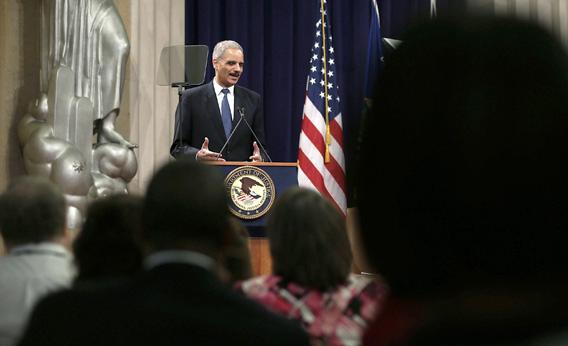
Attorney General Eric Holder has overseen more leak investigations under Obama than were pursued under Bush

Attorney General Eric Holder has overseen more leak investigations under Obama than were pursued under Bush

Shafer continues

The AP story that has so infuriated the government described the breakup of an al Qaeda in the Arabian Peninsula plot to place an underwear bomber on board a U.S.-bound airliner. Published on the afternoon of May 7, 2012, the story patted itself on the back for having heeded the White House and CIA requests to not publish the previous week, when the AP first learned of the operation. The AP states in the article that it published only after being told by “officials” that the original “concerns were allayed.” In a chronology published in today’s Washington Post, we’re told that the CIA was no longer resisting publication of the AP story on the day it hit the wire (Monday) and that the White House was planning to “announce the successful counterterrorism operation that Tuesday.”

That may be the case, but the government was still incensed by the leak. In fact, it appears that officials were livid. As my Reuters colleagues Mark Hosenball and Tabassum Zakaria reported last night, the government found the leak so threatening that it opened a leak investigation before the AP ran its story.

Now, what would make the Obama administration so furious? My guess is it wasn’t the substance of the AP story that has exasperated the government but that the AP found a source or sources that spilled information about an ongoing intelligence operation and that even grander leaks might surge into the press corps’ rain barrels.

At the risk of making the Department of Justice’s argument for it, a leak once sprung can turn into a gusher as the original leakers keep talking and new ones join them, or as the government attempts to explain itself, or as others in the government begin to speak out of turn. From what I can tell, all of the above happened after the AP story appeared.

So there you have it.  It was not the particular leak, but the fact that there was a leaker that could potentially leak again.  As Shafer points out when there is a leak there is also the problem of government officials saying too much and, in effect becoming leakers.  What happened here was the existence of a double agent got out, mostly because of what government officials said in trying to explain the original AP story.   Shafer summarizes the trail and concludes

To begin with, the perpetrators of a successful double-agent operation against al Qaeda in the Arabian Peninsula would not want to brag about their coup for years. Presumably, al Qaeda in the Arabian Peninsula will now use the press reports to walk the dog back to determine whose misplaced trust allowed the agent to penetrate it. That will make the next operation more difficult. Other intelligence operations — and we can assume they are up and running — may also become compromised as the press reports give al Qaeda in the Arabian Peninsula new clues.

Likewise, the next time the CIA or foreign intelligence agency tries to recruit a double agent, the candidate will judge his handlers wretched secret keepers, regard the assignment a death mission and seek employment elsewhere.

Last, the leaks of information — including those from the lips of Brennan, Clarke and King — signal to potential allies that America can’t be trusted with secrets. “Leaks related to national security can put people at risk,” as Obama put it today in a news conference.

The ultimate audience for the leaks investigation may not be domestic but foreign. Obviously, the government wants to root out the secretspillers. But a country can’t expect foreign intelligence agencies to cooperate if it blows cover of such an operation. I’d wager that the investigations have only begun.

None of this means we should go rooting around people’s cell phone and email records without some protection.  In his reaction to the scandal, President Obama called for Congress to enact an updated media shield law which would replace the Justice Department’s internal regulations (which I think they actually didn’t follow).  Wouldn’t it be interesting for Congress to take some proactive steps instead of just investigating?

Photograph: Alex Wong/Getty Images

What does this mean?!

What does this mean?!

Jonathan Capehart wrote this about it in the Washington Post.

I’ve grown accustomed to the lunacy that emanates from the far right on Capitol Hill. But a tweet last night from Rep. Steve Stockman (R-Tex.) promoting his new bumper sticker was a jaw-dropper.

Just when you think things can’t get sicker something new comes along.

A question for the Chief Justice

So, Mr. Chief Justice, where did you say you went to law school?  That’s what I want to ask Mr. Roberts after yesterday’s hearing on The Defense of Marriage Act or DOMA.

Here is the relevant exchange as reported by the New York Times.

He expressed irritation that the case was before the court, saying President Obama’s approach — to enforce the law but not defend it — was a contradiction.

“I don’t see why he doesn’t have the courage of his convictions,” the chief justice said. He said Mr. Obama should have stopped enforcing a statute he viewed as unconstitutional “rather than saying, ‘Oh, we’ll wait till the Supreme Court tells us we have no choice.’ ”

The White House took umbrage at the remark and said the president was upholding his constitutional duty to execute the laws until the Supreme Court rules otherwise. “There is a responsibility that the administration has to enforce laws that are on the books,” said Josh Earnest, a deputy White House press secretary. “And we’ll do that even for laws that we disagree with, including the Defense of Marriage Act.”

The Chief Justice should know that the President has to enforce laws until they are declared unconstitutional by a court.  Thus my question.

The situation, however, is a little bit more complicated.  NPR explains it this way.

Has the Obama administration abrogated its responsibility by continuing to enforce DOMA, while refusing to defend it in court?

Justice Antonin Scalia: “And I’m wondering if we’re living in this new world where the attorney general can simply decide, ‘Yeah, it’s unconstitutional, but it’s not so unconstitutional that I’m not willing to enforce it.’ If we’re in this new world, I — I don’t want these cases like this to come before this court all the time. And I think they will come all the time if that’s … the new regime in the Justice Department that we’re dealing with.”

Deputy U.S. Solicitor General Sri Srinivasan: “Justice Scalia, one recognized situation in which an act of Congress won’t be defended in court is when the president makes a determination that the act is unconstitutional. That’s what happened here. The president made an accountable legal determination that this act of Congress is unconstitutional.”

Paul Clement, lawyer for GOP House leadership in defense of DOMA: “The House’s single most important prerogative, which is to pass legislation and have that legislation, if it’s going to be repealed, only be repealed through a process where the House gets to fully participate.”

Justice Kennedy: “Suppose that constitutional scholars have grave doubts about the practice of the president signing a bill but saying that he thinks it’s unconstitutional — what do you call it, signing statements or something like that? It seems to me that if we adopt your position that that would ratify and confirm and encourage that questionable practice because if the president thinks the law is unconstitutional, he shouldn’t sign it, according to some view. And that’s a lot like what you’re arguing here. It’s very troubling.”

Deputy U.S. Solicitor General Sri Srinivasan: “But my point is simply that when the president makes a determination that a statute is unconstitutional, it can follow that the Department of Justice won’t defend it in litigation.”

What should a President do in a situation like this one?  Does he just continue to enforce the law while trying to get Congress to repeal it as Paul Clement seems to argue.  Or does he do what he did:  say he thought the law was unconstitutional while both appealing and enforcing it.  I suppose that he could have issued an executive order to the IRS to accept joint tax returns from all legally married couples but that would have created an even bigger uproar that going to the Supreme Court.

My point, Mr. Chief Justice, is that yes, this may be an unprecedented situation, but the job of the Supreme Court and therefore your job is to make the ultimate decision on Constitutionality.  So just do your job.  And by the way, where did you go to law school?

Edith Windsor, the plaintiff in the DOMA case,

Edith Windsor, the plaintiff in the DOMA case.

Photograph Christopher Gregory/The New York Times


The Supremes and Gay Marriage

There were wonderful thing said by some of the Justices today, but I want to concentrate on the cartoons.  Here are three from the Washington Post.

First Pat Oliphant.

Oliphant 3-26-2013

I love the duck in the corner reminding everyone that this is the same court that gave us corporations as people.

Moving on to Tom Toles.

Toles 3-26-2013

And finally Nick Anderson.

Anderson 3-26-2013

Do we have to say more?

Law and Order: Life imitates art – or is the other way around?

I am a major fan of  Law and Order.  The original not any of the spin offs.  I still like to catch a re-run now and then and particularly like the older ones.  Last week a story in the New York Times about Robert M. Morgenthau the retired DA from Manhattan reminded me of the show.  Morgenthau is the model for the original DA, Adam Schiff, from the TV show. Morgenthau retired about three years ago at 90.  He had been DA for 35 years.

Morgenthau is still practicing law.

Mr. Morgenthau, 93, and two other prominent former prosecutors are asking the United States Supreme Court to take up the case of William Ernest Kuenzel, who has been on death row in Alabama for 24 years.

Based on the testimony of two witnesses, Mr. Kuenzel was convicted in 1988 of murdering a convenience store clerk. Records that became available only in 2010 revealed that those two witnesses — one of whom admitted that he himself was involved in the murder — actually did not implicate Mr. Kuenzel when they first spoke with the authorities. In fact, they originally gave entirely different accounts from what they testified to at trial, but the defense lawyer was unaware that their stories had changed. So were the jurors.

Mr. Morgenthau learned about the case from Jeffrey Glen, a law partner of his late son-in-law. Their firm, Anderson Kill & Olick, was working on the appeal, along with David Kochman. To Mr. Morgenthau’s disbelief, the case was rejected by federal courts in Alabama, which ruled that the new evidence did not “refute the possibility that the defendant committed the crime.”

“It’s so wrong to say there’s presumption of guilt because he was convicted once — without the newly discovered evidence,” Mr. Morgenthau said. “I just thought that was off the wall.”

So Mr. Morgenthau contacted 2 other former DA’s and they have filed a friend of the court brief for the Supreme Court asking them to take the case on appeal.

He contacted Gil Garcetti, who served 32 years in the Los Angeles district attorney’s office, and E. Michael McCann, who was the district attorney of Milwaukee for 38 years, and they agreed to join him in a friend-of-the-court brief.

The opening lines explained why their views were worth hearing: They wrote “from the unique perspective of having overseen and been ultimately responsible for more than 7,000,000 criminal prosecutions.”

The concept of new evidence was what led to the reversal of the conviction of five teenaged boys for the attempted murder of  a Central Park jogger.  In 2009 Carlin DeGuerin Miller wrote for a CBS blog

But his tenure hasn’t been without its share of detractors and controversies,
one of the biggest being the wrongful convictions in the 1989 Central Park
Jogger case. In 2002, DNA evidence surfaced that incriminated someone else in
the rape and Morgenthau himself appeared in court to agree with the defense
request to dismiss the charges.

A good prosecutor knows when to cut his losses.  According to the Times, Morgenthau said

“That was a matter of newly discovered evidence,” he said. “I had to act. This case reminded me of that.”

Law and Order lives on in re-runs and Robert Morgenthau is still fighting the good fight for real.

Robert M. Morgenthau is asking the United States Supreme Court to take on the case of a man who has been on death row in Alabama for 24 years.

Robert M. Morgenthau is asking the United States Supreme Court to take on the case of a man who has been on death row in Alabama for 24 years.

Photograph Hiroko Masuike/The New York Times