Official end to California’s Prop 8

I woke up this morning to this news from the New York Times

Gay Couples Who Sued in California Are Married

Kris Perry and Sandy Stier, who have been together for more than 15 years and have four sons, were married at San Francisco City Hall by Attorney General Kamala Harris on Friday.

Kris Perry and Sandy Stier, who have been together for more than 15 years and have four sons, were married at San Francisco City Hall by Attorney General Kamala Harris on Friday.

The two couples who sued to overturn California’s ban on same-sex marriage were married late Friday afternoon, just hours after the United States Court of Appeals for the Ninth Circuit, in San Francisco, lifted the stay that had been in place.

The court had stopped same-sex marriages while the case wound its way through the Supreme Court, which issued its decision to clear the path for same-sex marriages in California on Wednesday.

Attorney General Kamala Harris rushed to San Francisco City Hall within minutes of the ruling to perform the wedding for Kris Perry and Sandy Stier, who have been together for more than 15 years and have four sons.

And in LA

Mayor Antonio R. Villaraigosa of Los Angeles, on his last workday in office, officiated at the Friday evening wedding of Paul Katami and Jeffrey Zarrillo, the two other plaintiffs in the case. Until Friday afternoon, they had no idea when their marriage could take place.

“Nobody really knew; that’s what our lawyers are there for. We don’t really care about any of that at this point, but we’re on our way to see the mayor,” Mr. Zarrillo told KCRW, a public radio station in Los Angeles.

The pair were stuck in traffic en route from their home to the county office to obtain their marriage license and then to City Hall downtown. But by 6:30 they walked in front of dozens of television cameras, kissed Mayor Villaraigosa and were pronounced married.

“Your relationship is an inspiration to us all,” Mr. Villaraigosa said. “Today, your wait is finally over.”

“Equal feels different,” Mr. Katami said. Mr. Zarrillo added, “Equal feels good.”

The Ninth Circuit acted with unusual speed.

Many legal experts and advocates had expected the court to wait for an official decision from the Supreme Court, as is the normal practice. But after the initial ruling was issued on Wednesday, Ms. Harris urged the Circuit Court to act immediately and said she would ensure that all counties in the state were prepared to issue licenses to same-sex couples.

Just after 3 p.m. Friday, the three-judge panel issued a one-sentence ruling lifting the stay on a district judge’s injunction to not enforce the ban on same-sex marriages.

Gov. Jerry Brown issued a statement late Friday afternoon saying that he had directed the state’s Department of Health to notify all 58 counties in the state that “same-sex marriage is now legal in California and that marriage licenses must be issued to same-sex couples immediately.”

I know there had been some confusion about the impact of the Supreme Court decision.  Some thought it would only apply to the plaintiff, but since the District and Appeals courts had already ruled Prop 8 unconstitutional it turns out that only the stay had to be lifted.

From Massachusetts:  Welcome to Marriage Equality, California!  And an aside to the opponents – don’t worry, the sky will not fall.  This is number 13.  Which state will be next?

Photograph:  Jim Wilson/The New York Times

Syria? Really?

The President, probably never believing that Assad would use chemical weapons, drew a red line.  He’s been stalling around saying he needs verification, but now he has it.  The question is what should we do now.  I think Obama is stuck.

130612_barack_obama_ap_605

The United States has a long history of failed interventions.  Vietnam was basically a civil war.  We armed the Taliban when they were our “friends”.  We actually started a civil war in Iraq by stupidly dismissing all the Baathists saying they can’t be part of any new Iraqi government.  Now we are again taking sides against the Baathist who currently rule Syria.  My big fear is that the region will explode into a Sunni v. Shia conflict and we will be seen as taking sides.

Andrew Sullivan wrote this morning

My strong view, vented last night as I absorbed this stunning collapse of nerve, is that we shouldn’t fight at all. We are damn lucky to have gotten every GI out of Iraq, and the notion of being sucked back into that region again – and to join sides in a sectarian conflict – is a betrayal of everything this president has said and stood for. It’s a slap in the face for everyone who backed him because he said he wouldn’t be another Bush or McCain or Clinton. If he intervenes in Syria, he will have no credibility left with those of us who have supported his largely sane and prudent foreign policy so far. Libya was bad enough – and look at the consequences. But Syria? And the entire Middle East? Is he out of his mind?

And can you think of a dumber war than this one?

The man who said he would never engage in a dumb war is apparently preparing to join the dumbest war since … well, Iraq.

My only hope right now is that we can somehow use our threat of intervention to maneuver some type of international peace keeping force while we try to bring both sides to a negotiating table.  And let us hope that President Obama knows to get Congress involved, gets a UN resolution and the Arab League to agree before we take any action.

Sullivan concludes

One reason I supported Obama so passionately in 2008 and 2012 was because I thought he understood this and had the spine to stand up to drama queens like McCain and armchair generals like William Jefferson Clinton. But it is beginning to appear that this president isn’t actually that strong. We voted for him … and he’s giving us Clinton’s and McCain’s foreign policy. If Cameron and Hollande want to pull another Suez, for Pete’s sake be Eisenhower – not Kennedy.

My cri de coeur is here. Don’t do it, Mr President. And don’t you dare involve us in another war without a full Congressional vote and national debate. That wouldn’t just be a mistake; it would be a betrayal.

Photograph:  AP

Red Sox, Celtics and Pride Week in Boston

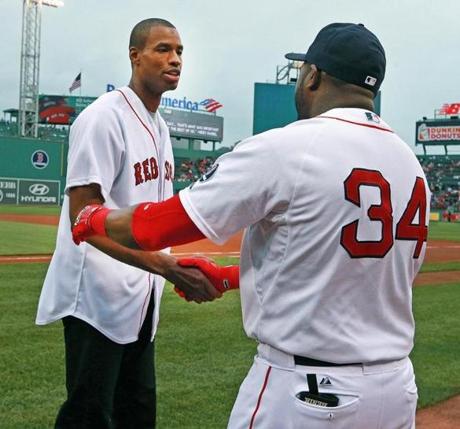
Jason Collins spent time last season with the Boston Celtics (and he might be back next season) before he came out in a now famous Sports Illustrated story.  Last night Collins helped the Red Sox celebrate Pride Night by throwing out the first pitch to Manager John Farrell.  It should be noted that managers rarely do this.

The Boston Globe ran this story from the Associate Press

The 7-foot center was greeted with a nice applause when the PA announcer read the opening of the SI article: ‘‘I’m a 34-year-old NBA center. I’m black. And I’m gay.’’

Wearing a Red Sox jersey with the No. 98 on the back, Collins threw out the first pitch to Red Sox manager John Farrell.

Red Sox slugger David Ortiz feels everyone should support each other based on how they act.

‘‘Nobody knows what is perfect and what is not,’’ Ortiz said, sitting at his locker about three hours before the game. ‘‘If you are respectful and you do what you’re supposed to do, it doesn’t matter what you are and what you come from, people should respect you and love you the same way.’’

Collins wears 98 on his jerseys to honor Matthew Shepard who was killed in 1998, a decision welcomed by Shepard’s parents.

2015 Pride Night at Fenway

2015 Pride Night at Fenway

Hey Danny and Doc, bring him back to the Celtics!

By the way, the Sox won on a walk-off 3 run homer by – David Ortiz.

Photograph Jim Davis/Globe Staff

A question for the Chief Justice

So, Mr. Chief Justice, where did you say you went to law school?  That’s what I want to ask Mr. Roberts after yesterday’s hearing on The Defense of Marriage Act or DOMA.

Here is the relevant exchange as reported by the New York Times.

He expressed irritation that the case was before the court, saying President Obama’s approach — to enforce the law but not defend it — was a contradiction.

“I don’t see why he doesn’t have the courage of his convictions,” the chief justice said. He said Mr. Obama should have stopped enforcing a statute he viewed as unconstitutional “rather than saying, ‘Oh, we’ll wait till the Supreme Court tells us we have no choice.’ ”

The White House took umbrage at the remark and said the president was upholding his constitutional duty to execute the laws until the Supreme Court rules otherwise. “There is a responsibility that the administration has to enforce laws that are on the books,” said Josh Earnest, a deputy White House press secretary. “And we’ll do that even for laws that we disagree with, including the Defense of Marriage Act.”

The Chief Justice should know that the President has to enforce laws until they are declared unconstitutional by a court.  Thus my question.

The situation, however, is a little bit more complicated.  NPR explains it this way.

Has the Obama administration abrogated its responsibility by continuing to enforce DOMA, while refusing to defend it in court?

Justice Antonin Scalia: “And I’m wondering if we’re living in this new world where the attorney general can simply decide, ‘Yeah, it’s unconstitutional, but it’s not so unconstitutional that I’m not willing to enforce it.’ If we’re in this new world, I — I don’t want these cases like this to come before this court all the time. And I think they will come all the time if that’s … the new regime in the Justice Department that we’re dealing with.”

Deputy U.S. Solicitor General Sri Srinivasan: “Justice Scalia, one recognized situation in which an act of Congress won’t be defended in court is when the president makes a determination that the act is unconstitutional. That’s what happened here. The president made an accountable legal determination that this act of Congress is unconstitutional.”

Paul Clement, lawyer for GOP House leadership in defense of DOMA: “The House’s single most important prerogative, which is to pass legislation and have that legislation, if it’s going to be repealed, only be repealed through a process where the House gets to fully participate.”

Justice Kennedy: “Suppose that constitutional scholars have grave doubts about the practice of the president signing a bill but saying that he thinks it’s unconstitutional — what do you call it, signing statements or something like that? It seems to me that if we adopt your position that that would ratify and confirm and encourage that questionable practice because if the president thinks the law is unconstitutional, he shouldn’t sign it, according to some view. And that’s a lot like what you’re arguing here. It’s very troubling.”

Deputy U.S. Solicitor General Sri Srinivasan: “But my point is simply that when the president makes a determination that a statute is unconstitutional, it can follow that the Department of Justice won’t defend it in litigation.”

What should a President do in a situation like this one?  Does he just continue to enforce the law while trying to get Congress to repeal it as Paul Clement seems to argue.  Or does he do what he did:  say he thought the law was unconstitutional while both appealing and enforcing it.  I suppose that he could have issued an executive order to the IRS to accept joint tax returns from all legally married couples but that would have created an even bigger uproar that going to the Supreme Court.

My point, Mr. Chief Justice, is that yes, this may be an unprecedented situation, but the job of the Supreme Court and therefore your job is to make the ultimate decision on Constitutionality.  So just do your job.  And by the way, where did you go to law school?

Edith Windsor, the plaintiff in the DOMA case,

Edith Windsor, the plaintiff in the DOMA case.

Photograph Christopher Gregory/The New York Times


Law and Order: Life imitates art – or is the other way around?

I am a major fan of  Law and Order.  The original not any of the spin offs.  I still like to catch a re-run now and then and particularly like the older ones.  Last week a story in the New York Times about Robert M. Morgenthau the retired DA from Manhattan reminded me of the show.  Morgenthau is the model for the original DA, Adam Schiff, from the TV show. Morgenthau retired about three years ago at 90.  He had been DA for 35 years.

Morgenthau is still practicing law.

Mr. Morgenthau, 93, and two other prominent former prosecutors are asking the United States Supreme Court to take up the case of William Ernest Kuenzel, who has been on death row in Alabama for 24 years.

Based on the testimony of two witnesses, Mr. Kuenzel was convicted in 1988 of murdering a convenience store clerk. Records that became available only in 2010 revealed that those two witnesses — one of whom admitted that he himself was involved in the murder — actually did not implicate Mr. Kuenzel when they first spoke with the authorities. In fact, they originally gave entirely different accounts from what they testified to at trial, but the defense lawyer was unaware that their stories had changed. So were the jurors.

Mr. Morgenthau learned about the case from Jeffrey Glen, a law partner of his late son-in-law. Their firm, Anderson Kill & Olick, was working on the appeal, along with David Kochman. To Mr. Morgenthau’s disbelief, the case was rejected by federal courts in Alabama, which ruled that the new evidence did not “refute the possibility that the defendant committed the crime.”

“It’s so wrong to say there’s presumption of guilt because he was convicted once — without the newly discovered evidence,” Mr. Morgenthau said. “I just thought that was off the wall.”

So Mr. Morgenthau contacted 2 other former DA’s and they have filed a friend of the court brief for the Supreme Court asking them to take the case on appeal.

He contacted Gil Garcetti, who served 32 years in the Los Angeles district attorney’s office, and E. Michael McCann, who was the district attorney of Milwaukee for 38 years, and they agreed to join him in a friend-of-the-court brief.

The opening lines explained why their views were worth hearing: They wrote “from the unique perspective of having overseen and been ultimately responsible for more than 7,000,000 criminal prosecutions.”

The concept of new evidence was what led to the reversal of the conviction of five teenaged boys for the attempted murder of  a Central Park jogger.  In 2009 Carlin DeGuerin Miller wrote for a CBS blog

But his tenure hasn’t been without its share of detractors and controversies,
one of the biggest being the wrongful convictions in the 1989 Central Park
Jogger case. In 2002, DNA evidence surfaced that incriminated someone else in
the rape and Morgenthau himself appeared in court to agree with the defense
request to dismiss the charges.

A good prosecutor knows when to cut his losses.  According to the Times, Morgenthau said

“That was a matter of newly discovered evidence,” he said. “I had to act. This case reminded me of that.”

Law and Order lives on in re-runs and Robert Morgenthau is still fighting the good fight for real.

Robert M. Morgenthau is asking the United States Supreme Court to take on the case of a man who has been on death row in Alabama for 24 years.

Robert M. Morgenthau is asking the United States Supreme Court to take on the case of a man who has been on death row in Alabama for 24 years.

Photograph Hiroko Masuike/The New York Times

The end-of-life decision

I’m sure that everyone has heard the tape of the 911 call or read the transcript.  An unidentified nurse at an independent living facility refused to do CRP on a resident who had collapsed.  The resident. 87 year old, Lorraine Bayless, collapsed in a dining room.  The New York Times published the transcript of part of the call

“She’s going to die if we don’t get this started. Do you understand?” the 911 dispatcher asked.

“I understand,” the nurse said. “But I cannot have our other citizens who don’t know CPR do it.”

“Is there anyone that’s willing to help this lady and not let her die?” the exasperated dispatcher said a bit later.

“Um, not at this time,” the nurse replied.

For me the most shocking part of this story is not that no CPR was performed, but that the nurse in question evidently thought she was following company policy.  The Boston Globe story elaborates

During the dramatic 7-minute, 16-second call, dispatcher Tracey Halvorson urged the nurse, who has not been identified, to start CPR. The nurse declined, citing company policy.

‘‘I understand if your boss is telling you, you can’t do it,’’ the dispatcher said. ‘‘But . . . as a human being . . .  you know, is there anybody that’s willing to help this lady and not let her die?’’

‘‘Not at this time,’’ the nurse answered.

Halvorson assured the nurse that Glenwood couldn’t be sued if anything went wrong in attempts to resuscitate the resident, saying the local emergency medical system ‘‘takes the liability for this call.’’

Later in the call, Halvorson asked, ‘‘Is there a gardener? Any staff, anyone who doesn’t work for you? Anywhere? Can we flag someone down in the street and get them to help this lady? Can we flag a stranger down? I bet a stranger would help her.’’

Now comes the firestorm and many, many questions.  Did Ms. Bayless have a DNR on file and did staff know about it?  Even if the independent living facility was “just housing”, don’t people just have an ordinary responsibility to each other to help and not just let someone die?  What was the policy really?  And were there other residents there who saw all this happening?

Like many people of my age, I am very familiar with this type of facility since my mother lived in one for many years.  Yes, she owned her own unit for most of those years and had a kitchen but she also was required to pay for one meal a day in a common dining room.  This is a common practice to help prevent isolation.  The facility also provided recreational activities including exercise classes, trips, a bus to go shopping and a nurse on site.  My mother had a DNR, but I’m not sure who knew about it until she moved into the assisted living section of the facility.  There all the staff knew.  Somehow I cannot begin to imagine that one of the staff in the dining room would not have started CPR if someone collapsed and started breathing.  My mother once choked and a wait staff member did the Heimlich on her.  And I saw other medical emergencies in which staff intervened even while waiting for the EMT’s to arrive.

So what went wrong here?  The NYT article points out the CPR can hurt frail elders more than it can help them.

In one study conducted in King County, Wash., where a surveillance system tracks every out-of-hospital cardiac arrest, University of Washington researchers found that only 9.4 percent of octogenarians and 4.4 percent of nonagenarians survived after CPR, compared with 19.4 percent of younger patients.

In another study of 2,600 out-of-hospital cardiac arrests over four and a half years in Oakland County, Mich., only 3.3 percent of patients over age 80 who received CPR survived to discharge from the hospital.

Even when older people survive CPR, the consequences can be deleterious: broken ribs and fractured sternums, punctures of the lungs or liver, vomit in the lungs and significant pain. Those who argue for CPR in the elderly say these complications, while serious, are preferable to death. Others say quality of life can be, and often is, terribly degraded.

Ms. Bayless’ family has expressed peace of mind with the decision saying that their mother wanted to go quickly, without intervention and given the potential consequences, I can understand their point of view.  But given that fact, why was there no DNR order on file?

Meanwhile everyone is investigating the need for clearer policies, the need for possible legislation and even the possibility of a criminal case.  According to the Globe

…the case has alarmed police, lawmakers, and advocates for the elderly. The Assisted Living Federation of America, the nation’s largest trade group for such centers, said Tuesday that even if facilities have policies saying employees don’t perform CPR, they should cooperate if asked by 911 dispatchers.

‘‘It was a complete tragedy,’’ said Maribeth Bersani, senior vice president of the trade group. “Our members are now looking at their policies to make sure they are clear.’’

Bakersfield police were trying to determine whether a crime was committed when the nurse refused to assist the 911 dispatcher.

And lawmakers are pledging an investigation.

‘‘This is a wakeup call,’’ said Assemblywoman Mariko Yamada, chair of the California Assembly Aging and Long-term Care Committee. ‘‘I’m sorry it took a tragedy like this to bring it to our attention.’’

For me the bottom line is this from the New York Times

There is another lesson here as well, much broader in scope, about what people owe each other in emergencies of this kind. Whether or not we have medical training, “all of us have a duty to respond to people in life-threatening situations,” said Dale Jamieson, director of the Center for Bioethics at New York University. “This is a general ethical commitment we have to each other as part of living in society.”

The main gate of Glenwood Gardens, a retirement community in Bakersfield, Calif., where an elderly woman died after a nurse refused to perform CPR

The main gate of Glenwood Gardens, a retirement community in Bakersfield, Calif., where an elderly woman died after a nurse refused to perform CPR

What develops from this incident will impact all of us boomers as we age.  And for younger people, this might be your parent.

Last meals

Julie Green is an associate professor of art at Oregon State University.  She has also painted at least 500 plates – white with cobalt blue – depicting the last meals requested and eaten by executed prisoners.  It is a grim reminder of our record of state killing but is, at the same time, a record of individuality.  Kirk Johnson wrote in a New York Times story

Julie Green has painted their stories — fittingly enough, on plates, in cobalt-blue paint fired to permanence — along with hundreds of other such chiaroscuro tales of food and death and choice, in a decade-long project she calls “The Last Supper.”

That the world knows what a condemned person was served — indeed, that such information is often part of the narrative of the execution itself, posted on Web sites and in news articles from the prison — is what initially caught Professor Green’s attention.

“The meals were so personal, they humanized death row for me,” she said.

But as she worked — spending six months of each year on the project, and making about 50 plates a year — she came to see the choice of last meal as a window into the soul in an hour of crisis, and also into the strange rituals society has attached to the ultimate punishment.

When I worked for the Virginia Department of Corrections, we all disliked executions.  I would stay up and watch the news until it was over.  Word would circulate about the last meal.  This is why I found Green’s project at once astounding and wonderful.  These men and a few women may have done horrible things.  Some might be innocent.  Others made terrible mistakes, but they are people.

The number of executions has declined in the United States in recent years, from a modern-era high of 98 in 1999 to 43 in 2012. Texas, which has put more people to death than any other state since capital punishment was restored in 1976 by the United States Supreme Court, stopped offering special last meals to the condemned in 2011. But the number of Professor Green’s plates keeps growing: She plans to continue painting as long as there is a death penalty.

Some of the paintings are inspired by long-ago executions, described in news clippings — like the plates she did about two black boys, ages 15 and 16, sent to the electric chair in Mississippi in 1947 on murder charges. They were given fried chicken and watermelon, the records show. Whether they requested that meal is unknown, Professor Green said, but it was dutifully recorded, and so those images — so fraught with racial baggage — went onto plates.

The last meal is one of the very few things over which the condemned has control and the choices show who they are.

But where some critics might see an unduly sympathetic portrait of people convicted of heinous crimes, David Huff, the executive director of the Arts Center in Corvallis, said he saw humanity with all its flaws and foibles. “I don’t think it excuses actions,” he said. “They may have done really bad things.”

“But regardless of what you think about it, you have to accept that these are people,” he added. “They were actual people with likes and dislikes — liking pizza and Coke, or shrimp.”

You can see a slide show of sixteen plated by clicking here.

Photographs Leah Nash

A huge win

Americans voted to give President Obama a second chance to change Washington.

The re-election of Barack Obama last night was a huge win in many ways.  I went to bed after the confetti dropped in Chicago and woke up too early with my head still spinning.  I figure I can sleep later.  So who won besides the President?  Here are a few of my thoughts.

Last night was a win for everyone who has been supporting a tax increase for the wealthiest Americans.  Politico summarizes the exit polling this way

Six in 10 voters nationwide say they think taxes should be increased, a welcome  statistic for President  Barack Obama and a sign that the president’s attacks on Mitt Romney’s  proposed tax cuts  for the wealthy may have been effective.

Almost half of voters said taxes should be boosted on Americans making more than  $250,000 per year, and one in seven voters said taxes should be increased on all  Americans.

I think the Democratic wins in the Senate as well as the President’s re-election reflect this.  It is a loss for Grover Nordquist perhaps Republicans in Congress can now forget that silly pledge and negotiate all the fiscal and budget issues hanging over us.

This was a big win for the ground game over big money.  The Adelsons, Roves and Kochs of the world can’t buy an election. The Senate wins by Tim Kaine and Sherrod Brown showed that if you turn out voters, all the negative spending on advertising can’t buy the election.  I watched and worked the ground game here in Massachusetts using the same database that was used by Democrats all over the country.  All the information added this election should only help Democrats in the future.  This email sent last night under the President’s name tells the story

I’m about to go speak to the crowd here in Chicago, but I wanted to thank you first.

I want you to know that this wasn’t fate, and it wasn’t an accident. You made this happen.

You organized yourselves block by block. You took ownership of this campaign five and ten dollars at a time. And when it wasn’t easy, you pressed forward.

I will spend the rest of my presidency honoring your support, and doing what I can to finish what we started.

But I want you to take real pride, as I do, in how we got the chance in the first place.

Today is the clearest proof yet that, against the odds, ordinary Americans can overcome powerful interests.

There’s a lot more work to do.

But for right now: Thank you.

The election was a huge win for people of color,  for marriage equality (Maine and Maryland, and probably Minnesota) and for an American that is changing.  From the Washington Post

The electorate was less white (from 74 percent in 2008 to 72 percent this year), more Latino (9 percent to 10 percent), just as African-American (13 percent to 13 percent), more female (53 percent to 54 percent), more low-income (38 percent making less than $50,000 in 2008 to 41 percent Tuesday) and — perhaps most remarkably, younger (18 percent to 19 percent).

It all suggests that Obama’s laser-like focus on turning out each of his key constituencies — minorities, women and young people — paid dividends.

And in many cases, these groups backed him as much or more as in 2008.

Women gave Obama 55 percent of the vote and low-income voters gave him 60 percent, about the same as four years ago.

Latinos gave Obama 67 percent of their vote four years ago, and 71 percent on Tuesday.

I think the racially tinged and anti-immigrant Republican campaign made people angry and they were angry enough to come out to vote.  Until the Republican party learns to deal with the changing demographics in this country, they will become more and more powerless.

And my final thought for right now – this was a huge win for Nate Silver.  For those of us who put our trust in him, this was vindication.  His final map looks suspiciously like the final map but if Florida continues today as it is trending, I think he underestimated the Electoral College vote.  Nate predicted 313 electoral votes but with Florida it will be 332.

[Photograph:  Doug Mills/The New York Times]

Marii K. Hasegawa

I haven’t written for quite a while.  Over the past couple of months I have been dealing with two life changing events:  The final illness and death of my mother and my own retirement from working life.  (I am one of the lucky ones who can afford to retire.)  But I wanted to make my first post back about my mother.  So here is her obituary.

Marii Kyogoku Hasegawa

September 17, 1918 to July 1, 2012

Marii was born in the tiny seaside village of Tada-no-umi near Hiroshima to Itsuzo and Kiyo Kyogoku.  Her father, a Buddhist priest in the Kyogoku family temple, came to Los Angeles, California in 1919 to minister to the Japanese community.  Marii and her sisters grew up and were educated in California.  She graduated from the University of California at Berkeley in 1938 with a degree in home economics.

After the start of World War II, when 110,000 Japanese Americans living on the West Coast were relocated, Marii and her parents were interned at the Topaz Relocation Center in Utah.  There she worked as a social worker and wrote for the literary quarterly, Trek.  Because she had skills needed outside of the camp, she was released and moved to Cleveland where she worked as a dietician at a hospital.  Two of her college roommates were in Philadelphia where she moved to take a job with the Food, Tobacco and Agricultural Workers Union. 

In Philadelphia she met Ichiro Hasegawa, originally from Seattle, Washington, who had come east from the Heart Mountain Relocation Center in Wyoming.  They were married in 1946 and lived in Mt. Laurel, New Jersey and Richmond, Virginia until his death in 1999.  She moved to the Loomis Village Retirement Center in South Hadley, Massachusetts in 2001. 

Marii was a life-long champion of peace and justice, working with a number of organizations but particularly with the Women’s International League for Peace and Freedom where she was a national board member and served as President from 1971 to 1975.  In 1973 she travelled to Hanoi with an international delegation of women using her Japanese passport, as it was illegal at that time for Americans to travel to North Vietnam.

In 1996 she traveled to Tokyo to accept the Niwano Peace Prize which is awarded annually by the Buddhist Niwano Foundation to persons who have contributed to inter-religious cooperation furthering the cause of world peace.  A documentary film of her life, Marii Hasegawa: Gentle Woman of a Dangerous Kind, was released in April 2012.

Marii had many other interests. She was a Girl Scout leader and a PTA president. She travelled extensively with her husband and family. Marii loved following tennis and college basketball. Most recently she enjoyed watching Rafael Nadal win the 2012 French Open.  She was an excellent cook, a skill she taught her daughters. She was an avid reader and in her last years particularly loved good mystery stories. At Loomis Village, she was active in current affairs discussions, book groups, and the chorus.  She wrote poetry and attended concerts regularly.

 What we didn’t have roon to say was that my sister and I learned much from our mother.  She was the one who taught to cook, to work hard, to love books, and to love peace and justice.  She encouraged us to be what we wanted to be.  I know she was worried at the end about whether Elizabeth Warren could beat Scott Brown and she disliked Mitt Romney with a almost the same passion with which she loved President Obama.  She was looking forward to voting this year.  My mother was an extraordinary woman and I will miss her.

The President and Gay Marriage

The commentators are in full flower.  “This is a great move.”  “It is risky.”  “This could cost him the election.”  What does it really mean?  We won’t know until the election in November, but we can try to bring some clarity to some of the noise.

Photograph by Pete Souza

We know that many of those who oppose gay marriage for religious or other grounds will never be convinced, but I expect that some will come around to saying something like “I personally don’t support gay marriage, but as a matter of rights, people should be able to choose.”  Kind of like what many Democrats have said about abortion.  But the majority of the opposition will remain opposed. 

Some will say this was a cynical move on the part of the President to solidify his gay and lesbian supporter.  I don’t think so.  Richard Socarides wrote in the New Yorker

For a long time, Democrats have taken the gay vote for granted. Political consultants tell Democrats that gay and lesbian voters have nowhere else to go, and thus, in effect, can be counted on, so long as politicians pay lip service to the issue. But that is old thinking, out of touch with the new reality of the gay-rights movement. While I know that most gays and lesbians would have supported President Obama, both with their votes and with their financial contributions, no matter what he did on the issue of marriage equality, we were also not going to take “no” for an answer on the most important civil-rights issue of our day. That meant holding the President’s feet to the fire—first on the repeal of Don’t Ask, Don’t Tell, and then on marriage equality.

What we do know is that this was an act of courage and leadership.  President Obama may be part of the tide rising toward marriage equality, but he is part of the leading edge.  Andrew Sullivan

I do not know how orchestrated this was; and I do not know how calculated it is. What I know is that, absorbing the news, I was uncharacteristically at a loss for words for a while, didn’t know what to write, and, like many Dish readers, there are tears in my eyes.

The interview changes no laws; it has no tangible effect. But it reaffirms for me the integrity of this man we are immensely lucky to have in the White House. Obama’s journey on this has been like that of many other Americans, when faced with the actual reality of gay lives and gay relationships. Yes, there was politics in a lot of it. But not all of it. I was in the room long before the 2008 primaries when Obama spoke to the mother of a gay son about marriage equality. He said he was for equality, but not marriage. Five years later, he sees – as we all see – that you cannot have one without the other. But even then, you knew he saw that woman’s son as his equal as a citizen. It was a moment – way off the record at the time – that clinched my support for him.

Today Obama did more than make a logical step. He let go of fear. He is clearly prepared to let the political chips fall as they may. That’s why we elected him. That’s the change we believed in. The contrast with a candidate who wants to abolish all rights for gay couples by amending the federal constitution, and who has donated to organizations that seek to “cure” gays, who bowed to pressure from bigots who demanded the head of a spokesman on foreign policy solely because he was gay: how much starker can it get?

Both Sullivan and Socarides do believe that in the long run, this will not hurt Obama’s reelection chances.  Sullivan first

My view politically is that this will help Obama. He will be looking to the future generations as his opponent panders to the past. The clearer the choice this year the likelier his victory. And after the darkness of last night, this feels like a widening dawn.

Then Socarides

This is not to take anything away from the courage exhibited by President Obama today. His willingness to share with the American people his thinking, indeed, his struggle around this issue will help build a national consensus. Everyone is entitled to a journey on this issue.

I suspect that at the end of this national conversation the result will be a good one, and the process, including Obama’s painstakingly slow evolution, will have been a positive experience for the country. Hopefully, it will lead us in a positive direction—which, after all, is the job of a President.

This is a conversation that is just beginning and we owe the President a conversation that is at once passionate and reasoned.  Let me end with this from him

This is something that, you know, we’ve talked about over the years and she, you know, she feels the same way, she feels the same way that I do. And that is that, in the end the values that I care most deeply about and she cares most deeply about is how we treat other people and, you know, I, you know, we are both practicing Christians and obviously this position may be considered to put us at odds with the views of others but, you know, when we think about our faith, the thing at root that we think about is, not only Christ sacrificing himself on our behalf, but it’s also the Golden Rule, you know, treat others the way you would want to be treated. And I think that’s what we try to impart to our kids and that’s what motivates me as president, and I figure the most consistent I can be in being true to those precepts, the better I’ll be as a dad and a husband and, hopefully, the better I’ll be as president.