The Frank-Dodd Financial Reform Bill

Helene Cooper writes in the New York Times this afternoon

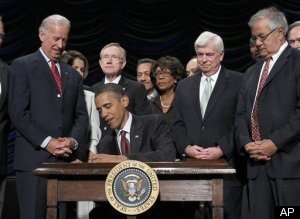
 President Obama signed into law on Wednesday a sweeping expansion of federal financial regulation, marking another — and perhaps last — major legislative victory before the midterm elections in November, which could recast the Congressional landscape.

The signature achievement — a response to the 2008 financial crisis that fundamentally alters the relationship between Wall Street and the federal officials charged with regulating it — is a culmination of two years of fierce lobbying and intense debate over how to deal with the financial excesses that tipped the nation into the worst recession since the Great Depression.

The law subjects more financial companies to federal oversight, regulates many derivatives contracts and creates a panel to detect risks as well as a consumer protection regulator. A number of the details have been left for regulators to work out, inevitably setting off complicated tangles down the road that could last for years.

Obama Financial Reform

Mr. Obama took pains to try to show how the complex legislation, with is dense pages on derivatives practices, will protect ordinary Americans.

“If you’ve ever applied for a credit card, a student loan, or a mortgage, you know the feeling of signing your name to pages of barely understandable fine print,” Mr. Obama said. “But what often happens as a result, is that many Americans are caught by hidden fees and penalties, or saddled with loans they can’t afford.”

He said the law would crack down on abusive practices in the mortgage industry, simplifying contracts and ending hidden fees and penalties, “so folks know what they’re signing.”

So what exactly is in the bill?  According to a summary in the Christian Science Monitor

A bill summary by Capitol Hill staff members includes 100 points. Here’s a shorter take, 10 points, focusing on less-publicized elements as well as some core provisions:

• A first-ever federal office focused on the insurance industry will monitor the insurance industry for systemic risk. The industry will remain regulated largely at the state level.

• FDIC deposit insurance for account-holders at banks, thrift institutions, and credit unions will be raised to $250,000 (from $100,000) retroactive to Jan. 1, 2008.

• The State Department would have to submit an “illicit minerals trade strategy” for the Congo region. Manufacturers that use minerals originating in the Democratic Republic of Congo would have to disclose measures taken to exercise due diligence on the source and chain of custody of the materials. The provision, sponsored by Sen. Sam Brownback (R) of Kansas, could affect high-tech firms like Intel and Apple.

• The bill beefs up the powers of the Securities and Exchange Commission, including extra funds for enforcement. The SEC would get new power to impose fiduriary responsibility on investment brokers. That means the brokers would have to offer advice based on the best interest of clients, not broker fees. Consumer advocates say the bill should have mandated this change, not allowed the SEC to consider it.

• New disclosure rules would apply to credit-rating firms, along with new penalties if the firms are irresponsible. In a nod to an amendment backed by Sen. Al Franken (D) of Minnesota, the bill seeks to end “shopping for ratings” by calling for the SEC to propose ways to prevent issuers of asset-backed securities from picking the firm they think will give the highest rating.

• Shareholders would get a “say on pay,” with the right to a nonbinding vote on executive pay and golden parachutes. Standards for listing on an exchange would require that compensation committees include only independent directors.

• Reforms would reshape Federal Reserve powers, including a ban on Fed bailouts targeted at specific firms (like AIG) in the future. The presidents of regional Fed banks would be selected entirely by directors representing the public, and not partly by directors representing banks that the Fed regulates.

• The bill creates a new Consumer Financial Protection Bureau to consoldiate duties now charged to various federal agencies. It would have a consumer hot line, for questions on things like mortgages, and a new office of financial literacy.

• A Financial Stability Oversight Council of top economic regulators will monitor systemwide risks. The bill summary says this group will ask the Federal Reserve to adopt “increasingly strict rules for capital, leverage, liquidity, risk management and other requirements as companies grow in size and complexity.”

• An “orderly liquidation” mechanism would allow the Federal Deposit Insurance Corp. (FDIC) to dismantle large financial companies that are on the brink of failure. Shareholders and unsecured creditors would bear losses, to end taxpayer bailouts. But the bill also allows the FDIC to shelter solvent banks from having to bear losses if there is a threat to overall US financial stability

Thank you to Barney Frank, Chris Dodd, Olympia Snowe, Susan Collins and Scott Brown and all the Democrats except Ben Nelson we have a start and reining in the runway, unregulated financial system.

Talking jobs and unemployment

Today I went to a graduation for 58 men and women – almost all over 3o – who went to a program at the local YMCA to sharpen skills and make them more competitive in the job market.  I shared an intern with several others in my agency.  It was announced that 8 or 9 had found jobs.  Not bad in this market, but not good either. 

Last week the Boston Globe ran a story about the report by the National Skills Coalition. 

The report projects that by 2016, Massachusetts will have nearly 400,000 job openings that require more than a high school diploma, but less than a four-year college degree. The report says “middle-skill” jobs will account for 38 percent of all openings.

Ranging from licensed practical nurses to computer support specialists, the jobs have median annual incomes of about $50,000 to $55,000.

The report says the state faces challenges in meeting the demand for middle-skilled workers, with only 32 percent of current employees having the credentials.

The graduation I attended was designed to train people for these middle-skill jobs.  But until the jobs are created, the graduates still need to pay the rent, the mortgage, buy food and clothes.  These are men and women who are doing the rights things and are still finding it tough to find a job.  Some of them were unemployed before entering the program and some will be unemployed after graduation.  Some may be eligible for unemployment benefits, but may have exhausted their time.  Which brings me to the unemployment benefits issue.

Let’s start with Paul Krugman.

There was a time when everyone took it for granted that unemployment insurance, which normally terminates after 26 weeks, would be extended in times of persistent joblessness. It was, most people agreed, the decent thing to do.

But that was then. Today, American workers face the worst job market since the Great Depression, with five job seekers for every job opening, with the average spell of unemployment now at 35 weeks. Yet the Senate went home for the holiday weekend without extending benefits. How was that possible?

The answer is that we’re facing a coalition of the heartless, the clueless and the confused. Nothing can be done about the first group, and probably not much about the second. But maybe it’s possible to clear up some of the confusion.

So who are the heartless?  They are Republicans and some Democrats a tiny number of whom may be acting out of principle.  They hide behind the deficit and statements from the clueless.

By the clueless I mean people like Sharron Angle, the Republican candidate for senator from Nevada, who has repeatedly insisted that the unemployed are deliberately choosing to stay jobless, so that they can keep collecting benefits. A sample remark: “You can make more money on unemployment than you can going down and getting one of those jobs that is an honest job but it doesn’t pay as much. We’ve put in so much entitlement into our government that we really have spoiled our citizenry.”

Now, I don’t have the impression that unemployed Americans are spoiled; desperate seems more like it. One doubts, however, that any amount of evidence could change Ms. Angle’s view of the world — and there are, unfortunately, a lot of people in our political class just like her.

And then Krugman tackles the misinformed.

But there are also, one hopes, at least a few political players who are honestly misinformed about what unemployment benefits do — who believe, for example, that Senator Jon Kyl, Republican of Arizona, was making sense when he declared that extending benefits would make unemployment worse, because “continuing to pay people unemployment compensation is a disincentive for them to seek new work.” So let’s talk about why that belief is dead wrong.

Do unemployment benefits reduce the incentive to seek work? Yes: workers receiving unemployment benefits aren’t quite as desperate as workers without benefits, and are likely to be slightly more choosy about accepting new jobs. The operative word here is “slightly”: recent economic research suggests that the effect of unemployment benefits on worker behavior is much weaker than was previously believed. Still, it’s a real effect when the economy is doing well.

But it’s an effect that is completely irrelevant to our current situation. When the economy is booming, and lack of sufficient willing workers is limiting growth, generous unemployment benefits may keep employment lower than it would have been otherwise. But as you may have noticed, right now the economy isn’t booming — again, there are five unemployed workers for every job opening. Cutting off benefits to the unemployed will make them even more desperate for work — but they can’t take jobs that aren’t there.

Will extending benefit add the to deficit?  Krugman tackles this one also.

But won’t extending unemployment benefits worsen the budget deficit? Yes, slightly — but as I and others have been arguing at length, penny-pinching in the midst of a severely depressed economy is no way to deal with our long-run budget problems. And penny-pinching at the expense of the unemployed is cruel as well as misguided.

But is being against extending benefits a political plus?  Not according to two new polls out today.  According to the New York Times story in the Caucus both a CBS News and a ABC News/Washington Post poll found the majority of those surveyed believed that Congress should extend benefits.

In the CBS News survey, 52 percent of respondents said Congress should extend unemployment benefits for people currently out of work, even if it meant increasing the budget deficit. Thirty-nine percent disagreed, and the rest said “it depends” or gave no opinion.

Broken down by party affiliation, about 7 in 10 Democrats said they supported an extension, while most Republicans said they opposed it. Independents were more evenly divided, with 47 percent in favor and 42 percent opposed.

The ABC News/Washington Post poll asked the question a little differently, and found even more support for an extension of unemployment benefits. The question noted that Congress had previously extended benefits because of the economic downturn, and was considering extending them again. It also presented capsules of each side of the debate, noting that supporters of the extension say it “will help those who can’t find work” while opponents say it “adds too much to the federal budget deficit.”

The result: 62 percent of respondents said Congress should approve another extension, while 36 percent said it should not. Those in favor included 80 percent of Democrats and 59 percent of independents, as well as 43 percent of Republicans.

So there doesn’t seem to be a lot of gain in opposition.

Standing with three Americans who have struggled to find work, President Obama spoke in the Rose Garden about the need to extend unemployment benefits.

The last word goes to the President.

Under pressure in an election year to reduce the unemployment rate, now at 9.5 percent, Mr. Obama also urged the Senate to approve a package of tax cuts and an expansion of lending to small businesses. “We all have to continue our efforts to do everything in our power to spur growth and hiring,” Mr. Obama said at the White House.

Mr. Obama, appearing before reporters in the Rose Garden flanked by three Americans who have had difficulty finding work, took aim at that argument. “That attitude reflects a lack of faith in the American people,” Mr. Obama said. “They’re not looking for a handout. They desperately want to work.”

Mr. Obama sharply criticized Republicans who have several times in the past month voted against bringing an unemployment extension bill to the Senate floor.

“After years of championing policies that turned a record surplus into a massive deficit, the same people who didn’t have any problem spending hundreds of billions of dollars on tax breaks for the wealthiest Americans are now saying we shouldn’t offer relief to middle-class Americans like Jim or Leslie or Denise, who really need help,” Mr. Obama said, referring to the three people who stood with him in the Rose Garden, brought to Washington by the White House to help illustrate the president’s point.

The Bill will pass this week, probably without Republican support, after we get the new temporary Senator from West Virginia, Carte Goodwin. 


The politics of Presidential vacations

If we want to go away for a long weekend, Bob and I just pick the place and book a place to stay or more likely, just tell my sister we are coming up to Vermont.  No politics involved.  But where and for how long a President vacations becomes grist for the political mill.

The Obamas walked along a trail with their daughters Sasha, left, and Malia on Cadillac Mountain.

The first family picked Bar Harbor, Maine and Acadia National Park.  But the big flap is that they didn’t go to the Gulf.

In a New York Times “White House Memo”, Sheryl Gay Stolberg wrote

Mr. Obama arrived here Friday for a summer weekend getaway with his wife, Michelle, and their daughters, Malia, 12, and Sasha, 9 — a precursor to a longer family vacation they are planning next month on Martha’s Vineyard. But what sounds like a much-needed family escape from the literal and political heat of Washington to some sounds like hypocrisy to others, given recent statements by both the president and first lady urging Americans to spend their vacation time and money along the shores of the oil-stricken Gulf of Mexico.

“Michelle Obama: Take your Vacation in the Gulf, America — If You Need Us, We’ll be In Maine,” blared the headline on the Web site of Michelle Malkin, the conservative commentator, on Monday, the day Mrs. Obama toured the gulf. ABC News served up similar, if more muted fare: “First Lady Encourages Americans to Vacation on Gulf — But Obamas Head to Maine Instead.”

A trip to the Gulf Coast, of course, would hardly be much of a vacation for Mr. Obama, whose political fortunes were undercut by the spill. But the flap does point up how politically fraught the modern presidential vacation — or, for that matter, presidential leisure time in general — has become.

Of course, if they did go to the Gulf Coast for a vacation scheduling no public events, everyone would be upset by their not having helped clean up a beach or visiting fishermen who are not working because of the spill.  It would not, as the Memo points out, have been a vacation.  This is a trip with their children, Ms. Malkin.  Remember family values?   Both the President and First Lady have gone often to the Gulf and they will be returning many times, I’m sure.

The Memo continues

Bill Clinton and his family traveled to Jackson Hole, Wyo., in the summer of 1996 after polling showed that Americans viewed Martha’s Vineyard as too elitist. George W. Bush caught so much flak for spending a month at his ranch in Crawford, Tex., in the summer of 2001, said his former press secretary, Ari Fleischer, that his staff printed T-shirts listing all the work-related side trips he had taken. Mr. Fleischer may disagree with Mr. Obama’s policies, but he said he was protective of the president’s right to “recharge his batteries” wherever it suited him.

“I just think that people should leave the president alone and not make a political issue of where he takes vacation or how he takes vacation,” Mr. Fleischer said. “He and his family are perfectly entitled to do whatever works for them.”

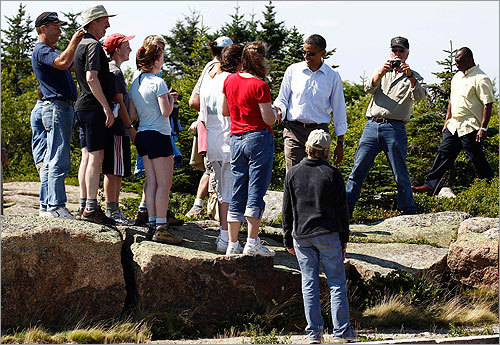
President Obama greeted people after walking along a trail on Cadillac Mountain.

One thing I have noticed is that President Obama likes ice cream.  He seem to gravitate to ice cream shops wherever he goes.

Once last thing:  While looking through  pictures of the trip to put in this entry, I kept  spotting Reggie Love.  Does he ever get to go on a vacation by himself? 

The pictures are from the Boston Globe and the New York Times.

Keeping the Faith

I’ve been thinking about the mid-term elections a lot recently.  With financial reform and health care reform passed, President Obama has kept two big promises.  Of course, neither bill is perfect.  But both are steps in the right direction.  So when his poll numbers go down anyway and the pundits think mid-term election disaster it is hard to keep the faith.  In this connection, I’m looking at a piece from last Sunday’s Boston Globe and Paul Krugman’s New York Times column from yesterday.

The Globe article by Joe Keohane in the Ideas section was titled “How Facts Backfire”  and the role factual information plays in a democracy.  It was pretty bleak and discouraging.

It’s one of the great assumptions underlying modern democracy that an informed citizenry is preferable to an uninformed one. “Whenever the people are well-informed, they can be trusted with their own government,” Thomas Jefferson wrote in 1789. This notion, carried down through the years, underlies everything from humble political pamphlets to presidential debates to the very notion of a free press. Mankind may be crooked timber, as Kant put it, uniquely susceptible to ignorance and misinformation, but it’s an article of faith that knowledge is the best remedy. If people are furnished with the facts, they will be clearer thinkers and better citizens. If they are ignorant, facts will enlighten them. If they are mistaken, facts will set them straight.

Maybe not. Recently, a few political scientists have begun to discover a human tendency deeply discouraging to anyone with faith in the power of information. It’s this: Facts don’t necessarily have the power to change our minds. In fact, quite the opposite. In a series of studies in 2005 and 2006, researchers at the University of Michigan found that when misinformed people, particularly political partisans, were exposed to corrected facts in news stories, they rarely changed their minds. In fact, they often became even more strongly set in their beliefs. Facts, they found, were not curing misinformation. Like an underpowered antibiotic, facts could actually make misinformation even stronger.

This bodes ill for a democracy, because most voters — the people making decisions about how the country runs — aren’t blank slates. They already have beliefs, and a set of facts lodged in their minds. The problem is that sometimes the things they think they know are objectively, provably false. And in the presence of the correct information, such people react very, very differently than the merely uninformed. Instead of changing their minds to reflect the correct information, they can entrench themselves even deeper.

“The general idea is that it’s absolutely threatening to admit you’re wrong,” says political scientist Brendan Nyhan, the lead researcher on the Michigan study. The phenomenon — known as “backfire” — is “a natural defense mechanism to avoid that cognitive dissonance.”

Paul Krugman wrote Friday about the Republicans proposed economic plan.  Basically tax cuts for the rich and nothing for the rest of us according to Krugman.

Republicans are feeling good about the midterms — so good that they’ve started saying what they really think. This week the party’s Senate leadership stopped pretending that it cares about deficits, stating explicitly that while we can’t afford to aid the unemployed or prevent mass layoffs of schoolteachers, cost is literally no object when it comes to tax cuts for the affluent

And that’s one reason — there are others — why you should fear the consequences if the G.O.P. actually does as well in November as it hopes.

For a while, leading Republicans posed as stern foes of federal red ink. Two weeks ago, in the official G.O.P. response to President Obama’s weekly radio address, Senator Saxby Chambliss devoted his entire time to the evils of government debt, “one of the most dangerous threats confronting America today.” He went on, “At some point we have to say ‘enough is enough.’ ”

But this past Monday Jon Kyl of Arizona, the second-ranking Republican in the Senate, was asked the obvious question: if deficits are so worrisome, what about the budgetary cost of extending the Bush tax cuts for the wealthy, which the Obama administration wants to let expire but Republicans want to make permanent? What should replace $650 billion or more in lost revenue over the next decade?

His answer was breathtaking: “You do need to offset the cost of increased spending. And that’s what Republicans object to. But you should never have to offset the cost of a deliberate decision to reduce tax rates on Americans.” So $30 billion in aid to the unemployed is unaffordable, but 20 times that much in tax cuts for the rich doesn’t count.

The next day, Mitch McConnell, the Senate minority leader, confirmed that Mr. Kyl was giving the official party line: “There’s no evidence whatsoever that the Bush tax cuts actually diminished revenue. They increased revenue, because of the vibrancy of these tax cuts in the economy. So I think what Senator Kyl was expressing was the view of virtually every Republican on that subject.”

The Republicans seem to be making it pretty clear that they want to go back to the old economic way.  Krugman continues

But we’re talking about voodoo economics here, so perhaps it’s not surprising that belief in the magical powers of tax cuts is a zombie doctrine: no matter how many times you kill it with facts, it just keeps coming back. And despite repeated failure in practice, it is, more than ever, the official view of the G.O.P.

Why should this scare you? On paper, solving America’s long-run fiscal problems is eminently doable: stronger cost control for Medicare plus a moderate rise in taxes would get us most of the way there. And the perception that the deficit is manageable has helped keep U.S. borrowing costs low.

But if politicians who insist that the way to reduce deficits is to cut taxes, not raise them, start winning elections again, how much faith can anyone have that we’ll do what needs to be done? Yes, we can have a fiscal crisis. But if we do, it won’t be because we’ve spent too much trying to create jobs and help the unemployed. It will be because investors have looked at our politics and concluded, with justification, that we’ve turned into a banana republic.

Krugman also looks at the facts

…But the real news here is the confirmation that Republicans remain committed to deep voodoo, the claim that cutting taxes actually increases revenues.It’s not true, of course. Ronald Reagan said that his tax cuts would reduce deficits, then presided over a near-tripling of federal debt. When Bill Clinton raised taxes on top incomes, conservatives predicted economic disaster; what actually followed was an economic boom and a remarkable swing from budget deficit to surplus. Then the Bush tax cuts came along, helping turn that surplus into a persistent deficit, even before the crash.

So the facts seem to be higher taxes on higher incomes results in lower deficits and more economic benefit for the rest of us.  But if we believe Joe Keohane, the facts don’t matter much to those that have settled beliefs.

…Most of us like to believe that our opinions have been formed over time by careful, rational consideration of facts and ideas, and that the decisions based on those opinions, therefore, have the ring of soundness and intelligence. In reality, we often base our opinions on our beliefs, which can have an uneasy relationship with facts. And rather than facts driving beliefs, our beliefs can dictate the facts we chose to accept. They can cause us to twist facts so they fit better with our preconceived notions. Worst of all, they can lead us to uncritically accept bad information just because it reinforces our beliefs. This reinforcement makes us more confident we’re right, and even less likely to listen to any new information. And then we vote.

This effect is only heightened by the information glut, which offers — alongside an unprecedented amount of good information — endless rumors, misinformation, and questionable variations on the truth. In other words, it’s never been easier for people to be wrong, and at the same time feel more certain that they’re right.

So how exactly do the Democrats combat all the Republican nonsense?  Not only the Kyl and McConnell quotes that Krugman mentions, but also statements that if the Republicans take over during the mid-terms they will repeal the health and financial reforms.  They know very well that if they try, there will be a Presidential veto and that they will not be able to keep that promise, but despite that fact, they will be believed.  Keohane discusses a number of studies and possibilities but the most immediate solution to this problem seems to be increasing self-esteem.

One avenue may involve self-esteem. Nyhan worked on one study in which he showed that people who were given a self-affirmation exercise were more likely to consider new information than people who had not. In other words, if you feel good about yourself, you’ll listen — and if you feel insecure or threatened, you won’t. This would also explain why demagogues benefit from keeping people agitated. The more threatened people feel, the less likely they are to listen to dissenting opinions, and the more easily controlled they are.

Increasing the self-esteem of the American electorate right now means creating jobs and making some radical moves on the economy.  Some of the benefits of the reforms will also begin to impact voters by fall.

The Democrats should take Eugene Robinson’s advice on Keith Olbermann’s Countdown last night. 

I mean it’s not like the Democrats don’t have something to run on this fall. So get out there and run on it.

Gene also said in a recent column in the Washington Post

One reason I’m not so confident of a Republican blowout in the fall is that while polls clearly show that the country is in an anti-incumbent mood, there’s also considerable evidence that people see the GOP as part of the problem, not part of the solution. A new Post-ABC News poll, for example, showed that 58 percent of voters have “just some” confidence, or even less, in President Obama’s leadership, and that 68 percent were similarly doubtful about the ability of congressional Democrats to lead. But 72 percent had little or no faith in congressional Republicans — which suggests to me that the GOP has work to do before its leaders start picking out new office suites in the Capitol.

Another reason for caution is that the Republican Party is out of step with the American public on so many issues. Americans want to see unemployment benefits extended. They want tougher financial regulation, complete with consumer protections. Even health-care reform, which the GOP succeeded in painting as the apocalypse, becomes more popular as the months pass and somehow the world does not end.

I have to believe that there is a large portion of the American electorate that can be swayed by facts.  And the ray of hope is in the slide that Olbermann showed with the results of the NBC/Wall Street Journal Poll which indicates that the majority would like more, not less regulation of Wall Street, big business, the health care industry and, by a big margin, the oil industry.  They won’t get that from the Republicans who want a moratorium on regulation.

Queen Elizabeth at the United Nations

On July 6, Queen Elizabeth addressed the General Assembly of the United Nations for eight minutes.  The speech received little of no attention and I wouldn’t even have known about it until I read the most recent Newsweek and Jon Meacham’s very interesting thoughts on the speech.

Queen Elizabeth

First from the New York Times

Queen Elizabeth II addressed the United Nations for the first time since 1957 on Tuesday, paying homage to the organization’s accomplishments since she last stood at the famous green podium of the General Assembly.

It was a brief speech (see text), just eight minutes, assuring that  the queen’s remarks would not join the annals of infamous harangues from the podium delivered by long-reigning leaders like Muammar al-Qaddafi, who spoke for more than 90 minutes last fall, or Fidel Castro of Cuba. It was the first of three public visits during the queen’s daylong stop in New York City.

On her first visit, just four years after she took the throne, the queen came gliding into the United Nations in a black slip dress (or at least it looked black in the rapturous newsreels about the visit), high heels and a fur wrap. There was definitely no need for the fur wrap in the suffocating July heat on Tuesday — the queen wore a flowered suit and a curvy, elegant hat.

If the monarch, now 84, did not exactly sweep through the hall with the same grace as her 31-year-old self, the United Nations building itself looked rather more tattered, only now undergoing its first renovations since it was built around 1950.

So what did Jon Meacham make of the speech?

Given her audience and the constitutional restraints on her role—the personification of political life, she must be above politics—Elizabeth’s brief address could be read as an exercise in ceremonial conventionality. Yet her little-noted remarks offer a meditation on globalism and post-imperialism from a woman whose ancestors ruled much of the world. For American conservatives who worry that President Obama (or, really, any Democratic president) veers dangerously close to “one worldism,” the queen’s speech in New York serves as an inadvertent endorsement of a habit of mind in which power, both military and economic, is best exercised cooperatively rather than coercively. Saluting the U.N.’s diplomatic and relief work, she specifically cited the challenges of terrorism and climate change; the latter is of special concern, she said, for a “careful account must be taken of the risks facing smaller, more vulnerable countries, many of them from the Commonwealth.”

Meacham continues

What she takes very seriously—and I use that “very” advisedly—is the British Commonwealth, the loose association of 54 countries of which she is the titular head. There is no single superpower in her realm; she came to the throne in 1952 in the aftermath of World War II, a conflict in which the U.K. saved freedom but lost an empire. She has spent the last half century offering the Commonwealth a kind of subtle but steady rhetorical leadership—not unlike that provided by the U.N.

In a world of asymmetrical threats—terror, nuclear proliferation, disease, poverty, and climate change—multilateralism is not, to borrow an image from Richard Haass of the Council on Foreign Relations, a policy of choice but of necessity. This does not mean America ought to go limp. Quite the opposite, in fact: the projection of our strength is magnified when we project it in concert with allies, whether through the U.N., NATO, or some provisional force created for a given military or policy purpose.

Foreign-policy doctrines are, in my view, chiefly useful in retrospect, not in real time, for the making of policy is almost always provisional, subject to the forces and the exigencies of a given moment. Which is why if we have to go it alone, we will. We learned how from Elizabeth’s first prime minister, Winston Churchill. But those hours will prove the exception, not the rule.

The rule is a world like Elizabeth’s Commonwealth. And the work endures. Quoting the late U.N. secretary-general Dag Hammarskjöld, the queen said, “ ‘Constant attention by a good nurse may be just as important as a major operation by a surgeon.’ Good nurses get better with practice; sadly, the supply of patients never ceases.”

This quote from Queen Elizabeth sums up what she believes and what I think Barack Obama’s view of diplomacy comes close to

It has perhaps always been the case that the waging of peace is the hardest form of leadership of all.  I know of no single formula for success, but over the years I have observed that some attributes of leadership are universal, and are often about finding ways of encouraging people to combine their efforts, their talents, their insights, their enthusiasm and their inspiration, to work together.

I have to think that the conservative, George W. Bush/Dick Cheney/Tea Party view of the world where the United States is the ultimate power and can just tell other countries what is going to happen is rapidly becoming outdated.  The world is becoming a large democracy with everyone needing to have a say.  We need to listen to the Queen and work together.

Bob Smith, White House Piano Man

Politico.com had this great human interest piece today about Bob Smith who first played at the White House for Richard Nixon, but retired before George W. 

According to Politico

Former White House pianist Bob Smith provided entertainment to presidents, their spouses and guests for more than 30 years. As such, he has plenty of stories to tell — like the one from his White House debut, with the Army Band Chorus, at Tricia Nixon’s 1971 St. Patrick’s Day engagement party. “My Three Sons” star Fred MacMurray arrived at the event seemingly inebriated and took up the saxophone. 

 “He was just horrible. … The most awful thing you heard in your life,” Smith recalled. President Richard Nixon asked Smith to “get rid of him,” and Smith, with help from the Secret Service, complied.

Bob Smith plays the piano.

Made official White House pianist,

…First lady Pat Nixon, Smith said, used to bypass protocol and call him directly on his home phone to ask him personally to play various events—from background music at cocktail parties and receptions, to sitting in as accompanist to a hired musical act.

He later played for and with the Clintons and Gores

Later, he got along great with the Clintons. He and the president bonded over their shared love of playing music. Smith recalled several duets he played with Clinton on sax, an instrument “that was always in reaching distance” of the president.

 He was in with the Gores, too.

 “So while I’m doing saxophone things with [Clinton] at the White House, I’d go over to the vice president’s house, [where] Tipper Gore had her drum set set-up outside in the living room next to the grand piano. She’d come over and say, ‘Can I sit in?,’” Smith recalled. Tipper Gore was a “very good player,” he said.

Over the years, Smith also had numerous interactions with celebrity White House visitors, including Audrey Hepburn and Lena Horne, who sang along while he played. Cary Grant once skipped out of a White House dinner to sit outside the dining room at the piano with Smith. At the actor’s request, Smith said, the two played Cole Porter songs for over an hour.

But the reason he retired is one of the most interesting parts of the story

Smith decided to retire when the Clintons moved out of the White House because, after playing for Bush 41 and spending time with the Bush family, he preferred leave before Bush 43 moved in.

 President George H.W. Bush “was very cool,” Smith said. “But there were too many times where I saw [his son, President George W. Bush,] over that time where he was less than statesmanlike,” he laughed.

Maybe the Obamas should get him out of retirement.


Diversity in the making

I am often amazed when I ride the T at the variety of languages I hear.  I can’t identify them all, but a lot of students will mix in American Slang.  In my office people speak Korean, Spanish, Turkish, Chinese and Vietnamese and I speak a little Japanese.  On my own staff I have Turkish and Spanish.  This is the new Boston.

In the Boston Globe this morning was a story about 27 people who became citizens yesterday on the U.S.S. Constitution.

Yesterday, on the deck of the world’s oldest commissioned warship that is still afloat, on the birthday of the country, the country’s newest citizens — 17 women and 10 men from 20 countries — were the guests of honor. They included a young Moroccan woman who won a visa through the green card lottery and now works as a housekeeper in a Boston hotel; a Brazilian woman from Medford who just finished basic training in the Army National Guard; a Wellesley College human rights leader and Harvard Law School graduate from Sri Lanka; and a husband and wife, born in India, who met at the University of Southern California and now live with their son in Newton.

The immigrants came from Barbados, Brazil, Cameroon, Cape Verde, China, France, Guyana, India, Ireland, Indonesia, Kenya, Liberia, Malaysia, Morocco, Mexico, Nigeria, Russia, Somalia, Sri Lanka, and the United Kingdom.

Lianne Smith and Luke Wanami, who just became a US citizen, left the USS Constitution after the ceremony yesterday.

I know that many people are opposed to immigration reform.  And I don’t deny that these 27 did things right.  But there are many children of illegals who should be granted citizenship if they will serve in the military, the Peace Corps, City Year or go to college.  What the new citizens from the Constitution achieved yesterday, needs to be available to many more.

The State of the Obama Presidency

All of our expectations were so high when Barack Obama took office 18 months ago.  He was going to fix the economy, end the wars in Iraq and Afganistan, give us health care reform, fix the schools, walk on water….

After 8 years of George W. and after the wasted Clinton years, we progressives were ready.  So where are we now?  This Doonesbury cartoon says its all.

We are like his kids and think he can do anything.  Unfortunately, there is the Senate to deal with and the fall elections which still look difficult for the Democrats.  I’m hoping they can just hang on to enough seats to keep control and Obama’s agenda has a fighting chance.

The Supreme Court, Baseball and Elena Kagan

Back in April in one of my last posts, I wrote about the Supreme Court.  Today, nominee Elena Kagan responded to questions about Chief Justice John Roberts’ metaphor that being judges is like being umpires.

According to Political.com

Supreme Court nominee Elena Kagan on Wednesday gently criticized Chief Justice John Roberts’s hotly debated assertion that a Supreme Court justice’s job is “to call balls and strikes” like an umpire, suggesting the description may have misled the public about the work judges do.

 “The metaphor might suggest to some people that law is a kind of robotic enterprise, that there’s a kind of automatic quality to it, that it’s easy, that we just sort of stand there and, you know, we go ball and strike, and everything is clear-cut, and that there is no judgment in the process. And I do think that that’s not right,” Kagan said in response to a question from Sen. Amy Klobuchar (D-Minn.) “It’s especially not right at the Supreme Court level where the hardest cases go and the cases that have been the subject of most dispute go.”

 Kagan went on to imply that Roberts may have downplayed the degree to which judging requires perspective.

 “Judges do, in many of these cases, have to exercise judgment. They’re not easy calls. That doesn’t mean that they’re doing anything other than applying law,” Kagan said. “But we do know that not every case is decided 9-0, and that’s not because anybody’s acting in bad faith. It’s because those legal judgments are ones in which reasonable people can reasonably disagree sometimes. And so in that sense, law — law does require a kind of judgment, a kind of wisdom.”

 Her mild criticism of Roberts was a notable departure for Kagan, who has studiously declined senators’ repeated invitations to discuss her opinions on previous Supreme Court’s decisions or to cast aspersions on the motivations or analytical techniques of the justices.

The hearings have turned into a discussion about what an activist judge looks like.  Is it Justice Thurgood Marshall as some Republicans tried to say an activist judge?  And if he is Elana Kagan will be the same because she clerked for him and will somehow channel him.

Supreme Court nominee Elena Kagan has come under an unusual line of attack from Republicans on the Senate Judiciary Committee. The Senators are going after Kagan’s 1988 clerkship for former Supreme Court Justice Thurgood Marshall, the first-ever African American justice, who retired in 1991 after helping to bring the court through some of the biggest civil-rights cases in its history. Some Republicans are taking this as an opportunity not only to put Marshall on trial but also make Kagan the chief witness. Here’s what’s happening, why, and what it means.

  • Going After Thurgood Marshall The Washington Post’s Dana Milbank reports, “‘Justice Marshall’s judicial philosophy,’ said Sen. Jon Kyl (Ariz.), the No. 2 Republican in the Senate, ‘is not what I would consider to be mainstream.’ Kyl — the lone member of the panel in shirtsleeves for the big event — was ready for a scrap. Marshall ‘might be the epitome of a results-oriented judge,’ he said. Sen. Jeff Sessions (Ala.), the ranking Republican on the panel, branded Marshall a ‘well-known activist.’ Sen. Chuck Grassley (R-Iowa) said Marshall’s legal view ‘does not comport with the proper role of a judge or judicial method.’ Sen. John Cornyn (R-Tex.) pronounced Marshall ‘a judicial activist’ with a ‘judicial philosophy that concerns me.'”
  • Making Everything About Marshall Talking Points Memo’s Christina Bellantoni reports, “Ranking member Sen. Jeff Sessions (R-AL) criticized Kagan for having ‘associated herself with well-known activist judges who have used their power to redefine the meaning of our constitution and have the result of advancing that judge’s preferred social policies,’ citing Marshall as his son, Thurgood Marshall Jr., sat in the audience of the Judiciary Committee hearings. In an example of how much the GOP focused on Marshall, his name came up 35 times.”

Of course, I think, along with Senators Al Franken,  Patrick Leahy and many others that actually the Roberts’ Court is the activist court.

When Judiciary Committee Chairman Patrick Leahy called on Franken, Minnesota’s junior Senator got right to his criticism that the current Supreme Court has been favoring powerful corporate interests over the rights of individuals.

Franken talked about how he believes that mandatory arbitration clauses strip Americans of the right to have grievances heard in a neutral court.

“Do you still agree … that one of the glorious things about courts is that they provide a level playing field in all circumstances?” he asked Kagan.

She replied that she agreed “very strongly” with Franken.

Democrats have accused the court — led by Chief Justice John Roberts — of overstepping its role by establishing policy rather than interpreting the law. Franken has been outspoken on the issue. In his time with Kagan, Franken was sharply critical of Chief Justice Roberts.

He accused Roberts and other justices of judicial activism that contradicted their own stated tenets. Franken cited the campaign finance case “Citizens United” as an example of the Robert’s court going beyond specific questions before it.

The landmark ruling this year determined that corporate funding of political broadcasts cannot be limited. It stemmed from a case of a non-profit corporation airing a film critical of Hillary Clinton.

The New York Times reported

Indeed, Ms. Kagan was unusually expansive when talking about matters in which she is already on record. She volunteered that she is not morally opposed to the death penalty, a position she took when she was confirmed as solicitor general. And she spoke freely about this year’s ruling in Citizens United v. Federal Election Commission, in which the conservative bloc on the court ruled against her, striking down legal limits on corporate spending to influence elections.

Democrats have portrayed that ruling as “conservative judicial activism.” Ms. Kagan — who as solicitor general argued in defense of the campaign finance rules — said she convinced herself in preparing that “we had extremely strong arguments.”

Ms. Kagan also displayed a bit of her law professor side, talking more extensively about abstract issues like how constitutional law develops over time. In a mild challenge to the conservative view that the Constitution can be interpreted based only on the original meaning of its text, she said there were also instances in which the Supreme Court had applied a principle embedded in the Constitution in a new way.

She cited the 1954 case of Brown v. Board of Education, which struck down segregation in schools. The case relied upon the 14th Amendment’s guarantee of equal protection of the laws, yet Ms. Kagan noted that the amendment’s drafters thought it “perfectly consistent with segregated schools.”

Justice Thurgood Marshall, who as a lawyer argued the Brown case, has emerged as a dominant figure in the hearings. Ms. Kagan clerked for him, and Republicans, led by Senator Jon Kyl of Arizona, have attacked Justice Marshall as a liberal “activist” and expressed concerns about Ms. Kagan’s association with him.

On Tuesday, Ms. Kagan told Mr. Kyl that she was not her former boss. “I love Justice Marshall,” she said. “He did an enormous amount for me, but if you confirm me to this position, you’ll get Justice Kagan, you won’t get Justice Marshall. And that’s an important thing.”

I think that Elena Kagan is doing her best to criticize the Republicans and the current conservatives on the Supreme Court as she can without antagonizing her future colleagues.  She isn’t a “progressive activist” (whatever that is), but I think she is smart enough and diplomatic enough to get Justice Kennedy’s vote and maybe even Justice Alito’s vote.