Crazy state gun laws

Dylan Matthews posted this today on Ezra Klein’s Wonkblog.  He lists the 6 craziest.  I will talk about the craziest of the craziest, but the entire list is worth reading.

Concealed carry at 16 — with no permit: Most states that allow people to carry a concealed weapon on their person require gun owners to obtain a permit before doing so. But four states — Alaska, Arizona, Wyoming and Vermont — allow concealed carry without any permit. That means, the Brady Campaign’s Brian Malte tells me, that Jared Loughner was in full compliance with Arizona law up until the moment he used his concealed weapons to kill six people and severely injure Rep. Gabrielle Giffords.

Vermont, however, stands out from the pack because it allows people as young as 16 to conceal carry without parental permission, as well as buy handguns. So a Vermont teenager aged 16 can’t legally go to an R-rated movie alone or join the military, but he can buy a handgun and carry it in his jeans and be completely within the limits of the law.

I have family who have lived in Vermont for years.  My husband lived there for a while.  Who knew?

Property rights end where gun rights begin: According to the Law Centerto Prevent Gun Violence, 17 states, including Oklahomaand Florida, bar employers from preventing their employees from bringing
guns to work and keeping them locked in their vehicles, even if those vehiclesare on the property of the employer. Indiana and North Dakota allowemployees to sue their employers for damages if asked about gun possession. TheNorth Dakota statue specifically bars employers from asking if employees’
vehicles parked on company property have weapons in them. Georgia bars employersfrom making employment conditional on not bringing guns to work.

So when you have to discipline an employee they can go out to their car at lunch or break and come back and shoot you.  This is very rational – not!

Open carry without a permit: Most legal disputes around carrying gunsin public involved concealed carry. But open carry, which is arguably morethreatening to surrounding community members, is largely unregulated.
Thirty-five states allow open carry of handguns without a permit, while only three (plus the District of
Columbia) ban it outright. Forty-seven states plus the District allow open carryof long guns (that is, rifles or shotguns) in public, while only three ban it.

I guess it is better to know the guy next to you at the local bar is carrying so you can avoid arguments about the Red Sox and Yankees.

Members of the Virginia Citizens Defense League gather in July 2010 to celebrate
a new law permitting open carry of guns in bars. (Dayna Smith/For The Washington
Post)

Guns at schools: In 2010, Kansas passed a law allowing the concealed carry of guns in K-12 schools, in violation of the federal Gun-Free School Zones Act, which criminalizing the carrying of firearms in specified school zones. That act was ruled unconstitutional in U.S. v. Lopez as exceeding the federal government’s powers under the Commerce Clause, and a revised statute was passed that limits the ban to guns “involved in interstate commerce,” so it is possible that the Kansas statute does not run afoul of federal law in all cases.

This past week, Michigan followed suit, with state legislators passing a law allowing concealed carry in schools, bars, daycare centers and churches. Gov. Rick Snyder (R) has not signed the bill into law, and its ultimate passage is now in doubt due to the Newtown incident.

We all know that if the principal at Sandy Hook Elementary School had had a gun, she could have shot Adam Lanza.  Of course, no one has talked about where a teacher would keep the weapon so that the kids wouldn’t get access because they are curious.  We all know that kids are curious.

In addition to these gems, there are many states with Stand Your Ground laws and we know from the incidents in Florida how well that works out for the shooters.

If we can just figure out a way to get states to repeal some of these, I think we would be safer than we are today.

Brady Campaign

Brady Campaign (Photo credit: Wikipedia)

Marilyn Monroe, Hal Schaefer, Joe DiMaggio, Frank Sinatra and the wrong door

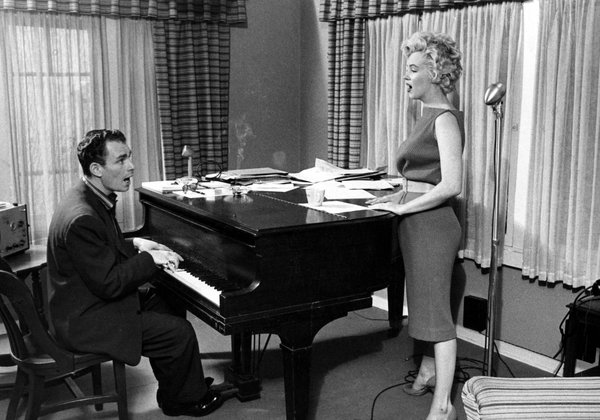
The New York Times published an obituary for Hal Schaefer today.  I had never heard of him, but this picture caught my eye.

This is Mr. Schaefer with Marilyn Monroe in 1953.

Hal Schaefer was a vocal coach, arranger and jazz pianist.  According to the Times

In his professional life as well as his personal one, Mr. Schaefer was often the least famous person in the room; his musical career was substantial but largely uncelebrated. A former prodigy who was inspired by the clean, tumbling melodic lines of Art Tatum, Mr. Schaefer played with big bands led by Benny Carter and Harry James and was the accompanist for Peggy Lee, Billy Eckstine, Vic Damone and other singers. Before he was 21 he led a trio that performed at the intermission of Duke Ellington concerts.

He was also an arranger and a modern jazz composer and for more than 50 years performed and recorded as a soloist and as a leader of small ensembles and jazz orchestras.

“A romantic with a rhythmic soul,” John S. Wilson of The New York Times called Mr. Schaefer after a performance at the Kool Jazz Festival in New York in 1982. “Mr. Schaefer is very much a mainstream pianist, but he has his own way of looking at the mainstream, enlivening the relatively standard repertory that he played with fresh and entertaining ideas.”

Mr. Schaefer probably made his biggest imprint as an arranger and vocal coach in Hollywood, where he often worked with the choreographer Jack Cole. He coached Monroe through “Diamonds Are a Girl’s Best Friend,” her signature number in the 1953 movie “Gentlemen Prefer Blondes” (he arranged the music as well), and Jane Russell, who also starred in that film. He also worked on other movies with Mitzi Gaynor, Betty Grable and Judy Garland. He wrote film scores for “The Money Trap,” a 1965 police drama with Glenn Ford, Elke Sommer and Rita Hayworth, and “The Amsterdam Kill,” a 1977 thriller with Robert Mitchum.

But Schaefer was also involved in an incident involving DiMaggio, Sinatra, and Monroe.  According to his obituary

On Nov. 5, 1954, not long after Marilyn Monroe filed for divorce from Joe DiMaggio, DiMaggio was having dinner with Frank Sinatra when he heard, probably from a private investigator, that if he went to a certain apartment house on Waring Avenue in West Hollywood, he’d find her in the arms of another man.

There are different accounts of what happened later that night, but what is certain is that a party of men, including DiMaggio and Sinatra, showed up at the address and someone broke down the door of the ostensible love nest, terrifying the woman who lived there, Florence Kotz — sometimes identified as Florence Kotz Ross — who was in bed by herself.

“Mrs. Ross was fast asleep about 11 p.m. when five or six men suddenly battered down the back door to her apartment, tearing it from its hinges and leaving glass strewn on the floor,” The Los Angeles Times reported, adding, “A bright flash of light was shone in her eyes and she was confronted with a number of men, some of whom seemed to be carrying an instrument which at first sight she believed to be an ax.”

The incident, which came to be known as “the wrong door raid,” resulted in a lawsuit filed by Mrs. Ross against Sinatra, DiMaggio and four others, which was settled for $7,500. And where was Monroe?

Los Angeles Times story from June 2, 1957 had an account that was similar.  But added this detail.

The men fled and Ross reported the incident to police as a burglary. Then Confidential magazine published a story about the raid in its February 1957 issue, touching off the Legislature’s investigation of scandal magazines and private detectives.  Ross learned the identities of the raiders when one of the private detectives, Philip Irwin, told the story to the investigative committee and the grand jury.

Sinatra received similar treatment when he was served with a subpoena in Palm Springs at 4 a.m. on Feb. 16, 1957, and he filed a complaint with the LAPD about the incident. Although his testimony was contradicted by others, Sinatra was adamant that he remained in a Cadillac parked outside the complex during the raid.

Private detective Barney Ruditsky, Irwin’s boss, testified before the grand jury that Sinatra and DiMaggio remained outside while he and Irwin broke down the door. During the investigation, Irwin testified that he had been beaten up by six men after he told an official of the State’s Bureau of Private Investigators and Adjusters his version of the raid. He also testified that he hadn’t sold the details to Confidential magazine.

In September 1958, the “wrong door” lawsuit against DiMaggio, Sinatra, Irwin, Ruditsky, Patsy D’Amore and John Seminola was settled for $7,500 ($53,739.63 USD 2006).

And where was Monroe during all of this? Next door, visiting girlfriend Sheila Stewart Renour at 8120 Waring.

Wrong.  Monroe was, Schaefer claimed, with him.

A female friend of hers claimed at the time that they had been together that evening, but years later, Hal Schaefer, a jazz pianist who was also Monroe’s vocal coach and who had become her confidant and romantic partner, admitted in interviews that he and Monroe were trysting in an apartment just a few yards away.

“We were very close to making love; I don’t remember the stage we were at, but I would say half-dressed,” Mr. Schaefer recalled. He added: “And all of a sudden for some reason, Marilyn got these vibrations, and we went over to the window and saw this group standing across the street, one of whom was Joe DiMaggio and another was Frank Sinatra. They all came en masse and broke this door in, demolished it. We scrambled to get out the back way, and we made it, luckily.”

Frank, Joe and their pals got off easy even for accounting for inflation.  And we are left with this interesting story told by a man who once loved her.

Wrong_door_8122

The wrong door.

Let’s talk about gun safety

This morning Nate Silver published two charts I found very interesting.

If the news coverage is any guide, there has been a change of tone in recent years in the public conversation about guns. The two-word phrase “gun control” is being used considerably less often than it was 10 or 20 years ago. But the phrase “gun rights” is being used more often. And the Second Amendment to the United States Constitution is being invoked more frequently in the discussion.

In the chart below, I’ve tracked the number of news articles that used the terms “gun control,” “gun rights,” “gun violence” and “Second Amendment” in American newspapers, according to the database NewsLibrary.com. (Because the number of articles in the database changes over time, the figures are normalized to reflect the overall volume of database coverage in any given year, with the numbers representing how often the gun-related phrases were used per 1,000 articles on any subject.)

The usage of all four phrases, but particularly the term “gun control,” has been subject to sharp but temporary shifts based on news events.

The second showed five year averages.

As we can see, discussion of gun control has dropped off sharply.  Silver points out

The change in rhetoric may reflect the increasing polarization in the debate over gun policy. “Gun control,” a relatively neutral term, has been used less and less often. But more politically charged phrases, like “gun violence” and “gun rights,” have become more common. Those who advocate greater restrictions on gun ownership may have determined that their most persuasive argument is to talk about the consequences of increased access to guns — as opposed to the weedy debate about what rights the Second Amendment may or may not convey to gun owners. For opponents of stricter gun laws, the debate has increasingly become one about Constitutional protections. Certainly, many opponents of gun control measures also argue that efforts to restrict gun ownership could backfire in various ways or will otherwise fail to reduce violence. But broadly speaking, they would prefer that the debate be about what they see as Constitutional rights, rather than the utilitarian consequences of gun control measures.

Their strategy may have been working. The polling evidence suggests that the public has gone from tending to back stricter gun control policies to a more ambiguous position in recent years. There may be some voters who think that the Constitution provides broad latitude to own and carry guns – even if the consequences can sometimes be tragic.

But this morning I heard Representative Carolyn McCarthy say something very interesting when she was talking to Chris Hayes on MSNBC.  She wants to call for changes that lead to gun safety not gun control.  She wants to add a new term that is less politically loaded to the conversation.  She pointed out that the word “control” has negative connotations.

This morning in the Boston Globe, Adrian Walker wrote

By now the sites of tragedies practically roll off our tongues. Columbine. ­Aurora. Tucson. And now tiny Newtown can be added to this roster of unthinkable, preventable tragedy.

Yes, I said preventable. Every single one of these might have been prevented if getting hold of a gun in this country was as difficult as, say, getting a driver’s ­license.

Don’t talk to me about the right to bear arms. There is no right to open fire on defense­less children or a congresswoman meeting her constituents or a theater full of moviegoers. Don’t bother trying to tell me that the Founding Fathers intended access to guns as a “right” with almost no limits. That insipid argument is an insult to history, even if a majority of our highest court seems persuaded by it.

Those of us who do not believe that everyone has a right to own and carry a weapon because of the myth of “self-protection” need to step up.  To push our congressmen and women, to push our Senators and to push President Obama.  We know the statistics:  We are up there in gun ownership with Yemen.  Should be proud of that?  We know that guns kept in cars and homes are often used to kill family members, commit suicide, or in a mistaken effort at self-defense.

I remember seeing an interview after Congresswoman Giffords was shot.  The young man said he had been getting coffee and heard shots.  He rushed out to find a man on the ground who was being held by another.  He had a gun and thought about using it.  If he had done so, he would have shot, not the gunman, but the person trying to disarm the shooter.

Let’s work to make owning a gun as difficult as getting a driver’s license.  Let’s talk about gun safety the same way we talk about traffic safety or driver safety.

Carolyn McCarthy ran for office after her husband died and her son was injured by a gunman on the Long Island Railroad.

About the Republican request for a balanced approach

Ezra Klein posted this today

This is a very sharp point by Josh Barro:

The Republicans’ main problem in this negotiation is that they know President Barack Obama will not agree to cut in the area they want to cut: aid to the poor. The signal Obama has sent is that he is willing to make a deal that cuts old-age entitlements, meaning Medicare and Social Security, and Republicans are internally conflicted over those programs.

He’s right. Think back to Mitt Romney’s proposed budget. Medicare and Social Security were held harmless for at least 10 years. Defense spending got a lift. PBS and the National Endowment for the Arts were on the table, but they cost so little it hardly mattered.

And there is the Ryan budget problem which remains the basic Republican budget outline.  It is what they ran on.

These are, however, classes of cuts the White House won’t even consider. A year ago, they were open to modest cuts in Medicaid, but after the Supreme Court’s health-care decision, even that door has shut. As for discretionary spending cuts, so many of those were made in 2011, there’s just not much left to do.

That leaves Medicare and Social Security. It’s possible that the negotiators will enact a backdoor, but significant, cut to Social Security by changing the government’s measure of inflation. But they’re not going to come at Social Security from the front. It’s too politically potent. Even Ryan’s budget left Social Security alone.

As for Medicare, as Barro says, if “Republicans ask for near-term Medicare cuts, that will mean reversing a position that is popular with a core constituency (old white people) and giving up a cudgel that they feel they have used effectively to beat up the president since 2009.” It’s a pickle.

In addition, as Steve Benen on the Rachel Maddow blog reminds us, the President has already offered spending cuts, of about 1.7 trillion over 10 years.

The White House keeps saying it wants a ‘balanced approach’ but this offer is completely unbalanced and unrealistic,” a Capitol Hill Republican said yesterday. “It calls for $1.6 trillion in tax hikes — all of that upfront — in exchange for only $400 billion in spending cuts that come later.”

Let’s put aside, for now, the irony of hearing Republicans talking about “balanced” debt-reduction plans. Instead, the importance of complaints like these is that they overlook everything that happened a year ago. Jonathan Cohn had a good piece on this.

…As part of the 2011 Budget Control Act, Obama agreed to spending  reductions of about $1.5 trillion over the next ten years. If you count  the interest, the savings is actually $1.7 trillion. Boehner should have  no problem remembering the details of that deal: As Greg Sargent points out, Boehner at the time actually gloated about the fact that the deal was “all spending cuts.”

And now, with this latest offer, Obama is proposing yet more spending  reductions, to the tune of several hundred billion dollars. Add it up  and it’s more than $2 trillion in spending cuts Obama has either signed  into law or is endorsing now. That’s obviously greater than the $1.6 trillion in new tax revenue he’s seeking. (And that doesn’t even take into account automatic cuts  from the 2011 budget sequester, which Obama has proposed to defer, or  savings from ending the wars in Afghanistan and Iraq.)

I can understand the temptation to block 2011 from memory, but what transpired is clearly relevant to the current debate. Obama wanted a “balanced” approach last year — some cuts, some new revenue — but didn’t get it. Instead, faced with the prospect of Republicans crashing the economy on purpose, the president accepted a deal with a whole lot of spending cuts.

How much new tax revenue came as the result of last year’s deal? Zero. The entire package came in the form of spending reductions and savings.

So with the new tax revenues and the already proposed budget cuts, President Obama is offering exactly what the Republicans keep asking for:  a balanced approach.  I’m not sure what they are waiting for.  Senator Harry Reid is mystified and so am I.

We need a comprehensive solution that lasts for a couple of years at a minimum because this non-economist doesn’t think the economy will improve as long as we seem to be in a continuous a budget or debt ceiling crisis.

I generally don’t do a lot of reblogging, but this is too much to pass up!

Progressive Action NH's avatarProgressive Action New Hampshire

Worst Marketing Decision Ever: Drycleaner Puts “Pro-life” Message on Their Hangers

From Dependable Renegade that got it from RH Reality Check:

There is a branch of anti-choice activists that will use pretty much anything as a medium for their message: newspaper ads, graphic signs displayed in front of schools, bus stop benches. You would think they would know well enough to leave one place untouched, though. Wire coat hangers.

You would be wrong.

Springdale Drycleaners of Cincinnati, Ohio, has been etching “Choose Life” ads on wire coat hangers used to hang dry-cleaning.

What’s worse is that this seems to be an ongoing effort. Reports of the “choose life” coat hangers already were on the internet back in March of 2011, when Joe.My.God posted a picture of the hanger then. And before that on Regretsy in 2010. So despite over two years of attention, the business continues to think…

View original post 58 more words

Things aren’t always what they appear to be

I think that Chris Matthews and others may have been taken in by the first footage released showing the Fox News contributor, Steven Crowder, being punched by a union supporter in a scuffle outside of the Capitol builing in Michigan.  Both Salon and the New York Times are reporting this morning that Crowder edited the tape to omit the fact that union guy had been knocked down before he got up and took a swing at Crowder.

The Times reports

Unfortunately for Mr. Crowder, a look at the video broadcast on the Sean Hannity show appears to show quite clearly that he left out an important section of the footage when he put together his edit. A section of the Fox News broadcast preserved by the Web site Mediaite shows that Mr. Hannity’s producers at Fox News started the clip five seconds earlier than Mr. Crowder did. What the extra footage reveals is the man who punched Mr. Crowder being knocked to the ground seconds before and then getting up and taking a swing at the comedian.

There is one more anomaly in Mr. Crowder’s edit of the footage shot by his associates. The still frame he used for the clip’s title image on YouTube, which offers a much clearer image of the man punching him, was obviously shot by a second camera, from an entirely different angle than the rest of the footage he presented of the man hitting him.  If Mr. Crowder wants to clear up the mystery of exactly what happened just before he was punched, it might make sense for him to release any footage of the incident shot from that second angle.

Poor Chris was trying to be so even handed by decrying the union supporters for condoning violence.

Fox News revealed selective editing of punched Fox News contributor

I think that as the Republicans become more and more anti-union in the states and even more obstructionist in Congress, things will only get uglier.  And perhaps this is good for the other side giving workers and unions a wake-up call.

It is now being reported that Crowder has admitted punching the union protester.

Photograph:  A still from the Crowder video.

Playing with Medicare and Social Security

I retired recently from a white collar, management, high stress job at the age I have always expected to retire, 65.  I think I can say that my retirement was a cause of envy among many of my co-workers who are just as tired and stressed as I was but have many years before they can retire.  As I said to my former staff members at lunch the other day, you don’t realize how tired you are until you retire.  And even then it takes time to de-stress.  So I can imagine if I were working a job that was physically demanding (and maybe also stressful) and how it would make me feel if I knew I had to work until 67 or 70 to get any kind of benefits which is where many Republicans (and some Democrats) want us to end up.  I don’t think that some of the corporate CEO’s and elected officials understand this which is why this piece by Ezra Klein caught my eye.

I’ll be clear: Raising the Medicare eligibility age makes no sense. It cuts federal health-care spending but raises national health spending, which is what really matters. It doesn’t modernize the system or bend the cost curve. It doesn’t connect to any coherent theory of health reform, like increasing Medicare’s bargaining power, increasing competition in Medicare, ending fee-for-service medicine, or learning which treatments work and which don’t. I’m not opposed to cutting Medicare — quite the opposite, actually — but this is a particularly brain-dead way to do it.

Its importance in the negotiations is attributable to the fact that raising the age at which Americans can receive Medicare and Social Security has a weird, symbolic power in Washington. As House Minority Leader Nancy Pelosi puts it, the eligibility age is “a trophy” that Republicans can bring back to their base. Though the policy is deeply unpopular with voters, it’s quite popular among Republican elites.

Klein floats this idea

If it’s age increases that the political system wants, there’s a better way to do it. Ezekiel Emanuel, who advised the Obama administration on health care and now works with the Center for American Progress, calls it “graduated eligibility,” and it would link the age of eligibility with lifetime earnings:

Here’s how it would work. People in the bottom half of the lifetime earnings distribution would become eligible for normal retirement benefits at age 65 for Medicare and 66 for Social Security, just as they are today. But people in the next quarter of the lifetime earnings distribution would become eligible for the respective programs at 67 and 68, and those in the top quarter would become eligible at 70 and 71. All eligibility ages would increase over time, as they are scheduled to now.

This makes sense on a few different levels. For one thing, a favorite argument for raising the age at which benefits begin is that seniors live longer today than they did when these programs began. But those gains aren’t equal: Richer seniors live six years longer than poorer seniors, on average. “Graduated eligibility” accounts for that fact.

This does make a certain amount of sense, but I still worry about those who work physically demanding jobs like construction.  I’m not even sure about the scheduled age increases for full benefits.  Maybe we should lower ages at the bottom, leave the middle, and raise it even highter at the top.

I remembered that I heard somewhere that the average retirement age is 62 and went looking for confirmation.  I found this story in the Financial Advisor from April 2012.

More than one third of pre-retirees (35%) surveyed think they will never retire, an increase from 29% in the 2009 survey. Only one in 10 pre-retirees thinks they will retire before age 60. Half of pre-retirees say they will wait until at least age 65.

In reality, 31% of retirees quit work before age 55, 20% before age 60, and another 10% before age 62.

“There is a major disconnect between when people say they plan to retire and when they actually do,” the survey says. Some of it may be because of health problems or because they are downsized. “Many who lose jobs in their 50s and 60s experience more difficulty finding new employment,” the survey adds.

The survey was taken of 800 pre-retirees and 800 retirees, ages 40 to 80. It is the sixth survey of this type taken by the Society of Actuaries since 2001.

So there is also a disconnect between the proposals on age eligibility and what people so in real life.

I am worried that we are going to end up with a policy that has very bad unintended consequences.  I saw Nancy Pelosi in an interview a few nights ago when she said she hadn’t seen how raising the Medicare age was going to create savings.  She said, “Show me the money.”  I would go further and say, I don’t think that anyone has done the math and I can only hope that the President, Democrats in Congress and maybe some Republicans will do the math first.

Photograph:  Alex Wong

The death of the Republican party? Part 2

Maureen Dowd calls them  “A Lost civilization”. likening them to the lost tribes of civilization.

The Mayans were right, as it turns out, when they predicted the world would end in 2012. It was just a select world: the G.O.P. universe of arrogant, uptight, entitled, bossy, retrogressive white guys.

Just another vanishing tribe that fought the cultural and demographic tides of history.

Someday, it will be the subject of a National Geographic special, or a Mel Gibson movie, where archaeologists piece together who the lost tribe was, where it came from, and what happened to it. The experts will sift through the ruins of the Reagan Presidential Library, Dick Cheney’s shotgun casings, Orca poll monitoring hieroglyphics, remnants of triumphal rants by Dick Morris on Fox News, faded photos of Clint Eastwood and an empty chair, and scraps of ancient tape in which a tall, stiff man, his name long forgotten, gnashes his teeth about the 47 percent of moochers and the “gifts” they got.

Instead of smallpox, plagues, drought and Conquistadors, the Republican decline will be traced to a stubborn refusal to adapt to a world where poor people and sick people and black people and brown people and female people and gay people count.

As the historian Will Durant observed, “A great civilization is not conquered from without until it has destroyed itself from within.”

Who would ever have thought blacks would get out and support the first black president? Who would ever have thought women would shy away from the party of transvaginal probes? Who would ever have thought gays would work against a party that treated them as immoral and subhuman? Who would have ever thought young people would desert a party that ignored science and hectored on social issues? Who would ever have thought Latinos would scorn a party that expected them to finish up their chores and self-deport?

Calvin Trillin puts it this way

Mitt Romney Explains Why He Lost

Obama was clever as clever could be;
To targeted groups he gave gifts that were free:
Say, healthcare for free until age 26,
And free contraceptives (for sex just for kicks).
Debates in the primaries left our team bruised
From harsh accusations the White House then used.
Whatever the reason for losing might be,
Of one thing I’m sure: it could not have been me.
I’m perfect.

But those of us on the other side should remember that the Democrats have also had some near-death experiences – like after the 1972 election – and we have spent our time in the wilderness, too.  The party has had internal struggles and differences, but, correct me if I’m wrong, there has never been a point where the Democratic party was this close to making itself irrelevant.

Trillin again.

Republican Soul Searching   

We’re searching our souls and we’re wondering why
We got beat so badly our rivals are gloating.
It’s obvious now where our campaign went wrong:
We should have prevented more people from voting.

The Supremes and getting married

Marriage is several things.  It is a contract between two people recognized by the state and it is a spiritual and, for some, a religious bond.  When my parents were married in a Buddhist ceremony, one of their friends, a Jewish lawyer, is alleged to have said in a stage whisper, “It doesn’t matter what ritual is used, it’s still just a contract.”  I wish I had thought to ask him about this when I became an adult, but true or not it makes a nice story.

Yes, same sex couples can live together and in some places they can have a recognized civil union which may provide some benefits, but it is not the same as being married.  I can tell you from personal experience that they create very different states of mind.  Being married provides a level of comfort and security just living together does not.  And part of this comes from marriage being a contract.  Yes, all types of relationships fail and they fail for as many reasons as there are failures, but marriages are more difficult to sever therefore can provide more of a base on which a relationship can grow.

I’ve been writing about gay marriage as states are added to the list and I’ve been watching the attitude of the country toward gay marriage change.  Chris Cillizza posted two helpful charts on his Washington Post blog, the Fix.

Pretty amazing change is a relatively short period of time.  And Democrats have gone from not wanting to touch the issue to running for office supporting gay marriage in the space of one presidential election cycle.  This change was reflected at the ballot box.  I am happy that Washington State, Maryland, and Maine voted to legalize same sex marriage, but I still have this voice in the back of my head that says equal rights are not something that should be determined by a majority vote.

The Boston Globe reported

Last month, Washington, Maine, and Maryland became the first states to pass same-sex marriage by popular vote. They joined six other states — New York, Connecticut, Iowa, Massachusetts, New Hampshire, Vermont — and the District of Columbia that had already enacted laws or issued court rulings permitting same-sex marriage.

And now the Supreme Court will be ruling on the issue.  The New York Times explains

One of the cases, from California, could establish or reject a constitutional right to same-sex marriage. The justices could also rule on narrower grounds that would apply only to marriages in California.

The second case, from New York, challenges a federal law that requires the federal government to deny benefits to gay and lesbian couples married in states that allow such unions.

The California case was brought by the two lawyers who were on opposing sides in the infamous, Bush v. Gore case, Ted Olson and David Boies.  The second case is one of several that challenged the Defense of Marriage Act or DOMA.  It is interesting that the Massachusetts case is not the one being heard.

There was reason to think that Justice Elena Kagan was not free to hear an appeal from the Boston case because she had worked on it or a related case as United States solicitor general. The current solicitor general, Donald B. Verrilli Jr., gave the court a number of other options, including Windsor, probably partly to make sure that a case of such importance could be heard by a full nine-member court.

Edith Windsor of New York sued to be treated as a surviving spouse

The Obama Administration is not defending DOMA.

Chris Cillizza ended his post with this thought.

Go deeper into the Pew numbers — and thanks to Pew, you can! —  and you see why those trend lines won’t be reversing themselves.  In 2011-2012, 62 percent of people 18-29 supported gay marriage — by far the strongest support among any age group. During that same time period, just 32 percent of those 65 or older supported gay marriage.

The simple truth: Support for gay marriage tracks directly with age. The younger you are, the more likely you are to support it. Given that, it’s hard to imagine gay marriage getting less popular as the years go on.

Whatever the Supreme Court does with its two gay marriage cases next year, the die has been cast on the politics of the issue. By the 2016 presidential election, this could well be a decided issue that neither party — yes, that includes Republicans — spends much time talking about.

My guess is that the Supreme Court will overturn DOMA and rule that states can allow gay marriage if they want.  We will see in a few months if I’m right.

Photograph – Chester Higgins Jr./The New York Times