Beating the heat

We just finished a week or so of 90+ temperatures with high humidity in Boston without air conditioning.  We survived quite well.  It wasn’t until day 6 or 7 that I really began to suffer – that the was day there was no afternoon sea breeze.  Exhaust fans on each floor pull air through the house and smaller fans are placed in the rooms we use the most.  We are lucky to have good four-way ventilation.  Cool showers and cooking in the mornings = or not at all – also help.  (We went out once to out favorite pub so find that their air conditioning was not 100%, but it was just fine.)  I am one of those rare people that don’t like living in refrigerated air.  So I was very interested in the Boston Globe article in the Sunday Ideas Section titled “How to Live Without Air Conditioning”  In it, Leon Neyfakh  points out the life style changes that we could make so that we at least reduce our energy consumption.

Since the technology was invented in 1902, and the first window unit was brought to market in 1939, air conditioners have become ubiquitous in the United States. Today, almost 90 percent of American households have one—as do the vast majority of restaurants, stores, museums, and office buildings. During weeks like the one we’ve just had, these places are sanctuaries: To walk into one after being outside is to be reminded how sweet life can be.

But all that magic chilling comes at a cost—something most people are aware of on a personal level, because their electricity bills are so high during the summer, but not so much on a global scale, which is really where the problem lies. In China and India, air conditioning sales have reportedly been growing by 20 percent per year; around the world, air conditioning energy demand is projected to increase vastly over the next decades. According to Stan Cox, author of the 2010 book “Losing Our Cool,” air conditioning in the United States already has a global-warming impact equivalent to every US household driving an extra 10,000 miles per year.

English: Series of air conditioners at UNC-CH.

English: Series of air conditioners at UNC-CH. (Photo credit: Wikipedia)

Think about that.  And we continue to build office buildings taller and more dependent on artificial cooling.  Yes, maybe some are energy efficient and green building, but they still consume vast amounts of energy.

When experts look at A/C use in America, they immediately see a spot of illogic: We use vast amounts of energy just to let businesspeople do something they’d probably rather not do anyway. “We are probably overcooling our office buildings by 4 to 6 [degrees] F just so that office workers, particularly the males, can wear their business suits,” wrote Richard de Dear, who is head of architectural design science at the University of Sydney and a researcher on thermal comfort. “The current clothing behaviour is costing us a fortune in energy and greenhouse emissions!”

In Japan every summer, in an environmental initiative called “Cool Biz” that started in 2005, government officials encourage building managers to let temperatures climb to 82 degrees and advise employees to loosen their sartorial standards. In 2011, the government even put on a fashion show, with models catwalking in untucked polos, capri pants, and Kariyushis, a Japanese take on the Hawaiian shirt.

Here in America, it probably wouldn’t require such a hard sell. Many female workers already dress for summer weather, and would likely be delighted not to have to huddle in sweaters against the A/C. Among men, polos are already considered appropriate on casual Fridays, and it’s not hard to imagine that most would happily embrace a breezier style for the rest of the week. Instead of long pants, they could don formal shorts—a concept that has long been embraced in Bermuda, where executives can be seen attending meetings with exposed knees.

And people can do similar things at home.

Even a mid-sized building could save considerable amounts every year by operating at shorts temperature. But if modifying what we put on our bodies could help us give up extreme climate control, rethinking buildings themselves—and how we ventilate them—would go even further. Already, some of us live in homes that can be effectively cooled by opening windows in the basement and on the top floor every morning, thus taking advantage of the so-called stack effect to pull cool air up through the house and allow hot air to vent into the street. People can also try “evaporative cooling,” a modest, low-tech form of air conditioning, by hanging wet towels in the window or setting them in front of a basic electric fan.

Some of  Neyfakh’s life style suggestions like changing to a work schedule with early morning hours, a mid afternoon siesta, and late work hours are a tougher sell:  Too many people commute long distances.  But people who telecommute could try raising the temperature at home a few degrees so that they at least don’t have fried brains and the inertia that comes with it.  Also try adjusting blinds to follow the sun and plant trees.

There are some parts of life, it must be said, for which air conditioning is not just a luxury but a necessity. The Internet depends on servers that require climate control in order to not go up in flames. Modern skyscrapers depend on it, as well. If we gave up air conditioning, New England would largely be fine, at least for now, but entire swaths of the country would become uninhabitable: Summers in the Sun Belt cities and in parts of the South would be so harsh that millions of people would simply move away. We also would be unwilling to take away A/C from those most sensitive to extreme heat—namely, the sick, the very young, and the elderly.

That doesn’t mean that trying to reduce our society’s addiction to A/C is a fool’s errand. The fact is, our bodies are built to adjust to heat—it’s just that we haven’t had to lately, because we’ve become so accustomed to refrigerating ourselves when the weather gets hot. A study in which researchers surveyed 21,000 people, spread out across 160 buildings on four continents, found that “people in warmer climates were more comfortable in warmer indoor temperatures than their counterparts in cooler climate zones,” according to Richard de Dear, one of the coauthors.

The findings indicate that people actually prefer being in places where the temperature fluctuates, as long as they have some control over it. “If you have the ability to open or close a window, turn a fan on or off, change the blinds, modify your clothing—it just becomes a natural part of your day-to-day living, and you don’t build these expectations that conditions should be the same all day and all year round, which I would call ‘thermal monotony,’” said Gail Brager, an architecture professor at UC Berkeley who also worked on the study. “We not only accept—we actually prefer—a wider range of conditions that float with the natural rhythms of the outdoor climate.”

No doubt this is hard to believe, as you sit there in your air-conditioned home, happily soaking up the artificial breeze emanating from the murmuring machine in your window. But is there not something fearful about refrigerating ourselves with such vigilance? We’re not cartons of milk, after all; we will not spoil, even if we do sweat a little. In fact, by taking full advantage of the technology inside our own bodies—technology that makes it possible for us to adapt to a whole spectrum of temperatures—we might discover we’ve been missing out on a way of life that actually feels quite natural.

Everyone doesn’t have to go air conditionless as we do, but there is nothing wrong, and much to gain by not making all of our buildings so cold.  Maybe we can at least agree on a temperature like 80 or, like the Japanese, 82 and save some energy.

And the race is on!

The Red Sox begin the second half of the season tonight facing steamy heat and the somewhat diminished, but always dangerous, New York Yankees.  The real race for the American League East title begins.  The Boston Globe story by Julian Benbow lays out the facts.

Whenever Jonny Gomes would glance at the standings, he got an idea just how much of a tug of war the American League East is.

The fact that four of the five teams are above .500 was overshadowed by what the division did against the rest of the league.

In the first half, the AL East went a combined 70-54 against the Central, 53-39 against the West, and 35-19 in interleague play.

“I’ve actually looked at our standings and you saw the whole AL East win,” Gomes said. “It seems like the only time a team loses is when we play each other. It’s a big division. It truly is.”

Which is why the Red Sox’ first 10 games out of the All-Star break will be a grueling and critical test.  They start with a three-game set this weekend with the Yankees, then play four with the second-place Rays, and then hit the road for three games against the Orioles.

The Sox enter Friday with a major league-leading 58 wins, but 38 of their final 65 games are against division foes.

So how did they do against the division so far?  According to Steve Melewski who writes about the Orioles

Boston is 4-2 this year against the Yankees and 9-3 against Tampa, but just 2-5 versus the Orioles.

My father used to say about the Atlanta Braves who had trouble with the Mets, “It never matters how bad or good the teams are, the Mets win.”  I hope this isn’t true about the Red Sox and Orioles.

Clay Buchholz needs to get better without rushing his recovery and Jon Lester needs to get his head straight and start winning.  Lester started out the season pitching quicker than he had before, but now he seems to have slowed again.

More from Gomes and Benbow

The Sox know how crucial the final months of the season can be. They’ve gone into the break with the division lead in five of the last seven seasons, but have won the division just once over that span.

“It’s going to be a scrap,” Gomes said. “It’s a tough division. You see last place here could be third or second in other divisions. So that speaks for itself. At the same time, the Sox aren’t going to sneak up on anybody on the road.”

The Sox were able to navigate injuries and issues in the first half in large part because of depth and some deft decision-making by Farrell.

But with a daunting schedule ahead in a tightly packed division, returning to full strength will play a large part in sustaining success and returning to the postseason.

“Where we’re at right now, we’re not going to sneak up on anyone,” Gomes said. “So we just have to simplify — win each game, win each inning, stay healthy and keep going north.”

Many Sox fans, including me (I predicted a .500 team.) were surprised by the first half.  Now we are ready to be surprised by the second.  Let’s start by beating up on the Yankees.

The Red Sox head into the post-All-Star Game portion of the season with a 2.5-game lead in the AL East.

The Red Sox head into the post-All-Star Game portion of the season with a 2.5-game lead in the AL East.

Photograph:  Jared Wickerham/Getty Images

A sort of apology

I generally don’t have a lot to say about international politics, but I am interested in education, especially education for girls.  This story was in the Guardian.

A senior member of the Pakistani Taliban has written an open letter to Malala Yousafzai – the teenager shot in the head as she rode home on a school bus – expressing regret that he didn’t warn her before the attack, but claiming that she was targeted for maligning the insurgents.

Adnan Rasheed, who was convicted for his role in a 2003 assassination attempt on the country’s then-president Pervez Musharraf, did not apologise for the attack, which left Malala gravely wounded, but said he found it shocking.

“I wished it would never happened [sic] and I had advised you before,” he wrote.

Malala was 15 when she and two classmates were targeted by a masked gunman who picked them out on a school bus as they went home from school in Pakistan‘s northwest Swat valley last October.

Last week, she celebrated her 16th birthday by delivering a defiant speech at the United Nations in New York, in which she called on world leaders to provide free schooling for all children.

In the letter, Rasheed claimed that Malala was not targeted for her efforts to promote education, but because the Taliban believed she was running a “smearing campaign” against it.

“You have said in your speech yesterday that pen is mightier than sword,” Rasheed wrote, referring to Malala’s UN speech, “so they attacked you for your sword not for your books or school.”

Malala Yousafzai speaking at the United Nations

Malala Yousafzai speaking at the United Nations

I think most of us know that what the Taliban was interpreting as a “smear campaign” was her advocacy of education.  An educated person, and an educated woman in particular, is a threat to any kind of fundamentalism.  (Ask Rick Perry.)

The letter doesn’t make a lot of sense:  “they attacked you for your sword not for your books or school”.  Huh?  Do you think he considers education a sword?  Or maybe talking about education.

He admitted that the Taliban are “blowing up” schools, but justified the attacks on the grounds that the Pakistani army and the paramilitary Frontier Corps use schools as hideouts.

Hundreds of schools have been targeted in Pakistan’s north-west: activists say some had been used by the military, but many attacks were motivated by the Taliban’s opposition to girls’ education.

The Taliban commander also justified recent attacks in Pakistan on health workers vaccinating children against polio by claiming the west was trying to sterilise Muslims.

The letter is clearly intended to influence opinion in Pakistan: although in much of the world Malala has been hailed as a symbol of courage, at home she has been the subject of intense criticism and vilification. Online commentators have described her as a “drama queen” and even accused her of spying for the CIA.

Rasheed contrasted international support for Malala with the lack of coverage given to those killed in US drone attacks – a source of intense grievance in Pakistan.

I understand the anger about civilian deaths from drone attacks since I don’t think they can simply be excused as collateral damage, but I think that may be the only part I do understand.

Rasheed wants Malala to return to Pakistan and attend a female seminary so she can advocate for Islam.  I think that her advocacy for women and for education generally can do a lot to show people in the West who think of Muslims as only terrorists another side of Islam.  She IS an advocate,  Rasheed.

Photograph:   Rick Bajornas/UN Photo/PA

Florida’s strange gun laws

I’ve been thinking a great deal about the verdict in the Trayvon Martin/George Zimmerman case and have concluded that one reason for the verdict is Florida law.  I’ve read the jury instructions and while they were confusing, they had to follow the law which led to acquittal.

The best piece I’ve read on Florida gun laws is an OpEd by Farah Stockman in the Boston Globe.  Stockman writes about Florida gun laws generally and cites 4 currently incarcerated people as examples:  Marissa Alexander, Ronald Thompson, Orville Lee Wollard and Erik Weyant.    All but Alexander are white men, all including Alexander fired a gun to frighten and not to kill.  All are currently serving 20 year minimum sentences.

IF IT BOGGLES your mind that George Zimmerman, a 29-year-old with a gun, could be acquitted after pursuing — and killing — an unarmed 17-year-old, here’s another brain teaser: How could Marissa Alexander, a 31-year-old mother of three, receive a 20-year prison sentence for firing a bullet into a wall near her abusive ex-husband, even though no one was harmed?

It’s true. Florida is one of the worst places to fire a gun into the air, even as it appears to be one of the best places to actually shoot at a person.

Marissa Alexander of Florida received a 20-year prison sentence for firing a warning shot at her abusive ex-husband.

Marissa Alexander of Florida received a 20-year prison sentence for firing a warning shot at her abusive ex-husband.

She goes on to explain.

Alexander, whose ex-husband admitted that she was afraid of his abuse, is not the only one in prison for shooting at nothing.

Ronald Thompson, 62, a disabled veteran, fired two shots into the ground to protect an elderly woman from her violent 17-year-old grandson. State Attorney Angela Corey — the same prosecutor in the Zimmerman case — charged him with four counts of aggravated assault. Thompson was sentenced to 20 years in prison,  a punishment that the judge in the case called a “crime in itself.”  (He is currently awaiting a new trial.)

Orville Lee Wollard, a former auxiliary police force member, shot a bullet into the wall to scare away his daughter’s abusive boyfriend. Prosecutors offered him probation. But he wanted to be exonerated at trial. Now he’s serving 20 years.

Erik Weyant, 22, fired shots in the air to disperse a group of drunk men who accosted him in a parking lot outside a bar and blocked his car. No one was hurt. But he’s in for 20 years.

In many cases, the fact that they chose to fire a warning shot, instead of aiming to kill, was used as evidence against them at trial, said Greg Newburn of Families Against Mandatory Minimums. If you were truly in fear of your life, the logic goes, you would aim at the chest, not the wall.

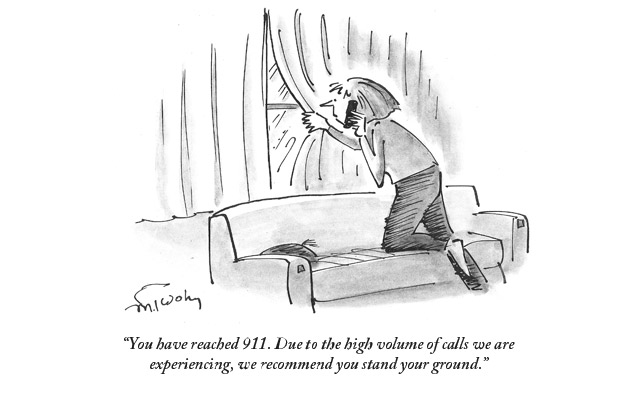
Florida lawmakers, in their infinite wisdom, began to notice that a lot of people were getting severely punished simply for defending themselves. But instead of repealing the Draconian measure, they passed another one: the “stand your ground” law.

Somehow, both of the laws are not working.  George Zimmerman who killed Trayvon Martin is free, the four named above are in prison.

…And had Alexander shot and killed her abusive ex-husband, would she have had a better chance of getting immunity with a “stand your ground” defense?

“I think so,” said her attorney Michael Dowd.

So in the sick logic of Florida’s gun laws, the message is clear: If you are going to shoot, shoot to kill. You stand a better chance of walking free.

What is happening in Florida is just another reason we need to take a careful look at all of our gun laws.  Florida’s gun laws have little to do with race and as pressure mounts to help Alexander, let us not forget everyone else.

Photograph:  Bob Self/The Florida Times-Union

Republicans try to attract women

I was getting ready to call it a night as my head is swimming with a half written post about Trayvon Martin when I saw the new Tom Tomorrow cartoon.  It really needs no explanation.

TMW2013-07-17color  Great pick up lines.  I’m sure that women voters will be flocking to them in droves.

‘House Democrat And Former Teacher Mark Takano Grades GOP Letter To John Boehner, Hilarity Ensues’

Representative Mark Takano gives Boehner an “F”. Great stuff.

fatherkane's avatarThe Last Of The Millenniums

letter

‘House Republicans have been the laughingstock of the nation since the GOP/Tea Party took control of the House of Representatives back in 2010, but what one House Democrat did to embarrass them this week will make them even more so’.

‘Democratic Representative Mark Takano of California was elected to the House in 2012’.

‘Before election night, he had been an English teacher for 24 years. So perhaps it was a matter of fate or plain old bad luck that Republicans would do something that would allow Takano to use his experience as a former teacher to thoroughly embarrass themselves’.

‘In response to the major immigration reform bill passed by the US Senate, members of the House GOP decided to write a letter to Speaker John Boehner to decry the bill and convince him not to bring it up for a vote’.

‘Republicans circulated copies of their letter around the chamber…

View original post 227 more words

More nails in the Republican coffin?

For a number of years now, I have watched part of the Republican party that has as its main, if not sole, purpose, to dismantle government.  They called the Democrats bluff with the sequester which so far has appeared to have little effect.  Who cares if a military base can’t afford fireworks or if the Blue Angels can’t afford to do a fly over?  In the big scheme of things, those are pretty unimportant.  But now more and more federal workers are being furloughed.  For example, local HUD (Housing and Urban Development) offices are closing for five Fridays in July and August.  That is 5 Fridays that staff will not be paid.  This is money that won’t be spent on a vacation or for car repairs or for food and clothing – all things that add to the economy.  (Here is an interesting website that tracks furloughs.)  And while a number of agencies have figured out ways to avoid furloughs, many workers will still be affected – still more if Congress can’t manage to pass a budget for the fiscal year that begins in October.  The loss of incomes will slowly begin to mount.

But it isn’t just the failure to produce a budget.  A recent New York Times editorial summed up the issue quite neatly.  They called it a refusal to govern.

On two crucial issues this week, the extremists who dominate the Republican majority in the House of Representatives made it clear how little interest they have in the future prosperity of their country, or its reputation for fairness and decency.

The two issues are immigration reform and the removal of the food stamp program for the House agriculture bill.

These actions show how far the House has retreated from the national mainstream into a cave of indifference and ignorance. House members don’t want to know that millions of Americans remain hungry (in an economy held back by their own austerity ideology), and they don’t want to deal with the desperation of immigrant families who want nothing more than a chance to work and feed themselves without fear of deportation.

On both issues, in fact, many House Republicans are proudly asserting that they will stand in the way of any attempts to conduct a conference with the Senate. That might, after all, lead to a compromise.

And it isn’t just in the House.

Few things sum up the attitude of the current crop of Republicans in Washington than their loathing of conference committees. On issue after issue, they have passed radical bills and then refused to negotiate. On Thursday, for example, Senate Republicans refused for the 16th time to allow the Democratic Senate budget to be negotiated with its dangerously stingy counterpart in the House.

On immigration, House members fear a conference with the Senate would add back the pathway to citizenship that they consider a giveaway to undesirable non-English speakers. The eventual House border bills “should not be handed to a conference committee so that they can be reconciled with the Senate bill,” wrote Representative Tom Cotton of Arkansas in The Wall Street Journal on Thursday. Instead, he and others say, the Senate should be forced to take up whatever the House produces.

Senate Minority Leader Mitch McConnell may believe that ending the filibuster with a majority vote will spell the end of the Senate and cause Harry Reid to be remembered “as the worst leader of the Senate ever”, but in my opinion, the continuous use of the filibuster has already come close to destroying the Senate.  Everything should not require 60 votes.

The New York Times editorial ends with this

A refusal to even to sit at a bargaining table is another way of refusing to govern. The nation’s founders created two chambers for a reason, but Republicans, in their blind fury to harm the least fortunate, are forgetting even those fundamental national values.

From left, Representatives Tim Murphy, Mark Sanford, Cathy McMorris Rodgers and Sean P. Duffy, all Republicans, after the House approved an agriculture bill.

From left, Representatives Tim Murphy, Mark Sanford, Cathy McMorris Rodgers and Sean P. Duffy, all Republicans, after the House approved an agriculture bill.

This is why the most recent Quinnipiac poll shows that while 53% felt the President was doing too little to compromise with Congress, a whopping 68% felt the Republicans leaders in Congress were doing to little to compromise with the President.  And everyone thinks Congress is dysfunctional blaming both parties.

There is something called the greater good and I think many in Congress, particularly Republicans, have forgotten that ideal.

Photograph: Christopher Gregory/The New York Times

Will books – and bookstores – survive?

I am surrounded by books.  I’ve always kept my books, carting them from place to place, but things began to get out of control when I bought my first house in Virginia and I had the room to have bookshelves.  Then 19 years ago I married another collector.  Luckily we live in a large space because we not only combined libraries, but we continue to acquire books at an alarming rate.  We started cataloging our books on LibraryThing.com a year ago and are still less than half way done at 2,100 books.  We get our books from many sources:  online used book dealers, yard and library sales, used book stores, independent stores wherever we vacation, Barnes and Noble and our local independent for new books.  So I was happy to see this story in the Washington Post this morning.

On Monday, Barnes and Noble announced that the chain’s CEO, William Lynch, was stepping down.

It’s never a good sign for a company when its CEO resigns, leaving it provisionally leaderless. In the case of a struggling chain like Barnes & Noble, it’s enough to make people wonder how long it’ll be until it declares bankruptcy. But headlines, in this case, are deceptive. Lynch’s resignation doesn’t show Barnes and Noble is doomed in the age of Amazon. It shows how Barnes and Noble can survive — as long as it doesn’t try to compete with Amazon.

Ah, the Nook.  I had a coworker with two teenagers that read a lot.  She got them Nooks for Christmas one year.  One of them loved it, the other wanted real books.  I understand there might be times when reading a book electronically might be convenient, but for me that convenience is outweighed by a physical, print book.

If you’ve got a teleological conception of new technology as something that eventually drives the old into oblivion, Barnes & Noble is doomed. It sells physical things in a digital world, and other companies are better at selling digital things than it will ever be. Blockbuster and Tower Records essentially disappeared from the face of the earth, after all, and we should have no illusions that Barnes & Noble won’t go the same way.

Here’s the thing: Bookstores, more so than movie rental and record stores, are oases in the middle of cities (and even in suburban malls). We go there to kill time, expose ourselves to new stuff, look for a gift without something specific in mind, and maybe pick up something on impulse while we’re there. Even Borders’ disorganized warehouses left holes in the urban fabric when they disappeared, and Barnes and Nobles would do the same–they’re a kind of public good, at a time when the public is getting less good at supporting libraries.

So, is there a way for Barnes & Noble to survive? The answer is yes–in a vastly different form.

There’s a happy storyline buried in Barnes and Noble’s overall revenue picture. The Nook disaster clouds the fact that the physical stores actually aren’t doing that badly, generating a comfortable $374 million profit last quarter. The chain got a significant bump when Borders closed 399 stores, and it’s now the only national bookstore chain in the country. It’s been shedding unprofitable real estate, letting expensive leases expire, and consolidating into the spaces that actually generate revenue.

“When you look at the financials on the retail stores, it’s basically a pretty good business,” says Al Greco, a professor of marketing at Fordham University School of Business.

It’s also got a hidden weapon: The academic market. Barnes and Noble now manages some 700 university bookstores, which are essentially monopolies over high-priced textbooks as well as collegiate merchandise. They’ve been moving into textbook rental and e-books there as well, and the millions of students on financial aid that includes textbooks are more willing to shop local rather than scour the internet for deals.

Finally, they’ve got an important friend: The publishers, who hate the idea of an all-Amazon world. To help keep the only large physical retailer alive, they might be willing to do things like offer some inventory on consignment, so that the bookstore doesn’t have to eat the cost of unsold books. They could even help offer e-books with the paper version at cut-rate prices on the Nook, whoever ends up owning it, or open-platform tablets like the Nexus.

The company’s management has noticed. Len Riggio, who started the chain and is now back running it, is interested in splitting off the retail stores and taking them private. Without the Nook, the business would get hammered by the markets anyway, so it’s best to avoid them. Absent the pressure of quarterly earnings statements, he might be able to try some radical new ideas, like drastically shrinking their square footage and offering a smaller selection of books curated by a knowledgeable and passionate staff.

bmail_topper042913

The Brookline Booksmith which is the other store where I buy books has a wonderful staff  – and they send out a great weekly email newsletter.  Not that the BN folks where I go aren’t helpful, just that it can be more difficult to find one of them.  I have to admit that I use BN online a lot especially when I know what I want.  But there is nothing like roaming around a bookstore:  one never knows what treasure one will find.

And besides, print may be one of those things that never vaporizes entirely, just as newspapers still put out daily editions because they pay the bills. People like giving books as objects, having shelves full of them as decoration, traveling with them and not worrying about them getting stolen. Even in a smaller form, Barnes & Noble could be there to serve them.

“Will it survive? Yes it will,” says Greco. “We will still be buying and selling printed books in the U.S. in the year 2020. There will be a decline, but print is not going to disappear.”

Is 2020 supposed to be comforting?  That’s not very far away.  I’m hoping for way longer than that.  And will continue to do my part by buying books.

Photograph:  Brookline Booksmith

The real danger: The FISA Court

Congress and the President can say all they want to that everything about the surveillance is approved by the FISA Court.  OK.  But what do we know about this secret court?  Some revelations this past weekend by the Wall Street Journal and the New York Times tell us a great deal that I, for one, didn’t know.  For example, did you know that Chief Justice John Roberts was in charge?

The Ezra Klein/Evan Soltas Wonkblog had a great summary this morning.

The laws we live by aren’t just the bills Congress passes and the president signs. It’s what the courts decide those bills actually mean.

We’re used to that. The Affordable Care Act, for instance, says that states that don’t accept the Medicaid expansion lose all their Medicaid money. The Supreme Court decided that went too far. The law might still say that if you read the underlying bill, but it no longer means that. Now states can reject the Medicaid expansion without jeopardizing the rest of their Medicaid money — and many are.

But here’s the thing: When judges make the laws, Congress can always go back and remake the laws. The changes the court makes are public, and so is their reasoning. Both the voters and Congress know what the court has done, and can choose to revisit it.

Well, usually.

The Foreign Intelligence Surveillance Court (FISA court) that governs the national surveillance state is also remaking the law. But it’s remaking the law in secret. The public has no opportunity to weigh in, and Congress can’t really make changes, because few know what the court is deciding, and almost no one can discuss the decisions without endangering themselves.

So that’s a real Catch 22.

Surveillance types make a distinction between secrecy of laws, secrecy of procedures and secrecy of operations. The expectation is that the laws that empower or limit the government’s surveillance powers are always public. The programs built atop those laws are often secret. And the individual operations are almost always secret. As long as the public knows about and agreed to the law, the thinking goes, it’s okay for the government to build a secret surveillance architecture atop it.

But the FISA court is, in effect, breaking the first link in that chain. The public no longer knows about the law itself, and most of Congress may not know, either. The courts have remade the law, but they’ve done so secretly, without public comment or review.

These rules have been remade in a court where the government is the only witness, and there’s no possibility for appeal, and all 11 judges were chosen by Chief Justice John Roberts, and 10 of the 11 judges were Republican appointees to the federal bench. This is not a court like any other court in the United States save for the secrecy. It’s a court pretty much unlike any other in the United States.

When asked who watches over the National Security Agency’s surveillance efforts, the administration says that the FISA courts do. Trite as it may be, that leads to the age-old question: Well, then who watches over the watchers?

The answer would be to rewrite the law but how does one do that with a dysfunctional Congress and a law with impacts that no one can discuss without violating it?  As I said, a Catch-22.  But there is a proposal by Senator Jeff Merkley of Oregon and a bi-partisan group of other senators to end some of the secrecy.

We should be discussing ways to rein in the FISA Court and modify the Patriot Act.  Forget Edward Snowden.  He can stay at the Moscow airport or get smuggled to South American.  Fixing the law is what is important.

Let me end with Tom Tomorrow.

This Modern World

This Modern World