The joys of aging

Having been retired now for almost 18 months, I can say  after the getting through adjustments of the first few months – getting into a new routine, figuring out which of the many projects I had always said I would do when I retired, and adjusting to living with another retired person – that retirement has been a joy.  As people before me have said, “I wonder how I ever had time to work.”  But the last few months have reminded me that getting older is not all fun.

This is my first post since mid-November when I was diagnosed with tendonitis in one of my wrists.  I pretty much stayed away from the computer for a couple of weeks and have cautiously approached email.  I am trying very hard to limit my time at the keyboard to 15-20 minute stretches which means I haven’t really been on Facebook or Twitter both of which can be super addictive and could lead me to pass my time limit without knowing it.

And now I have another challenge.  Cataract surgery.  I think cataracts may be genetic on my mother’s side of the family, at least the relatively early need for surgery  has been the rule for my mother, my sister (who is 5 years younger) and me.  I’ve known the day would come sooner rather than later for several years as my doctor and I waited until they got bad enough to warrant surgery.  So a week ago, I had the operation on my right eye.  Very little pain, just a little discomfort.   Which brings us to the challenging phase.  That is what my sister labeled the period between the two surgeries.  Your old glasses don’t work too well because the prescription is very wrong for the implanted lens.  So your choices are to live with really blurry vision in that eye and mostly use the other eye and to periodically take off your glasses when you are looking far away (I had a distance lens implanted.) or, as my doctor suggested, take out the right lens.

I had an old pair of glasses with a prescription that wasn’t too bad for the left eye.  My husband took the right lens out after we went on the internet to learn how.  I did that for a couple of days, but it got tiresome not being able to really see well out of either eye.  Since I knew that none of my glasses were ever going to work for me again, we took the right lens out of my most recent glasses  last night.  That works well, as long as you make adjustments for whether you are looking away or reading.  Middle distance is still a challenge which involves moving my head around until I find a decent focus.  I think this works for people who can adjust to having each eye see differently.  Depth perception is almost non-existent for me at this point although it is better than it was two days ago.  And the right eye is still healing and adjusting so sometimes I think my vision is changing by the minute!

English: A pair of reading glasses with LaCost...

English: A pair of reading glasses with LaCoste frames. (Photo credit: Wikipedia)

Tomorrow is the day I can fully resume all normal activities (like bending over and taking a shower and washing my hair without worrying about getting water in my eye) but the challenging phase will remain until I have the cataract removed from the left eye in early January.  Then I’ll have the new challenge of reading glasses for a month or so while both eyes heal and I can get proper glasses.  But even now I can wake up and see more clearly without glasses than I have since I was in my teens.  It will be wonderful to not have to reach  for my glasses the minute I open my eyes!

Silence

Just a brief post to explain why I haven’t and won’t be posting or commenting much for a while.  I have been diagnosed with tendonitis in one of my wrists and advised to stay off of the computer as much as possible.  And we all know that once you start reading posts or emails it is hard to stop!  Like peanuts you want more.

This is tough because right now I have a lot I want to say about the sequester, the ACA, and the elections just past, but I also don’t want the tendonitis to get worse….  Don’t know how long I will be silent (mostly), but hopefully soon.

Can we cure Congressional dysfunction?

The pundits are dissecting the results of the local and state elections and speculating on what, if any, effect they will have on the 2014 mid-terms and the 2016 Presidential election.  There is plenty of time for that.  I want to talk about the current dysfunction in Congress.

George Packer posted an interesting comment in the New Yorker yesterday.  His Daily Comment began

Going to cast a vote Tuesday, less than three weeks after the government shutdown and the near-default, put me in a sour mood. Usually, I exercise the franchise in a state of embarrassing, heart-swelling affection for the imperfect republic, my under-informed fellow-citizens, confused poll workers, even the dubious names on the ballot. But yesterday, with the gross malpractice of elected officials in Washington still fresh in mind, I walked to the local polling place thinking about some of the stupidities of our democracy, grouping them into two categories: necessary and unnecessary.

His list of unnecessary traditions includes the filibuster.  While the Senate is slightly more functional than the House, the idea that every piece of legislations needs 60 votes to pass needs to be changed before that morphs into a new “tradition”.

The filibuster is an unnecessary stupidity. Senators speak reverently of the filibuster as if it were inscribed in the Preamble to the Constitution, but it’s nowhere in our founding documents. The Senate created the rule almost by accident, in 1806, and for around the next hundred and seventy years used it sparingly, until self-restraint began to disappear from the upper chamber. It has almost no positive effect—try to think of the last time a truly terrible bill was prevented from being stampeded into law by the Senate’s failure to pass a cloture vote. Rampant abuse has exposed the filibuster as an anti-democratic tool of the defeated minority to thwart the will of the elected majority.

Some senators keep making noises about reforming, if not abolishing, the filibuster—most recently last month, when two Obama Administration nominees were blocked by Senate Republicans. But it never happens, and I don’t think it ever will happen, which only shows the profound conservatism of our democratic system. We’re stuck with necessary stupidities because trying to eliminate them would do more damage than it’s worth, but why are we stuck with so many unnecessary stupidities?

While we are talking about traditions, what about the tradition that an president’s nominees get approved absent clear evidence of criminal past, lack of qualifications, or some moral issue.  The putting a “hold” on a nominee, sometimes almost at random, because the Senator wants something else to happen, is an other tradition we don’t need.  At least the Senate has managed to pass Immigration Reform, a non-sequester budget, and the Employment Non-discrimination Act (ENDA).  There seems to be little hope for ENDA or Immigration Reform in the House.

IVoted

Packer goes on to cite the New York Times columnist, Joe Nocera on what we might do to fix some of the dysfunction.  Nocera’s suggestions include moving election day to the weekend, term limits for the Supreme Court, and an end to gerrymandering.

Move elections to the weekend. Do you know why elections fall on a Tuesday in early November? I didn’t either. According to a group called Why Tuesday?, it goes back to the 1840s, when “farmers needed a day to get to the county seat, a day to vote, and a day to get back, without interfering with the three days of worship.” Today, of course, casting your ballot on a Tuesday is an impediment: lines in urban areas are long, people have to get to work, etc. It is especially difficult for blue-collar workers — a k a Democratic voters — who don’t have the same wiggle room as white-collar employees.

Chris Rock — yes, Chris Rock — has been quoted as saying that this is the reason Election Day remains on Tuesday. “They don’t want you to vote,” he said in 2008. “If they did, they wouldn’t have it on a Tuesday.” Even if you aren’t conspiratorially minded, you have to admit that moving elections to the weekend makes a ridiculous amount of sense.

Moving election day is a solution, but we could also expand early voting and explore voting by computer and mail.  Most of all we need to do away with the absurd new ID laws where there is no evidence of widespread fraud which so far no one in Florida, Texas, North Carolina and other states has produced.  Why have ID laws when we could just prosecute anyone who tries to vote illegally?

Nocera also proposes terms limits for the Supreme Court.

 Somewhat to my surprise, most of the experts I spoke to were against Congressional term limits. Norman Ornstein, the resident scholar at the American Enterprise Institute, believes that the unintended consequences of term limits would outweigh the benefits. (He cited, among other things, the likelihood that “they come to office thinking about their next job.”)

Instead, Ornstein proposes term limits for Supreme Court justices. If he could wave his magic wand, he would give the justices one 18-year term, and he would stagger them, so that a new justice joined the court — while another departed — every two years. Ornstein likes this idea, in part, because presidents would be willing to nominate older justices; now, the emphasis is on younger nominees who can remain on the court, and influence American society, for decades. I like the idea because nothing fuels partisan politics like a Supreme Court nomination. If the parties knew there would be a new nominee every two years, it might lessen the stakes just a bit, and bleed some of the anger out of politics.

I’m not sure about this, but it is interesting to contemplate.

The next suggestion, open primaries, is something we have in Boston for municipal elections.  I should note that very few candidates here identify as Republicans (I think there was one running for Mayor), but that shouldn’t hold true for most places.

Why are so many extremist Republicans being elected to Congress? A large part of the reason is that highly motivated, extremist voters dominate the current Republican primary system. Mickey Edwards, the former congressman who is now at the Aspen Institute, wrote a book last year called “The Parties Versus The People: How to Turn Republicans and Democrats Into Americans.” At the top of his list of reforms is open primaries — which would allow anybody to vote for any candidate. Indeed, California has already adopted an open primary system, in which the top two vote-getters run against each other in the general election — even if they are from the same party. As Adam Nagourney wrote in The Times a few weeks ago, this reform is one of the reasons California’s Legislature has become less partisan and more productive. Chances are good that the same reform at the federal level would produce the same result.

California also provides an example that could reduce, if not end, gerrymandering.

As a tool to entrench the party in power, few maneuvers can beat gerrymandering. It’s another reason that the Tea Party Republicans can pursue an agenda that most citizens disagree with: thanks to gerrymandering, their districts could not be safer. Here, again, California offers a better model. It has a 14-person commission made up of five Democrats, five Republicans and four people unaffiliated with either party. In 2011, the new commission redrew lines in a way that broadened the diversity of many districts. That is exactly what should happen everywhere.

Nocera talks about bringing back small donors.  I think this will take a Congressional change to modify or repeal Citizens United.

Many of these suggestions have to be implemented on the state/local level, but we should start talking about them now.  Change comes slowly because of “tradition” and people wanting to retain power, but unless something changes we are going to sink further and further into dysfunction.

Election Day in Boston: Will the unions rule?

Since my pick for Mayor, Charlotte Golar Richie is not in the final, I will vote for Marty Walsh.  Some of the reasons are in Kevin Cullen’s column in today’s Boston Globe.  [Warning:  This is a subscriber link so I will quote more of it than I normally would.]

Mercifully, the campaign for mayor of Boston is over, and while I have no idea who will emerge the winner at the polls, I am quite certain who lost most in this race: union workers.

If there was a message, both explicit and subliminal, in all the debates and some of the news coverage, it’s that the city’s unions and unions in general are peopled by greedy, unreasonable, insatiable Bolsheviks who would gladly make Boston go the way of Detroit as long as they can get Bunker Hill Day off.

Funny, but I don’t know union workers who think like that, but then I’m in the tank.

My father was able to raise a family, and my mother was able to be a stay-at-home mom, because he belonged to a union. I belong to a union, and at one point, for reasons that remain a mystery, was elected president of the editorial workers at the Boston Herald back when Ronald Reagan became the darling of free marketeers everywhere by busting up the air traffic controllers union.

I grew up in a union household.  We were taught not to cross picket lines.  I joined SEIU 888 when I had the opportunity and helped negotiate one contract with the City of Boston.  I’m with Kevin.

With all due respect to Tommy Nee from the patrolman’s association and Richie Paris of Local 718 of the firefighters, if they think they had it hard with Tommy Menino’s minions, try negotiating a contract with the union-busting lawyers Rupert Murdoch flew in and sicced on us at Herald Square back in the day. I was just a kid and naively suggested to one of those Armani-clad lawyers my earnest wish that we could agree to add a dental plan because many of my members didn’t earn enough to get their cavities filled. He looked down his glasses at me and sniffed, “Maybe they should get a second job.”

That’s exactly the attitude of McDonald’s and Walmart and any number of corporations that pay their leaders millions and their workers so little that they have to get a second job or, in many cases, file for government assistance. Taxpayers subsidize corporations that pay their people off in the dark.

“Look,” Tommy Nee was saying, “unions built this country. They built this city. And right now union members make up a big chunk of the middle class in Boston. But they are stereotyped and disparaged in a way that would be considered deeply unfair if you were talking about any other group.”

I’m not sure that people know that if you work for the City you have to live in the City for at least the first ten years of your employment, but if you are priced out of the housing market, it can get tough.

The Globe and the Herald editorial pages can’t agree on what time it is, but they agree on the danger of electing a mayor who is a union activist.

It’s perfectly legitimate to ask if Marty Walsh would be beholden to unions, especially given the amount of money that unions have given his campaign, but both candidates should have been asked just as often if they’d be beholden to developers or law firms or any number of other monied interests.

The emphasis on the threat that unions pose to the future of the city left many union workers wishing they were only half as powerful as their critics believe them to be.

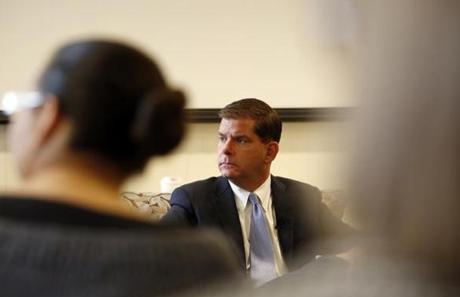
Martin J. Walsh at a Central Boston Elder Services meeting Thursday in Roxbury,

Martin J. Walsh at a Central Boston Elder Services meeting Thursday in Roxbury,

But I’m not just voting for Walsh because he is a union man.  I like his proposal to re-do the Boston Redevelopment Authority and what he has said about changes to education. There is also evidence from his time in the state legislature that he knows how to built coalitions.

I don’t know if Walsh can win, but I think he is the best man to make changes that will transition the City from the Menino Era.

Photograph:  Jessica Rinaldi For The Boston Globe

Random thoughts about the Red Sox and the World Series

I am exhausted.  Let’s face it the sixteen games played to take home the World Series Trophy (our Mayor Menino calls it the World Series Cup) have been emotionally draining and the cause of much sleep deprivation.  And I don’t have to get up and go to work!  Tampa Bay, Detroit, and St. Louis were all tough opponents.  (By the way, one of my predictions finally came true:  Sox in 6.)

Here are a few random thoughts about the Sox.

Bib Papi hugs manger John Farrell

Bib Papi hugs manger John Farrell

David Ortiz was the MVP of the Series.  He had a ridiculous batting average of .688 and we got to watch him play first during the games in St. Louis as if he played there every game.  People were whining about the rules that took away the DH, but in the end it didn’t hurt the Sox.  Maybe it did make Mike Napoli a little rusty at the plate but he did get a hit last night.  The thing about Ortiz is that he is the first non-Yankee to win three World Series with the same team (2004, 2007, and 2013) since Jim Palmer with the Baltimore Orioles (1966, 1970 and 1983).  I learned that from a Tweet from Peter Abraham.  Big Papi is probably going to play one more season and then retire.  What a hole that will leave!

If you don’t think a manager makes a difference just study the styles of Bobby Valentine and John Farrell.  One had respect from day one and it produced a winning team.  I don’t know for a fact, but I suspect that Valentine was forced on general manager, Ben Cherington.   Nick Cafardo wrote in today’s Boston Globe

Ben Cherington hit .400, won the Triple Crown for general managers, and then won the World Series.

He picked the right manager, the right players, and still had an eye for the future. He traded only redundant players, such as Jose Iglesias in a three-way deal for Jake Peavy, knowing he had Xander Bogaerts.

Cherington deserved the bucket of champagne, let alone the bottle, as the architect of the 2013 World Series champions.

,,,

While the perception is Bobby Valentine was forced on him, Cherington was able to decide to fire him and deal for Farrell, the manager he wanted all along. He allowed Farrell to name his coaching staff and continue pretty much what Terry Francona had done with the team prior to the September 2011 collapse.

Cherington cleared out the poisonous players. And then he watched it. Maybe it wasn’t completely like he mapped it out, but close, real close.

“Once we got into the season you don’t know what the outcome was going to be, but this was a different group of people,” said Cherington. “They were completely selfless. It was a lot of fun to be around. It’ll sink in two weeks from now.”

He combined the desire to prove everyone wrong, the players with chips on their shoulders, with some new chemistry. He hit the jackpot.

Carlton Fisk, sporting a phony beard, and Luis Tiant, with a real one, threw out the first pitch.

Carlton Fisk, sporting a phony beard, and Luis Tiant, with a real one, threw out the first pitch.

And then the Sox had history.  Having former players like Jim Rice, Pedro Martinez, Mike Lowell, Dennis Eckersley and many others hanging around the team even if they weren’t formally coaching has to have been a plus.  Even Carlton Fisk entered into the fun.

Someday soon it will all seem real.  It will be hot stove time and Ben Cherington will have to get to work.  Will Jacoby Ellsbury give up boat loads of money and do what Dustin Pedroia did and take the hometown salary to stay?  What about Napoli?  Will Salty take his longest name on a jersey and move on – and more important – do we want him to stay?

But those are questions for another day.  Bring on the Duck Boats and let’s have a parade!

Photograph:  Ortiz and Farrell, stan grossfeld/globe staff

Photograph:  Fisk and Tiant, Stan Grossfeld/Globe Staff

Poverty and microcredit

Ever since I read about Muhammad Yunus winning the Nobel Peace Prize for his Grameen Bank in his native Bangladeshi, I wondered why no one in the United States had thought of doing something similar for small businesses especially as credit got tighter.  Buried in the business section of yesterday’s New York Times was the story of the Grameen Bank in the Jackson Heights section of Queens.  There was microcredit offered in parts of the United States, I just didn’t know about it.  This, according to the Times story by Shaila Dewan, is how it works.

On a recent Thursday, dozens of Latina immigrants clustered in a small, noisy second-floor office in the Jackson Heights neighborhood of Queens, waiting for one of a half-dozen loan officers to call their names and hand over a check. Children loitered in the stairwell or sprawled, calflike, over their mothers’ laps.

The loans were recorded the old-fashioned way, with ink, in green passbooks that enumerated the borrowers’ commitments to “exercise responsible financial behavior,” “seek preventative health care” and meet each week in a “comfortable and safe place.” Aside from these words, little secured the loans in question, which ranged from $1,500 to $8,000.

In the United States, microcredit has generally been defined as loans of less than $50,000 to people — mostly entrepreneurs — who cannot, for various reasons, borrow from a bank. Most nonprofit microlenders include services like financial literacy training and business plan consultations, which contribute to the expense of providing such loans but also, those groups say, to the success of their borrowers.

Grameen America dispenses with the advice and makes smaller, less formal loans at a lower cost. It hews closely to the model developed in Bangladesh: borrowers form groups of five, approve one another’s loans and make weekly payments at 15 percent annual interest, a rate comparable to those charged by other nonprofit lenders. That is far less than the rates of payday lenders, which can charge 400 percent or more.

If everyone in the group repays on time, each member is entitled to a larger loan in the next cycle. Members are supposed to be below the federal poverty line when they join and use the money for entrepreneurial purposes. Grameen does not ask if they are legal residents.

What are the women doing with the loans?

In Jackson Heights, borrowers said they used the money to buy costume jewelry, Herbalife nutritional supplements or Mary Kay cosmetics for resale in home-based businesses or door to door, many supplementing income from another job like housecleaning. Some make cakes or empanadas; others tailor clothing or sell flowers. One woman buys designer clothes at closeouts and resells them from a tiny shop on the second floor of a commercial complex; another sends clothes home to the Dominican Republic, where her sister sells them on the street.

S. M. Nural Kabir fills out papers for borrowers, many of whom lack access to credit

S. M. Nural Kabir fills out papers for borrowers, many of whom lack access to credit

The question is:   Will selling Mary Kay bring a lot of families out of poverty?  Two women with storefront business were profiled in the story.

…Guadalupe Perez, 51, took a loan when business fell off during the recession. She and her husband were having trouble paying rent on the party decoration store they had started with their life savings. “It opened up a way for me to keep my business,” she said through an interpreter, standing near a display of ribbons and wine glasses that she had embellished with glittery designs. “I wanted to hear what the rules were for Grameen because I was afraid of going to a bank. It was a loan that I could pay little by little; I felt it was a good choice for me.”

Ms. Perez has used subsequent loans to expand the size of her store and now plans to invest in enough tablecloths to decorate two parties at the same time. But the loans have not increased her enthusiasm for entrepreneurship. Asked whether, had she the chance to do it over, she would go into business for herself, her answer was short and simple: no.

Ms. Perez said she and her husband worked every day and earned $500 to $600 a week, or about $29,000 a year — a “very low” income by federal standards for New York. They are not able to save.

Elizabeth de Jesus, 45, is a hairdresser who, with Grameen’s help, achieved her dream of opening her own salon in Corona, Queens. But she is unable to estimate her annual income. “I don’t know because I don’t keep it,” she said. “I spend it all on the payments, on the rent, on food. I spend it every week.”

The life of a small business owner is always difficult and I was surprised that there wasn’t more financial planning and management training provided by Grameen to those receiving loans.  There is, however,  one very bright light in the story:  establishing credit.

Grameen helps its clients in another way that many experts say is more important than increasing income — it establishes good credit scores. Many poverty alleviation groups have shifted their focus from saving to credit building, because people with poor or no credit must leave large deposits for basic needs like utilities, have trouble renting decent housing, pay much higher interest rates and have a harder time finding jobs.

Nayrobi Gonzalez de Quiroz, 26, recently received her first Grameen loan but decided not to follow through with her plan to buy handbags for resale. After using about $200 to pay off a debt, she said, she decided it was safer to leave the money in the bank and make the payments from her earnings as a manicurist.

“Here, you have to have good credit,” she said. “I have a young son and I have to think about his future.”

The results appear to be mixed.

Good data on the benefits of microcredit are scarce, and the few randomized studies have not demonstrated that it substantially improves prosperity in developing countries. In the United States, data collected by the Field program of the Aspen Institute show that microloans yield significant increases in income and create jobs. Joyce Klein, the program’s director, said the surveys had limitations but more rigorous studies that included randomized control groups would be prohibitively expensive.

Grameen says that its loan recipients have increased their incomes by an average of $2,500 during each six-month loan cycle, and that one in five hires an additional worker. But Katherine Rosenberg, a senior vice president at Grameen, acknowledged that pinning down income data is the group’s biggest challenge, because borrowers tend to think in terms of whether they have enough to cover their next bill, not how much they make over all. Ms. Rosenberg said many clients may not earn more but instead work less, dropping one of several low-wage jobs or taking advantage of the flexibility of self-employment to spend more time with their children.

Peer pressure produces a good repayment rate on microloans and I know they are not a magic bullet and way out of poverty, but it appears they have other benefits for those women who want to start businesses and/or build credit.   There is no easy way to break the cycle of poverty.

Photograph:  Ruth Fremson/The New York Times

Healthcare confusion

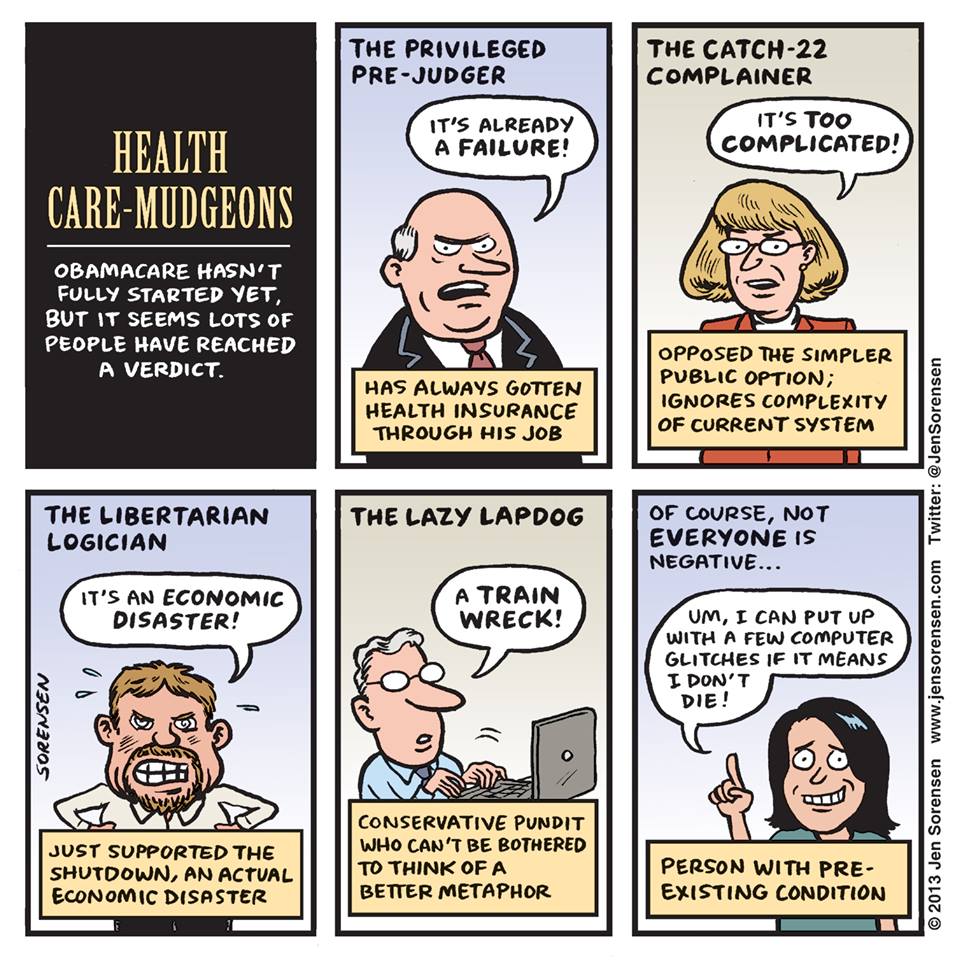
Let’s start with Jen Sorensen

Jen Sorenson

A lot of people are confused about what the Affordable Care Act does and don’t seem to realize that their insurance will actually come from a combination of Medicaid (or Medicare (for those who qualify) and a private insurer or just from a private insurer.  This is  the kind of insurance many got (I understand there are fewer offered these days) when they retired and got Medicare Advantage from a private insurer through their former employer as I do.  My retiree’s Medicare Advantage is partly subsidized by the City of Boston but I pay a monthly premium just as I pay a monthly premium for Medicare.  The ACA changes none of this for me.  And it changes nothing about employees who get qualified plans through their employers.  But to hear some of the Republicans carry on you would think that some staffer from the Department of Health and Human Services – or maybe Kathleen Sebelius herself will be performing medical exams.

As Gail Collins explained in her New York Times column today

The Democrats are depressed. The Republicans enjoy pointing out that the Obamacare rollout has been a mess. But they obviously can’t pretend to be upset that people are finding it hard to sign up for a program their party wanted to kill, eviscerate and stomp into tiny pieces, which would then be fed to a tank of ravenous eels.

Well, actually, they can.

“I haven’t heard one of you apologize to the American public,” Representative David McKinley of West Virginia sternly told government contractors who had worked on the HealthCare.gov Web site. McKinley’s party recently shut down everything from the national parks to preschool programs, while costing the economy an estimated $24 billion. Nobody apologized. Perhaps they’ll write a note this weekend.

“I’m damned angry that I and 700,000 Texans I represent have been misled, misled and misled,” said Representative Pete Olson. The only thing that could conceivably make Olson angrier would be if the Obamacare site was working so well that Texans could get health insurance as easily as they can order a chrome scarf holder from Amazon.com.

I thought these guys would be happy that people couldn’t get insurance and that the whole enterprise was a flop.  But maybe it is just the technical failures with the website that they don’t like.  I’m very confused.  As Andy Borowitz posted ” I guess once the Obamacare website is fixed the Republicans will be totally on board.”

But I don’t think the news will be good in the long run for the Republicans who want to repeal the ACA even if access to the sign-up website gets fixed.  This post from Sarah Kliff on Ezra Klein’s Wonkblog is likely just the start.

More than 330,000 people have managed to get deep enough into new government health insurance Web sites to learn how much financial assistance they will receive purchasing coverage, the Internal Revenue Service said Saturday.

That figure is arguably the most robust measure released to date by the Obama administration of how many Americans are successfully applying for financial help in purchasing a private insurance plan.

Calculations of financial assistance is a step that follows filing an application and tells applicants how much of a tax credit–if any–they can use to purchase a private health plan. This figure does not include shoppers who were found to likely qualify for Medicaid earlier in the shopping process.

The IRS said it has also received and responded to more than 1.3 million requests from the marketplace for personal data used to apply for Affordable Care Act programs, such as household income and family size.

The IRS said it is currently receiving about 80,000 such data requests each day. It is one of about a half-dozen agencies that send information to a federal data hub, along with the Department of Homeland Security and the Social Security Administration.

“Our IT systems are working well and providing both the historical tax data and the computation service accurately and quickly through the government’s data hub,” IRS spokesman Terry Lemons said. “The requests are being processed within seconds.”

This federal data hub determines eligibility for premium tax credits for the 36 states using the federal insurance marketplace and also for some, but not all, of the state-based exchanges. California, for example, opted to use its own technology to determine who qualifies for which programs.

The federal data hub was built by the contracting firm QSSI. The Obama administration announced Friday that QSSI would take on a new role as HealthCare.gov’s general contractor, overseeing efforts to fix the Web sites’ problems.

HealthCare.gov pings this federal data hub to verify a consumer’s identity and also when shoppers indicate in their applications that they would like to apply for financial assistance with coverage. Health and Human Services has said that, as of Thursday, 700,000 applications have been filed through the federal and state insurance exchanges.

People were slow to sign up when Massachusetts rolled out Romeycare and now there is close to universal coverage.  ACA sign-up, despite the problems is going even faster.

mass_enrollment_blue

The World Series: beards and music

Superstitious, I guess.  I didn’t want to write about the Red Sox in the World Series for fear of jinxing them.  Not that I have any such power, but with the baseball gods one never knows.  But now each team has had one horrid game – the Cardinals were worse than the Sox – and the Series is tied.  The Sox need to win at least one game in St. Louis to get back home team advantage.  This is beginning to feel like the games with Detroit that got them where they are.  That turned out OK, so we can still have hope.  All we need is for Jake Peavy to live up to his hype and for some combination of Clay Buchholtz/Felix Dubrount to pitch well and there is a chance for two wins.  And then we get Lester again.  So I’m feeling OK about the situation.  I feel badly for John Lackey who has had a great pitching year, but can’t seem to catch a break when it comes to run support and wins.

The player who did his job last night was Koji Uehara the accidental closer.  Once more.  3 outs on 10 pitches.  The beardless one.  I think we all assumed he didn’t have a beard because he couldn’t grow one.  We were wrong.  A few days ago, this story was in the New York Times.

Long, bushy beards have become the unifying trademark of the 2013 Boston Red Sox, but the most valuable player of their American League Championship Series victory stands out for more than his pitching.

The series M.V.P., the cleanshaven closer Koji Uehara, was given a pass on the team’s unofficial pro-beard policy because most of his teammates thought he was incapable of growing one.

But that is hardly the case. Well before the Red Sox’ shaggy faces entered the national consciousness, Uehara was a longstanding member of the antirazor brigade.

Until January, when he shaved it off on Japanese national television, Uehara had one of the most famous beards in Japan: light, Fu Manchu-style scruff with a wraparound beard connecting to his sideburns. It was considered ugly and brutish by many of his friends and countrymen, but he wore it defiantly for several years after coming to the United States in 2009.

Koji in Baltimore

People must have known.  I watched him pitch when he was with Baltimore, but I guess the beard never registered.  He also had a beard with the Rangers.

“I just didn’t know where I was going with that beard,” Uehara, 38, said through an interpreter Saturday afternoon before the final game of the A.L.C.S. “So I thought it was best to shave it off. It was a good time to do it, and I think many people were happy. They said I looked younger.”

Without facial hair, Uehara posted a career-low 1.09 E.R.A. in the regular season and had 21 saves after taking over as Boston’s full-time closer June 26. In the playoffs, he has been just as good, allowing one run in nine innings over eight games. He has five saves this postseason: two in a division series against the Tampa Bay Rays and three in the A.L.C.S. against the Detroit Tigers, including the save that clinched the pennant Saturday night.

But has shaving made him a better postseason pitcher?

“I don’t know,” he said, shrugging. “I am not sure about that.”

Whatever.  If being beardless got him MVP for the ALCS, then it is good for him and for us.

In one way, it makes sense that Uehara is now clean shaven in the midst of players who look like desert-island castaways. He originally grew his beard to stand apart from his teammates in Japan and from Japanese players in the majors, many of whom did not have facial hair.

Now that he is with a rowdy band of bearded Red Sox, he is distinguished in a different way.

“If I had a beard now,” he said, “I would not stand out.”

Meanwhile the symphony orchestras in Boston and St. Louis are getting in the act.  Even if you don’t root for either team this clip is wonderful.  I have to concede that the brass from St. Louis are better trash talkers, but the BSO has Seiji Ozawa.  http://www.youtube.com/watch?v=-_k8oICRBH4&feature=youtu.be

By the way, Boston in six.  With ZZ Top on our side, how can we lose?

Photograph: Mark Duncan/Associated Press

The more things change…

the more they stay the same.  I’m reading “The Mansion of Happiness” by Jill Lepore, a collection of essays arranged so they comprise a history of life and death which is the book’s subtitle.  Lepore is an historian and essayist.  (We heard her lecture on her newest book about Jane Franklin and my husband came home and ordered all of his books.)  One chapter is titled Mr. Marriage.  In it, Lepore recounts a number of things including the history of marriage counseling and the history of eugenics.  I bet you didn’t know they were connected; I certainly didn’t.

Cover of "Can This Marriage Be Saved?"

Cover of Can This Marriage Be Saved?

When I was a kid, my mother used to subscribe to the Ladies Home Journal and I would read “Can this Marriage Be Saved?”.  I wonder how many of my generation got some of their ideas about marriage from reading this feature.  In any case, Paul Popenoe who wrote the column was the father of marriage counseling.  He was also a leader in the movement to sterilize the “unfit” to prevent them from having children.  Lepore writes, ” He considered marriage counseling the flip side of compulsory vasectomy and tubal ligation:  sterilize the unfit; urge the fit to marry.”  The early eugenicists  were influenced by Darwin and the theory of evolution.  If one could breed better plants and livestock, why not better people?

Lepore writes

…In the United States, what come to be called social Darwinism provided conservatives with an arsenal of arguments in favor of laissez-faire economic policies, against social welfare programs, and in support of Jim Crow. “The Negro”, it was argued, was “nearer to the anthropoid or pre-human ancestry of men” than any other race, a living missing link; only slavery had prevented the extinction of the black American; if not for the peculiar institution, natural selection would have led to the death of the entire race.

I guess they ignored the fact that many, likely most, African-Americans had a white ancestor in the family tree.  No matter, Paul Popenoe thought about 10% of the population should be sterilized.  This would have been determined in part by the IQ test that was relatively new at the time and, of course, by race. In 1918, Popenoe wrote a book with Rosewell Hill Johnson titled “Applied Eugenics”.

Popenoe and Johnson deemed miscegenation “biologically wrong” because “the Negro lacks in his germ-plasm excellence of some qualities which the white races possess. For poverty, Popenoe and Johnson blamed the poor, citing a study reporting that 55 percent of  retarded children belonged to the laboring class.  The solution to want was to sterilize the needy.  Following Terman [Lewis M.], Popenoe and Johnson opposed old-age pensions, minimum-wage legislation, and child-labor laws: by helping the biologically and mentally unfit, these programs perpetuated a poor gene pool, just as slavery had protected blacks from extinction.

Echoes of the eugenicists can be heard in the current efforts of certain members of the Republican party who only wanted to fund programs they liked during the recent government shutdown.  And the intense dislike, maybe hatred isn’t too strong a word, of President Obama perhaps isn’t just because he is black, but because he is the product of a an African father and white mother.  You hear it in the effort to defund the Affordable Heath Care Act.  As my husband pointed out when I was reading Lepore and ranting, Ron Paul stated during a Republican Presidential debate the if someone couldn’t afford care or didn’t have a policy that would be their own responsibility.  (Going back to the transcript, Paul didn’t actually say that person should be left to die, but that nonprofits like churches would help after the hospital provided medical care, that having health insurance should be a private decision, and provision of health care should not be a governmental responsibility.  Actually, given the current state of the economy and the finances of nonprofits these day, it is the equivalent of letting someone die.)

I will listen to the arguments in the upcoming budget fight with great interest and I bet I will hear more echoes of Paul Popenoe.  The more things change…

A father remembers his daughter in music

Right after the shootings in Newtown, CT, I was listening to “Eric in the Evening”, the local jazz program on Boston’s WGBH public radio.  Eric Jackson, the host, said he was going to play some Jimmy Greene.  He explained that he had heard that Greene’s daughter, Ana, was among the victims.  So this story in the New York Times caught my eye.

Before last Dec. 14, Jimmy Greene had been a jazzman for most of his 38 years, well known among serious jazz fans. He had dozens of albums to his name. He played with such luminaries as Freddie Hubbard. He was a scholar, too, teaching jazz at a public university.

On Dec. 14, Mr. Greene’s 6-year-old daughter, Ana Márquez-Greene, who shared his passion for music and loved to listen to her father play, was a student at Sandy Hook Elementary School in Newtown, Conn. That was the day a gunman killed Ana along with 19 other children and 6 educators.

Weeks after the massacre, he slowly began accepting invitations to play publicly, as long as the performances were close to his Connecticut home. He returned to Western Connecticut State University, where he teaches jazz.

Slowly, Mr. Greene said, the spirit of Ana’s “beautiful life” began comforting and inspiring him to begin writing music again. Then there were the many musician friends, like Harry Connick Jr., who helped console him. One result is a new album called, appropriately, “Beautiful Life,” a work inspired by and dedicated to Ana’s life.

“I want it to give a sense of how she lived,” said Mr. Greene, who recently performed some of the music from the album at a jazz club on the Upper West Side of Manhattan. The nearly completed album, whose proceeds will go partly toward charities set up in Ana’s name, exemplifies a decision by the family not to let the pain of Ana’s death keep them from discussing her life, he said.

“It’s a way for us to keep Ana alive, and keep her on the tip of our tongues,” he said. “I don’t want to avoid talking about it because one problem we have in our culture is that if something is difficult, we don’t talk about it.”

I found this link to a YouTube tune called “Ana Grace” written before Ana was killed. http://www.youtube.com/watch?v=mVkVYJUsuDM

Ana loved to dance joyfully around the house and she loved Disney movies, including “The Princess and the Frog,” whose dark-skinned Princess Tiana appealed to her.

Mr. Greene asked the singer Anika Noni Rose, a childhood friend who was the voice of the princess in the film, to recite spoken word on his song “Little Voices” on the new album, which also features Kurt Elling, a Grammy Award winner, performing on “Ana’s Way,” and Javier Colon on “When I Come Home.”

The recording also includes a duet by Mr. Greene and the guitarist Pat Metheny of the hymn “Come Thou Almighty King,” which Ana liked to sing while her older brother accompanied her on the piano.

Ana Márquez-Greene

Ana Márquez-Greene

Greene performed songs from the album recently at the New York jazz club Smoke.

On the morning of the shooting, he was teaching and got a call from his wife — both are Hartford natives who have been together since high school — and he raced home preparing himself for anything. Many friends and relatives rushed to his house, including Mr. Connick, whose band Mr. Green was a member of for a long time. Mr. Connick later wrote a song called “Love Wins” for Ana and recorded it with Mr. Greene.

The horror that unfolded, Mr. Greene said, “has changed me as a human and you reflect that humanity in your art.”

“It shapes you as an artist when you lose something so precious,” he said on a recent Friday night between sets at Smoke jazz club in Manhattan. His band featured an all-star lineup of Renee Rosnes on piano, Ben Wolfe on bass and Jeff (Tain) Watts on drums.

Between songs, Mr. Greene thanked the audience for their prayers and condolences, which help him keep “strengthening day by day,” he said. The audience applauded after he talked about what happened last December and urged the audience to “show your love for each other often.”

“With that in mind,” he said, the next song would be Cole Porter’s “I Love You,” whose lyrics speak about those three words being hummed by the April breeze, echoed by the hills and seconded by the dawn.

This sounds like a wonderful tribute to a beautiful child.