The Police, Henry Louis Gates, Jr. and Racial Profiling

I know the controversy is just beginning.  Volumes will be written about the incident in Cambridge.  Both sides will defend themselves and blame the other side.  Everyone will play the race card.  People who already mistrust President Obama because of his skin color will use his remarks as proof they are right.

The best commentary I’ve seen on the incident so far is from Joan Vennochi writing this morning in the Boston Globe.  In her regular op-ed column Vennochi wrote

The arrest of Henry Louis Gates Jr. by a Cambridge police officer is playing out along racial lines. But it’s also about power and machismo – on both sides.

Machismo.  That’s the key.  Gates, whether true or not, felt he was being treated differently than a white man would be in his own home.  Years of disparate treatment combined with the ego that comes from being an important and respected person in your field, caused him to lose his temper.  The police sergeant, James Crowley, faced with a potential break-in and a tired angry man reacted, not by backing down, but by arresting him.

Gates was in his own home when a Cambridge police officer responded to a call about a possible break-in at that address. The professor had just returned home from filming a documentary in China. His front door was stuck shut and his taxi driver helped him pry it open. Then, Sergeant James Crowley appeared at his door and demanded to see identification. Gates provided it, although some facts about how and when are in dispute.

The police report states that Gates was arrested after exhibiting “loud and tumultuous behavior, in a public place, directed at a uniformed police officer who was investigating a report of a crime in progress.’’ Gates disputes some information provided in the police report, but does acknowledge that he responded with anger.

Human beings of all races have a tendency to react as Gates did, especially when they are tired, frustrated, and privileged. Police officers usually don’t like it. The question is whether this police officer responded more harshly because of skin color.

The answer isn’t obvious, but both men could use some sensitivity training. Gates shouldn’t have yelled at the police officer; still, what he did was irritating, not criminal. Once the officer determined Gates did live in the house, he should have left, no matter what the professor was shouting.

Harvey Silverglate, a criminal defense lawyer, civil liberties defender, and Harvard Law School graduate, believes Gates’s arrest should be investigated, but not only because of its racial implications: Was Gates arrested and held as a way to teach him a lesson? If so, asks Silverglate, “Is this acceptable, regardless of whether the citizen is white or black?’’

In an ideal world, no. When it happens to a black man, racism may be the easy explanation, but that doesn’t make it the only explanation. Life and power in 21st-century America are more complicated than that.

President Obama at his July 22 press conference offered this

Wednesday night’s press conference seemed to be a different deal as the president leaped into a highly charged controversy that has ignited passions across talk radio, the blogosphere and the old-fashioned water cooler.

But in fact, racial profiling was a major issue for Mr. Obama when he was in the Illinois legislature. He was the chief sponsor of a bill, which became law, that requires police to record the race, age and gender of all drivers they stop for traffic violations and for those records to be analyzed for evidence of racial profiling.

Mr. Obama, asked Wednesday what the incident said about race relations in America, noted up front that Professor Gates is a friend and that his comments might be biased. He said “words” had been exchanged and added:

“Now, I don’t know, not having been there and not seeing all the facts, what role race played in that, but I think it’s fair to say, number one, any of us would be pretty angry; number two, that the Cambridge police acted stupidly in arresting somebody when there was already proof that they were in their own home; and, number three, what I think we know, separate and apart from this incident, is that there is a long history in this country of African-Americans and Latinos being stopped by law enforcement disproportionately. And that’s just a fact.” He added later that the incident was “a sign of how race remains a factor in this society.”

He also used biting humor, grinning broadly as he imagined being in Professor Gates’s seemingly preposterous circumstance of being arrested after trying to get into his own home.

“Here, I’d get shot,” Mr. Obama said, referring to his new address of 1600 Pennsylvania Avenue.

The whole racial profiling question becomes curiouser and curiouser as we learn that the officer involved spent time at the police academy teaching racial profiling.

I heard a discussion this morning on MSNBC’s Morning Joe in which Joe Scarborough talked about the serious question of racial profiling and admitted that he would have probably had a similar reaction to Dr. Gates’ and likely would not have been arrested.  Perhaps what we need is a discussion of racial profiling and we can begin with a civil dialogue between Sergeat Crowley and Dr. Gates – an expert police profiler and one who has been profiled.  They both need to lose their machismo and have a serious talk.  No one would have to lose face and no one needs to apologize. Oh and yes, as Joan Vennochi suggested let’s throw in some sensitivity training.

Lessons from the Sotomayor Hearings

Over the weekend two very interesting pieces appeared.  One was Frank Rich’s column  in the New York Times, the other Melissa Harris Lacewell in the Nation.  Both approach the subject of Senatorial attitude toward a Latina woman.  One writer is a middle aged white male and former New York Times theater critic, the other a young, African American professor at Princeton. 

Here is Rich

Yet the Sotomayor show was still rich in historical significance. Someday we may regard it as we do those final, frozen tableaus of Pompeii. It offered a vivid snapshot of what Washington looked like when clueless ancien-régime conservatives were feebly clinging to their last levers of power, blissfully oblivious to the new America that was crashing down on their heads and reducing their antics to a sideshow as ridiculous as it was obsolescent.

The hearings were pure “Alice in Wonderland.” Reality was turned upside down. Southern senators who relate every question to race, ethnicity and gender just assumed that their unreconstructed obsessions are America’s and that the country would find them riveting. Instead the country yawned. The Sotomayor questioners also assumed a Hispanic woman, simply for being a Hispanic woman, could be portrayed as The Other and patronized like a greenhorn unfamiliar with How We Do Things Around Here. The senators seemed to have no idea they were describing themselves when they tried to caricature Sotomayor as an overemotional, biased ideologue.

And here Harris-Lacewell

The hearing was a performance of a broader set of social rules that govern race and gender interactions in American politics. Women, and most especially black and brown women, have to prove their fitness for public life by demonstrating the ability to endure harsh brutality without openly fighting back. The ability to bear up under public degradation is a test of worth. America’s favorite black woman heroine is Rosa Parks, a woman who is remembered as silently enduring the humiliation of being ejected from a public bus for refusing to comply with segregated seating.

Sotomayor passed the test. She met the Senators’ questioning with thoughtful responses. Her voice did not quiver. Her face did not scowl. Many women of all races feel inspired by her. But I wonder about this lesson that continues to teach women that we can only have space in the public realm as long as we control all emotion.

They are both describing what Harris-Lacewell calls “the politics of public humiliation.”  The practice of this kind of politics in the year 2009 says more about the Republicans than about Sotomayor – or the current status of women of color.

Rich ties the Republicans to the Class of  1994, the Class of the Contract with America, the Newt Gingrich class.

That the class of ’94 failed on almost every count is a matter of history, no matter how hard it has retroactively tried to blame its disastrous record on George W. Bush. Its incompetence may even have been greater than its world-class hypocrisy. Its only memorable achievements were to shut down the government in a fit of pique and to impeach Bill Clinton in a tsunami of moral outrage.

…Today the G.O.P.’s token black is its party chairman, Michael Steele, who last week unveiled his latest strategy for recruiting minority voters. “My plan is to say, ‘Y’all come!’ ” he explained, adding “I got the fried chicken and potato salad!”Among Sotomayor’s questioners, both Coburn and Lindsey Graham are class of ’94. They — along with Jeff Sessions, a former Alabama attorney general best known for his unsuccessful prosecutions of civil rights activists — set the Republicans’ tone last week. In one of his many cringe-inducing moments, Graham suggested to Sotomayor that she had “a temperament problem” and advised that “maybe these hearings are a time for self-reflection.” That’s the crux of the ’94 spirit, even more than its constant, whiny refrain of white victimization: Hold others to a standard that you would not think of enforcing on yourself or your peers. Self-reflection may be mandatory for Sotomayor, but it certainly isn’t for Graham.

Harris-Lacewell puts it this way

All Supreme Court nominees endure tough, ideologically driven questioning. It’s as true for white male conservative justices as for Sotomayor. But this public display took on different meaning as white men repeatedly asserted that Sotomayor was capable of making legal judgments based only on her personal experience and ethnic identity.

I was proud of Sotomayor’s restraint, but I also wanted her to counter attack, to punch back, to show anger. She couldn’t do so in part because she is bound by the rules of judicial decorum. She also couldn’t do so because of the racialized, gender rules of political engagement that allow white men, from senators to firemen, to express outrage, indignation, and emotion, but disallow those same expressions from women of color.

So what have we learned?  We have learned that maybe Lacewell-Harris is right when she compares Sonia Sotomayor to Little Rock Nine student, Elizabeth Eckford.

One of the most enduring images of the Civil Rights Movement is of Elizabeth Eckford. She is being harassed and taunted by a group of white students, parents, and police on her way to desegregate Central High School in Little Rock, Arkansas. On that morning Eckford missed connecting with the eight other African American students of the Little Rock Nine and their NAACP leader, Daisy Bates. Eckford was alone when the angry crowd surrounded and confronted her

Only now the mob is the composed of white, mostly southern, Republican Senators.

We have learned that women, regardless of race, regardless of how successful they may be,  still have to behave differently than men, that there is still a double standard.

We have learned, again, that the Republican Party is mostly clueless when it comes to race.  And I believe that their fear and dislike of Barack Obama will drive most of their behavior over the next eight years.

Virginia Sweet and Henry Allingham

Today, forty years ago, Neil Armstrong set foot on the moon.  In the last few days two pioneering pilots, one from World War I and the other from World War II have died.

VIRGINIA SWEET

Virginia Sweet’s obituary as published in the Boston Globe is short so here it is in its entirty.

Inspired by a story she read as a young girl about Amelia Earhart’s trans-Atlantic flight, Virginia Sweet became a pioneering female aviator in her own right.

She was a pilot with the Women’s Airforce Service Pilots, ferrying every imaginable type of military aircraft from factories to air bases during World War II to free male pilots for combat overseas.

Sometimes Ms. Sweet was assigned to fly shot-up, barely functional aircraft in for repair. Thirty-eight of her fellow female fliers were killed during duty.

After the war, when these Rosie the Riveters of the skies no longer were needed, the nation essentially turned its back on Ms. Sweet and hundreds of Women’s Airforce Service Pilots like her.

The longtime Schenectady resident died July 12 at 88, two weeks after President Obama signed a law that offered recognition and Congressional Gold Medals, the highest award Congress can give to a civilian, to the WASP fliers.

Ms. Sweet prided herself on a five-decade flying record without an accident

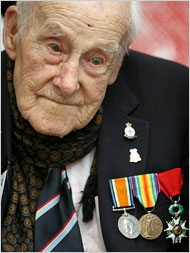
Henry Allingham was one of the few veterans of World War I still alive when he died at aged 113.  The New York Times obituary tells his story.

An iconic figure to many in Britain, Mr. Allingham did wartime service including stints on land, in the air and at sea. In 1915, he flew as an observer and gunner in the Royal Naval Air Service, hunting zeppelins over the North Sea. He was aboard one of the Royal Navy ships that fought in the Battle of Jutland in 1916, in which Britain lost 14 ships and 6,000 seamen.

Mr. Allingham was born in London in 1896. He lost his father to tuberculosis the next year. After his mother also died, he was raised by a grandmother. He became a trainee maker of surgical instruments before moving into the motor trade, training as a mechanic. After his wartime service, he worked until retirement for the Ford Motor Company. Judged to be too old to serve in combat in World War II, he was assigned to a project that sought to neutralize German magnetic mines.

The Associated Press  news account of Mr. Allingham’s death has this wonderful account

He spent the war’s first months refitting trucks for military use, but when his mother died in June 1915, he decided to join after seeing a plane circling a reservoir in Essex.

Only a dozen years after the Wright brothers first put up their plane, Allingham and other airmen set out from England on motorized kites made with wood, linen, and wire. They piled on clothes and smeared their faces in Vaseline, whale oil, or engine grease to block the cold.

“To be honest, all the planes were so flimsy and unpredictable – as well as incapable of carrying large fuel loads – at the start of the war that both British and German pilots would immediately turn back rather than face each other in the skies if they did not enjoy height supremacy,’’ Allingham would later write.

As a mechanic, Allingham’s job was to maintain the rickety craft. He also flew as an observer on a biplane. At first, his weaponry consisted of a standard issue Lee Enfield .303 rifle – sometimes two. Parachutes weren’t issued. He fought in the Battle of Jutland, the largest naval battle of World War I. He served on the Western Front.

We owe Virginia Sweet and Henry Allingham not only for their service during war, but for their part in advancing aviation.  As anyone who plays Sid Meir’s Civilization knows:  you have to have flight before you can get rocketry.

Health Care: A couple of things to think about

I’m like most Americans:  I have employer paid health care with pretty decent coverage and better than average care.  I belong to a doctor run HMO.  I like my primary care doctor who shares my philosophy that less can be more when it comes to drugs, but she makes sure that I get all the necessary tests amd tracks the results which I can see online.  But the cost of my coverage keeps going up and what I contribute to the cost will be a big part of our next union negotiations.

So this whole debate about reform boils down to two things for me.  First, can care be provided more efficiently and at less cost for everyone.  Two, we need to solve the question of the uninsured because we all pay when they use the emergency room for care. 

I live in Massachusetts and we have made a stab at universal coverage which is now under a great deal of pressure given the fiscal situation for the state.  But one thing I have observed is that without national reform on things like Medicare and Medicaid, states will have trouble balancing coverage with cost.  Somehow we have to control costs and improve quality.  I posted about this in my piece on Health Care as a Subprime Mortgage.

So here are a couple of other things to consider.  Nate Silver  did an analysis of where the largest concentrations of uninsured are living. 

Throughout last year, Gallup included a module on health and well being in their standard tracking surveys. This meant they had tens of thousands of interviews between all 435 Congressional Districts. One of the questions on the well-being module was about whether or not people had health insurance. Eric Nielsen at Gallup was kind enough, a while back, to send me these results broken down by Congressional District.

The median Congressional District has an uninsured population of 14.6 percent, according to Gallup’s data (the average is slightly higher at 15.5 percent). Of the 48 McCainocrat districts, 31 (roughly two-thirds) have an above-median number of uninsured. A complete list follows below (actual Blue Dogs are denoted in … you guessed it … blue):


So why are the blue dog Democrats so unwilling to vote for reform? 

 The second thing to consider is the Dennis Kucinich amendment.  Joshua Holland writes on Alternet

No time today for a lengthy analysis of the Tri-Committee health bill. My quick-and-dirty take is this. Those who think the bill is a wonderful progressive victory with a robust public option are wrong, and, on the flip side, the charge that it’s a “bailout for the insurance industry” is totally divorced from what the bill would actually do if passed.

 It is the most progressive, comprehensive and significant health care legislation to come down the pike since Medicare was passed in 1965. If it were enacted as written, it’d go a long way to solving a lot of our problems (but by no means all) and wouldn’t break the bank in the process.

 But it also fails some of the basic criteria that most progressives have long said is a red-line that can’t be crossed. First and foremost, it doesn’t have a public option that can compete with private insurers and result in significant cost savings. 

Enter the Kucinich Amendment,

Obviously, a public insurance plan for which 10 million are eligible to enroll isn’t going to serve as an example of the efficiency that comes with a single-payer type system. And the fact that they designed a pretty good public option for which most of the public will be ineligible to enroll (and that wouldn’t have as much potential for cost savings as one would hope) was enough to make me consider opposing it. Howard Dean told me recently that he thought a bill without a robust public option wasn’t worth passing, and I agree.

 And that’s where Kucinich, a supporter of single-payer, comes in. He’s trying to save the whole promise of this project.

 On Friday, an amendment he authored was added to the House bill that allows states to create their own single-payer systems instead of adopting the federally-run exchange system. The original bill allowed states only to enact their own exchange system — it was a nod to federalism — with the proviso that if a state (think a deep red one in the South) refused to adopt the plan, the feds could step in and set it up.

 The Kucinich amendment is really key. If it were to survive the legislative sausage-making and be enacted into law, the we might expect a progressive state to take advantage of the opportunity and enact a single-payer system in the coming years. And, if those of us who have been pushing such an arrangement are correct, the result will be greater access and better outcomes at a lower price tag for that state’s residents. 

Health care reform is going to cost us, but I think doing nothing will cost more in the long run.  I am looking forward to President Obama’s Wednesday press conference where this will probably be topic A.  Stay ‘tooned.

Nancy Drew, Cherry Ames, and Vicki Barr

Nancy Drew figured in the recent hearings for Sonia Sotomayor to become a judge.  It seems that Hillary Rodham Clinton, Ruth Ginsberg, and Sonia Sotomayor all read the series when they were growing up.  I have to say that I hated the Nancy Drew books.  Oh, I’ve read one or two when they were there and there was nothing else to read, but I much preferred Cherry Ames (the nurse who solved mysteries) or Vicki Barr (the flight attendant who did the same).

In her article in the New York Times, Jan Hoffman recounts the many successful women who read, enjoyed and consider Nancy Drew a role model.

Touchstone, pole star, reflecting pool. Often what women remember about the books speaks to who they were — shy girls seeking inspiration; smart girls seeking affirmation. The series even gave voice to girls who rebelled against the Girl Sleuth’s pearl-necklace perfection.

All told, the women’s recollections capture the impact of a formulaic, ghostwritten series approaching its 80th year.

Since its debut in 1930, the series has thrived in a germ-free bubble, scarcely brushed by time and social upheaval. Nancy Drew, 16 or 18, depending on the edition, is a daddy’s girl, living with her father, Carson, a lawyer — her mother conveniently died when she was 3 — and housekeeper, Hannah Gruen, in a comfortable home in River Heights where the words “Amber Alert” have never been heard.

With curiosity and confidence, she attacks mysteries and solves them, helped by her friends Bess, who is always “pleasingly plump,” and George, a slim tomboy. There’s a harmless boyfriend, Ned Nickerson, about whom the actress Ellen Barkin once snickered, “He was like her driver to me.”

But others feel the way I do about Nancy

“Nancy is too perfect,” said Laura Lippman, 50, who writes a popular series about Tess Monaghan, a detective with questionable taste in boyfriends and an aversion to rules. Even Nancy’s father “is helpless in front of her perfection. She requires Bess and George to constantly talk about her perfection. Bess is fat and George is unfeminine and they are not as fabulous as Nancy.”

In the very early days of the internet and email, I participated in a discussion group with a number of women.  The topic of Nancy Drew came up and I famously wrote that I didn’t like her because you never felt she ever used the bathroom.  This is the perfection Lippman is speaking about.

Vicki Barr and Cherry Ames were also mid-westerners with supportive families but they left those families to pursue their professions and dreams.  They had interesting friends and were not the center of their own universe although they were the center of their cicles. 

Cherry Ames became a nurse to serve during World War II.  The first six books, Student Nurse, Senior Nurse, Army Nurse, Chief Nurse, Flight Nurse, and Veterans’ Nurse specifically discuss the war, the war effort, and her role.  Her brother went to fight in the war.  I liked her because she actually did stuff. Instead of Ned Nickerson, Cherry had doctors and other professional men hanging around.  But Cherry also taught us that one has to study to achieve our goals.  The first two books are set during her nurse training days.

But my favorite is Vicki Barr.  The books are set just after the end of World War II when passenger flights were becoming more popular and less of a novelty.

She reads this ad and talks her way into the class as she in not quite old enough.  In fact, she has to get a letter from her parents giving permission.

“If you are twenty-one to twenty-eight, and single – if you are a registered nurse, or if you have at least two years of college or of business experience in dealing with people – then here’s the most appealing job in the world!  Apply tomorrow!”


Vicki Barr, like Cherry Ames. had a profession for which she had to be trained.  She lived in an apartment in New York City with other stewardesses as they were then called.  The first book is about their training which was quite extensive and talked about responsibility for passenger safety.  The women who were Vicki’s frends and roommates were diverse, if not racially than in background and even age.  She flew a lot of different routes and involved herself in the lives of her passengers which is how she came to solve mysteries.  Like Cherry, Vicki had cool boyfriends like the pilot, Dean, and newspaper man, Pete.  The boyfriends were always enlisted to help her solve the case, but not to rescue her.

I still read mysteries and I still prefer women sluths, but in response to Jan Hoffman’s question,  “And who was your Nancy Drew?”  I have to say Vicki Barr.  Besides, the first one was published the year I was born.

Sonia Sotomayor and Senator Graham

Let’s look at this exchange as published in the Washington Post

GRAHAM: Now, during your time as an advocate, do you understand identity politics? What is identity politics?

SOTOMAYOR: Politics based simply on a person’s characteristics, generally referred to either race or ethnicity or gender, religion. It is politics based on . . .

GRAHAM: Do you embrace identity politics personally?

SOTOMAYOR: Personally, I don’t as a judge in any way embrace it with respect to judging. As a person, I do believe that certain groups have and should express their views on whatever social issues may be out there. But as I understand the word “identity politics,” it’s usually denigrated because it suggests that individuals are not considering what’s best for America.

. . .

GRAHAM: Do you believe that your speeches properly read embrace identity politics?

SOTOMAYOR: I think my speeches embrace the concept that I just described, which is, groups, you have interests that you should seek to promote, what you’re doing is important in helping the community develop, participate, participate in the process of your community, participate in the process of helping to change the conditions you live in.

I don’t describe it as identity policies, because — politics — because it’s not that I’m advocating the groups do something illegal.

GRAHAM: Well, Judge, to be honest with you, your record as a judge has not been radical by any means. It’s, to me, left of center. But your speeches are disturbing, particularly to — to conservatives. . . . Those speeches to me suggested gender and racial affiliations in a way that a lot of us wonder: Will you take that line of thinking to the Supreme Court in these cases of first precedent?

Sen. Lindsey O. Graham is viewed as a bellwether for how large a majority of the Senate will vote for Supreme Court nominee Sonia Sotomayor.

The Republicans have spent most of their time over the last four days trying to figure out what makes Judge Sotomayor tick.  I think the answer is pretty simple:  Yes, she is a woman and yes, she is Latina and in her private time, she may volunteer for groups that advocate those causes.  But when she is a judge, she is not an advocate.   And that’s why none of you could find anything objectionable in any of her many decisions.  Isn’t that what you said you want from a judge?  Isn’t that why you were all upset about empathy?  Sonia Sotomayor has shown that she has empathy and that she rules according to the facts and the law.  I think that is what you said you wanted.

Sonia Sotomayor – Day 3

Except for Senator Coburn’s lame attempt at doing a racist Ricky Ricardo imitation and the discussion with Al Franken about Perry Mason, nothing much happened yesterday.

The best summary I’ve seen of the hearing so far is by Liz Halloran of NPR.

Grain commodity trading contracts. Orange peels for animal feed. Goose bumps. Fendi. Securities law. The baseball All-Star game. And Perry Mason.All were on the table Wednesday as her advocates worked to run out the clock on Supreme Court nominee Judge Sonia Sotomayor’s confirmation hearing.

Republicans On Sotomayor:

Sotomayor disses heroic firefighters.

She thinks people have different physiologies.

She gives shocking speeches about ethnicity and judgment that undermine her 17 years on the bench.

She might support a woman’s right to abortion.

The National Rifle Association has reservations about her.

And some lawyers who have appeared before her think she’s a pushy broad.

Democrats On Sotomayor:

Her mind is always open.

Jurors are heroes.

She was once a prosecutor.

Did they mention she was a prosecutor?

She is dispassionate when it comes to the law.

She loves facts, not hypotheticals.

She’s tough on white-collar criminals and sends them to prison.

She believes in deference to each branch of government.

Hispanic chambers of commerce support her.

She supports voting rights.

Her life story gives Democratic Sen. Sheldon Whitehouse of Rhode Island “goose bumps.”

And she really, really wishes she was better at rhetorical flourishes.

And there you have it. 

Day 4 coming up.

Obama and the All-Stars

The President is a White Sox fan to which I say, “wrong color sox, Mr. President.”  But leaving partisanship aside, it appears that he was the first President to be at an All-Star game since 1978 – when I think the President was Jimmy Carter.

Obama Throws First Pitch

We already knew that basketball and not baseball was Obama’s game so we shouldn’t be surprised when

Obama, who warmed up with Pujols in the batting cage, threw a pitch that was a lot slower than one of Tim Wakefield’s knuckleballs.

Jack Curry  goes on in the New York Times Bats blog

Before Obama tossed the first pitch, he stopped to shake hands with Stan Musial, a Hall of Famer for the Cardinals, who was sitting in a red golf cart. After Obama’s pitch, he shook hands with Bob Gibson, Ozzie Smith, Bruce Sutter, Red Schoendienst and Lou Brock, the other living Cardinals who are in the Hall. Brock saluted Obama, who saluted back.

When Obama visited the National League clubhouse before the game, Shane Victorino of the Philadelphia Phillies, a fellow Hawaiian, gave the president some macadamia nuts. The players had been advised not to give Obama anything, but Victorino did anyway, and his teammates howled.

Witnesses said Obama glided from player to player before the game, shaking hands and exchanging small talk. Obama spent the most time with Pujols. He also teased Pujols, who plays here, and Ryan Howard, who is from here, about losing the Home Run Derby to Prince Fielder on their home turf.

The last time Obama threw out the first pitch was before Game 2 of the 2005 American League Championship Series, so he was pitching on 1,371 days’ rest. Those White Sox won eight consecutive postseason games and a World Series title. After Obama noted how he brought his favorite team some luck, he added, “Any of these teams need a lefty

Interestingly, Obama also visited the umpires before the game and signed things for them and for a charity auction. Alan Schwartz  wrote in Bats

So 40 players and staff on each All-Star team got 15-minute clubhouse drop-ins from the president? Big deal. The six umpires got 10 minutes all to themselves.

“For the leader of the free world to take the time to talk to us lowly umpires was just incredible,” the left-field ump Tim Timmons said. “I barely remember it, I was just in awe.”

Don’t think that has happened before.

And finally there is this.  Alan Schwartz asked some players –  no Red or White Sox – what they would ask the President.

— Miguel Tejada, Astros: “How does it feel to have all that power?
— Prince Fielder, Brewers: “When do you get to just watch TV? When can you just sit and not talk to nobody?”
— Trevor Hoffman, Brewers: “Did you think that things would slow down once you got into the White House?”
— Zach Duke, Pirates: “What’s the highest bowling score you’ve gotten down there?”
— David Wright, Mets: “Something about A.C.C. basketball. I know he hooped it up with the Tar Heels.”
— Adrian Gonzalez, Padres: “Can you get us a college football playoff?
— Brian McCann, Braves: “When’s the economy going to turn around?”
— Carlos Pena, Rays: “Are you a see-it-to-believe-it person or a believe-it-to-see-it person?”
— Mark Teixeira, Yankees: “Who was your favorite athlete growing up, when you were just a kid enjoying sports?”
— Curtis Granderson, Tigers: “Are you tired? Do you get stressed?”
— Michael Young: “How can I help?”

And about the game:  The American League won.  Beckett and Wakefield did not pitch.  Youk and Bay each had a hit and Pap had a one-two-three inning but one of his high wire performances.

Sonia Sotomayor – Day 2

Does Senator Jeff Sessions understand the roles of the various courts?  Does he understand the use of precedent?  Is he really a lawyer?  Kate Phillips blogging the hearing in the New York Times

Judge Sotomayor, confronted by Senator Sessions about how her take on a wise Latina’s decisions differed from that of Judge Miriam Cedarbaum, pointed out that Ms. Cedarbaum was her friend and was sitting in the audience. (In one of her speeches, Ms. Sotomayor had referred to Ms. Cedarbaum’s discussions about the number of women joining the bench and whether those numbers were having any impact.)Mr. Sessions repeatedly said he was “troubled” and very concerned as to whether she could be impartial if she couldn’t put her experiences aside. Ms. Sotomayor replied that she believed she did apply the facts to each case, and applied the law.

We all see the world through our own lens.  Sessions, whether he wants to admit it or not, see the world through his white, Southern, racist one.  To expect any judge to lay aside his or her experience when looking at a case is to want robots or cyborgs to become judges.  However, we do not want them to judge cases on emotion or experience alone, they must also apply the law.

Howard Fineman blogging this afternoon for Newsweek wrote

Sotomayor was saying that it was better to admit the existence of personal biases, and then control them with that knowledge. Sessions was forced to argue that a judge must come to the bench with no biases whatsoever─an ironic position indeed for a son of the segregated Deep South.

Senator Schumer tried to tackle this issue.  Phillips writes

He began by knocking down concerns over empathy that Republicans have cited: “Now I believe that empathy is the opposite of indifference,” he said, adding “the opposite of having ice water in your veins.”

He then went through a number of cases, including the litigation around the plane crash into Long Island Sound brought by the surving families.  Even though she, along with everyone in the country, felt for the plaintiffs, she applied the relevant law and ruled against them.

And then there was her Republican “supporter”, Lindsey Graham, who turned condesending and lecturing

Mr. Graham has been one of the more outspoken critics in the Senate about the judge’s wise Latina remarks. As we mentioned Monday, he complained, around the time of his meeting with her, that as an “everyday white guy,” he wouldn’t have been able to get away with such comments.During his session today, Senator Graham pounded home that point. Perhaps this was his Southern upbringing coming out, but at one point as he wove his way through his objections to her statements, he said, “Do you understand, ma’am?”

If he had uttered those words — that as a white man he would make a better decision, for example, against a minority opponent in a political race, “they would have my head,” Mr. Graham declared.

In a chastising voice, Mr. Graham added: “It would make national news and it should. Having said that I am not going to judge you by that one statement. I just hope you’ll appreciate the world we live in, meaning you can say those things and still inspire somebody and still get a chance to get on the Supreme Court.” If others used those words, they “wouldn’t survive.”

Does that make sense? he asked.

Yes, she answered.

And then she went to to hope that we will move past this type of thinking and had Graham agreeing that if the hearing moved the discussion closer to this goal, it would have been worth while.

Back to Fineman

So it goes: pretty easily for the judge. The feeling in the Hart Building hearing room today is almost sleep-inducing, for the following reasons

  • The discipline, preparation, canniness, record, and intellect of the nominee.
  • The ambivalence, even confusion, of her GOP interlocutors (with the exception of the canny Lindsey Graham).
  • The nature of confirmation hearings, which have become a form of predictable puppet theater, especially since everyone knows in advance that Sotomayor has the votes.

Aside from her personal demeanor─calm, almost painfully explanatory─Sotomayor’s best weapon in the hearings has been her record as a judge. There just aren’t many cases that the GOP has been able to cite to make her sound like a wild-eyed “activist,” liberal or otherwise. So far, they have mentioned about 10 of her cases, out of hundreds.

This Wasserman cartoon from the Boston Globe sums it up well.

07.14%20WISE%20LATINA%20copy

Sotomayor: Day One

It was the first day of confirmation hearings for Sonia Sotomayor.  She didn’t get to say much and it is a good thing she has all that experience on the bench where she learned to listen because the Senators all got to make opening statements.  And when she did speak, she was short and to the point as she talked about her background and her judicial philosophy “assuring senators that she believes a judge’s job “is not to make law” but “to apply the law,” as the two parties used her nomination to debate the role of the judiciary.”

Al Franken made his debut as a Senator,

As most of you know, this is my fifth day in office,” he said, as a few people laughed. He then turned somber, saying that he took his oath of office very seriously.

I thought he was clearly a little nervous as he said he represented the common person, the one who is not a lawyer.

But the real kicker was Senator Jeff Sessions.  I think he resented the fact that he never made it though his district court nonination hearings and now had to be the ranking Republican on a Judiciary Committee about to confirm an Hispanic woman to the Supreme Court.  He came off as a bitter, sour old white guy.

Eugene Robinson writes in this morning’s Washington Post

The only real suspense in the confirmation hearings for Supreme Court nominee Sonia Sotomayor is whether the Republican Party will persist in tying its fortunes to an anachronistic claim of white male exceptionalism and privilege.

Republicans’ outrage, both real and feigned, at Sotomayor’s musings about how her identity as a “wise Latina” might affect her judicial decisions is based on a flawed assumption: that whiteness and maleness are not themselves facets of a distinct identity. Being white and male is seen instead as a neutral condition, the natural order of things. Any “identity” — black, brown, female, gay, whatever — has to be judged against this supposedly “objective” standard.

Thus it is irrelevant if Justice Samuel A. Alito Jr. talks about the impact of his background as the son of Italian immigrants on his rulings — as he did at his confirmation hearings — but unforgivable for Sotomayor to mention that her Puerto Rican family history might be relevant to her work. Thus it is possible for Sen. Jeff Sessions (R-Ala.) to say with a straight face that heritage and experience can have no bearing on a judge’s work, as he posited in his opening remarks yesterday, apparently believing that the white male justices he has voted to confirm were somehow devoid of heritage and bereft of experience

Amy Klobuchar captured the diversity issue in a different way in her statement as quote in the New York Times live blog on the hearings

In describing their varied experiences, Ms. Klobuchar notes that sitting near her is Senator Whitehouse, who grew up in Laos and Cambodia as the son of a diplomat while she worked as a carhop at the A&W Root Beer stand. In addition, she pointed out, while Senator Hatch is a gospel music songwriter, Mr. Leahy is quite the Dead-head and once had difficulty taking a call from the president because he was onstage at a Grateful Dead concert.

Eugene Robinson again

The whole point of Sotomayor’s much-maligned “wise Latina” speech was that everyone has a unique personal history — and that this history has to be acknowledged before it can be overcome. Denying the fact of identity makes us vulnerable to its most pernicious effects. This seems self-evident. I don’t see how a political party that refuses to accept this basic principle of diversity can hope to prosper, given that soon there will be no racial or ethnic majority in this country.

There is, after all, a context in which these confirmation hearings take place: The nation continues to take major steps toward fulfilling the promise of its noblest ideals. Barack Obama is our first African American president. Sonia Sotomayor would be only the third woman, and the third member of a minority group, to serve on the nation’s highest court. Aside from these exceptions, the White House and the Supreme Court have been exclusively occupied by white men — who, come to think of it, are also members of a minority group, though they certainly haven’t seen themselves that way.

Judging from Monday’s hearing, some Republican senators are beginning to notice this minority status — and seem a bit touchy about it.

Sotomayor confirmation hearing

Day Two, coming up.