Cameron Todd Willingham and the Death Penalty

I haven’t had the chance to read the article in the New Yorker Magazine by David Grann but Bob Herbert has written a powerful op-ed in today’s New York Times about Cameron Willingham’s execution by the State of Texas.

There is a long and remarkable article in the current New Yorker about a man who was executed in Texas in 2004 for deliberately setting a fire that killed his three small children. Rigorous scientific analysis has since shown that there was no evidence that the fire in a one-story, wood frame house in Corsicana was the result of arson, as the authorities had alleged.

In other words, it was an accident. No crime had occurred.

Cameron Todd Willingham, who refused to accept a guilty plea that would have spared his life, and who insisted until his last painful breath that he was innocent, had in fact been telling the truth all along.

The fire broke out on the morning of Dec. 23, 1991. Willingham was awakened by the cries of his 2-year-old daughter, Amber. Also in the house were his year-old twin girls, Karmon and Kameron. The family was poor, and Willingham’s wife, Stacy, had gone out to pick up a Christmas present for the children from the Salvation Army.

Willingham said he tried to rescue the kids but was driven back by smoke and flames. At one point his hair caught fire. As the heat intensified, the windows of the children’s room exploded and flames leapt out. Willingham, who was 23 at the time, had to be restrained and eventually handcuffed as he tried again to get into the room.

According to Grann and Herbert,  an incompetent arson investigator decided the fire was arson, witnesses decided that Willingham had not tried to rescue his children and there was a jailhouse snitch.   Herbert continues

Willingham was arrested and charged with capital murder.

When official suspicion fell on Willingham, eyewitness testimony began to change. Whereas initially he was described by neighbors as screaming and hysterical — “My babies are burning up!” — and desperate to have the children saved, he now was described as behaving oddly, and not having made enough of an effort to get to the girls.

And you could almost have guaranteed that a jailhouse snitch would emerge. They almost always do. This time his name was Johnny Webb, a jumpy individual with a lengthy arrest record who would later admit to being “mentally impaired” and on medication, and who had started taking illegal drugs at the age of 9.

The jury took barely an hour to return a guilty verdict, and Willingham was sentenced to death.

He remained on death row for 12 years, but it was only in the weeks leading up to his execution that convincing scientific evidence of his innocence began to emerge. A renowned scientist and arson investigator, Gerald Hurst, educated at Cambridge and widely recognized as a brilliant chemist, reviewed the evidence in the Willingham case and began systematically knocking down every indication of arson.

The authorities were unmoved. Willingham was executed by lethal injection on Feb. 17, 2004.

The fundamental problem with the death penalty is that you can’t take it back. 

Now comes a report on the case from another noted scientist, Craig Beyler, who was hired by a special commission, established by the state of Texas to investigate errors and misconduct in the handling of forensic evidence.

The report is devastating, the kind of disclosure that should send a tremor through one’s conscience. There was absolutely no scientific basis for determining that the fire was arson, said Beyler. No basis at all. He added that the state fire marshal who investigated the case and testified against Willingham “seems to be wholly without any realistic understanding of fires.” He said the marshal’s approach seemed to lack “rational reasoning” and he likened it to the practices “of mystics or psychics.”

Cameron Todd Willingham was executed by the State of Texas on no evidence.  Who will pay for his death?

What I did on my vacation

If I were President Obama, I would have to write something like this “I was going on vacation but there was a hurricane so I was late.  Then my advisors said I had to make an announcement about reappointing the Fed Chairman.  Then one of my best friends died and I had to write his eulogy and attend the funeral.  All I really wanted to do was to spend a week more or less out of the public eye and hang out with the family and the dog, maybe some friends.  Oh, well.”

Obamas on Vacation

I think we should actually be concerned that the President didn’t really have a vacation.    Here the First Family is arriving, full of hope for a fun time. 

Barack Obama goes biking with his daughters.

Then one of the few times he did something fun in public, he got criticized for not wearing a helmut. 

We need to lighten up.  There is a happy medium between the, to my mind, excessive vacationing done by George W. Bush and Obama’s measly, not quite a week.  There is also a medium between Bill Clinton many public times when he was on the Vineyard and W. hiding on his ranch.

As Susan Jacoby wrotes in the introduction to her discussion blog in the Washington Post

Why would a president, having just had the delightful experience of speaking at town hall meetings to which some upstanding citizens saw fit to carry loaded guns, need a vacation with his wife and daughters? Incredibly, President Obama is being criticized by the political right for his decision to spend a few more days on vacation with his family at Camp David next week. Of course, no president is ever really on vacation; his day always begins with a lengthy national security briefing and he is always out of touch with advisers on important issues. In this case, the family’s five days on Martha’s Vineyard have already been shortened by the inevitable political and personal duties associated with the death of Sen. Edward M. Kennedy. It seems to me that there is an ethical blindness about this country’s obsession with working—or appearing to work—24/7.

I, for one, an suspicious of anyone who never takes a vacation.  Everyone needs some time away from the world in which they reside most of the time – a different location, a different rhythm to the day, a new experience.  I just do not understand those who think that President Obama should not vacation while there is a deficit or whatever the person’s issue is. 

I hope the President enjoys his few days a Camp David this week despite his daily briefings.  Come back and we will tackle health care, Mr. President.  With a public option.


Another reflection on Senator Kennedy

Now that I, like much of Massachusetts, have spent several days glued to the television or, in the case of my husband, participating in the memorial, but before we turn to the speculation about his successor, I want to post a few thoughts from Patricia Williams writing in the Sunday Guardian.

There isn’t anyone who grew up in Massachusetts who doesn’t feel personally touched by the life of Kennedy. There’s the family legacy. His maternal grandfather was the amiably colourful mayor of Boston, John Francis Fitzgerald, the child of immigrants and the first Irish Catholic to achieve such power in the then-English – or “Boston Brahmin” – dominated-political landscape of New England.

The election of “Honey Fitz”, as he was known, was significant because this was the Boston of Henry James and the Irish were very much looked down upon. I remember my grandmother describing signs in the windows of certain establishments that read: “No Irish, no coloured, no dogs.”

The particular struggles of the Irish in Boston is largely forgotten today; indeed, the Kennedys are often characterised as part of “the north east liberal elite”. But the origins of their family success are rooted in a fight that spans all aspects of a broader civil rights movement that stretches back to the 1800s and included not merely African Americans but Irish and Italian immigrants, the descendants of indentured servants, the poor, the labouring classes.

It is true that the senator’s life history was one of great human complexity. And just as the healthcare debates have been disrupted by an astonishing amount of hateful speech, so the national blogosphere is filled with bitter, ungenerous commentary about the time he cheated on an exam at Harvard; or how he called his political advisers before he called paramedics when his car plunged off a bridge on Martha’s Vineyard, leaving the body of Mary Jo Kopechne, a young campaign aide, submerged for nearly nine hours; or whetherhe drank to excess.

But here in Massachusetts, it is the political commitment that counts. It is his public service that means the most and the regional allegiance to this man crosses all partisan boundaries. The Boston Herald, a local tabloid that spilled oceans of ink denouncing him in life, remembered him with uncharacteristic mistiness.

As I write, President Obama is giving the eulogy at Senator Kennedy’s funeral. To African Americans, Obama is “our Kennedy”. I wept when I discovered that the funeral was to be held at the Basilica of Our Lady of Perpetual Help. Although many in the national press cite the church as one close to the hospital where his daughter Kara was treated for lung cancer, or one that is in a neighbourhood once inhabited by Irish immigrants, it is also in the neighbourhood where I grew up. It is in what most Bostonians know as a black neighbourhood, a “dangerous” neighbourhood, a neighbourhood “in transition”.

(This is Tremont Street near Mission Church.  Photograph from the New York Times.)

These days, it reflects the demographic that both Kennedy and Obama represent: a new generation of the American dream. It is a neighbourhood filled with hopeful immigrants from the Caribbean and West Africa and Bosnia and the Middle East. It is on the cusp of gentrification – a neighbourhood of college students and the underemployed, of medical technicians and starving artists.

There’s a black barbershop next door to the church, and a pizza joint and restaurant that serves Jamaican food. If some reporters were surprised when they set up the satellite feeds, those who knew anything about Ted Kennedy and the tradition from which he came were not.

There was a quote from Tennyson’s Ulysses that Senator Kennedy loved, a quote that he read at his brother Robert’s funeral, and one that is now being read as he is laid to rest: ” I am a part of all that I have met… ” begins the stanza. Senator Edward Kennedy lived his life precisely at the crossroads of all that he encountered – at the intersection of statesmanship, of history, of moral purpose, of tragedy, of compromise.

There are many who think that his passing means the end of an era. When I look at the unparalleled outpouring of those he met, whose world he touched, I am confident that the work he began lives on not only in the politics and presidency of Barack Obama, but in the dreams he ignited in so many, many others.

Some people will question the sanity of women, people of color, the poor, the disabled and the gays and lesbians wondering how we can mourn a man who in the words of one of the commentators who posted about this piece “left a woman to die in his car”.   I don’t think they will ever (or perhaps can’t) understand what he did for people who were not born with his priviledges.  This is why so many of us stood and watched the motorcade and were glued to the television.  This is why Governor Deval Patrick could quote his mother “I love me some Kennedy.”  This is what we will miss.

Senator Ted Kennedy and the Dream

Today I stood out on Court Street in Boston and watched the motorcade with Senator Kennedy’s hearse pass by.  It was an extraordinary moment as first the hearse and then cars with family members passed by to the waves and applause of those of us lining the street.

This from the editorial in the Nation

Senator Edward Kennedy, who died on August 25 after a battle with brain cancer, was one of the giants of American political life. For five decades, virtually every major piece of legislation to advance civil rights, healthcare and the economic well-being of Americans bore his name and resulted from his tenacious, passionate and effective efforts. His commitment to public service was driven by an exuberant engagement with politics, a deep sense of compassion and a belief that every American is entitled to dignity as well as equal justice under the law.

Yes, I know he was a flawed man.  A womanizer and partier well past the age when one should give up such activities.  And there was always Chappaquiddick.  But in some way those flaws made him more of a common man. 

I worked for his short lived Presidential campaign in 1980 and will never forget his speech to that convention.  Again from the Nation.

That was not to be. So on the second night of the Democratic National Convention in New York City that summer, Kennedy addressed the delegates. His speech, the most inspired in a career of inspired oratory, was not a concession. It was a call to arms. Kennedy’s was a plea to the party to stay true to “the cause of the common man and the common woman”–a call that, unfortunately, would not be heeded by too many Democratic nominees who would campaign for lesser purposes. “I’m asking you–I am asking you to renew the commitment of the Democratic Party to economic justice,” Kennedy proclaimed, as he outlined the jobs-with-justice pledges he and his delegates had nailed to the party platform. “Simply put, they are the heart of our tradition, and they have been the soul of our party across the generations. It is the glory and the greatness of our tradition to speak for those who have no voice, to remember those who are forgotten, to respond to the frustrations and fulfill the aspirations of all Americans seeking a better life in a better land. We dare not forsake that tradition. We cannot let the great purposes of the Democratic Party become the bygone passages of history.”

Kennedy ended that speech by declaring, “For me, a few hours ago, this campaign came to an end. For all those whose cares have been our concern, the work goes on, the cause endures, the hope still lives, and the dream shall never die.”

The question in my mind is who will replace him as the leader of what has often been called the liberal wing of the Democratic party.  Senator Kennedy was really “The Fighting Liberal.”

Kennedy’s early support for Barack Obama’s presidential candidacy, eloquently outlined in his final address to the Democratic convention in Denver last year, was never naïve. Kennedy knew the younger man would stumble and struggle, make mistakes, disappoint the faithful. Kennedy himself had done all these things. But he believed that Obama was made of stronger stuff, the same mettle that led a defeated presidential candidate to deliver a fight-on address to the 1980 Democratic National Convention and then to do just that across the next three decades. It is this understanding that “the cause endures” that made Kennedy so inspiring, and so essential to the political and policy struggles of his time. If he was right to place his faith in Obama, as we now must hope more fervently than ever, the loss of the liberal lion will be a cause of sadness but not a setback. And we will know that on that hot summer night in New York City twenty-nine years ago, Ted Kennedy was right: “the dream shall never die.”

I end with some words from the Boston Globe’s Derrick Jackson.

As one African-American woman, a former educator, said to me yesterday , “I’m not so sure that the other Kennedy brothers ‘got it’ right here’’ – she pointed to her heart – “about civil rights. Ted Kennedy did. I cannot think of a single vote on a single issue that I disagreed with.’’

Nor can I, come to think of it. Like no other senator, Kennedy sought to weave the legal gains of the 1960s into the working fabric of American life. He helped make a reality not just of civil rights and voting rights for African-Americans, but also of rights for women, the poor, people with disabilities, and people who need health care.

He was an overdog for the underdog. Without him, how much more would the Democrats have teetered in the face of Ronald Reagan’s anti-welfare campaign of the 1980s? Without him, how much more of an identity crisis would the party have had when President Clinton steered the Democrats to the center, finishing off Reagan’s anti-welfare work?

His work could not close the  still-growing chasm between rich and poor, between CEOs and grunt workers. But he was a leader in recognizing the gaps. In law after law, he converted the heat from the torch of the 1960s into a warmer embrace by America of all its people.

Joe Scarborough: convert to single payer?

Congressman Anthony Weiner appeared on Morning Joe last week to talk about health care reform.   Weiner, from New York, is a leader of the progressive caucus.  I find Scarborough an interesting character.  He is a former congressman from Florida who is a conservative, but in my opinion is more of an old fashioned Republican than most in Congress today.  He often scolds his fellow Republicans.  On the rare occasions I get to watch Morning Joe, I have found it very interesting.  But back to Weiner’s appearance last week.  The summary is from Leslie Savan’s account in the Nation which contains a link to the video.

Weiner, who recently warned that President Obama could lose as many as 100 votes on a health bill if a public option is not included, really wants single payer–Medicare for all Americans is his goal. What a crazy, way-out, reckless notion, Joe went into their encounter believing. But Weiner asked some simple, direct questions that no politician, much less Obama or HHS Secretary Kathleen Sebelius, has managed to pose:

What is an insurance company? They don’t do a single check-up. They don’t do a single exam, they don’t perform an operation. Medicare has a 4 percent overhead rate. The real question is why do we have a private plan?

“It sounds like you’re saying you think there is no need for us to have private insurance in healthcare,” Joe asked at one point.

Weiner replied: “I’ve asked you three times. What is their value? What are they bringing to the deal?”

And then Joe sees the light

He even repeated Weiner’s points clearly: The goverment would take over only the “paying mechanism” of healthcare, not the doctors or their medical decisions themselves. His ears perked up every time Weiner mentioned that the nonprofit Medicare spends 4 percent on overhead, while private insurers spend 30 percent.

And Joe, who has been criticizing mob rule at town halls, seemed to appreciate the way Weiner counters the fearmongering over Medicare: After decades of railing against the program’s wasteful, “runaway” spending, Republicans have done a 180 and are now trying to scare seniors that the Democrats’ proposed Medicare cuts will come directly from their medical care and not, as is actually proposed, from wasteful, stupid practices in the system–like, as Weiner mentions, putting people into a $700-a-night hospital bed when all they really need, and often prefer, is a visit by a homecare attendant in the two-digit-a-day range.

And here is my favorite part

Maybe the real turning point came when Weiner asked, “How does Wal-mart offer $4 prescriptions?” Joe and co-host Mika Brzezinski looked as if they’d been thwacked by a hardback copy of Atlas Shrugged, and sat back to let the congressman explain it all to them:

They go to the pharmaceutical companies and say, “Listen, we have a giant buying pool here. You’re going to give us a great deal.”

Who’s bigger than Wal-Mart? We are, the taxpayers. Do we do that? No. Because we have outsourced this to insurance companies who don’t have necessarily as much incentive to keep those costs down because, frankly, they are getting a piece of the action.

Progressives tend to understand this stuff, but many conservatives won’t trust such logic, especially in the abstract, which is how most Dems have been communicating. But Weiner, aware that if you can’t visualize something it ain’t going to stick, argued with a specific, familiar visual–that of a successful, supercapitalist, and, as Mika might say, “real American” company. And suddenly, as the mote dropped from the MJ crew’s eyes, Weiner went from “scaring American citizens,” in Joe’s words, to instant celeb.

“That was SO great!” said Mika, as she and Joe asked Anthony to please, please come back soon, this week if possible!.

So let this be a lesson to all us who favor reform, President Obama included:  be concrete and be succinct

Rethinking budget priorities

In a recent op-ed column in the New York Times, Nicholas Kristof asks a simple question:  Prisons or Health Care?  We could expand that to ask the states, education or prisons?

At a time when there is no state that is not having trouble balancing its budget and cuts are being made to things like physical education and after school programs while class sizes are increasing, I haven’t heard anyone talk about cost we pay for incarceration.  And our prisons are also overcrowded.  There was a recent distrubance in the Middlesex County jail during which water pipes were destroyed leaving the prison uninhabitable.  We taxpayers will pay to reconstruct the jail, of course.

Why is no one talking about reducing the prison population as a way to save money?  We’ve known for a long time that the three strikes rule is great in baseball, but not so great when it comes to criminal justice, but I haven’t heard of anyone who has repealed their law.

To quote Kristof

It’s time for a fundamental re-evaluation of the criminal justice system, as legislation sponsored by Senator Jim Webb has called for, so that we’re no longer squandering money that would be far better spent on education or health. Consider a few facts:

¶The United States incarcerates people at nearly five times the world average. Of those sentenced to state prisons, 82 percent were convicted of nonviolent crimes, according to one study.

¶California spends $216,000 annually on each inmate in the juvenile justice system. In contrast, it spends only $8,000 on each child attending the troubled Oakland public school system, according to the Urban Strategies Council.

¶For most of American history, we had incarceration rates similar to those in other countries. Then with the “war on drugs” and the focus on law and order in the 1970s, incarceration rates soared.

¶One in 10 black men ages 25 to 29 were imprisoned last year, partly because possession of crack cocaine (disproportionately used in black communities) draws sentences equivalent to having 100 times as much powder cocaine. Black men in the United States have a 32 percent chance of serving time in prison at some point in their lives, according to the Sentencing Project.

I think Jim Webb is becoming one of my favorite Senators.

Senator Webb has introduced legislation that would create a national commission to investigate criminal justice issues — for such a commission may be the best way to depoliticize the issue and give feckless politicians the cover they need to institute changes.

“There are only two possibilities here,” Mr. Webb said in introducing his bill, noting that America imprisons so many more people than other countries. “Either we have the most evil people on earth living in the United States, or we are doing something dramatically wrong in terms of how we approach the issue of criminal justice.”

Opponents of universal health care and early childhood education say we can’t afford them. Granted, deficits are a real constraint and we can’t do everything, and prison reform won’t come near to fully financing health care reform. Still, would we rather use scarce resources to educate children and heal the sick, or to imprison people because they used drugs or stole a pair of socks?

Obama reversal on Defense of Marriage Act?

I have written about several of the lawsuits filed asking for repeal of the Defense of Marriage Act or DOMA.  One was filed by Massachusetts Attorney General Martha Coakley.  Then Bill Clinton came out and said it was time for repeal.  Now it appears that the Obama administration is taking some positive steps toward repeal. 

According to stories by Josh Gerstein for Politico.com and the Washington Post, the newest brief filed by the Obama Justice Department contains language that makes opposition explicit.

President Obama made clear Monday that he favors the repeal of the Defense of Marriage Act, and intends to ask Congress to repeal the 13-year-old law that denies benefits to domestic partners of federal employees and allows states to reject same-sex marriages performed in other states.

Obama has long opposed the law, which he has called discriminatory. But his Justice Department has angered the gay community, which favored Obama by a wide margin in last year’s election, by defending the law in court. The administration has said it is standard practice for the Justice Department to do so, even for laws that it does not agree with.

The Justice Department did so again Monday in its response in Smelt v. United States, a case before a U.S. District Court in California. But, for the first time, the filing itself made clear that the administration “does not support DOMA as a matter of policy, believes that it is discriminatory, and supports its repeal.”

According to Gerstein

In a brief filed Monday morning in a lawsuit challenging the validity of DOMA, the Justice Department put on the record that the administration favors repeal of the statute — a position that was omitted from a controversial legal filing the department made in June. DOJ also explicitly rejected arguments put forward by conservative groups that the importance of marriage for child rearing is a legitimate justification for DOMA’s ban on federal recognition of same-sex unions.

On the child-rearing issue, Simpson wrote:

The government does not contend that there are legitimate government interests in “creating a legal structure that promotes the raising of children by both of their biological parents” or that the government’s interest in “responsible procreation” justifies Congress’s decision to define marriage as a union between one man and one woman. … Since DOMA was enacted, the American Academy of Pediatrics, the American Psychological Association, the American Academy of Child and Adolescent Psychiatry, the American Medical Association, and the Child Welfare League of America have issued policies opposing restrictions on lesbian and gay parenting because they concluded, based on numerous studies, that children raised by gay and lesbian parents are as likely to be well-adjusted as children raised by heterosexual parents. … The United States does not believe that DOMA is rationally related to any legitimate government interests in procreation and child-rearing and is therefore not relying upon any such interests to  defend DOMA’s constitutionality 

This is a great development.  I hope that Obama does not wait too long for Congress to act before he issues a repeal by Executive Order.

The Madisons and Paul Jennings

James and Dolley Madison owned slaves.  One of those slaves, Paul Jennings, actually wrote a recently rediscoved memoir.  His story appeared in the New York Times.

In 1809, a young boy from a wealthy Virginia estate stepped into President James Madison’s White House and caught the first glimpse of his new home. The East Room was unfinished, he recalled years later in a memoir. Pennsylvania Avenue was unpaved and “always in an awful condition from either mud or dust,” he recounted.

“The city was a dreary place,” he continued.

His name was Paul Jennings, and he was an unlikely chronicler of the Madison presidency. When he first walked into the Executive Mansion, he was a 10-year-old slave.

But over the course of his long life, Mr. Jennings witnessed, and perhaps participated in, the rescue of George Washington’s portrait from the White House during the War of 1812 and stood by the former president’s side at his deathbed. He bought his freedom, helped to organize a daring (and unsuccessful) slave escape and became the first person to put his White House recollections into a memoir.

I grew up in Philadelphia and learned from an early age the story of Dolley Madison, the young Quaker girl who married out of the Meeting, but married a President.  I was taught that she became very worldly.  (I think this was a cautionary tale told to young Friends.) Later, living in Virginia and visiting Montpelier, it was brought home to me that she and James had owned slaves.  What I didn’t know was that she allegedly treated her slaves, including Mr. Jennings, very poorly, refusing to free him after the President’s death.

…In March 1848, the Liberator newspaper published a letter charging that Mrs. Madison had hired out Mr. Jennings to others and then kept “the last red cent” of his pay, “leaving him to get his clothes by presents, night work, or as he might.”The letter also said Mrs. Madison had refused to free Mr. Jennings, as her husband had wished. Instead, she sold him to an insurance agent, who in turn sold him to Senator Daniel Webster for $120. (He promptly set Mr. Jennings free and let him work off the debt as a servant in his household.)

Mr. Jenning left a 19 page memoir of life with the Madisons and at the White House.

In the 19-page memoir, Mr. Jennings, who served as a footman and later a valet to President Madison, recalled the chaotic escape from the White House hours before the British burned the building in 1814.

He described President Madison as a frugal and temperate man who owned only one suit, socialized with Thomas Jefferson and was so careful with his liquor that he probably never “drank a quart of brandy in his whole life.”

Mr. Jennings said he often served and shaved the president and recalled that his master was kind to his slaves. He was 48 when he finally bought his freedom, years after Madison’s death in 1836.

As a free man, Mr. Jennings worked in the government’s pension office, bought property and even helped support the former first lady Dolley Madison with “small sums from my own pocket” when she fell on hard times.

Mr. Jennings’ decendents will visit the White House together next week.  The visit will bring together the family of a slave who worked there in the house built by slaves and now occupied by by the first African American President.  How remarkable and wonderful is that?

Some Reasons for Hope

Yesterday I was feeling a little discouraged about health care reform, but this morning there are a few things that make me believe that the Democrats , in particular, the progressives, are pushing back.

The first story that caught my eye in the New York Times this morning was about advertisers cancelling ads on the Glenn Beck Show on Fox News.

ABOUT a dozen companies have withdrawn their commercials from “Glenn Beck,” the Fox News Channel program, after Glenn Beck, the person, said late last month that President Obama was a racist with a “deep-seated hatred for white people or the white culture.”

The companies that have moved their ads elsewhere in recent days included ConAgra, Geico, Procter & Gamble and the insurance company Progressive. In a statement that echoed the comments of other companies, ConAgra said on Thursday that “we are firmly committed to diversity, and we would like to prevent the potential perception that advertising during this program was an endorsement of the viewpoints shared.”

The companies that have moved their ads elsewhere in recent days included ConAgra, Geico, Procter & Gamble and the insurance company Progressive. In a statement that echoed the comments of other companies, ConAgra said on Thursday that “we are firmly committed to diversity, and we would like to prevent the potential perception that advertising during this program was an endorsement of the viewpoints shared.”

The companies may still be advertising on Fox, but not on Glenn Beck’s shows.  A small victory. 

Then there is the still optimistic Eugene Robinson reminding us this morning what thing would have been like if Obama had lost.

We’re told the economy is on the mend, but we still see six-figure job losses every month. The health-care debate has become so polarized that even if it ends in breakthrough legislation, chances are that opponents will still be irate and supporters more exhausted than overjoyed. The deficit is gargantuan, bipartisanship is nonexistent, the prison at Guantanamo is still open, and the war in Afghanistan looks like a potential quagmire. The summer has become a bummer.

But anyone sliding into a slough of despond should keep things in perspective. Almost every day, there’s some reminder of how far we’ve come since President Obama’s inauguration — and how much worse things could be.

On Thursday, there were two such aide-mémoires. The first was a report in The Post that Dick Cheney, in his upcoming book, plans to detail his behind-closed-doors clashes with George W. Bush. The story, by Post reporter Barton Gellman — whose book “Angler” is the definitive account of how Cheney, as vice president, basically tried to rule the world — quotes a source as saying that Cheney believes Bush went all soft on him during the second term.

That was when Bush ordered a halt to the waterboarding of terrorism suspects, closed the secret overseas CIA prisons, made diplomatic overtures to hostile states such as North Korea and Iran, and generally started to behave in ways that Cheney apparently deemed entirely too reasonable.

Othere recent revelations (not by Mr. Cheney) include his wanting a pardon for Scooter Libby (and not getting it) and his campaign to build secret prisons.  If this is true, more places than the Brattleboro, Vermont need to be indicting Dick Cheney for war crimes.  And does this mean that Cheney was no longer President during the second W term? 

Robinson continues

I know that I’m not alone in wishing that Obama were moving more quickly to erase the stain that the Bush-Cheney excesses left on our national honor. I wish Guantanamo were already closed — but Obama did set a date certain for shutting the place down and pledges to follow through. I’m troubled that he hasn’t flatly rejected the concept of indefinite detention — but he at least recognizes that some kind of due process needs to be involved.

I’m most troubled by Obama’s resistance to a full-bore investigation of the Bush-Cheney transgressions. I can only hope that the president sees the error of his ways — or at least that the probe of CIA interrogation abuses that Attorney General Eric Holder might launch is allowed to follow the evidentiary trail to whatever crimes it may reveal.

We are then reminded that Sarah Palin could have replaced Dick Cheney as Vice President.

But witness Sarah Palin’s weird near-daily eruptions — about imaginary death panels and the like — and reflect on what the summer would have been like if she were serving as vice president of the United States.I don’t know about you, but I’m feeling much better about everything.

I’m seeing some signs of hope too, Gene.  I never believed that the election of Barack Obama was a magic bullet that was going to instantaeously cure all our ills, but it sure does make a difference in lots of intangible ways.  The biggest being the need to confront our continued racism.

The Health Care Debate – mid-August

Everyone is talking about health care.  Sarah Palin thinks one of the House bills would lead a death panel.  Stephen Hawking defends the British system from attack by Americans.  Howard Dean thinks Palin is making things up.  And Christopher Hayes mocks us all proving that the Left has a sense of humor.

Sarah has retired as Governor of Alaska but she’s still posting on her facebook page.  CNN quotes her

In her post, the former Republican vice presidential candidate said President Obama’s health care plan would create a “death panel” that would weigh whether her parents or son Trig were “worthy of health care.”

This phrase, “Death Panel”, is now resonanting all around the country.  President Obama addressed it at his town hall meeting in New Hampshire.  Howard Dean tried to refute it

Former Democratic National Committee Chairman Howard Dean told CNN Sunday that former Alaska Gov. Sarah Palin had deliberately made up charges that the Obama administration’s health care bill would lead to euthanasia.“About euthanasia, they’re just totally erroneous. She just made that up,” he said. “Just like the ‘Bridge to Nowhere’ that she supposedly didn’t support.

“There’s nothing like euthanasia in the bill. I practiced medicine for a long time, and of course you have to have end of life discussions — the patients want that. There’s nothing… euthanasia’s not in this bill.”

In the past few years, I have been party to several end of life discussions most directly with my parents and more indirectly with my in-laws.  All have been conducted with the patient, family, and doctors.  Don’t we want our insurance, including Medicare, to pay the doctor for his or her time and encourage those discussions?

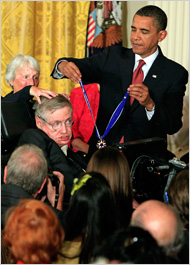
And now the British are weighing in also.  Yesterday, Stephen Hawking received his Presidential Medal of Freedom and jumped in with a response to the Investor’s Business Daily – which in it’s zeal appears to have forgotten that Mr. Hawking is British and under National Health.  The best summary is in the New York Times ,

The physicist Stephen Hawking is defending Britain’s National Health Service after an editorial in Investor’s Business Daily said Mr. Hawking “wouldn’t have a chance in the U.K.,” where the health service would have deemed his life “essentially worthless.”

The publication’s mistake, which came in an editorial titled “How House Bill Runs Over Grandma,” has since been corrected. But on a larger level, the snafu also shows how quickly rationing, particularly at the end of life, has become a focus of the health care reform debate.

Mr. Hawking — who received the Presidential Medal of Freedom at the White House on Wednesday — responded to the editorial this week, telling The Guardian newspaper, “I wouldn’t be here today if it were not for the N.H.S. I have received a large amount of high-quality treatment without which I would not have survived.”

DESCRIPTION

At this point, I fear for any type of health care reform.  New polls seem to show that older Americans oppose reform. The medical industry is threatening to pull support if legislation call for anything more that the co-op model.  Chris Matthews interviewed a man carrying a gun outside of the President’s New Hampshire town hall meeting.   I wonder if when they get back to Washington, there will be anyone left, Democratic or Republican, who wants to vote for health care reform.  Maybe they would prefer to just left the system explode or maybe implode.  Or we can be like Chris Hayes and try to laugh at the situation.

Here are parts of Hayes’  “Your Questions About Health Care Reform Answered”

Ok, so there’s been a lot of misinformation about proposals to reform the health insurance industry and provide (near) universal coverage. Understandable! It’s complicated stuff. Herewith, I’ll try to answer some questions

1) Is it true that all of the bills currently proposed would end the practice of “rescission,” whereby health insurance providers refuse to treat customers who’ve paid their premiums simply because they’ve become ill?

No! That’s a common misunderstanding. Actually, all of the bills would ban incisions, that is, they would legally bar surgeons from performing surgery until a panel of twelve gay illegal immigrant government bureaucrats unanimously signed off on the procedure.

2) Is it true that health care reform would ban insurers from refusing to insure people because of pre-existing conditions?

Wrong again. To get rid of health inequality, the bills actually mandate that every American be given a pre-existing condition. A National Illness Commission, with academics appointed from Harvard, Reed College and Berkeley, will evaluate each citizen, and based on their demographic profile, choose their malady. Each disease or syndrome is scored on a scale of 1 to 10, with 10 being the most severe. White christian men will receive pre-existing conditions of 8 or higher. Black people, “wise latinas,” and ACORN members will be exempted.

5) Will the current bills plug the “donut hole” in the Medicare prescription drug benefit so seniors don’t have to pay exorbitant out of pocket expenses for their medication?

Absolutely not. The legislation will ban donuts.

If you don’t laugh, you’ll have to cry.