
Elizabeth Warren and the race card

I’ve been thinking about this since the story broke that Senator Scott Brown and the Boston Herald had uncovered what they thought was Elizabeth Warren’s deception:  She had checked off the Native American box when in law school and Harvard Law School had listed her as Native American in some directory a number of years back.  First, I don’t think she and her campaign handled it well at first saying she didn’t remember ever telling Harvard about her racial heritage, but saying she did have an ancestor who was Native American.  Second, why is Scott Brown doing this? 

Warren has made a better answer since her initial reaction, but she would have been a lot better off if she had just said “I’m from Oklahoma and have some Cherokee and Delaware ancestors and I’m proud of it.”  But checking that box is always fraught with pitfalls for anyone who is mixed race.  This is the Tiger Woods dilemma.  What box do you check and how do you decide?  Back in 1990 when I was a census worker we were told that a person was whatever they said they were.  I have a family story my aunt told me to explain why my hair is naturally curly in humidity even through I am clear Asian.  She said that I had a Portuguese ancestor from long ago who had had a liaison with a great, great, etc. grandmother.  True?  Who knows.  But I think it is clear that Warren does have the right to claim Native American heritage.

Elizabeth Warren at a campaign stop in Shrewsbury, Mass. on APril 29.Steven Senne/Associated Press

And then I read this very thoughtful piece in the New York Times by Kevin Noble Maillard.  Titled Elizabeth Warren’s Birther Moment,  It begins

If you are 1/32 Cherokee and your grandfather has high cheekbones, does that make you Native American? It depends. Last Friday, Republicans in Massachusetts questioned the racial ancestry of Elizabeth Warren, the Democratic Senate candidate. Her opponent, Senator Scott Brown, has accused her of using minority status as an American Indian to advance her career as a law professor at Harvard, the University of Pennsylvania and the University of Texas. The Brown campaign calls her ties to the Cherokee and Delaware nations a “hypocritical sham.”

In a press conference on Wednesday, Warren defended herself, saying, “Native American has been a part of my story, I guess since the day I was born, I don’t know any other way to describe it.” Despite her personal belief in her origins, her opponents have seized this moment in an unnecessary fire drill that guarantees media attention and forestalls real debate.

This tactic is straight from the Republican cookbook of fake controversy. First, you need a rarefied elected office typically occupied by a certain breed of privileged men. Both the Presidency and the Senate fit this bill. Second, add a bit of interracial intrigue. It could be Kenyan economists eloping with Midwestern anthropologists, or white frontiersmen pairing with indigenous women. Third, throw in some suspicion about their qualifications and ambitions. Last but not least, demand documentation of ancestry and be dissatisfied upon its receipt. Voila! You have a genuine birther movement.

In this case, Brown seems to be claiming that Warren’s success is all because she checked that box.  Of course when Warren first came to public notice working for Congress monitoring the financial bailout and making sure consumers weren’t hurt no one questioned her smarts or her ability.  Neither did all those Harvard students she has taught over the years.  Neither did anyone she worked with when she was doing her famous early study of bankruptcy.  The whole idea that she owes her success to her having checked that box is laughable.  More from Maillard:

Even within Indian Country, the meaning of race and citizenship is contested. And now the Brown campaign wants to dictate Warren’s own belief in her identity. According to the Brown campaign, Warren could not be Indian because she is blonde, rich and most of all, a Harvard law professor. Her 1/32 Cherokee ancestry, sufficient for tribal citizenship, is not enough for the Republican party. To most people, she appears as white as, well, Betty White, but to the Scott Brown campaign, she is just Dancing With Wolves.

The Brown campaign asserts that Warren knowingly classified herself as Native American in the 1990s when Harvard weathered sharp criticism for its lack of faculty diversity. During this time, they argue, Warren relied upon this classification to enhance her employment opportunities and to improve Harvard’s numbers. Her faculty mentors at Harvard deny this and assert that the law school hired Warren without any knowledge of her ancestry.

For the Cherokee Nation, Warren is “Indian enough”; she has the same blood quantum as Cherokee Nation Chief Bill John Baker. For non-Natives, this may be surprising. They expect to see “high cheekbones,” as Warren described her grandfather as having, or tan skin. They want to know of pow wows, dusty reservations, sweat lodges, peyote and cheap cigarettes. When outsiders look at these ostensibly white people as members of Native America, they don’t see minorities. As a result, Warren feels she must satisfy these new birthers and justify her existence.

As a law professor and Native American himself, Maillard concludes that Harvard could not have used Warren’s status to promote her since

Looked at from the inside, however, the Warren controversy is all new. When the Brown campaign accused Elizabeth Warren of touting herself as American Indian to advance her career, this was news to Native law professors. We have a good eye for welcoming faculty to the community and identifying promising scholars. We know where people teach, what they have published and we honor them when they die. Harvard Law School named its first Native American tenured professor? Really? In our small indigenous faculty town, we would have heard about it already.

My own conclusion is that Warren checked that box somewhere way back.  She has said she was hoping to meet others like her by doing so.  She has every right to call herself Native American.  Someone at Harvard picked up on the checked box and noted it in the directory, but Harvard never made a big deal about it and they could have.  Hey, maybe someone messed up and forgot to announce the appointment of a Native American. 

Scott Brown has nothing of substance on which to talk so why not create a birther controversy.  He is the one playing the race card.  It is tight race and if he can convince a few voters that Elizabeth Warren is untrustworthy and of mixed race ancestry, it might just make a difference.
Paying a Fair Share or the Buffett Rule

I’ve gotten several email recently from the President, from Elizabeth Warren and from other progressive organizations about the Senate vote on the Buffett rule.  Since I’m pretty sure that Senator John Kerry will vote for the bill and Senator Scott Brown will vote against it, I haven’t called, emailed or written either of them about it.

I have, however,  wondered what the bill actually does.  So thank you to Ezra Klein’s Wonkblog in the Washington Post this morning for his explanation.  The big vote everyone is talking about is actually a bill introduced by Senator Sheldon Whitehouse from Rhode Island.  He explained the bill to Ezra who explains it to us.

In other words: The “Paying a Fair Share Act” doesn’t mean someone making $1,500,000 will pay at least the same percentage of his income in taxes as the average middle-class family. It means he would pay a somewhat higher marginal rate on the income he earns over $1 million — in this case, on the excess $500,000.

Moreover, that higher marginal rate would only reach 30 percent on income over $2 million. Between $1 million and $2 million, the Buffett rule phases in so as to avoid a sharp “tax cliff” at the million-dollar mark.

But would it still raise money to help ease the deficit?

Another misconception: The proposal doesn’t raise $47 billion over 10 years. Or, rather, it does, but only if you use the “current law baseline” that assumes the full expiration of the Bush tax cuts. No one really uses that baseline. If you look at Paul Ryan’s budget, for instance, its appendix tables use a “current policy baseline,” which assumes, among other things, that the Bush tax cuts are extended.

Compared with that baseline, the Paying a Fair Share Act actually raises about $160 billion. Still not enough to solve our deficit problems on its own, but nothing to sneeze at.

So as usual it is a little more complicated than the President makes it sound, but still a good thing to support.


The Frank-Dodd Financial Reform Bill

Helene Cooper writes in the New York Times this afternoon

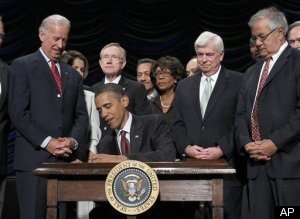
 President Obama signed into law on Wednesday a sweeping expansion of federal financial regulation, marking another — and perhaps last — major legislative victory before the midterm elections in November, which could recast the Congressional landscape.

The signature achievement — a response to the 2008 financial crisis that fundamentally alters the relationship between Wall Street and the federal officials charged with regulating it — is a culmination of two years of fierce lobbying and intense debate over how to deal with the financial excesses that tipped the nation into the worst recession since the Great Depression.

The law subjects more financial companies to federal oversight, regulates many derivatives contracts and creates a panel to detect risks as well as a consumer protection regulator. A number of the details have been left for regulators to work out, inevitably setting off complicated tangles down the road that could last for years.

Obama Financial Reform

Mr. Obama took pains to try to show how the complex legislation, with is dense pages on derivatives practices, will protect ordinary Americans.

“If you’ve ever applied for a credit card, a student loan, or a mortgage, you know the feeling of signing your name to pages of barely understandable fine print,” Mr. Obama said. “But what often happens as a result, is that many Americans are caught by hidden fees and penalties, or saddled with loans they can’t afford.”

He said the law would crack down on abusive practices in the mortgage industry, simplifying contracts and ending hidden fees and penalties, “so folks know what they’re signing.”

So what exactly is in the bill?  According to a summary in the Christian Science Monitor

A bill summary by Capitol Hill staff members includes 100 points. Here’s a shorter take, 10 points, focusing on less-publicized elements as well as some core provisions:

• A first-ever federal office focused on the insurance industry will monitor the insurance industry for systemic risk. The industry will remain regulated largely at the state level.

• FDIC deposit insurance for account-holders at banks, thrift institutions, and credit unions will be raised to $250,000 (from $100,000) retroactive to Jan. 1, 2008.

• The State Department would have to submit an “illicit minerals trade strategy” for the Congo region. Manufacturers that use minerals originating in the Democratic Republic of Congo would have to disclose measures taken to exercise due diligence on the source and chain of custody of the materials. The provision, sponsored by Sen. Sam Brownback (R) of Kansas, could affect high-tech firms like Intel and Apple.

• The bill beefs up the powers of the Securities and Exchange Commission, including extra funds for enforcement. The SEC would get new power to impose fiduriary responsibility on investment brokers. That means the brokers would have to offer advice based on the best interest of clients, not broker fees. Consumer advocates say the bill should have mandated this change, not allowed the SEC to consider it.

• New disclosure rules would apply to credit-rating firms, along with new penalties if the firms are irresponsible. In a nod to an amendment backed by Sen. Al Franken (D) of Minnesota, the bill seeks to end “shopping for ratings” by calling for the SEC to propose ways to prevent issuers of asset-backed securities from picking the firm they think will give the highest rating.

• Shareholders would get a “say on pay,” with the right to a nonbinding vote on executive pay and golden parachutes. Standards for listing on an exchange would require that compensation committees include only independent directors.

• Reforms would reshape Federal Reserve powers, including a ban on Fed bailouts targeted at specific firms (like AIG) in the future. The presidents of regional Fed banks would be selected entirely by directors representing the public, and not partly by directors representing banks that the Fed regulates.

• The bill creates a new Consumer Financial Protection Bureau to consoldiate duties now charged to various federal agencies. It would have a consumer hot line, for questions on things like mortgages, and a new office of financial literacy.

• A Financial Stability Oversight Council of top economic regulators will monitor systemwide risks. The bill summary says this group will ask the Federal Reserve to adopt “increasingly strict rules for capital, leverage, liquidity, risk management and other requirements as companies grow in size and complexity.”

• An “orderly liquidation” mechanism would allow the Federal Deposit Insurance Corp. (FDIC) to dismantle large financial companies that are on the brink of failure. Shareholders and unsecured creditors would bear losses, to end taxpayer bailouts. But the bill also allows the FDIC to shelter solvent banks from having to bear losses if there is a threat to overall US financial stability

Thank you to Barney Frank, Chris Dodd, Olympia Snowe, Susan Collins and Scott Brown and all the Democrats except Ben Nelson we have a start and reining in the runway, unregulated financial system.

Tea Party on Boston Common

Yesterday the Tea Party came to Boston.  About 5000 gathered to hear Sarah Palin give her talking points.  As I was going to work, I saw the booths being set up and the motorcycle police gathering.  The few black faces at that early point were Boston Police officers. We heard the helicopters circling all morning.  When I went for a walk at lunch the rally had ended and I saw a tea partier too busy trying to hang on to his sign to notice he was crossing a busy intersection against the walk light and in front of a bus pulling out from a stop.  The driver did see him and the man finally noticed, but to me it was emblematic of the tea party movement: oblivious to the reality of the world around them.

Yvonne Abraham had a great column in the Boston Globe this morning.

I was standing in the crowd at the tea party rally on the Common yesterday, enjoying Sarah Palin’s applause lines (Do you love your freedom? We’re not going to stand for it any more! Oh no ya don’t! Drill, baby, drill!), when a friendly woman asked me a question.

“We don’t look insane, do we, really?’’

Well, no, I had to allow. They didn’t. In fact, most in the excited crowd seemed pretty normal — unless you count Doug Bennett, the Boston City Council candidate whose giant grin and jolly handshake show up so often around town it’s kind of creepy.

In fact, most of the people I spoke to treated me as if I were the one who was soft in the head, unable to comprehend elementary concepts. They patiently dedicated themselves to my enlightenment.

“Here, have a copy of the Constitution, so you know what we’re talking about,’’ one kind man offered. They even engaged in civil debate with some counterprotesters.

Donna Tripp was thrilled with this development. Holding a sign that read “No Matter What I Write, I Will Still Be Called a ‘Racist, Nazi, Tea-bagger . . . ,’ ’’ the Avon resident had just been interviewed on camera by a young man who works for Palin.

“It gives me the willies!’’ she told her friend. “He’s shooting for Sarah!’’

She loves Palin because “the Constitution is her mantra, and that’s what I’m all about,’’ Tripp said. “She’s done what all those women wanted to do in the ’60s. She earned everything she has, all on her own.’’

Like everybody else at the rally yesterday, Tripp hates, hates, hates the health care overhaul recently signed into law.

“This country is taking a hard right turn for socialism,’’ she said. “I don’t want to be told to buy a service I don’t want. America is about freedom of choice.’’

Tripp, 55, already lives in a state that requires everybody to buy health insurance, but she refuses to do it.

“I’m healthy,’’ she said. When her husband went to Canada for prostate cancer treatment five years ago, they paid $25,000 out of pocket.

But what if she got really sick — if she needed, say, heart bypass surgery, which could cost more than $100,000?

“I’d mortgage my house,’’ she said. And if that wasn’t enough?

“I guess I’d die,’’ she said. “But under our Constitution, I should be able to take that risk.’’

More likely, Tripp would get her treatment, and if she couldn’t afford to pay for it, the rest of us would pick up the tab.

That’s how this country is set up: According to the preamble in the little Constitution the kind man gave me, we are all about promoting “the general Welfare.’’

Scott Brown, our new Senator, didn’t show up.  Neither did Charlie Baker who is running for Governor as a Republican.  Wonder why?

Today the New York Times and CBS released a new poll about the Tea Party.

Tea Party supporters are wealthier and more well-educated than the general public, and are no more or less afraid of falling into a lower socioeconomic class, according to the latest New York Times/CBS News poll.

The 18 percent of Americans who identify themselves as Tea Party supporters tend to be Republican, white, male, married and older than 45.

They hold more conservative views on a range of issues than Republicans generally. They are also more likely to describe themselves as “very conservative” and President Obama as “very liberal.”

And while most Republicans say they are “dissatisfied” with Washington, Tea Party supporters are more likely to classify themselves as “angry.”

And I hate to burst Donna Tripp’s bubble, but the reason why she is perceived as racist is because many of her fellow tea partiers appear to be racist.  According to the poll, “Supporters of the Tea Party movement are more likely to be men, over the age of 45, white, married, and either employed or retired. Few are unemployed. They are more affluent and more educated than most Americans. Almost all said they are registered to vote, and most are Republicans.”

Tea Party supporters’ fierce animosity toward Washington, and the president in particular, is rooted in deep pessimism about the direction of the country and the conviction that the policies of the Obama administration are disproportionately directed at helping the poor rather than the middle class or the rich.

The overwhelming majority of supporters say Mr. Obama does not share the values most Americans live by and that he does not understand the problems of people like themselves. More than half say the policies of the administration favor the poor, and 25 percent think that the administration favors blacks over whites — compared with 11 percent of the general public.

So this well educated, overwhelmingly white group obviously feels threatened by the way the world is changing and afraid they will lose theirs.

When talking about the Tea Party movement, the largest number of respondents said that the movement’s goal should be reducing the size of government, more than cutting the budget deficit or lowering taxes.

And nearly three-quarters of those who favor smaller government said they would prefer it even if it meant spending on domestic programs would be cut.

But in follow-up interviews, Tea Party supporters said they did not want to cut Medicare or Social Security — the biggest domestic programs, suggesting instead a focus on “waste.”

Some defended being on Social Security while fighting big government by saying that since they had paid into the system, they deserved the benefits.

Others could not explain the contradiction.

“That’s a conundrum, isn’t it?” asked Jodine White, 62, of Rocklin, Calif. “I don’t know what to say. Maybe I don’t want smaller government. I guess I want smaller government and my Social Security.” She added, “I didn’t look at it from the perspective of losing things I need. I think I’ve changed my mind.”

It looks like the Tea Party is really the party of “I’ve got mine and I don’t want to share with anyone who is not like me.”

Massachusetts Politics and Health Care or Mitt, Scott and Rachel

This Luckovich cartoon is a good picture of Massachusetts politics after health care reform.  You could swap Romney for Scott Brown is it would almost be the same.

Joan Vennochi’s column in the Boston Globe last week provides a good summary of the dilemma faced by Romney and Brown.

WHEN YOU dance to the right with the one who brung you, you can end up with two left feet.

Two Massachusetts Republicans — US Senator Scott Brown and former Governor Mitt Romney — are in that awkward state.

Brown won election as an independent who happened to belong to the Republican Party. He’s quickly learning that in Washington, the “R’’ next to your name means your soul belongs to the GOP.

Brown paused for an instant before promising to vote against the Democrats’ historic health care package. That slight hesitation was enough to enrage conservatives who are already suspicious about his core beliefs.

No wonder he has to raise money by raising the specter of Rachel Maddow! (more on that later)

Brown’s campaign rallying cry — that he would be the 41st vote against health care reform — never made much sense. As a Massachusetts lawmaker, Brown voted for the health care reform package that was spearheaded by Romney and became the model for the federal law that President Obama just signed.

Brown never really explained how he could rail against a measure he once supported. Then, again, neither did Romney. He now sounds slightly unhinged as he attacks Obamacare, which is, after all, based on Romneycare. Right after the House vote, Romney condemned Obama as having “betrayed his oath to the nation.’’ Yesterday, his political action committee announced a new program, dubbed “Prescription for Repeal’’ to support conservative candidates who will repeal “the worst aspects of Obamacare.’’

The Republican problem is they wanted President Obama to fail so badly (and were conviced he would never pass any type of health care reform) they dug themselves into a corner. 

Brown and especially Romney should have known better. But they seized the path to the right as the best route to political victory. In the end, it could be the road to political defeat.

Brown will have to decide whether he belongs to the people of Massachusetts or to Senate Minority Leader Mitch McConnell and assorted Tea Party activists. He was attacked from the right when he joined the Democratic majority and backed a Senate jobs bill, and the attacks will continue.

To win reelection, he must be the independent he promised to be. Yet, conservatives will become incensed each time he strays from the party line, and even when he doesn’t. Some blame Brown for the passage of health care reform on the grounds that his election forced Democrats to go for it even without 60 Senate votes. That’s unfair, but that’s raw, partisan politics.

As for Romney, when he ran for president in 2008, he twisted and turned into a flip-flopper to a degree that severely undercut his credibility on the national stage. Still, based on past history, he was well-positioned to become his party’s nominee in 2012. The Republican nomination generally goes to a loser from the previous election cycle. Despite myriad weaknesses, that’s what happened with John McCain.

Now, to play in the Republican primary world, Romney has to do the mother of all flip-flops on health care reform. It’s hard to imagine how he does it, but if he succeeds, where does that leave him in a general election? Forget about two left feet. With his clumsy dance, he will have waltzed himself off the cliff.

If memory serves me, we just finished electing Scott Brown to 3 years in the Senate, but he is already trying to raise funds from his friends on the right by raising the specter of that scary Rachel Maddow running against him.  And Rachel is trying to use this to raise her profile and ratings.  It was good theater for a while.  And even though a number of commentors in the Boston Globe seem disposed to a Maddow run (according to a Tweet I glimpsed on Boston.com), I think is was just theater for her.  Brown, however is in a different position.  Even Newsweek is weighing in.  Liz White posted last week.

The fake 2012 Massachusetts senatorial race between newly elected Sen. Scott Brown and MSNBC host Rachel Maddow is really heating up—er, sort of.

Earlier this week Brown sent a fundraising letter to supporters all over the country claiming the “political machine” in Massachusetts was vetting “liberal MSNBC anchor Rachel Maddow” to oppose him in the state’s election in 2012. Maddow quickly fired back, announcing that she had no plan to run for office while denouncing Brown for making up the story just to raise money. On Friday, Maddow approved a full-page ad in The Boston Globe to make her plans known to Brown’s constituents.

It really says something that two years in advance and a few months after what GOP supporters called his “Massachusetts Miracle” election, Brown is already worried about competition, even if it is just to bring in more money. As the first Republican to be elected for Senate in Massachusetts in 40 years and a with no vote on the health-care-reform bill—not to mention his more moderate tendencies could turn off the far right—he could face a tough reelection campaign. The rumor of Maddow’s run might be false, but it’s clear Brown’s fear of the next election isn’t.

Hey Scott, why don’t you take Rachel up on her offer to come on her show?  I don’t think she will ask you any thing too hard – just why you were for health care reform before you were against it.  And what exactly is the difference between the Massachusetts bill and the National one?  Easy stuff like that.

Is Massachusetts turning Purple?

Massachusetts, the proud commonwealth that voted for George McGovern, has voted for the first Tea Party senator.  I’ve been too busy (and depressed) to write about it, but I’m slowly becoming philosophical about it all.  As Brian McGrory wrote in the Boston Globe the day after

I’m going to need some Advil and a cold compress, please. I’m the Massachusetts Electorate, and I have what is bar none the absolute worst hangover of my entire voting life.

Seriously, I was so drunk on power, so caught up in the moment, so free of any of my usual inhibitions, I can’t remember what’s gone on these last two weeks. Think, Electorate, think. What did I do?

McGrory goes on to describe the Massachusetts electorate’s seduction by Scott Brown.

And now I’m vaguely recalling that stranger across the room, the one in the barn jacket who kept smiling at me and seemed to know my name. Martha vanished for a while, and – is it bad that I’m saying this? — I didn’t really care.

Suddenly, that tall, handsome man was standing at my side doing something that Martha rarely did – offering to pay for drinks, chatting me up, curious what was on my mind.

Every time I ever tried telling Martha about my day, my hopes, my dreams, she shushed me up and said she was preparing a legal brief or watching Law & Order. And now there’s a stranger telling me he could change my entire world.

I had been hoping that Coakley might pull out the race – even if it were by a few votes – until she spoke at the Martin Luther King Day breakfast.  Speaking before a friendly audience which loves it’s politicians, Martha did not get a standing ovation or a “you go, girl” shouted from the audience.  Martin Luther King, III was more eloquent on her behalf than she was and he lives in Atlanta.  That was when I began the process of resigning myself to the inevitable.

There were lots of reasons she lost.  She ran a very poor campaign and Martha has always seemed uncomfortable campaigning, pressing the flesh.  She always talks like a prosecutor.  I represented the Somerville Women’s Commission on her Violence Against Women Task Force and I know she believes all the right things.  She would have made a good, hard-working Senator but she never made the case.  Maybe she thought until the polls started to turn that she didn’t have to work hard for the seat.  Democrats appeared to have voted for her.  She lost the swing independents.

Where were her Emily’s List supporters that helped her defeat Mike Capuano in the Democratic Primary?  Why didn’t she have the money to advertise more?  (probably too many people like me who wanted to vote for her, but didn’t feel moved to give her money.) She never, that I recall, ran an ad that defined who she was as a person.  One that showed her with her dogs and husband walking on the Charles River or something.  We all learned about Brown’s truck.  Unions and other supporters didn’t seem do much.  Was it because they thought she was a shoe-in or because she didn’t find a role for them in her campaign?  (there are rumors to that effect)  Instead of reaching out to the independents and Republicans, I’m sure we were like every Democratic household  in the Commonwealth:  We got robocalls from everyone about her.  President Obama, Bill Clinton, and Angela Menino, the Mayor’s wife.   (We have to find a better way to get the word out and get people out to vote than all these endless calls.  I stopped answering the phone.)  But with all the calls, she never fired up her base.  She’s running for re-election for Attorney General now and maybe that will go better.  People may feel more comfortable with her as their lawyer and than with her as senator.

Meanwhile we have to face the reality that Scott Brown is our Senator for the next 3 years.  He once pointed out that it was 3 years, like a test drive, and we could vote him out if we didn’t like what he did.

I like Congressman Capuano’s take during an interview with one of the local public radio stations

Political watchers have already begun talk of Capuano mounting a challenge for Brown’s Senate seat in 2012, but Capuano laughed off that idea.

“I have never in my life had the luxury of planning my political career three years in advance. I think we need to let Mr. Brown have an opportunity to prove himself, to prove whether he is the independent he claims to be or whether he’s a lockstep Republican or something in between. I hope he’s a great senator for Massachusetts.”

I don’t know if Mike would have been able to beat Brown, but he would have gone down with a fight, not a whimper.

The Massachusetts Senate Election

On the 19th, we get to vote for a new Senator.  And although the Rasmussen poll has Scott Brown, the Republican, within 10 points, I am willing to guess the margin will be more like 12 to 15 for Martha Coakley, the Democrat .  Believe it or not, I wrote that on Saturday before the Boston Globe poll was published today showing Coakley with a 15 point lead.  (There is also a Libertarian, Joseph Kennedy – not one of the Kennedys.  They have endorsed Martha.)

I favored Congressman Michael Capuano in the Democratic primary, but it will be good to elect a woman Senator for the first time.  Besides the fact that Mike was once my boss when he was Mayor of Somerville, I have only partially forgiven Coakley for her intransigence on the Fells Acre child care case she prosecuted as Middlesex County Assistant DA.  As far as federal issues go, there was not a lot of difference between them 

But I became solidly in Martha’s court after Scott Brown said that while he didn’t favor torture, it being against the Geneva Convention and all, he was in favor of waterboarding which, according to him, is not torture.  Coakley disagrees, agreeing with the Obama Administration policy.  Brown’s endorsement of waterboarding became the subject of a great Wasserman cartoon

 Brown has been running ads comparing himself with John F. Kennedy which don’t seem to have helped him much.

According to the poll released today

Half of voters surveyed said they would pick Coakley, the attorney general, if the election were held today, compared with 35 percent who would pick Brown. Nine percent were undecided, and a third candidate in the race, independent Joseph L. Kennedy, received 5 percent.

Coakley’s lead grows to 17 points – 53 percent to 36 percent – when undecideds leaning toward a candidate are included in the tally. The results indicate that Brown has a steep hill to climb to pull off an upset in the Jan. 19 election. Indeed, the poll indicated that nearly two-thirds of Brown’s supporters believe Coakley will win.

“She’s simply better known and better liked than Brown,’’ said Andrew E. Smith, director of the University of New Hampshire Survey Center, which conducted the poll for the Globe.

Coakley is seen as strongest on health care, the issue that 31 percent of respondents said was the most important. Fifty-one percent said they trusted Coakley to best handle the issue, with only 29 percent saying Brown.

Brown has trumpeted the prospect that he would be the 41st vote to block the health care proposals before Congress, while Coakley has said she would proudly cast the 60th vote to prevent a filibuster and grant final approval for the legislation.

The war in Afghanistan was the best issue for Brown, with 34 percent saying they trust him, compared with 35 percent for Coakley. Brown, a National Guardsman, supports President Obama’s plan to increase troop levels in Afghanistan; Coakley opposes it.

The turn out will be very light and with the Democrats holding the edge in party registration all Martha has to do is to get more voters out.  The ten day weather projection calls for temps around freezing and partly sunny in Boston. 

Looking at November in January

The Republicans are hopeful that they will take over the House and the Senate.  When it is the 5th of January, anything is possible, but there are some signs that it might not be easy – especially in the House.

Writing in today’s Washington Post, Chris Cillizza writes about Republican House retirements.

While the recent political chatter in Washington has focused on Democrats retiring from Congress, Republicans are leaving the House in greater numbers, a trend that could blunt the party’s momentum heading into the November midterm elections.

Rep. Henry E. Brown Jr. (S.C.) on Monday became the 14th Republican to announce that he will not run for reelection this year. Ten Democrats have said the same, including an attention-grabbing four in the past two months from swing and Republican-leaning districts.

A broad look at those seats suggests more parity, in terms of the two parties’ opportunities and vulnerabilities, than conventional wisdom would suggest.

There are also potential money problems for Republicans.  Politico reported the other day

The National Republican Congressional Committee, the key cog in helping to finance GOP campaigns, has banked less than a third as much money as its Democratic counterpart and is ending the year with barely enough money to fully finance a single House race — no less the dozens that will be in play come 2010.

 A big part of the problem, according to Republican strategists, is that GOP members themselves — the ones who stand the most to gain from large-scale House gains — haven’t chipped in accordingly, despite evidence of solid opportunities in at least 40 districts next year and with as many as 80 seats in play, according to the Cook Political Report’s estimates.

The fundraising disparity between the two committees is striking: The DCCC outraised the NRCC this year by more than $18 million, according to FEC figures at the end of November. The NRCC has only $4.3 million left in its campaign account — with more than $2 million in debt — leaving it with just a pittance to fund the dozens of races it hopes to aggressively contest.

The DCCC, meanwhile, is sitting on a $15.3 million nest egg (with $2.6 million owed), steadily expanding its cash-on-hand advantage over Republicans throughout the year.

It is always possible that more Democrats will retire (Senator Dorgan – D  N.D. just announced he was not going to seek reelection for example) and change the equation again, right now it does not look as if the Republicans can retake the House.  Lose some seats, yes, but not enough to lose the majority.  It is also possible that the Republicans will start coughing up more money.  January is very early.

But there is a Senatorial election here is Massachusetts in two weeks.  While one poll shows Republican Scott Brown within single digits, it is curious that he is getting no financial support from national Republicans.  Is this a concession to Martha Coakely?  If you think about it the Rasmussen Poll could help Martha by making her supporter nervous enough to work hard to get out the vote. 

I think Massachusetts is safe for the Democrats, but the rest of the Senate is unclear.