The President Speaks at Wakefield High

Updated September 9 .  I added this cartoon by Dan Wasserman.

09.09%20OBAMA%20SCHOOLKIDS%20copy


President Obama gave a “first day of school” speech today that was broadcast to schools across the country – and available on the internet to anyone who wants to watch.  (there is a link in the New York Times story below) The conservatives, actually, the far right Limbaugh and Beck followers were convinced that the President was going to indoctrinate the the nation’s school population.  It has been compared with speeches given in North Korea and the former Soviet Union.

So what did he actually say?  According to the New York Times

President Obama exhorted America’s students on Tuesday to study hard, set goals, accept personal responsibility, and “get serious this year’’ in a back-to-school address that became a lightning rod for conservative parents who accused the White House of trying to indoctrinate their children with a political message.“The future of America depends on you,’’ the president declared, in one of the few departures from his script.


President Barack Obama spoke to students at Wakefield High School

This was a speech worthy of Bill Cosby.

“At the end of the day, the circumstances of your life – what you look like, where you come from, how much money you have, what you’ve got going on at home – none of that is an excuse for neglecting your homework or having a bad attitude,’’ the president said. “That’s no excuse for talking back to your teacher, or cutting class, or dropping out of school. There is no excuse for not trying.’’

The President tried to explain that you won’t like everything you study and that some things will be hard but you had to set a plan for yourself and stick to it.  I think this is my favorite part of the speech.

Whatever you resolve to do, I want you to commit to it. I want you to really work at it. 
I know that sometimes, you get the sense from TV that you can be rich and successful without any hard work — that your ticket to success is through rapping or basketball or being a reality TV star, when chances are, you’re not going to be any of those things. 
But the truth is, being successful is hard. You won’t love every subject you study. You won’t click with every teacher. Not every homework assignment will seem completely relevant to your life right this minute. And you won’t necessarily succeed at everything the first time you try.
That’s OK.  Some of the most successful people in the world are the ones who’ve had the most failures. JK Rowling’s first Harry Potter book was rejected twelve times before it was finally published. Michael Jordan was cut from his high school basketball team, and he lost hundreds of games and missed thousands of shots during his career. But he once said, “I have failed over and over and over again in my life. And that is why I succeed.” 
These people succeeded because they understand that you can’t let your failures define you – you have to let them teach you. You have to let them show you what to do differently next time. If you get in trouble, that doesn’t mean you’re a troublemaker, it means you need to try harder to behave. If you get a bad grade, that doesn’t mean you’re stupid, it just means you need to spend more time studying. 

E. J. Dionne comments in the Washington Post

We have just gone through one of the most shameful episodes of the young Obama presidency — shameful because of the behavior of the right wing, shameful because the media played into an extremist agenda, shameful because we proved that our political system has become so dysfunctional that a president gets punished for doing the right thing.

Upon Barack Obama’s election, even my most conservative friends who supported John McCain said Obama could do a world of good for poor children in the country by stressing the importance of education, hard work, staying in school and taking responsibility. Yes, those are often thought of as conservative values.

But when Obama proposed to do just that on the first day of school, the far right — without asking any questions or seeking any information — decided to pounce, on the theory that everything Obama did should be attacked relentlessly as part of some secret and dangerous ideological agenda.

Out popped Jim Greer, the Florida Republican chairman, who accused the president of trying to “indoctrinate America’s children to his socialist agenda.”

In a normal world, the media would have asked Greer for proof of such a wild charge and, since he didn’t have any, his press release would have gone into the circular file.

But, no, the media is so petrified of being criticized for being “liberal” that it chose to take a lunatic charge seriously and helped gin up this phony controversy.

And, of course, Obama’s speech was not at all “political” in any conventional definition of that word. It was about highlighting the importance of individual achievement. Here is an example of the president’s “socialist” propaganda, from the text of his speech:

I’ve talked a lot about your government’s responsibility for setting high standards, supporting teachers and principals, and turning around schools that aren’t working where students aren’t getting the opportunities they deserve.

But at the end of the day, we can have the most dedicated teachers, the most supportive parents, and the best schools in the world — and none of it will matter unless all of you fulfill your responsibilities. Unless you show up to those schools; pay attention to those teachers; listen to your parents, grandparents and other adults; and put in the hard work it takes to succeed.

And that’s what I want to focus on today: the responsibility each of you has for your education. I want to start with the responsibility you have to yourself.

If that’s “socialist,” then Barry Goldwater, Ronald Reagan and just about every parent in America are “socialists.”

So have the Limbaughs, Beck’s and Greers apologized?  Of course not.  There had to be a hidden or coded message in the speech somewhere.  Greer did concede it was a good speech but seems to continue to insist that it must have been rewritten.  Asked on CNN for proof, he had none.

It was a good speech.  Newt Gingrich, Laura Bush and Karl Rove said so.

Facts for the Health Care Debate

Anyone who reads this blog regularly already knows that I am in favor of reform all the way to single payer.  However, with single payer not an option, I have been sending email and writing everyone , including President Obama, that we need to keep the public option.  I don’t believe anything will really change without it.  But the debate has really degeneated.  Things are being presented as “fact” that are not true, but once said take on a life of their own.

This week Newsweek presented a two-page spread by Sharon Begley titled “The Five Biggest Lies in the Health Care Debate”.  But I think there are actually 6.  The quotes are from Begley; the comments are mine.

1) There will be electric funds transfers out of your bank account that you will not control.

 Take the claim in one chain e-mail that the government will have electronic access to everyone’s bank account, implying that the Feds will rob you blind. The 1,017-page bill passed by the House Ways and Means Committee does call for electronic fund transfers—but from insurers to doctors and other providers. There is zero provision to include patients in any such system.

2) You’ll have no choice in what health benefits you receive.

In fact, the House bill sets up a health-care exchange—essentially a list of private insurers and one government plan—where people who do not have health insurance through their employer or some other source (including small businesses) can shop for a plan, much as seniors shop for a drug plan under Medicare part D. The government will indeed require that participating plans not refuse people with preexisting conditions and offer at least minimum coverage, just as it does now with employer-provided insurance plans and part D. The requirements will be floors, not ceilings, however, in that the feds will have no say in how generous private insurance can be.

3) Older patients and the very sick will not get treatment.  This is related to the Stephen Hawking myth.  The one that he would be dead now if he were getting benefits under the British health care system.  Only he is under the British National Health and as of this morning is alive and still doing his work.

The House bill does not use the word “ration.” Nor does it call for cost-effectiveness research, much less implementation—the idea that “it isn’t cost-effective to give a 90-year-old a hip replacement.”The general claim that care will be rationed under health-care reform is less a lie and more of a non-disprovable projection (as is Howard Dean’s assertion that health-care reform will not lead to rationing, ever). What we can say is that there is de facto rationing under the current system, by both Medicare and private insurance. No plan covers everything, but coverage decisions “are now made in opaque ways by insurance companies,” says Dr. Donald Berwick of the Institute for Healthcare Improvement.

What I don’t understand is why wouldn’t we want to know what is most effective so we can all be treated in the best, most cost effective and beneficial way.

4) Illegal Immigrants will get free health care.  I think they already do when they go to emergency rooms and our insurance premiums reflect that cost.

Will they be eligible for subsidies to buy health insurance? The House bill says that “individuals who are not lawfully present in the United States” will not be allowed to receive subsidies.

Can we say that none of the estimated 11.9 million illegal immigrants will ever wangle insurance subsidies through identity fraud, pretending to be a citizen? You can’t prove a negative, but experts say that Medicare—the closest thing to the proposals in the House bill—has no such problem.

5) There will be death panels making decisions about who gets treatment.   Related to #)3, this has been debunked all over but still lives particularly in the minds of Betsey McCaughy and Sarah Palin.

This lie springs from a provision in the House bill to have Medicare cover optional counseling on end-of-life care for any senior who requests it. This means that any patient, terminally ill or not, can request a special consultation with his or her physician about ventilators, feeding tubes, and other measures. Thus the House bill expands Medicare coverage, but without forcing anyone into end-of-life counseling.

I’ve had a lot of older relatives who have had end of life discussions with their doctors to decide on the level of treatment desired.  Everyone found them comforting and helpful to have decisions made.

6)  The government will set doctor’s wages.  I believe that one way to control costs is to put doctor’s on salary rather than fee for service which often ends up in many extra tests as the doctor and his or her practice tries to pay for equipment and up the billing.  However the proposed bills do not do this.

This, too, seems to have originated on the Flecksoflife blog on July 19. But while page 127 of the House bill says that physicians who choose to accept patients in the public insurance plan would receive 5 percent more than Medicare pays for a given service, doctors can refuse to accept such patients, and, even if they participate in a public plan, they are not salaried employees of it any more than your doctor today is an employee of, say, Aetna. “Nobody is saying we want the doctors working for the government; that’s completely false,” says Amitabh Chandra, professor of public policy at Harvard’s Kennedy School of Government.

I close with the picture Newsweek chose to accompany this story.

Town Hall Face:   An unsightly condition caused by unsanitary health-care politics

What I did on my vacation

If I were President Obama, I would have to write something like this “I was going on vacation but there was a hurricane so I was late.  Then my advisors said I had to make an announcement about reappointing the Fed Chairman.  Then one of my best friends died and I had to write his eulogy and attend the funeral.  All I really wanted to do was to spend a week more or less out of the public eye and hang out with the family and the dog, maybe some friends.  Oh, well.”

Obamas on Vacation

I think we should actually be concerned that the President didn’t really have a vacation.    Here the First Family is arriving, full of hope for a fun time. 

Barack Obama goes biking with his daughters.

Then one of the few times he did something fun in public, he got criticized for not wearing a helmut. 

We need to lighten up.  There is a happy medium between the, to my mind, excessive vacationing done by George W. Bush and Obama’s measly, not quite a week.  There is also a medium between Bill Clinton many public times when he was on the Vineyard and W. hiding on his ranch.

As Susan Jacoby wrotes in the introduction to her discussion blog in the Washington Post

Why would a president, having just had the delightful experience of speaking at town hall meetings to which some upstanding citizens saw fit to carry loaded guns, need a vacation with his wife and daughters? Incredibly, President Obama is being criticized by the political right for his decision to spend a few more days on vacation with his family at Camp David next week. Of course, no president is ever really on vacation; his day always begins with a lengthy national security briefing and he is always out of touch with advisers on important issues. In this case, the family’s five days on Martha’s Vineyard have already been shortened by the inevitable political and personal duties associated with the death of Sen. Edward M. Kennedy. It seems to me that there is an ethical blindness about this country’s obsession with working—or appearing to work—24/7.

I, for one, an suspicious of anyone who never takes a vacation.  Everyone needs some time away from the world in which they reside most of the time – a different location, a different rhythm to the day, a new experience.  I just do not understand those who think that President Obama should not vacation while there is a deficit or whatever the person’s issue is. 

I hope the President enjoys his few days a Camp David this week despite his daily briefings.  Come back and we will tackle health care, Mr. President.  With a public option.


Another reflection on Senator Kennedy

Now that I, like much of Massachusetts, have spent several days glued to the television or, in the case of my husband, participating in the memorial, but before we turn to the speculation about his successor, I want to post a few thoughts from Patricia Williams writing in the Sunday Guardian.

There isn’t anyone who grew up in Massachusetts who doesn’t feel personally touched by the life of Kennedy. There’s the family legacy. His maternal grandfather was the amiably colourful mayor of Boston, John Francis Fitzgerald, the child of immigrants and the first Irish Catholic to achieve such power in the then-English – or “Boston Brahmin” – dominated-political landscape of New England.

The election of “Honey Fitz”, as he was known, was significant because this was the Boston of Henry James and the Irish were very much looked down upon. I remember my grandmother describing signs in the windows of certain establishments that read: “No Irish, no coloured, no dogs.”

The particular struggles of the Irish in Boston is largely forgotten today; indeed, the Kennedys are often characterised as part of “the north east liberal elite”. But the origins of their family success are rooted in a fight that spans all aspects of a broader civil rights movement that stretches back to the 1800s and included not merely African Americans but Irish and Italian immigrants, the descendants of indentured servants, the poor, the labouring classes.

It is true that the senator’s life history was one of great human complexity. And just as the healthcare debates have been disrupted by an astonishing amount of hateful speech, so the national blogosphere is filled with bitter, ungenerous commentary about the time he cheated on an exam at Harvard; or how he called his political advisers before he called paramedics when his car plunged off a bridge on Martha’s Vineyard, leaving the body of Mary Jo Kopechne, a young campaign aide, submerged for nearly nine hours; or whetherhe drank to excess.

But here in Massachusetts, it is the political commitment that counts. It is his public service that means the most and the regional allegiance to this man crosses all partisan boundaries. The Boston Herald, a local tabloid that spilled oceans of ink denouncing him in life, remembered him with uncharacteristic mistiness.

As I write, President Obama is giving the eulogy at Senator Kennedy’s funeral. To African Americans, Obama is “our Kennedy”. I wept when I discovered that the funeral was to be held at the Basilica of Our Lady of Perpetual Help. Although many in the national press cite the church as one close to the hospital where his daughter Kara was treated for lung cancer, or one that is in a neighbourhood once inhabited by Irish immigrants, it is also in the neighbourhood where I grew up. It is in what most Bostonians know as a black neighbourhood, a “dangerous” neighbourhood, a neighbourhood “in transition”.

(This is Tremont Street near Mission Church.  Photograph from the New York Times.)

These days, it reflects the demographic that both Kennedy and Obama represent: a new generation of the American dream. It is a neighbourhood filled with hopeful immigrants from the Caribbean and West Africa and Bosnia and the Middle East. It is on the cusp of gentrification – a neighbourhood of college students and the underemployed, of medical technicians and starving artists.

There’s a black barbershop next door to the church, and a pizza joint and restaurant that serves Jamaican food. If some reporters were surprised when they set up the satellite feeds, those who knew anything about Ted Kennedy and the tradition from which he came were not.

There was a quote from Tennyson’s Ulysses that Senator Kennedy loved, a quote that he read at his brother Robert’s funeral, and one that is now being read as he is laid to rest: ” I am a part of all that I have met… ” begins the stanza. Senator Edward Kennedy lived his life precisely at the crossroads of all that he encountered – at the intersection of statesmanship, of history, of moral purpose, of tragedy, of compromise.

There are many who think that his passing means the end of an era. When I look at the unparalleled outpouring of those he met, whose world he touched, I am confident that the work he began lives on not only in the politics and presidency of Barack Obama, but in the dreams he ignited in so many, many others.

Some people will question the sanity of women, people of color, the poor, the disabled and the gays and lesbians wondering how we can mourn a man who in the words of one of the commentators who posted about this piece “left a woman to die in his car”.   I don’t think they will ever (or perhaps can’t) understand what he did for people who were not born with his priviledges.  This is why so many of us stood and watched the motorcade and were glued to the television.  This is why Governor Deval Patrick could quote his mother “I love me some Kennedy.”  This is what we will miss.

Some Reasons for Hope

Yesterday I was feeling a little discouraged about health care reform, but this morning there are a few things that make me believe that the Democrats , in particular, the progressives, are pushing back.

The first story that caught my eye in the New York Times this morning was about advertisers cancelling ads on the Glenn Beck Show on Fox News.

ABOUT a dozen companies have withdrawn their commercials from “Glenn Beck,” the Fox News Channel program, after Glenn Beck, the person, said late last month that President Obama was a racist with a “deep-seated hatred for white people or the white culture.”

The companies that have moved their ads elsewhere in recent days included ConAgra, Geico, Procter & Gamble and the insurance company Progressive. In a statement that echoed the comments of other companies, ConAgra said on Thursday that “we are firmly committed to diversity, and we would like to prevent the potential perception that advertising during this program was an endorsement of the viewpoints shared.”

The companies that have moved their ads elsewhere in recent days included ConAgra, Geico, Procter & Gamble and the insurance company Progressive. In a statement that echoed the comments of other companies, ConAgra said on Thursday that “we are firmly committed to diversity, and we would like to prevent the potential perception that advertising during this program was an endorsement of the viewpoints shared.”

The companies may still be advertising on Fox, but not on Glenn Beck’s shows.  A small victory. 

Then there is the still optimistic Eugene Robinson reminding us this morning what thing would have been like if Obama had lost.

We’re told the economy is on the mend, but we still see six-figure job losses every month. The health-care debate has become so polarized that even if it ends in breakthrough legislation, chances are that opponents will still be irate and supporters more exhausted than overjoyed. The deficit is gargantuan, bipartisanship is nonexistent, the prison at Guantanamo is still open, and the war in Afghanistan looks like a potential quagmire. The summer has become a bummer.

But anyone sliding into a slough of despond should keep things in perspective. Almost every day, there’s some reminder of how far we’ve come since President Obama’s inauguration — and how much worse things could be.

On Thursday, there were two such aide-mémoires. The first was a report in The Post that Dick Cheney, in his upcoming book, plans to detail his behind-closed-doors clashes with George W. Bush. The story, by Post reporter Barton Gellman — whose book “Angler” is the definitive account of how Cheney, as vice president, basically tried to rule the world — quotes a source as saying that Cheney believes Bush went all soft on him during the second term.

That was when Bush ordered a halt to the waterboarding of terrorism suspects, closed the secret overseas CIA prisons, made diplomatic overtures to hostile states such as North Korea and Iran, and generally started to behave in ways that Cheney apparently deemed entirely too reasonable.

Othere recent revelations (not by Mr. Cheney) include his wanting a pardon for Scooter Libby (and not getting it) and his campaign to build secret prisons.  If this is true, more places than the Brattleboro, Vermont need to be indicting Dick Cheney for war crimes.  And does this mean that Cheney was no longer President during the second W term? 

Robinson continues

I know that I’m not alone in wishing that Obama were moving more quickly to erase the stain that the Bush-Cheney excesses left on our national honor. I wish Guantanamo were already closed — but Obama did set a date certain for shutting the place down and pledges to follow through. I’m troubled that he hasn’t flatly rejected the concept of indefinite detention — but he at least recognizes that some kind of due process needs to be involved.

I’m most troubled by Obama’s resistance to a full-bore investigation of the Bush-Cheney transgressions. I can only hope that the president sees the error of his ways — or at least that the probe of CIA interrogation abuses that Attorney General Eric Holder might launch is allowed to follow the evidentiary trail to whatever crimes it may reveal.

We are then reminded that Sarah Palin could have replaced Dick Cheney as Vice President.

But witness Sarah Palin’s weird near-daily eruptions — about imaginary death panels and the like — and reflect on what the summer would have been like if she were serving as vice president of the United States.I don’t know about you, but I’m feeling much better about everything.

I’m seeing some signs of hope too, Gene.  I never believed that the election of Barack Obama was a magic bullet that was going to instantaeously cure all our ills, but it sure does make a difference in lots of intangible ways.  The biggest being the need to confront our continued racism.

The Health Care Debate – mid-August

Everyone is talking about health care.  Sarah Palin thinks one of the House bills would lead a death panel.  Stephen Hawking defends the British system from attack by Americans.  Howard Dean thinks Palin is making things up.  And Christopher Hayes mocks us all proving that the Left has a sense of humor.

Sarah has retired as Governor of Alaska but she’s still posting on her facebook page.  CNN quotes her

In her post, the former Republican vice presidential candidate said President Obama’s health care plan would create a “death panel” that would weigh whether her parents or son Trig were “worthy of health care.”

This phrase, “Death Panel”, is now resonanting all around the country.  President Obama addressed it at his town hall meeting in New Hampshire.  Howard Dean tried to refute it

Former Democratic National Committee Chairman Howard Dean told CNN Sunday that former Alaska Gov. Sarah Palin had deliberately made up charges that the Obama administration’s health care bill would lead to euthanasia.“About euthanasia, they’re just totally erroneous. She just made that up,” he said. “Just like the ‘Bridge to Nowhere’ that she supposedly didn’t support.

“There’s nothing like euthanasia in the bill. I practiced medicine for a long time, and of course you have to have end of life discussions — the patients want that. There’s nothing… euthanasia’s not in this bill.”

In the past few years, I have been party to several end of life discussions most directly with my parents and more indirectly with my in-laws.  All have been conducted with the patient, family, and doctors.  Don’t we want our insurance, including Medicare, to pay the doctor for his or her time and encourage those discussions?

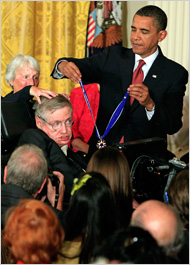
And now the British are weighing in also.  Yesterday, Stephen Hawking received his Presidential Medal of Freedom and jumped in with a response to the Investor’s Business Daily – which in it’s zeal appears to have forgotten that Mr. Hawking is British and under National Health.  The best summary is in the New York Times ,

The physicist Stephen Hawking is defending Britain’s National Health Service after an editorial in Investor’s Business Daily said Mr. Hawking “wouldn’t have a chance in the U.K.,” where the health service would have deemed his life “essentially worthless.”

The publication’s mistake, which came in an editorial titled “How House Bill Runs Over Grandma,” has since been corrected. But on a larger level, the snafu also shows how quickly rationing, particularly at the end of life, has become a focus of the health care reform debate.

Mr. Hawking — who received the Presidential Medal of Freedom at the White House on Wednesday — responded to the editorial this week, telling The Guardian newspaper, “I wouldn’t be here today if it were not for the N.H.S. I have received a large amount of high-quality treatment without which I would not have survived.”

DESCRIPTION

At this point, I fear for any type of health care reform.  New polls seem to show that older Americans oppose reform. The medical industry is threatening to pull support if legislation call for anything more that the co-op model.  Chris Matthews interviewed a man carrying a gun outside of the President’s New Hampshire town hall meeting.   I wonder if when they get back to Washington, there will be anyone left, Democratic or Republican, who wants to vote for health care reform.  Maybe they would prefer to just left the system explode or maybe implode.  Or we can be like Chris Hayes and try to laugh at the situation.

Here are parts of Hayes’  “Your Questions About Health Care Reform Answered”

Ok, so there’s been a lot of misinformation about proposals to reform the health insurance industry and provide (near) universal coverage. Understandable! It’s complicated stuff. Herewith, I’ll try to answer some questions

1) Is it true that all of the bills currently proposed would end the practice of “rescission,” whereby health insurance providers refuse to treat customers who’ve paid their premiums simply because they’ve become ill?

No! That’s a common misunderstanding. Actually, all of the bills would ban incisions, that is, they would legally bar surgeons from performing surgery until a panel of twelve gay illegal immigrant government bureaucrats unanimously signed off on the procedure.

2) Is it true that health care reform would ban insurers from refusing to insure people because of pre-existing conditions?

Wrong again. To get rid of health inequality, the bills actually mandate that every American be given a pre-existing condition. A National Illness Commission, with academics appointed from Harvard, Reed College and Berkeley, will evaluate each citizen, and based on their demographic profile, choose their malady. Each disease or syndrome is scored on a scale of 1 to 10, with 10 being the most severe. White christian men will receive pre-existing conditions of 8 or higher. Black people, “wise latinas,” and ACORN members will be exempted.

5) Will the current bills plug the “donut hole” in the Medicare prescription drug benefit so seniors don’t have to pay exorbitant out of pocket expenses for their medication?

Absolutely not. The legislation will ban donuts.

If you don’t laugh, you’ll have to cry.

What Affirmative Action Means in Real Life

Sonia Sotomayor is now officially Justice Sotomayor.  She took the oath administered by Chief Justice John Robert a few minutes ago.

On Thursday afternoon when the Senate voted to confirm her, the newest Senator, Al Franken the former comedian from Minnesota, was presiding and announced the vote.  Is this a great country or what?

Anita Hill has a very interesting Op-Ed in today’s Boston Globe discussing the role of what she calls “educational democracy” played in Justice Sotomayor’s elevation to the Supreme Court.

A LATINA from a Bronx housing project is probably not what Woodrow Wilson envisioned when he called for “educational democracy’’ as president of Princeton University in 1910. Yet decades later, when Sonia Sotomayor ascended to the top of her class, his idea of an open and accessible university system was on its way to coming to fruition. In Wilson’s day, Princeton admitted no women and Wilson himself is said to have looked with disfavor on the admission of men of color. Nevertheless, educational reform was a springboard for his larger aims of social and political reform and his fight against “the rule of materialism in our national life.’’

Indeed, Wilson would have needed a high-definition crystal ball to foresee Sotomayor’s “incredible journey’’ to become an African-American president’s nominee to the Supreme Court. Yet, as a critical chapter in our country’s pursuit of educational equality, her story of hard work and high achievement is an extension of Wilson’s idea. She represents the positive change that can occur when social institutions – law and education in particular – shed their roles as tools for exclusion and open their doors to those previously barred. It took nearly 220 years for the first Latina justice to be appointed to the Supreme Court, but, in a country constitutionally committed to equal opportunity, it was inevitable.

It was under President Wilson that women gained the right to vote – a reward for suspending demonstrations for suffrage during World War I.  And I’ve always thought that Edith Wilson had influence here also even though I don’t believe that any historical facts have ever surfaced to proved this.

Hill goes on

Sotomayor is poised to prove that the social experiment of the 1970s built on the idea of educational democracy has, thus far, worked. For its full realization, President Obama must correct the documented shortcomings of public schools that weigh most heavily on poor and minority community schools. We can’t be satisfied with one Sonia Sotomayor when we have the potential for so many more. For now, with her confirmation as the first Latina and third woman on the Supreme Court, Obama has reminded us of what egalitarian ideals and the will to pursue them can accomplish.

I think Hill is right.  Educational democracy leads to a critical mass of women, African Americans, or other ethnic minorities ready to take on jobs and challenges that have not been open to them in the past.  This leads to a cascade of changes in our society such as the election of the first African American President. 

I think it is the loss of this exclusivity that has the white Republican men on the Senate Judiciary Committee so frightened.  Perhaps they have seen all along where affirmative action or educational democracy was going to lead and why they have been so opposed to change.  But that is probably giving them too much credit and they are just frightened of change that puts them in a position where they are no longer superior.  One where they have to share power and priviledge.

Congratuations, Justice Sotomayor!  And may the President’s next appointment be someone as wise as you.  Perhaps a wise Asian American man or woman or a wise African American woman.  Mary Frances Berry, anyone?

Liar, Liar

Interesting story on NPR tonight.  A group called PoliFact is following the health care debate.

Bill Adair, editor of PolitiFact and the Washington bureau chief for the St. Petersburg Times, tells Melissa Block that one group that opposes an overhaul says the health care bill allows illegal immigrants to get free medicine.

“We gave that our lowest rating on our Truth-O-Meter: a pants on fire,” he says. “To the contrary, there’s language [in the bill] that says that undocumented aliens would not be eligible for the credit under this plan.”

The claim came from a chain e-mail that included many other assertions, including one that said a “health choices commissioner” would decide health benefits and that individual consumers would have no choices. This claim, too, got a “pants on fire” from PolitiFact.

“This chain e-mail is very persuasive in many ways because it has specific language, page numbers from the bill, but when you look at what it uses to back up a claim like that, it’s just not true,” Adair says. “There is a health commissioner that would be responsible for running the exchange under the main bills that have been discussed, but it’s not like that person would say you couldn’t get coverage or you could. That person would just be responsible to administer what the general standards were for the programs.”

Bogus claims aren’t just coming from those who oppose an overhaul. Democratic Rep. Russ Carnahan of Missouri recently claimed that the Congressional Budget Office estimated the current plan would create a $6 billion surplus over 10 years. Adair’s group has rated that as false.

“That really was a little bit of budget trickery there,” he says. “He is wrong that the CBO said this. The CBO said that the health care plan would post a deficit of something like $239 billion, something like that.

“What he’s doing is including some other numbers to try to erase that and actually make it look like a $6 billion surplus, but that’s not what the CBO says.”

Very interesting.

The Police, Henry Louis Gates, Jr. and Racial Profiling

I know the controversy is just beginning.  Volumes will be written about the incident in Cambridge.  Both sides will defend themselves and blame the other side.  Everyone will play the race card.  People who already mistrust President Obama because of his skin color will use his remarks as proof they are right.

The best commentary I’ve seen on the incident so far is from Joan Vennochi writing this morning in the Boston Globe.  In her regular op-ed column Vennochi wrote

The arrest of Henry Louis Gates Jr. by a Cambridge police officer is playing out along racial lines. But it’s also about power and machismo – on both sides.

Machismo.  That’s the key.  Gates, whether true or not, felt he was being treated differently than a white man would be in his own home.  Years of disparate treatment combined with the ego that comes from being an important and respected person in your field, caused him to lose his temper.  The police sergeant, James Crowley, faced with a potential break-in and a tired angry man reacted, not by backing down, but by arresting him.

Gates was in his own home when a Cambridge police officer responded to a call about a possible break-in at that address. The professor had just returned home from filming a documentary in China. His front door was stuck shut and his taxi driver helped him pry it open. Then, Sergeant James Crowley appeared at his door and demanded to see identification. Gates provided it, although some facts about how and when are in dispute.

The police report states that Gates was arrested after exhibiting “loud and tumultuous behavior, in a public place, directed at a uniformed police officer who was investigating a report of a crime in progress.’’ Gates disputes some information provided in the police report, but does acknowledge that he responded with anger.

Human beings of all races have a tendency to react as Gates did, especially when they are tired, frustrated, and privileged. Police officers usually don’t like it. The question is whether this police officer responded more harshly because of skin color.

The answer isn’t obvious, but both men could use some sensitivity training. Gates shouldn’t have yelled at the police officer; still, what he did was irritating, not criminal. Once the officer determined Gates did live in the house, he should have left, no matter what the professor was shouting.

Harvey Silverglate, a criminal defense lawyer, civil liberties defender, and Harvard Law School graduate, believes Gates’s arrest should be investigated, but not only because of its racial implications: Was Gates arrested and held as a way to teach him a lesson? If so, asks Silverglate, “Is this acceptable, regardless of whether the citizen is white or black?’’

In an ideal world, no. When it happens to a black man, racism may be the easy explanation, but that doesn’t make it the only explanation. Life and power in 21st-century America are more complicated than that.

President Obama at his July 22 press conference offered this

Wednesday night’s press conference seemed to be a different deal as the president leaped into a highly charged controversy that has ignited passions across talk radio, the blogosphere and the old-fashioned water cooler.

But in fact, racial profiling was a major issue for Mr. Obama when he was in the Illinois legislature. He was the chief sponsor of a bill, which became law, that requires police to record the race, age and gender of all drivers they stop for traffic violations and for those records to be analyzed for evidence of racial profiling.

Mr. Obama, asked Wednesday what the incident said about race relations in America, noted up front that Professor Gates is a friend and that his comments might be biased. He said “words” had been exchanged and added:

“Now, I don’t know, not having been there and not seeing all the facts, what role race played in that, but I think it’s fair to say, number one, any of us would be pretty angry; number two, that the Cambridge police acted stupidly in arresting somebody when there was already proof that they were in their own home; and, number three, what I think we know, separate and apart from this incident, is that there is a long history in this country of African-Americans and Latinos being stopped by law enforcement disproportionately. And that’s just a fact.” He added later that the incident was “a sign of how race remains a factor in this society.”

He also used biting humor, grinning broadly as he imagined being in Professor Gates’s seemingly preposterous circumstance of being arrested after trying to get into his own home.

“Here, I’d get shot,” Mr. Obama said, referring to his new address of 1600 Pennsylvania Avenue.

The whole racial profiling question becomes curiouser and curiouser as we learn that the officer involved spent time at the police academy teaching racial profiling.

I heard a discussion this morning on MSNBC’s Morning Joe in which Joe Scarborough talked about the serious question of racial profiling and admitted that he would have probably had a similar reaction to Dr. Gates’ and likely would not have been arrested.  Perhaps what we need is a discussion of racial profiling and we can begin with a civil dialogue between Sergeat Crowley and Dr. Gates – an expert police profiler and one who has been profiled.  They both need to lose their machismo and have a serious talk.  No one would have to lose face and no one needs to apologize. Oh and yes, as Joan Vennochi suggested let’s throw in some sensitivity training.

Obama and the All-Stars

The President is a White Sox fan to which I say, “wrong color sox, Mr. President.”  But leaving partisanship aside, it appears that he was the first President to be at an All-Star game since 1978 – when I think the President was Jimmy Carter.

Obama Throws First Pitch

We already knew that basketball and not baseball was Obama’s game so we shouldn’t be surprised when

Obama, who warmed up with Pujols in the batting cage, threw a pitch that was a lot slower than one of Tim Wakefield’s knuckleballs.

Jack Curry  goes on in the New York Times Bats blog

Before Obama tossed the first pitch, he stopped to shake hands with Stan Musial, a Hall of Famer for the Cardinals, who was sitting in a red golf cart. After Obama’s pitch, he shook hands with Bob Gibson, Ozzie Smith, Bruce Sutter, Red Schoendienst and Lou Brock, the other living Cardinals who are in the Hall. Brock saluted Obama, who saluted back.

When Obama visited the National League clubhouse before the game, Shane Victorino of the Philadelphia Phillies, a fellow Hawaiian, gave the president some macadamia nuts. The players had been advised not to give Obama anything, but Victorino did anyway, and his teammates howled.

Witnesses said Obama glided from player to player before the game, shaking hands and exchanging small talk. Obama spent the most time with Pujols. He also teased Pujols, who plays here, and Ryan Howard, who is from here, about losing the Home Run Derby to Prince Fielder on their home turf.

The last time Obama threw out the first pitch was before Game 2 of the 2005 American League Championship Series, so he was pitching on 1,371 days’ rest. Those White Sox won eight consecutive postseason games and a World Series title. After Obama noted how he brought his favorite team some luck, he added, “Any of these teams need a lefty

Interestingly, Obama also visited the umpires before the game and signed things for them and for a charity auction. Alan Schwartz  wrote in Bats

So 40 players and staff on each All-Star team got 15-minute clubhouse drop-ins from the president? Big deal. The six umpires got 10 minutes all to themselves.

“For the leader of the free world to take the time to talk to us lowly umpires was just incredible,” the left-field ump Tim Timmons said. “I barely remember it, I was just in awe.”

Don’t think that has happened before.

And finally there is this.  Alan Schwartz asked some players –  no Red or White Sox – what they would ask the President.

— Miguel Tejada, Astros: “How does it feel to have all that power?
— Prince Fielder, Brewers: “When do you get to just watch TV? When can you just sit and not talk to nobody?”
— Trevor Hoffman, Brewers: “Did you think that things would slow down once you got into the White House?”
— Zach Duke, Pirates: “What’s the highest bowling score you’ve gotten down there?”
— David Wright, Mets: “Something about A.C.C. basketball. I know he hooped it up with the Tar Heels.”
— Adrian Gonzalez, Padres: “Can you get us a college football playoff?
— Brian McCann, Braves: “When’s the economy going to turn around?”
— Carlos Pena, Rays: “Are you a see-it-to-believe-it person or a believe-it-to-see-it person?”
— Mark Teixeira, Yankees: “Who was your favorite athlete growing up, when you were just a kid enjoying sports?”
— Curtis Granderson, Tigers: “Are you tired? Do you get stressed?”
— Michael Young: “How can I help?”

And about the game:  The American League won.  Beckett and Wakefield did not pitch.  Youk and Bay each had a hit and Pap had a one-two-three inning but one of his high wire performances.