Race is complicated

3 days ago no one had heard of Shirley Sherrod who turns out to be the wife of Charles Sherrod, a founding member of the Student Nonviolent Coordinating Committee.

The Nation reports on Melissa Harris-Lacewell’s appearance on MSNBC’s Morning Joe.

Up until a few days ago, most of the nation didn’t know who Shirley Sherrod was, but for people who have made a life and a career out of studying civil rights, like Nation columnist Melissa Harris-Lacewell, that name was no news to them. Shirley Sherrod is the wife of Charles Sherrod, a foundational member of the Civil Rights Movement and one of the founders of Student Nonviolent Coordinating Committee (SNCC). Lacewell explains that Sherrod “was not just a bureaucrat working away in Georgia; this is a woman who is part of a family that has made real contributions to advancing the conversation on race in America.”

And even though right-wing blogger Andrew Breitbart only showed a short excerpt of Shirley Sherrod’s NAACP banquet speech and the administration rushed to judgment, Harris-Lacewell told Morning Joe that some good could come out of this scenario. She says that a national conversation on race is a bad idea, but a national classroom on race should be considered. Embedded under all of this mess is a beautiful story of Sherrod, the Spooner Family and interracial cooperation around issues of justice, Harris-Lacewell says. “The real narrative that Ms. Sherrod was telling is the narrative of someone who’s father was killed by the Ku Klux Klan, who developed prejudices and yet found a way through her advocacy and work to be a true advocate for this white farm family.”

And lest we forget, the NAACP also rushed to judgement by first applauding her dismissal.  I guess we can forgive Ben Jealous who is too young to have lived though the SNCC days or the segregated schools attended by Shirley Sherrod.  Did he recognize the last name, I wonder.  The white family she helped, the Spooners, jumped to her defense.

Image: Former Agriculture Department official Shirley Sherrod

For wisdom on this issue, I turn to Eugene Robinson’s column in today’s Washington Post.

After the Shirley Sherrod episode, there’s no longer any need to mince words: A cynical right-wing propaganda machine is peddling the poisonous fiction that when African Americans or other minorities reach positions of power, they seek some kind of revenge against whites.

A few of the purveyors of this bigoted nonsense might actually believe it. Most of them, however, are merely seeking political gain by inviting white voters to question the motives and good faith of the nation’s first African American president. This is really about tearing Barack Obama down.

It looked like a clear case of black racism in action. Within hours, Agriculture Secretary Tom Vilsack had forced her to resign. The NAACP, under attack from the right for having denounced racism in the Tea Party movement, issued a statement blasting Sherrod and condemning her attitude as unacceptable.

But Breitbart had overstepped. The full video of Sherrod’s speech showed that she wasn’t bragging about being a racist, she was telling what amounted to a parable about prejudice and reconciliation. For one thing, the incident happened in 1986, when she was working for a nonprofit, long before she joined the federal government. For another, she helped that white man and his family save their farm, and they became friends. Through him, she said, she learned to look past race toward our common humanity.

In effect, she was telling the story of America’s struggle with race, but with the roles reversed. For hundreds of years, black people were enslaved, oppressed and discriminated against by whites — until the civil rights movement gave us all a path toward redemption.

So why was she forced to pull over and text a resignation?  Robinson explains

The Sherrod case has fully exposed the right-wing campaign to use racial fear to destroy Obama’s presidency, and I hope the effect is to finally stiffen some spines in the administration. The way to deal with bullies is to confront them, not run away. Yet Sherrod was fired before even being allowed to tell her side of the story. She said the official who carried out the execution explained that she had to resign immediately because the story was going to be on Glenn Beck’s show that evening. Ironically, Beck was the only Fox host who, upon hearing the rest of Sherrod’s speech, promptly called for her to be reinstated. On Wednesday, Vilsack offered to rehire her.

Shirley Sherrod stuck to her principles and stood her ground. I hope the White House learns a lesson.

Tom Vilsack, the Secretary of Agriculture has apologized and offered her a job.  President Obama called to apologize.  It seems unlikely at this writing that she will go back to work for the USDA, but one can never tell.

The New York Times story points out

That, however, is unlikely to be the end of it for Mr. Obama, who has struggled since the beginning of his presidency with whether, when and how to deal with volatile matters of race. No matter how hard his White House tries to keep the issue from defining his presidency, it keeps popping back up, fueled in part by high expectations from the left for the first black president, and in part by tactical opposition politics on the right.

The Sherrod flap spotlighted how Mr. Obama is caught between these competing political forces, and renewed criticism from some of his supporters, especially prominent African-Americans, that he has been too defensive in dealing with matters of race — and too quick to react to criticism from the right

“I think what you see in this White House is a hypersensitivity about issues of race, that has them often leaning too far to avoid confronting these issues, and in so doing lays the foundation for the very problem they would like to avoid,” said Wade Henderson, president and chief executive of the Leadership Conference on Civil and Human Rights, an advocacy group here.

I don’t pretend to know what the President should do.  On one hand you have the right including leaders like Newt Gingrich and the Tea Party quick to find reverse racism, i.e. favoritism, is anything that the President tries to do.  It is unlikely that given what is happened Congress will vote to fund the settlement for black farmers denied loans and other benefits for which he requested an appropriation.   The lawsuit was settled in 1999, but farmers have never seen a penny.  According the NPR story, some of them are hopeful that the Shirley Sherrod incident will help move things along, but I am afraid just the opposite will happen.  I hope they are right.

A small group of black farmers rally at the Agriculture Department

The White House may have, as Eugene Robinson hopes, learned the lesson not to react without all the facts.  But I fear that race is still an issue that divides us to the point we can’t talk about it.  During the Lincoln-Douglas debates. the part of Andrew Breitbart/Glenn Beck was played by Stephen Douglas.  Douglas said “I do not regard the negro as my equal, and positively deny that he is any kin to me whatsoever.”  The problem for all the modern day Stephen Douglas’s is that a black man has been elected President.  The problem for Barack Obama is being the first.  And the ultimate irony is that it is almost exactly one year since Henry Lewis Gates was arrested.
The Frank-Dodd Financial Reform Bill

Helene Cooper writes in the New York Times this afternoon

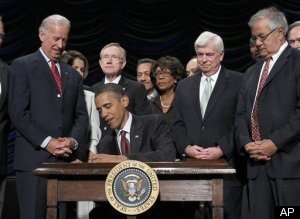
 President Obama signed into law on Wednesday a sweeping expansion of federal financial regulation, marking another — and perhaps last — major legislative victory before the midterm elections in November, which could recast the Congressional landscape.

The signature achievement — a response to the 2008 financial crisis that fundamentally alters the relationship between Wall Street and the federal officials charged with regulating it — is a culmination of two years of fierce lobbying and intense debate over how to deal with the financial excesses that tipped the nation into the worst recession since the Great Depression.

The law subjects more financial companies to federal oversight, regulates many derivatives contracts and creates a panel to detect risks as well as a consumer protection regulator. A number of the details have been left for regulators to work out, inevitably setting off complicated tangles down the road that could last for years.

Obama Financial Reform

Mr. Obama took pains to try to show how the complex legislation, with is dense pages on derivatives practices, will protect ordinary Americans.

“If you’ve ever applied for a credit card, a student loan, or a mortgage, you know the feeling of signing your name to pages of barely understandable fine print,” Mr. Obama said. “But what often happens as a result, is that many Americans are caught by hidden fees and penalties, or saddled with loans they can’t afford.”

He said the law would crack down on abusive practices in the mortgage industry, simplifying contracts and ending hidden fees and penalties, “so folks know what they’re signing.”

So what exactly is in the bill?  According to a summary in the Christian Science Monitor

A bill summary by Capitol Hill staff members includes 100 points. Here’s a shorter take, 10 points, focusing on less-publicized elements as well as some core provisions:

• A first-ever federal office focused on the insurance industry will monitor the insurance industry for systemic risk. The industry will remain regulated largely at the state level.

• FDIC deposit insurance for account-holders at banks, thrift institutions, and credit unions will be raised to $250,000 (from $100,000) retroactive to Jan. 1, 2008.

• The State Department would have to submit an “illicit minerals trade strategy” for the Congo region. Manufacturers that use minerals originating in the Democratic Republic of Congo would have to disclose measures taken to exercise due diligence on the source and chain of custody of the materials. The provision, sponsored by Sen. Sam Brownback (R) of Kansas, could affect high-tech firms like Intel and Apple.

• The bill beefs up the powers of the Securities and Exchange Commission, including extra funds for enforcement. The SEC would get new power to impose fiduriary responsibility on investment brokers. That means the brokers would have to offer advice based on the best interest of clients, not broker fees. Consumer advocates say the bill should have mandated this change, not allowed the SEC to consider it.

• New disclosure rules would apply to credit-rating firms, along with new penalties if the firms are irresponsible. In a nod to an amendment backed by Sen. Al Franken (D) of Minnesota, the bill seeks to end “shopping for ratings” by calling for the SEC to propose ways to prevent issuers of asset-backed securities from picking the firm they think will give the highest rating.

• Shareholders would get a “say on pay,” with the right to a nonbinding vote on executive pay and golden parachutes. Standards for listing on an exchange would require that compensation committees include only independent directors.

• Reforms would reshape Federal Reserve powers, including a ban on Fed bailouts targeted at specific firms (like AIG) in the future. The presidents of regional Fed banks would be selected entirely by directors representing the public, and not partly by directors representing banks that the Fed regulates.

• The bill creates a new Consumer Financial Protection Bureau to consoldiate duties now charged to various federal agencies. It would have a consumer hot line, for questions on things like mortgages, and a new office of financial literacy.

• A Financial Stability Oversight Council of top economic regulators will monitor systemwide risks. The bill summary says this group will ask the Federal Reserve to adopt “increasingly strict rules for capital, leverage, liquidity, risk management and other requirements as companies grow in size and complexity.”

• An “orderly liquidation” mechanism would allow the Federal Deposit Insurance Corp. (FDIC) to dismantle large financial companies that are on the brink of failure. Shareholders and unsecured creditors would bear losses, to end taxpayer bailouts. But the bill also allows the FDIC to shelter solvent banks from having to bear losses if there is a threat to overall US financial stability

Thank you to Barney Frank, Chris Dodd, Olympia Snowe, Susan Collins and Scott Brown and all the Democrats except Ben Nelson we have a start and reining in the runway, unregulated financial system.

Talking jobs and unemployment

Today I went to a graduation for 58 men and women – almost all over 3o – who went to a program at the local YMCA to sharpen skills and make them more competitive in the job market.  I shared an intern with several others in my agency.  It was announced that 8 or 9 had found jobs.  Not bad in this market, but not good either. 

Last week the Boston Globe ran a story about the report by the National Skills Coalition. 

The report projects that by 2016, Massachusetts will have nearly 400,000 job openings that require more than a high school diploma, but less than a four-year college degree. The report says “middle-skill” jobs will account for 38 percent of all openings.

Ranging from licensed practical nurses to computer support specialists, the jobs have median annual incomes of about $50,000 to $55,000.

The report says the state faces challenges in meeting the demand for middle-skilled workers, with only 32 percent of current employees having the credentials.

The graduation I attended was designed to train people for these middle-skill jobs.  But until the jobs are created, the graduates still need to pay the rent, the mortgage, buy food and clothes.  These are men and women who are doing the rights things and are still finding it tough to find a job.  Some of them were unemployed before entering the program and some will be unemployed after graduation.  Some may be eligible for unemployment benefits, but may have exhausted their time.  Which brings me to the unemployment benefits issue.

Let’s start with Paul Krugman.

There was a time when everyone took it for granted that unemployment insurance, which normally terminates after 26 weeks, would be extended in times of persistent joblessness. It was, most people agreed, the decent thing to do.

But that was then. Today, American workers face the worst job market since the Great Depression, with five job seekers for every job opening, with the average spell of unemployment now at 35 weeks. Yet the Senate went home for the holiday weekend without extending benefits. How was that possible?

The answer is that we’re facing a coalition of the heartless, the clueless and the confused. Nothing can be done about the first group, and probably not much about the second. But maybe it’s possible to clear up some of the confusion.

So who are the heartless?  They are Republicans and some Democrats a tiny number of whom may be acting out of principle.  They hide behind the deficit and statements from the clueless.

By the clueless I mean people like Sharron Angle, the Republican candidate for senator from Nevada, who has repeatedly insisted that the unemployed are deliberately choosing to stay jobless, so that they can keep collecting benefits. A sample remark: “You can make more money on unemployment than you can going down and getting one of those jobs that is an honest job but it doesn’t pay as much. We’ve put in so much entitlement into our government that we really have spoiled our citizenry.”

Now, I don’t have the impression that unemployed Americans are spoiled; desperate seems more like it. One doubts, however, that any amount of evidence could change Ms. Angle’s view of the world — and there are, unfortunately, a lot of people in our political class just like her.

And then Krugman tackles the misinformed.

But there are also, one hopes, at least a few political players who are honestly misinformed about what unemployment benefits do — who believe, for example, that Senator Jon Kyl, Republican of Arizona, was making sense when he declared that extending benefits would make unemployment worse, because “continuing to pay people unemployment compensation is a disincentive for them to seek new work.” So let’s talk about why that belief is dead wrong.

Do unemployment benefits reduce the incentive to seek work? Yes: workers receiving unemployment benefits aren’t quite as desperate as workers without benefits, and are likely to be slightly more choosy about accepting new jobs. The operative word here is “slightly”: recent economic research suggests that the effect of unemployment benefits on worker behavior is much weaker than was previously believed. Still, it’s a real effect when the economy is doing well.

But it’s an effect that is completely irrelevant to our current situation. When the economy is booming, and lack of sufficient willing workers is limiting growth, generous unemployment benefits may keep employment lower than it would have been otherwise. But as you may have noticed, right now the economy isn’t booming — again, there are five unemployed workers for every job opening. Cutting off benefits to the unemployed will make them even more desperate for work — but they can’t take jobs that aren’t there.

Will extending benefit add the to deficit?  Krugman tackles this one also.

But won’t extending unemployment benefits worsen the budget deficit? Yes, slightly — but as I and others have been arguing at length, penny-pinching in the midst of a severely depressed economy is no way to deal with our long-run budget problems. And penny-pinching at the expense of the unemployed is cruel as well as misguided.

But is being against extending benefits a political plus?  Not according to two new polls out today.  According to the New York Times story in the Caucus both a CBS News and a ABC News/Washington Post poll found the majority of those surveyed believed that Congress should extend benefits.

In the CBS News survey, 52 percent of respondents said Congress should extend unemployment benefits for people currently out of work, even if it meant increasing the budget deficit. Thirty-nine percent disagreed, and the rest said “it depends” or gave no opinion.

Broken down by party affiliation, about 7 in 10 Democrats said they supported an extension, while most Republicans said they opposed it. Independents were more evenly divided, with 47 percent in favor and 42 percent opposed.

The ABC News/Washington Post poll asked the question a little differently, and found even more support for an extension of unemployment benefits. The question noted that Congress had previously extended benefits because of the economic downturn, and was considering extending them again. It also presented capsules of each side of the debate, noting that supporters of the extension say it “will help those who can’t find work” while opponents say it “adds too much to the federal budget deficit.”

The result: 62 percent of respondents said Congress should approve another extension, while 36 percent said it should not. Those in favor included 80 percent of Democrats and 59 percent of independents, as well as 43 percent of Republicans.

So there doesn’t seem to be a lot of gain in opposition.

Standing with three Americans who have struggled to find work, President Obama spoke in the Rose Garden about the need to extend unemployment benefits.

The last word goes to the President.

Under pressure in an election year to reduce the unemployment rate, now at 9.5 percent, Mr. Obama also urged the Senate to approve a package of tax cuts and an expansion of lending to small businesses. “We all have to continue our efforts to do everything in our power to spur growth and hiring,” Mr. Obama said at the White House.

Mr. Obama, appearing before reporters in the Rose Garden flanked by three Americans who have had difficulty finding work, took aim at that argument. “That attitude reflects a lack of faith in the American people,” Mr. Obama said. “They’re not looking for a handout. They desperately want to work.”

Mr. Obama sharply criticized Republicans who have several times in the past month voted against bringing an unemployment extension bill to the Senate floor.

“After years of championing policies that turned a record surplus into a massive deficit, the same people who didn’t have any problem spending hundreds of billions of dollars on tax breaks for the wealthiest Americans are now saying we shouldn’t offer relief to middle-class Americans like Jim or Leslie or Denise, who really need help,” Mr. Obama said, referring to the three people who stood with him in the Rose Garden, brought to Washington by the White House to help illustrate the president’s point.

The Bill will pass this week, probably without Republican support, after we get the new temporary Senator from West Virginia, Carte Goodwin. 


The politics of Presidential vacations

If we want to go away for a long weekend, Bob and I just pick the place and book a place to stay or more likely, just tell my sister we are coming up to Vermont.  No politics involved.  But where and for how long a President vacations becomes grist for the political mill.

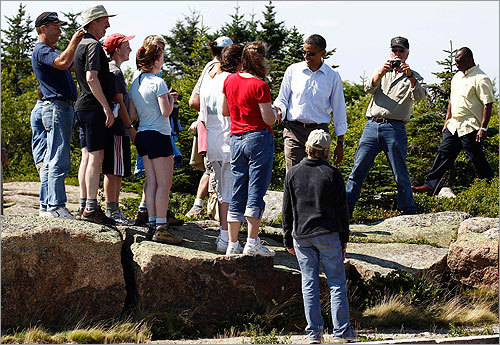
The Obamas walked along a trail with their daughters Sasha, left, and Malia on Cadillac Mountain.

The first family picked Bar Harbor, Maine and Acadia National Park.  But the big flap is that they didn’t go to the Gulf.

In a New York Times “White House Memo”, Sheryl Gay Stolberg wrote

Mr. Obama arrived here Friday for a summer weekend getaway with his wife, Michelle, and their daughters, Malia, 12, and Sasha, 9 — a precursor to a longer family vacation they are planning next month on Martha’s Vineyard. But what sounds like a much-needed family escape from the literal and political heat of Washington to some sounds like hypocrisy to others, given recent statements by both the president and first lady urging Americans to spend their vacation time and money along the shores of the oil-stricken Gulf of Mexico.

“Michelle Obama: Take your Vacation in the Gulf, America — If You Need Us, We’ll be In Maine,” blared the headline on the Web site of Michelle Malkin, the conservative commentator, on Monday, the day Mrs. Obama toured the gulf. ABC News served up similar, if more muted fare: “First Lady Encourages Americans to Vacation on Gulf — But Obamas Head to Maine Instead.”

A trip to the Gulf Coast, of course, would hardly be much of a vacation for Mr. Obama, whose political fortunes were undercut by the spill. But the flap does point up how politically fraught the modern presidential vacation — or, for that matter, presidential leisure time in general — has become.

Of course, if they did go to the Gulf Coast for a vacation scheduling no public events, everyone would be upset by their not having helped clean up a beach or visiting fishermen who are not working because of the spill.  It would not, as the Memo points out, have been a vacation.  This is a trip with their children, Ms. Malkin.  Remember family values?   Both the President and First Lady have gone often to the Gulf and they will be returning many times, I’m sure.

The Memo continues

Bill Clinton and his family traveled to Jackson Hole, Wyo., in the summer of 1996 after polling showed that Americans viewed Martha’s Vineyard as too elitist. George W. Bush caught so much flak for spending a month at his ranch in Crawford, Tex., in the summer of 2001, said his former press secretary, Ari Fleischer, that his staff printed T-shirts listing all the work-related side trips he had taken. Mr. Fleischer may disagree with Mr. Obama’s policies, but he said he was protective of the president’s right to “recharge his batteries” wherever it suited him.

“I just think that people should leave the president alone and not make a political issue of where he takes vacation or how he takes vacation,” Mr. Fleischer said. “He and his family are perfectly entitled to do whatever works for them.”

President Obama greeted people after walking along a trail on Cadillac Mountain.

One thing I have noticed is that President Obama likes ice cream.  He seem to gravitate to ice cream shops wherever he goes.

Once last thing:  While looking through  pictures of the trip to put in this entry, I kept  spotting Reggie Love.  Does he ever get to go on a vacation by himself? 

The pictures are from the Boston Globe and the New York Times.

Queen Elizabeth at the United Nations

On July 6, Queen Elizabeth addressed the General Assembly of the United Nations for eight minutes.  The speech received little of no attention and I wouldn’t even have known about it until I read the most recent Newsweek and Jon Meacham’s very interesting thoughts on the speech.

Queen Elizabeth

First from the New York Times

Queen Elizabeth II addressed the United Nations for the first time since 1957 on Tuesday, paying homage to the organization’s accomplishments since she last stood at the famous green podium of the General Assembly.

It was a brief speech (see text), just eight minutes, assuring that  the queen’s remarks would not join the annals of infamous harangues from the podium delivered by long-reigning leaders like Muammar al-Qaddafi, who spoke for more than 90 minutes last fall, or Fidel Castro of Cuba. It was the first of three public visits during the queen’s daylong stop in New York City.

On her first visit, just four years after she took the throne, the queen came gliding into the United Nations in a black slip dress (or at least it looked black in the rapturous newsreels about the visit), high heels and a fur wrap. There was definitely no need for the fur wrap in the suffocating July heat on Tuesday — the queen wore a flowered suit and a curvy, elegant hat.

If the monarch, now 84, did not exactly sweep through the hall with the same grace as her 31-year-old self, the United Nations building itself looked rather more tattered, only now undergoing its first renovations since it was built around 1950.

So what did Jon Meacham make of the speech?

Given her audience and the constitutional restraints on her role—the personification of political life, she must be above politics—Elizabeth’s brief address could be read as an exercise in ceremonial conventionality. Yet her little-noted remarks offer a meditation on globalism and post-imperialism from a woman whose ancestors ruled much of the world. For American conservatives who worry that President Obama (or, really, any Democratic president) veers dangerously close to “one worldism,” the queen’s speech in New York serves as an inadvertent endorsement of a habit of mind in which power, both military and economic, is best exercised cooperatively rather than coercively. Saluting the U.N.’s diplomatic and relief work, she specifically cited the challenges of terrorism and climate change; the latter is of special concern, she said, for a “careful account must be taken of the risks facing smaller, more vulnerable countries, many of them from the Commonwealth.”

Meacham continues

What she takes very seriously—and I use that “very” advisedly—is the British Commonwealth, the loose association of 54 countries of which she is the titular head. There is no single superpower in her realm; she came to the throne in 1952 in the aftermath of World War II, a conflict in which the U.K. saved freedom but lost an empire. She has spent the last half century offering the Commonwealth a kind of subtle but steady rhetorical leadership—not unlike that provided by the U.N.

In a world of asymmetrical threats—terror, nuclear proliferation, disease, poverty, and climate change—multilateralism is not, to borrow an image from Richard Haass of the Council on Foreign Relations, a policy of choice but of necessity. This does not mean America ought to go limp. Quite the opposite, in fact: the projection of our strength is magnified when we project it in concert with allies, whether through the U.N., NATO, or some provisional force created for a given military or policy purpose.

Foreign-policy doctrines are, in my view, chiefly useful in retrospect, not in real time, for the making of policy is almost always provisional, subject to the forces and the exigencies of a given moment. Which is why if we have to go it alone, we will. We learned how from Elizabeth’s first prime minister, Winston Churchill. But those hours will prove the exception, not the rule.

The rule is a world like Elizabeth’s Commonwealth. And the work endures. Quoting the late U.N. secretary-general Dag Hammarskjöld, the queen said, “ ‘Constant attention by a good nurse may be just as important as a major operation by a surgeon.’ Good nurses get better with practice; sadly, the supply of patients never ceases.”

This quote from Queen Elizabeth sums up what she believes and what I think Barack Obama’s view of diplomacy comes close to

It has perhaps always been the case that the waging of peace is the hardest form of leadership of all.  I know of no single formula for success, but over the years I have observed that some attributes of leadership are universal, and are often about finding ways of encouraging people to combine their efforts, their talents, their insights, their enthusiasm and their inspiration, to work together.

I have to think that the conservative, George W. Bush/Dick Cheney/Tea Party view of the world where the United States is the ultimate power and can just tell other countries what is going to happen is rapidly becoming outdated.  The world is becoming a large democracy with everyone needing to have a say.  We need to listen to the Queen and work together.

The State of the Obama Presidency

All of our expectations were so high when Barack Obama took office 18 months ago.  He was going to fix the economy, end the wars in Iraq and Afganistan, give us health care reform, fix the schools, walk on water….

After 8 years of George W. and after the wasted Clinton years, we progressives were ready.  So where are we now?  This Doonesbury cartoon says its all.

We are like his kids and think he can do anything.  Unfortunately, there is the Senate to deal with and the fall elections which still look difficult for the Democrats.  I’m hoping they can just hang on to enough seats to keep control and Obama’s agenda has a fighting chance.

Tea Party on Boston Common

Yesterday the Tea Party came to Boston.  About 5000 gathered to hear Sarah Palin give her talking points.  As I was going to work, I saw the booths being set up and the motorcycle police gathering.  The few black faces at that early point were Boston Police officers. We heard the helicopters circling all morning.  When I went for a walk at lunch the rally had ended and I saw a tea partier too busy trying to hang on to his sign to notice he was crossing a busy intersection against the walk light and in front of a bus pulling out from a stop.  The driver did see him and the man finally noticed, but to me it was emblematic of the tea party movement: oblivious to the reality of the world around them.

Yvonne Abraham had a great column in the Boston Globe this morning.

I was standing in the crowd at the tea party rally on the Common yesterday, enjoying Sarah Palin’s applause lines (Do you love your freedom? We’re not going to stand for it any more! Oh no ya don’t! Drill, baby, drill!), when a friendly woman asked me a question.

“We don’t look insane, do we, really?’’

Well, no, I had to allow. They didn’t. In fact, most in the excited crowd seemed pretty normal — unless you count Doug Bennett, the Boston City Council candidate whose giant grin and jolly handshake show up so often around town it’s kind of creepy.

In fact, most of the people I spoke to treated me as if I were the one who was soft in the head, unable to comprehend elementary concepts. They patiently dedicated themselves to my enlightenment.

“Here, have a copy of the Constitution, so you know what we’re talking about,’’ one kind man offered. They even engaged in civil debate with some counterprotesters.

Donna Tripp was thrilled with this development. Holding a sign that read “No Matter What I Write, I Will Still Be Called a ‘Racist, Nazi, Tea-bagger . . . ,’ ’’ the Avon resident had just been interviewed on camera by a young man who works for Palin.

“It gives me the willies!’’ she told her friend. “He’s shooting for Sarah!’’

She loves Palin because “the Constitution is her mantra, and that’s what I’m all about,’’ Tripp said. “She’s done what all those women wanted to do in the ’60s. She earned everything she has, all on her own.’’

Like everybody else at the rally yesterday, Tripp hates, hates, hates the health care overhaul recently signed into law.

“This country is taking a hard right turn for socialism,’’ she said. “I don’t want to be told to buy a service I don’t want. America is about freedom of choice.’’

Tripp, 55, already lives in a state that requires everybody to buy health insurance, but she refuses to do it.

“I’m healthy,’’ she said. When her husband went to Canada for prostate cancer treatment five years ago, they paid $25,000 out of pocket.

But what if she got really sick — if she needed, say, heart bypass surgery, which could cost more than $100,000?

“I’d mortgage my house,’’ she said. And if that wasn’t enough?

“I guess I’d die,’’ she said. “But under our Constitution, I should be able to take that risk.’’

More likely, Tripp would get her treatment, and if she couldn’t afford to pay for it, the rest of us would pick up the tab.

That’s how this country is set up: According to the preamble in the little Constitution the kind man gave me, we are all about promoting “the general Welfare.’’

Scott Brown, our new Senator, didn’t show up.  Neither did Charlie Baker who is running for Governor as a Republican.  Wonder why?

Today the New York Times and CBS released a new poll about the Tea Party.

Tea Party supporters are wealthier and more well-educated than the general public, and are no more or less afraid of falling into a lower socioeconomic class, according to the latest New York Times/CBS News poll.

The 18 percent of Americans who identify themselves as Tea Party supporters tend to be Republican, white, male, married and older than 45.

They hold more conservative views on a range of issues than Republicans generally. They are also more likely to describe themselves as “very conservative” and President Obama as “very liberal.”

And while most Republicans say they are “dissatisfied” with Washington, Tea Party supporters are more likely to classify themselves as “angry.”

And I hate to burst Donna Tripp’s bubble, but the reason why she is perceived as racist is because many of her fellow tea partiers appear to be racist.  According to the poll, “Supporters of the Tea Party movement are more likely to be men, over the age of 45, white, married, and either employed or retired. Few are unemployed. They are more affluent and more educated than most Americans. Almost all said they are registered to vote, and most are Republicans.”

Tea Party supporters’ fierce animosity toward Washington, and the president in particular, is rooted in deep pessimism about the direction of the country and the conviction that the policies of the Obama administration are disproportionately directed at helping the poor rather than the middle class or the rich.

The overwhelming majority of supporters say Mr. Obama does not share the values most Americans live by and that he does not understand the problems of people like themselves. More than half say the policies of the administration favor the poor, and 25 percent think that the administration favors blacks over whites — compared with 11 percent of the general public.

So this well educated, overwhelmingly white group obviously feels threatened by the way the world is changing and afraid they will lose theirs.

When talking about the Tea Party movement, the largest number of respondents said that the movement’s goal should be reducing the size of government, more than cutting the budget deficit or lowering taxes.

And nearly three-quarters of those who favor smaller government said they would prefer it even if it meant spending on domestic programs would be cut.

But in follow-up interviews, Tea Party supporters said they did not want to cut Medicare or Social Security — the biggest domestic programs, suggesting instead a focus on “waste.”

Some defended being on Social Security while fighting big government by saying that since they had paid into the system, they deserved the benefits.

Others could not explain the contradiction.

“That’s a conundrum, isn’t it?” asked Jodine White, 62, of Rocklin, Calif. “I don’t know what to say. Maybe I don’t want smaller government. I guess I want smaller government and my Social Security.” She added, “I didn’t look at it from the perspective of losing things I need. I think I’ve changed my mind.”

It looks like the Tea Party is really the party of “I’ve got mine and I don’t want to share with anyone who is not like me.”

Nuclear Security

I grew up going to protests and vigils to urge President Kennedy to ban open air testing so I am thrilled that President Obama has taken the first steps to get the world talking about securing bomb-making materials from terrorists and other rogues.  And if you click this link, you will see him “dance” as he greets all the leaders.  Watch it full screen.

The New York Times reports

The meeting that Mr. Obama convened, and to a great degree stage-managed, was unlike any negotiations over arms control with the Soviets during the cold war or, more recently, the so-far fruitless talks to get North Korea to disarm. This was a far broader effort to persuade African, Latin American, Asian and European nations to agree on steps to deny terrorist groups the two materials necessary to make a bomb: plutonium and highly enriched uranium.

Mr. Obama began the session arguing that while superpower confrontation was far more remote, the risk of nuclear terrorism had never been greater, and he quoted the warning of Albert Einstein soon after the beginning of the nuclear age: “We are drifting towards a catastrophe beyond comparison.”

Critics contended that this session was all for show.

“The summit’s purported accomplishment is a nonbinding communiqué that largely restates current policy, and makes no meaningful progress in dealing with nuclear terrorism threats or the ticking clock represented by Iran’s nuclear weapons program,” said Senator Jon Kyl, the Arizona Republican who has vowed to oppose nuclear treaties Mr. Obama regards as essential.

Mr. Obama acknowledged that the commitments were voluntary, but he said the situation was nothing new. “If you are asking, ‘Do we have an international, one-world law enforcement,’ we don’t, and we never have,” he said.

Isn’t getting someone to do something voluntarily better than forcing them to do it? 

At the end of two days of meetings, Mr. Obama could claim two major accomplishments: The summit meeting forced countries that had failed to clean up their nuclear surpluses to formulate detailed plans to deal with them, and it kicked into action nations that had failed to move on previous commitments.

A second summit meeting will be held in two years in South Korea, Mr. Obama said, to make sure countries are on track.

Some countries arrived with what Gary Samore, Mr. Obama’s nuclear adviser, called “house gifts” that the United States had encouraged as signs of sincerity. For example, Canada, Mexico and Ukraine committed to eliminating their surplus weapons-grade materials or giving them to the United States.

This week, Russia closed a plutonium reactor it had used to make weapons-grade fuel. Other nations agreed to convert research reactors to fuel that could not be used for weapons.


Outside experts were optimistic. Sam Nunn, the former senator who tutored Mr. Obama on proliferation issues, said he thought “we are now closer to cooperation than catastrophe.” Graham Allison, a Harvard expert on nuclear terrorism, made the case that if countries “lock down all nuclear weapons and bomb-usable material as securely as gold in Fort Knox, they can reduce the likelihood of a nuclear 9/11 to nearly zero.”

As I said at the beginning, baby steps are better than taking no steps at all.  We have made a start.

Still fighting the Civil War

I’ve heard people chuckle in amazement at factions in other countries who still feud over “ancient” injuries, but we have our own on-going civil war.  It appears that for many, the Confederacy was never defeated and the South can rise again.  Two smart women, Melissa Harris-Lacewell and Gail Collins have written about this phenomenon each using the Virginia Confederate History Month as a starting point.

Harris-Lacewell writes of the “Two Virginias” in the Nation

Governor Robert McDonnell declared April Confederate History Month in Virginia. In his declaration Governor McDonnell called for Virginians to “understand the sacrifices of the Confederate leaders, soldiers and citizens during the period of the Civil War.”

In his original declaration, McDonnell made no mention of slavery as a root cause for the Civil War. His insistence on remembering only “leaders, soldiers, and citizens” refuses to acknowledge the existence of black people in the South. There were some black soldiers who fought in the Confederate army, but the vast majority of African Americans contributed to the Confederate effort through the violently coerced, unpaid labor that was part and parcel of the their dehumanizing, totalizing, intergenerational, chattel bondage. McDonnell seems to believe that this reality is unworthy of remembrance.

It’s taken me nearly two days to respond to the Governor’s declaration of Confederate History Month and his flip erasure of black life, suffering, and struggle because this particular news story is profoundly personal.

On my father’s side we traced our family tree as far as we could follow it and discovered we are descended from an African woman sold into slavery on a corner in Richmond, Virginia.

Harris-Lacewell continues

My father and his siblings grew up in the Church Hill neighborhood in Richmond. They attended racially segregated schools. Despite being nearly starved for school resources by the state, my father and his twin brother became the first in the family to attend college. Both became college professors. My uncle had a distinguished career as a student at the University of Virginia. My father went on to become the first Dean of African American Affairs at the University of Virginia in 1976.I grew up in Virginia. I had social studies teachers who referred to the Civil War as “the war between the states” or “the war of Northern aggression.” My interracial family experienced harassment and abuse during the two decades we made our home in the Commonwealth. But Virginia is also the place where I made lifelong friends, found spiritual communities and was educated by many tough and loving teachers. I came to political consciousness in Virginia and distinctly remember listening to every word of Douglass Wilder’s inauguration address as the first black governor. I cheered on election night 2008 when Virginia turned blue just moments before Barack Obama’s presidential win was announced.

I share this personal history because it is not exceptional. Black Americans are, by and large, Southerners. Our roots, our stories, our lives, our struggles, our joys have a distinctly Southern flavor. Slavery and Jim Crow are part of our experience, but so are church picnics, HBCU football games and jazz music. There is no Black American history that is not deeply intertwined with Southern history. It is extraordinarily painful to watch an elected official in the 21st century engage in an act of willful and racist historical erasure of our very selves.

I also lived in Virginia for many years.  My first job with the Commonwealth of Virginia was enforcing Executive Order Number One issued by a former segregationist governor, Mills E. Godwin.  E.O. 1 which was issued by every governor until Bob McDonnell forbids discrimination in state employment.  I had the day off for Lee-Jackson Day every January.  (That’s Robert E. and Stonewall.)  When Martin Luther King’s birthday was made a national holiday, the day became Lee-Jackson-King Day.  Virginia has always been different, but McDonnell seems determined to really turn back time.

Harris-Lacewell concludes

Without a hint of irony McDonnell suggested that he hopes to profit from Confederate inspired tourism. Clearly he hopes that the racial anxieties brewing in America will serve as a tourist boon for the former Confederate capital. Having profited for centuries from the forced labor of enslaved black Americans, Virginia seeks to further commodify black suffering in the 21st century. McDonnell is welcoming Rebel flag waving whites from rural Pennsylvania, downstate Illinois, and Southern California to come spend their money and steep themselves in Virginia past when white citizens, determined to keep black people as non-humans, fought back against the federal government.

Virginia has other histories that we can use to resist this false and frightening narrative. We must insist on remembering Jefferson’s Virginia that called us to be better than ourselves, to defend freedom, and to hold together our union. We must remember the histories of all the black families like my own whose struggle and strength cannot be erased from Southern history.

I have visited all the Civil War battle sites in Virginia.  I spent my honeymoon visiting the Shenandoah sites, Harper’s Ferry and Gettysburg and most of the national parks try to recognize the role of blacks, free and slave, mostly on the side of the Union.  If the Governor really wants to promote tourism there are a lot better ways to do so.

Gail Collins writes in her New York Times column

April is the cruelest month. Or, if you live in Virginia, Confederate History Month.

The state is buzzing over Gov. Bob McDonnell’s proclamation urging citizens to spend the month recalling Virginia’s days as a member of the Confederate States of America. Although since McDonnell had previously turned April over to child abuse prevention, organ donation and financial literacy, perhaps it was O.K. to just pick your favorite.

The original Confederate History proclamation was a miracle of obfuscation. It did not even mention slavery. On Wednesday, the governor apologized for that and said that slavery “has left a stain on the soul of this state and nation.”

People, what’s our bottom line here. The governor of Virginia has decided to bring slavery into his overview of the history of the Confederacy. Good news, or is this setting the bar a wee bit too low?

The love affair with all things Confederate is way more worrisome. Once again, it’s in to talk secession. The Republican attorneys general are lining up to try to nullify the health care bill.

“Many issues of the Civil War are still being debated today,” said Brag Bowling of the Sons of Confederate Veterans, which led the push to get that proclamation in Virginia. That seems extremely depressing, as if we were Serbs stewing about what the Turks did at the Plain of Blackbirds in 1389.

Actually, a national discussion of Civil War history sounds fine — as long as we could start by agreeing that the whole leaving-the-union thing was a terrible idea. In the proclamations, it generally sounds as if everything went swimmingly until the part where the South lost and grudgingly rejoined the country.

I have been accused by at least one commentator on this blog of seeing everything in racial terms.  I think just the opposite is true.  People like Governor McDonnell and Representative Joe Wilson and, in fact, the entire “just say no” to anything proposed by President Obama is based on the President’s race.  We need to have a serious discussion about race.  I don’t know how that can happen as President Clinton tried to initiate one and failed and President Obama can’t initiate it.  Maybe Clinton tries again.  Maybe Clinton and President Carter together.  But no matter how much the McDonnell and Republicans want to go backward, the fact remains:  We have elected a black man as President and the population of the United States will soon have a majority population of people of color and there isn’t much they can do about those two things.

Sure signs of spring

The NCAA basketball tournaments are over.  We can only hope that UConn is not so dominent next year and someone else has a shot at the women’s championship.  I did have Duke in the men’s final which salvaged something although not as much as Reggie Love, President Obama’s assistant and former Duke player, who had Duke winning it all.

I planted my spring pots of pansies for the front steps, started some herbs and played with all the indoor plants  this weekend.  All signs of spring.

The Yankee’s opened at Fenway on Sunday night.  (I really dislike opening night.  One is supposed to skip school and work on opening day!)   The Sox took opening day, but lost last night.  Here is Wiley Miller’s take in Non Sequitur

There was the Easter Egg Roll at the White House where the President tried to help this poor bewildered child who was having trouble starting. 

White House Easter Egg Roll

It’s gonna be 80 today!