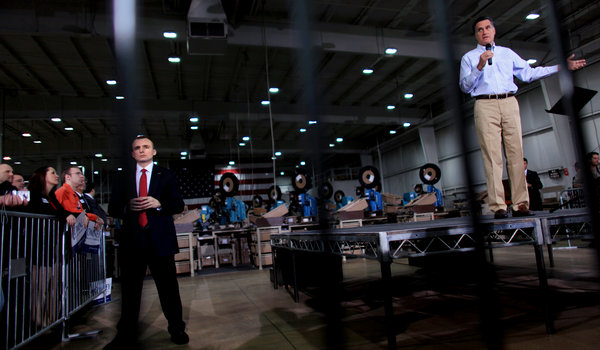
Mittens the mean

Whether you are going to vote for him or not, Mitt Romney has kinda a nice but clueless rich guy image.  Don’t let that fool you.  Joan Vennochi reminds us of his history here in Massachusetts.

Massachusetts is where Romney first showed his appetite for running over any candidate who stands between him and political office. Here, it happened to be women.

When Romney decided to run against Ted Kennedy in 1994, Republican Janet Jeghelian, a former talk radio host, was in the race. Once Romney jumped in, he and the state GOP kept her off the primary ballot.

Jeghelian wasn’t a strong candidate, but she was a prescient one. After she was forced out, she predicted he would waffle on abortion rights. It took awhile, but he did.

Seven years later, Romney muscled out acting Governor Jane Swift, who had his pledge that he would not challenge her for the nomination. But fresh from running the winter Olympics, Romney jumped in, and without so much as a courtesy phone call, pushed out the politically weak Swift.

Realizing the delicacy of kicking aside the Bay State’s first female chief executive, Romney recruited another woman, Kerry Healey, to run as his lieutenant governor and vouch for his pro-choice credentials. Once elected, he relegated Healey to back channel roles, but she remains loyal and supports his presidential bid.

These tactics should be familiar to Rick Santorum and the other Republican candidates only there he did it with his super Pac and advertising.

Joan’s point is that all of this leads to a lack of trust which hurts him particularly among women.  And while he has flip-flopped on a number of issues two matter to women.  The first is his support of abortion rights during his Massachusetts Senate campaign.  And he has done a major flop on Massachusetts health care reform.

As Shannon O’Brien, the Democrat he defeated in 2002, points out, “The choice issue is just one glaring reason why women can’t trust Mr. Romney. The broader, more profound issue is about what he will do to protect and preserve family health care across the country. Where he had such promise as governor, setting the stage for using Massachusetts as a national model, now he’s saying he didn’t mean it, never said it, doesn’t want it. That’s the biggest flip-flop-flip that women should be concerned about.’’

Massachusetts Democrats are gleefully reminding voters of Romney’s singular role in health care reform. He pushed for the individual mandate. He personally escorted the first woman who signed up for Romneycare. At his request, his official State House portrait, which hangs in the reception area of the governor’s office, includes the artist’s rendition of Romney’s wife, Ann, and a stack of papers representing the state’s health care law.

Will he have his portrait replaced next?

Men and women run against each other with regularity these days.  Look at President Obama and Secretary of State Clinton.  The point is that Mitt doesn’t seem to care about the niceties.  He could have run in a primary against both Swift and Jeghelian and maybe he would have won.  Maybe it is just coincidence that the two candidates he ran over were women and we will never know whether he would have jumped in if they had been men.  I think he just would have competed in the primary and blasted his opponent with negative advertising.

So all of you fellow Obama supporters take heed:  this is not a nice guy and brace yourself for a negative campaign and he tries desperately to recapture the women’s vote he needs to win.  Luckily, I don’t think he can flip again on either abortion or health care as that flip will cost him his Republican support. 

We can only hope he stays perplexed.


Ryan’s Budget and the 2012 Election

 Dan Wasserman sums up the Ryan Budget.

04.04RYANBUDGET.gif

President Obama called the Ryan Budget “Social Darwinism” quoting that wise Republican, Newt Gingrich.  Mitt Romney called it “marvelous”.  Paul Krugman calls it “Pink Slime Economics”

Here is Krugman

And when I say fraudulent, I mean just that. The trouble with the budget devised by Paul Ryan, the chairman of the House Budget Committee, isn’t just its almost inconceivably cruel priorities, the way it slashes taxes for corporations and the rich while drastically cutting food and medical aid to the needy. Even aside from all that, the Ryan budget purports to reduce the deficit — but the alleged deficit reduction depends on the completely unsupported assertion that trillions of dollars in revenue can be found by closing tax loopholes.

And we’re talking about a lot of loophole-closing. As Howard Gleckman of the nonpartisan Tax Policy Center points out, to make his numbers work Mr. Ryan would, by 2022, have to close enough loopholes to yield an extra $700 billion in revenue every year. That’s a lot of money, even in an economy as big as ours. So which specific loopholes has Mr. Ryan, who issued a 98-page manifesto on behalf of his budget, said he would close?

None. Not one. He has, however, categorically ruled out any move to close the major loophole that benefits the rich, namely the ultra-low tax rates on income from capital. (That’s the loophole that lets Mitt Romney pay only 14 percent of his income in taxes, a lower tax rate than that faced by many middle-class families.)

This budget fight and the election to come are about what we want the country to be.  The Republicans have that much right.  Will we become a country with the rich hiding in gated communities and getting richer or will we a a country where everyone has a chance to succeed, where the less fortunate get help, and where there is a robust middle class?  Democracies thrive in countries with an educated middle class.  Look at the driving forces behind the Arab Spring.  The choices this election will be clear. 

The budget fight is also about whether or not a deficit is important right now.  Yes, we can’t continue to grow the deficit indefinitely, but it seems to this non-economist, that the way to deal with the deficit is not through draconian cuts to the domestic budget, but spend on things that result in jobs.  When people work they pay taxes and the deficit can begin to come down.  But cutting food stamps, unemployment insurance, job retaining programs, aid to education, are all key to growing jobs or helping those who can’t find them.

Andrew Rosenthal put it better in today’s New York Times.

He ticked off some of the budget’s most near-sighted assaults: financial aid cuts to nearly 10 million college students; 1,600 fewer medical grants; 4,000 fewer scientific research grants. Starting in 2014, it would cut around 200,000 children from the Head Start program and 2 million mothers and their young children from a food assistance program. “We wouldn’t have the capacity to enforce the laws that protect the air we breathe, the water we drink or the food that we eat,” he said.

Medicaid would be gutted, Medicare would be turned into a voucher program – but the Republicans would still cut taxes by $4.6 trillion over the next decade. The cuts, as usual, would mostly benefit the wealthy.

Mr. Obama noted that the stated purpose of the Republican budget is to reduce the federal budget deficit, but he called it a Trojan horse and “thinly veiled social Darwinism.” The real purpose is to cripple government. And he said, because it guts “the very things we need to grow an economy that’s built to last – education and training, research and development, our infrastructure – it is a prescription for decline.”

The Republican response to Mr. Obama – that the nation is in a debt crisis and the president doesn’t get it – just made his point for him. We don’t have a debt crisis. We have a medium- to long-term budget problem, driven largely by rising health costs combined with an aging population. Health care reform is an honest attempt to deal with that. Letting the Bush tax cuts expire, starting with the high-end ones, would be an honest attempt to deal with that. Then there’s our lack of jobs, lack of income growth, diminishing prospects and dwindling opportunities.

And we shouldn’t forget that George W. Bush told us we didn’t need to raise taxes to pay for the war in Iraq because it would pay for itself through oil revenue.  He cut taxes for the 1% instead and created a deficit.  This probably wouldn’t have been so catastrophic except that the economy collapsed in 2008.  Here is a link to a nice chart.

So the Ryan Budget will be at the heart of the election this fall – especially if Paul Ryan is Romney’s VP.  It will be interesting.


Seamus and Etch a Sketch

Can’t resist posting this.  There is an Etch a Sketch with Seamus on the roof of Romney’s car.


This was done by Andrew Kaczynski.  It sums up Romney’s problems in one nice picture.  Seamus on the roof going to Canada.  Somehow I don’t think that Mitt can erase this no matter how hard he tries to shake up his Etch a Sketch

And you also have this on the Dogs Against Romney blog.

These are just going to multipy to fit any situation.  I wondered for a while why Romney didn’t fire Eric Fehrnstrom but then I realized that this would go away whether he continues to work on the campaign or not.  Wonder if Eric thinks Scott Brown is also like an Etch a Sketch?

Polls, Polls, Polls


Don’t know about you but sometimes I get dizzy reading all the polls.  There are so many variables:  how the question was asked, when it was asked, how the sample was selected, etc. etc.  So this little piece from the Daily Kos Morning Digest from March 20 was, I thought worth passing on.

NJ-Sen (PDF): Farleigh Dickinson University has Dem Sen. Bob Menendez leading state Sen. Joe Kyrillos 43-33 in their newest poll, little changed from the 43-31 they saw in January. FDU also tested Menendez against “someone else,” who utterly upends the race and leads 37-30. I have to give props to FDU here, because they actually wrote a very funny press release about this possible contender:

According to poll director Peter Woolley, “Most voters think someone else is a nearly ideal candidate. They say someone else is refreshing, straightforward, honest and represents the true interests of ordinary people.”
Woolley continued, “Someone else is almost always more popular. Someone else is a better dresser. Someone else gets the hot stock tips. Someone else gets promotions and pay raises too. Someone else even wins the lottery.”
Someone else does have a downside. “Someone else seems to have a troubled domestic life,” opined Woolley. “Someone else always leaves dishes in the sink, lets the dog get out, and chips the paint on your brand new car. Someone else is also reputed to have broken up more than a few marriages.”
The poll did not ask about anyone else. “Asking about anyone else would be ridiculous,” said the poll director. “Anyone else may not even be eligible to run.”

Where does David Nir find this stuff?!

So here is some hopeful news, also from the Daily Kos of March 20.

GENERAL ELECTION TRIAL HEATS:

NATIONAL (Rasmussen Tracking):Obama d. Romney (46-45); Obama d. Santorum (48-43) 

NEVADA (Rasmussen): Obama d. Romney (50-44); Obama d. Santorum (52-36)

VIRGINIA (Quinnipiac): Obama d. Romney (50-42); Obama d. Santorum (49-40); Obama d. Paul (49-39); Obama d. Gingrich (54-35)

Can we believe those Nevada and Virginia numbers?  Guess we will have to wait until November to find out.


Understanding Health Care Reform

Health Care reform is coming before the Supreme Court soon and in an effort to really understand what it is all about I picked up a copy of Jonathan Gruber‘s book “Health Care Reform

Health Care Reform: What It Is, Why It's Necessary, How It Works

It is a nifty graphic novel which does an excellent job of explaining why we need health care reformm what the reform will do and when, and how is will help reduce the deficit.  This last is the most complicated and I’m not sure I got it all in a single reading.

Gruber uses several characters in differing circumstances to illustrate the law’s impact.  On the whole, very nicely done and highly recommended if you want to understand what the Affordable Health Care Act is all about.  Gruber is an economist who worked first with Mitt Romney on reform in Massachusetts and then with President Obama and his team.

Mitt’s Best Friend

is Rick Santorum!  Both Roger Simon writing for Politico.com and David Firestone writing in the New York Times Loyal Opposition column strike similar chords today. 

Simon writes in “Mr. Bumble vs. Mr. Scary”

Is it possible to stumble and bumble your way to a presidential nomination?

Certainly. And Mitt Romney is determined to prove it.

Still, Romney manages to screw up.

In December, at one of the innumerable Republican debates, Rick Perry accused Romney of having changed his position on something or other. Perry had about as much chance of getting the Republican nomination as getting Texas to secede from the Union and naming him king, but he got Romney’s goat nonetheless.

Romney angrily stuck out his hand and said, “Rick, I’ll tell you what, 10,000 bucks? $10,000 bet?”

Grand, Mitt. Just grand. Remind everybody that $10,000 is chump change to you.

And who can forget Romney telling us that “corporations are people” or that he made “not very much” money in speaking fees in a year in which he made $374,000 in speaking fees. He wasn’t lying. It’s just that $374,000 wasn’t very much to him.

POLITICO’s Reid J. Epstein has assembled a delicious list of all these gaffes that is worth wandering through.

What it shows is a man totally sincere in his isolation from average Americans. Except for his blue jeans — which one comic says that he wears over his suit pants — Romney doesn’t pretend to be average. He is a highly successful businessman, and he is proud of it.

Firestone put it this way in the New York Times

Mr. Romney doesn’t bother to play in the deep end. His speeches now are simply strings of slogans, spliced together at random, criticizing President Obama or his rivals. He never conveys the sense of having really thought hard about an issue and reaching a deliberate decision.

Now to Santorum.  Simon writes

But even with all this, Romney has one great thing going for him: Rick Santorum.

Rick Santorum doesn’t flub. He speaks from his deeply held convictions. Some of which are very scary.

Speaking in Troy, Mich., on Saturday, Santorum said, “President Obama once said he wants everybody in America to go to college. What a snob.”

Had Santorum gone on to say that not everyone in America wants to go to college and that there is nothing shameful about manual labor, he may have had a point.

But that’s not all Santorum was saying. He added that he doesn’t want kids to go to college because if they do they are going to be “taught by some liberal college professor trying to indoctrinate them.”

I am not entirely sure what Santorum was venting about or what Satanic ritual he was made to undergo in college — paddling? beer pong? — but it obviously affected him deeply.

So much so that he left college convinced that the First Amendment was not only hooey, but stomach-turning. Literally.

Santorum says that John F. Kennedy’s famous 1960 speech stating there should be an “absolute separation” of church and state in America “makes me throw up and it should make every American.”

Santorum went on: “I don’t believe in an America where the separation of church and state is absolute. The idea that the church can have no influence or no involvement in the operation of the state is absolutely antithetical to the objectives and vision of our country.”

The Republicans are finally realizing they are in trouble.  I think that Mitt Romney will get his dream and be the nominee mostly because his best friend Rick is so scary, but he really has to step up is game if he is going to defeat President Obama.  I cringe at a debate between them.

Tonight we have Michigan and Arizona. It should be interesting.


Who is really European?

I was reading Paul Krugman’s column in the New York Times this morning and I started thinking.  The Republicans accuse President Obama of trying to make us more like European Socialists, but in reality it is they who want to make us European.  Think about it a minute.

Krugman writes

Last week the European Commission confirmed what everyone suspected: the economies it surveys are shrinking, not growing. It’s not an official recession yet, but the only real question is how deep the downturn will be.

And this downturn is hitting nations that have never recovered from the last recession. For all America’s troubles, its gross domestic product has finally surpassed its pre-crisis peak; Europe’s has not. And some nations are suffering Great Depression-level pain: Greece and Ireland have had double-digit declines in output, Spain has 23 percent unemployment, Britain’s slump has now gone on longer than its slump in the 1930s.

Worse yet, European leaders — and quite a few influential players here — are still wedded to the economic doctrine responsible for this disaster.

What is that doctrine?  Basically you gut the retirement system, layoff workers, cut wages, and increase taxes.  Krugman puts it this way

Specifically, in early 2010 austerity economics — the insistence that governments should slash spending even in the face of high unemployment — became all the rage in European capitals. The doctrine asserted that the direct negative effects of spending cuts on employment would be offset by changes in “confidence,” that savage spending cuts would lead to a surge in consumer and business spending, while nations failing to make such cuts would see capital flight and soaring interest rates. If this sounds to you like something Herbert Hoover might have said, you’re right: It does and he did.

President Herbert Hoover.

Image via Wikipedia


Thomas Wright in a column published in the Financial Times brings in the Republicans.  He points out the while Mitt Romney and Newt Gingrich want to deal immediately with the debt crisis – like the Europeans – Democrats and, in particular the President, believe that the debt is a long term issue and not a near term crisis. 

I’m certainly not an expert, but it does appear that the European Hooverism is being largely driven by Germany.  It will be interesting to see how that works out for them in the long run.  What happens when the Greek economy continues to sink and they decide to pull out of the Euro? 

Back to Krugman again.

Meanwhile, countries that didn’t jump on the austerity train — most notably, Japan and the United States — continue to have very low borrowing costs, defying the dire predictions of fiscal hawks.

So what will it take to convince the Pain Caucus, the people on both sides of the Atlantic who insist that we can cut our way to prosperity, that they are wrong?

After all, the usual suspects were quick to pronounce the idea of fiscal stimulus dead for all time after President Obama’s efforts failed to produce a quick fall in unemployment — even though many economists warned in advance that the stimulus was too small. Yet as far as I can tell, austerity is still considered responsible and necessary despite its catastrophic failure in practice.

The big question:  Will the Congress pass the President’s new jobs bill?  Or will it stick to slash, slash, slash?  Increasing aid to local governments for police, fire, schools and programs like the Community Development Block Grant (CDBG) will prevent layoffs and enable hiring.  Take CDBG  for example.  The City of Boston uses the funds to assist human services programs like afterschool and youth recreation, to assist small businesses and nonprofits make repairs and improvements, and help low income homeowners make repairs.  There are rules about who can get assistance.  Jobs are ceated when the business or nonprofit hires staff or a contractor to make repairs and improvements.  Assistance to homeowners also creates jobs.  Many other localities use CDBG to improve roads and sidewalks.  I think everyone understand how keeping teachers, police, and firefighters employed helps local governments.  It also increases the tax base for all levels of government and will eventually help lower the debt.  Or am I being too simplistic?

Krugman ends this way

Look, I understand why influential people are reluctant to admit that policy ideas they thought reflected deep wisdom actually amounted to utter, destructive folly. But it’s time to put delusional beliefs about the virtues of austerity in a depressed economy behind us.

So it seems that it is really the Republicans who are more European with their belief in continued austerity.  They need to look around and see what is happening in Europe and decide if they – and us – really want to be like them or continue to pursue the President’s American exceptionalism.


Belichick, the Pats, and the 2012 Campaign

I am not a big football fan, but you can’t live in New England without knowing about Bill Belichick, the Patriots coach, and his monosyllabic style.  Here is it captured perfectly by Dan Wasserman.

02.05BELICHICKIAN.gif

The Pats lost yesterday as we know here in Boston, but one of these guys will be the next President.

Rich Mitt just doesn’t get it

Mitt Romney is extremely wealthy.  Theodore Roosevelt, Franklin Roosevelt, John Kennedy and Lyndon Johnson also all had money.  But they also had something else that Mitt just doesn’t have:  empathy for people who have to work for a living and sometimes can’t even make it with a job (or jobs) and certainly empathy for those who can’t find a job, are in fear of losing their homes, and for whatever reason are poor.

Let’s look at selected quotes from Mitt compiled by AshleyParker in the New York Times.

On Wednesday morning in an interview with CNN, Mr. Romney said, “I’m not concerned about the very poor,” a sound bite that ricocheted around the Web and cable news channels, and which Mr. Romney felt the need to clarify with reporters as he flew to Minnesota.

Taking in the full context of his remarks, as Mr. Romney urged reporters to do, his statement seems more benign: “I’m not concerned about the very poor. We have a safety net there. If it needs a repair, I’ll fix it. I’m not concerned about the very rich; they’re doing just fine.” He is most concerned about the middle class, he said.  [Of course Romney has already endorsed the Ryan budget which would rip craters into that safety net he wants to repair.]

But for a campaign that has itself been accused of taking President Obama’s words out of context, the remark about the poor immediately became cataloged in a growing list of awkward comments by Mr. Romney, including a remark that his speaking fees last year of $374,327 were “not very much” and his line that “corporations are people.”

 And we know that Romney would make a better President than others because he has “lived on the streets” I think meaning he hasn’t lived in Washington.  If I remember correctly he asked some homeowners facing foreclosure to have empathy for the banks because like corporations they were people, but I may have just dreamed that. 

Last June, he told a group of unemployed workers in Florida, who had just finished telling him their stories, that he understood their plight.

“I’m also unemployed,” Mr. Romney said as a joke. “I’m networking. I have my sight on a particular job.”

At a debate, he offered Gov. Rick Perry of Texas a $10,000 wager — an amount that, even if facetious, reminded voters just how much disposable income Mr. Romney has.

Speaking to crowds in New Hampshire, Mr. Romney claimed that he, too, had feared the “pink slip” during his life.

I think when Romney says these things, going off script, he is showing his true colors.  He really doesn’t understand or care about how the 99% live.  Just like Hollingsworth.


td120127.gif


Obama and Gingrich: The Cool and the Hot

South Carolina is over and Newt Gingrich is the winner – the big winner.  Some are predicting that Mitt Romney can’t come back from this self-inflicted near death experience, that he doesn’t have the personal or political skills to fix the way he has handled the non-release of his tax returns.  (Note to Mitt:  So your 2011 returns aren’t ready yet.  Just release the last 5 or 6 years.)  Romney’s saving grace may be Florida where there has been early voting and a lot of Republicans (this is a closed primary) and many have voted before all this drama.  Since Romney has been working to get his folks out, maybe that will save him, but if it is Newt who ends up the nominee, is it bad for the President’s reelection?

My husband thinks that Newt is dangerous and could get enough people to buy into what he is saying to prevail.  I think it will be a hard election no matter who the Republican nominee is but one thing is for certain – if it is Obama and Gingrich the contract in styles will be stark.  Gingrich is a bomb-thrower while the President is calm and methodical.  Roger Simon writing in Politico this morning says “Anger, umbrage and bitterness are so much a part of Gingrich’s public persona that he likes to attack the very concept of happiness.”  In contrast you have the President playing what Andrew Sullivan calls “the long game.”    (Sullivan’s long article for Newsweek is well worth reading no matter which side you are on.)

Simon goes on to say

Gingrich, like other candidates for the Republican nomination, has a fondness for quoting the Founding Fathers, but he now says that when they wrote “life, liberty and the pursuit of happiness” in the Declaration of Independence, it did not mean what we think it means.

“Happiness in the 18th century meant wisdom and virtue, not hedonism,” Gingrich says without a scintilla of embarrassment, even though he, himself, has pursued a fair amount of hedonism in his lifetime.

And they promised us the right to pursue,” Gingrich continues. “There is no provision for a Department of Happiness. They issued no happiness stamps. And if you said that you were going to take happiness from some and distribute it to others, the Founding Fathers would have asked by what right?”

So if we don’t have happiness to look forward to, what does Gingrich offer?

Work. Effort. Struggle.

“Work is something you need,” Gingrich says. “I don’t think it’s inappropriate for a 12- or 13-year-old to push a mop.

Americans don’t want sunshine, lollipops and rainbows. They want blood, toil, tears and sweat. They want a dependably gloomy man in the Oval Office. They want Newt!
 
Newt Gingrich gives his victory speech in S.C. | Reuters
 
 
This is a man with big ideas.  Remember the Contract with America?  Gingrich is not a patient man and I understand that his campaign is not well organized.  Look at his failure to get on the ballot in his new home state of Virginia.  He has also said he wants to be able to haul judges before Congress to testify if they make rulings he doesn’t like.  This doesn’t bode well for District Judge John A. Gibney if Gingrich gets elected.  Gibney issued the ruling denying Perry, Gingrich, Santorum and Huntsman access to the Virginia Republican Primary ballot. 
 
Will Gingrich’s anger continue to play well?  Will the American voters in November, assuming he is the nominee, want a President who is angry? 
 
On the other hand, the President has a style that may be difficult to sell for another term.  He plays what Andrew Sullivan calls the long game.   
it remains simply a fact that Obama has delivered in a way that the unhinged right and purist left have yet to understand or absorb. Their short-term outbursts have missed Obama’s long game—and why his reelection remains, in my view, as essential for this country’s future as his original election in 2008.
Sullivan goes on to talk about why it seems to take the President so long to do things.
 

What liberals have never understood about Obama is that he practices a show-don’t-tell, long-game form of domestic politics. What matters to him is what he can get done, not what he can immediately take credit for. And so I railed against him for the better part of two years for dragging his feet on gay issues. But what he was doing was getting his Republican defense secretary and the chairman of the Joint Chiefs to move before he did. The man who made the case for repeal of “don’t ask, don’t tell” was, in the end, Adm. Mike Mullen. This took time—as did his painstaking change in the rule barring HIV-positive immigrants and tourists—but the slow and deliberate and unprovocative manner in which it was accomplished made the changes more durable. Not for the first time, I realized that to understand Obama, you have to take the long view. Because he does.

And last week we got another example of the President’s style in the proposed reorganization of the six agencies that deal with business.  Joe Davidson had an interesting piece in his Federal Diary column in the Washington Post.

When President Obama detailed proposals to reorganize and streamline certain government functions last week, some folks wanted to know why it took nearly a year to develop the plan.

One reason is the involvement of federal employees.

No, they didn’t gum up the bureaucracy or sit on their hands or hinder progress, as is too often the unfair and inaccurate caricature of government workers.

Instead, they were a valuable part of a long process leading to Obama’s announcement that six agencies dealing with business and trade would be consolidated into what is now the Commerce Department. The National Oceanic and Atmospheric Administration (NOAA), which takes the largest part of Commerce’s budget and includes the National Weather Service, would move to the Interior Department.

The reorganization proposal, which must be approved by Congress, took time, Jeffrey D. Zients, the administration’s chief performance officer, told reporters last week. “We talked to hundreds of businesses, reached out to federal employees,” he said. “This is very rigorous work, and we wanted to make sure we got it right.”

So now, the employees of the agencies concerned have a stake in what happens.  It is all about buy in. 

If November is Gingrich v. Obama we will have a clear contrast in styles.  I wonder if Gingrich sings.


President Barack Obama at the Apollo Theater on Thursday The President at the Apollo Theater

Photo: Shahar Azran/WireImage

Obama sings. Maybe that is the President’s secret weapon.