First Look at the House Health Care Vote

A few days after the one year anniversary of Barack Obama’s election, the House of Representatives has succeeded in passing what pundits of many stripes are calling  “sweeping reform.”  I’m one of those sick political junkies who stayed up to watch the vote.  220 to 215.  39 Democrats voted against final passage while one Republican voted for.  The magic number was 218.

Speaker Pelosi and the House Leadership.  Photo from the New York Times.

I’ve been looking at the voting pattern posted on the New York Times “Inside Congress” webpage.  There were four votes taken last night.  Looking at Democrat Rick Boucher, an old friend from the mountains of Virginia in a district that voted for McCain and two Republicans, An Cao from New Orleans and Timothy Johnson from Illinois, is quite interesting.

On the Stupak Amendment that added language relating to abortion beyond that of the horrible Hyde Amendment, all three men voted party line and the amendment passed 240 to 194.   The next vote was on the Republican substitute bill.  Rick Boucher and Timothy Johnson voted against the Republican bill while An Cao voted for it.   The substitute was defeated 258 to 176.  (Speaker Pelosi didn’t vote.)

The third vote was to recommit the Democratic Bill.  This was defeated 247 to 187 with Boucher and Johnson (joined by Republican John Duncan from Tennessee) voted against and An Cao voting for recommitment.On the vote for final passage, Boucher and Johnson voted against the Democratic bill while An Cao voted for it.  The Senate Democrats should take a lesson from Rick and vote to end the Republican filibuster even if they vote against the final bill.  And An Cao stood with his leadership on everything but final passage.  (Snowe and Collins take note. )  Harry Reid needs only 50 Democratic votes for passage and Joe Biden can break the tie. 

Chris Cillizaa makes an interesting observation in the Washington Post this morning. 

8

That’s the number of House Democrats voting against tonight’s health care bill who represent districts carried by President Barack Obama during the 2008 election.

Of the eight, Obama’s highest percentage came in Rep. Artur Davis‘ 7th district where he won 74 percent of the vote. Davis’ vote is rightly understood through a political lens as, despite the overwhelming support for Obama in his district, he is running for governor of a conservative-leaning state next November and wants to safeguard against attacks from Republicans.

Six of the remaining seven members — Reps. John Adler (N.J.), Brian Baird (Wash.), John Barrow (Ga.), Larry Kissell (N.C.), Scott Murphy (N.Y.) and Glenn Nye (Va.) — represent districts where the President took 55 percent or less in 2008, making their decision to vote “no” strategically defensible

(The last Democratic member holding an Obama district to vote against the bill was Rep. Dennis Kucinich who, as we all know, is tough to predict.)

That means — for you non-math majors out there — that 31 of the 39 Democrats who voted against the bill represent seats won by Sen. John McCain (Ariz.) last fall.

Hats off to Speaker Nancy Pelosi for getting the bill passed.  Ball is now passed to Harry Reid.

The Joe Problem

I started thinking about the Democrats Joe Lieberman problem back when the President (who was really new then and trying to play nice) gave his blessing to allowing Joe, a McCain and other Republicans supporter, back into the Democratic Senate caucus.  They also let him be the Chair of the Homeland Security committee.  So now why is Joe going to vote with the Republicans to let them filibuster the health care bill.  He claims he is opposed to the public option and worried about the deficit.

The other night Rachael Maddow had an interesting piece about Joe and Birch Bayh.  Yesterday, Bayh flipped flopped around, but in the end said he will vote with the Democrats to let Health Care Reform come to the floor of the Senate.  I hope he was scared of the ads that reform supporters would be running showing his wife on the board of directors of Wellpoint and graphs of how much money they made from the insurance companies. 

But Joe is a different problem.  As Nate Silver writes

The reason this is a little scary for Democrats is because the usual things that serve to motivate a Congressman don’t seem to motivate Joe Lieberman.

Would voting to filibuster the Democrats’ health care bill (if it contains a decent public option) endear Lieberman to his constituents? No; Connecticutians favor the public option 64-31.

Would it make his path to re-election easier? No, because it would virtually assure that Lieberman faces a vigorous and well-funded challenge from a credible, capital-D Democrat, and polls show him losing such a match-up badly.

Would it buy him more power in the Senate? No, because Democrats would have every reason to strip him of his chairmanship of the Homeland Security Committee.

Is Lieberman’s stance intended to placate the special interests in his state? Perhaps this is part of it — there are a lot of insurance companies in Connecticut — but Lieberman is generally not one of the more sold-out Senators, ranking 75th out of the 100-member chamber in the percentage of his fundraising that comes from corporate PACs.

So what does Harry Reid need to do?  Stroke Joe’s ego more?  Buy him a puppy as Nate Silver suggests?  And how many times does Reid do this?  Back to Nate

The other way that this is damaging to Democrats, of course, is that it may embolden an Evan Bayh or a Blanche Lincoln or a Ben Nelson to adopt Lieberman’s stance. None of these guys want to be the lone Democratic member to filibuster — but it’s much easier to defray individual responsibility on a procedural vote against your party when you have someone else joining you.

But while a Nelson or a Lincoln is liable to have a fairly rational set of concerns — basically, they want to ensure they get re-elected — it’s tough to bargain with people like Lieberman who are a little crazy. In certain ways, he resembles nothing so much as one of those rogue, third-bit Middle Eastern dictators that he’s so often carping about, capable of creating great anxiety with relatively little expenditure of resources, and taking equal pleasure in watching his friends and enemies sweat.

In other word:  Joe Lieberman is not rational and is more than a little nuts.  And he must be feeling great because his, little Joe Lieberman, is standing single handedly in the way of what is looking like an acceptable health care bill.

Moving closer to Health Care Reform

Everyone on the Sunday talk shows yesterday optined that the health care reform effort was moving closer to passage. 

“We’re entering the final stage, and everyone is maneuvering to get the best possible deal,” said Drew E. Altman, president of the nonpartisan Kaiser Family Foundation. “The odds of passing legislation are steadily moving up.”

The final bill will not be perfect, but I believe it will contain a public option of some kind.  The other big questions are financing  and affordability.  The reason I think the bill will have a public option is because a friend my husband  was talking to the other morning supports one.  He is not a political activist, tends to be conservative, and is a veteran.  He talked about the rise in premiums he had experienced and the fact that vets have now come to understand that they won’t lose their coverage under VA – or have to pay for it – but that others will gain  the kind of health care they have.  He thinks this is a good thing.  And the opinion polls show others are moving his way.

I think there will be an opt out provision for the states, but, unlike the stimulus funding, the governors will not be able to “refuse” to implement the reforms at all.  I think it will end up will a 3 to 5 year trial period after which a state could opt out or a similar period during which the insurance companies in a state would have to lower premiums or they would have to become part of the government provided health care.

There are a lot of details to negotiate.  Like how to pay for reform.  We will have to see if the President has, in the end, provided the weapon to defeat the bill .  Is his 900 Billion cap going to mean a bad bill or no bill?

Howard Dean has a great feature on his health care reform webpage.  The vote tracker allow one to sort for public option supporters.  Dean, like President Obama, is not supporting a particular bill, but iw helping to keep an eye on the votes in support of the public option.  His latest count is 218 house votes and 51 in the Senate.  We need to work on those undecideds in the House, but it appears that if all Democratic caucus members vote against the filibuster, the Senate can then pass a bill with a public option.  Go to his list and filter for undecided Democrats and if your Congressperson or Senator is on the list, give them a call.

Even John McCain now thinks Congress will pass a bill with some kind of public option.

“I think the Democrats have the votes, and in the House, Blue Dogs bark but never bite,” Mr. McCain said on CBS’s “Face the Nation,” using the nickname for conservative Democrats . “So I don’t think they have a problem over in the House side. In the Senate I think the Democrats are very aware that they don’t want a repeat of the Clinton failure in 1994. So I think it’s very likely they will get something through. But it’s not clear to me what it is.”

The Democrats need to forget the Republicans and get the votes in the party.  Even Senator Ben Nelson appears to be moving toward support of some type of public option.

The remaining big pitfall is abortion and whether the bill has a provision to pay for the procedure under the public option.  Right now, I have to say that will be a compromise point and reproductive choice will remain a choice only for those that can afford a choice.

Back with some random observations

I haven’t posted for a while for a number of reasons.  The two major reasons are first, I have been spending a lot of time on the computer at work and didn’t want to come home and do the same (rather watch the Red Sox) and, second, because the health care debate was beginning to depress me.  I’ve been kicked into starting to post again by what happened over the weekend  on the golf course in Lakeville, MA.

In case you haven’t heard the news, a swastika and Obama were carved into the 18th green.  This picture is from the Boston Globe.

lakeville_swastika_101309.jpg

President Obama is coming to Boston in a couple of weeks to support Deval Patrick.  The FBI, Secret Service, and Lakeville police are investigating.  The Globe reports

Lou Mincone, the public club’s assistant manager, said he was stunned by the vandals’ gall, and baffled by the senseless, hateful act.

“What would motivate anyone to do such a thing?” he asked incredulously. “To use the president’s name like that? It’s crazy.”

Mincone, who discovered the damage, said the vandals dug the message more than an inch into the turf, likely using a tool or sports cleats. He said the message, which was about 10 feet by 15 feet wide, was written sometime Sunday night or Monday morning

It took a while to do,” he said. “It wasn’t a five-minute deal.”

This is what the climate surrounding the election of a black man to be President has brought.  The tea baggers with the posters of the President as Hitler, the Rush Limbaugh’s, the Glenn Becks, and the Michelle Bachman’s.  I have been jolted out of my hiatus.

The Red Sox are all done.  And likely done is Jason Veritek.  We need to sign Jason Bay, figure out what ails Josh Beckett, hope Matsuzaka stays thin and strong over the winter, and that Papi finds his mojo.  Go Phillies!

The Senate Finance Committee compromised away real health care reform to court the insurance companies and the Republicans.  So the night before the vote the insurance companies issue a report that they will have to raise rates anyway and only Olympia Snowe voted for the bill.  To show what an Alice in Wonderland world this this, the President thought this was progress.  At this point he probably thinks, well, let’s pass something and fix it later which is the point I am rapidly reaching.

The insurance company report was issued by a group called America’s Health Insurance Plans.  According to the story in the New York Times

“The overall impact will be to increase the cost of private insurance coverage for individuals, families and businesses above what these costs would be in the absence of reform,” said Karen M. Ignagni, president of the trade association.

The report says that the cost of the average family coverage, now $12,300, will rise to $18,400 in 2016 under current law and to $21,300 if the Senate bill is adopted. Likewise, it said, the cost of individual coverage, now $4,600, will average $6,900 in 2016 under current law and $7,900 under the bill.

The study provides ammunition to Republicans attacking the legislation and might intensify the concerns of some Democrats who worry that the bill does not provide enough help to low- and middle-income people to enable them to buy insurance.

Scott Mulhauser, a spokesman for Democrats on the Finance Committee, said: “This report is untrue, disingenuous and bought and paid for by the same health insurance companies that have been gouging consumers for too long. Now that health care reform grows ever closer, these health insurers are breaking out the same tired playbook of deception. It’s a health insurance company hatchet job.”

I am becoming increasingly convinced that nothing can get done in this country because everyone is too worried about the effect on their profits.  Regulation of the finance industry, health care reform, tort reform.  In every instance those opposed worry about their own bottom line.  What ever happened to the idea of the common good?

Facts for the Health Care Debate

Anyone who reads this blog regularly already knows that I am in favor of reform all the way to single payer.  However, with single payer not an option, I have been sending email and writing everyone , including President Obama, that we need to keep the public option.  I don’t believe anything will really change without it.  But the debate has really degeneated.  Things are being presented as “fact” that are not true, but once said take on a life of their own.

This week Newsweek presented a two-page spread by Sharon Begley titled “The Five Biggest Lies in the Health Care Debate”.  But I think there are actually 6.  The quotes are from Begley; the comments are mine.

1) There will be electric funds transfers out of your bank account that you will not control.

 Take the claim in one chain e-mail that the government will have electronic access to everyone’s bank account, implying that the Feds will rob you blind. The 1,017-page bill passed by the House Ways and Means Committee does call for electronic fund transfers—but from insurers to doctors and other providers. There is zero provision to include patients in any such system.

2) You’ll have no choice in what health benefits you receive.

In fact, the House bill sets up a health-care exchange—essentially a list of private insurers and one government plan—where people who do not have health insurance through their employer or some other source (including small businesses) can shop for a plan, much as seniors shop for a drug plan under Medicare part D. The government will indeed require that participating plans not refuse people with preexisting conditions and offer at least minimum coverage, just as it does now with employer-provided insurance plans and part D. The requirements will be floors, not ceilings, however, in that the feds will have no say in how generous private insurance can be.

3) Older patients and the very sick will not get treatment.  This is related to the Stephen Hawking myth.  The one that he would be dead now if he were getting benefits under the British health care system.  Only he is under the British National Health and as of this morning is alive and still doing his work.

The House bill does not use the word “ration.” Nor does it call for cost-effectiveness research, much less implementation—the idea that “it isn’t cost-effective to give a 90-year-old a hip replacement.”The general claim that care will be rationed under health-care reform is less a lie and more of a non-disprovable projection (as is Howard Dean’s assertion that health-care reform will not lead to rationing, ever). What we can say is that there is de facto rationing under the current system, by both Medicare and private insurance. No plan covers everything, but coverage decisions “are now made in opaque ways by insurance companies,” says Dr. Donald Berwick of the Institute for Healthcare Improvement.

What I don’t understand is why wouldn’t we want to know what is most effective so we can all be treated in the best, most cost effective and beneficial way.

4) Illegal Immigrants will get free health care.  I think they already do when they go to emergency rooms and our insurance premiums reflect that cost.

Will they be eligible for subsidies to buy health insurance? The House bill says that “individuals who are not lawfully present in the United States” will not be allowed to receive subsidies.

Can we say that none of the estimated 11.9 million illegal immigrants will ever wangle insurance subsidies through identity fraud, pretending to be a citizen? You can’t prove a negative, but experts say that Medicare—the closest thing to the proposals in the House bill—has no such problem.

5) There will be death panels making decisions about who gets treatment.   Related to #)3, this has been debunked all over but still lives particularly in the minds of Betsey McCaughy and Sarah Palin.

This lie springs from a provision in the House bill to have Medicare cover optional counseling on end-of-life care for any senior who requests it. This means that any patient, terminally ill or not, can request a special consultation with his or her physician about ventilators, feeding tubes, and other measures. Thus the House bill expands Medicare coverage, but without forcing anyone into end-of-life counseling.

I’ve had a lot of older relatives who have had end of life discussions with their doctors to decide on the level of treatment desired.  Everyone found them comforting and helpful to have decisions made.

6)  The government will set doctor’s wages.  I believe that one way to control costs is to put doctor’s on salary rather than fee for service which often ends up in many extra tests as the doctor and his or her practice tries to pay for equipment and up the billing.  However the proposed bills do not do this.

This, too, seems to have originated on the Flecksoflife blog on July 19. But while page 127 of the House bill says that physicians who choose to accept patients in the public insurance plan would receive 5 percent more than Medicare pays for a given service, doctors can refuse to accept such patients, and, even if they participate in a public plan, they are not salaried employees of it any more than your doctor today is an employee of, say, Aetna. “Nobody is saying we want the doctors working for the government; that’s completely false,” says Amitabh Chandra, professor of public policy at Harvard’s Kennedy School of Government.

I close with the picture Newsweek chose to accompany this story.

Town Hall Face:   An unsightly condition caused by unsanitary health-care politics

Joe Scarborough: convert to single payer?

Congressman Anthony Weiner appeared on Morning Joe last week to talk about health care reform.   Weiner, from New York, is a leader of the progressive caucus.  I find Scarborough an interesting character.  He is a former congressman from Florida who is a conservative, but in my opinion is more of an old fashioned Republican than most in Congress today.  He often scolds his fellow Republicans.  On the rare occasions I get to watch Morning Joe, I have found it very interesting.  But back to Weiner’s appearance last week.  The summary is from Leslie Savan’s account in the Nation which contains a link to the video.

Weiner, who recently warned that President Obama could lose as many as 100 votes on a health bill if a public option is not included, really wants single payer–Medicare for all Americans is his goal. What a crazy, way-out, reckless notion, Joe went into their encounter believing. But Weiner asked some simple, direct questions that no politician, much less Obama or HHS Secretary Kathleen Sebelius, has managed to pose:

What is an insurance company? They don’t do a single check-up. They don’t do a single exam, they don’t perform an operation. Medicare has a 4 percent overhead rate. The real question is why do we have a private plan?

“It sounds like you’re saying you think there is no need for us to have private insurance in healthcare,” Joe asked at one point.

Weiner replied: “I’ve asked you three times. What is their value? What are they bringing to the deal?”

And then Joe sees the light

He even repeated Weiner’s points clearly: The goverment would take over only the “paying mechanism” of healthcare, not the doctors or their medical decisions themselves. His ears perked up every time Weiner mentioned that the nonprofit Medicare spends 4 percent on overhead, while private insurers spend 30 percent.

And Joe, who has been criticizing mob rule at town halls, seemed to appreciate the way Weiner counters the fearmongering over Medicare: After decades of railing against the program’s wasteful, “runaway” spending, Republicans have done a 180 and are now trying to scare seniors that the Democrats’ proposed Medicare cuts will come directly from their medical care and not, as is actually proposed, from wasteful, stupid practices in the system–like, as Weiner mentions, putting people into a $700-a-night hospital bed when all they really need, and often prefer, is a visit by a homecare attendant in the two-digit-a-day range.

And here is my favorite part

Maybe the real turning point came when Weiner asked, “How does Wal-mart offer $4 prescriptions?” Joe and co-host Mika Brzezinski looked as if they’d been thwacked by a hardback copy of Atlas Shrugged, and sat back to let the congressman explain it all to them:

They go to the pharmaceutical companies and say, “Listen, we have a giant buying pool here. You’re going to give us a great deal.”

Who’s bigger than Wal-Mart? We are, the taxpayers. Do we do that? No. Because we have outsourced this to insurance companies who don’t have necessarily as much incentive to keep those costs down because, frankly, they are getting a piece of the action.

Progressives tend to understand this stuff, but many conservatives won’t trust such logic, especially in the abstract, which is how most Dems have been communicating. But Weiner, aware that if you can’t visualize something it ain’t going to stick, argued with a specific, familiar visual–that of a successful, supercapitalist, and, as Mika might say, “real American” company. And suddenly, as the mote dropped from the MJ crew’s eyes, Weiner went from “scaring American citizens,” in Joe’s words, to instant celeb.

“That was SO great!” said Mika, as she and Joe asked Anthony to please, please come back soon, this week if possible!.

So let this be a lesson to all us who favor reform, President Obama included:  be concrete and be succinct

Rethinking budget priorities

In a recent op-ed column in the New York Times, Nicholas Kristof asks a simple question:  Prisons or Health Care?  We could expand that to ask the states, education or prisons?

At a time when there is no state that is not having trouble balancing its budget and cuts are being made to things like physical education and after school programs while class sizes are increasing, I haven’t heard anyone talk about cost we pay for incarceration.  And our prisons are also overcrowded.  There was a recent distrubance in the Middlesex County jail during which water pipes were destroyed leaving the prison uninhabitable.  We taxpayers will pay to reconstruct the jail, of course.

Why is no one talking about reducing the prison population as a way to save money?  We’ve known for a long time that the three strikes rule is great in baseball, but not so great when it comes to criminal justice, but I haven’t heard of anyone who has repealed their law.

To quote Kristof

It’s time for a fundamental re-evaluation of the criminal justice system, as legislation sponsored by Senator Jim Webb has called for, so that we’re no longer squandering money that would be far better spent on education or health. Consider a few facts:

¶The United States incarcerates people at nearly five times the world average. Of those sentenced to state prisons, 82 percent were convicted of nonviolent crimes, according to one study.

¶California spends $216,000 annually on each inmate in the juvenile justice system. In contrast, it spends only $8,000 on each child attending the troubled Oakland public school system, according to the Urban Strategies Council.

¶For most of American history, we had incarceration rates similar to those in other countries. Then with the “war on drugs” and the focus on law and order in the 1970s, incarceration rates soared.

¶One in 10 black men ages 25 to 29 were imprisoned last year, partly because possession of crack cocaine (disproportionately used in black communities) draws sentences equivalent to having 100 times as much powder cocaine. Black men in the United States have a 32 percent chance of serving time in prison at some point in their lives, according to the Sentencing Project.

I think Jim Webb is becoming one of my favorite Senators.

Senator Webb has introduced legislation that would create a national commission to investigate criminal justice issues — for such a commission may be the best way to depoliticize the issue and give feckless politicians the cover they need to institute changes.

“There are only two possibilities here,” Mr. Webb said in introducing his bill, noting that America imprisons so many more people than other countries. “Either we have the most evil people on earth living in the United States, or we are doing something dramatically wrong in terms of how we approach the issue of criminal justice.”

Opponents of universal health care and early childhood education say we can’t afford them. Granted, deficits are a real constraint and we can’t do everything, and prison reform won’t come near to fully financing health care reform. Still, would we rather use scarce resources to educate children and heal the sick, or to imprison people because they used drugs or stole a pair of socks?

The Health Care Debate – mid-August

Everyone is talking about health care.  Sarah Palin thinks one of the House bills would lead a death panel.  Stephen Hawking defends the British system from attack by Americans.  Howard Dean thinks Palin is making things up.  And Christopher Hayes mocks us all proving that the Left has a sense of humor.

Sarah has retired as Governor of Alaska but she’s still posting on her facebook page.  CNN quotes her

In her post, the former Republican vice presidential candidate said President Obama’s health care plan would create a “death panel” that would weigh whether her parents or son Trig were “worthy of health care.”

This phrase, “Death Panel”, is now resonanting all around the country.  President Obama addressed it at his town hall meeting in New Hampshire.  Howard Dean tried to refute it

Former Democratic National Committee Chairman Howard Dean told CNN Sunday that former Alaska Gov. Sarah Palin had deliberately made up charges that the Obama administration’s health care bill would lead to euthanasia.“About euthanasia, they’re just totally erroneous. She just made that up,” he said. “Just like the ‘Bridge to Nowhere’ that she supposedly didn’t support.

“There’s nothing like euthanasia in the bill. I practiced medicine for a long time, and of course you have to have end of life discussions — the patients want that. There’s nothing… euthanasia’s not in this bill.”

In the past few years, I have been party to several end of life discussions most directly with my parents and more indirectly with my in-laws.  All have been conducted with the patient, family, and doctors.  Don’t we want our insurance, including Medicare, to pay the doctor for his or her time and encourage those discussions?

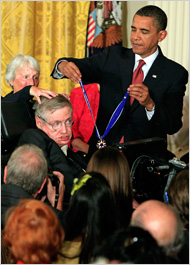
And now the British are weighing in also.  Yesterday, Stephen Hawking received his Presidential Medal of Freedom and jumped in with a response to the Investor’s Business Daily – which in it’s zeal appears to have forgotten that Mr. Hawking is British and under National Health.  The best summary is in the New York Times ,

The physicist Stephen Hawking is defending Britain’s National Health Service after an editorial in Investor’s Business Daily said Mr. Hawking “wouldn’t have a chance in the U.K.,” where the health service would have deemed his life “essentially worthless.”

The publication’s mistake, which came in an editorial titled “How House Bill Runs Over Grandma,” has since been corrected. But on a larger level, the snafu also shows how quickly rationing, particularly at the end of life, has become a focus of the health care reform debate.

Mr. Hawking — who received the Presidential Medal of Freedom at the White House on Wednesday — responded to the editorial this week, telling The Guardian newspaper, “I wouldn’t be here today if it were not for the N.H.S. I have received a large amount of high-quality treatment without which I would not have survived.”

DESCRIPTION

At this point, I fear for any type of health care reform.  New polls seem to show that older Americans oppose reform. The medical industry is threatening to pull support if legislation call for anything more that the co-op model.  Chris Matthews interviewed a man carrying a gun outside of the President’s New Hampshire town hall meeting.   I wonder if when they get back to Washington, there will be anyone left, Democratic or Republican, who wants to vote for health care reform.  Maybe they would prefer to just left the system explode or maybe implode.  Or we can be like Chris Hayes and try to laugh at the situation.

Here are parts of Hayes’  “Your Questions About Health Care Reform Answered”

Ok, so there’s been a lot of misinformation about proposals to reform the health insurance industry and provide (near) universal coverage. Understandable! It’s complicated stuff. Herewith, I’ll try to answer some questions

1) Is it true that all of the bills currently proposed would end the practice of “rescission,” whereby health insurance providers refuse to treat customers who’ve paid their premiums simply because they’ve become ill?

No! That’s a common misunderstanding. Actually, all of the bills would ban incisions, that is, they would legally bar surgeons from performing surgery until a panel of twelve gay illegal immigrant government bureaucrats unanimously signed off on the procedure.

2) Is it true that health care reform would ban insurers from refusing to insure people because of pre-existing conditions?

Wrong again. To get rid of health inequality, the bills actually mandate that every American be given a pre-existing condition. A National Illness Commission, with academics appointed from Harvard, Reed College and Berkeley, will evaluate each citizen, and based on their demographic profile, choose their malady. Each disease or syndrome is scored on a scale of 1 to 10, with 10 being the most severe. White christian men will receive pre-existing conditions of 8 or higher. Black people, “wise latinas,” and ACORN members will be exempted.

5) Will the current bills plug the “donut hole” in the Medicare prescription drug benefit so seniors don’t have to pay exorbitant out of pocket expenses for their medication?

Absolutely not. The legislation will ban donuts.

If you don’t laugh, you’ll have to cry.

Where are the Republican Ideas?

The Democrats have large majorities in the House and Senate.  The President is a Democrat.  I believe the majority of governors are also now Democrats.  And being Democrats, they are bickering among themselves about the details of things they all agree need to be done.  It seems to me this would be a perfect opportunity for the Republicans to offer a substantial plan on, say health care.  Instead, we have the birther movement.  Newsweek has published the President’t birthcertificate to celebrate his birthday.

But the birthers are sure this is fake.

Back to health care.  Congress is back home this month and holding town meetings.  Instead of offering alternative and maybe asking some reasonable questions, the Republican strategy is to scream and disrupt these meetings.  In fairness to them, this is not a tactic they invented (as much as Dick Armey’s lobbying firm might want to think they did).  Chris Hayes  in his blog in the Nation looks at the situation this way

I’m on a team in American politics: I’m proudly, vigorously on the left. So there’s no need to bend over backwards to be formally consistent. That said, intellectual honesty requires one to separate out one’s formal objections from substantive ones and I’ve been given pause by the remarks of some right-wing activists like Jon Henke. He and others have been saying: wait a sec, when the left shows up and makes noise somewhere it’s activism, but when the right does it it’s thuggery and mob rule?

So after discussing the issue on Maddow last night, I’ve been asking myself, aside from the deep substantive opposition I have to the tea-baggers’ ideological agenda (and the insane hypocrisy of people on Medicare screaming about the dangers of government-run health care), what, exactly, my beef is?

I don’t think there’s anything “wrong” with the tactics of those people who, with the facilitation of large monied interests, are organizing and shouting down their opponents at town hall meetings. But one thing should be clear: these are the tactics of a small, motivated, enraged and engaged minority. The footage of recent town hall scrums remind me, actually, of ACT-UP actions back in NYC when I was growing up. ACT-UP, the AIDS and gay rights group that flourished in the 1980s and 1990s, was impassioned and angry and used dramatic confrontational action to great public effect. They were a vanguard. They were a small, tightly coordinated impassioned minority. And they were fundamentally on the right side of history.

What frustrates me, however, is that no one in the press confused ACT-UP with broader public opinion. No pundits said “the public is clearly feeling rising unease about government inaction on AIDS, as evidenced by the latest ACT-UP protest.” Why? Because they were gay, and they had AIDS and they didn’t look like “average citizens” or “heartland” voters.

At their root, the town hall protests are a very similar phenomenon. I think these people, unlike ACT-UP, are wrong. Deeply wrong. (They’re also not literally fighting for their lives because of a homophobic and indifferent government, but that’s neither here nor there). But they’re a small, tightly coordinated, enraged minority. They want to scream and fuss, it’s a free country, as they say.

The problem is the overwhelming instinct on the part of pundits and the MSM to look, and see old white men in overalls and Legionnaire hats and think they are watching someone give voice to the sentiments of broad swaths of the electorate. And it’s just not true. What we’re seeing at these events are the voices of radicals, extremists and zealots.

Harold Myerson writing in the Washington Post points out that the protesters are overwhemingly not people of color.

Last weekend, right-wing Republicans stormed a number of such meetings across the country, shouting down members of the House and, in Philadelphia, Sen. Arlen Specter and Health and Human Services Secretary Kathleen Sebelius. In Austin, protesters blocked Democratic Rep. Lloyd Doggett’s car and made it impossible for him to talk to constituents about such matters as appointments to military academies.

What’s particularly curious about these two protests is that they took place on very liberal turf — Philadelphia and Austin — yet the local liberals and people of color seemed absent. Philadelphia is a heavily African American city, yet one strains to see any blacks among the protesters on the YouTube clips. The activists who have been whipped into a frenzy, and who have dominated the recess meetings so far, appear to be conservative whites.

The question, as Meyerson goes on to ask, is why aren’t people of color, the young folks who worked for Obama, the progressives and the liberals turning out for the town hall meetings?   Meyerson again

When future historians look back at this passage in our nation’s history, I suspect they’ll conclude that this Obama-isn’t-American nuttiness refracted the insecurities and, in some cases, the hatred that a portion of conservative white America felt about having a black president and about the transformation of what many thought of as their white nation into a genuinely multiracial republic. But whatever the reasons, a mobilized minority is making a very plausible play to thwart a demobilized majority.

So we have a black President that one whole segment of the population (77% of Americans think he is a citizen but only 42% of Republicans think he is)  thinks is not really not President trying to reverse the slide into economic inequality and to promote racial equality at the same time.  This is a time when we should be having great debates about ideas not screaming at each other about where the President was born.

A genuine debate about ideas would help create better legislation and make the Democrats sharpen their ideas.  Maybe it would get those of us who support health care reform out to town hall meetings to talk about ideas.  But, unfortunately, the Republican party seems to be out of ideas.

So what’s up with the Democrats and Health Care

Will the Blue Dogs kill Heath Care reform or can Nancy Pelosi, Ted Kennedy, and the President prevail?

Here is a blog entry by Christopher Hayes from July 28 titled “What the Hell Is Max Baucus thinking!?!”

The following comes from a reader and frequent correspondent. This is not someone with particularly progressive politics. In fact, he only very recently has come to identify as a Democrat. No radical lefty, he.

 I don’t get the democrats on this one. Even if Charles Grassley and Olympia Snowe vote for this deal, the Republicans will still run against it as the Obama/Pelosi plan. Why not stick to your guns, treat the problem from a parliamentary perspective, and put through a plan that you actually think is optimal. The current attempt won’t protect their downside at all and may limit the upside. Very frustrating.

 More than frustrating. Enraging.

That’s it, the entire entry.  A lot of us are asking the same question.

Then there is my health care guy, Howard Dean.

Howard Dean guest hosted Countdown with Keith Olbermann at an opportune time last night, following reports that the Senate Finance Committee–helmed by Montana Democrat Max Baucus–is preparing to exclude a public option from its long-awaited healthcare bill.

“What if the Senate Finance Committee has already done the Republicans’ dirty work for them?” Dean asked rhetorically at the beginning of show.

Dean has just authored a book on healthcare reform–detailing why America needs a public option–and knows quite a bit about the subject from his years as a doctor and governor of Vermont. He called Baucus’s reported bill the “so-called compromise.”

Dean asked Chris Van Hollen, chairman of the Democratic Congressional Campaign Committee, why Baucus would “give away something something so fundamental to healthcare reform as a public option?”

“We‘ve got to have a public option in the plan that we send to the president‘s desk,” Van Hollen responded. “We‘re all still hoping that the Senate Finance Committee bill will have a public option.”

Dean noted that 72 percent of Americans, according to a New York Times poll, support a public option. “Is what Americans want already dead in the Senate?” Dean asked.

“No,” Van Hollen answered. “I certainly hope not. It‘s certainly not dead with respect to the bill that we‘ll send to the president‘s desk.” But it isn’t clear what kind of leverage House Democrats have with the likes of Baucus, nor do we know yet whether they’ll be able to keep their own Blue Dog conservatives in line.

“Voters were promised change they can believe in,” Dean told Van Hollen. “Are you concerned about what may happen to our party in 2010 or 2012 if we don‘t get any change at all?”

I’m not quite sure why the Blue Dogs and the Republicans are so afraid of the public option.  Health care for veterans which works pretty well is public as is Medicare.  So back to Chris Hayes and his post from today.

This has got me thinking: Republicans opposed Medicare when it was created. They hate socialized medicine, government-run health care and the public option now. So why don’t they put their money with their mouths are and propose scrapping Medicare? Any bills like this been introduced? If not, why not? I seriously think every single conservative and Republican caught railing against government run healthcare needs to be asked if they support disbanding Medicare.