Family legacies

It must be difficult to be the son or daughter of a famous person.  We have all read about the child of a Hollywood star who does drugs, goes to jail, and generally is a sad case.  We have also read of children who try to live their own lives out of the public view.  And there are also children who work at preserving the parent’s legacy.  But it can’t be easy.  I’ve been thinking for the last couple of days about the column Adrian Walker wrote in the Boston Globe for MLK Day.  It was titled “King had a dream. His children have an army of lawyers.”

But a far less joyous scene is being played out in a courtroom in Atlanta. Not for the first time, King’s three surviving children are on opposing sides of a lawsuit involving his legacy.

At stake is ownership of King’s 1964 Nobel Peace Prize and his Bible, which President Obama used for his second swearing-in. King’s sons, Martin III and Dexter, apparently want to sell the heirlooms; his daughter, Bernice, has sued to stop them. By court order, both items have been stored in a safe deposit box for nearly a year.

If King had a dream, the King children have a piggy bank. They are one litigious group.

Aside from having previously sued one another, they have sued their father’s closest friends, too. Both former Atlanta mayor Andrew Young and actor/activist Harry Belafonte have been the target of lawsuits about King’s property. Belafonte sued them back in a dispute about ownership of one of King’s most famous speeches, one in which he came out in opposition to the Vietnam War. The parties reached an undisclosed settlement last year.
OLYMPUS DIGITAL CAMERA

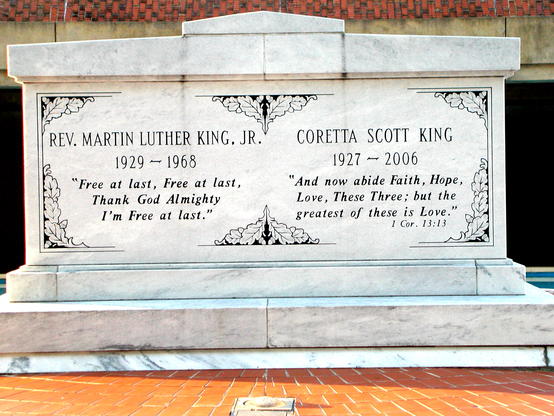
I hate to mention it to the King children, but sometimes a person is bigger than just being a family member.  He – or she – actually belongs to all of us.  Most of us would love to be able to go to Atlanta and see the Nobel Prize metal and the family Bible.  When I was there a few years back, we visited Ebenezer Baptist Church, the family home, and the pool with the tomb containing Martin and Coretta King at the King Center.  It was a very moving experience.  To see the various artifacts would have added a great deal.

The family feuds about money have not tarnished King’s legacy, but they have wasted opportunities to enhance it. At the end of the Selma march, King stood in front of the Alabama capital and gave one of the most deeply moving speeches of his career. But you won’t hear it in “Selma” — it’s paraphrased, painfully — because the filmmakers couldn’t get permission to use it.

There are a lot of stories like that. The Kings sued CNN over airing the “I Have A Dream” speech, essentially taking the video of it out of circulation.

King’s greatest moments are increasingly available only in truncated form. That is not the way to honor his memory.

While it is not clear that the brothers would sell the artifacts should they prevail in court, that is the most likely possibility.  Nobel Peace prizes should not be auctioned off.

Walker ends his piece

King’s career offers so much to celebrate. Like few Americans before or since, he challenged us to live up to our best and truest selves. Though unfinished, the results of the heroic campaign he led can be seen all around us. As much as anything, he stood for the collective good over the glorification of one individual. He certainly wasn’t about money.

Tragically, that lesson never quite made it to his successors.

King taught us about nonviolence, but it seems that his children have yet to learn that violence does not have to be physical.

Photograph:  King Center website http://thekingcenter.org/plan-your-visit

The Supremes, Judge Posner, and gay marriage

The news late last week that the Supreme Court would hear an appeal from the Sixth Circuit ruling upholding bans on same-sex marriage in Ohio, Michigan, Kentucky, and Tennessee brought to mind the Seventh Circuit ruling last fall written by Judge Posner.  Mark Joseph Stern writing in Slate noted that suddenly there was a “race” among judges to …”write the one marriage equality opinion that history will remember.”  But Stern wrote

Thursday’s ruling by 7th Circuit Judge Richard Posner, which struck down Indiana’s and Wisconsin’s gay marriage bans, is a different beast altogether. In his opinion, Posner does not sound like a man aiming to have his words etched in the history books or praised by future generations. Rather, he sounds like a man who has listened to all the arguments against gay marriage, analyzed them cautiously and thoroughly, and found himself absolutely disgusted by their sophistry and rank bigotry. The opinion is a masterpiece of wit and logic that doesn’t call attention to—indeed, doesn’t seem to care about—its own brilliance. Posner is not writing for Justice Anthony Kennedy, or for judges of the future, or even for gay people of the present. He is writing, very clearly, for himself.

Ironically, by writing an opinion so fixated on the facts at hand, Posner may have actually written the one gay marriage ruling that the Supreme Court takes to heart.Other, more legacy-minded judges have attempted to sketch out a revised framework for constitutional marriage equality, granting gay people heightened judicial scrutiny and declaring marriage a fundamental right. But Posner isn’t interested in making new law: The statutes before him are so irrational, so senseless and unreasonable, that they’re noxious to the U.S. Constitution under almost anyinterpretation of the equal protection clause.

I spent time this morning reading Judge Poster’s opinion.  It is readable and understandable even by non-lawyers.  He takes each argument made by Indiana and then Wisconsin against same-sex marriage one at a time and uses precedent, social science, and history to demolish them.  Posner sets out to answer four questions.

Does the challenged practice involve discrimination, rooted in a history of prejudice, against some identifiable group of persons, resulting in unequal treatment harmful to them?

Is the unequal treatment based on some immutable or at least tenacious characteristic of the people discriminated against (biological, such as skin color, or a deep psychological commitment, as religious belief often is, both types being distinct from characteristics that are easy for a person to change, such as the length of his or her fingernails)? The characteristic must be one that isn’t relevant to a person’s ability to participate in society.

Does the discrimination, even if based on an immutable characteristic, nevertheless confer an important offsetting benefit on society as a whole?

Though it does confer an offsetting benefit, is the discriminatory policy overinclusive because the benefit it confers on society could be achieved in a way less harmful to the discriminated-against group, or underinclusive because the government’s purported rationale for the policy implies that it should equally apply to other groups as well?

Throughout his decision, Judge Posner concentrates on children and marriage.  The same persons who argue against same-sex marriage are often the same persons who argue that the state needs to encourage heterosexual marriage to provide stability to children.

Our pair of cases is rich in detail but ultimately straight- forward to decide. The challenged laws discriminate against a minority defined by an immutable characteristic, and the only rationale that the states put forth with any conviction— that same-sex couples and their children don’t need marriage because same-sex couples can’t produce children, intended or unintended—is so full of holes that it cannot be taken seriously. To the extent that children are better off in families in which the parents are married, they are better off whether they are raised by their biological parents or by adoptive parents. The discrimination against same-sex couples is irrational, and therefore unconstitutional even if the discrimination is not subjected to heightened scrutiny, which is why we can largely elide the more complex analysis found in more closely balanced equal-protection cases.

In Indiana a same-sex couple can adopt while in Wisconsin, one member of a same-sex couple can adopt.  So the logical conclusion is that marriage is just as important for same-sex couples with children as for heterosexual couples with families.  And he points out that those who say that same-sex marriage will some how erode or damage heterosexual marriage need only to look at the 10 year history in Massachusetts to see that there is no impact at all.

Judge Posner’s decision is full of “zingers” most aimed with impatience at irrational argument.  But he also takes aim at Justice Scalia citing his dissent in Lawrence v. Texas which struck down laws against sodomy.

…But Justice Scalia, in a dissenting opinion in Lawrence, 539 U.S. at 586, joined by Chief Justice Rehnquist and Justice Thomas, thought not. He wrote that “principle and logic” would require the Court, given its decision in Lawrence, to hold that there is a constitutional right to same-sex marriage. Id. at 605.

In the end, Judge Posner can find no rational argument against same-sex marriage.

Pete Prete with Equality Beyond Gender waved a Marriage Pride flag attached to an American flag outside the Supreme Court in Washington on Friday.

Pete Prete with Equality Beyond Gender waved a Marriage Pride flag attached to an American flag outside the Supreme Court in Washington on Friday.

The Supreme Court will hear arguments on two questions:  The right to marry and the right to have out-of-state marriages recognized.  Because there are four states in the appeal with four different questions, the Supreme Court in accepting the appeals wrote the questions they will try to answer.  Some in the legal community were alarmed, but the New York Times quotes Harvard Law professor, Lawrence Tribe

“The court’s order represents good housekeeping,” said Laurence H. Tribe, a law professor at Harvard.

But Professor Tribe also voiced a small note of caution.

“The rephrased questions,” he said, “technically leave open a middle path along which the court would prevent states from discriminating against same-sex couples lawfully married in their home states without requiring any state to take the affirmative step of issuing its own marriage licenses to same-sex couples.”

I haven’t seen the appeal documents, but if the arguments are anything like those from Indiana and Wisconsin and I assume they are as those are the arguments being made nationally, the Supreme Court need to look no further than Judge Posner’s decision for answers and require the right to marry in all states.  And, after all, Justice Scalia has already concluded that once sodomy laws are found unconstitutional, same-sex marriage must follow.  I predict a 7-2 decision in favor of the right to marry.  We will see in June if I am correct.

Photograph:  Jabin Botsford/The New York Times

Science and magic

When I was a child, my father took me up on the roof of the chicken coop on our small New Jersey farm to watch Sputnik whiz by.   I couldn’t believe that it was so small and so fast.  It was, to be honest, a little anti-climactic to my 10 year old mind.  Still, I was amazed by the concept that something could be put on a rocket and sent into space for us to see.  It was like magic.  Science often seems magical.  In her essay, “Retrograde Beliefs” in the Sunday’s New York Times Magazine, Kristen Dombek, an essayist and teacher at Princeton, writes about this connection.

Magical beliefs include astrology.

On Jan. 21, at 10:54 a.m. Eastern Time, Mercury will begin its first pass by Earth of the new year. For about three weeks, it will appear to move backward across our sky and will, according to astrologers, disrupt technology, communication and human concord. Facebook and Twitter will clog with reports of appointments missed, important email sent to the spam folder, wars between nations, cars crashed and iPhones dropped in toilets, all followed by some version of the hashtag “#mercuryretrograde.” Advice from astrology blogs will arrive in unison: Back up your computer, expect miscommunications, don’t make agreements or important decisions and don’t sign contracts — and hide.

The sun and plants.  Arrow points to Mercury.

The sun and plants. Arrow points to Mercury.

There is, of course a scientific explanation for Mercury’s movements.

The story of Mercury is a cautionary tale too, about thinking there is a connection between how things work on Earth and how they work in the heavens. Every time Mercury orbits the sun, it ends up a bit ahead of where it began, so that the planet traces in space not a steady ellipsis but a pattern of flower petals. Called precession, some of this jumping ahead is explainable by Newton’s laws. But some isn’t. The difference between where Mercury should end up, according to the law of gravity that works on Earth, and where it actually ends up, is minuscule — 43 arc seconds per century — but it was enough to puzzle astronomers for years, even leading to speculation about a phantom planet, Vulcan, that might influence Mercury’s orbit.

What it took, in the end, to explain Mercury’s precession was Albert Einstein’s theory of general relativity; Mercury flies close enough to the sun that it travels through a part of space-time so bent by the sun’s mass that the planet is dragged a bit farther along each time. The fact that things work so differently in space than they do on Earth, not to mention at the quantum level, has physicists conjuring ideas even stranger than any malevolent planet — string theory, multiple universes — to connect it all together again.

The really scary thing about astrology, however, is not that so many will be worried about their technology as well as their lives, but that

The belief that the movements of celestial bodies govern our lives is more popular in the United States than it has been in two decades, according to a recent National Science Foundation report. In a 2012 survey, a third of Americans viewed astrology as “sort of scientific” and another 10 percent as “very scientific.” Belief is most prevalent among 18-to-24-year-olds but has markedly increased among 35-to-44-year-olds in recent years. To put this in perspective: More Americans believe in astrology, or “sort of” believe in astrology, than believe that climate change is influenced by the burning of fossil fuels.

Think of that.  More Americans believe in astrology than believe there is a human element to climate change!  This is part of the current trend to distrust science and facts.  Everything is magic.  The moon landings and most certainly the recent landing on a comet were staged.  There can’t be climate change because winters are so cold.  The increase in the number of earthquakes in places where there is fracking is just a coincidence.  We have forgotten about facts because it is more convenient to ignore them when they don’t fit a particular belief system.

Like Kristen Dombek, I love Madeline L’Engle’s “A Wrinkle in Time”.  Dombek writes

There was something about this story that married a love of quantum physics and astrophysical theory to a witchy sense of cosmic magic; it sent me not away from science, but toward it, suggesting that my relentless research, in my parents’ library and in the woods and streams of our farm, might matter, even though I was a girl.

I am not a scientist, but I read science articles, follow space exploration, and think that mapping the brain is fascinating.  Real science that discovers facts is even more magical than all those science deniers could ever imagine.  All they need to do is look.

Illustration: 3horoscopes.com

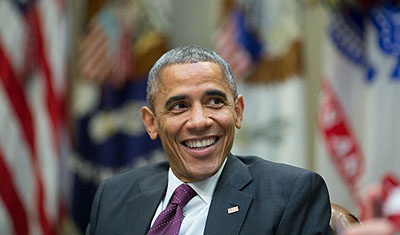
Looking at President Obama

The annual Gallup poll of the most admired man has just picked President Obama.  Even among Republicans he tied with Pope Francis.  But to hear some Republican elected officials and pundits, Barack Obama is the devil incarnate.  If he says the sky is a little cloudy, they will say it is clear.  So what is going on?  Are people finally catching on to what he has accomplished?  Are people starting to look beyond the media’s short attention span?  I don’t have any answers, but I know that the President has managed more than one could ever imagine given the Tea Party and solid Republican opposition to everything he proposes. Even people like Paul Krugman, who one would think would be a supporter, was not.  But Krugman has changed his mind and in October wrote a widely circulated defense.

When it comes to Barack Obama, I’ve always been out of sync. Back in 2008, when many liberals were wildly enthusiastic about his candidacy and his press was strongly favorable, I was skeptical. I worried that he was naive, that his talk about transcending the political divide was a dangerous illusion given the unyielding extremism of the modern American right. Furthermore, it seemed clear to me that, far from being the transformational figure his supporters imagined, he was rather conventional-minded: Even before taking office, he showed signs of paying far too much attention to what some of us would later take to calling Very Serious People, people who regarded cutting budget deficits and a willingness to slash Social Security as the very essence of political virtue.

I certainly haven’t agreed with everything Obama has proposed or done, but no one agrees with anyone else 100% of the time.  And there have been some scary moments.  Remember the “Grand Bargain”?  But we can list as accomplishments the Affordable Care Act, Dodd-Frank financial reform (despite the reluctance of Congress to fund the Consumer Protection Bureau and the recent gutting of the prohibitions on banks and derivatives.), the steady improvement of the economy (the only one in the world not on the verge of tanking again) and the ending of our combat roles in the wars in Iraq and Afghanistan.  But I just don’t understand the continuous bashing by everyone.  Plus, I firmly believe that the mid-term elections would not have been quite so bad if the Democrats had had the guts to run on the President’s record.

Krugman writes

But now the shoe is on the other foot: Obama faces trash talk left, right and center – literally – and doesn’t deserve it. Despite bitter opposition, despite having come close to self-inflicted disaster, Obama has emerged as one of the most consequential and, yes, successful presidents in American history. His health reform is imperfect but still a huge step forward – and it’s working better than anyone expected. Financial reform fell far short of what should have happened, but it’s much more effective than you’d think. Economic management has been half-crippled by Republican obstruction, but has nonetheless been much better than in other advanced countries. And environmental policy is starting to look like it could be a major legacy.

I think one of the problems the President has is that he is a canvas on which each person paints the picture of what they want him to be.  Michelle Bachmann sees him as a non-Christian, non-American.  Cornel West thinks he is a ‘counterfeit progressive”, meaning, I guess a conservative in progressive clothing.  The problem is people do not look at facts.  And they certainly don’t understand the character of the man.  I found this description of him on the golf course very apt.

One of the golfers who played with Mr. Obama said the way the president carried himself on the course provided significant insight into his character.

“If you came down from Mars and saw his disposition on the golf course, you would think he would be a pretty good president,” the golfer said. “He’s honest, he keeps his composure through terrible adversity, he’s unruffled, he smiles, and he doesn’t quit.”

Obama

This is why after the mid-term elections, President Obama was able to have what Kevin Drum writing in Mother Jones magazine was able to call “a Hellava month”.  Drum lists his accomplishments during November and December.  Here are a few from his list.

  • November 11: Concluded a climate deal with China that was not only important in its own right, but has since been widely credited with jumpstarting progress at the Lima talks last week.

  • November 20: Issued an executive order protecting millions of undocumented workers from the threat of deportation.

  • November 26: Signed off on an important new EPA rule significantly limiting ozone emissions.

  • December 17: Announced a historic renormalization of relations with Cuba.

Plus a number of judicial and other nominees were approved by the Senate before they went home for the holidays. Jennifer Bendery explains in the Huffington Post.

If there’s one thing from 2014 that will define President Barack Obama’s legacy after he’s left the White House, it’s the number of lifetime judges he put on the federal bench.

In its final act of the year, the Senate blew through a dozen U.S. district court nominees on Tuesday night. That puts Obama at a whopping 89 district court and circuit court confirmations for the year, and means he’ll wrap up his sixth year in office with a grand total of 305 district court and circuit court confirmations — a tally that puts him well beyond where his predecessors were by this point in their presidencies.

It may be that, in the end, his biggest effect on the judiciary isn’t sheer numbers as much as the diversity of his judges. Forty-two percent of Obama’s confirmed judges are women, 19 percent are black and 11 percent are Hispanic, according to data provided by the White House. Eleven of his confirmed judges are openly gay or lesbian.

Even the 12 nominees confirmed Tuesday night will make a mark: Robert Pitman will be the first openly gay judge to serve in the Fifth Circuit, which includes Texas, Louisiana and Mississippi. Loretta Biggs will be the first black woman to serve as a district judge in North Carolina.

The most interesting part of the nominee confirmation story is that the last were made possible by Senator Ted Cruz who probably had no idea what he was doing.

Democrats spent the final days of the lame duck thanking Sen. Ted Cruz (R-Texas) for inadvertently helping to expedite votes on Obama’s nominees. On Friday, Cruz derailed a plan by party leaders to leave for the weekend and come back Monday in an effort to force a show vote on Obama’s immigration executive action. The stunt kept senators in session all day Saturday, with hours to kill. So, Senate Majority Leader Harry Reid (D-Nev.) used the time to tee up votes for the 12 district court nominees still on the calendar.

With two years to go, I don’t think any of us should write President Obama off as a “lame duck”.  He seems to be freed by not having to run for office again.  We all need to stay tuned to see what he does next.

Photograph:  Uncredited from Mother Jones.


The importance of place

Amy Davidson has written  a piece for the New Yorker summarizing the last year using seven addresses.  It must have been on my mind after I read it last night because early this morning in that time when you are not quite awake and yet not asleep, I tried to name the street and visualize all the places I’ve lived.  I don’t, of course, remember the first place I went after I was born except from a vague memory of visiting as a very young child.  I do remember with some effort the other places.  Some of them – particularly early rentals as a young adult – were actually pretty awful.  I even remember a couple of the landlords.  But the last, almost 40 years, I’ve only lived at three addresses.  All of them were/are wonderful in their own way.  The seven addresses Davidson picked to remember 2014 evoke feelings from horrifying and sad to wonderment.

Davidson begins with West Florissant Avenue, Ferguson, Missouri and Bay Street, Staten Island, New York where Michael Brown and Eric Garner died at the hands of the police, events which have the potential to change policing as well as the way we talk about race.  Her next set of addresses are where Thomas Eric Duncan was exposed to Ebola and where he first became ill:  72nd Samuel K. Doe Boulevard, Paynesville, Liberia and The Ivy Apartments, Fair Oaks Avenue, Dallas.  Duncan’s illness set off an extraordinary and irrational panic here.  An epidemic never materialized and so, in the American way, we have mostly forgotten that people are still dying in West Africa.  One consequence is that people there no longer seek medical help for problems that have cures because they fear medical facilities and Ebola causing the number of deaths from ordinary medical problems to rise also.

A memorial for Eric Garner at the site where he died, on Staten Island.

A memorial for Eric Garner at the site where he died, on Staten Island.

Have you heard of this next address?

Nathan Road [Hong Kong], which is six lanes wide and cuts through the central Mong Kok district, was closed for weeks this fall, as students and others assembled to protest what they saw as Beijing’s broken promises about free elections. It, along with other gleaming thoroughfares, was the scene of standoffs whose contrasts—crowds holding up umbrellas amid teargassing near destination boutiques and offices—embodied some trade-offs that have accompanied China’s economic rise in graphic, or geographic, terms. (Traffic or democracy?) The barricades on Nathan Avenue were mostly cleared away in a major police action at the end of November. Cars are passing through again, but the story is not complete, for either side.

We hear almost nothing about the students and their supporters these days unless one listens to the BBC.  Right now, no one is sure where the protests are headed and protesters themselves are divided about whether to continue or to rethink tactics.

I had never heard of this next address:  Naem Roundabout, Raqqa, Syria.

The rise of the Islamic State in Iraq and al-Sham, also known as ISIS, has been geographically disorienting: it has made sudden, sweeping moves into Northern Iraq, threatened the Turkish border, and put out videos, shot in indeterminate stretches of desert, in which hostages are mocked and killed. But there are moments when the group’s brutality and degraded character can be given an exact address, as when, in Raqqa, the Syrian town that serves as its base, prisoners were beheaded and their remains put on display along the Naem Roundabout. (Naem, in Arabic, means “bliss.”)

Davidson ends with the wonderful address of Comet 67/P Churyumov-Gerasimenko.

The Rosetta spacecraft’s trip to this address took a decade and covered four billion miles. On November 12th, after a couple of bouncy knocks, Rosetta’s Philae module landed on the comet’s surface—the first such visit in human history. The lander settled in a shady spot and then, over a frantic fifty-seven hours, scientists at the European Space Agency performed all the experiments they could before its solar-powered batteries shut down. Philae is sleeping on the comet now, but it may wake up again next summer, when the comet next turns toward the sun.

Thinking about the world and one’s own life through place is a fascinating thing to do.  Try thinking about all of your addresses and how they shaped your life and how they will shape your future.  Think about places you have been.  And I can’t wait to see if Philae wakes up next summer.

Photograph:  MARK PETERSON/REDUX


Anne Perry: crime and punishment

A few years ago, a good friend suggested I try reading a book by Anne Perry.  She knew I enjoyed Victorian mysteries.  She also told me that when Perry was a teenager, she had been convicted as an accessory to a matricide by her good friend, served time, and now wrote mysteries.  I thought it curious that someone who had committed such a serious crime now wrote so well about crime, but I read my first Thomas and Charlotte Pitt book and was hooked.  After I retired, I went back and read all of them in order.  I’ve also read some of her William Monk books, but I find the Pitts very compelling.  I had forgotten about Perry’s criminal past until I read this past week’s column by Rebecca Balint in the Brattleboro Reformer. [link to be added when column is posted online,]

Becca is my neighbor and newly elected State Senator whose weekly column my husband and I always find interesting.  She had not known until recently that Anne Perry had committed murder.  Her column explores how she feels about Perry after finding out.

…Details of their delusions can be found in Parker’s [Perry’s friend] adolescent journal.  But the question persists for me:  Do I believe in rehabilitation and redemption?  If I do, as I have always claimed, then why do I view Anne Perry differently now that I know of her troubled past?  I’ve read her Victorian mysteries for years and always enjoyed them as inconsequential breathers from the dense non-fiction I read.  I’ve joked about some of her writing tropes but still find her characters compelling.  Yet, I feel undeniably uneasy about a convicted murderer as an author.

The first Thomas and Charlotte Pitt novel.

The first Thomas and Charlotte Pitt novel.

I read this and wondered why I had reacted so differently.  I went back and located the interview I had read years earlier in the Guardian.

In 1954, Hulme felt as if she had been pushed to the limit. Three days before she took part in the killing of Honora Parker on June 22, her parents announced that they were to divorce – triggered by Hulme having found her mother, Hilda, in bed with a lover. At the same time, her father lost his job and she was to be sent to South Africa to stay with an aunt. The shock to Hulme – who had not been at school because of tuberculosis, from which she had suffered since the age of 13 – was cataclysmic.

She turned to her close friend, Parker, a working-class girl from a humble background. Some felt it was a curious friendship for Hulme, whose family were well to do, her mother glamorous and clever. The two friends believed they could stay together if Pauline’s mother would let her leave New Zealand. Her refusal triggered Parker’s murderous rage and Hulme believed she owed it to her friend to help lure Mrs Parker to a Christchurch park and cosh her with a brick in a stocking.

“I felt I had a debt to repay,” says Perry. “Pauline was the only one who had written to me when I was in hospital, and she threatened to kill herself if I didn’t help. She was vomiting after every meal and losing weight all the time. I am sure now she was bulimic. I really believed she would take her life and I couldn’t face it.”

Hulme served five years at Mt Eden women’s prison in Auckland – “supposedly the toughest in the southern hemisphere,” she says with what sounds like pride.

Yet Perry now calls her time in prison “the best thing that could have happened”. “It was there that I went down on my knees and repented,” she says. “That is how I survived my time while others cracked up. I seemed to be the only one saying, I am guilty and I am where I should be.”

In an interview with Ian Rankin, Perry explains further.

IR: I wondered: at what point does redemption come do you think, I mean at some point during incarceration?

AP: That is a very spiritual question, to which I can only give you my own estimate of the answer. The redemption comes when you no longer wish to be that kind of person. When you understand that… when you see it as ugly, and you understand why it is not what you want to be. Not what you should be, not what you want to be. And that’s the difference. Not because somebody outside is telling you: this is not what you do. But because you, yourself, say: this is not who I want to be.

IR: How do you feel about the fact that society requires people to be locked up, especially at such a young age, that we require what seems to be not redemption so much as a kind of vengeance.

AP: I suppose society does require a certain level of vengeance. It needs to be not only done but seen to be done because it is supposed to be enough to prevent other people wanting to do the same. I think it would have been the worst thing that could ever have happened to me in my life if somehow they had said: “Well, look. You know, you were under medical treatment. These are mind altering drugs. I am sure you are not really wicked. You go ahead and forget about it.” I think that would have been totally destructive to me.

IR: How important was the punishment to you?

AP: I feel it is vital. I think until you feel that you have settled the debt, you cannot move on. It is a bit like trying to walk with an open parachute open behind you. By paying, you cut the strings and then you can move on. You can allow yourself to move on. I can say it and look you in the eye, because I can say: Yes, I have dealt with it. I believe that I have paid. I believe that I have been forgiven where it matters. And it now for me no longer exists. I can move on and be the best person I am capable of being. But I think that is true of everybody. As long as you don’t say: “somehow it wasn’t really me, it was that person and somehow it didn’t matter and I don’t need to pay.”

I think this explains why she writes novels about crime and punishment.  I can read Perry’s books without thinking of her past because it is her past that allows her to write.


History and war

I have to admit that my knowledge of the Second World War in Europe is limited to what I know from high school history class, some novels and movies.  I can name some of the famous battles and tell you that the all Japanese American 442nd fought in Italy, but my ignorance is pretty shocking.  So I have started reading the Rick Atkinson Liberation Trilogy starting with “An Army at Dawn” about North Africa.

But it seems that I am not the only one with a need to know some history.  Sunday’s New York Times had a long story about young Japanese students going to Guadalcanal to look for remains and learn history.

Using a trowel to dig into the shadowy floor of the rain forest, pausing only to wipe away sweat and malaria-carrying mosquitoes, Atsushi Maeda holds up what he has traveled so far, to this South Pacific island, to find: a human bone, turned orange-brown with age.

Mr. Maeda, 21, was looking for the remains of missing Japanese soldiers at the site of one of World War II’s most ferocious battles. Others have done this work before him, mostly aging veterans or bereaved relatives. But he was with a group of mostly university students and young professionals, nearly all of them under 40 and without a direct connection to the soldiers killed here.

A Japanese vessel was partly submerged off Guadalcanal in 1942 after being hit by American forces. The battle helped turn the Pacific war in favor of the United States and its allies. Some 7,000 Japanese were reported missing on Guadalcanal

A Japanese vessel was partly submerged off Guadalcanal in 1942 after being hit by American forces. The battle helped turn the Pacific war in favor of the United States and its allies. Some 7,000 Japanese were reported missing on Guadalcanal

As I understand it, the Japanese talk even less about WWII than Americans.  I had two uncles who were in Japan with the American occupying forces but it wasn’t until a few years before they both died that I knew anything about what they actually did. Ostensibly translators, they worked in support roles for the American army – mostly in supply.  My uncles didn’t talk much about the war because, like many vets, they were raised to accept the experience and move on.  In Japan, however, it has been almost national policy not to talk about the war they lost.

As the 70th anniversary of the end of World War II approaches, there has been a surge in interest among young Japanese about the disastrous war that their nation has long tried to forget.

It is a phenomenon that crosses political lines, encompassing progressives who preach the futility of war as well as conservatives who question the historical record of Japan’s wartime atrocities. What these young people have in common is an urgent sense that they learned too little about the war, both from school, where classes focus on earlier Japanese history, and from tight-lipped family members, who prefer not to revisit a painful time remains strong in Japan.

I found it interesting that most of the Japanese students are several generations younger than I am but that we are both driven by the need to know more.  200 pages into Atkinson’s story of North Africa, I keep reading about familiar names:  Tunis, Casablanca,  Marrakesh, Algeria – names of places that have been romanticized but where hundreds died.  North Africa is where there is an on-going struggle for democracy complicated by terrorism and tribalism.  (Think Benghazi)  We American invaders during WWII didn’t understand the local population or make a lot of effort to do so.  A mistake we still make today.

Kankoh Sakitsu, 42, the head priest of a Buddhist temple in Tokyo who organizes expeditions to Guadalcanal, has seen interest among young people grow after his first trip here in 2008. Since then, he has arranged three other journeys for groups of Japanese, including this one in September.

Mr. Sakitsu originally went to Guadalcanal to pray at the battle sites out of a sense of contrition because he feels Japanese Buddhism failed to oppose the war in the 1930s and 1940s, and so shares responsibility for it.

The story ends with a note of caution from a Japanese Guadalcanal veteran.

Mr. Sakitsu, the leader, said the September group was special because it was joined for the first time by one of the last surviving Japanese veterans from the battle, Junshiro Kanaizumi. Mr. Kanaizumi, 95, was an army engineer who helped build roads in the jungle. Now bent and frail with age, shuffling to the edge of the jungle with the help of a walking stick, Mr. Kanaizumi wore the same khaki jumpsuit with a Japanese flag on one shoulder as the other members.

Peering into one of the leaf-wrapped bundles, Mr. Kanaizumi said it was possible he once knew the man now reduced to a pile of crumbling bones.

“I hope they learn the miserable reality of war,” he said. “Once I am gone, who will be around to tell them that the only lesson from war is to never do it again?”

I think when I finish reading about Europe, I’ll have to move to the Pacific theater.

Photograph:   US Navy/Getty Images

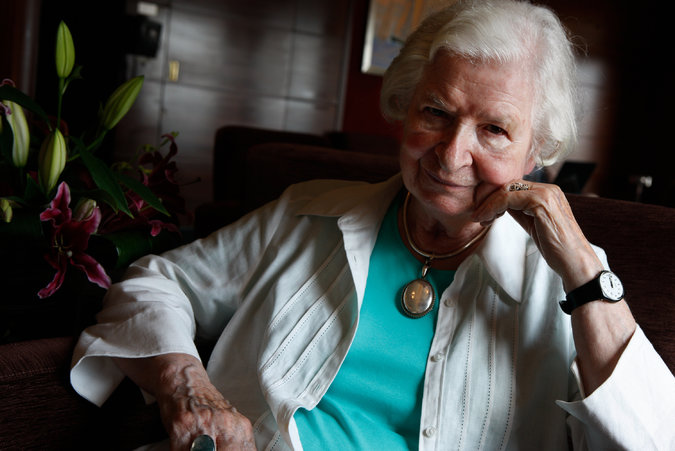
P.D. James, Queen of Crime

My mother introduced me to the mystery novels of P. D. James many years ago when I was a teenager.  James didn’t publish often; she was not a twice a year or even once a year mystery writer.  A new James was the occasion for celebration and we read all of them.  I believe there were 18.  The New York Times obituary outlines the story of her life.

She was born Phyllis Dorothy James on Aug. 3, 1920, in Oxford, the eldest of three children of Dorothy and Sidney James, a civil servant who did not believe in inflicting too much education on his daughter. The family settled in Cambridge when she was 11, and before she left the Cambridge High School for Girls, at 16, she already knew that she wanted to be a writer and that mysterious death intrigued her.

“When I first heard that Humpty Dumpty fell off the wall,” she was fond of saying, “I immediately wondered: Did he fall — or was he pushed?” But a marriage to Ernest C. B. White, a medical student, and World War II halted her plans for a writing career.

P.D. James, in 2010.

P.D. James, in 2010.

James was a hospital administrator for a number of years and used hospitals as the setting for some of her early novels.  But

[a]fter the death of her husband at 44, in 1964, Ms. James took a Civil Service examination and became an administrator in the forensic science and criminal law divisions of the Department of Home Affairs. The work would supply her novels with the realistic procedural detail on which she prided herself.

Although she rarely describes actual murder, the dead bodies in her novels always make an indelible impression on the innocent bystanders who chance upon them. “To many of them, it’s a really appalling and dreadful discovery,” Ms. James said. “I think that the reader should share that horror and that shock, so I make the descriptions just as realistic as I can.”

Her primary detective, Adam Dalgleish, was designed to be the anti-Peter Wimsey.

Her intention with Dalgliesh, she told the British critic and writer Julian Symons in 1986, was to create a detective “quite unlike the Lord Peter Wimsey kind of gentlemanly amateur” popularized by Dorothy L. Sayers. Ms. James envisioned a realistic cop as her protagonist, a dedicated and skilled professional, and yet “something more than just a policeman, you see, a complex and sensitive human being,” she said.

A few months back, James was featured on the Barnes and Noble mystery section as one of the authors who discussed their favorite books.  It was interesting that she picked Josephine Tey’s The Franchise Affair and Dorothy Sayer’s Murder Must Advertise, two of the more complicated   stories by each author.  Also on the list were a book by Ruth Rendell/Barbara Vine (A Fatal Inversion), the first Ian Rankin (The Complaints), and Sue Grafton’s V is for Vengance.  I have to confess that I don’t care all that much for Rendell, but I liked the other books on her list, so maybe I’ll try again.  There was one book, Dissolution by C. J. Sansom, I had never heard of before.  On James’ recommendation, I ordered it and have it on my pile to read.

It is sad that there will be no more books by P.D. James, but I will spend them this next year re-reading and savoring all that she had left us.

Photograph:  Ruth Fremson/The New York Times

Grand juries, Ferguson, lots of questions and incredible sadness

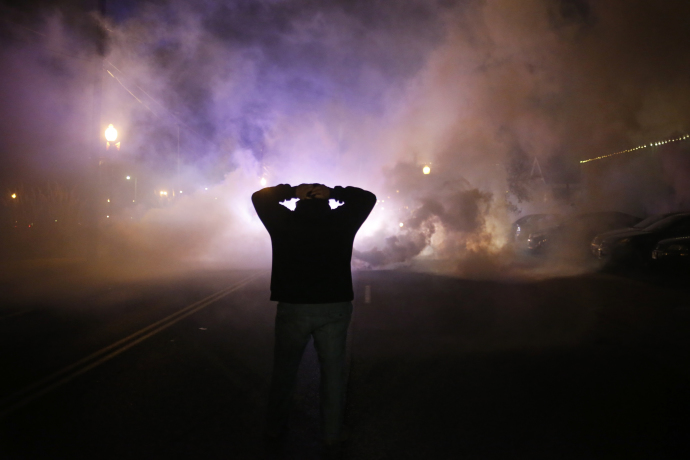
What do I feel this morning after the grand jury failed to indict Officer Wilson on any charge?  Just incredible sadness and weariness.

I served on a grand jury in Boston.  It was supposed to be a six month gig, but turned out to be over a year because we were following evidence in a case.  We heard maybe 75 or 80 different cases and I can only recall two in which we didn’t indict.  One was a drug deal complete with very bad video and audio.  We decided we just couldn’t see or hear well enough to know what was going on.  There was another case, don’t remember exactly what it involved, where there was also not enough evidence.  If I remember correctly, the prosecutors can find more evidence and present again to a different grand jury.  In both cases where we declined to indict, they came to talk to us about why we didn’t do so.  In my year and a half, we heard many cases of unemployment insurance fraud, one child porn case, several Big Dig contractor fraud cases, and the biggie, a public corruption case.  We were constantly reminded that we were not a jury deciding guilt or innocence, but were just to decide if there was enough that a jury should hear the case.  We were often given the option, as was the Ferguson grand jury, of indicting on one of several charges.  We heard the prosecutor’s case only as the process was designed to determine if the prosecutor had enough evidence to go to trial.  It is an interesting process.

We have no idea what went on inside that grand jury room.  We don’t know if there were jurors who voted to indict and on which charges.  (Grand juries usually need a minimum, but not unanimous, vote.)  This was a special grand jury which heard no other cases.  We do know that in this instance, the grand jury did hear from Darren Wilson the defendant.  According to the New York Times summary of the case

The prosecutor usually chooses the evidence that a grand jury will hear, but in this case, the grand jury was given more latitude in calling witnesses and issuing subpoenas, according to Susan McGraugh, a law professor at the St. Louis University who has followed the case extensively. Grand jurors viewed photographs, forensic evidence and medical reports. Witnesses who testified include people who saw the events and police officers who worked on the investigation. While it is unusual in grand jury proceedings for the defendant to appear, Officer Wilson also gave testimony.

I watched Prosecutor McCulloch give his lengthy and sometimes repetitious statement on why the grand jury decided not to indict and I was left with several nagging questions.  There had been an altercation at Officer Wilson’s car and Officer Wilson was the only one who fired a weapon.  Michael Brown was clearly not armed.  Why was he shot, from the front, twelve times?   Why the press conference at night?  John Cassidy, writing in the New Yorker this morning, has many of the same questions.

A protester stands with his hands on his head as a cloud of tear gas approaches after a grand jury returned no indictment in the shooting of Michael Brown in Ferguson, Missouri

A preliminary question to ask is why the St. Louis authorities scheduled such an incendiary announcement for after dark, even though the news that the grand jury had reached a decision had become public hours earlier. Surely, it would have been wiser for Robert P. McCulloch, the St. Louis County prosecutor, to have met with reporters earlier in the day.

A more important question, also unanswered in anything but the most general terms, is this: Why did the grand jury decide not to indict the police officer, Darren Wilson? McCulloch’s press conference, when it eventually took place, was notably lacking in detail about the shots that killed Brown.

But we didn’t learn precisely how far away Brown was when Wilson shot him fatally, or what persuaded the police officer that his life was in danger, which is one legal justification in Missouri for shooting someone who is unarmed. According to some accounts, Brown had his arms raised when he was shot for the final time. Other accounts say that he was charging at Wilson. McCulloch, beyond saying that some eyewitnesses provided contradictory statements, didn’t say what evidence the grand jury had relied on in reaching its decision. He did say, though, that the grand jury had met for twenty-five days and heard from more than sixty witnesses.

I’m sure that there will be extensive analysis from legal scholars in the coming days and I look forward to reading them.  I hope someone answers one of my questions which is:  Did hearing from Darren Wilson make the grand jury feel this was a trial where they were to determine guilt or innocence?

Meanwhile, if the grand jury decision makes me sad, the reaction of the fools on the streets makes me even sadder.  I’ve seen this too many times before – when Dr. King was killed, after Rodney King, right after Michael Brown’s death, etc. etc.   John Cassidy writes

Perhaps the grand-jury transcripts, some of which were released late on Monday, will help clear up what actually happened. More likely, the exact sequence of events will remain in dispute, and so will the grand jury’s decision. Americans who believe that the legal system generally works well, and fairly, will be inclined to believe that the members of the grand jury reached the right decision. Those who believe the criminal-justice system is stacked against minorities, particularly against young African-American men, will be inclined to believe that this was another whitewash.

I am among those who can’t understand the grand jury’s decision, but burning police cars and Walgreen’s will not change the racism in the criminal justice system.  There is more than enough blame to go around.  The announcement made after dark and the declaration of martial law and calling out the National Guard before the decision created a confrontational atmosphere and, in the end, didn’t prevent anything.  Prosecutor McCulloch’s long non-explanation explanation.  The rioters who through their actions fulfilled every stereotype.  There are no good guys here.

It just leaves me sad and frustrated.

Photograph:  ADREES LATIF/REUTERS