And the race is on!

The Red Sox begin the second half of the season tonight facing steamy heat and the somewhat diminished, but always dangerous, New York Yankees.  The real race for the American League East title begins.  The Boston Globe story by Julian Benbow lays out the facts.

Whenever Jonny Gomes would glance at the standings, he got an idea just how much of a tug of war the American League East is.

The fact that four of the five teams are above .500 was overshadowed by what the division did against the rest of the league.

In the first half, the AL East went a combined 70-54 against the Central, 53-39 against the West, and 35-19 in interleague play.

“I’ve actually looked at our standings and you saw the whole AL East win,” Gomes said. “It seems like the only time a team loses is when we play each other. It’s a big division. It truly is.”

Which is why the Red Sox’ first 10 games out of the All-Star break will be a grueling and critical test.  They start with a three-game set this weekend with the Yankees, then play four with the second-place Rays, and then hit the road for three games against the Orioles.

The Sox enter Friday with a major league-leading 58 wins, but 38 of their final 65 games are against division foes.

So how did they do against the division so far?  According to Steve Melewski who writes about the Orioles

Boston is 4-2 this year against the Yankees and 9-3 against Tampa, but just 2-5 versus the Orioles.

My father used to say about the Atlanta Braves who had trouble with the Mets, “It never matters how bad or good the teams are, the Mets win.”  I hope this isn’t true about the Red Sox and Orioles.

Clay Buchholz needs to get better without rushing his recovery and Jon Lester needs to get his head straight and start winning.  Lester started out the season pitching quicker than he had before, but now he seems to have slowed again.

More from Gomes and Benbow

The Sox know how crucial the final months of the season can be. They’ve gone into the break with the division lead in five of the last seven seasons, but have won the division just once over that span.

“It’s going to be a scrap,” Gomes said. “It’s a tough division. You see last place here could be third or second in other divisions. So that speaks for itself. At the same time, the Sox aren’t going to sneak up on anybody on the road.”

The Sox were able to navigate injuries and issues in the first half in large part because of depth and some deft decision-making by Farrell.

But with a daunting schedule ahead in a tightly packed division, returning to full strength will play a large part in sustaining success and returning to the postseason.

“Where we’re at right now, we’re not going to sneak up on anyone,” Gomes said. “So we just have to simplify — win each game, win each inning, stay healthy and keep going north.”

Many Sox fans, including me (I predicted a .500 team.) were surprised by the first half.  Now we are ready to be surprised by the second.  Let’s start by beating up on the Yankees.

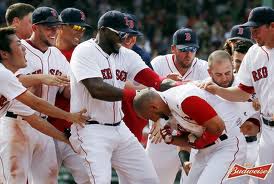
The Red Sox head into the post-All-Star Game portion of the season with a 2.5-game lead in the AL East.

The Red Sox head into the post-All-Star Game portion of the season with a 2.5-game lead in the AL East.

Photograph:  Jared Wickerham/Getty Images

Singing the Anthem

I’ve always thought that the Star Spangled Banner was a poor choice for our national song.  It is very militaristic for one thing.  For another, it is very difficult to sing.  I would much prefer America. But since I don’t think there will be a change in my lifetime, I have fun by watching the rendition before ball games and other events and seeing how it is done and whether the singer makes it all the way through it without an error.  Or adding horrible extra notes.  (And I don’t blame Beyoncé for lip-synching at the Inauguration.  She was singing outdoors with the band on a totally different level of the platform.  Besides, she totally nailed it live at the Super Bowl.)  But watching and listening is a spot in itself.

We went to the Brockton Rox opening game a few weeks ago.  (They play in a Futures League.)  An elementary school band played and were terrific.  But we’ve also seen some clinkers.  When it is a kid, you want to give them an “A” for trying.  An adult, not so much.  The New York Times had a recent story singing at ballparks.

It is a notoriously difficult song to sing, a musical high-wire act, with an octave-and-a-half range and a devilishly spaced melody. You usually sing it a cappella in a stadium where the echo hits your ear a half-beat behind the melody, and the lyrics are so familiar and fraught with meaning that every fan in the stands can hear the slightest mistake or botched note.

“It’s certainly nerve-racking,” said David Cook, the pop singer and “American Idol” winner who will sing the anthem on the Fourth of July in Kansas City, Mo., just before the Royals take on the Cleveland Indians. “For every person who wants to talk about Whitney Houston killing it years ago, 10 people want to talk about Roseanne Barr butchering it, so there is always that fear that ‘I better not forget the words to this song.’”

And most people like it done straight.  No Jimi Hendrix.   Me, I like his version.

Not all baseball anthems are done traditionally. Pop musicians who are ardent baseball fans often jump at the chance to do the honors. Kirk Hammett, the lead guitarist of the band Metallica, who grew up in San Francisco, and James Hetfield, the band’s lead singer, opened a game for the San Francisco Giants with a distorted guitar duet of the anthem in May this year. Steven Tyler and James Taylor have done the anthem in their own inimitable styles for their home team, the Red Sox, at Fenway Park in Boston.

Mr. Steinberg, a senior adviser to the Red Sox who has worked as an executive for the Dodgers and the Orioles, said it has become common for rock stars to try their hands at the anthem ever since Joan Jett had success singing it for her beloved Orioles in the late 1980s. Boston being the cradle of the Revolution, however, the Red Sox tend to go with a military theme on the Fourth of July, Mr. Steinberg said, so the team has asked Musician Second Class Nina Church, a vocalist with the Navy Band Northeast in Newport, R.I. to do the honors in her dress whites.

Petty Officer Church, 29, said that as a member of the Navy band, “you could call me a professional at singing the national anthem.” The key to pulling it off, she said, is to start on the right note. “The range of the piece is an octave plus a fifth,” she explained. “A lot of people start a little too high.”

But even Petty Officer Church stumbled a little, but recovered well.  I wonder if the Dropkick Murphy’s have done the Anthem at Fenway?  Don’t think so.  That might be interesting.  Or I read someplace that Justin Verlander, the pitcher for the Detroit Tigers can sing.  Maybe he can start a new trend:  Players who sing the Anthem.

Clockwise from top left: STEVEN TYLER at Fenway Park in 2002; CHAKA KHAN in 2008 at Dodger Stadium; JAMES HETFIELD in San Francisco in May; ROSEANNE BARR at a San Diego Padres game in 1990; MARC ANTHONY at Shea Stadium in 2001; and TAYLOR SWIFT at Dodger Stadium in 2007.

Clockwise from top left: STEVEN TYLER at Fenway Park in 2002; CHAKA KHAN in 2008 at Dodger Stadium; JAMES HETFIELD in San Francisco in May; ROSEANNE BARR at a San Diego Padres game in 1990; MARC ANTHONY at Shea Stadium in 2001; and TAYLOR SWIFT at Dodger Stadium in 2007.

Photographs: Clockwise from top left: Elise Amendola/AP; Stephen Dunn/Getty; Jason O. Watson/Getty; Andy Hayt/AP; Ray Stubblebine/Reuters; Kevork Djansezian/AP

Red Sox: 50 wins

I remember a few years ago when Josh Beckett (traded to the Dodger and now out for the rest of the year) boasted that the Sox could win 100 games.  They didn’t.  That was 2011, the year of the great September swoon.  The year that Terry Francona was fired.  Not a good year.  Fast forward through last year and the Bobby Valentine debacle to 2013.  This is a year for those who love baseball.  There are no superstars, no celebrity players.  What you have is a bunch of guys who play ball.  Christopher Gasper summed it up well in his Boston Globe column this morning.

Red Sox

If you have tuned out the Sox over the first three months of the season because of disinterest or lingering resentment from the past two seasons, you have missed a good time and a good team.

At 50-34, the Sox have the best record in the American League. They’re one of only two teams in baseball to spend the entire season above .500 — the other is the Atlanta Braves. They have a plus-80 run differential, second only to the St. Louis Cardinals in all of baseball. They’ve won in walkoff fashion seven times, including against the Toronto Blue Jays on Sunday, when they triumphed on an error at first base by a converted catcher, Josh Thole.

It’s one of those games you win when your team has good karma, instead of a toxic dump of a clubhouse. The personality makeover Red Sox general manager Ben Cherington gave the clubhouse in the offseason has taken, and the manager, John Farrell, is a source of stability, instead of a source of insurrection.

John Farrell, former pitching coach for the Red Sox under Francona, has done what the owners thought he would do for the team.  He stays out of the spotlight and does his job.

The Sox lead the majors in runs scored (431), OPS (on-base plus slugging percentage) at .793, and pitches seen per plate appearance (4.06). Traditionally a team that runs the bases at the pace that ketchup drips out of a new bottle, the Red Sox entered Monday tied for second in the majors in stolen bases.

It’s increasingly difficult to say that what is happening in the Fens is just a fluke, that Daniel Nava, Mike Carp, and Jose Iglesias, who is hitting .409, are all wearing glass cleats and the clock is about to strike midnight.

The poster boy for these revitalized Red Sox is John Derran Lackey. That’s right, I said John Lackey.

Like his team, Lackey was written off, derided and despised. He was unlikable and unwatchable. He missed all of last season because of Tommy John surgery.

This year, I have even seen Lackey smile.

But, Gasper asks, won’t people come out and root for the team.  Why is the buzz still about the Bruins and the Celtics?  I have to admit that I haven’t been to Fenway this year.  I only go every 3-5 years (have to save up my money)  and I went last just as the Sox were hitting their 2011 dive.  But I do watch them, listen to games and follow them closely.

Maybe Boston sports fans believe the team is going to fray and show its holes like a pair of mittens that keep getting caught on a fence. Fenway Fatalists assume Clay Buchholz won’t be able to return from the pain in his neck that has kept him out since June 8 and the team’s closer carousel will keep spinning without an answer. Koji Uehara is the latest to try the role.

Maybe they just find the team a bit hard to identify with. They’re no eccentric savants, long-haired idols, or free-spirited frat boys.

No gimmicks, just gamers.

Whatever it is, the Sox don’t have the buzz befitting a first-place baseball team more than halfway through the season.

Maybe those who derided the “new” fans as the pink hatters were right:  people were attending because it was the in thing to do, not because they loved the game.  Me?  I will watch any game.  I’ve even been known to watch a women’s tournament in Vermont.  They were playing to raise money for a women’s shelter.  But Gasper is right.  This is an exciting team.  Watch Uehara when he completes a successful inning.  They play hard every game and never quit until the last out.   And they may just bring us another American League Championship.  Maybe I should break my rule and go to a game.

The BSO and the Red Sox

I loved Seiji Ozawa when he was the music director of the Boston Symphony Orchestra and part of what I loved was that he was a regular part of Boston life, including going regularly to Red Sox games.  The new music director, Andris Nelsons has indicated that he would like to see a Bruins game – being from Latvia I would guess that ice hockey would be his thing – but one can’t say he isn’t game.

27namespedro1 Nelsons who said he had only seen a few baseball games threw out the first pitch Tuesday night.

The first pitch at Fenway capped a full day for Nelsons.  The Globe story had the details

As night fell, Nelsons headed into Gate C at Fenway for perhaps his most difficult assignment.

Early in the morning, over breakfast, he told Volpe he had watched some baseball but was concerned. He didn’t know how he was going to throw a pitch past a batter. Volpe explained that nobody would be at the plate except a catcher.

Later, while chatting with BSO concertmaster Malcolm Lowe, Nelsons made two different throwing motions, one sidearm, one more overhand.

“It is this way or this way?” Nelsons asked as he made a pair of throwing motions.

At Fenway, after getting a uniform with number 15, Nelsons ran into Red Sox great Pedro Martinez, who offered advice.

“Just don’t bounce it,” he said, smiling.

Nelsons didn’t. A few minutes later, on the mound and in uniform, the maestro let the ball go hard. It sailed through the air, arcing a good 25 feet over the catcher and into the hands of a photographer.

“At least he didn’t bounce it,” Red Sox executive vice president Charles Steinberg chuckled as fans cheered, another signal the Nelsons era had begun.

I suppose we have strange rituals here in Boston where our symphony music directors are initiated by throwing out the first pitch at Fenway, but Andris Nelsons seems to be adapting.  I haven’t seen him conduct yet, but as a BSO subscriber I’m sure I will soon.  And I love the fact that Pedro is back with the Sox.  I wonder if he can still pitch and fill in for Clay Buchholz.

Photograph: Stu Rosner

Red Sox, Celtics and Pride Week in Boston

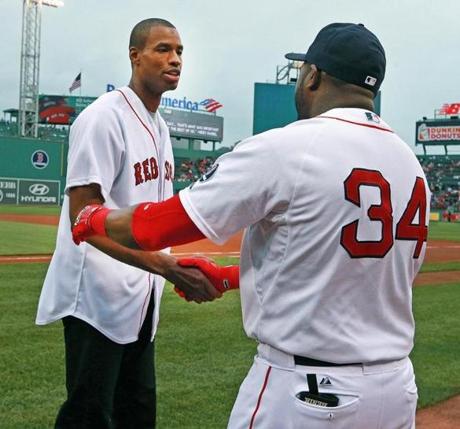
Jason Collins spent time last season with the Boston Celtics (and he might be back next season) before he came out in a now famous Sports Illustrated story.  Last night Collins helped the Red Sox celebrate Pride Night by throwing out the first pitch to Manager John Farrell.  It should be noted that managers rarely do this.

The Boston Globe ran this story from the Associate Press

The 7-foot center was greeted with a nice applause when the PA announcer read the opening of the SI article: ‘‘I’m a 34-year-old NBA center. I’m black. And I’m gay.’’

Wearing a Red Sox jersey with the No. 98 on the back, Collins threw out the first pitch to Red Sox manager John Farrell.

Red Sox slugger David Ortiz feels everyone should support each other based on how they act.

‘‘Nobody knows what is perfect and what is not,’’ Ortiz said, sitting at his locker about three hours before the game. ‘‘If you are respectful and you do what you’re supposed to do, it doesn’t matter what you are and what you come from, people should respect you and love you the same way.’’

Collins wears 98 on his jerseys to honor Matthew Shepard who was killed in 1998, a decision welcomed by Shepard’s parents.

2015 Pride Night at Fenway

2015 Pride Night at Fenway

Hey Danny and Doc, bring him back to the Celtics!

By the way, the Sox won on a walk-off 3 run homer by – David Ortiz.

Photograph Jim Davis/Globe Staff

Baseball and Justice Sotomayor or Flood v. Kuhn revisited

Anyone who loves baseball and history will love this story.  I found it on NPR reported by Nina Totenberg who covers the Supreme Court.  It is about a combination moot court and historic re-enactment.  The case is Curt Flood v. Bowie Kuhn from 1972.  Law school often do this kind of re-enactment, but this one was sponsored by the Supreme Court Historical Society.  Justice Sotomayor presided from the seat of the Chief Justice.

For those who don’t remember, the case was brought by St. Louis Cardinals great Curt Flood, who challenged baseball’s reserve clause — the provision that allowed teams to virtually own players, set salaries and conduct trades, with the players for all practical purposes never able to negotiate freely with other teams. That meant that at the time Flood brought his challenge in 1970, he was earning what was then considered a top salary of $90,000. This, for a player who had signed with the Cards at age 18, with no agent or lawyer, and who in six of the next 12 seasons batted .300 and won seven Gold Glove awards. So, when he was traded to the Philadelphia Phillies, a definitely lesser team at the time, he refused to go, and could not play for any team.

He wrote to the then-baseball commissioner, Bowie Kuhn, protesting that he was “not a piece of property to be bought and sold.” Kuhn denied his request for free agency — a concept unrecognized by baseball back then — and Flood sued, seeking to block the perpetual use of the reserve clause.

Flood lost, but baseball changed forever as the free agency system was put into place anyway.

In 1994, however, nearly two decades after the Flood decision and the ensuing changes in baseball, the owners sought to effectively nullify the free agency system, and the baseball players struck, wiping out the playoffs and the World Series. The National Labor Relations Board went to court, contending that the owners were negotiating in bad faith, and the case came before a young federal district court judge named Sonia Sotomayor.

She agreed that the owners were colluding illegally to fix salaries and granted a temporary injunction barring them from doing that. Sotomayor, a wildly dedicated Yankees fan, issued her opinion in time to allow the new baseball season to begin as scheduled on opening day, with the old baseball contract in effect. She thus earned the title, “the judge who saved baseball.”

The arguments in the re-enactment veered between history and current day baseball.

Representing Flood at the re-enactment was Stanford Law professor Pamela Karlan, a frequent Supreme Court advocate, and ironically, a former Blackmun law clerk. And representing Major League Baseball was another frequent Supreme Court advocate, Roy Englert.

Karlan opened, noting that the Supreme Court’s 1922 and 1953 decisions upholding baseball’s antitrust exemption were outliers and that the court had not permitted such an exemption for any other professional sport.

Sotomayor asked why the court should “break with tradition,” thus depriving the owners of their “reliance” on previous decisions.

Karlan shot back that if the court were to side with the owners for a third time, it would amount to something done in baseball only once before — three errors on a single play.

Sotomayor, with a straight face, opined that the court could apply another baseball rule: three strikes and you’re out.

Karlan, undaunted, replied, “I’m swinging for the fences here, your honor.”

Sotomayor is escorted onto the field by New York Yankees catcher Jorge Posada to throw out the ceremonial first pitch before the New York Yankees game against the Boston Red Sox at Yankee Stadium on Sept. 26, 2009.

The next exchange con free agency and salaries management to get in a dig at Sotomayor’s favorite Yankees.

Sotomayor asked what would happen if the court were to take away the antitrust exemption. Wouldn’t the players move around so much that fans would have no team loyalty?

No, rejoined Karlan, the owners would just have to pay the players what they are worth in order to hold on to them, and instead of year-to-year contracts that leave players with no leverage, the owners would have to negotiate longer-term contracts.

Sotomayor, in mock horror, said that if the antitrust exemption were abolished and owners could no longer collude to set player salaries at will, the Yankees might have to pay Reggie Jackson $1 million a year!

Worse, replied Karlan, would be if the Yanks paid Alex Rodriguez a quarter of a billion dollars not to play.

“I can’t imagine such a thing!” answered a shocked Sotomayor.

Next at bat were the owners.

Next up to the lectern was Roy Englert, representing the baseball commissioner and owners. He noted that some 50 bills had been introduced in Congress over the years to eliminate the antitrust exemption, and none had passed. The court, he said, should leave the question to Congress.

But Sotomayor asked, “Where are the rights of the players?” Quoting Curt Flood, she said that the baseball system was a form of “involuntary servitude” that does not exist in any other industry.

Englert replied that “these young men are making on average $28,000 … as much as Supreme Court justices.” Moreover, unlike other sports, he observed, baseball puts enormous investment into training players in the minor leagues.

The case does involve some serious legal questions, some raised by the decision written by Justice Blackmun.  It appears that Blackmun was reluctant to overturn the prior decisions, but wrote his opinion in such a was that everyone understood that baseball did in fact fall under that anti-trust laws and does engage in interstate commerce.

Justice Sotomayor concluded

‘There are Supreme Court decisions that are wrong,” she said. The court’s 1896 decision upholding segregation was wrong, and the Supreme Court was right to reverse it in 1954. But sometimes, she said, the question is not whether the decision was wrong, but whether this is the right time to overrule it.

Today, she observed, we see as “horrible” the reserve clause that deprived players of any real negotiating power. But at the time, what both sides thought they were arguing about was “the very survival of baseball.”

Voting for MVP

As Gary Washburn put it in his Boston Globe column this morning

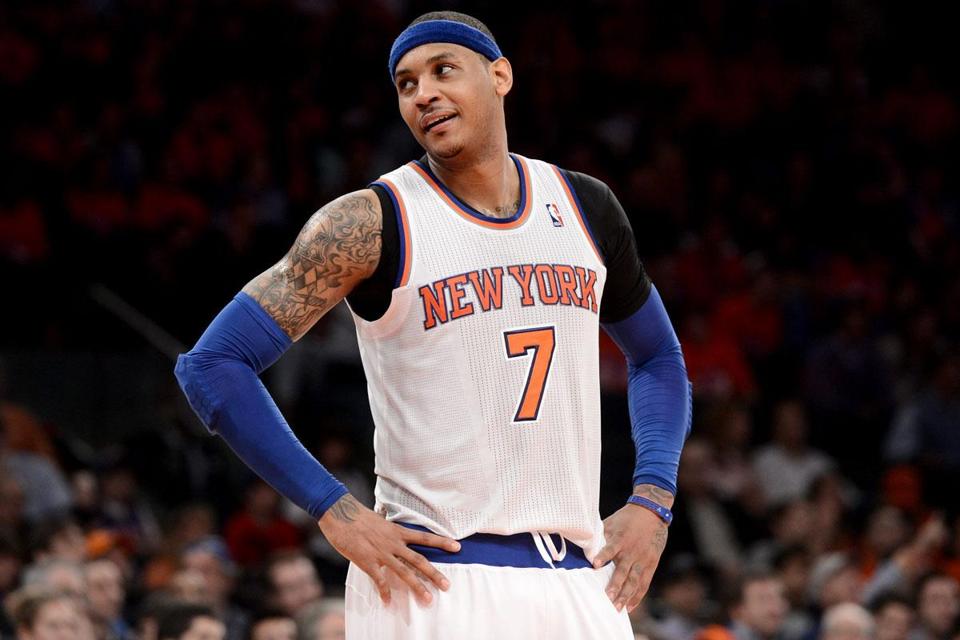
…this isn’t the Best Player in the Game award, it’s the Most Valuable Player award, and I think what [Carmelo]Anthony accomplished this season was worthy of my vote. He led the Knicks to their first division title in 19 years.

That’s a long time ago.

I have to admit that for some reason I didn’t follow basketball – college or pro – much this past season so I don’t know much about the teams in the playoffs although I know that the Knicks beat the Celtics in the first round.  I also know that I think LeBron James may be a great basketball player, but he has yet to win me over as a human being.  I’m with Cleveland here.

121 votes cast and only one not for LeBron James.   Last night I was listening to the BBC news and even they wanted to know who the voter who didn’t pick James was.  And now we know:  Gary Washburn from the Boston Globe.

Gary Washburn voted for Carmelo Anthony based on his importance to the New York Knicks

Gary Washburn voted for Carmelo Anthony based on his importance to the New York Knicks

Washburn continued

Anthony led the league in scoring average and basically carried an old Knicks team to the No. 2 seed in the Eastern Conference. Amar’e Stoudemire missed most of the season with knee issues, Raymond Felton missed six weeks, and Tyson Chandler dealt with nagging injuries, leaving Anthony, J.R. Smith, and a bunch of lottery picks from the mid-1990s to win 54 games and beat the Miami Heat three times.

LeBron can win the MVP award every year. He is that good. And it’s to the point where I put him on a Michael Jordan scale. Jordan won five MVP awards but could have earned 10. In the 1992-93 season, Jordan averaged 32.6 points, 6.7 rebounds, 5.5 assists, and 2.8 steals and shot 49.5 percent from the field.

And the MVP award went to Charles Barkley.

So my vote had more to do with Anthony and less to do with the dominance of LeBron. If you were to take Anthony off the Knicks, they are a lottery team. James plays with two other All-Stars, the league’s all-time 3-point leader, a defensive stalwart, and a fearless point guard. The Heat are loaded.

If LeBron was taken away from the Heat, they still would be a fifth or sixth seed. He is the best player of this generation, a multifaceted superstar with the physical prowess of Adonis, but I chose to reward a player who has lifted his team to new heights.

Does James have the other writers so snowed they forgot the meaning of MVP?  Bravo to Gary Washburn!

Photograph:  EPA

The Boston Marathon bombing

I was checking into a hotel in Philadelphia minutes after the bombs went off near the finish line of the Boston Marathon and learned what had happened from the desk clerk.  For the next week, we followed the story mostly by reading the paper in the morning and sometimes catching a few snippets on television.  I had made the decision not to do email or any social media while I was gone.  I did have my cell phone on, mostly in case of a cat emergency at home or a Philly friend calling.  It was strange to be away from home and hearing about familiar places.

Things got particularly weird  for me late Thursday afternoon.  The authorities had just released the video of the suspects and in the tape was a person walking who resembled me.  I started getting text messages and calls from friends in Boston who wondered if it was me and if I were OK.  It wasn’t, but when we turned on the TV and watched the endless loop, the other “me” was easy to spot.  Blue jacket, ball cap, grey purse strap across the back.  A short woman, a little stocky.  As one of my friends said even after being reassured, “It really does look like you.”

I got home to a pile of papers and more information on the incident.  It was interesting to see what people got wrong in the early days and it should get more interesting as the investigation continues.  My husband and I were thinking that bombing like this are regular occurrences in other countries and in many ways we are lucky that our law enforcement can actually track the two kids who planted the bombs.  We will bring the survivor to trial eventually, but as someone, I think it was Senator Elizabeth Warren, said these are the early days of the investigation and this is not NCIS where crimes get solved in an hour.

James Carroll wrote this morning in the Boston Globe about the Boston Marathon, the votes in Washington against any regulation of guns, and democracy.  Here is some of what he said.

In 490 BC, the legendary runner brought urgent news to Athens of the Greek victory in Marathon over the armies of the Persian Empire. The Battle of Marathon secured a peace that ushered in the Athenian Golden Age, during which a vibrant democracy finally found the balance between the exercise of force and the fulfillment of human needs. Last week, as an American commemoration of the Battle of Marathon unfolded in Boston, that same democratic balance was dangerously stretched amid the Doric columns of Washington, where the Senate cast a tragic vote for violence.

Yet even our definition of “tragic” goes back to Athens, to the spacious imagination that flourished there — especially in the plays of Sophocles, who lived from about 497 to 406 BC. He taught us that every choice has its consequence, that character is destiny, that the exercise of power must always be measured by the health of the whole community. He also taught us that tragedy, when faced directly and bravely, leaves humans not diminished, but ennobled.

The traumas of Boston last week, culminating in the killing and pursuit of the men suspected of planting the bombs, were heartbreaking and repugnant, but they left the city whole. With all citizens commanded to “shelter in place” Friday while responsible officials conducted the manhunt, Boston was itself a character in the extraordinary drama. A vast ad hoc web of Internet users to whom law enforcement had appealed gave new meaning to the term “community policing.” The fugitives knew that an entire commonwealth had become their antagonist. This surely forced the drama’s denouement. There were no bystanders in Boston.

From Homer on, Greek culture honored competition (“agon” in Greek, which gives us the word “agony”). But in Athens, the philosopher Alasdair MacIntyre has explained, this spirit of contest was balanced by the politics of cooperation. The virtues of the first (discipline, bravery, self-actualization) meshed with the virtues of the second (empathy, humility, selflessness). Athenian democracy was the reconciliation of these opposites. Strength was joined to tenderness.

The Boston Marathon wonderfully embodies this balanced moral order, too: Every year the fiercely determined runners strive to be best (or for their personal best), while surrounded by multitudes whose cooperation makes the race so radically inclusive.

But death changes everything — a jolting transformation to which Greek tragedy itself gave first expression. “In the face of death,” as MacIntyre puts it, “winning and losing no longer divide.” Instead, competition drops away, and cooperation becomes the absolute mandate. That is precisely what happened in Boston, as the city held Martin Richard, Krystle Campbell, Lu Lingzi, and later Sean Collier in its heart.

Last week, a separate drama unfolded in Washington. “It’s almost like you can see the finish line, but you just can’t get there.” These words could have been spoken by thousands of Boston runners, but were said by the father of a shooting victim who witnessed the Senate vote on gun control.

We will, once again, show the world that we can have an investigation and fair trial.  And we will one day enact some sensible gun safety measures.  Watching the events unfold from a distance, I was proud of my fellow Bostonians, law enforcement and  public officials particularly Mayor Menino and Governor Patrick.

Candles for the victims.

Candles for the victims.

Play ball! The 2013 season starts

Like Red Sox fans all over, I was extremely happy that we won’t be starting the season with another losing streak.  Well, at least we won’t be 0 for whatever.  And having the first win against the Yankees was icing.  I will have all summer to write about the team so I will just leave it at that and turn to more general baseball spring subjects.

Yesterday, Neil Genzlinger wrote a wonderful piece in the New York Times warning owners of souvenir baseballs to take care of them well.

Baseball’s opening week seems a good time to issue this public-service advisory: If you own an autographed baseball with significant financial or sentimental value, be prepared for it to be destroyed unless you take drastic action immediately.

That cautionary announcement is inspired by television and the movies, which love a good baseball yarn, especially if it involves an autographed ball that comes to a gruesome end. For decades, the big and small screens have been sprouting stories about beloved balls that have been ruined, usually by a child who has not been properly schooled in the importance of sports memorabilia. And in these tales we can find vital lessons for this time of year.

Two of his advisories are my favorites.  First is from “Leave it to Beaver”, a show I watched as a child and later in re-runs.  I don’t remember this episode but it is typical.  Genzlinger advises you live in a roadless neighborhood.

That is the lesson of an episode of “Leave It to Beaver” first broadcast in April 1960, during the show’s third season. Ward, the Beaver’s father, discovers a prized baseball from his childhood in a trunk and puts it on display in his den, a foolish thing to do given Beaver’s already well-established knack for wreaking havoc.

How valuable was this baseball? It had been signed by Babe Ruth, Lou Gehrig, Lefty Grove, Kiki Cuyler, Augie Galan, Bill Dickey and Grover Cleveland Alexander, which means it could have paid for the Beaver’s college education.

Others can research whether those players were ever in the same locker room at the same time, as Ward attests. Our focus here is what happens to the ball. The Beaver’s nitwit friend Larry persuades him to play catch with it, Larry heaves it over the Beaver’s head and into the street, and a passing truck squashes it. So if you own a ball with those autographs on it — or, really, with any one of those autographs on it — find a roadless place to live. No road, no trucks.

The second favorite piece of advice is to get rid of the family dog.  Easy enough for me since I have cats who just roll things around the floor.  Baseballs are much to big for them to bite.

It’s the family pet that does the damage in an episode of the sitcom “George Lopez” first broadcast in October 2002. The son in the fictional Lopez family, Max, is being pressured by his father to improve his baseball skills, which are abysmal, and he practices with one of George’s most treasured possessions, a ball signed by Steve Garvey, Joe Morgan, Jim Palmer and Rod Carew. The family mutt nabs it and reduces it to a gooey lump.

The episode, by the way, features four of the daffiest athlete cameos in television history. Garvey, Morgan, Palmer and Carew appear or, more accurately, their heads do, as George’s bobblehead-doll collection lectures him after he yells at Max.

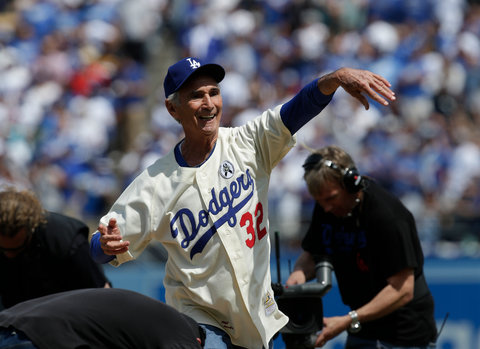
I thought my picture of the day from opening day would be Jackie Bradley, Jr.’s catch of the day for the Red Sox, but then I saw this of my first favorite player beginning when he was a Brooklyn Dodger, Sandy Koufax, who still bleeds Dodger Blue.

Sandy Koufax threw out the ceremonial first pitch at Dodger Stadium on Monday.

Sandy Koufax threw out the ceremonial first pitch at Dodger Stadium on Monday.

Baseball is all about making memories.  Time to make some new ones.

Photograph Jae C. Hong/Associated Press

The state of the Sox

Thank goodness the baseball season starts in a week.  My March Madness bracket is sooo busted I can’t decide if I will continue with the next round on the CBS round by round contest.  But baseball.  That’s a different story.  The season is ahead of us, all those games from April to September and beyond to the World Series.

The big question for Boston is whether the Red Sox can rebound from last year’s train wreck.  Actually the disaster began in September 2011, but things got worse under Bobby Valentine.  Maybe it is time to forgive Bobby.  After all, he was a new manager coming into a difficult situation, but he was just wrong for Boston and wrong for the Sox so no forgiveness yet.  Now it is John Farrell’s turn to try.

Spring training has been about what one could expect.  The Sox are .500.  We’ve seen some good youngsters and the pitchers are working faster – even Cloy Bucholtz.  The bullpen seems solid.  The question is:  Can the Sox hit?

Nick Carfardo had a nice list of issues the Red Sox have to resolve to get to their roster of 25 in the Boston Globe this morning.

1. Lyle Overbay — He is the most immediate decision since he has an opt-out Tuesday. The Sox have to tell him by noon Tuesday whether he will make the 25-man active roster. If he does not ask for his release and agrees to open the season in Pawtucket, he will receive a $100,000 retention bonus. The Sox might be OK with that as insurance in case something happens to Mike Napoli.

Overbay is also a proven first baseman while Napoli is not. We’re assuming that David Ross, Pedro Ciriaco, and Daniel Nava are on the bench. That leaves one spot for Ryan Sweeney (who has a March 28 opt-out), Mike Carp, and Overbay. Nava is protection at first base and in the outfield and is also a better fielder than Carp. Overbay is a pure first baseman (he made a nice diving stop Monday) and lefthanded bat. Carp went 1 for 2 against the Orioles and is hitting .211.

I haven’t been that impressed with Overbay or Carp and Napoli is doing OK at first.  I’d let Overbay opt out this morning and keep Nava as back up.

Jackie Bradley Jr. has raised his spring average to .444.

Jackie Bradley Jr. has raised his spring average to .444.

2. Bradley — It appears he’s made the team, at least that’s the indication after the team reversed its decision not to play him in left. He’s passed every eye test, including facing a tough lefty Sunday in Cliff Lee, whom he took deep for a three-run homer and sacrifice fly in his first two-at bats. He followed that up Monday by coming off the bench with two hits, a two-run single up the middle against Pedro Strop and a triple vs. lefty Chris Petrini.

Jackie Bradley, Jr.  Jerry Remy keeps using his full name.  He might be a rookie, but he’s been to the College World Series and appears very mature and stable.  I know there is all this talk about the free agency date being different if he starts the season at Pawtucket, but let’s face it, we need his bat.  Even if he cools off, as he will, I think he will be as asset.

3. Daniel Bard — We’re assuming the bullpen spots that are set are Joel Hanrahan, Andrew Bailey, Andrew Miller, Koji Uehara, Alfredo Aceves, Junichi Tazawa, and Clayton Mortensen. That could change if Aceves or Mortensen is traded. Mortensen, who was touched up for two homers Monday, is out of options and the Sox don’t want to lose him because he’s stretched out and basically fills the same role as Aceves.

Bard has options and could go back to the minors, as his performance hasn’t been smooth this spring. The Sox also could option Tazawa as well.

I would trade Mortensen ( I’ve read that there is interest in him.), keep Tazawa and have Bard start in Pawtucket.  It is a long season and we will need Bard sooner or later.

How will the Sox do this season?  Predictions have a way of coming back to haunt you (take my March Madness bracket), but I think the Sox will be a better than .500 team.  The AL East is tough and I think Baltimore is the team to beat, but never, never count the Yankees out.

(By the way, I picked Indiana to win the basketball crown this year, but any team but Louisville will suit me fine.)

Photograph Kathy Willens/Associated Press