Curling and skating

For me, the Sochi Olympic Games are just about over.  I’ll try to catch the men’s curling finals, but other than that, I’m done.  Yes, I know that there are a few more days to go including hockey, but I probably won’t be watching.  I’ve always loved the skating and this year, decided I needed to figure out curling.  I still don’t understand all the rules of either sport, but I’m getting there.  I just hope that unlike skating, the curling rules don’t keep changing on me.

Curling diagram

Curling diagram

Turns out that curling is very interesting and can be quite dramatic.  It is a game not only of skill, but also of strategy.  As my husband said a reason for kids to learn math and geometry.  It is not fast like hockey, but more like baseball.  Maybe that’s why I like it.

Two stories in the New York Times sum up my feeling about skating this year.  The first was a comment by Gia Kourlas.

…It’s not just the flawed judging system, in which skaters who hope to win a medal must focus more energy on racking up points than on refining their artistic point of view, or even Scott Hamilton’s effusive screech.

Not much has changed since the 2010 Olympics. For many figure skaters, artistry remains that elusive muse. The costumes are appallingly infantile. Why are male skaters so enamored of suspenders? What’s the deal with grown women wearing skating dresses that look as if they were found on the sale rack at the tiara store? It’s as if competitors were still on the junior circuit and hadn’t made a commitment: beauty pageants or skating.

Figure skating is gliding, and a jump is a continuation of that flow, a breathtaking release in which the human body conquers gravity and soars. But in competition, jumps have increasingly become cause for anguish. Must we be made to feel so worried? The men’s final, which took place on Friday, made a case for why figure skating has turned into a coldblooded circus act.

Four years ago, quadruple jumps weren’t the norm. Perhaps by 2018, skaters will have figured out how to land them. This year, it was disheartening to see so many go down, a list that included the Japanese gold medalist Yuzuru Hanyu. The men’s free skate was as nuanced as a rodeo on ice, where the quadruple jump was the equivalent of a bucking bronco.

I have to say that I just finished watching the women’s free skate and the top 5 or 6 women did have more skating and artistry than the men did, but one still worried that they would go splat.  For Gracie Gold, it was one of the differences between a medal and 4th place, but looking at the final standing, Adelina Sotnikova used her jumps to beat the artistry of Yu-na Kim and Carolina Kostner.  There will be lots of debate about whether she got a hometown Russian advantage or not.  But still the women were much more fun to watch than the men.

Forget about the perennial question: Is figure skating an art or a sport? The main concern is the disintegration of performance quality. In most programs, you can tell that the word “compete” has replaced “perform,” and the effect is devastating as you endure — if you’re a die-hard — rounds of skaters gritting their teeth as they pop from one element to the next.

You could find solace in two skaters. The American Jason Brown, a happier version of Mitch Kramer in the film “Dazed and Confused,” didn’t attempt a quadruple jump. He’s only 19, but his skating is already rich, enhanced by his flexibility, deep edge-work and fleet spins. He performs as he skates; the two are interchangeable. And the French veteran Brian Joubert, whose scores didn’t reflect his artistry, seemed like the only man out there.

I have to say I was surprised by Joubert’s scores; I enjoyed watching him a lot.  I hope that when Jason Brown gets that quad, I hope he doesn’t give up actually skating and performing.

Torvill and Dean 1984

Torvill and Dean 1984

But my favorite is not pairs, but ice dancing.  I discovered it along with millions of others in 1984 when Jane Torvill and Christopher Dean skated Bolero.  This year the ice dancing was dominated by whether Charlie White and Meryl Davis could pull off a gold or the Canadians would repeat.

Ice dancing ended on Monday, and, as expected, the Americans Meryl Davis and Charlie White defeated their Canadian rivals Tessa Virtue and Scott Moir for the gold. Both couples have soul: Ms. Virtue and Mr. Moir meld sophistication with emotional, fervent sensitivity, skating with a sweeping creaminess.

And Ms. Davis and Mr. White are fascinating; like Fred Astaire and Ginger Rogers, they’re opposites. The tension between Ms. Davis’s cool, exotic plasticity and Mr. White’s surfer bum earthiness forges an unexpected harmony in their skating. They truly skate as if they were dancing: Floating airily from one edge to the other, they skim over the ice with a velvety touch.

That is what skating should be about as far as I’m concerned.  Yes, like curing, it is an athletic even, but also like curling, it should seem effortless and serious fun.

What was terrific about getting to watch the skating live were the commentators Tara Lipinski and Johnny Weir.  If for no other reason one had to tune in to see was Johnny was wearing.  The New York Times had this review of them.

One of the eureka moments of the 2012 London Games was that live television and online coverage helped push viewership upward in prime time.

So NBCSN was endowed with live hours to show team figure skating, pairs, ice dancing, and the men’s and women’s programs. And it got its own announcers: Tara Lipinski, the 1998 women’s gold medalist, and Johnny Weir, a two-time Olympian, along with Terry Gannon, who called figure skating for ABC.

NBCSN’s announcers call every skater, every pair and every dance team. NBC’s team calls a sampling.

For example, NBCSN showed all 30 competitors in the men’s short program. NBC taped eight or nine of them.

“Prime time is so time-structured,” said David Michaels, the coordinating producer of figure skating for NBC Olympics. “We do so much juggling.” But with such a continuous flow on NBCSN, Weir and Lipinski have more time to tell stories, often about skaters who never show up on NBC.

Asked if he wanted to call every skating routine, Hamilton said, with a laugh, “I’m not sure I’d want to work that hard.”

Weir said that his skater-after-skater-after-skater schedule has been exhausting. “Tara and I take our work seriously,” he said. “She’s my work wife. And she’s a slave driver, so we sit up and study until she’s satisfied. We not only plan how we look, but we’re up until three in the morning looking at all the skaters’ backgrounds and biographies.”

Tara and Johnny

Tara and Johnny

And today they even had Terry Gannon color-coordinated with his pocket square.

Weir is generally calmer yet colorful. And his chemistry with Lipinski suggests an ongoing, enthusiastic conversation among confidants.

“We’re very good friends, and we have the best time educating people about our sport,” Weir said. Asked if he thinks he has surprised viewers who might have expected analysis as flashy as his wardrobes, he said: “I come from a small town in Pennsylvania, so I’ve spent a lot of time educating my family about my sport. It’s something I’ve learned to do without being aggressive or arrogant.”

And I did learn a lot about what to look for and how certain moves are done by listening to them.  As Gia Kourlas said in her commentary

While never short of opinions, they’re generally quiet during performances. While they get to the nitty-gritty of technique — pointing out when skaters are flat on their feet, or why they fall out of synchronization — they also have information about more obscure aspects of skating, like how ice temperature affects a performance (speed skating requires harder ice than figure skating) or how male ice dancers have been known to build up their heels for extra height.

It helps that Mr. Weir is a champion of inspired one-liners. While watching several near collisions during a men’s warm-up, he blurted, “It is Nascar out here in the world of rhinestones.”

We were entertained and educated.

So except for men’s curing tomorrow, my Olympics are done.  But I have to say I learned a lot – and had some fun.

Picture of Curling Ice Sheet: uswca.org

Photograph of Torvill and Dean:  The Daily Mail

Photograph of Lipinski and Weir:  John Berry/Getty Images

Shortstops: Jeter and Bogaerts

So maybe it is premature to mention Derek Jeter and Xander Bogaerts in the same breath, but I can’t resist.  Jeter just announced that this coming season will be his last and Bogaerts is preparing for his first full season.  But there is something about them that seems to be to be so similar.  Maybe it has to do with demeanor.  Maybe it is just being Red Sox fan hopeful.  Whatever it is, I was struck by the comparison.

Derek Jeter is the Yankee that even Red Sox fans admire.  Tyler Kepner wrote in the New York Times about his retirement.

The greatest compliment we can give Derek Jeter, as he prepares to leave the grandest stage in baseball, is that he never let us down. He has made thousands of outs and hundreds of errors and finished most of his seasons without a championship. Yet he never disappointed us.

This is no small feat for the modern athlete, in an age of endless traps and temptations.

From cheating to preening to taunting — even to defensible acts, like fleeing to a new team in free agency — the hero, almost invariably, breaks our heart sometime. Not Jeter.

He grew up beside a baseball diamond in Kalamazoo, Mich., dreaming of playing shortstop for the Yankees, and that is what he has done. He has never played another position, never been anything but No. 2 for the Yankees. But this season, he announced Wednesday, will be his last.

“The one thing I always said to myself was that when baseball started to feel more like a job, it would be time to move forward,” Jeter said in a statement on Facebook, adding later: “I could not be more sure. I know it in my heart. The 2014 season will be my last year playing professional baseball.”

Derek Jeter in 2008 after breaking Lou Gehrig’s mark with his 1,270th hit at Yankee Stadium

Derek Jeter in 2008 after breaking Lou Gehrig’s mark with his 1,270th hit at Yankee Stadium

If Frank Sinatra were around, he could sing “My Way” at Jeter’s retirement.

Jeter is perhaps the most secure, self-confident player in baseball, a sharp contrast to the disgraced Alex Rodriguez, whose season-long suspension means that he will never again be teammates with Jeter. Groch [Dick Groch, the scout who signed Jeter] said he noticed these traits while scouting Jeter, who smiled under pressure and showed the leadership skills of a chief executive.

Derek Jeter always knew who he was and never acted out of character.

And what of the Red Sox rookie?  Xander Bogaerts, the kid from Aruba who speaks four languages (Dutch, English, Spanish, and Papiamento [the official language of Aruba]) also grew up playing baseball.  Even though he was called up last August, he remains eligible for rookie of the year for 2014.  Peter Abraham profiled him in today’s Boston Globe.

Xander Bogaerts took a few ground balls at third base last Friday. That ended when Red Sox manager John Farrell arrived at JetBlue Park over the weekend.

“He told me to go to shortstop and not to worry about third base,” Bogaerts said Wednesday after a lengthy workout. “I hope that means something good for me.”

As it stands today, Bogaerts is the shortstop. But that could change if the Red Sox sign Stephen Drew, who remains a free agent on the eve of spring training officially opening. Until Drew signs, Bogaerts can’t be sure exactly what role he’ll have.

“Nobody has said anything to me about it,” Bogaerts said. “It’s definitely not perfect, but I have to play baseball no matter what. I can’t worry about it too much. I’m working at shortstop every day and trying to get my reps in and get ready.”

I think the Sox need to forget Drew, even if he is a great fielder, and go with Pedroia, Middlebrooks and Bogaerts. Time to see how the kids do.

Xander Bogaerts during the ALCS vs. Detroit

Xander Bogaerts during the ALCS vs. Detroit

We will need to see how he matures but Bogaerts seems, so far, to be cast in a Jeter mold.

But with players now on the field, Sox officials have been more measured with their comments about Drew and seem ready to start the season with Bogaerts at shortstop and Will Middlebrooks at third base.

That the two arrived at camp early and have been working hard with infield coach Brian Butterfield doesn’t hurt their chances.

The 21-year-old Bogaerts is certain to make the team regardless. He hit .250 in 18 regular-season games last year before emerging as a starter in the postseason. Bogaerts started eight games in October, entering the lineup for Game 5 of the American League Championship Series and staying there.

Bogaerts was 8 for 27 (.296) in the postseason with four extra-base hits and nine runs scored. Teammates marveled at how unaffected he was by the atmosphere.

“I learned so much about the game last year, the preparation you need,” Bogaerts said. “The other teams will find your weakness right away. I need to get better at everything, especially recognizing pitches. But I know I can do it.”

Last October, Joon Lee wrote a long profile of Bogaerts for Red Sox blog, Over the Monster.  One quote stood out for me.

“I’ve always been a pretty quiet guy,” Xander said. “I don’t really go out a lot so I try to stay out of the most trouble as possible. Nothing good happens at night so that’s why it’s good to stay at home.”

Not a wild and crazy guy.  Yes, I know, Jeter didn’t exactly stay at home, but he never talked about his personal life.

Derek Jeter and Xander Bogaerts:  The past and the future?  We shall see.

Photograph:  Jeter, Barton Silverman/The New York Times

Photograph: Bogaerts, Robert Deutsch-USA TODAY

Nadal and Federer, Borg and McEnroe

In June 2009, I wrote a post about Rafael Nadal as a role model for young athletes.  It began

I’ve just come back from visiting my mother a 90 year old tennis fanantic.  I picked up last week’s New York Times Magazine and there, on the cover, is Rafael Nadal, the curremt number one in men’s tennis and as well as the current heartthrob for women.  I look at Nadal and Federer as Borg and McEnroe:  Borg was the pin-up but they could both play tennis.

Yesterday I watched the semifinal of the Australian Open between Nadal and Federer and was reminded again of all those great Borg/McEnroe matches.   Bjorn Borg and John McEnroe last played each other in 2011 at a charity event.  The New York Times reported

They were like oil and water during their heyday three decades ago, but John McEnroe, the brassy New Yorker, and Bjorn Borg, the cool Swede, are the best of friends now. Such good friends that Borg agreed to fly to New York to play McEnroe on Thursday in a charity match on Randalls Island.

Bjorn Borg, at left, and John McEnroe at a charity match on Randall's Island in New York.  July 2011

Bjorn Borg, at left, and John McEnroe at a charity match on Randall’s Island in New York. July 2011

True to form, McEnroe won many of his points at the net, while Borg favored backhand slices and a strong serve. McEnroe, who had played a doubles match before taking on Borg, was in character, slamming his racket against a baseboard and holding his hands on his hips after losing several points.

But when their match ended in front a crowd that included the former Mayor David N. Dinkins, they hugged at center court. The result, they said, was less important than their friendship and their efforts to promote tennis.

Borg and McEnroe, of course, are best known for their epic 18-16 tie-breaker in the fourth set of the final match at Wimbledon in 1980, which Borg eventually won. McEnroe won the next year, ending Borg’s five-year championship run at the event. By 1983, Borg retired; McEnroe followed him a few years later.

But for those few years, they played great tennis and provided a contrast in styles that came to characterize their generation. Borg, the quiet gentleman, was a link to the game’s more patrician roots, which were fading. McEnroe, an argumentative finger-pointer, typified a new era when athletes were more openly blunt and out for money.

According to the ATP, Borg and McEnroe played 14 times and 7-7.

This is where Nadal and Federer are a bit different.  After yesterday, they had played 33 times; Nadal had won 23.  The Guardian reported

Rafael Nadal will have to beat Swiss players back to back to win his second Australian Open on Sunday, and may have a slightly tougher time of it against Stanislas Wawrinka than he did in a curiously uneven semi-final against Roger Federer on Friday.

The world No1 took two hours and 23 minutes to win 7-6, 6-3, 6-3 – his 23rd victory over the Swiss, in 33 matches, moving him to within a win of drawing alongside Pete Sampras on 14 slam titles – and three behind Federer. Sampras was in the audience at the Rod Laver Arena, the first time he saw them play each other live.

“I never thought about 13 grand slams, or 14 either,” Nadal said. “I need to keep playing great to win this title. Stan’s serve is huge, and he is hitting the ball very hard. I will try to play the same as I did tonight. When I play with Roger, it’s a very special feeling. We play a lot of times for important things in our career. He’s a really great champion, and it’s an honour to play him. We played some tough rallies in the first set, he was playing some very aggressive tennis. I think tonight I played my best tennis of the tournament. After missing last year, it is very emotional for me to be back on this court.”

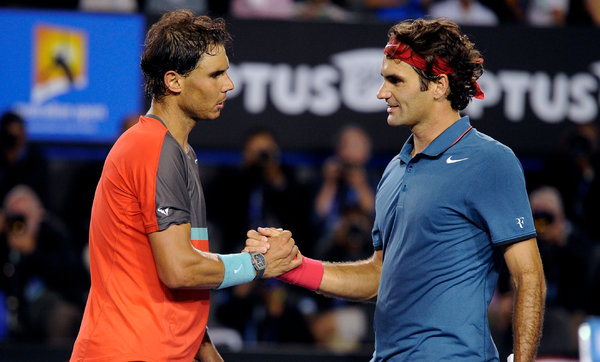
Rafael Nadal, left, shaking Roger Federer's hand after their match. The Nadal-Federer rivalry ranks among the most compelling and the most lopsided in tennis history.

Rafael Nadal, left, shaking Roger Federer’s hand after their match. The Nadal-Federer rivalry ranks among the most compelling and the most lopsided in tennis history.

The first set, won by Nadal in a tie breaker, was classic.  Both men were asked why Nadal wins so often.  The New York Times summarizes

Nadal would be content with never answering another question about his ability to turn any version of Federer — the invincible Federer, the injured, the best, the greatest — into just another guy. But he took one Friday anyway. His answer was a roundabout route to “it is what it is.”

“The real thing is I played a lot of times against him,” Nadal said. “And a lot of times I played great against him.”

And Federer

It was more difficult for Federer to explain why he struggled so with Nadal. He tried. To play Nadal, he said, was different from playing Djokovic or Murray. To beat Nadal, Federer could not play the way he wanted. He needed to be more aggressive, to hit at sharper angles, to take more risks.

His explanation was more fact than excuse. Nadal makes Federer play like someone else.

“I enjoy playing against him,” Federer said, a comment that all but begged for a lie-detector test.

Pete Sampras watched them live for the first time.

…Earlier in the day, Sampras gave a long, thoughtful, conflicted answer about the greatest-of-all-time debate.

Some decades, he said, seemed to have one player who stood above the rest. There was Rod Laver. There was Sampras, although of himself he said only, “I certainly had my moments.” Now, there is Federer and Nadal, greatness squared, and while Federer is 32 and Nadal is 27, their respective careers have overlapped for years — and much of their primes have, too.

“Let’s just appreciate what we’re watching,” Sampras said. “These are two of the greatest players of all time, playing in the same decade. It’s one for the ages.”

That it is, an era-defining rivalry, must-watch TV, every time the two of them take to the court. Even if one of them, the left-handed baseline bully, the Spaniard who answers to Rafa, now seems to win most every match that matters.

And my mother would have enjoyed every minute of yesterday’s match.

Photograph of Borg and McEnroe:  Barton Silverman/The New York Times

Photograph of Nadal and Federer:  Andrew Brownbill/Associated Press

Random thoughts about the Red Sox and the World Series

I am exhausted.  Let’s face it the sixteen games played to take home the World Series Trophy (our Mayor Menino calls it the World Series Cup) have been emotionally draining and the cause of much sleep deprivation.  And I don’t have to get up and go to work!  Tampa Bay, Detroit, and St. Louis were all tough opponents.  (By the way, one of my predictions finally came true:  Sox in 6.)

Here are a few random thoughts about the Sox.

Bib Papi hugs manger John Farrell

Bib Papi hugs manger John Farrell

David Ortiz was the MVP of the Series.  He had a ridiculous batting average of .688 and we got to watch him play first during the games in St. Louis as if he played there every game.  People were whining about the rules that took away the DH, but in the end it didn’t hurt the Sox.  Maybe it did make Mike Napoli a little rusty at the plate but he did get a hit last night.  The thing about Ortiz is that he is the first non-Yankee to win three World Series with the same team (2004, 2007, and 2013) since Jim Palmer with the Baltimore Orioles (1966, 1970 and 1983).  I learned that from a Tweet from Peter Abraham.  Big Papi is probably going to play one more season and then retire.  What a hole that will leave!

If you don’t think a manager makes a difference just study the styles of Bobby Valentine and John Farrell.  One had respect from day one and it produced a winning team.  I don’t know for a fact, but I suspect that Valentine was forced on general manager, Ben Cherington.   Nick Cafardo wrote in today’s Boston Globe

Ben Cherington hit .400, won the Triple Crown for general managers, and then won the World Series.

He picked the right manager, the right players, and still had an eye for the future. He traded only redundant players, such as Jose Iglesias in a three-way deal for Jake Peavy, knowing he had Xander Bogaerts.

Cherington deserved the bucket of champagne, let alone the bottle, as the architect of the 2013 World Series champions.

,,,

While the perception is Bobby Valentine was forced on him, Cherington was able to decide to fire him and deal for Farrell, the manager he wanted all along. He allowed Farrell to name his coaching staff and continue pretty much what Terry Francona had done with the team prior to the September 2011 collapse.

Cherington cleared out the poisonous players. And then he watched it. Maybe it wasn’t completely like he mapped it out, but close, real close.

“Once we got into the season you don’t know what the outcome was going to be, but this was a different group of people,” said Cherington. “They were completely selfless. It was a lot of fun to be around. It’ll sink in two weeks from now.”

He combined the desire to prove everyone wrong, the players with chips on their shoulders, with some new chemistry. He hit the jackpot.

Carlton Fisk, sporting a phony beard, and Luis Tiant, with a real one, threw out the first pitch.

Carlton Fisk, sporting a phony beard, and Luis Tiant, with a real one, threw out the first pitch.

And then the Sox had history.  Having former players like Jim Rice, Pedro Martinez, Mike Lowell, Dennis Eckersley and many others hanging around the team even if they weren’t formally coaching has to have been a plus.  Even Carlton Fisk entered into the fun.

Someday soon it will all seem real.  It will be hot stove time and Ben Cherington will have to get to work.  Will Jacoby Ellsbury give up boat loads of money and do what Dustin Pedroia did and take the hometown salary to stay?  What about Napoli?  Will Salty take his longest name on a jersey and move on – and more important – do we want him to stay?

But those are questions for another day.  Bring on the Duck Boats and let’s have a parade!

Photograph:  Ortiz and Farrell, stan grossfeld/globe staff

Photograph:  Fisk and Tiant, Stan Grossfeld/Globe Staff

The World Series: beards and music

Superstitious, I guess.  I didn’t want to write about the Red Sox in the World Series for fear of jinxing them.  Not that I have any such power, but with the baseball gods one never knows.  But now each team has had one horrid game – the Cardinals were worse than the Sox – and the Series is tied.  The Sox need to win at least one game in St. Louis to get back home team advantage.  This is beginning to feel like the games with Detroit that got them where they are.  That turned out OK, so we can still have hope.  All we need is for Jake Peavy to live up to his hype and for some combination of Clay Buchholtz/Felix Dubrount to pitch well and there is a chance for two wins.  And then we get Lester again.  So I’m feeling OK about the situation.  I feel badly for John Lackey who has had a great pitching year, but can’t seem to catch a break when it comes to run support and wins.

The player who did his job last night was Koji Uehara the accidental closer.  Once more.  3 outs on 10 pitches.  The beardless one.  I think we all assumed he didn’t have a beard because he couldn’t grow one.  We were wrong.  A few days ago, this story was in the New York Times.

Long, bushy beards have become the unifying trademark of the 2013 Boston Red Sox, but the most valuable player of their American League Championship Series victory stands out for more than his pitching.

The series M.V.P., the cleanshaven closer Koji Uehara, was given a pass on the team’s unofficial pro-beard policy because most of his teammates thought he was incapable of growing one.

But that is hardly the case. Well before the Red Sox’ shaggy faces entered the national consciousness, Uehara was a longstanding member of the antirazor brigade.

Until January, when he shaved it off on Japanese national television, Uehara had one of the most famous beards in Japan: light, Fu Manchu-style scruff with a wraparound beard connecting to his sideburns. It was considered ugly and brutish by many of his friends and countrymen, but he wore it defiantly for several years after coming to the United States in 2009.

Koji in Baltimore

People must have known.  I watched him pitch when he was with Baltimore, but I guess the beard never registered.  He also had a beard with the Rangers.

“I just didn’t know where I was going with that beard,” Uehara, 38, said through an interpreter Saturday afternoon before the final game of the A.L.C.S. “So I thought it was best to shave it off. It was a good time to do it, and I think many people were happy. They said I looked younger.”

Without facial hair, Uehara posted a career-low 1.09 E.R.A. in the regular season and had 21 saves after taking over as Boston’s full-time closer June 26. In the playoffs, he has been just as good, allowing one run in nine innings over eight games. He has five saves this postseason: two in a division series against the Tampa Bay Rays and three in the A.L.C.S. against the Detroit Tigers, including the save that clinched the pennant Saturday night.

But has shaving made him a better postseason pitcher?

“I don’t know,” he said, shrugging. “I am not sure about that.”

Whatever.  If being beardless got him MVP for the ALCS, then it is good for him and for us.

In one way, it makes sense that Uehara is now clean shaven in the midst of players who look like desert-island castaways. He originally grew his beard to stand apart from his teammates in Japan and from Japanese players in the majors, many of whom did not have facial hair.

Now that he is with a rowdy band of bearded Red Sox, he is distinguished in a different way.

“If I had a beard now,” he said, “I would not stand out.”

Meanwhile the symphony orchestras in Boston and St. Louis are getting in the act.  Even if you don’t root for either team this clip is wonderful.  I have to concede that the brass from St. Louis are better trash talkers, but the BSO has Seiji Ozawa.  http://www.youtube.com/watch?v=-_k8oICRBH4&feature=youtu.be

By the way, Boston in six.  With ZZ Top on our side, how can we lose?

Photograph: Mark Duncan/Associated Press

Can we send David Ortiz to the budget negotiations?

It has been a discouraging last few days with the only real bright spot being Friday (and then we went back Saturday) at Symphony Hall with the Boston Symphony Orchestra. We wanted to hear Thomas Ades, Polaris a second time and Friday night the BSO did not do Franck’s Symphony in D Minor which my husband loves.   But we came home Saturday night to no budget/debt ceiling deal and the Red Sox striking out, also.  I often tune in to some of the Sunday news shows, but couldn’t stand to hear any more Republican Congresspersons who have no clue about what the debt ceiling is much less understand any thing about the economy.  One of my friends posted this on Facebook the other day

Despite their lofty status in managing American affairs, it appears to me that few Congresspersons have any meaningful understanding of how their chronic politicization of economic policies substantially degrades, perhaps permanently, the dollar’s status as the global reserve currency. Evidence of the dollar’s decline to a commodity status is increasingly apparent. In time, every American will feel a crippling pain that no amount of political negotiating can cure.

Given this state of things, I retreated to a game of Civilization V where I could control, more or less, my own universe until after Sunday dinner when the Red Sox could take over.  But, after watching strike out after strike out with Clay Buchholz pitching sooo very slowly while getting slammed around in the sixth, I retreated.  I woke up just before 6 am this morning having just had a dream that I woke up and the Sox had come back.  I turned on the radio, I found that is was true!

Peter Abraham explains

In what has been a season full of memorable late-inning victories at Fenway Park, the Red Sox saved the best for when they needed it the most in Game 2 of the American League Championship Series Sunday night.

Trailing by four runs against the Detroit Tigers, the Sox tied the game on a grand slam by David Ortiz in the eighth inning then won it, 6-5, when Jarrod Saltalamacchia singled to drive in Jonny Gomes in the ninth.

The remarkable victory had the players chasing Saltalamacchia across the outfield and the sellout crowd of 38,029 chanting “Let’s Go Red Sox!” as they left Fenway.

“When you back us into a wall, you either do two things: cave or fight. We’re gonna fight,” Dustin Pedroia said.

That wall was hard to get over. The Sox had scored one run through the 16 innings in the series, going 3 for 51 at the plate with 30 strikeouts. Detroit starter Max Scherzer allowed one run on two hits over seven innings and struck out 13.

And then.

Will Middlebrooks doubled to left field off Jose Veras to start the rally. Then Jacoby Ellsbury drew a walk off Drew Smyly.

Al Albuquerque was next out of the Detroit bullpen. He struck out Shane Victorino for the second out, but Pedroia singled to right. Third base coach Brian Butterfield held Middlebrooks, wanting to make sure Ortiz got his chance.

Ortiz swung at the first pitch, a changeup away, and was strong enough to pull it into the Red Sox bullpen in right field for his first career postseason grand slam and the fourth in Red Sox history.

Right fielder Torii Hunter tumbled over the wall trying to make a catch as Boston police officer Steve Horgan raised his arms in joy. Bullpen catcher Mani Martinez, who was warming up Koji Uehara, casually turned and caught the ball.

It was bedlam at Fenway and the crowd kept cheering until Ortiz emerged from the dugout and tipped his helmet to them.

“My idea wasn’t to go out and hit a grand slam,” Ortiz said. “If I was telling you about thinking about hitting a grand slam, I’d be lying to you now.”

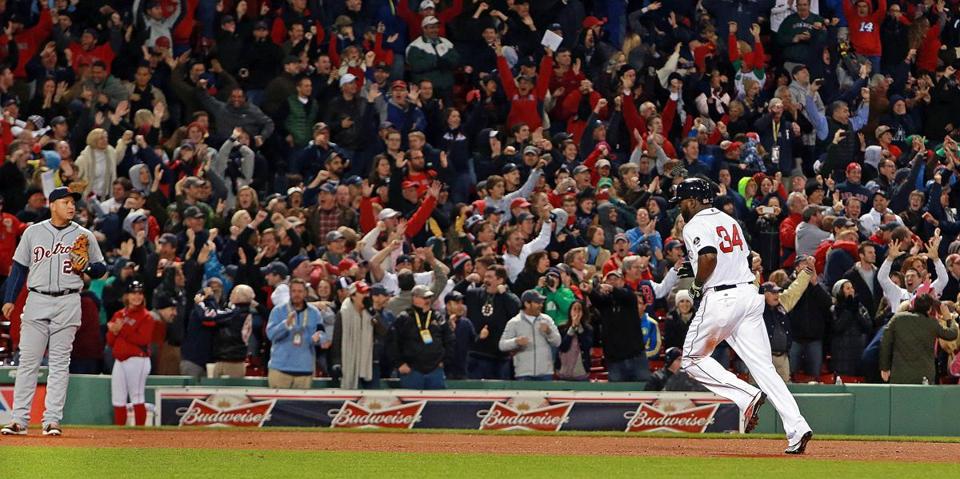
A hero of postseasons past, David Ortiz rounds third base — as the Tigers’ Miguel Cabrera looks on — to a standing ovation after his grand slam in the eighth inning tied Game 2 at 5.

A hero of postseasons past, David Ortiz rounds third base — as the Tigers’ Miguel Cabrera looks on — to a standing ovation after his grand slam in the eighth inning tied Game 2 at 5.

Gotta love David.

There was still a game to win. After Uehara retired the Tigers in order, Gomes was again the catalyst.

He reached on an infield single off Rick Porcello and took second on a throwing error by shortstop Jose Iglesias, the former Sox player known for his defensive skills.

“No is not an option for this team,” Gomes said. “Once I got on second, I was going to do anything I could to score.”

Gomes advanced on a wild pitch and scored when Saltalamacchia singled to left field.

“I felt good,” Saltalamacchia said. “Trying to hit the ball up the middle and take your chance.”

It was the 12th walkoff win of the season for the Red Sox.

So now we have something to watch on the highlight reels other than strike out after strike out.  There is joy in Mudville after all.  The Red Sox head for Detroit to face Justin Verlander, still another one of the Tigers’ great pitchers.  Let’s end this with something to ponder.  My husband heard Verlander ask this question:  If a pitch grazes a Red Sox’s beard, did he get hit by the pitch?

Now if only someone would hit a grand slam on the budget and knock out Ted Cruz and his friends.

Photograph:  Jim Davis/Globe Staff

Red Sox and the postseason

I have to admit that I was a little worried at the beginning of the first game with the Tampa Bay Rays.  I would have preferred to face Cleveland even with all the drama of Terry Francona coming back to Boston to face his old team and his friend, John Farrell.  But with two games in the win column, I’m not quite with Dan Shaughnessy and ask why we need to go to Tampa at all, but I think the Sox are going to be moving on to maybe face the Detroit Tigers.

My husband calls them the Civil War team because they look like the generals.  Even the babies on the team are trying to grow a little facial hair.  I heard someone, I think it was either Tim Wakefield or Dennis Eckersley describe Sox locker room conversation which includes brands of beard shampoo and conditioner.  And, yes, one of them admitted the other day, it does hurt when someone tugs on it.  It is this year’s gimmick and makes no more sense that the silly “Cowboy Up” Sox in 2004, but they are winning.

So Shaughnessy asks

Do we really have to go to Tampa/St. Pete? Can’t we just forgo the formalities and let the Red Sox advance to the American League Championship Series on sheer style, dominance, karma, and duende?

The Duck Dynasty/ZZ Top/Fidel Castro Red Sox look unbeatable at this hour. They bested the fatigued Rays, 7-4, at Fenway Park again on Saturday night and will send 12-1 Clay Buchholz to the mound to finish the series Monday.

The Sox look like the best team in baseball. No team won more regular-season games (97),  and the Sox have played even better in the first two games of the playoffs. They won the opener, 12-2, with every man in the lineup registering at least one hit and one run. It was more of the same Saturday night (eight of nine starters got hits) as the John Farrell All-Stars bolted to a 5-1 lead, then cruised. David Ortiz hit two monstrous home runs. In games started by Matt Moore and David Price, the Sox have 19 runs and 25 hits.

Koji Uehara gets a lift from David Ortiz after the Red Sox closer finished off Tampa Bay with just 11 pitches.  Notice the little smile on John Farrell.

Koji Uehara gets a lift from David Ortiz after the Red Sox closer finished off Tampa Bay with just 11 pitches. Notice the little smile on John Farrell.

The problem is that we Sox fans know all about karma and all the things that could happen.  We all remember Pedro Martinez melt down and poor Bucky Dent.  Thanks why the next sentence is

It’s a little scary. Baseball is not supposed to be this easy. It’s a hard game. It’ll humble you in an instant.

But the Sox are making it look easy. They hit. They don’t make errors. They run the bases well (great takeout slide by Shane Victorino on Saturday night). They have great beards. They have a closer, Koji Uehara, who throws only strikes and can work a 1-2-3 inning while you make a three-minute egg.

There is this little note in today’s Boston Globe

Since 1995, 22 teams have fallen behind two games to none in the ALDS. Only four have come back to win the series. The last team to do it was the Red Sox in 2003 against Oakland. The Sox also did it in 1999 against Cleveland. The Rays fell behind, 2-0, to Texas in the 2010 ALDS and forced a Game 5, but lost . . .

I probably won’t be watching the game tonight since it is First Monday at Jordan Hall and time for some nice chamber music, but unless Clay Bucholz decides to have a meltdown along with the bullpen or the bats go very cold, all of which has happened this year, I expect to find out when I get home that the sox have moved on to the next round.

And while predictions are dangerous:  Sox and Pirates in the Series with the Sox winning in 5.

Photograph:  barry chin/globe staff

Kittie Knox: Bicycle Racer

Never heard of her?  Me either until this morning when the Boston Globe carried a front page story by Dan Adams about the ceremony putting a headstone on her long forgotten grave at Mount Auburn Cemetery in Cambridge.

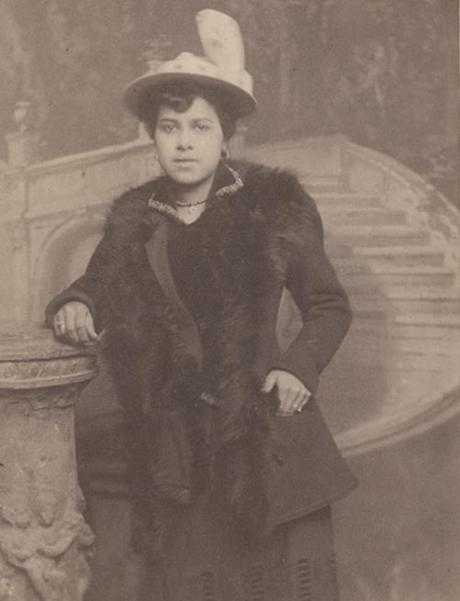
Kittie Knox

Kittie Knox

Knox, a seamstress born in 1874 to a free black father and a white mother, became a prominent and accomplished cyclist by the 1890s in Boston. But her mixed racial heritage raised eyebrows, as did her insistence on riding a man’s bike and wearing pantaloons of her own design instead of the long, heavy skirts prescribed by Hopkins and her ilk.

And if that weren’t enough, she excelled at the sport: Knox completed multiple 100-mile rides and placed 12th out of 50 male and female cyclists in a major national race, “far ahead of her lighter-hued sisters,” one magazine reported.

Knox had seemed doomed to obscurity. But six years ago, author Lorenz Finison stumbled across her name while researching a forthcoming book on Boston’s cycling history. Passing references to Knox in cycling books prompted Finison to search local newspaper archives for more information.

“I found an article saying she won a cycling costume contest in Waltham,” said Finison, a teacher at the Boston University School of Public Health and a cofounder of Cycling Through History, which develops bike routes between African-American heritage sites. “I thought, that’s really amazing. Why, given the racial climate of the time, would she have won a contest out there? I thought I should look into it more.”

Kittie Knox faced not only sexism but also racism.

Finison eventually unearthed a trove of stories about Knox. While many articles were preoccupied with her race and appearance — “a beautiful and buxom black bloomerite” was one reference in Referee Magazine — he learned that Knox had been a member of Boston’s only black cycling group, the Riverside Cycle Club, before joining the Boston-based National League of American Wheelman in 1893.

Knox soon found herself at the epicenter of a fight over whether blacks could join the league, he said. After a Southern faction of league leaders successfully politicked in 1894 to make the group for whites only, Knox’s appearance at the league’s 1895 national meet in Asbury Park, N.J., caused an uproar. Trouble began upon her arrival, when, rather than appease critics, “Miss Knox did a few fancy cuts in front of the clubhouse and was requested to desist,” The New York Times reported.

Then, when Knox went to register for the meet and presented her membership card, the credentials were rejected.

“[Knox’s] entrance today, in the parlor of the Asbury Park wheelmen, caused wild consternation among the ladies gathered there,” wrote a San Francisco paper, according to Finison’s manuscript. “She was politely told that she was in the wrong house. To their utter surprise she produced a league membership card and declared that no exception had ever been taken to her color by wheelmen or wheelwomen. After asserting herself to that extent, Miss Knox walked defiantly out with her wheel.”

Even after members of the Massachusetts delegation intervened to ensure her participation, successfully arguing she had been admitted before the color bar, Finison writes that anger persisted: A group of white women cyclists threatened to quit in protest; dozens walked out of a League dance when Knox partnered with a white man; a Southern paper slammed League leaders for permitting “this murky goddess of Beanville” to ride.

Don’t you love it?  “[M]urky goddess of Beanville”.  A dig at Knox’s race and at Boston.   Good for the Massachusetts delegation for standing up for her.

Much of the Globe’s coverage of early Boston cycling clubs, as cited by Finison, betrays blatantly racist and sexist attitudes common in that era. But one Globe report from  the event in 1895 at Asbury Park trumpeted Knox’s abilities, perhaps to point a finger at Southern papers that had decried her participation.

“The leaders tried to lose Knox during the eighteen mile run but she was game, and when the big crowd entered the town on the return trip she was up with the leaders, sailing with the best of them,” the Globe wrote. “She was not to be consigned to the tribe of ‘also rans,’ and today all the League members are anxious to see her. And when she appears in the street she receives more attention than a half dozen star racing men.”

Kittie Knox died in 1900 at the age of 26, but through Finison’s efforts, her family was found and she was honored on Sunday,

Three generations of Kittie Knox’s relatives attended a ceremony dedicating a new headstone at Mount Auburn Cemetery.

Three generations of Kittie Knox’s relatives attended a ceremony dedicating a new headstone at Mount Auburn Cemetery.

Another remarkable woman has been rediscovered.
Photograph:  Jim Davis/Boston Globe

Red Sox and Yankees: September 2013

Sox fans always worry about a big fold in September.  I’m beginning to breathe a little easier after yesterday afternoon when they had a huge lead, started to give it up, stopped the bleeding and added a run.  The Sox last loss was six games ago and they will, before September is done, lose again.  But probably not often.  Not more than a game here or there.  The losers from last year are now the team to beat.  The only possible rain cloud is the injury to Jacoby Ellsbury which may mean he has already played his last game for the Sox.  As another fan tweeted, “Let the Bradley [Jackie Jr.} era begin.”  But I think the air has gone out of the Sox-Yankees games that remain.  The Sox have a replacement for Ells, but the Yankees can’t really replace Derek Jeter who appears to have re-injured himself after missing most of the season.

The different coverage from the Boston Globe and the New York Times this morning tells the story.  First Tyler Kepner from the Times.

Before this weekend, the Yankees had never lost three games in a row while scoring at least eight runs every time. Now it has happened, against the surging Boston Red Sox in the Bronx, and if that were not sobering enough, Derek Jeter aggravated his fragile left ankle Saturday and departed Yankee Stadium for a hospital.

His CT scan was negative, according to the Yankees, who sent the test results to Jeter’s ankle surgeon in Charlotte, N.C., anyway. There is a reason only one player in Jeter’s lifetime (Omar Vizquel) has played 100 games at shortstop at age 39 or older.

Alex Rodriguez missed Saturday’s game altogether. Rodriguez has helped the lineup during his appeal of his drug suspension, and he had no injury on Saturday, Manager Joe Girardi said. He is simply 38 years old and has played a lot lately. A day game after a night game was too much for Girardi to ask.

So it goes for the Yankees, who have fewer quality starts than the Mets this season and a bullpen ravaged by injuries. Shawn Kelley and Boone Logan are out, and the indispensable David Robertson will miss at least a few more days with shoulder soreness.

The Yankees are old and have no pitching, but they can still insult the Sox.

The Red Sox, quite clearly, made the most of their bailout by the Los Angeles Dodgers last August. They gave short-term contracts to professional, if poorly groomed, hitters in their primes. The newcomers Shane Victorino, Stephen Drew, Jonny Gomes and especially Mike Napoli have taken turns drilling big hits all series, and Xander Bogaerts, the 20-year-old shortstop, clubbed his first career homer on Saturday, a rocket over the bullpen in left.

Bogaerts connected off Jim Miller, who made his Yankees debut in relief of David Huff. Huff had been impressive in relief, but his first Yankees start was a fiasco. It was the first time since 1941 that a Yankee starter allowed at least nine earned runs to the Red Sox in fewer than four innings.

Poorly groomed?  I guess Kepner means they have beards.  And Drew, by the way,  is clean-cut enough to be a Yankee.

Third base coach Brian Butterfield (left) congratulated Xander Bogaerts after the 20-year-old’s first major league home run.

Third base coach Brian Butterfield (left) congratulated Xander Bogaerts after the 20-year-old’s first major league home run.

What is Nick Cafardo saying in the Globe?

If I were Brian Cashman or Joe Girardi, what would bug me the most about Saturday’s 13-9 loss to the Red Sox was seeing Will Middlebrooks, Jackie Bradley Jr., Ryan Lavarnway, and Xander Bogaerts occupying the 6-9 spots in the Boston order and having them go 6 for 17 with four RBIs, a home run, and six runs.

Here we are in the middle of a September pennant race and the Red Sox have four of their guys from the farm system providing that type of production. The Yankees have nothing resembling that, and are in fact a very old team, albeit a team that has lost three straight to Boston and still managed to score 25 runs. Which is why, folks, the Yankees still have a chance to make the playoffs.

I think Xander speaks five languages and thinks he would be teaching school if he couldn’t play baseball.

Bogaerts, who is the youngest player (20 years, 341 days) to homer for the Red Sox since Dwight Evans (who was 20 years, 322 days old on Sept. 20, 1972), claimed, “I wasn’t sharp at all. I was bad in batting practice so I went back to my leg kick. I’ve always had a leg kick so I went back to that. I got some new bats, so I tried them out and it worked good. Give credit to the bat.”

On the barehanded play on Cano, the shortstop said, “I saw Cano hustle down the line so I didn’t know if I had a chance. So that was real good that I got him.”

Plus the kid got his first homer on his mother’s birthday.  I bet he gives her the ball. [The Yankees got it back for him.]

Will the Yankees even make the playoffs?  Kepner thinks they aren’t ready for the fork just yet.

The Yankees are far from finished. The Rays’ slump — they have lost 11 of 14 after Saturday’s loss in Seattle — has kept the race close. But a deep Boston lineup has exposed a thin and weary Yankees pitching staff.

“Our guys are battling,” Cashman said. “They’ve been battling all year. We’re obviously up against a really good team. You can’t afford to make mistakes, or you can’t afford to not be at full strength, or you can’t afford to not be firing on all cylinders, or they’ll take advantage. And they’ve been taking advantage of every extra inch you give.”

To be fair, the Red Sox are not at full strength, either. Their center fielder, Jacoby Ellsbury, is in Colorado for a second opinion on his injured right foot. If further tests reveal a broken bone, the Red Sox would lose a major catalyst at the top of their lineup.

Of course, they have not needed Ellsbury to thump the Yankees the last few days. The Yankees have been too old, too young or too overmatched to hang with the Red Sox, no matter which players they use.

And Cafardo pointed out that Yankees still scored 25 runs in the last three losses which makes them ever dangerous, especially with the Tampa Bay Rays beginning their own collapse.

These are two teams that seem to be headed in opposite directions.  The Sox have their veterans and youngsters, while the Yankees have mostly old guys – and are likely to lose Alex Rodriguez during his suspension next year.

Cafardo writes

The Yankees are going to try to rebuild their team this offseason similar to the way the Red Sox did with strategically placed veteran players. What they can’t do is come up with a Bogaerts, Bradley, or a Middlebrooks, because they don’t have any of those types in their system.

Their young catchers haven’t come around as they had hoped and their young relievers such as Shawn Kelley and Preston Claiborne have hit walls. Brett Marshall pitched well in 4⅓ innings Saturday after starter David Huff allowed nine earned runs in 3⅓ innings. But Boston’s answer to Marshall, Brandon Workman, has been successful in high-leverage situations.

It was doubly good for the Red Sox — they beat up the Yankees for a third straight day and showed them a glimpse of the future, which right now, the Yankees have no answer for.

According to Kepner, the Yankees have used 54 different players this year, most of whom I’ve never heard of and likely won’t again.

Give credit to Girardi for extracting a winning season from these 54, whether or not they reach the playoffs. It has been a noble run, but on days like Saturday, it seems destined to collapse before October.

So my question is this:  Who is the manager of the year?  John Farrell or Joe Girardi?

Photograph:  Bill Kostroun/Associated Press

Talkin’ Biogenesis and A-Rod

As I write this on Monday morning, Baseball Commissioner Bug Selig is expected to announce who is getting suspended for use of performance enhancing drugs.  One has to have some respect for Ryan Braun the 2011 National League MVP who has already started his 50 game suspension without a whimper.  Contrast that to Alex Rodriguez.  There are rumors of a suspension through the end of next season, but I’m not sure why he isn’t being banned for life.  He’s already been caught once.  Can you tell that I don’t much like the man?

George Vecsey has a  great piece in the New York Times today about A-Rod and the entire scandal.  Rodriguez’s father disappeared when he was nine – the excuse for his inability to grow up.

The singular event in the life of Alex Rodriguez is not his imminent suspension, or the career home run record that now will never happen.

The event that makes him so remote, so rudderless, took place when he was 9, when his father disappeared. This is not pop psychology to explain a man who blundered into the airplane propeller of adult reality. This is his own theory.

Back when he was a young major leaguer, Rodriguez would occasionally explain himself in terms of his missing father. His mother was strong and smart, and remains so to this day, but he expressed bewilderment that a father could just take off.

Many commentators have pointed out the we have a President who actually never knew his father.  While some consider President Obama to be aloof, he cannot be accused of not being an adult.  He also has what is from all appearances a terrific marriage and kids who love him and he loves back.  So can A-Rod really use this as an excuse?   Everyone is different and reacts differently to the same situation.  But here you have an intelligent, gifted man who has wasted his life

Now A-Rod is like the Zelig of baseball, showing up in the spotlight on the busy Canadian doctor, Anthony Galea, who helped bulk up American superstars. And now he is unable to bury his tracks leading to the defunct anti-aging clinic Biogenesis in South Florida. He was a five-tool player. Now he is a multitool cheat, rejected, like a badly grafted body part, by the main corpus of the New York Yankees.

I’ve never been a Yankee fan even before I moved to Boston.  They were the team my friends and I love to hate, but even I understand that there are guys who play for the Yankees and then there are Yankees.  (The same could be said about the Red Sox – just think about Carl Crawford.)

He swatted a ball from the glove of a Boston Red Sox pitcher, violating the rule, and he yelled at a Toronto Blue Jays third baseman trying to catch a pop-up, violating the code. You could vaguely sense Yankees heads jerking and eyes rolling, nothing you could prove, as A-Rod walked past.

In February 2009, Rodriguez made one of those ritualistic explanations of his adventures with drugs. Jason Giambi had staved off the posse in 2005, and Andy Pettitte had charmed us with his spiritual confession in 2008. Now A-Rod was supposedly coming clean. His old pal Jeter looked sick as he made the mandatory response to A-Rod’s comments about how common drug use was back in the olden days, a few years past.

“One thing that irritates me is that this was the steroid era,” Jeter said. “I don’t know how many people tested positive, but everybody wasn’t doing it.”

Alex Rodriguez with Derek Jeter in 2004

Alex Rodriguez with Derek Jeter in 2004

Too bad A-Rod had a falling out – of his own making with Jeter who is clearly a grown-up and someone even a Red Sox fan can admire.

By contrast, Derek Jeter has a father, Charles, who was a drug counselor, and a mother, Dorothy, who was an accountant, as well as a sister. The family seems to have sent him a message: Derek, whatever you do, don’t be a jerk. Which he never has been.

Rodriguez and Jeter discovered each other when they were teenagers, and in their early years in the majors offered the spare room on trips to Seattle and New York.

In 1999, the teams milled around in one of those baseball brawls, and Jeter and Rodriguez paired off away from the scrum, smiling and keeping each other occupied. A transient Yankee, Chad Curtis, criticized Jeter for waltzing with the enemy, but Jeter and Rodriguez were showing good sense in not risking their expensive talents.

In March 2001, A-Rod moved to Texas for that infamous contract of $252 million for 10 years. Just as infamous was an interview with Esquire in which Rodriguez blabbered that Jeter was “never your concern” when playing the Yankees, and that Jeter “never had to lead” his team. They patched it up superficially, but they never waltzed after that.

Jealously?

Vecsey ends on this sad note.

During the 2007 World Series, Rodriguez opted out of his contract, making himself available to other teams, but the Yankees re-signed him to a higher infamous contract, the one ticking over the team today. His broken marriage and his escapades are well known. So is his testing of the Yankees’ front office. All that is left now is for Rodriguez to save as much as possible of the approximately $95 million that remains on his contract.

He is heading for the dreaded Sargasso Sea of sports, where banished athletes wait, becalmed, hoping for winds of pardon. Shoeless Joe Jackson, who never ratted on the plot to throw the 1919 World Series, never reached the Hall of Fame. Pete Rose hobbles around on his aging, stumpy body, paying for being a knucklehead when baseball caught him betting on his team’s games, as a manager. Lance Armstrong is downsizing his life in Texas. Many behemoths of the past generation are hoping baseball writers forget why they aren’t voting all those fantastic career statistics into the Hall. And good luck with that.

Alex Rodriguez, just turned 38, is about to fade away. He never had that stern voice in his ear that said, “Alex — don’t!”

I don’t know if he will ever play again and if he does if he can play at his all-star level.  What a waste.

Photograph: Barton Silverman/The New York Times