Myths about the Health Care Law

I will likely be writing a lot about the health care law as the Supreme Court hears the case next week.   Walter Dellinger had a nice piece in today’s Washington Post dissecting five of the myths related to the Affordable Health Care Act or Health Care Reform.  I look at 3 of the myths.

Myth 1:  Everyone is forced to buy health insurance.  Dellinger writes

The law states that, beginning in 2014, individuals must ensure that they and their dependents are covered by health insurance. Taxpayers who do not meet this requirement will have to pay a penalty that the law calls a “shared responsibility payment.” It begins at $95 for the first year and never exceeds 21 / 2 percent of anyone’s annual taxable income.

A great majority of Americans, of course, have health insurance through their employers, Medicare or Medicaid and are already in compliance with this requirement. Given the relatively modest payment required of those who choose not to maintain insurance, no one is being literally forced to buy a product they don’t want.

The challengers argue that the mandate is a binding requirement that makes anyone who goes without insurance a lawbreaker. The government has determined, however, that those who pay the penalty, like those who are exempt from the penalty, are not lawbreakers. As a practical matter, the so-called mandate is just a relatively modest financial incentive to have health insurance.

Myth 3:  If the Supreme Court uphold the Affordable Care Act, Congress could force us to buy anything.

The health-care case is a test of Congress’s power under the Constitution to regulate commerce among the states. One way to defend the law is simply to say that a requirement to purchase insurance or any other product sold in interstate commerce is obviously a regulation of that commerce. President Ronald Reagan’s solicitor general, Charles Fried, and conservative judge Laurence Silberman have adopted this view.

The Obama administration is not relying upon such a sweeping argument, however, and its more limited claim would not justify any law that required Americans to buy products such as cars or broccoli.

Myth 5:  The Law is an extraordinary intrusion into liberty

Liberty is always said to be fatally eroded, it seems, when great advances in social legislation take place. The lawyers who urged the Supreme Court to strike down the Social Security Act of 1935 argued that if Congress could provide a retirement system for everyone 65 and older, it would have the power to set the retirement age at 30 and force the very young to support everyone else.

It was said that if Congress had the authority to create a minimum wage of $5 an hour, it would also be a regulation of commerce to set the minimum at $5,000 an hour. In 1964, critics argued that if Congress could tell restaurant owners not to discriminate on the basis of race, it could tell them what color tablecloths to use. None of these things happened.

Nothing in the health-care law tells doctors what they must say to patients or how those patients are to be treated. It only requires people to either have insurance coverage or pay a modest tax penalty.

I think this last is the argument you hear the most.  Change is always scary and many argue their fears.  One of the big arguments used against the Equal Rights Amendment by opponents was that it would require all bathrooms to be unisex.  In Virginia where I worked for the General Assembly to ratify the amendment, this was pretty potent especially with older women.  I think they envisioned a public rest room where men were lined up in full view using urinals!

How will the Court decide?  Hard to predict but there is one piece of hopeful new.  A moot court at the National Constitutional Center upheld Health Care Reform, 8 to 1.    The judges were:

Chief Judge: Timothy K. Lewis, Of Counsel at Schnader, Harrison, Segal & Lewis and former Judge, United States Court of Appeals for the Third Circuit

D. Michael Fisher, Judge, United States Court of Appeals for the Third Circuit

Thomas C. Goldstein, Partner, Goldstein and Russel, P.C., co-founder and publisher of SCOTUSblog

Kent A. Jordan, Judge, United States Court of Appeals for the Third Circuit

Theodore McKee, Chief Judge, United States Court of Appeals for the Third Circuit

Neil S. Siegel, Professor of Law and Political Science and co-director of the Program in Public Law at Duke University School of Law

Dolores K. Sloviter, Judge, United States Court Appeals for the Third Circuit

Patricia Wald, Judge, United States Court of Appeals for the District of Columbia Circuit

Richard C. Wesley, Judge, United States Court of Appeals for the Second Circuit

You can see video here.


Understanding Health Care Reform

Health Care reform is coming before the Supreme Court soon and in an effort to really understand what it is all about I picked up a copy of Jonathan Gruber‘s book “Health Care Reform

Health Care Reform: What It Is, Why It's Necessary, How It Works

It is a nifty graphic novel which does an excellent job of explaining why we need health care reformm what the reform will do and when, and how is will help reduce the deficit.  This last is the most complicated and I’m not sure I got it all in a single reading.

Gruber uses several characters in differing circumstances to illustrate the law’s impact.  On the whole, very nicely done and highly recommended if you want to understand what the Affordable Health Care Act is all about.  Gruber is an economist who worked first with Mitt Romney on reform in Massachusetts and then with President Obama and his team.

Colbert, Stewart, and Super PACS

If you haven’t seen the Colbert/Stewart Better Tomorrow Tomorrow Super PAC aka The Definitely Not Coordinating with Stephen Colbert Super PAC ad yet, take a look.  Here is the link on the Colbert Report website:  http://www.colbertnation.com/the-colbert-report-videos/405930/january-15-2012/colbert-super-pac-ad—attack-in-b-minor-for-strings?xrs=share_copy

Notice that it is called the Attack in B Minor for Strings and features the voice of John Lithgow.

You may recall that Stephen Colbert handed over his PAC to Jon Stewart in a live ceremony in the presence of a lawyer explaining the rules after Citizens United.  As the New York Times wrote

Mr. Colbert has used his PAC — called either “Americans for a Better Tomorrow Tomorrow” or “The Definitely Not Coordinating With Stephen Colbert Super PAC” — to mock the loopholes in the nation’s campaign finance system. Last week he announced he was handing over control of the PAC to his fellow Comedy Central host Jon Stewart so he could run for “president of the United States of South Carolina” without legal complications. A super PAC is not supposed to coordinate with the campaign it is supporting.

In a statement announcing the ad’s debut on Sunday, Mr. Stewart said, “Mitt Romney claims to be pro-corporations. But would you let him date your daughter’s corporation?”

A few days ago, I wrote about Citizens United and three approaches to overturning the decision.  We can add this as a fourth.

Colbert 2008 Shirt from the last election.


Leslie Savin writes in The Nation about his appearance on This Week with George Stephanopolus.

You know how hard it is to give away your baby?” Colbert bemoaned  on This Weekwith George Stephanopolus on Sunday. “Now imagine if that baby had a lot of money.”

It is clear that Colbert knows how to talk like a candidate, specifically a certain front-runner. “Excuse me, George, I was talking,” he said at one point, and of the PAC ad in question, he claimed, “I have not seen this ad.” Colbert also took umbrage whenever Stephanopoulos referred to his “campaign” for president, explaining that he is not “campaigning” but forming an “exploratory committee.” “I’m a one-man Lewis and Clark.”

Explorer Stephen, of course, wholeheartedly believes that corporations are people, but when Stephanopoulos wouldn’t agree, Colbert went further than Mitt or even Newt would dare: “You won’t weigh in on whether some people are people? That’s seems kind of racist, George.”

As for the ad’s controversial contention, Colbert said, “I don’t know if Mitt Romney is a serial killer. That’s a question he’s going to have to answer.”

Do you think any of the Supremes thinks this is funny?  Will it help them think of a graceful way they can get us out of this mess they have gotten us into?  This is more than Pat Paulson running for President.  This is serious business.

Citizens United and the 2012 election

We thought the Congressional elections in 2010 were heavily influenced by PACs after the Supreme Court Citizens United decision but we actually did not get the full impact.  While the case was decided with various concurrences and dissents in part,  it upheld the right of corporations to have free political speech.  Because, as Mitt Romney can tell you, “corporations are people, too.”  So now we are reaping what the Supreme Court sowed.  Secret money is flowing to Super PAC’s and influencing the Republican primary.  And anyone who says that it is OK because unions have the same rights is mad.  Sheldon Adelson, a casino magnate, just dropped $5 million to shore up a pro-Gingrich PAC.  No union I know could do that.  New York Times published this account on the 9th

But on Friday, the cavalry arrived: a $5 million check from Mr. Adelson to Winning Our Future, a “super PAC” that supports Mr. Gingrich. By Monday morning, the group had reserved more than $3.4 million in advertising time in South Carolina, a huge sum in a state where the airwaves come cheap and the primary is 11 days away. The group is planning to air portions of a movie critical of Mr. Romney’s time at Bain Capital, the private equity firm he helped found.

The last-minute injection underscores how the 2010 landmark Supreme Court ruling on campaign finance has made it possible for a wealthy individual to influence an election. Mr. Adelson’s contribution to the super PAC is 1,000 times the $5,000 he could legally give directly to Mr. Gingrich’s campaign this year.

And Mr. Adelson is not the only one.  Most contributors are hidden.

So what can we do about this?  Martha Coakley, Masschusetts Attorney General  writes in the Huffington Post that we need a Constitutional amendment to make it clear that corporations are not people.

There is a national movement afoot to amend the Constitution to make clear that the First Amendment applies only to people and not corporations. Several proposed amendments have been introduced in Congress, including the so-called “People’s Rights Amendment” introduced by Congressman James P. McGovern with bipartisan support. Further, at least 10 states, including Massachusetts, have introduced resolutions calling on Congress to pass one of these proposed amendments.

I was proud to join with 25 other state Attorneys General during the Citizens case in filing a brief urging the Supreme Court to leave the states’ ability to regulate and restrict corporate political spending intact. And I am proud to be the first state Attorney General to call for passage of a constitutional amendment to reverse the Citizens decision.

But Constitutional amendments take time and the outcome of an effort is never certain.  I remember working for the Equal Rights Amendment which finally failed.  The ideal may be that states should be allowed to make their own regs for their states.  Montana is already headed in that direction with the recent Montana Supreme Court ruling that Citizen’s United does not apply to Montana campaign finance laws.

Last Friday [December 30, 2011], the Montana Supreme Court upheld the constitutionality of a 1912 voter initiative – the Corrupt Practices Act – that prohibits corporations from making contributions to or expenditures on behalf of state political candidates and political parties. In 2010, the Supreme Court ruled that a similar federal prohibition was unconstitutional, prompting a wave of bills and court rulings that erased prohibitions on corporate and union political expenditures around the country.

“For over 100 years, Montana has had an electoral system that preserves the integrity of the political process, encourages full participation and safeguards against corruption,” state Attorney General Steve Bullock said in a statement after the ruling, adding, “the [Montana] Supreme Court’s decision upholds that system and is truly a victory for all Montanans.”

 Montana Supreme Court

Of course it will be appealed.

Besides state by state fights and the long road to a Constitutional amendment, President Obama could issue an Executive Order.  He could direct that any company that gets any federal money has to disclose its political contributions.  Remember that corporations are people.  People who give money have to say they are citizens and who employs them.  It makes sense that corporations have to make some disclosures also.  Steven Rosenfeld writing in AlterNet thinks this is a possibility.

“It’s simple—any company that is paid with taxpayer dollars should be required to disclose political contributions,” said Rep. Anna Eshoo, D-Calif., who has pushed for the White House to issue the order. “With public dollars come public responsibilities, and I hope President Obama will issue his executive order right away.”

The order, if issued, would likely be the only campaign finance initiative to emerge from Washington this year as nothing is expected from Congress. It would take effect after the Federal Acquisition Regulatory Council adopts new disclosure rules. That could come as the 2012 election season moves beyond the primaries and it would offer a new way to see who is behind the newest independent groups spending millions on political attack ads.

Spending on federal contracts was $541 billion in 2010, which was about 4 percent of the gross domestic product, according to the Congressional Research Service, and almost 15 percent of the federal budget. The top 100 contractors are some of America’s biggest firms, and include support services for the military overseas, weapons makers, computer companies, telecommunication firms and other service providers. Companies that could fall under the disclosure order employ about 22 percent of the domestic workforce, CRS said. 

When the possibility of an executive order was last floated, Congressional Republicans and the Chamber of Commerce rose up in arms.  Maybe now that they see the distortion money is causing in the Republican primaries, the Congressional Republicans, at least, will change their tune.  Given the growing awareness of Super PAC’s through the sheer volume of advertising being unleashed in South Carolina, the average citizen may well decide to support measures to mitigated their influence.

And Scalia, too

A few days ago, I posted about Justice Thomas and his conflicts of interest.  Now it seems that Justice Scalia has his own ethical problems.

td110701.gif

Looking around, it appears that ethics are not a huge consideration for a lot of judges and politicians these days.  Massachusetts has two political leaders currently serving time and a third one is likely on the way.  Plus, a former Senate President, William Bulger, has got to be concerned about his reputation as his brother, James, faces trial on 19 counts of murder here as well as others in Florida and Oklahoma.  There have always been hints that William tried to shield James while James was on the run.  William’s son has been implicated in conflict of interest in hiring at the Massachusetts Department of Probation. 

There is a new translation of Aristotle’s Nicomachean Ethics reviewed in this week’s New York Times Book Review.  While I’m not sure I agree with the reviewer, Harry V. Jaffa, that Leo Strauss was the “greatest political philosopher of the 20th century”, a couple of sentences caught my attention.

The existence of politics before political philosophy is what makes political philosophy possible. Politics is inherently controversial because human beings are passionately attached to their opinions by interests that have nothing to do with the truth. But because philosophers — properly so called — have no interest other than the truth, they alone can bring to bear the canon of reason that will transform the conflict of opinion that otherwise dominates the political world.

Unfortunately, what has been called philosophy for more than a century has virtually destroyed any belief in the possibility of objective truth, and with it the possibility of philosophy. Our chaotic politics reflects this chaos of the mind. No enterprise to replace this chaos with the cosmos of reason could be more welcome

Maybe Aristotle should be required summer reading for the Supreme Court, the Massachusetts General Court (Legislature) as well as for the rest of us.  My husband pulled our copy of Aristotle down from the shelf last night.  Neither of us have read it since our freshman year at St. John’s College:  Maybe it is time to read it again.  Maybe Justice Scalia and Justice Thomas need to think about whether the opinions they are writing as influenced by interests “that have nothing to do with the truth.”

Justice Clarence Thomas should resign

I’ve been thinking about this for several days now.  I’ve asked myself if this is just the left/progressive/liberal media piling on someone they have never liked much?  Am I attracted to this story because I never wanted him confirmed in the first place?  (I have my “I believe Anita” button somewhere.)  Is it because he never asks questions?  Because 99% of the time he does what Justice Scalia does?

I don’t think the New York Times is the liberal media.  And, yes, I’d like him to fall as payback for what he did to Anita Hill.  (I can’t be as forgiving as she).  I do believe that having him on the Court is a waste of a seat.  I also know that when Justice Kagan does not recuse herself from voting on the health care reform Fox etc. will be jumping all over her.  Justice Kagan has, however, recused herself from several cases that were already filed and being considered by the Department of Justice as well as her former office, Solicitor General.

What is the Times story about?  It is about preservation of a site in Pin Point, GA where Justice Thomas’ mother once picked crabs and the creation of a museum there.  It is about the owner making connection with Harlen Crow through Justice Thomas.  Crow, you may remember, financed the Swift Boat campaign against Senator John Kerry.

Mr. Crow stepped in to finance the multimillion-dollar purchase and restoration of the cannery, featuring a museum about the culture and history of Pin Point that has become a pet project of Justice Thomas’s.

The project throws a spotlight on an unusual, and ethically sensitive, friendship that appears to be markedly different from those of other justices on the nation’s highest court.

The two men met in the mid-1990s, a few years after Justice Thomas joined the court. Since then, Mr. Crow has done many favors for the justice and his wife, Virginia, helping finance a Savannah library project dedicated to Justice Thomas, presenting him with a Bible that belonged to Frederick Douglass and reportedly providing $500,000 for Ms. Thomas to start a Tea Party-related group. They have also spent time together at gatherings of prominent Republicans and businesspeople at Mr. Crow’s Adirondacks estate and his camp in East Texas.

OK, Justices have to have a life outside of court and they have friends.  But as the Mike McIntire who wrote the story in the Times points out

In several instances, news reports of Mr. Crow’s largess provoked controversy and questions, adding fuel to a rising debate about Supreme Court ethics. But Mr. Crow’s financing of the museum, his largest such act of generosity, previously unreported, raises the sharpest questions yet — both about Justice Thomas’s extrajudicial activities and about the extent to which the justices should remain exempt from the code of conduct for federal judges.

Although the Supreme Court is not bound by the code, justices have said they adhere to it. Legal ethicists differed on whether Justice Thomas’s dealings with Mr. Crow pose a problem under the code. But they agreed that one facet of the relationship was both unusual and important in weighing any ethical implications: Justice Thomas’s role in Mr. Crow’s donation for the museum.

The code says judges “should not personally participate” in raising money for charitable endeavors, out of concern that donors might feel pressured to give or entitled to favorable treatment from the judge. In addition, judges are not even supposed to know who donates to projects honoring them.

What do other Justices, Justices on the other side of the Court’s ideological divide do?

It is not unusual for justices to accept gifts or take part in outside activities, some with political overtones.

Justice Stephen G. Breyer has attended Renaissance Weekend, a retreat for politicians, artists and media personalities that is a favorite of Democrats, including former President Bill Clinton. Justice Ruth Bader Ginsburg participated in a symposium sponsored by the National Organization for Women’s Legal Defense and Education Fund, and a philanthropic foundation once tried to give her a $100,000 achievement award. She instructed that the money be given to charity.

And as I pointed out earlier, Justice Kagan has recused herself from a number of cases.

Justice Thomas and Harlan Crow are friends.  They spend time together.  Crow is helping to finance the museum and Thomas has done more than simply introduce the property owners to him.  According to the Times story he has picked the people to put the exhibit together and has worked on the film that will be shown.  Opposition first came from a group that opposes Thomas politically, but does that make this suspect?

No one is saying that Crow and his money have directly influenced any of Thomas’ votes.  But we can have suspicions.

Mr. Crow has not personally been a party to Supreme Court litigation, but his companies have been involved in federal court cases, including four that went to the appellate level. And he has served on the boards of two conservative organizations involved in filing supporting briefs in cases before the Supreme Court. One of them, the American Enterprise Institute, with Mr. Crow as a trustee, gave Justice Thomas a bust of Lincoln valued at $15,000 and praised his jurisprudence at an awards gala in 2001.

The institute’s Project on Fair Representation later filed briefs in several cases, and in 2006 the project brought a lawsuit challenging federal voting rights laws, a case in which Justice Thomas filed a lone dissent, embracing the project’s arguments. The project director, an institute fellow named Edward Blum, said the institute supported his research but did not finance the brief filings or the Texas suit, which was litigated pro bono by a former clerk of Justice Thomas’s.

“When it came time to file a lawsuit,” he said, “A.E.I. had no role in doing that.”

Plus we all know that the Affordable Health Care Act will be coming to the Court.

Supreme Court ethics have been under increasing scrutiny, largely because of the activities of Justice Thomas and Ms. Thomas, whose group, Liberty Central, opposed President Obama’s health care overhaul — an issue likely to wind up before the court. Mr. Crow’s donation to Liberty Central was reported by Politico.

So what does this all mean?  What can anyone do about it?

The Code of Conduct for judges does not directly apply to the Supreme Court largely because there is not higher court to enforce it.  Justices do say that they follow the Code anyway.  But Thomas does not seem to have reported all the travel paid for by Crow.  Even as a group of law professors and Common Cause call for legislation to extend the Code directly to Supreme Court Justices one has to wonder who would be the enforcer.  If a Justice is already ethically aware there is no problem.   But there will always be a Clarence Thomas who appears not to have a clue.  His friends should tell him it is time for him to leave the Court.


The Supreme Court, Baseball and Elena Kagan

Back in April in one of my last posts, I wrote about the Supreme Court.  Today, nominee Elena Kagan responded to questions about Chief Justice John Roberts’ metaphor that being judges is like being umpires.

According to Political.com

Supreme Court nominee Elena Kagan on Wednesday gently criticized Chief Justice John Roberts’s hotly debated assertion that a Supreme Court justice’s job is “to call balls and strikes” like an umpire, suggesting the description may have misled the public about the work judges do.

 “The metaphor might suggest to some people that law is a kind of robotic enterprise, that there’s a kind of automatic quality to it, that it’s easy, that we just sort of stand there and, you know, we go ball and strike, and everything is clear-cut, and that there is no judgment in the process. And I do think that that’s not right,” Kagan said in response to a question from Sen. Amy Klobuchar (D-Minn.) “It’s especially not right at the Supreme Court level where the hardest cases go and the cases that have been the subject of most dispute go.”

 Kagan went on to imply that Roberts may have downplayed the degree to which judging requires perspective.

 “Judges do, in many of these cases, have to exercise judgment. They’re not easy calls. That doesn’t mean that they’re doing anything other than applying law,” Kagan said. “But we do know that not every case is decided 9-0, and that’s not because anybody’s acting in bad faith. It’s because those legal judgments are ones in which reasonable people can reasonably disagree sometimes. And so in that sense, law — law does require a kind of judgment, a kind of wisdom.”

 Her mild criticism of Roberts was a notable departure for Kagan, who has studiously declined senators’ repeated invitations to discuss her opinions on previous Supreme Court’s decisions or to cast aspersions on the motivations or analytical techniques of the justices.

The hearings have turned into a discussion about what an activist judge looks like.  Is it Justice Thurgood Marshall as some Republicans tried to say an activist judge?  And if he is Elana Kagan will be the same because she clerked for him and will somehow channel him.

Supreme Court nominee Elena Kagan has come under an unusual line of attack from Republicans on the Senate Judiciary Committee. The Senators are going after Kagan’s 1988 clerkship for former Supreme Court Justice Thurgood Marshall, the first-ever African American justice, who retired in 1991 after helping to bring the court through some of the biggest civil-rights cases in its history. Some Republicans are taking this as an opportunity not only to put Marshall on trial but also make Kagan the chief witness. Here’s what’s happening, why, and what it means.

  • Going After Thurgood Marshall The Washington Post’s Dana Milbank reports, “‘Justice Marshall’s judicial philosophy,’ said Sen. Jon Kyl (Ariz.), the No. 2 Republican in the Senate, ‘is not what I would consider to be mainstream.’ Kyl — the lone member of the panel in shirtsleeves for the big event — was ready for a scrap. Marshall ‘might be the epitome of a results-oriented judge,’ he said. Sen. Jeff Sessions (Ala.), the ranking Republican on the panel, branded Marshall a ‘well-known activist.’ Sen. Chuck Grassley (R-Iowa) said Marshall’s legal view ‘does not comport with the proper role of a judge or judicial method.’ Sen. John Cornyn (R-Tex.) pronounced Marshall ‘a judicial activist’ with a ‘judicial philosophy that concerns me.'”
  • Making Everything About Marshall Talking Points Memo’s Christina Bellantoni reports, “Ranking member Sen. Jeff Sessions (R-AL) criticized Kagan for having ‘associated herself with well-known activist judges who have used their power to redefine the meaning of our constitution and have the result of advancing that judge’s preferred social policies,’ citing Marshall as his son, Thurgood Marshall Jr., sat in the audience of the Judiciary Committee hearings. In an example of how much the GOP focused on Marshall, his name came up 35 times.”

Of course, I think, along with Senators Al Franken,  Patrick Leahy and many others that actually the Roberts’ Court is the activist court.

When Judiciary Committee Chairman Patrick Leahy called on Franken, Minnesota’s junior Senator got right to his criticism that the current Supreme Court has been favoring powerful corporate interests over the rights of individuals.

Franken talked about how he believes that mandatory arbitration clauses strip Americans of the right to have grievances heard in a neutral court.

“Do you still agree … that one of the glorious things about courts is that they provide a level playing field in all circumstances?” he asked Kagan.

She replied that she agreed “very strongly” with Franken.

Democrats have accused the court — led by Chief Justice John Roberts — of overstepping its role by establishing policy rather than interpreting the law. Franken has been outspoken on the issue. In his time with Kagan, Franken was sharply critical of Chief Justice Roberts.

He accused Roberts and other justices of judicial activism that contradicted their own stated tenets. Franken cited the campaign finance case “Citizens United” as an example of the Robert’s court going beyond specific questions before it.

The landmark ruling this year determined that corporate funding of political broadcasts cannot be limited. It stemmed from a case of a non-profit corporation airing a film critical of Hillary Clinton.

The New York Times reported

Indeed, Ms. Kagan was unusually expansive when talking about matters in which she is already on record. She volunteered that she is not morally opposed to the death penalty, a position she took when she was confirmed as solicitor general. And she spoke freely about this year’s ruling in Citizens United v. Federal Election Commission, in which the conservative bloc on the court ruled against her, striking down legal limits on corporate spending to influence elections.

Democrats have portrayed that ruling as “conservative judicial activism.” Ms. Kagan — who as solicitor general argued in defense of the campaign finance rules — said she convinced herself in preparing that “we had extremely strong arguments.”

Ms. Kagan also displayed a bit of her law professor side, talking more extensively about abstract issues like how constitutional law develops over time. In a mild challenge to the conservative view that the Constitution can be interpreted based only on the original meaning of its text, she said there were also instances in which the Supreme Court had applied a principle embedded in the Constitution in a new way.

She cited the 1954 case of Brown v. Board of Education, which struck down segregation in schools. The case relied upon the 14th Amendment’s guarantee of equal protection of the laws, yet Ms. Kagan noted that the amendment’s drafters thought it “perfectly consistent with segregated schools.”

Justice Thurgood Marshall, who as a lawyer argued the Brown case, has emerged as a dominant figure in the hearings. Ms. Kagan clerked for him, and Republicans, led by Senator Jon Kyl of Arizona, have attacked Justice Marshall as a liberal “activist” and expressed concerns about Ms. Kagan’s association with him.

On Tuesday, Ms. Kagan told Mr. Kyl that she was not her former boss. “I love Justice Marshall,” she said. “He did an enormous amount for me, but if you confirm me to this position, you’ll get Justice Kagan, you won’t get Justice Marshall. And that’s an important thing.”

I think that Elena Kagan is doing her best to criticize the Republicans and the current conservatives on the Supreme Court as she can without antagonizing her future colleagues.  She isn’t a “progressive activist” (whatever that is), but I think she is smart enough and diplomatic enough to get Justice Kennedy’s vote and maybe even Justice Alito’s vote.


Thinking about the Supreme Court

I’m not going to speculate (at least in this post) on who President Obama will nominate in a few weeks, but I am going to talk about  two pieces discussing the Court itself and how decisions are made. The first by Geoffrey R. Stone in the New York Times, the second posted by William Forbath  this weekend on Politico’s Arena in response to Stone.
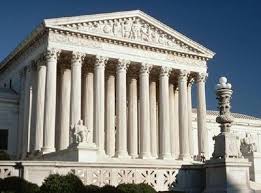
Stone begins

AS the Senate awaits the nomination of a new Supreme Court justice, a frank discussion is needed on the proper role of judges in our constitutional system. For 30 years, conservative commentators have persuaded the public that conservative judges apply the law, whereas liberal judges make up the law. According to Chief Justice John Roberts, his job is just to “call balls and strikes.” According to Justice Antonin Scalia, conservative jurists merely carry out the “original meaning” of the framers. These are appealing but wholly disingenuous descriptions of what judges — liberal or conservative — actually do.

As both Stone and Forbath remind us, the Constitution is an 18th Century document.  I believe that the vague yet sweeping language is why the Constitution is still a living and useful document.  The question addressed by Stone and Forbath is how one interprets it to meet the modern age. Neither thinks much of the way the current conservative majority uses the constitution.

Stone

Rulings by conservative justices in the past decade make it perfectly clear that they do not “apply the law” in a neutral and detached manner. Consider, for example, their decisions holding that corporations have the same right of free speech as individuals, that commercial advertising receives robust protection under the First Amendment, that the Second Amendment prohibits the regulation of guns, that affirmative action is unconstitutional, that the equal protection clause mandated the election of George W. Bush and that the Boy Scouts have a First Amendment right to exclude gay scoutmasters.

Whatever one thinks of these decisions, it should be apparent that conservative judges do not disinterestedly call balls and strikes. Rather, fueled by their own political and ideological convictions, they make value judgments, often in an aggressively activist manner that goes well beyond anything the framers themselves envisioned. There is nothing simple, neutral, objective or restrained about such decisions. For too long, conservatives have set the terms of the debate about judges, and they have done so in a highly misleading way. Americans should see conservative constitutional jurisprudence for what it really is. And liberals must stand up for their vision of the judiciary.

Forbath

… Conservative judges use history to claim that when they strike down a law, they are merely applying the “original understanding” or “intentions” of the framers of the Constitution. This is bunk. But it is reassuring. It enables conservatives on and off the Court to claim that what liberal judges do is something different and illegitimate. Liberals are “judicial activists.” When liberal judges strike down a law, they are “making up” new law. They are “betraying” the Founding Fathers. This is also bunk. Conservative and liberal judges alike bring their own present-day values and convictions to bear on interpreting and applying the Constitution. Conservatives are wrong to deny it. But they are right that appealing to history and “keeping faith with the past” is an indispensable part of our constitutional tradition – and one that helps mobilize popular support behind the constitutional commitments a judge, lawmaker, or citizen may prize. So, liberals need to get a better handle on the way to use history.

So what should the role of history be?  And how can liberal justices use it more to their advantage?  Stone points out that

So, how should judges interpret the Constitution? To answer that question, we need to consider why we give courts the power of judicial review — the power to hold laws unconstitutional — in the first place. Although the framers thought democracy to be the best system of government, they recognized that it was imperfect. One flaw that troubled them was the risk that prejudice or intolerance on the part of the majority might threaten the liberties of a minority. As James Madison observed, in a democratic society “the real power lies in the majority of the community, and the invasion of private rights is chiefly to be apprehended … from acts in which the government is the mere instrument of the major number of the constituents.” It was therefore essential, Madison concluded, for judges, whose life tenure insulates them from the demands of the majority, to serve as the guardians of our liberties and as “an impenetrable bulwark” against every encroachment upon our most cherished freedoms.

Conservative judges often stand this idea on its head. As the list of rulings above shows, they tend to exercise the power of judicial review to invalidate laws that disadvantage corporations, business interests, the wealthy and other powerful interests in society. They employ judicial review to protect the powerful rather than the powerless.

Liberal judges, on the other hand, have tended to exercise the power of judicial review to invalidate laws that disadvantage racial and religious minorities, political dissenters, people accused of crimes and others who are unlikely to have their interests fully and fairly considered by the majority. Liberal judges have ended racial segregation, recognized the principle of “one person, one vote,” prohibited censorship of the Pentagon Papers and upheld the right to due process, even at Guantanamo Bay. This approach to judicial review fits much more naturally with the concerns and intentions of people like Madison who forged the American constitutional system.

Where Forbath disagrees is with Stone’s reliance on James Madison and original intent.  He points out

So, judges today must attend to the text the framers gave us, the general principles it enshrines, the Amendments Americans have added, and the meaning and range of applications generations of judges, lawmakers and citizens have poured into them. And judges must consult their own conscience and experience as they sift through these materials that history provides and decide how best to keep faith with the past.

As long as they hew to this honest approach to history, liberals often draw compelling lessons from it. But lately, liberals are being drawn into the fictions and falsities of the “framers’ intentions” in order to sound just as “true” to the Founding Fathers as our conservative foes. When we liberals play the “framers’ intentions” game, however, we end up sounding silly and disingenuous.

Take for example constitutional scholar Geoffrey Stone’s important op-ed piece in last Wednesday’s New York Times. Looking ahead to President Obama’s soon-to-be-announced nomination of a new Supreme Court Justice, Stone urges “a frank discussion .on the proper role of judges in our constitutional system.” He laments that for thirty years or so, conservatives have dominated the national conversation about the Constitution and the Court, and he rightly points out that they have done so “in a highly misleading way” by claiming that conservative judges just “apply” the Constitution by enforcing the “framers’ intentions.” Stone goes on to contrast the kinds of laws that liberal judges strike down – laws that burden racial minorities, the poor and the powerless, with laws that conservative judges strike down – laws that “disadvantage corporations, business interests, the wealthy and other powerful interests in society.” And he suggests that liberal judges surely have a wiser vision of the role of judges in a constitutional democracy, since they wield the power of judicial review to safeguard people most at risk of being shortchanged in the ordinary political process, while the conservative judges conjure up new safeguards for those who already enjoy ample sway in the political arena.

So far so good. But along the way, Stone proves unable to resist the siren song of “framers’ intentions.” He tries to turn the table on the conservatives. He goes to some lengths trying to cloak liberal constitutional values and commitments in the mantle of James Madison’s “intentions.” Stone has dressed up James Madison as a Great Society liberal. Says Stone, the “intentions of people like Madison who forged the American constitutional system” was to safeguard minorities like African-Americans, undocumented immigrants and the Guantanamo detainees against the tyranny of the majority. That is what liberal judges do. Conservatives, Stone declares, stand Madison’s “idea on its head.” They wield judicial review to overturn affirmative action, gun control, and restrictions on corporate speech; they “tend to exercise. judicial review to invalidate laws that disadvantage corporations, business interests, the wealthy and other powerful interests in society.”

Stone’s James Madison is bunk too. The real James Madison was largely hostile to any kind of judicial review. More important: while Madison did craft the Constitution to safeguard minority rights against the tyranny of the majority, and while Madison, the wealthy slaveholder, was concerned about protecting religious minorities, he had no concern for the rights of “racial minorities,” and it was mainly the rights of the wealthy over against the majority of Americans of modest means that Madison hoped to protect! Thus, the conservatives on today’s Court have about as good a claim to Madison’s mantle as we liberals do.

I think Forbath is right about history and original intent.  As long as we argue about which view of original intent is correct, liberals will never prevail.  We need to move on to take into about all the history since 1787.  Forbath writes

History is on our side; but that has much less to do with James Madison and much more to do with the bloodshed of the Civil War and the Civil War and Reconstruction Amendments that made the Constitution a charter of equal rights for all Americans, including the former slaves. It was the Republicans of the Reconstruction Era, the New Dealers, the Civil Rights Movement, and the twentieth-century Court who gradually enlarged Madison’s original conception of minority rights and majority tyranny to make it a safeguard for the poor and vulnerable.

We do need “a frank discussion” on the Constitution and the proper role of judges, and we can’t be half-frank about it. There are good arguments why the liberals’ account is better. Stone offers a few. But wrapping ourselves in the mantle of the 18th century framers’ intentions as he tries to do is not one. Our constitutional commitments have emerged over two centuries of tumultuous change. The arc of constitutional history generally has bent toward a more inclusive and generous vision of rights-bearing membership in We, the People. Conservatives are bending it back. The 18th century framers might have agreed with them; but the Civil War, the Reconstruction Amendments, and much else have intervened in the mean time; and, in any case, the choice – about how to keep faith with our constitutional past – is ours.

We need a Supreme Court with Justices that are willing to grow, to learn and to change with the times.  President Obama could do worse that nominate someone in the Earl Warren or Justice Powell or Justice Brennan mold.  Those were men who learned to consider cases on their merits, who understood the need to connect decisions to real ordinary people.  They were men with empathy.

What Affirmative Action Means in Real Life

Sonia Sotomayor is now officially Justice Sotomayor.  She took the oath administered by Chief Justice John Robert a few minutes ago.

On Thursday afternoon when the Senate voted to confirm her, the newest Senator, Al Franken the former comedian from Minnesota, was presiding and announced the vote.  Is this a great country or what?

Anita Hill has a very interesting Op-Ed in today’s Boston Globe discussing the role of what she calls “educational democracy” played in Justice Sotomayor’s elevation to the Supreme Court.

A LATINA from a Bronx housing project is probably not what Woodrow Wilson envisioned when he called for “educational democracy’’ as president of Princeton University in 1910. Yet decades later, when Sonia Sotomayor ascended to the top of her class, his idea of an open and accessible university system was on its way to coming to fruition. In Wilson’s day, Princeton admitted no women and Wilson himself is said to have looked with disfavor on the admission of men of color. Nevertheless, educational reform was a springboard for his larger aims of social and political reform and his fight against “the rule of materialism in our national life.’’

Indeed, Wilson would have needed a high-definition crystal ball to foresee Sotomayor’s “incredible journey’’ to become an African-American president’s nominee to the Supreme Court. Yet, as a critical chapter in our country’s pursuit of educational equality, her story of hard work and high achievement is an extension of Wilson’s idea. She represents the positive change that can occur when social institutions – law and education in particular – shed their roles as tools for exclusion and open their doors to those previously barred. It took nearly 220 years for the first Latina justice to be appointed to the Supreme Court, but, in a country constitutionally committed to equal opportunity, it was inevitable.

It was under President Wilson that women gained the right to vote – a reward for suspending demonstrations for suffrage during World War I.  And I’ve always thought that Edith Wilson had influence here also even though I don’t believe that any historical facts have ever surfaced to proved this.

Hill goes on

Sotomayor is poised to prove that the social experiment of the 1970s built on the idea of educational democracy has, thus far, worked. For its full realization, President Obama must correct the documented shortcomings of public schools that weigh most heavily on poor and minority community schools. We can’t be satisfied with one Sonia Sotomayor when we have the potential for so many more. For now, with her confirmation as the first Latina and third woman on the Supreme Court, Obama has reminded us of what egalitarian ideals and the will to pursue them can accomplish.

I think Hill is right.  Educational democracy leads to a critical mass of women, African Americans, or other ethnic minorities ready to take on jobs and challenges that have not been open to them in the past.  This leads to a cascade of changes in our society such as the election of the first African American President. 

I think it is the loss of this exclusivity that has the white Republican men on the Senate Judiciary Committee so frightened.  Perhaps they have seen all along where affirmative action or educational democracy was going to lead and why they have been so opposed to change.  But that is probably giving them too much credit and they are just frightened of change that puts them in a position where they are no longer superior.  One where they have to share power and priviledge.

Congratuations, Justice Sotomayor!  And may the President’s next appointment be someone as wise as you.  Perhaps a wise Asian American man or woman or a wise African American woman.  Mary Frances Berry, anyone?

Lessons from the Sotomayor Hearings

Over the weekend two very interesting pieces appeared.  One was Frank Rich’s column  in the New York Times, the other Melissa Harris Lacewell in the Nation.  Both approach the subject of Senatorial attitude toward a Latina woman.  One writer is a middle aged white male and former New York Times theater critic, the other a young, African American professor at Princeton. 

Here is Rich

Yet the Sotomayor show was still rich in historical significance. Someday we may regard it as we do those final, frozen tableaus of Pompeii. It offered a vivid snapshot of what Washington looked like when clueless ancien-régime conservatives were feebly clinging to their last levers of power, blissfully oblivious to the new America that was crashing down on their heads and reducing their antics to a sideshow as ridiculous as it was obsolescent.

The hearings were pure “Alice in Wonderland.” Reality was turned upside down. Southern senators who relate every question to race, ethnicity and gender just assumed that their unreconstructed obsessions are America’s and that the country would find them riveting. Instead the country yawned. The Sotomayor questioners also assumed a Hispanic woman, simply for being a Hispanic woman, could be portrayed as The Other and patronized like a greenhorn unfamiliar with How We Do Things Around Here. The senators seemed to have no idea they were describing themselves when they tried to caricature Sotomayor as an overemotional, biased ideologue.

And here Harris-Lacewell

The hearing was a performance of a broader set of social rules that govern race and gender interactions in American politics. Women, and most especially black and brown women, have to prove their fitness for public life by demonstrating the ability to endure harsh brutality without openly fighting back. The ability to bear up under public degradation is a test of worth. America’s favorite black woman heroine is Rosa Parks, a woman who is remembered as silently enduring the humiliation of being ejected from a public bus for refusing to comply with segregated seating.

Sotomayor passed the test. She met the Senators’ questioning with thoughtful responses. Her voice did not quiver. Her face did not scowl. Many women of all races feel inspired by her. But I wonder about this lesson that continues to teach women that we can only have space in the public realm as long as we control all emotion.

They are both describing what Harris-Lacewell calls “the politics of public humiliation.”  The practice of this kind of politics in the year 2009 says more about the Republicans than about Sotomayor – or the current status of women of color.

Rich ties the Republicans to the Class of  1994, the Class of the Contract with America, the Newt Gingrich class.

That the class of ’94 failed on almost every count is a matter of history, no matter how hard it has retroactively tried to blame its disastrous record on George W. Bush. Its incompetence may even have been greater than its world-class hypocrisy. Its only memorable achievements were to shut down the government in a fit of pique and to impeach Bill Clinton in a tsunami of moral outrage.

…Today the G.O.P.’s token black is its party chairman, Michael Steele, who last week unveiled his latest strategy for recruiting minority voters. “My plan is to say, ‘Y’all come!’ ” he explained, adding “I got the fried chicken and potato salad!”Among Sotomayor’s questioners, both Coburn and Lindsey Graham are class of ’94. They — along with Jeff Sessions, a former Alabama attorney general best known for his unsuccessful prosecutions of civil rights activists — set the Republicans’ tone last week. In one of his many cringe-inducing moments, Graham suggested to Sotomayor that she had “a temperament problem” and advised that “maybe these hearings are a time for self-reflection.” That’s the crux of the ’94 spirit, even more than its constant, whiny refrain of white victimization: Hold others to a standard that you would not think of enforcing on yourself or your peers. Self-reflection may be mandatory for Sotomayor, but it certainly isn’t for Graham.

Harris-Lacewell puts it this way

All Supreme Court nominees endure tough, ideologically driven questioning. It’s as true for white male conservative justices as for Sotomayor. But this public display took on different meaning as white men repeatedly asserted that Sotomayor was capable of making legal judgments based only on her personal experience and ethnic identity.

I was proud of Sotomayor’s restraint, but I also wanted her to counter attack, to punch back, to show anger. She couldn’t do so in part because she is bound by the rules of judicial decorum. She also couldn’t do so because of the racialized, gender rules of political engagement that allow white men, from senators to firemen, to express outrage, indignation, and emotion, but disallow those same expressions from women of color.

So what have we learned?  We have learned that maybe Lacewell-Harris is right when she compares Sonia Sotomayor to Little Rock Nine student, Elizabeth Eckford.

One of the most enduring images of the Civil Rights Movement is of Elizabeth Eckford. She is being harassed and taunted by a group of white students, parents, and police on her way to desegregate Central High School in Little Rock, Arkansas. On that morning Eckford missed connecting with the eight other African American students of the Little Rock Nine and their NAACP leader, Daisy Bates. Eckford was alone when the angry crowd surrounded and confronted her

Only now the mob is the composed of white, mostly southern, Republican Senators.

We have learned that women, regardless of race, regardless of how successful they may be,  still have to behave differently than men, that there is still a double standard.

We have learned, again, that the Republican Party is mostly clueless when it comes to race.  And I believe that their fear and dislike of Barack Obama will drive most of their behavior over the next eight years.