Leaks, national security and the press

Every administration on every level of government worries about leaks.  Mayors worry about information on a big new construction project or policy initiative getting out too soon.  Presidents worry about national security.  Members of legislatures worry about a stand on an issue leaking before it can be “properly framed.”  Actually all politicians worry about that.  Look at VP Biden “leaking” his position on gay marriage.  I’ve been suspected of being a leaker because I knew reporters – and I’ve helped look for leaks.   I also believe in a free press, but as with any freedom, limits are needed.  The question is where that line should be.

Do you understand what the AP scandal is all about?  I have to admit that until I read this piece by Jack Shafer of Reuters, I really didn’t.  I don’t think the press did a good job of trying to explain their own story.  Did you know that the leak had to do with the underwear bomber?  I didn’t.  Never heard or saw that and I follow the news pretty closely.

Shafer writes

Journalists gasp and growl whenever prosecutors issue lawful subpoenas ordering them to divulge their confidential sources or to turn over potential evidence, such as notes, video outtakes or other records. It’s an attack on the First Amendment, It’s an attack on the First Amendment, It’s an attack on the First Amendment, journalists and their lawyers chant. Those chants were heard this week, as it was revealed that Department of Justice prosecutors had seized two months’ worth of records from 20 office, home and cell phone lines used by Associated Press journalists in their investigation into the Yemen underwear-bomber leaks.

First Amendment radicals — I count myself among them — resist any and all such intrusions: You can’t very well have a free press if every unpublished act of journalism can be co-opted by cops, prosecutors and defense attorneys. First Amendment attorney Floyd Abrams speaks for most journalists when he denounces the “breathtaking scope” of the AP subpoenas. But the press’s reflexive protests can prevent it from seeing the story in full, which I think is the case in the current leaks investigation.

,,,

The Obama administration has already used the Espionage Act to prosecute more government officials for leaking than all of his predecessors put together, but we shouldn’t automatically lump its pursuit of the underwear-bomb leaker in with those cases. Perhaps this investigation is chasing an extra-extraordinary leak, and the underwear-bomber leak is but one of the drops.

I have to point out here that the Republicans in Congress have pushed the administration to find leakers and, I fear, have caused the Democrats and President Obama to catch their paranoia.
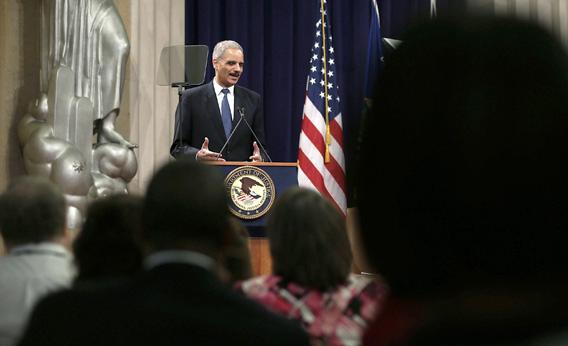
Attorney General Eric Holder has overseen more leak investigations under Obama than were pursued under Bush

Attorney General Eric Holder has overseen more leak investigations under Obama than were pursued under Bush

Shafer continues

The AP story that has so infuriated the government described the breakup of an al Qaeda in the Arabian Peninsula plot to place an underwear bomber on board a U.S.-bound airliner. Published on the afternoon of May 7, 2012, the story patted itself on the back for having heeded the White House and CIA requests to not publish the previous week, when the AP first learned of the operation. The AP states in the article that it published only after being told by “officials” that the original “concerns were allayed.” In a chronology published in today’s Washington Post, we’re told that the CIA was no longer resisting publication of the AP story on the day it hit the wire (Monday) and that the White House was planning to “announce the successful counterterrorism operation that Tuesday.”

That may be the case, but the government was still incensed by the leak. In fact, it appears that officials were livid. As my Reuters colleagues Mark Hosenball and Tabassum Zakaria reported last night, the government found the leak so threatening that it opened a leak investigation before the AP ran its story.

Now, what would make the Obama administration so furious? My guess is it wasn’t the substance of the AP story that has exasperated the government but that the AP found a source or sources that spilled information about an ongoing intelligence operation and that even grander leaks might surge into the press corps’ rain barrels.

At the risk of making the Department of Justice’s argument for it, a leak once sprung can turn into a gusher as the original leakers keep talking and new ones join them, or as the government attempts to explain itself, or as others in the government begin to speak out of turn. From what I can tell, all of the above happened after the AP story appeared.

So there you have it.  It was not the particular leak, but the fact that there was a leaker that could potentially leak again.  As Shafer points out when there is a leak there is also the problem of government officials saying too much and, in effect becoming leakers.  What happened here was the existence of a double agent got out, mostly because of what government officials said in trying to explain the original AP story.   Shafer summarizes the trail and concludes

To begin with, the perpetrators of a successful double-agent operation against al Qaeda in the Arabian Peninsula would not want to brag about their coup for years. Presumably, al Qaeda in the Arabian Peninsula will now use the press reports to walk the dog back to determine whose misplaced trust allowed the agent to penetrate it. That will make the next operation more difficult. Other intelligence operations — and we can assume they are up and running — may also become compromised as the press reports give al Qaeda in the Arabian Peninsula new clues.

Likewise, the next time the CIA or foreign intelligence agency tries to recruit a double agent, the candidate will judge his handlers wretched secret keepers, regard the assignment a death mission and seek employment elsewhere.

Last, the leaks of information — including those from the lips of Brennan, Clarke and King — signal to potential allies that America can’t be trusted with secrets. “Leaks related to national security can put people at risk,” as Obama put it today in a news conference.

The ultimate audience for the leaks investigation may not be domestic but foreign. Obviously, the government wants to root out the secretspillers. But a country can’t expect foreign intelligence agencies to cooperate if it blows cover of such an operation. I’d wager that the investigations have only begun.

None of this means we should go rooting around people’s cell phone and email records without some protection.  In his reaction to the scandal, President Obama called for Congress to enact an updated media shield law which would replace the Justice Department’s internal regulations (which I think they actually didn’t follow).  Wouldn’t it be interesting for Congress to take some proactive steps instead of just investigating?

Photograph: Alex Wong/Getty Images

Taxes, taxes, taxes

Who was it that said, “Nothing is certain but death and taxes”?  They should have added tax loopholes and exemptions to that list.

Here in Massachusetts we have a Senate candidate who took at $281,000 tax credit for agreeing not to made changes to the facade of his home located in a historic district.  I don’t know how this works in other states but here local city and town councils can pass by-laws regulating historic districts.  Cohasset, the town where Gabriel Gomez lives, has a by-law on the books that says owners of homes in the historic district may not change the facades of their homes.  So Mr. Gomez basically took a tax credit for something he was prohibited from doing anyway.  Adrian Walker wrote this in the Globe this morning.

Challenged to explain, a testy Gomez set a new standard for chutzpah. He claimed that his tax break is really the fault of his opponent, Ed Markey — because in 1981, Markey voted for the law that established tax breaks for historical preservation.

OK.  So maybe taking the tax break was not illegal, but there is something about it that makes me – and it appears – other voters wonder if this is the guy we want representing us.  Plus there is the fact that most of us don’t make $281K over many years much less get to take that much off our taxes.

Walker continues

Andy Hiller of WHDH-TV cornered Gomez and asked a few questions about it, or tried to. What he got back from Gomez was this: “I don’t apologize for any success I’ve had. Absolutely not. I’m proud of everything I’ve done. I’ve worked for everything I’ve done. I’ve earned everything I’ve done.”

Gomez is an accomplished military veteran who has earned many things in his life, but he certainly didn’t earn this. Even the Internal Revenue Service has decried the historical-preservation deduction he took as a farce.

The questions about Gomez’s taxes probably haven’t ended, either.

On a financial disclosure form filed in March, Gomez said that under his separation agreement from the private equity firm Advent International, he received something called “carried interests.”

Carried interests are fees paid to equity firms and hedge funds to manage portfolios. They are taxed as capital gains, at a rate of 20 percent, rather than the top income rate of 39.5 percent.

Carried interests are fees paid to equity firms and hedge funds to manage portfolios. They are taxed as capital gains, at a rate of 20 percent, rather than the top income rate of 39.5 percent.

The carried interest rate — which costs taxpayers an estimated $1.3 billion a year — has long been the subject of dispute, with some critics arguing that this is one of the first tax loopholes lawmakers should close.

How much of Gomez’s income falls under the “carried interest” loophole is unclear from the disclosure form.

Gabriel Gomez is running as a reformer, as an outsider but as Walker points out, he already knows all the tricks.  Maybe we need someone like him to help reform the tax code – not!

Internal Revenue Service Building

Internal Revenue Service Building

Taxes are also at the heart of what the Republicans hope will be the scandal that brings down the Obama Administration if Benghazi doesn’t work out for them.  According to the New York Times this is what we know.

The Internal Revenue Service’s special scrutiny of small-government groups applying for tax-exempt status went beyond keyword hunts for organizations with “Tea Party” or “Patriot” in their names, to a more overtly ideological search for applicants seeking to “make America a better place to live” or “criticize how the country is being run,” according to part of a draft audit by the inspector general that has been given to Capitol Hill.

The head of the division on tax-exempt organizations, Lois Lerner, was briefed on the effort in June 2011, seemingly contradicting her assertion on Friday that she learned of the effort from news reports. But the audit shows that she seemed to work hard to rein in the focus on conservatives and change it to a look at any political advocacy group of any stripe.

Since last year’s elections, Republicans in Congress have struggled for traction on their legislative efforts, torn between conservatives who drove the agenda after their 2010 landslide and new voices counseling a shift in course to reflect President Obama’s re-election and the loss of Republican seats in the House and the Senate.

But the accusations of I.R.S. abuse are sure to fuel an effort that appears to be uniting dispirited Republicans and their conservative political base: investigating Mr. Obama and his administration. Republicans are pushing a portrayal of an administration overreaching its authority and punishing its enemies.

“The bottom line is they used keywords to go after conservatives,” Representative Darrell Issa of California, the chairman of the House Oversight and Government Reform Committee, said Sunday on the NBC News program “Meet the Press.” He requested the inspector general’s audit along with another Republican, Representative Jim Jordan of Ohio. As an audit, it will not find blame or refer anyone for criminal prosecution.

This all goes back to the Citizens United decision by the Supreme Count and the flood of organization, most it seems on the right to register as 501(c)4 social welfare groups.  This leaves me puzzled.  How can a group which supports political lobbying be tax exempt?  I give money to Planned Parenthood to support clinics.  I also give money for the political operations.  The first is tax exempt, the second is not.  So maybe the problem is, once again, with the tax code.  Ezra Klein explains.

Let’s try to keep two things in mind simultaneously: The IRS does need some kind of test that helps them weed out political organizations attempting to register as tax-exempt 501(c)4 social welfare groups. But that test has to be studiously, unquestionably neutral.

The story thus far seems both chilling and cheering. Employees at the agency’s Cincinnati branch did employ a test that, in effect, targeted tea party groups. Whether they meant it to be discriminatory or they simply created one that was discriminatory is in contention, but ultimately immaterial. The IRS, more so than almost any other agency, must act in ways above  reproach.

But when the Cincinnati group explained their test to IRS exempt organizations division chief Lois G. Lerner, she objected to it and it was changed. A few months later, the IRS would release new guidance that suggested scrutinizing “political action type organizations involved in limiting/expanding Government, educating on the Constitution and Bill of Rights, social economic reform movement,” and after that, “organizations with indicators of significant amounts of political  campaign intervention (raising questions as to exempt purpose and/or excess private benefit.)”

The context for all this is that after Citizens United and some related decisions, the number of groups registering as 501(c)4s doubled. Because the timing of that doubling coincided with a rise in political activism on the right rather than the left, a lot of the politicized groups attempting to register as 501(c)4s were describing their purpose in tea party terms. A popular conceit, for  instance, was that they existed to educate on the Constitution — even if the particular pedagogical method meant participating in Republican Party primaries and pressuring incumbent politicians.

In looking for that kind of language in 2010, the Cincinnati employees were attempting to create a usable shortcut. Like Willie Sutton robbing banks, they were going where the action was. But they needed a clearer test that also identified the language of the left, even if left-leaning  groups weren’t exhibiting the same surge in activism. And, frankly, it shouldn’t have been left to career employees in Cincinnati. The IRS needed clearer rules coming from the top. But the top didn’t know what to do with these 501(c)4s, in part because it feared a situation precisely like this one.

It is worth remembering an important fact here: The IRS is supposed to reject groups that are primarily political from registering as 501(c)4s. If they’re going to do  that, then they need some kind of test that helps them flag problematic applicants. And that test will have to be a bit impressionistic. It will mean taking the political rhetoric of the moment and watching for it in applications. It will require digging into the finances and activities of groups on the left and the right that seem to be political even as they’re promising their activities are primarily non-political.

If we’re not comfortable with that, then we need to either  loosen the definition of 501(c)4s or create a new designation that gives explicitly political groups the benefits of the 501(c)4s (namely, they don’t have to pay taxes and they can keep their donors anonymous). But either way, as I wrote on Friday, the only way to make sure this doesn’t keep happening is for the IRS — or the Congress and White House that control it — to make some tough decisions about 501(c)4s.

To make things look even more suspicious, Ms. Lerner appears to have been confused about the order in which events unfolded.  But, is there a scandal here?   It does not appear that any group, on the right or left has been denied 501(c)4 status.  I believe that to get 501(c)3 status which most community development groups and organizations like the Girl Scouts and the Boys and Girls clubs have one must provide a lot of information including board membership and by-laws.  The problem here is that many these new groups appear to be political organizations regardless of whether or not they claim to be educational.  I question whether any of these groups, right or left, should be tax exempt.

“Tax-exempt social-welfare groups organized under section 501(c)(4) of the Internal Revenue Code are allowed to engage in some political activity, but the primary focus of their efforts must remain promoting social welfare. That social-welfare activity can include lobbying and advocating for issues and legislation, but not outright political-campaign activity. But some of the rules leave room for IRS officials to make judgment calls and probe individual groups for further information. Organizing as such a group is desirable, not just because such entities typically don’t have to pay taxes, but also because they generally don’t have to identify their donors.” John D. McKinnon and Siobhan Hughes in The Wall Street Journal.

The odds are against Mr. Gomez being elected to the Senate and they are likely to be against the Republicans making a credible argument about the IRS, but taxes and tax exemptions are clearly land mines for anyone in politics today.  But if the Republicans are right, that is a place where the Obama Administration and I will part company.  As my Congressman Mike Capuano said today, “There’s no way in the world, I’m going to defend that. [if the accounts are true] Hell, I spent my youth vilifying the Nixon administration for doing the same thing.”

Photograph:  Reuters

Let’s Define Hypocrisy

Best summary of what is up with the Republicans and Benghazi, including a reminder from Steve Lynch of MA that the Republicans all voted to cut the embassy security budger.

h2dog's avatarDesert Dogmeh

Republicans remind us not to politicize something that they have been, and are currently, hell-bent on politicizing.

Seems fair.

Republicans lead a witch hunt on Benghazi

By Eugene Robinson,

May 09, 2013 11:31 PM EDT

The Washington Post

Those who are trying to make the Benghazi tragedy into a scandal for the Obama administration really ought to decide what story line they want to sell.

Actually, by “those” I mean Republicans, and by “the Obama administration” I mean Hillary Clinton. The only coherent purpose I can discern in all of this is to sully Clinton’s record as secretary of state in case she runs for president in 2016.

Did Clinton’s State Department fail to provide adequate security for the U.S. Consulate in Benghazi? In retrospect, obviously so. But the three diplomats who testified at the hearing gave no evidence that this failure sprang from anything other than the need to…

View original post 797 more words

Burying the dead

Tamerlan Tsarnaev hijacked a car and kidnapped the owner but did not kill him.  He died in a shootout with police – maybe from gunshots, maybe from his younger brother running over him.  These are facts.  It is likely he set off at least two explosive devices near the finish line of the Boston Marathon.  Either he or his brother shot a MIT police officer in cold blood.  Does this mean he does not deserve to be buried in his adopted hometown of Cambridge?  Or barring that, somewhere in the Boston area.

We have a long history of abusing the bodies of our enemies.  Antigone wants to bury of the body of her brother, Polyneices.  At the beginning of the play named for her, she tells her sister

…they say he [Creon] has proclaimed to the whole town

that none may bury him and none bewail,

but leave him unwept, untombed, a rich sweet sight

for the hungry birds’ beholding.

Antigone is trying to persuade her sister they should commit what we would call civil disobedience and bury Polyneices anyway.

Achilles dragged the body of Hector behind his chariot for days after the Trojan had killed his best friend, Patroclus.  Achilles finally relents to Hector’s father.  We are told that the gods had kept the body from showing signs of abuse.

Adam Lanza, the Newtown shooter, and Albert DeSalvo perhaps the Boston Strangler, were both buried in private cemeteries.  So was Lee Harvey Oswald.

Massachusetts law gives a cemetery the right to refuse burial, but I haven’t seen any stories that discuss how often this right is invoked.  A number of funeral home directors have spoken out saying that the protests outside the funeral home are not right.  The most interesting comment came from a North Carolina Republican who sponsored legislation to limit protests by groups like Westboro Church.

“The family can have peace and say goodbye to their loved ones without hearing screaming and noise,” says North Carolina Republican state Rep. John Szoka, who sponsored a bill this year to strengthen that state’s ban.

Most Americans find the Westboro protests outrageous because they believe deeply in the right of a family to bury their dead and not be challenged about it, Sloane [David C. Sloane, author of The Last Great Necessity: Cemeteries in American History] says.

That’s what makes the protests in Worcester unusual. Tradition dictates that bodies of even the most heinous criminals be given over to the families to deal with in their private grief.

Regardless of his actions, though, a funeral home is not the appropriate place for such public expression of anger, says Szoka, the North Carolina legislator.

“I’m not really in favor of protesting outside funeral homes, no matter how disgusting the individual or whatever he did,” Szoka says. “There are other venues for that.”

Cemeteries in Massachusetts may have the legal right to refuse, but they should think more about why they exist and what their mission is.  The problem they are thinking of is future vandalism.  Another act that most of those protesting would normally find outrageous.

Protesters outside the funeral home.

Protesters outside the funeral home.

As I understand it, Muslim dead, like Jewish dead need to be buried as soon as possible.  They cannot be cremated.  Quite honestly, I think the statements of all the Massachusetts politicians who have spoken including Representative and Senate candidate Ed Markey, Senate candidate Gabriel Gomez, Mayor Thomas Menino and Governor Deval Patrick have been less than worthy of them.  They are behaving like so many Creons.  The Worcester funeral home director, Peter A. Stefan and the Worcester Police Chief Gary Gemme seem to be the only ones actively and constuctively working toward a solution.

Whether Tamerlan Tsarnaev’s body is buried in another state or sent back to Russia, what is going on is not worthy of Massachusetts.  It is not worthy of “OneBoston.”  We are better than this.

Photograph:  AP

Translation of Antigone: Richmond Lattimore

If you have a gun…

If you decided to own a gun, you may be certain that you are someone who will store and use it safely, that it will not be used except for (hunting, self-defense, target shooting).  But we are realizing what has probably always been true:  If you own a gun, you really don’t have control over how or when it is used.

We can begin with Columbine.  The weapons used were in a locked gun cabinet broken into by the two teenaged shooters.  I’m sure that the grandfather thought they were safe.  I haven’t seen any stories yet about the Newtown shooter and how he and his mother stored their many guns.  I imagine that she thought they were safe until she was shot with one of them.  Reading the column in the New York Times yesterday by Joe Nocera and listening to the speeches at the NRA convention made me realize that there are parallel worlds here and maybe they will never meet.

Nocera writes about two incidents.  The first happened last year.

On the afternoon of Aug. 7, 2012, Greg Imhoff — a big, friendly 61-year-old construction superintendent from Madison, Wis., who had moved to Florida with his partner, Shari Telvick — went to check on the home of a neighbor.

The neighbor, Richard Detlor, was a friend, someone Imhoff had known back in Madison, where the Detlors still lived for part of the year. Whenever the Detlors went back to Wisconsin, Imhoff would look in on their house, something he did for many of his neighbors.

It is impossible to know whether, on that August afternoon, Imhoff ever saw the stranger in the house with the .22 caliber revolver; all we know for sure is that Imhoff was shot in the head. When Telvick and a friend found him that evening, he was lying in a pool of blood, dead.

The killer turned out to be a man named Billy Ray Retherford, who was on the lam after killing a woman two weeks earlier and was hiding in the Detlors’ empty home. The next day, Retherford was killed in a shootout with the police. He was using the same .22 handgun.

The gun, however, was not his. It belonged to Richard Detlor, who, according to the police report, had left it, loaded, in the nightstand by his bed before departing for Wisconsin several months earlier.

Gregory Imhoff (Photograph from online obituary)

Gregory Imhoff
(Photograph from online obituary)

OK.  So Detlor probably thought the gun was safe even though he didn’t unload it and lock it up.  I know the argument:  If the gun isn’t loaded then it really isn’t any good for self-defense in the case of a home invasion.  Same with trigger locks.  But what about the various technologies that could prevent anyone by Detlor from firing it?  How can one be opposed to that?  Want your wife to be able to use it if you aren’t around?  I don’t know for sure, but I imagine there is technology to allow that, too.  In Florida, safe storage laws apply only when there is a minor in the household so leaving a loaded, unsecured weapon in an empty house is not illegal.  But it is stupid.

And you have the two year old killed by her five year old brother.

Just the other day, in Burkesville, Ky., a 5-year-old boy shot and killed his 2-year-old sister with a small rifle that had been given to him as a present. Who gives a 5-year-old a gun? (The rifle is called a Crickett; incredibly, it is marketed specifically to children.) Who leaves the room where their children are playing without checking whether the rifle in the corner is loaded? For that matter, who puts a shotgun within such easy reach of a child?

Gary White, the county coroner, was quick to say that no charges would be brought because it was an accident — and, after all, “accidents happen.” But it was a completely preventable accident. When a passenger dies in a car accident that is the result of negligence, there are usually serious legal consequences for the driver. If we really want to reduce gun violence, there must be consequences for negligent gun owners, too. The entire culture of gun ownership has to begin emphasizing safety in a way it doesn’t now. It is as important as universal background checks, or limits on magazine rounds.

And her family says that it was an accident and that she is with God.  Gun deaths and hunting accidents may be part of rural life, but does that mean things can never be different?

We are clearly living in a parallel universe and I’m not sure what we can do to make the lines meet.  Perhaps beginning with changes in the laws relating to negligence would be a place to start.

Change comes to South Boston

If you know anything about South Boston it is probably from the busing crisis of the 1970s when images flashed across the country and no one could believe they were from Boston and not Mississippi or Georgia.  Images like these.

sb1sb2sb4

Or maybe it is from reading “Common Ground”, the Pulizer Prize winner by J. Anthony Lukas which followed families through the crisis.  If this is what you remember, it has all just changed.

Yesterday, May 1, 2013, we all woke up to the reality that the next state senator from the district that includes South Boston will be Linda Dorcena Forry.  The “Southie Seat” has moved into a new era.  Boston has changed.

Linda Dorcena Forry held her daughter Madeline Forry, 2, as she celebrated a possible close victory at Phillips Freeport Tavern in Dorchester. (taken before Nick Collins conceded.)

Linda Dorcena Forry held her daughter Madeline Forry, 2, as she celebrated a possible close victory at Phillips Freeport Tavern in Dorchester. (taken before Nick Collins conceded.)

Linda is Haitian-American married to Bill Forry the Irish American publisher of the Dorchester (MA) Reporter.  South Boston, like it or not, is represented by a woman of color from a mixed marriage.  My fearless prediction: they will come to love her.  I have yet to meet anyone who can resist her enthusiasm and energy – or any of her four children.  I first met her nine years ago, before she ran for office, and have followed her career ever since.  She will win over those Collins (and Dahill) voters from Southie.  The Globe story this morning points out

The race was no easy win for Forry. The Wednesday morning hugs and handshakes among her, Collins, and Dahill came as the candidates were processing an Election Day fraught with mishaps. Voting day began with incorrect ballots distributed at some South Boston polling locations. Then, as votes were being counted that evening, the Associated Press erroneously ­declared Collins the winner, ­only for the final tally to show Forry with a 378-vote lead.

Forry’s path to victory was carved in Dorchester, Hyde Park, and Mattapan, and despite her poor showing in South Boston.

She will have the support of Collins (no word on Dahill) and of former Mayor, Ray Flynn.

For decades, men from South Boston have held the First Suffolk seat, which also includes Mattapan and a portion of Hyde Park.

Jack Hart Jr., who resigned the seat in January to take a job with a law firm, has held it since 2002, when he was elected to replace US Representative Stephen Lynch, a native of South boston. Before Lynch, the seat was held for 25 years by William Bulger.

“I never refer to it as the Southie seat,” Hart said in an interview Wednesday. “The reason South Boston has historically held that seat is because they’ve had higher turnout.”

Now, Hart and other members of South Boston’s political old guard insist that residents will unite behind any leader, from any part of the district, who listens to their needs. That includes Forry, a Haitian-
American, who finished a distant third among South Boston voter.

I know Linda and she will be out there with her family and the South Boston residents she meets will fall in love the way the rest of us who know her have.  Times have changed.

“I thought Collins should have won it,” said Bill Barrett, a 65-year-old South Boston resident, as he sat on the park benches on Castle ­Island, where people gather to catch a sea breeze and gossip. “It’s been a long time since that seat has left South Boston, but [Forry] seems like a nice lady.”

Barrett said that the neighborhood and district are different from those he remembers as a young man, but that change is not always bad.

“Change can be good,” said ­Barrett, who is retired. “There are a lot of young people moving into South Boston, but I think ­Dorchester also wanted a voice, too.”

She still has to win the special general election but her opponent, Dorchester native Joseph Anthony Ureneck, has already all but conceded.  It will be fun to see Linda inject some life into the annual St. Patrick’s Day breakfast next year.

Photograph of Forry Jessica Rinaldi for The Boston Globe

Photographs of busing from democratandchronicle.com, civilrights.wikispaces and busingproject.blogspot.com

Local Terrorism: the third wave

It is early days yet for both the investigation and the legal process but we are beginning to know bits and pieces about two brothers, graduates of Cambridge Rindge and Latin, the same school that produced Matt Damon and Ben Affleck, who decided to bomb the finish line of the Boston Marathon.  Farah Stockman had a very thoughtful column in the Boston Globe this morning.  She begins with a book written in 2008 by Mark Sageman, a former CIA psychiatrist, who predicted “The threat is no longer ‘foreign fanatics,’ but people who grew up in the West.”   His book is “Leaderless Jihad”  Stockman continues

We still don’t know how much support the Boston Marathon bombers had from overseas. Chechnya’s main militant group, Caucasus Emirate, denies any link to the brothers. Instead, the Marathon bombing appears to be the work of what Sageman describes as the “Third Wave” of terrorism. The Third Wave isn’t about Al Qaeda grooming recruits and dispatching them to do its bidding. It’s about young men who surf the Internet and decide on their own to write their names in history with a bomb. They get inspiration from Al Qaeda. In some cases, they even get training. But they are the ones that seek it out.

“Like Harvard, Al Qaeda did not have to recruit,” Sageman wrote. Young men came in droves, begging for an affiliation.

Sageman says the average recruit at Al Qaeda Central in the 1990s was nearly 30 years old. The average Third Waver is in his early 20s. The majority of Al Qaeda Central grew up in religious homes. About 75 percent of the Third Wavers had fairly secular childhoods.

So why would they turn to building bomb and other acts of terrorism.

For some, it was out of a warped romanticism for a homeland they barely knew; an act of rebellion against hardworking immigrant parents who brought them to the West for “a better life.” Others were US-born converts to Islam who found in terrorism a sense of camaraderie and purpose that had eluded them all their lives. A few became terrorists after years of gang-banging and drug dealing. It was an ideology that transformed their violent tendencies into something heroic. It made them feel they were on the side of the angels.

Both Tsarnaev Brothers were heavy smokers of marijuana and local police are now looking at a connection between them and the murder of the man Tamerlan once said was his only American friend.  Brendan Mess was one of the victims of a triple homicide.  The murders have never been solved.

Third Wavers “are basically trying to find out who they are,” Sageman said. “Their identities are very different from their parents. What they imagine their parents’ country to be never really was.”

That rings true of the Tsarnaev brothers, whose parents immigrated to the Boston area in 2002. The older brother, who dropped out of community college and was once accused of assaulting a girlfriend, might have been casting about for something to believe in. Searching the Internet for information about his troubled homeland in Chechnya would have yielded a trove of jihadi websites full of rhetoric about America’s “war against Islam.’’ As he became more radical, he may have dragged his more outgoing and successful younger  brother down with him.

We will know much more in the days and months ahead, but I think that Sageman and Stockman are right:  the time of terror from outside is over.  Dzhokhar Tsarnaev is not the first local to be tried in Boston.  Tarek Mehanna, from nearby wealthy suburb  Sudbury  was convicted in 2011 of conspiring to support Al Qaeda. He was sentenced in April 2012 to 17½ years in federal prison.  His actions also surprised everyone who knew him.

These crimes may have been inspired by outside forces, but they are crimes in an ordinary sense and the voices, mostly Republican, clamoring for miliary tribunals and an end to immigration have it all wrong.  I think part of the venom is because Boston is a symbol of what the right calls “liberal” America.  And maybe we are.  But Dzhokhar Tsarnaev is an American citizen and deserves to be tried as one.  He is not an “enemy combatant”.   And if Sageman is right, and he appears to be, we can expect to see more of these incidents and trials in our future.  And as the right complains about unanswered questions, we have to remember that some information will be kept for trial and some questions we won’t know the answers to for a long time.

The moment of silence at 2:50 pm April 22, 2013.  Copley Square.

The moment of silence at 2:50 pm April 22, 2013. Copley Square.

The miracle for Boston is that there were only four people killed and close to 300 now reported as injured.  All of the injured are now expected to live.

The Boston Marathon bombing

I was checking into a hotel in Philadelphia minutes after the bombs went off near the finish line of the Boston Marathon and learned what had happened from the desk clerk.  For the next week, we followed the story mostly by reading the paper in the morning and sometimes catching a few snippets on television.  I had made the decision not to do email or any social media while I was gone.  I did have my cell phone on, mostly in case of a cat emergency at home or a Philly friend calling.  It was strange to be away from home and hearing about familiar places.

Things got particularly weird  for me late Thursday afternoon.  The authorities had just released the video of the suspects and in the tape was a person walking who resembled me.  I started getting text messages and calls from friends in Boston who wondered if it was me and if I were OK.  It wasn’t, but when we turned on the TV and watched the endless loop, the other “me” was easy to spot.  Blue jacket, ball cap, grey purse strap across the back.  A short woman, a little stocky.  As one of my friends said even after being reassured, “It really does look like you.”

I got home to a pile of papers and more information on the incident.  It was interesting to see what people got wrong in the early days and it should get more interesting as the investigation continues.  My husband and I were thinking that bombing like this are regular occurrences in other countries and in many ways we are lucky that our law enforcement can actually track the two kids who planted the bombs.  We will bring the survivor to trial eventually, but as someone, I think it was Senator Elizabeth Warren, said these are the early days of the investigation and this is not NCIS where crimes get solved in an hour.

James Carroll wrote this morning in the Boston Globe about the Boston Marathon, the votes in Washington against any regulation of guns, and democracy.  Here is some of what he said.

In 490 BC, the legendary runner brought urgent news to Athens of the Greek victory in Marathon over the armies of the Persian Empire. The Battle of Marathon secured a peace that ushered in the Athenian Golden Age, during which a vibrant democracy finally found the balance between the exercise of force and the fulfillment of human needs. Last week, as an American commemoration of the Battle of Marathon unfolded in Boston, that same democratic balance was dangerously stretched amid the Doric columns of Washington, where the Senate cast a tragic vote for violence.

Yet even our definition of “tragic” goes back to Athens, to the spacious imagination that flourished there — especially in the plays of Sophocles, who lived from about 497 to 406 BC. He taught us that every choice has its consequence, that character is destiny, that the exercise of power must always be measured by the health of the whole community. He also taught us that tragedy, when faced directly and bravely, leaves humans not diminished, but ennobled.

The traumas of Boston last week, culminating in the killing and pursuit of the men suspected of planting the bombs, were heartbreaking and repugnant, but they left the city whole. With all citizens commanded to “shelter in place” Friday while responsible officials conducted the manhunt, Boston was itself a character in the extraordinary drama. A vast ad hoc web of Internet users to whom law enforcement had appealed gave new meaning to the term “community policing.” The fugitives knew that an entire commonwealth had become their antagonist. This surely forced the drama’s denouement. There were no bystanders in Boston.

From Homer on, Greek culture honored competition (“agon” in Greek, which gives us the word “agony”). But in Athens, the philosopher Alasdair MacIntyre has explained, this spirit of contest was balanced by the politics of cooperation. The virtues of the first (discipline, bravery, self-actualization) meshed with the virtues of the second (empathy, humility, selflessness). Athenian democracy was the reconciliation of these opposites. Strength was joined to tenderness.

The Boston Marathon wonderfully embodies this balanced moral order, too: Every year the fiercely determined runners strive to be best (or for their personal best), while surrounded by multitudes whose cooperation makes the race so radically inclusive.

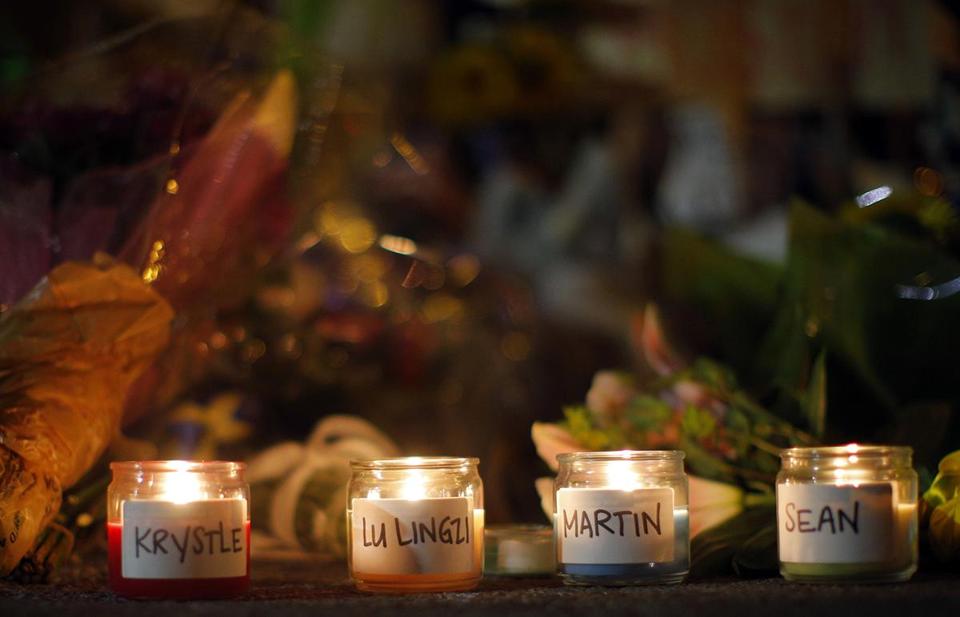
But death changes everything — a jolting transformation to which Greek tragedy itself gave first expression. “In the face of death,” as MacIntyre puts it, “winning and losing no longer divide.” Instead, competition drops away, and cooperation becomes the absolute mandate. That is precisely what happened in Boston, as the city held Martin Richard, Krystle Campbell, Lu Lingzi, and later Sean Collier in its heart.

Last week, a separate drama unfolded in Washington. “It’s almost like you can see the finish line, but you just can’t get there.” These words could have been spoken by thousands of Boston runners, but were said by the father of a shooting victim who witnessed the Senate vote on gun control.

We will, once again, show the world that we can have an investigation and fair trial.  And we will one day enact some sensible gun safety measures.  Watching the events unfold from a distance, I was proud of my fellow Bostonians, law enforcement and  public officials particularly Mayor Menino and Governor Patrick.

Candles for the victims.

Candles for the victims.

What does this mean?!

What does this mean?!

Jonathan Capehart wrote this about it in the Washington Post.

I’ve grown accustomed to the lunacy that emanates from the far right on Capitol Hill. But a tweet last night from Rep. Steve Stockman (R-Tex.) promoting his new bumper sticker was a jaw-dropper.

Just when you think things can’t get sicker something new comes along.