American defectors: life for Edward Snowden in Russia

Now that Edward Snowden has been granted temporary asylum in Russia (I suspect they mostly just wanted him gone from the airport.), it is not so certain he will have an easy life.  No matter how terrible you think surveillance is in the United States, I can guarantee that it is worse there.  And he likely has nothing more to trade to get better treatment.  NPR ran this story a few days ago.

If NSA leaker Edward Snowden is allowed to leave the Moscow airport and enter Russia, as some news reports suggest, he’ll join a fairly small group of Americans who have sought refuge there.

So how did it work out for the others?

In short, not so well. Some became disillusioned and left, like Lee Harvey Oswald. Others were sent to Josef Stalin’s gulags, where they served long sentences or were executed. Some lived out their days in an alcoholic haze.

“There’s little evidence from historical records that [Snowden] has anything good to look forward to,” says Peter Savodnik, a journalist and author of the upcoming book, The Interloper: Lee Harvey Oswald Inside the Soviet Union. “Essentially, nobody from the U.S. who has defected to Russia has gone on to think that’s a smart decision.”

In the 1920s and ’30s, hundreds of American leftists moved to what was then the Soviet Union, motivated by a desire to build socialism.

Alexander Gelver of Oshkosh, Wis., was taken there by his parents. But when the 24-year-old wanted to return to the U.S., he was stopped by Soviet police outside the U.S. Embassy in Moscow. He was arrested and disappeared. Only in the 1990s did his fate become clear: He was executed in 1938, one of Stalin’s many victims.

The Associated Press documented the case of Gelver and 14 other Americans who disappeared in the Soviet Union in the 1930s and ’40s. All were either imprisoned or executed. Dozens, perhaps hundreds of other Americans, met a similar fate during the rule of Stalin, who suspected that foreigners were spies.

A famous case in the Cold War era has parallels to Snowden. William Martin and Bernon Mitchell, cryptologists at the NSA, defected in 1960. But they came to regret their decision and became alcoholics. Martin died in Mexico in 1987. Mitchell died in Russia in 2001.

One defector who did return was Oswald. He left for the Soviet Union in 1959, returned to the U.S. three years later, and became infamous as the assassin of President Kennedy in 1963.

Edward Snowden, the NSA leaker seen here in a photo taken in July, has been granted temporary asylum in Russia. Thursday, he left Moscow's airport for the first time in more than a month.

Let’s hope that Snowden has better luck.  It will be tough not knowing many people and not speaking Russian.  Personally, I don’t think he made a good choice or got good advice.  I have never understood why he couldn’t go directly from Hong Kong to South American someplace.

Photograph:  Tatyana Lokshina/AP

On the opposite sides of the Civil Rights struggle: Lindy Boggs and Robert Byrd, Jr.

This week has brought notice of the death of two political figures from the past:  Lindy Boggs and Harry Byrd, Jr.  Both in their late 90s and had been out of office and out of the news for a number of years.  But it is notable that although of similar age and from the south, they were opposites when it came to civil rights.

Lindy Boggs was the window of House Speaker Hale Boggs who died in a plane crash in Alaska.  I remember when this happened in 1972,  I was moving out of my student movement phase and beginning to take an interest in electoral politics. Boggs ran to replace him following a tradition of widows taking over for their politician husbands.   Boggs, however, was different.  She went on to serve nine terms in Congress (several of them representing a majority black district) and become a champion of women’s rights and civil rights while representing Louisiana.  The New York Times describes some of her legislative efforts.

Mrs. Boggs during her Congressional campaign in 1973

Mrs. Boggs during her Congressional campaign in 1973

The velvet Southern charm she had absorbed growing up on two Louisiana plantations was her not-so-secret weapon.

She displayed it early in her first term when the House banking committee was composing an amendment to a lending bill banning discrimination on the basis of race, age or veteran status. She added the words “sex or marital status,” ran to a copying machine and made a copy for each member.

In her memoir she recalled saying: “Knowing the members composing this committee as well as I do, I’m sure it was just an oversight that we didn’t have ‘sex’ or ‘marital status’ included. I’ve taken care of that, and I trust it meets with the committee’s approval.”

Thus was sex discrimination prohibited by the Equal Credit Opportunity Act of 1974.

I always loved that story.

Mrs. Boggs used her membership on the Appropriations Committee to push for other women’s economic concerns, like equal pay for government jobs and equal access to government business contracts. She became a champion of historic preservation and port development, flood control and housing in her New Orleans district.

Mrs. Boggs championed racial justice at a time when doing so invited the resentment if not hostility of most Southern whites. She saw the growing civil rights movement as necessary to the political reform movement of the 1940s and ’50s.

“You couldn’t want to reverse the injustices of the political system and not include the blacks and the poor; it was just obvious,” she said in 1990.

While her husband was in office, she supported civil rights legislation as well as Head Start and antipoverty programs. As the president of two organizations of Congressional wives, she saw to it that each group was racially integrated.

She has been honored by the House with the naming, in 1991, of the Lindy Claiborne Boggs Congressional Women’s Reading Room.  She was 97 when she died.

At the other end of the civil rights spectrum is Harry Byrd, Jr., the long time Senator from Virginia, and not to be confused with Robert Byrd of West Virginia.  When I moved to Virginia in 1965, Byrd was my Senator.  He had just been appointed to replace his father who had died.  The Byrd Machine ruled Virginia Democratic State politics at the time and both Byrds worked hard to maintain segregation in Virginia schools.  The New York Times writes

Even as a middle-aged man, Mr. Byrd was often called “Little Harry” or “Young Harry.” By the 1920s, his father, Harry F. Byrd Sr., had built a formidable Democratic political machine in Virginia that eventually elected him governor and then to the Senate, where he served from 1933 until his resignation in 1965. (Like his son, Harry Sr. was initially appointed to the Senate to fill a vacancy, after the resignation of Claude A. Swanson.)

The elder Mr. Byrd was a conservative Democrat who served for 11 years as chairman of the Senate Finance Committee. He also supported “massive resistance,” the name given to Virginia’s opposition to public school desegregation in the late 1950s. The son, who was serving in the State Senate at the time, helped develop the policy, which included closing some schools for several years rather than integrate them.

Harry F. Byrd  in 1965, when he was appointed to his father’s seat

Harry F. Byrd in 1965, when he was appointed to his father’s seat

Moorestown, N.J. where I was living as a teenager was one of the northern towns that hosted African-American high school seniors so they would have a chance to get diplomas and go to college.  I went to a number of social activities that were hosted for them, but never, much to my regret, got to know any of them well enough to stay in touch.

Although the Byrd machine began coming apart amid the fractured politics of the 1960s, it held together long enough to get Gov. Albertis S. Harrison Jr., a longtime supporter of the family, to appoint Harry Jr. to his father’s seat in 1965. The following year Mr. Byrd won a special election to complete his father’s term. By 1970, with blacks voting in larger numbers and urban labor unions supporting more liberal candidates, Mr. Byrd faced a potentially challenging Democratic primary in pursuit of his first full term. That March, saying he was unwilling to sign a party oath to support the Democratic nominee in the 1972 presidential election, particularly since the candidate was not yet known, he announced that he would become an independent.

If the decision seemed striking given his family history, it was also prudent. Taking votes from his Democratic and Republican opponents, he won easily that November. Mr. Byrd had dropped his party affiliation but essentially kept his voters, his politics and much of his power.

I don’t think he could have supported either George McGovern or Hubert Humphrey so he made the correct choice.  Byrd, however,  continued to caucus with the Democrats.  There is one more shameful incident I remember.

In the late 1970s, President Jimmy Carter asked Mr. Byrd to form judicial commissions to name black and female candidates for Virginia’s federal courts. In 1980, after Mr. Byrd’s commissions had named only white men, none of whom were judges, President Carter nominated James E. Sheffield, a black state court judge. Mr. Byrd vowed to fight his Senate confirmation and did so successfully.

I remember Judge Sheffield’s rejection well.  The only reason for his failure to be confirmed was race.

Senator Byrd was a bigot throughout his public life.  He did not run for re-election in 1982 by which time I think he would have lost as new young Democrats were winning office like Charles Robb who became governor in then.  And people like me who were taking over the Virginia Democratic Party.  Byrd’s time was thankfully passing.

He was 98 when he died.

Photographs:  United Press International

Urban sprawl, transportation, and poverty

I’ve been thinking since I read Paul Krugman’s column “Stranded by Sprawl” about successful urban areas and public transportation.  I lived for a number of years in Richmond, VA and for part of that time I didn’t drive or have a car.  After I acquired a car, I realized how limited my world was without one.  There were many places I couldn’t get to without driving and even if there was a bus, service was often erratic and infrequent.  I don’t know if thing have changed since I left twenty years ago, but I know that the counties surrounding the City of Richmond were where the new office parks and shopping malls were springing up.  I was lucky because I did live within easy walking distance of a nice shopping area with restaurants and some stores so I could leave the car behind when I met friends for breakfast or dinner.  But I didn’t live near any of the “projects” or poor areas which were pretty segregated back then.

One of my first memories of my Boston move was one of my new neighbors lamenting that the view from the back of the houses on our street was marred by looking down at the roofs of a large public housing project.  In fact, there are actually four projects within easy walking distance.  After I went to work for the Housing Authority I learned that public housing developments were scattered through the city neighborhoods.  The BHA takes pains in trying to maintain the grounds of each (with limited resources) so they don’t become a blight on the neighborhoods and several have been totally redesigned and no longer have the dead end streets which only serve to isolate residents.  Contrast this with the Atlanta described by Krugman

When the researchers looked for factors that correlate with low or high social mobility, they found, perhaps surprisingly, little direct role for race, one obvious candidate. They did find a significant correlation with the existing level of inequality: “areas with a smaller middle class had lower rates of upward mobility.” This matches what we find in international comparisons, where relatively equal societies like Sweden have much higher mobility than highly unequal America. But they also found a significant negative correlation between residential segregation — different social classes living far apart — and the ability of the poor to rise.

And in Atlanta poor and rich neighborhoods are far apart because, basically, everything is far apart; Atlanta is the Sultan of Sprawl, even more spread out than other major Sun Belt cities. This would make an effective public transportation system nearly impossible to operate even if politicians were willing to pay for it, which they aren’t. As a result, disadvantaged workers often find themselves stranded; there may be jobs available somewhere, but they literally can’t get there.

Is Detroit in trouble because its land area is too big?  I don’t know.  Detroit is 138 square miles with a population today of around 700,000 people.  Boston is 48 square miles with a population about 50,000 people smaller. In Boston, we gripe about the public transportation all the time and worry that some neighborhoods that are more affluent have better service, but we are always working on it.  I haven’t read anything about public transportation in Detroit:  It is the Motor City.

Boton T

Back to Krugman

The apparent inverse relationship between sprawl and social mobility obviously reinforces the case for “smart growth” urban strategies, which try to promote compact centers with access to public transit. But it also bears on a larger debate about what is happening to American society. I know I’m not the only person who read the Times article on the new study and immediately thought, “William Julius Wilson.”

A quarter-century ago Mr. Wilson, a distinguished sociologist, famously argued that the postwar movement of employment out of city centers to the suburbs dealt African-American families, concentrated in those city centers, a heavy blow, removing economic opportunity just as the civil rights movement was finally ending explicit discrimination. And he further argued that social phenomena such as the prevalence of single mothers, often cited as causes of lagging black performance, were actually effects — that is, the family was being undermined by the absence of good jobs.

My worry about Boston is that it will become more and more like Manhattan where only the well-off and the very poor can afford to live.  Jobs, particularly tech jobs, are moving back into the city and near suburbs from further out along the outer ring highways.  Will we end up with a shrinking middle?

These days, you hear less than you used to about alleged African-American social dysfunction, because traditional families have become much weaker among working-class whites, too. Why? Well, rising inequality and the general hollowing out of the job market are probably the main culprits. But the new research on social mobility suggests that sprawl — not just the movement of jobs out of the city, but their movement out of reach of many less-affluent residents of the suburbs, too — is also playing a role.

What’s to be done?  More investment in infrastructure in places like Atlanta and Los Angeles.  More investment in light rail systems.  More investment in maintenance of what we have for cities like Boston, Chicago and New York.  Unfortunately this is another thing in which the House Republicans are not interested.

The Next Fed Chair? Not Larry Summers.

Why would the President want to appoint someone who once opined that women were not good at science?  The man who was hired to end the economic crisis, but likely contributed to its making.  I’ve been thinking about how to approach this for a few days now and then I saw two pieces by Shirley Leung in the Boston Globe Business Section.  I think she says exactly what I wanted to say.  In the first, she discusses Larry Summers.

No need to hold back here: Larry Summers as the next Fed chairman?

Worst idea ever.

Summers, by all accounts, is a brilliant economist, one of the best of his generation. He is also someone who is confident, and, in times of crises, may be the adult in the room that he supposedly said the Obama administration didn’t have when the economy collapsed.

But he lacks one critical trait I like in my Fed chairmen: He’s not boring.

Summers is far from bland. He is arrogant and a lightning rod and would carry so much baggage he couldn’t fit it on the shuttle to Washington.

Do we need a Fed Chair that is all about Larry Summers?  I think not.

In his book “Confidence Men,” about the Obama White House’s handling of the economic crisis, former Wall Street Journal reporter Ron Suskind paints Summers as brilliant but overconfident and prone to unnecessary battles. “As he has aged, he has grown less troubled by being uninformed,” Suskind wrote.

That’s not what you want in a Fed chairman. The nation’s top central banker must manage the economy primarily by raising or lowering interest rates and must build consensus to do so. He must work with six other Fed governors and 12 regional Fed bank presidents. Imagine what would have happened if the Fed board was split over what to do with the economy in 2008? What would that have done to the markets?

“I know Larry very well. He is a smart guy,” said Allan Meltzer, a Carnegie Mellon professor who has written the definitive history on the Fed. “But the skills that are required for that job are not just brilliance, they are ability to manage compromise. He doesn’t do that well.”

This is to say nothing about how he ran Harvard.  When he left, they picked Drew Faust, a women who was his opposite in many important ways.

So, who should be the next Fed Chair?  How about a woman?  Senator Elizabeth Warren and Shirley Leung are backing Janet Yellen.

English: Official picture of Janet Yellen from...

English: Official picture of Janet Yellen from FRBSF web site. http://www.frbsf.org/federalreserve/people/officers/yellen.html (Photo credit: Wikipedia)

Just as forcefully as folks are coming out against Summers, there is a campaign mounting to promote Janet Yellen, Ben Bernanke’s number two.

Unlike Summers, Yellen has significant monetary policy experience. She has been the vice chair of the Fed board of governors since 2010, and prior to that she ran the San Francisco Federal Reserve bank for six years. She has been involved in the Fed’s quantitative easing strategy, hatched during the Great Recession to keep money flowing and the US economy alive.

And unlike Summers, she is sufficiently boring, a key trait we want in someone running our central bank.

If Yellen got the nod, she would break the glass ceiling at the Fed, becoming the first woman at the top. She already has some high profile endorsements from New York Times columnist Paul Krugman and former FDIC chair and UMass-Amherst professor Sheila Bair.

Bair, in a blog posted on Fortune earlier this week, argues that Yellen is the most qualified candidate, but the financial world’s old-boy network is trying to derail her candidacy:

“So why isn’t she a shoo-in? The ‘whispering’ campaign against her among industry types has been deafening. ‘Doesn’t understand markets.’ Translation: She may not bail us out if we get into trouble again. ‘Not assertive enough.’ Translation: She won’t stand up for us against the populists who want more regulation. ‘Lacks gravitas.’ Translation: She doesn’t show up very often in the financial media.”

I guess we haven’t come far enough for the Wall Street guys to be comfortable with a woman.

Bair also takes a whack at Summers. “Unlike Larry Summers, Tim Geithner, and other Bob Rubin minions frequently mentioned in the financial press as potential Bernanke successors, she was not part of the deregulatory cabal that got us into the 2008 financial crisis. In fact, she had a solid record as a bank regulator at the San Francisco Fed and was one of the few in the Fed system to sound the alarm on the risks of subprime mortgages in 2007.”

Others are also rallying behind Yellen. Senator Elizabeth Warren of Massachusetts on Friday confirmed that she has signed a letter Senate Democrats are circulating and plan to deliver to President Obama calling on him to nominate Yellen because “she is the best person for this job.” As early as Monday, activists, including women’s advocacy groups NOW and Ultraviolet plan to send a letter to Obama and Senate majority leader Harry Reid to support Yellen’s candidacy and oppose Summers’. When he ran Harvard, Summers set off a firestorm when he suggested women lacked the same “intrinsic aptitude” for science as men.

The President recently said he was not going to make a decision until fall, so we have time to make sure he appoints the best qualified person who, in this case is a woman.  Not Larry Summers.

Fixing FISA

Congress is beginning to have a debate about surveillance, oversight and secrecy – the one good thing to come out of  Edward Snowden’s continuing adventure.  Of course, it is hard to debate when you can’t talk about a lot of things in public or even to your fellow members, so I was very interesting in reading Judge James G. Carr’s op-ed in yesterday’s New York Times.  His suggestion is one that Congress and the Obama Administration should be able to debate and legislate without revealing anything that needs to be kept secret.  Judge Carr is identified as a senior federal judge for the Northern District of Ohio,[who] served on the Foreign Intelligence Surveillance Court from 2002 to 2008.

CONGRESS created the Foreign Intelligence Surveillance Court in 1978 as a check on executive authority. Recent disclosures about vast data-gathering by the government have raised concerns about the legitimacy of the court’s actions. Congress can take a simple step to restore confidence in the court’s impartiality and integrity: authorizing its judges to appoint lawyers to serve the public interest when novel legal issues come before it.

The court is designed to protect individual liberties as the government protects us from foreign dangers. In 1972, the Supreme Court ruled that the Nixon administration had violated the Fourth Amendment by conducting warrantless surveillance on a radical domestic group, the White Panthers, who were suspected of bombing a C.I.A. recruiting office in Ann Arbor, Mich. In 1975 and 1976, the Church Committee, a Senate panel, produced a series of reports about foreign and domestic intelligence operations, including surveillance by the F.B.I. of suspected communists, radicals and other activists — including, notoriously, the Rev. Dr. Martin Luther King Jr.

The Foreign Intelligence Service Act set up the FISA Court in response. To obtain authority to intercept the phone and electronic communications of American citizens and permanent residents, the government must only show probable cause that the target has a connection to a foreign government or entity or a foreign terrorist group. It does not have to show, as with an ordinary search warrant, probable cause that the target is suspected of a crime.

The problem is that the court only hears from one side.  I wrote recently that the real danger to our civil liberties is the FISA Court and I hoped that people will come up with ways to try to fix it.  Judge Carr has one suggestion at which Congress should take a serious look.

Critics note that the court has approved almost all of the government’s surveillance requests. Some say the court is virtually creating a secret new body of law governing privacy, secrecy and surveillance. Others have called for declassified summaries of all of the court’s secret rulings.

James Robertson, a retired federal judge who served with me on the FISA court, recently called for greater transparency of the court’s proceedings. He has proposed the naming of an advocate, with high-level security clearance, to argue against the government’s filings. He suggested that the Privacy and Civil Liberties Oversight Board, which oversees surveillance activities, could also provide a check. I would go even further.

In an ordinary criminal case, the adversarial process assures legal representation of the defendant. Clearly, in top-secret cases involving potential surveillance targets, a lawyer cannot, in the conventional sense, represent the target.

Congress could, however, authorize the FISA judges to appoint, from time to time, independent lawyers with security clearances to serve “pro bono publico” — for the public’s good — to challenge the government when an application for a FISA order raises new legal issues.

Having lawyers challenge novel legal assertions in these secret proceedings would result in better judicial outcomes. Even if the government got its way all or most of the time, the court would have more fully developed its reasons for letting it do so. Of equal importance, the appointed lawyer could appeal a decision in the government’s favor to the Foreign Intelligence Surveillance Court of Review — and then to the Supreme Court. No opportunity for such review exists today, because only the government can appeal a FISA court ruling.

A combination of a people’s advocate and public release of decision summaries would remove some of the mystery and secrecy.

One obvious objection: judges considering whether to issue an ordinary search warrant hear only from the government. Why should this not be the same when the government goes to the Foreign Intelligence Surveillance Court?

My answer: the court is unique among judicial institutions in balancing the right to privacy against the president’s duty to protect the public, and it encounters issues of statutory and constitutional interpretation that no other court does or can.

For an ordinary search warrant, the judge has a large and well-developed body of precedent. When a warrant has been issued and executed, the subject knows immediately. If indicted, he can challenge the warrant. He can also move to have property returned or sue for damages. These protections are not afforded to FISA surveillance targets. Even where a target is indicted, laws like the Classified Information Procedures Act almost always preclude the target from learning about the order or challenging the evidence. This situation puts basic constitutional protections at risk and creates doubts about the legitimacy of the court’s work and the independence and integrity of its judges. To avert these dangers, Congress should amend FISA to give the court’s judges the discretion to appoint lawyers to serve not just the interests of the target and the public — but those of the court as well.

079 Capitol Hill United States Congress 1993

079 Capitol Hill United States Congress 1993 (Photo credit: David Holt London)

We are already deep in uncharted waters and we need to take steps to try to protect ourselves.  It serves no purpose if we lose our civil liberties while protecting them.  I don’t have a great deal of hope that Congress can actually get itself together enough to act, but there has been some glimmer of bipartisanship about this issue.  Let us hope someone writes Judge Carr’s ideas into a bill so it can be introduced.

Beating the heat

We just finished a week or so of 90+ temperatures with high humidity in Boston without air conditioning.  We survived quite well.  It wasn’t until day 6 or 7 that I really began to suffer – that the was day there was no afternoon sea breeze.  Exhaust fans on each floor pull air through the house and smaller fans are placed in the rooms we use the most.  We are lucky to have good four-way ventilation.  Cool showers and cooking in the mornings = or not at all – also help.  (We went out once to out favorite pub so find that their air conditioning was not 100%, but it was just fine.)  I am one of those rare people that don’t like living in refrigerated air.  So I was very interested in the Boston Globe article in the Sunday Ideas Section titled “How to Live Without Air Conditioning”  In it, Leon Neyfakh  points out the life style changes that we could make so that we at least reduce our energy consumption.

Since the technology was invented in 1902, and the first window unit was brought to market in 1939, air conditioners have become ubiquitous in the United States. Today, almost 90 percent of American households have one—as do the vast majority of restaurants, stores, museums, and office buildings. During weeks like the one we’ve just had, these places are sanctuaries: To walk into one after being outside is to be reminded how sweet life can be.

But all that magic chilling comes at a cost—something most people are aware of on a personal level, because their electricity bills are so high during the summer, but not so much on a global scale, which is really where the problem lies. In China and India, air conditioning sales have reportedly been growing by 20 percent per year; around the world, air conditioning energy demand is projected to increase vastly over the next decades. According to Stan Cox, author of the 2010 book “Losing Our Cool,” air conditioning in the United States already has a global-warming impact equivalent to every US household driving an extra 10,000 miles per year.

English: Series of air conditioners at UNC-CH.

English: Series of air conditioners at UNC-CH. (Photo credit: Wikipedia)

Think about that.  And we continue to build office buildings taller and more dependent on artificial cooling.  Yes, maybe some are energy efficient and green building, but they still consume vast amounts of energy.

When experts look at A/C use in America, they immediately see a spot of illogic: We use vast amounts of energy just to let businesspeople do something they’d probably rather not do anyway. “We are probably overcooling our office buildings by 4 to 6 [degrees] F just so that office workers, particularly the males, can wear their business suits,” wrote Richard de Dear, who is head of architectural design science at the University of Sydney and a researcher on thermal comfort. “The current clothing behaviour is costing us a fortune in energy and greenhouse emissions!”

In Japan every summer, in an environmental initiative called “Cool Biz” that started in 2005, government officials encourage building managers to let temperatures climb to 82 degrees and advise employees to loosen their sartorial standards. In 2011, the government even put on a fashion show, with models catwalking in untucked polos, capri pants, and Kariyushis, a Japanese take on the Hawaiian shirt.

Here in America, it probably wouldn’t require such a hard sell. Many female workers already dress for summer weather, and would likely be delighted not to have to huddle in sweaters against the A/C. Among men, polos are already considered appropriate on casual Fridays, and it’s not hard to imagine that most would happily embrace a breezier style for the rest of the week. Instead of long pants, they could don formal shorts—a concept that has long been embraced in Bermuda, where executives can be seen attending meetings with exposed knees.

And people can do similar things at home.

Even a mid-sized building could save considerable amounts every year by operating at shorts temperature. But if modifying what we put on our bodies could help us give up extreme climate control, rethinking buildings themselves—and how we ventilate them—would go even further. Already, some of us live in homes that can be effectively cooled by opening windows in the basement and on the top floor every morning, thus taking advantage of the so-called stack effect to pull cool air up through the house and allow hot air to vent into the street. People can also try “evaporative cooling,” a modest, low-tech form of air conditioning, by hanging wet towels in the window or setting them in front of a basic electric fan.

Some of  Neyfakh’s life style suggestions like changing to a work schedule with early morning hours, a mid afternoon siesta, and late work hours are a tougher sell:  Too many people commute long distances.  But people who telecommute could try raising the temperature at home a few degrees so that they at least don’t have fried brains and the inertia that comes with it.  Also try adjusting blinds to follow the sun and plant trees.

There are some parts of life, it must be said, for which air conditioning is not just a luxury but a necessity. The Internet depends on servers that require climate control in order to not go up in flames. Modern skyscrapers depend on it, as well. If we gave up air conditioning, New England would largely be fine, at least for now, but entire swaths of the country would become uninhabitable: Summers in the Sun Belt cities and in parts of the South would be so harsh that millions of people would simply move away. We also would be unwilling to take away A/C from those most sensitive to extreme heat—namely, the sick, the very young, and the elderly.

That doesn’t mean that trying to reduce our society’s addiction to A/C is a fool’s errand. The fact is, our bodies are built to adjust to heat—it’s just that we haven’t had to lately, because we’ve become so accustomed to refrigerating ourselves when the weather gets hot. A study in which researchers surveyed 21,000 people, spread out across 160 buildings on four continents, found that “people in warmer climates were more comfortable in warmer indoor temperatures than their counterparts in cooler climate zones,” according to Richard de Dear, one of the coauthors.

The findings indicate that people actually prefer being in places where the temperature fluctuates, as long as they have some control over it. “If you have the ability to open or close a window, turn a fan on or off, change the blinds, modify your clothing—it just becomes a natural part of your day-to-day living, and you don’t build these expectations that conditions should be the same all day and all year round, which I would call ‘thermal monotony,’” said Gail Brager, an architecture professor at UC Berkeley who also worked on the study. “We not only accept—we actually prefer—a wider range of conditions that float with the natural rhythms of the outdoor climate.”

No doubt this is hard to believe, as you sit there in your air-conditioned home, happily soaking up the artificial breeze emanating from the murmuring machine in your window. But is there not something fearful about refrigerating ourselves with such vigilance? We’re not cartons of milk, after all; we will not spoil, even if we do sweat a little. In fact, by taking full advantage of the technology inside our own bodies—technology that makes it possible for us to adapt to a whole spectrum of temperatures—we might discover we’ve been missing out on a way of life that actually feels quite natural.

Everyone doesn’t have to go air conditionless as we do, but there is nothing wrong, and much to gain by not making all of our buildings so cold.  Maybe we can at least agree on a temperature like 80 or, like the Japanese, 82 and save some energy.

A sort of apology

I generally don’t have a lot to say about international politics, but I am interested in education, especially education for girls.  This story was in the Guardian.

A senior member of the Pakistani Taliban has written an open letter to Malala Yousafzai – the teenager shot in the head as she rode home on a school bus – expressing regret that he didn’t warn her before the attack, but claiming that she was targeted for maligning the insurgents.

Adnan Rasheed, who was convicted for his role in a 2003 assassination attempt on the country’s then-president Pervez Musharraf, did not apologise for the attack, which left Malala gravely wounded, but said he found it shocking.

“I wished it would never happened [sic] and I had advised you before,” he wrote.

Malala was 15 when she and two classmates were targeted by a masked gunman who picked them out on a school bus as they went home from school in Pakistan‘s northwest Swat valley last October.

Last week, she celebrated her 16th birthday by delivering a defiant speech at the United Nations in New York, in which she called on world leaders to provide free schooling for all children.

In the letter, Rasheed claimed that Malala was not targeted for her efforts to promote education, but because the Taliban believed she was running a “smearing campaign” against it.

“You have said in your speech yesterday that pen is mightier than sword,” Rasheed wrote, referring to Malala’s UN speech, “so they attacked you for your sword not for your books or school.”

Malala Yousafzai speaking at the United Nations

Malala Yousafzai speaking at the United Nations

I think most of us know that what the Taliban was interpreting as a “smear campaign” was her advocacy of education.  An educated person, and an educated woman in particular, is a threat to any kind of fundamentalism.  (Ask Rick Perry.)

The letter doesn’t make a lot of sense:  “they attacked you for your sword not for your books or school”.  Huh?  Do you think he considers education a sword?  Or maybe talking about education.

He admitted that the Taliban are “blowing up” schools, but justified the attacks on the grounds that the Pakistani army and the paramilitary Frontier Corps use schools as hideouts.

Hundreds of schools have been targeted in Pakistan’s north-west: activists say some had been used by the military, but many attacks were motivated by the Taliban’s opposition to girls’ education.

The Taliban commander also justified recent attacks in Pakistan on health workers vaccinating children against polio by claiming the west was trying to sterilise Muslims.

The letter is clearly intended to influence opinion in Pakistan: although in much of the world Malala has been hailed as a symbol of courage, at home she has been the subject of intense criticism and vilification. Online commentators have described her as a “drama queen” and even accused her of spying for the CIA.

Rasheed contrasted international support for Malala with the lack of coverage given to those killed in US drone attacks – a source of intense grievance in Pakistan.

I understand the anger about civilian deaths from drone attacks since I don’t think they can simply be excused as collateral damage, but I think that may be the only part I do understand.

Rasheed wants Malala to return to Pakistan and attend a female seminary so she can advocate for Islam.  I think that her advocacy for women and for education generally can do a lot to show people in the West who think of Muslims as only terrorists another side of Islam.  She IS an advocate,  Rasheed.

Photograph:   Rick Bajornas/UN Photo/PA

Florida’s strange gun laws

I’ve been thinking a great deal about the verdict in the Trayvon Martin/George Zimmerman case and have concluded that one reason for the verdict is Florida law.  I’ve read the jury instructions and while they were confusing, they had to follow the law which led to acquittal.

The best piece I’ve read on Florida gun laws is an OpEd by Farah Stockman in the Boston Globe.  Stockman writes about Florida gun laws generally and cites 4 currently incarcerated people as examples:  Marissa Alexander, Ronald Thompson, Orville Lee Wollard and Erik Weyant.    All but Alexander are white men, all including Alexander fired a gun to frighten and not to kill.  All are currently serving 20 year minimum sentences.

IF IT BOGGLES your mind that George Zimmerman, a 29-year-old with a gun, could be acquitted after pursuing — and killing — an unarmed 17-year-old, here’s another brain teaser: How could Marissa Alexander, a 31-year-old mother of three, receive a 20-year prison sentence for firing a bullet into a wall near her abusive ex-husband, even though no one was harmed?

It’s true. Florida is one of the worst places to fire a gun into the air, even as it appears to be one of the best places to actually shoot at a person.

Marissa Alexander of Florida received a 20-year prison sentence for firing a warning shot at her abusive ex-husband.

Marissa Alexander of Florida received a 20-year prison sentence for firing a warning shot at her abusive ex-husband.

She goes on to explain.

Alexander, whose ex-husband admitted that she was afraid of his abuse, is not the only one in prison for shooting at nothing.

Ronald Thompson, 62, a disabled veteran, fired two shots into the ground to protect an elderly woman from her violent 17-year-old grandson. State Attorney Angela Corey — the same prosecutor in the Zimmerman case — charged him with four counts of aggravated assault. Thompson was sentenced to 20 years in prison,  a punishment that the judge in the case called a “crime in itself.”  (He is currently awaiting a new trial.)

Orville Lee Wollard, a former auxiliary police force member, shot a bullet into the wall to scare away his daughter’s abusive boyfriend. Prosecutors offered him probation. But he wanted to be exonerated at trial. Now he’s serving 20 years.

Erik Weyant, 22, fired shots in the air to disperse a group of drunk men who accosted him in a parking lot outside a bar and blocked his car. No one was hurt. But he’s in for 20 years.

In many cases, the fact that they chose to fire a warning shot, instead of aiming to kill, was used as evidence against them at trial, said Greg Newburn of Families Against Mandatory Minimums. If you were truly in fear of your life, the logic goes, you would aim at the chest, not the wall.

Florida lawmakers, in their infinite wisdom, began to notice that a lot of people were getting severely punished simply for defending themselves. But instead of repealing the Draconian measure, they passed another one: the “stand your ground” law.

Somehow, both of the laws are not working.  George Zimmerman who killed Trayvon Martin is free, the four named above are in prison.

…And had Alexander shot and killed her abusive ex-husband, would she have had a better chance of getting immunity with a “stand your ground” defense?

“I think so,” said her attorney Michael Dowd.

So in the sick logic of Florida’s gun laws, the message is clear: If you are going to shoot, shoot to kill. You stand a better chance of walking free.

What is happening in Florida is just another reason we need to take a careful look at all of our gun laws.  Florida’s gun laws have little to do with race and as pressure mounts to help Alexander, let us not forget everyone else.

Photograph:  Bob Self/The Florida Times-Union

Republicans try to attract women

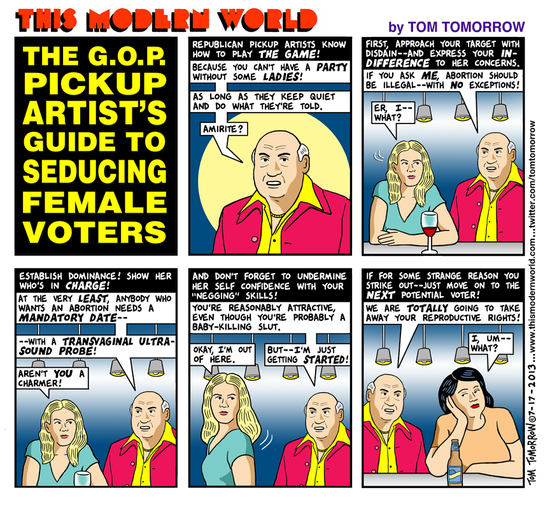
I was getting ready to call it a night as my head is swimming with a half written post about Trayvon Martin when I saw the new Tom Tomorrow cartoon.  It really needs no explanation.

TMW2013-07-17color  Great pick up lines.  I’m sure that women voters will be flocking to them in droves.