Talking jobs and unemployment

Today I went to a graduation for 58 men and women – almost all over 3o – who went to a program at the local YMCA to sharpen skills and make them more competitive in the job market.  I shared an intern with several others in my agency.  It was announced that 8 or 9 had found jobs.  Not bad in this market, but not good either. 

Last week the Boston Globe ran a story about the report by the National Skills Coalition. 

The report projects that by 2016, Massachusetts will have nearly 400,000 job openings that require more than a high school diploma, but less than a four-year college degree. The report says “middle-skill” jobs will account for 38 percent of all openings.

Ranging from licensed practical nurses to computer support specialists, the jobs have median annual incomes of about $50,000 to $55,000.

The report says the state faces challenges in meeting the demand for middle-skilled workers, with only 32 percent of current employees having the credentials.

The graduation I attended was designed to train people for these middle-skill jobs.  But until the jobs are created, the graduates still need to pay the rent, the mortgage, buy food and clothes.  These are men and women who are doing the rights things and are still finding it tough to find a job.  Some of them were unemployed before entering the program and some will be unemployed after graduation.  Some may be eligible for unemployment benefits, but may have exhausted their time.  Which brings me to the unemployment benefits issue.

Let’s start with Paul Krugman.

There was a time when everyone took it for granted that unemployment insurance, which normally terminates after 26 weeks, would be extended in times of persistent joblessness. It was, most people agreed, the decent thing to do.

But that was then. Today, American workers face the worst job market since the Great Depression, with five job seekers for every job opening, with the average spell of unemployment now at 35 weeks. Yet the Senate went home for the holiday weekend without extending benefits. How was that possible?

The answer is that we’re facing a coalition of the heartless, the clueless and the confused. Nothing can be done about the first group, and probably not much about the second. But maybe it’s possible to clear up some of the confusion.

So who are the heartless?  They are Republicans and some Democrats a tiny number of whom may be acting out of principle.  They hide behind the deficit and statements from the clueless.

By the clueless I mean people like Sharron Angle, the Republican candidate for senator from Nevada, who has repeatedly insisted that the unemployed are deliberately choosing to stay jobless, so that they can keep collecting benefits. A sample remark: “You can make more money on unemployment than you can going down and getting one of those jobs that is an honest job but it doesn’t pay as much. We’ve put in so much entitlement into our government that we really have spoiled our citizenry.”

Now, I don’t have the impression that unemployed Americans are spoiled; desperate seems more like it. One doubts, however, that any amount of evidence could change Ms. Angle’s view of the world — and there are, unfortunately, a lot of people in our political class just like her.

And then Krugman tackles the misinformed.

But there are also, one hopes, at least a few political players who are honestly misinformed about what unemployment benefits do — who believe, for example, that Senator Jon Kyl, Republican of Arizona, was making sense when he declared that extending benefits would make unemployment worse, because “continuing to pay people unemployment compensation is a disincentive for them to seek new work.” So let’s talk about why that belief is dead wrong.

Do unemployment benefits reduce the incentive to seek work? Yes: workers receiving unemployment benefits aren’t quite as desperate as workers without benefits, and are likely to be slightly more choosy about accepting new jobs. The operative word here is “slightly”: recent economic research suggests that the effect of unemployment benefits on worker behavior is much weaker than was previously believed. Still, it’s a real effect when the economy is doing well.

But it’s an effect that is completely irrelevant to our current situation. When the economy is booming, and lack of sufficient willing workers is limiting growth, generous unemployment benefits may keep employment lower than it would have been otherwise. But as you may have noticed, right now the economy isn’t booming — again, there are five unemployed workers for every job opening. Cutting off benefits to the unemployed will make them even more desperate for work — but they can’t take jobs that aren’t there.

Will extending benefit add the to deficit?  Krugman tackles this one also.

But won’t extending unemployment benefits worsen the budget deficit? Yes, slightly — but as I and others have been arguing at length, penny-pinching in the midst of a severely depressed economy is no way to deal with our long-run budget problems. And penny-pinching at the expense of the unemployed is cruel as well as misguided.

But is being against extending benefits a political plus?  Not according to two new polls out today.  According to the New York Times story in the Caucus both a CBS News and a ABC News/Washington Post poll found the majority of those surveyed believed that Congress should extend benefits.

In the CBS News survey, 52 percent of respondents said Congress should extend unemployment benefits for people currently out of work, even if it meant increasing the budget deficit. Thirty-nine percent disagreed, and the rest said “it depends” or gave no opinion.

Broken down by party affiliation, about 7 in 10 Democrats said they supported an extension, while most Republicans said they opposed it. Independents were more evenly divided, with 47 percent in favor and 42 percent opposed.

The ABC News/Washington Post poll asked the question a little differently, and found even more support for an extension of unemployment benefits. The question noted that Congress had previously extended benefits because of the economic downturn, and was considering extending them again. It also presented capsules of each side of the debate, noting that supporters of the extension say it “will help those who can’t find work” while opponents say it “adds too much to the federal budget deficit.”

The result: 62 percent of respondents said Congress should approve another extension, while 36 percent said it should not. Those in favor included 80 percent of Democrats and 59 percent of independents, as well as 43 percent of Republicans.

So there doesn’t seem to be a lot of gain in opposition.

Standing with three Americans who have struggled to find work, President Obama spoke in the Rose Garden about the need to extend unemployment benefits.

The last word goes to the President.

Under pressure in an election year to reduce the unemployment rate, now at 9.5 percent, Mr. Obama also urged the Senate to approve a package of tax cuts and an expansion of lending to small businesses. “We all have to continue our efforts to do everything in our power to spur growth and hiring,” Mr. Obama said at the White House.

Mr. Obama, appearing before reporters in the Rose Garden flanked by three Americans who have had difficulty finding work, took aim at that argument. “That attitude reflects a lack of faith in the American people,” Mr. Obama said. “They’re not looking for a handout. They desperately want to work.”

Mr. Obama sharply criticized Republicans who have several times in the past month voted against bringing an unemployment extension bill to the Senate floor.

“After years of championing policies that turned a record surplus into a massive deficit, the same people who didn’t have any problem spending hundreds of billions of dollars on tax breaks for the wealthiest Americans are now saying we shouldn’t offer relief to middle-class Americans like Jim or Leslie or Denise, who really need help,” Mr. Obama said, referring to the three people who stood with him in the Rose Garden, brought to Washington by the White House to help illustrate the president’s point.

The Bill will pass this week, probably without Republican support, after we get the new temporary Senator from West Virginia, Carte Goodwin. 


The politics of Presidential vacations

If we want to go away for a long weekend, Bob and I just pick the place and book a place to stay or more likely, just tell my sister we are coming up to Vermont.  No politics involved.  But where and for how long a President vacations becomes grist for the political mill.

The Obamas walked along a trail with their daughters Sasha, left, and Malia on Cadillac Mountain.

The first family picked Bar Harbor, Maine and Acadia National Park.  But the big flap is that they didn’t go to the Gulf.

In a New York Times “White House Memo”, Sheryl Gay Stolberg wrote

Mr. Obama arrived here Friday for a summer weekend getaway with his wife, Michelle, and their daughters, Malia, 12, and Sasha, 9 — a precursor to a longer family vacation they are planning next month on Martha’s Vineyard. But what sounds like a much-needed family escape from the literal and political heat of Washington to some sounds like hypocrisy to others, given recent statements by both the president and first lady urging Americans to spend their vacation time and money along the shores of the oil-stricken Gulf of Mexico.

“Michelle Obama: Take your Vacation in the Gulf, America — If You Need Us, We’ll be In Maine,” blared the headline on the Web site of Michelle Malkin, the conservative commentator, on Monday, the day Mrs. Obama toured the gulf. ABC News served up similar, if more muted fare: “First Lady Encourages Americans to Vacation on Gulf — But Obamas Head to Maine Instead.”

A trip to the Gulf Coast, of course, would hardly be much of a vacation for Mr. Obama, whose political fortunes were undercut by the spill. But the flap does point up how politically fraught the modern presidential vacation — or, for that matter, presidential leisure time in general — has become.

Of course, if they did go to the Gulf Coast for a vacation scheduling no public events, everyone would be upset by their not having helped clean up a beach or visiting fishermen who are not working because of the spill.  It would not, as the Memo points out, have been a vacation.  This is a trip with their children, Ms. Malkin.  Remember family values?   Both the President and First Lady have gone often to the Gulf and they will be returning many times, I’m sure.

The Memo continues

Bill Clinton and his family traveled to Jackson Hole, Wyo., in the summer of 1996 after polling showed that Americans viewed Martha’s Vineyard as too elitist. George W. Bush caught so much flak for spending a month at his ranch in Crawford, Tex., in the summer of 2001, said his former press secretary, Ari Fleischer, that his staff printed T-shirts listing all the work-related side trips he had taken. Mr. Fleischer may disagree with Mr. Obama’s policies, but he said he was protective of the president’s right to “recharge his batteries” wherever it suited him.

“I just think that people should leave the president alone and not make a political issue of where he takes vacation or how he takes vacation,” Mr. Fleischer said. “He and his family are perfectly entitled to do whatever works for them.”

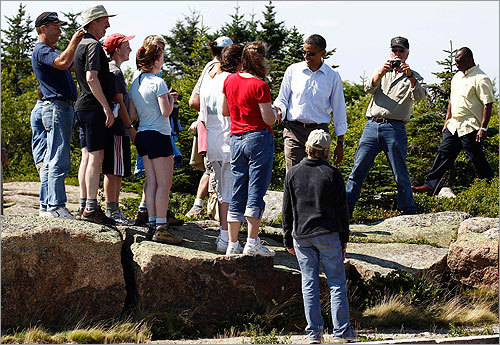
President Obama greeted people after walking along a trail on Cadillac Mountain.

One thing I have noticed is that President Obama likes ice cream.  He seem to gravitate to ice cream shops wherever he goes.

Once last thing:  While looking through  pictures of the trip to put in this entry, I kept  spotting Reggie Love.  Does he ever get to go on a vacation by himself? 

The pictures are from the Boston Globe and the New York Times.

Keeping the Faith

I’ve been thinking about the mid-term elections a lot recently.  With financial reform and health care reform passed, President Obama has kept two big promises.  Of course, neither bill is perfect.  But both are steps in the right direction.  So when his poll numbers go down anyway and the pundits think mid-term election disaster it is hard to keep the faith.  In this connection, I’m looking at a piece from last Sunday’s Boston Globe and Paul Krugman’s New York Times column from yesterday.

The Globe article by Joe Keohane in the Ideas section was titled “How Facts Backfire”  and the role factual information plays in a democracy.  It was pretty bleak and discouraging.

It’s one of the great assumptions underlying modern democracy that an informed citizenry is preferable to an uninformed one. “Whenever the people are well-informed, they can be trusted with their own government,” Thomas Jefferson wrote in 1789. This notion, carried down through the years, underlies everything from humble political pamphlets to presidential debates to the very notion of a free press. Mankind may be crooked timber, as Kant put it, uniquely susceptible to ignorance and misinformation, but it’s an article of faith that knowledge is the best remedy. If people are furnished with the facts, they will be clearer thinkers and better citizens. If they are ignorant, facts will enlighten them. If they are mistaken, facts will set them straight.

Maybe not. Recently, a few political scientists have begun to discover a human tendency deeply discouraging to anyone with faith in the power of information. It’s this: Facts don’t necessarily have the power to change our minds. In fact, quite the opposite. In a series of studies in 2005 and 2006, researchers at the University of Michigan found that when misinformed people, particularly political partisans, were exposed to corrected facts in news stories, they rarely changed their minds. In fact, they often became even more strongly set in their beliefs. Facts, they found, were not curing misinformation. Like an underpowered antibiotic, facts could actually make misinformation even stronger.

This bodes ill for a democracy, because most voters — the people making decisions about how the country runs — aren’t blank slates. They already have beliefs, and a set of facts lodged in their minds. The problem is that sometimes the things they think they know are objectively, provably false. And in the presence of the correct information, such people react very, very differently than the merely uninformed. Instead of changing their minds to reflect the correct information, they can entrench themselves even deeper.

“The general idea is that it’s absolutely threatening to admit you’re wrong,” says political scientist Brendan Nyhan, the lead researcher on the Michigan study. The phenomenon — known as “backfire” — is “a natural defense mechanism to avoid that cognitive dissonance.”

Paul Krugman wrote Friday about the Republicans proposed economic plan.  Basically tax cuts for the rich and nothing for the rest of us according to Krugman.

Republicans are feeling good about the midterms — so good that they’ve started saying what they really think. This week the party’s Senate leadership stopped pretending that it cares about deficits, stating explicitly that while we can’t afford to aid the unemployed or prevent mass layoffs of schoolteachers, cost is literally no object when it comes to tax cuts for the affluent

And that’s one reason — there are others — why you should fear the consequences if the G.O.P. actually does as well in November as it hopes.

For a while, leading Republicans posed as stern foes of federal red ink. Two weeks ago, in the official G.O.P. response to President Obama’s weekly radio address, Senator Saxby Chambliss devoted his entire time to the evils of government debt, “one of the most dangerous threats confronting America today.” He went on, “At some point we have to say ‘enough is enough.’ ”

But this past Monday Jon Kyl of Arizona, the second-ranking Republican in the Senate, was asked the obvious question: if deficits are so worrisome, what about the budgetary cost of extending the Bush tax cuts for the wealthy, which the Obama administration wants to let expire but Republicans want to make permanent? What should replace $650 billion or more in lost revenue over the next decade?

His answer was breathtaking: “You do need to offset the cost of increased spending. And that’s what Republicans object to. But you should never have to offset the cost of a deliberate decision to reduce tax rates on Americans.” So $30 billion in aid to the unemployed is unaffordable, but 20 times that much in tax cuts for the rich doesn’t count.

The next day, Mitch McConnell, the Senate minority leader, confirmed that Mr. Kyl was giving the official party line: “There’s no evidence whatsoever that the Bush tax cuts actually diminished revenue. They increased revenue, because of the vibrancy of these tax cuts in the economy. So I think what Senator Kyl was expressing was the view of virtually every Republican on that subject.”

The Republicans seem to be making it pretty clear that they want to go back to the old economic way.  Krugman continues

But we’re talking about voodoo economics here, so perhaps it’s not surprising that belief in the magical powers of tax cuts is a zombie doctrine: no matter how many times you kill it with facts, it just keeps coming back. And despite repeated failure in practice, it is, more than ever, the official view of the G.O.P.

Why should this scare you? On paper, solving America’s long-run fiscal problems is eminently doable: stronger cost control for Medicare plus a moderate rise in taxes would get us most of the way there. And the perception that the deficit is manageable has helped keep U.S. borrowing costs low.

But if politicians who insist that the way to reduce deficits is to cut taxes, not raise them, start winning elections again, how much faith can anyone have that we’ll do what needs to be done? Yes, we can have a fiscal crisis. But if we do, it won’t be because we’ve spent too much trying to create jobs and help the unemployed. It will be because investors have looked at our politics and concluded, with justification, that we’ve turned into a banana republic.

Krugman also looks at the facts

…But the real news here is the confirmation that Republicans remain committed to deep voodoo, the claim that cutting taxes actually increases revenues.It’s not true, of course. Ronald Reagan said that his tax cuts would reduce deficits, then presided over a near-tripling of federal debt. When Bill Clinton raised taxes on top incomes, conservatives predicted economic disaster; what actually followed was an economic boom and a remarkable swing from budget deficit to surplus. Then the Bush tax cuts came along, helping turn that surplus into a persistent deficit, even before the crash.

So the facts seem to be higher taxes on higher incomes results in lower deficits and more economic benefit for the rest of us.  But if we believe Joe Keohane, the facts don’t matter much to those that have settled beliefs.

…Most of us like to believe that our opinions have been formed over time by careful, rational consideration of facts and ideas, and that the decisions based on those opinions, therefore, have the ring of soundness and intelligence. In reality, we often base our opinions on our beliefs, which can have an uneasy relationship with facts. And rather than facts driving beliefs, our beliefs can dictate the facts we chose to accept. They can cause us to twist facts so they fit better with our preconceived notions. Worst of all, they can lead us to uncritically accept bad information just because it reinforces our beliefs. This reinforcement makes us more confident we’re right, and even less likely to listen to any new information. And then we vote.

This effect is only heightened by the information glut, which offers — alongside an unprecedented amount of good information — endless rumors, misinformation, and questionable variations on the truth. In other words, it’s never been easier for people to be wrong, and at the same time feel more certain that they’re right.

So how exactly do the Democrats combat all the Republican nonsense?  Not only the Kyl and McConnell quotes that Krugman mentions, but also statements that if the Republicans take over during the mid-terms they will repeal the health and financial reforms.  They know very well that if they try, there will be a Presidential veto and that they will not be able to keep that promise, but despite that fact, they will be believed.  Keohane discusses a number of studies and possibilities but the most immediate solution to this problem seems to be increasing self-esteem.

One avenue may involve self-esteem. Nyhan worked on one study in which he showed that people who were given a self-affirmation exercise were more likely to consider new information than people who had not. In other words, if you feel good about yourself, you’ll listen — and if you feel insecure or threatened, you won’t. This would also explain why demagogues benefit from keeping people agitated. The more threatened people feel, the less likely they are to listen to dissenting opinions, and the more easily controlled they are.

Increasing the self-esteem of the American electorate right now means creating jobs and making some radical moves on the economy.  Some of the benefits of the reforms will also begin to impact voters by fall.

The Democrats should take Eugene Robinson’s advice on Keith Olbermann’s Countdown last night. 

I mean it’s not like the Democrats don’t have something to run on this fall. So get out there and run on it.

Gene also said in a recent column in the Washington Post

One reason I’m not so confident of a Republican blowout in the fall is that while polls clearly show that the country is in an anti-incumbent mood, there’s also considerable evidence that people see the GOP as part of the problem, not part of the solution. A new Post-ABC News poll, for example, showed that 58 percent of voters have “just some” confidence, or even less, in President Obama’s leadership, and that 68 percent were similarly doubtful about the ability of congressional Democrats to lead. But 72 percent had little or no faith in congressional Republicans — which suggests to me that the GOP has work to do before its leaders start picking out new office suites in the Capitol.

Another reason for caution is that the Republican Party is out of step with the American public on so many issues. Americans want to see unemployment benefits extended. They want tougher financial regulation, complete with consumer protections. Even health-care reform, which the GOP succeeded in painting as the apocalypse, becomes more popular as the months pass and somehow the world does not end.

I have to believe that there is a large portion of the American electorate that can be swayed by facts.  And the ray of hope is in the slide that Olbermann showed with the results of the NBC/Wall Street Journal Poll which indicates that the majority would like more, not less regulation of Wall Street, big business, the health care industry and, by a big margin, the oil industry.  They won’t get that from the Republicans who want a moratorium on regulation.

Queen Elizabeth at the United Nations

On July 6, Queen Elizabeth addressed the General Assembly of the United Nations for eight minutes.  The speech received little of no attention and I wouldn’t even have known about it until I read the most recent Newsweek and Jon Meacham’s very interesting thoughts on the speech.

Queen Elizabeth

First from the New York Times

Queen Elizabeth II addressed the United Nations for the first time since 1957 on Tuesday, paying homage to the organization’s accomplishments since she last stood at the famous green podium of the General Assembly.

It was a brief speech (see text), just eight minutes, assuring that  the queen’s remarks would not join the annals of infamous harangues from the podium delivered by long-reigning leaders like Muammar al-Qaddafi, who spoke for more than 90 minutes last fall, or Fidel Castro of Cuba. It was the first of three public visits during the queen’s daylong stop in New York City.

On her first visit, just four years after she took the throne, the queen came gliding into the United Nations in a black slip dress (or at least it looked black in the rapturous newsreels about the visit), high heels and a fur wrap. There was definitely no need for the fur wrap in the suffocating July heat on Tuesday — the queen wore a flowered suit and a curvy, elegant hat.

If the monarch, now 84, did not exactly sweep through the hall with the same grace as her 31-year-old self, the United Nations building itself looked rather more tattered, only now undergoing its first renovations since it was built around 1950.

So what did Jon Meacham make of the speech?

Given her audience and the constitutional restraints on her role—the personification of political life, she must be above politics—Elizabeth’s brief address could be read as an exercise in ceremonial conventionality. Yet her little-noted remarks offer a meditation on globalism and post-imperialism from a woman whose ancestors ruled much of the world. For American conservatives who worry that President Obama (or, really, any Democratic president) veers dangerously close to “one worldism,” the queen’s speech in New York serves as an inadvertent endorsement of a habit of mind in which power, both military and economic, is best exercised cooperatively rather than coercively. Saluting the U.N.’s diplomatic and relief work, she specifically cited the challenges of terrorism and climate change; the latter is of special concern, she said, for a “careful account must be taken of the risks facing smaller, more vulnerable countries, many of them from the Commonwealth.”

Meacham continues

What she takes very seriously—and I use that “very” advisedly—is the British Commonwealth, the loose association of 54 countries of which she is the titular head. There is no single superpower in her realm; she came to the throne in 1952 in the aftermath of World War II, a conflict in which the U.K. saved freedom but lost an empire. She has spent the last half century offering the Commonwealth a kind of subtle but steady rhetorical leadership—not unlike that provided by the U.N.

In a world of asymmetrical threats—terror, nuclear proliferation, disease, poverty, and climate change—multilateralism is not, to borrow an image from Richard Haass of the Council on Foreign Relations, a policy of choice but of necessity. This does not mean America ought to go limp. Quite the opposite, in fact: the projection of our strength is magnified when we project it in concert with allies, whether through the U.N., NATO, or some provisional force created for a given military or policy purpose.

Foreign-policy doctrines are, in my view, chiefly useful in retrospect, not in real time, for the making of policy is almost always provisional, subject to the forces and the exigencies of a given moment. Which is why if we have to go it alone, we will. We learned how from Elizabeth’s first prime minister, Winston Churchill. But those hours will prove the exception, not the rule.

The rule is a world like Elizabeth’s Commonwealth. And the work endures. Quoting the late U.N. secretary-general Dag Hammarskjöld, the queen said, “ ‘Constant attention by a good nurse may be just as important as a major operation by a surgeon.’ Good nurses get better with practice; sadly, the supply of patients never ceases.”

This quote from Queen Elizabeth sums up what she believes and what I think Barack Obama’s view of diplomacy comes close to

It has perhaps always been the case that the waging of peace is the hardest form of leadership of all.  I know of no single formula for success, but over the years I have observed that some attributes of leadership are universal, and are often about finding ways of encouraging people to combine their efforts, their talents, their insights, their enthusiasm and their inspiration, to work together.

I have to think that the conservative, George W. Bush/Dick Cheney/Tea Party view of the world where the United States is the ultimate power and can just tell other countries what is going to happen is rapidly becoming outdated.  The world is becoming a large democracy with everyone needing to have a say.  We need to listen to the Queen and work together.

The State of the Obama Presidency

All of our expectations were so high when Barack Obama took office 18 months ago.  He was going to fix the economy, end the wars in Iraq and Afganistan, give us health care reform, fix the schools, walk on water….

After 8 years of George W. and after the wasted Clinton years, we progressives were ready.  So where are we now?  This Doonesbury cartoon says its all.

We are like his kids and think he can do anything.  Unfortunately, there is the Senate to deal with and the fall elections which still look difficult for the Democrats.  I’m hoping they can just hang on to enough seats to keep control and Obama’s agenda has a fighting chance.

Thinking about the Supreme Court

I’m not going to speculate (at least in this post) on who President Obama will nominate in a few weeks, but I am going to talk about  two pieces discussing the Court itself and how decisions are made. The first by Geoffrey R. Stone in the New York Times, the second posted by William Forbath  this weekend on Politico’s Arena in response to Stone.

Stone begins

AS the Senate awaits the nomination of a new Supreme Court justice, a frank discussion is needed on the proper role of judges in our constitutional system. For 30 years, conservative commentators have persuaded the public that conservative judges apply the law, whereas liberal judges make up the law. According to Chief Justice John Roberts, his job is just to “call balls and strikes.” According to Justice Antonin Scalia, conservative jurists merely carry out the “original meaning” of the framers. These are appealing but wholly disingenuous descriptions of what judges — liberal or conservative — actually do.

As both Stone and Forbath remind us, the Constitution is an 18th Century document.  I believe that the vague yet sweeping language is why the Constitution is still a living and useful document.  The question addressed by Stone and Forbath is how one interprets it to meet the modern age. Neither thinks much of the way the current conservative majority uses the constitution.

Stone

Rulings by conservative justices in the past decade make it perfectly clear that they do not “apply the law” in a neutral and detached manner. Consider, for example, their decisions holding that corporations have the same right of free speech as individuals, that commercial advertising receives robust protection under the First Amendment, that the Second Amendment prohibits the regulation of guns, that affirmative action is unconstitutional, that the equal protection clause mandated the election of George W. Bush and that the Boy Scouts have a First Amendment right to exclude gay scoutmasters.

Whatever one thinks of these decisions, it should be apparent that conservative judges do not disinterestedly call balls and strikes. Rather, fueled by their own political and ideological convictions, they make value judgments, often in an aggressively activist manner that goes well beyond anything the framers themselves envisioned. There is nothing simple, neutral, objective or restrained about such decisions. For too long, conservatives have set the terms of the debate about judges, and they have done so in a highly misleading way. Americans should see conservative constitutional jurisprudence for what it really is. And liberals must stand up for their vision of the judiciary.

Forbath

… Conservative judges use history to claim that when they strike down a law, they are merely applying the “original understanding” or “intentions” of the framers of the Constitution. This is bunk. But it is reassuring. It enables conservatives on and off the Court to claim that what liberal judges do is something different and illegitimate. Liberals are “judicial activists.” When liberal judges strike down a law, they are “making up” new law. They are “betraying” the Founding Fathers. This is also bunk. Conservative and liberal judges alike bring their own present-day values and convictions to bear on interpreting and applying the Constitution. Conservatives are wrong to deny it. But they are right that appealing to history and “keeping faith with the past” is an indispensable part of our constitutional tradition – and one that helps mobilize popular support behind the constitutional commitments a judge, lawmaker, or citizen may prize. So, liberals need to get a better handle on the way to use history.

So what should the role of history be?  And how can liberal justices use it more to their advantage?  Stone points out that

So, how should judges interpret the Constitution? To answer that question, we need to consider why we give courts the power of judicial review — the power to hold laws unconstitutional — in the first place. Although the framers thought democracy to be the best system of government, they recognized that it was imperfect. One flaw that troubled them was the risk that prejudice or intolerance on the part of the majority might threaten the liberties of a minority. As James Madison observed, in a democratic society “the real power lies in the majority of the community, and the invasion of private rights is chiefly to be apprehended … from acts in which the government is the mere instrument of the major number of the constituents.” It was therefore essential, Madison concluded, for judges, whose life tenure insulates them from the demands of the majority, to serve as the guardians of our liberties and as “an impenetrable bulwark” against every encroachment upon our most cherished freedoms.

Conservative judges often stand this idea on its head. As the list of rulings above shows, they tend to exercise the power of judicial review to invalidate laws that disadvantage corporations, business interests, the wealthy and other powerful interests in society. They employ judicial review to protect the powerful rather than the powerless.

Liberal judges, on the other hand, have tended to exercise the power of judicial review to invalidate laws that disadvantage racial and religious minorities, political dissenters, people accused of crimes and others who are unlikely to have their interests fully and fairly considered by the majority. Liberal judges have ended racial segregation, recognized the principle of “one person, one vote,” prohibited censorship of the Pentagon Papers and upheld the right to due process, even at Guantanamo Bay. This approach to judicial review fits much more naturally with the concerns and intentions of people like Madison who forged the American constitutional system.

Where Forbath disagrees is with Stone’s reliance on James Madison and original intent.  He points out

So, judges today must attend to the text the framers gave us, the general principles it enshrines, the Amendments Americans have added, and the meaning and range of applications generations of judges, lawmakers and citizens have poured into them. And judges must consult their own conscience and experience as they sift through these materials that history provides and decide how best to keep faith with the past.

As long as they hew to this honest approach to history, liberals often draw compelling lessons from it. But lately, liberals are being drawn into the fictions and falsities of the “framers’ intentions” in order to sound just as “true” to the Founding Fathers as our conservative foes. When we liberals play the “framers’ intentions” game, however, we end up sounding silly and disingenuous.

Take for example constitutional scholar Geoffrey Stone’s important op-ed piece in last Wednesday’s New York Times. Looking ahead to President Obama’s soon-to-be-announced nomination of a new Supreme Court Justice, Stone urges “a frank discussion .on the proper role of judges in our constitutional system.” He laments that for thirty years or so, conservatives have dominated the national conversation about the Constitution and the Court, and he rightly points out that they have done so “in a highly misleading way” by claiming that conservative judges just “apply” the Constitution by enforcing the “framers’ intentions.” Stone goes on to contrast the kinds of laws that liberal judges strike down – laws that burden racial minorities, the poor and the powerless, with laws that conservative judges strike down – laws that “disadvantage corporations, business interests, the wealthy and other powerful interests in society.” And he suggests that liberal judges surely have a wiser vision of the role of judges in a constitutional democracy, since they wield the power of judicial review to safeguard people most at risk of being shortchanged in the ordinary political process, while the conservative judges conjure up new safeguards for those who already enjoy ample sway in the political arena.

So far so good. But along the way, Stone proves unable to resist the siren song of “framers’ intentions.” He tries to turn the table on the conservatives. He goes to some lengths trying to cloak liberal constitutional values and commitments in the mantle of James Madison’s “intentions.” Stone has dressed up James Madison as a Great Society liberal. Says Stone, the “intentions of people like Madison who forged the American constitutional system” was to safeguard minorities like African-Americans, undocumented immigrants and the Guantanamo detainees against the tyranny of the majority. That is what liberal judges do. Conservatives, Stone declares, stand Madison’s “idea on its head.” They wield judicial review to overturn affirmative action, gun control, and restrictions on corporate speech; they “tend to exercise. judicial review to invalidate laws that disadvantage corporations, business interests, the wealthy and other powerful interests in society.”

Stone’s James Madison is bunk too. The real James Madison was largely hostile to any kind of judicial review. More important: while Madison did craft the Constitution to safeguard minority rights against the tyranny of the majority, and while Madison, the wealthy slaveholder, was concerned about protecting religious minorities, he had no concern for the rights of “racial minorities,” and it was mainly the rights of the wealthy over against the majority of Americans of modest means that Madison hoped to protect! Thus, the conservatives on today’s Court have about as good a claim to Madison’s mantle as we liberals do.

I think Forbath is right about history and original intent.  As long as we argue about which view of original intent is correct, liberals will never prevail.  We need to move on to take into about all the history since 1787.  Forbath writes

History is on our side; but that has much less to do with James Madison and much more to do with the bloodshed of the Civil War and the Civil War and Reconstruction Amendments that made the Constitution a charter of equal rights for all Americans, including the former slaves. It was the Republicans of the Reconstruction Era, the New Dealers, the Civil Rights Movement, and the twentieth-century Court who gradually enlarged Madison’s original conception of minority rights and majority tyranny to make it a safeguard for the poor and vulnerable.

We do need “a frank discussion” on the Constitution and the proper role of judges, and we can’t be half-frank about it. There are good arguments why the liberals’ account is better. Stone offers a few. But wrapping ourselves in the mantle of the 18th century framers’ intentions as he tries to do is not one. Our constitutional commitments have emerged over two centuries of tumultuous change. The arc of constitutional history generally has bent toward a more inclusive and generous vision of rights-bearing membership in We, the People. Conservatives are bending it back. The 18th century framers might have agreed with them; but the Civil War, the Reconstruction Amendments, and much else have intervened in the mean time; and, in any case, the choice – about how to keep faith with our constitutional past – is ours.

We need a Supreme Court with Justices that are willing to grow, to learn and to change with the times.  President Obama could do worse that nominate someone in the Earl Warren or Justice Powell or Justice Brennan mold.  Those were men who learned to consider cases on their merits, who understood the need to connect decisions to real ordinary people.  They were men with empathy.

Tea Party on Boston Common

Yesterday the Tea Party came to Boston.  About 5000 gathered to hear Sarah Palin give her talking points.  As I was going to work, I saw the booths being set up and the motorcycle police gathering.  The few black faces at that early point were Boston Police officers. We heard the helicopters circling all morning.  When I went for a walk at lunch the rally had ended and I saw a tea partier too busy trying to hang on to his sign to notice he was crossing a busy intersection against the walk light and in front of a bus pulling out from a stop.  The driver did see him and the man finally noticed, but to me it was emblematic of the tea party movement: oblivious to the reality of the world around them.

Yvonne Abraham had a great column in the Boston Globe this morning.

I was standing in the crowd at the tea party rally on the Common yesterday, enjoying Sarah Palin’s applause lines (Do you love your freedom? We’re not going to stand for it any more! Oh no ya don’t! Drill, baby, drill!), when a friendly woman asked me a question.

“We don’t look insane, do we, really?’’

Well, no, I had to allow. They didn’t. In fact, most in the excited crowd seemed pretty normal — unless you count Doug Bennett, the Boston City Council candidate whose giant grin and jolly handshake show up so often around town it’s kind of creepy.

In fact, most of the people I spoke to treated me as if I were the one who was soft in the head, unable to comprehend elementary concepts. They patiently dedicated themselves to my enlightenment.

“Here, have a copy of the Constitution, so you know what we’re talking about,’’ one kind man offered. They even engaged in civil debate with some counterprotesters.

Donna Tripp was thrilled with this development. Holding a sign that read “No Matter What I Write, I Will Still Be Called a ‘Racist, Nazi, Tea-bagger . . . ,’ ’’ the Avon resident had just been interviewed on camera by a young man who works for Palin.

“It gives me the willies!’’ she told her friend. “He’s shooting for Sarah!’’

She loves Palin because “the Constitution is her mantra, and that’s what I’m all about,’’ Tripp said. “She’s done what all those women wanted to do in the ’60s. She earned everything she has, all on her own.’’

Like everybody else at the rally yesterday, Tripp hates, hates, hates the health care overhaul recently signed into law.

“This country is taking a hard right turn for socialism,’’ she said. “I don’t want to be told to buy a service I don’t want. America is about freedom of choice.’’

Tripp, 55, already lives in a state that requires everybody to buy health insurance, but she refuses to do it.

“I’m healthy,’’ she said. When her husband went to Canada for prostate cancer treatment five years ago, they paid $25,000 out of pocket.

But what if she got really sick — if she needed, say, heart bypass surgery, which could cost more than $100,000?

“I’d mortgage my house,’’ she said. And if that wasn’t enough?

“I guess I’d die,’’ she said. “But under our Constitution, I should be able to take that risk.’’

More likely, Tripp would get her treatment, and if she couldn’t afford to pay for it, the rest of us would pick up the tab.

That’s how this country is set up: According to the preamble in the little Constitution the kind man gave me, we are all about promoting “the general Welfare.’’

Scott Brown, our new Senator, didn’t show up.  Neither did Charlie Baker who is running for Governor as a Republican.  Wonder why?

Today the New York Times and CBS released a new poll about the Tea Party.

Tea Party supporters are wealthier and more well-educated than the general public, and are no more or less afraid of falling into a lower socioeconomic class, according to the latest New York Times/CBS News poll.

The 18 percent of Americans who identify themselves as Tea Party supporters tend to be Republican, white, male, married and older than 45.

They hold more conservative views on a range of issues than Republicans generally. They are also more likely to describe themselves as “very conservative” and President Obama as “very liberal.”

And while most Republicans say they are “dissatisfied” with Washington, Tea Party supporters are more likely to classify themselves as “angry.”

And I hate to burst Donna Tripp’s bubble, but the reason why she is perceived as racist is because many of her fellow tea partiers appear to be racist.  According to the poll, “Supporters of the Tea Party movement are more likely to be men, over the age of 45, white, married, and either employed or retired. Few are unemployed. They are more affluent and more educated than most Americans. Almost all said they are registered to vote, and most are Republicans.”

Tea Party supporters’ fierce animosity toward Washington, and the president in particular, is rooted in deep pessimism about the direction of the country and the conviction that the policies of the Obama administration are disproportionately directed at helping the poor rather than the middle class or the rich.

The overwhelming majority of supporters say Mr. Obama does not share the values most Americans live by and that he does not understand the problems of people like themselves. More than half say the policies of the administration favor the poor, and 25 percent think that the administration favors blacks over whites — compared with 11 percent of the general public.

So this well educated, overwhelmingly white group obviously feels threatened by the way the world is changing and afraid they will lose theirs.

When talking about the Tea Party movement, the largest number of respondents said that the movement’s goal should be reducing the size of government, more than cutting the budget deficit or lowering taxes.

And nearly three-quarters of those who favor smaller government said they would prefer it even if it meant spending on domestic programs would be cut.

But in follow-up interviews, Tea Party supporters said they did not want to cut Medicare or Social Security — the biggest domestic programs, suggesting instead a focus on “waste.”

Some defended being on Social Security while fighting big government by saying that since they had paid into the system, they deserved the benefits.

Others could not explain the contradiction.

“That’s a conundrum, isn’t it?” asked Jodine White, 62, of Rocklin, Calif. “I don’t know what to say. Maybe I don’t want smaller government. I guess I want smaller government and my Social Security.” She added, “I didn’t look at it from the perspective of losing things I need. I think I’ve changed my mind.”

It looks like the Tea Party is really the party of “I’ve got mine and I don’t want to share with anyone who is not like me.”

Nuclear Security

I grew up going to protests and vigils to urge President Kennedy to ban open air testing so I am thrilled that President Obama has taken the first steps to get the world talking about securing bomb-making materials from terrorists and other rogues.  And if you click this link, you will see him “dance” as he greets all the leaders.  Watch it full screen.

The New York Times reports

The meeting that Mr. Obama convened, and to a great degree stage-managed, was unlike any negotiations over arms control with the Soviets during the cold war or, more recently, the so-far fruitless talks to get North Korea to disarm. This was a far broader effort to persuade African, Latin American, Asian and European nations to agree on steps to deny terrorist groups the two materials necessary to make a bomb: plutonium and highly enriched uranium.

Mr. Obama began the session arguing that while superpower confrontation was far more remote, the risk of nuclear terrorism had never been greater, and he quoted the warning of Albert Einstein soon after the beginning of the nuclear age: “We are drifting towards a catastrophe beyond comparison.”

Critics contended that this session was all for show.

“The summit’s purported accomplishment is a nonbinding communiqué that largely restates current policy, and makes no meaningful progress in dealing with nuclear terrorism threats or the ticking clock represented by Iran’s nuclear weapons program,” said Senator Jon Kyl, the Arizona Republican who has vowed to oppose nuclear treaties Mr. Obama regards as essential.

Mr. Obama acknowledged that the commitments were voluntary, but he said the situation was nothing new. “If you are asking, ‘Do we have an international, one-world law enforcement,’ we don’t, and we never have,” he said.

Isn’t getting someone to do something voluntarily better than forcing them to do it? 

At the end of two days of meetings, Mr. Obama could claim two major accomplishments: The summit meeting forced countries that had failed to clean up their nuclear surpluses to formulate detailed plans to deal with them, and it kicked into action nations that had failed to move on previous commitments.

A second summit meeting will be held in two years in South Korea, Mr. Obama said, to make sure countries are on track.

Some countries arrived with what Gary Samore, Mr. Obama’s nuclear adviser, called “house gifts” that the United States had encouraged as signs of sincerity. For example, Canada, Mexico and Ukraine committed to eliminating their surplus weapons-grade materials or giving them to the United States.

This week, Russia closed a plutonium reactor it had used to make weapons-grade fuel. Other nations agreed to convert research reactors to fuel that could not be used for weapons.


Outside experts were optimistic. Sam Nunn, the former senator who tutored Mr. Obama on proliferation issues, said he thought “we are now closer to cooperation than catastrophe.” Graham Allison, a Harvard expert on nuclear terrorism, made the case that if countries “lock down all nuclear weapons and bomb-usable material as securely as gold in Fort Knox, they can reduce the likelihood of a nuclear 9/11 to nearly zero.”

As I said at the beginning, baby steps are better than taking no steps at all.  We have made a start.

Bipartisan book buyer?

After his speech on health care in Iowa, President Obama stopped at a bookstore.  – an independent bookstore, Prairie Lights to browse and pick on some books for the kids.

I love this picture of the President holding books by Karl Rove and Mitt Romney taken by Doug Mills of the New York Times.

President Obama with books by Mitt Romney and Karl Rove.

The accompanying story in the Times by Sheryl Gay Stolberg reports some very amusing dialogue between Robert Gibbs and the President.  Here are some exerpts.  (This is based in part on reporting by the pool reporter.)

A few minutes later POTUS stepped up to the cash register with two books in his hands: “Journey to the River Sea” by Eva Ibbotson and “The Secret of Zoom” by Lynne Jonell for his daughters.

Obama pulled out five $20 bills to pay for the two books. Your pooler couldn’t hear the exact price but the two books didn’t cost that much.

Obama also bought a book for Gibbs, who was holding a large Star Wars pop-up book for his six-year-old son, Ethan.

“It’s a little expensive, sir,” Gibbs said to his boss as he handed it over.

POTUS showed the book to pool as the cashier rang it up for $37.44.

“I can handle it,” Obama said as Gibbs suggested he pay. “It’s for keeping his dad away for too many hours a day.”

“I need more books than that, sir,” Gibbs remarked.

Then after he left Prairie Lights

Nothing for Mrs. Obama?” Bloomberg’s Ed Chen asked.Obama paused to think for a second. “Thanks for getting me in trouble,” he replied.

We know that Obama used to visit a neighborhood bookstore in Chicago often.  I’m glad to see he still likes bookstores as they are among my favorite places.  And I never heard of another President who carried cash.  Obama buys shave ice in Hawaii, burgers in D.C. and now books in Iowa.  I also wonder how many copies of the books he bought will now be sold.  I know I will look into them for the grands.  Can we get the Obama girls to write some reviews?

Sunday morning health care and basketball

I’m like about 90% of the country (including the President) waking up to find out that Kansas really did lose.   I watched the game, but still hoped it would be different this morning.  Yesterday was a disaster for my bracket:  I lost both Kansas and BYU from my final four and the only reason I haven’t lost Duke and Kentucky is they haven’t had their games yet.  March Madness a few years ago was like this:  upset after upset.  Great games, but hell on one’s picks.  At this point, I’m just watching to see what happens next.

And we are also watching health care to see what happens next.  The Republican/Tea Party folks must know they are going to lose.  Yesterday they showed their true colors.  The story in the Washington Post by Paul Kane begins

Members of the Congressional Black Caucus said that racial epithets were hurled at them Saturday by angry protesters who had gathered at the Capitol to protest health-care legislation, and one congressman said he was spit upon. The most high-profile openly gay congressman, Rep. Barney Frank (D-Mass.), was heckled with anti-gay chants.

Republican members of Congress addressed the crowd both before and after the incident.  Where were they to control their followers?

Democratic leaders and their aides said they were outraged by the day’s behavior. “I have heard things today that I have not heard since March 15, 1960, when I was marching to get off the back of the bus,” said House Majority Whip James Clyburn (D-S.C.), the highest-ranking black official in Congress.

Between race (I believe that the opposition to anything proposed by President Obama and the wanting to see him fail is simply because the Republicans can’t stomach having a black man in the White House.) and abortion (The opposition to a woman’s right to choose stems, I think, from a deep seeded belief that women are incapable of having their own religious convictions or of making a rational decision), I worry what happens during the fall campaigns.

So I have to turn to Paul Krugman’s column earlier this week to remind myself what we are trying to do.

So this seems like a good time to revisit the reasons we need this reform, imperfect as it is.

As it happens, Reuters published an investigative report this week that powerfully illustrates the vileness of our current system. The report concerns the insurer Fortis, now part of Assurant Health, which turns out to have had a systematic policy of revoking its clients’ policies when they got sick. In particular, according to the Reuters report, it targeted every single policyholder who contracted H.I.V., looking for any excuse, no matter how flimsy, for cancellation. In the case that brought all this to light, Assurant Health used an obviously misdated handwritten note by a nurse, who wrote “2001” instead of “2002,” to claim that the infection was a pre-existing condition that the client had failed to declare, and revoked his policy.

This was illegal, and the company must have known it: the South Carolina Supreme Court, after upholding a decision granting large damages to the wronged policyholder, concluded that the company had been systematically concealing its actions when withdrawing coverage, not just in this case, but across the board.

But this is much more than a law enforcement issue. For one thing, it’s an example those who castigate President Obama for “demonizing” insurance companies should consider. The truth, widely documented, is that behavior like Assurant Health’s is widespread for a simple reason: it pays. A House committee estimated that Assurant made $150 million in profits between 2003 and 2007 by canceling coverage of people who thought they had insurance, a sum that dwarfs the fine the court imposed in this particular case. It’s not demonizing insurers to describe what they actually do.

Beyond that, this is a story that could happen only in America. In every other advanced nation, insurance coverage is available to everyone regardless of medical history. Our system is unique in its cruelty.

And one more thing: employment-based health insurance, which is already regulated in a way that mostly prevents this kind of abuse, is unraveling. Less than half of workers at small businesses were covered last year, down from 58 percent a decade ago. This means that in the absence of reform, an ever-growing number of Americans will be at the mercy of the likes of Assurant Health.

So what’s the answer? Americans overwhelmingly favor guaranteeing coverage to those with pre-existing conditions — but you can’t do that without pursuing broad-based reform. To make insurance affordable, you have to keep currently healthy people in the risk pool, which means requiring that everyone or almost everyone buy coverage. You can’t do that without financial aid to lower-income Americans so that they can pay the premiums. So you end up with a tripartite policy: elimination of medical discrimination, mandated coverage, and premium subsidies.

Or to put it another way, you end up with something like the health care plan Mitt Romney introduced in Massachusetts in 2006, and the very similar plan the House either will or won’t pass in the next few days. Comprehensive reform is the only way forward.

Krugman concludes

Can you imagine a better reform? Sure. If Harry Truman had managed to add health care to Social Security back in 1947, we’d have a better, cheaper system than the one whose fate now hangs in the balance. But an ideal plan isn’t on the table. And what is on the table, ready to go, is legislation that is fiscally responsible, takes major steps toward dealing with rising health care costs, and would make us a better, fairer, more decent nation.

All it will take to make this happen is for a handful of on-the-fence House members to do the right thing. Here’s hoping.

Are you rethinking your position Stephen Lynch?  And what about you, Rick Boucher in Virginia?  Do either of you really want to be the vote that kills Health Care Reform?