What I did on my vacation

If I were President Obama, I would have to write something like this “I was going on vacation but there was a hurricane so I was late.  Then my advisors said I had to make an announcement about reappointing the Fed Chairman.  Then one of my best friends died and I had to write his eulogy and attend the funeral.  All I really wanted to do was to spend a week more or less out of the public eye and hang out with the family and the dog, maybe some friends.  Oh, well.”

Obamas on Vacation

I think we should actually be concerned that the President didn’t really have a vacation.    Here the First Family is arriving, full of hope for a fun time. 

Barack Obama goes biking with his daughters.

Then one of the few times he did something fun in public, he got criticized for not wearing a helmut. 

We need to lighten up.  There is a happy medium between the, to my mind, excessive vacationing done by George W. Bush and Obama’s measly, not quite a week.  There is also a medium between Bill Clinton many public times when he was on the Vineyard and W. hiding on his ranch.

As Susan Jacoby wrotes in the introduction to her discussion blog in the Washington Post

Why would a president, having just had the delightful experience of speaking at town hall meetings to which some upstanding citizens saw fit to carry loaded guns, need a vacation with his wife and daughters? Incredibly, President Obama is being criticized by the political right for his decision to spend a few more days on vacation with his family at Camp David next week. Of course, no president is ever really on vacation; his day always begins with a lengthy national security briefing and he is always out of touch with advisers on important issues. In this case, the family’s five days on Martha’s Vineyard have already been shortened by the inevitable political and personal duties associated with the death of Sen. Edward M. Kennedy. It seems to me that there is an ethical blindness about this country’s obsession with working—or appearing to work—24/7.

I, for one, an suspicious of anyone who never takes a vacation.  Everyone needs some time away from the world in which they reside most of the time – a different location, a different rhythm to the day, a new experience.  I just do not understand those who think that President Obama should not vacation while there is a deficit or whatever the person’s issue is. 

I hope the President enjoys his few days a Camp David this week despite his daily briefings.  Come back and we will tackle health care, Mr. President.  With a public option.


Obama reversal on Defense of Marriage Act?

I have written about several of the lawsuits filed asking for repeal of the Defense of Marriage Act or DOMA.  One was filed by Massachusetts Attorney General Martha Coakley.  Then Bill Clinton came out and said it was time for repeal.  Now it appears that the Obama administration is taking some positive steps toward repeal. 

According to stories by Josh Gerstein for Politico.com and the Washington Post, the newest brief filed by the Obama Justice Department contains language that makes opposition explicit.

President Obama made clear Monday that he favors the repeal of the Defense of Marriage Act, and intends to ask Congress to repeal the 13-year-old law that denies benefits to domestic partners of federal employees and allows states to reject same-sex marriages performed in other states.

Obama has long opposed the law, which he has called discriminatory. But his Justice Department has angered the gay community, which favored Obama by a wide margin in last year’s election, by defending the law in court. The administration has said it is standard practice for the Justice Department to do so, even for laws that it does not agree with.

The Justice Department did so again Monday in its response in Smelt v. United States, a case before a U.S. District Court in California. But, for the first time, the filing itself made clear that the administration “does not support DOMA as a matter of policy, believes that it is discriminatory, and supports its repeal.”

According to Gerstein

In a brief filed Monday morning in a lawsuit challenging the validity of DOMA, the Justice Department put on the record that the administration favors repeal of the statute — a position that was omitted from a controversial legal filing the department made in June. DOJ also explicitly rejected arguments put forward by conservative groups that the importance of marriage for child rearing is a legitimate justification for DOMA’s ban on federal recognition of same-sex unions.

On the child-rearing issue, Simpson wrote:

The government does not contend that there are legitimate government interests in “creating a legal structure that promotes the raising of children by both of their biological parents” or that the government’s interest in “responsible procreation” justifies Congress’s decision to define marriage as a union between one man and one woman. … Since DOMA was enacted, the American Academy of Pediatrics, the American Psychological Association, the American Academy of Child and Adolescent Psychiatry, the American Medical Association, and the Child Welfare League of America have issued policies opposing restrictions on lesbian and gay parenting because they concluded, based on numerous studies, that children raised by gay and lesbian parents are as likely to be well-adjusted as children raised by heterosexual parents. … The United States does not believe that DOMA is rationally related to any legitimate government interests in procreation and child-rearing and is therefore not relying upon any such interests to  defend DOMA’s constitutionality 

This is a great development.  I hope that Obama does not wait too long for Congress to act before he issues a repeal by Executive Order.

Some Reasons for Hope

Yesterday I was feeling a little discouraged about health care reform, but this morning there are a few things that make me believe that the Democrats , in particular, the progressives, are pushing back.

The first story that caught my eye in the New York Times this morning was about advertisers cancelling ads on the Glenn Beck Show on Fox News.

ABOUT a dozen companies have withdrawn their commercials from “Glenn Beck,” the Fox News Channel program, after Glenn Beck, the person, said late last month that President Obama was a racist with a “deep-seated hatred for white people or the white culture.”

The companies that have moved their ads elsewhere in recent days included ConAgra, Geico, Procter & Gamble and the insurance company Progressive. In a statement that echoed the comments of other companies, ConAgra said on Thursday that “we are firmly committed to diversity, and we would like to prevent the potential perception that advertising during this program was an endorsement of the viewpoints shared.”

The companies that have moved their ads elsewhere in recent days included ConAgra, Geico, Procter & Gamble and the insurance company Progressive. In a statement that echoed the comments of other companies, ConAgra said on Thursday that “we are firmly committed to diversity, and we would like to prevent the potential perception that advertising during this program was an endorsement of the viewpoints shared.”

The companies may still be advertising on Fox, but not on Glenn Beck’s shows.  A small victory. 

Then there is the still optimistic Eugene Robinson reminding us this morning what thing would have been like if Obama had lost.

We’re told the economy is on the mend, but we still see six-figure job losses every month. The health-care debate has become so polarized that even if it ends in breakthrough legislation, chances are that opponents will still be irate and supporters more exhausted than overjoyed. The deficit is gargantuan, bipartisanship is nonexistent, the prison at Guantanamo is still open, and the war in Afghanistan looks like a potential quagmire. The summer has become a bummer.

But anyone sliding into a slough of despond should keep things in perspective. Almost every day, there’s some reminder of how far we’ve come since President Obama’s inauguration — and how much worse things could be.

On Thursday, there were two such aide-mémoires. The first was a report in The Post that Dick Cheney, in his upcoming book, plans to detail his behind-closed-doors clashes with George W. Bush. The story, by Post reporter Barton Gellman — whose book “Angler” is the definitive account of how Cheney, as vice president, basically tried to rule the world — quotes a source as saying that Cheney believes Bush went all soft on him during the second term.

That was when Bush ordered a halt to the waterboarding of terrorism suspects, closed the secret overseas CIA prisons, made diplomatic overtures to hostile states such as North Korea and Iran, and generally started to behave in ways that Cheney apparently deemed entirely too reasonable.

Othere recent revelations (not by Mr. Cheney) include his wanting a pardon for Scooter Libby (and not getting it) and his campaign to build secret prisons.  If this is true, more places than the Brattleboro, Vermont need to be indicting Dick Cheney for war crimes.  And does this mean that Cheney was no longer President during the second W term? 

Robinson continues

I know that I’m not alone in wishing that Obama were moving more quickly to erase the stain that the Bush-Cheney excesses left on our national honor. I wish Guantanamo were already closed — but Obama did set a date certain for shutting the place down and pledges to follow through. I’m troubled that he hasn’t flatly rejected the concept of indefinite detention — but he at least recognizes that some kind of due process needs to be involved.

I’m most troubled by Obama’s resistance to a full-bore investigation of the Bush-Cheney transgressions. I can only hope that the president sees the error of his ways — or at least that the probe of CIA interrogation abuses that Attorney General Eric Holder might launch is allowed to follow the evidentiary trail to whatever crimes it may reveal.

We are then reminded that Sarah Palin could have replaced Dick Cheney as Vice President.

But witness Sarah Palin’s weird near-daily eruptions — about imaginary death panels and the like — and reflect on what the summer would have been like if she were serving as vice president of the United States.I don’t know about you, but I’m feeling much better about everything.

I’m seeing some signs of hope too, Gene.  I never believed that the election of Barack Obama was a magic bullet that was going to instantaeously cure all our ills, but it sure does make a difference in lots of intangible ways.  The biggest being the need to confront our continued racism.

The Health Care Debate – mid-August

Everyone is talking about health care.  Sarah Palin thinks one of the House bills would lead a death panel.  Stephen Hawking defends the British system from attack by Americans.  Howard Dean thinks Palin is making things up.  And Christopher Hayes mocks us all proving that the Left has a sense of humor.

Sarah has retired as Governor of Alaska but she’s still posting on her facebook page.  CNN quotes her

In her post, the former Republican vice presidential candidate said President Obama’s health care plan would create a “death panel” that would weigh whether her parents or son Trig were “worthy of health care.”

This phrase, “Death Panel”, is now resonanting all around the country.  President Obama addressed it at his town hall meeting in New Hampshire.  Howard Dean tried to refute it

Former Democratic National Committee Chairman Howard Dean told CNN Sunday that former Alaska Gov. Sarah Palin had deliberately made up charges that the Obama administration’s health care bill would lead to euthanasia.“About euthanasia, they’re just totally erroneous. She just made that up,” he said. “Just like the ‘Bridge to Nowhere’ that she supposedly didn’t support.

“There’s nothing like euthanasia in the bill. I practiced medicine for a long time, and of course you have to have end of life discussions — the patients want that. There’s nothing… euthanasia’s not in this bill.”

In the past few years, I have been party to several end of life discussions most directly with my parents and more indirectly with my in-laws.  All have been conducted with the patient, family, and doctors.  Don’t we want our insurance, including Medicare, to pay the doctor for his or her time and encourage those discussions?

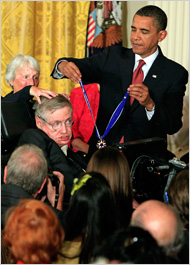
And now the British are weighing in also.  Yesterday, Stephen Hawking received his Presidential Medal of Freedom and jumped in with a response to the Investor’s Business Daily – which in it’s zeal appears to have forgotten that Mr. Hawking is British and under National Health.  The best summary is in the New York Times ,

The physicist Stephen Hawking is defending Britain’s National Health Service after an editorial in Investor’s Business Daily said Mr. Hawking “wouldn’t have a chance in the U.K.,” where the health service would have deemed his life “essentially worthless.”

The publication’s mistake, which came in an editorial titled “How House Bill Runs Over Grandma,” has since been corrected. But on a larger level, the snafu also shows how quickly rationing, particularly at the end of life, has become a focus of the health care reform debate.

Mr. Hawking — who received the Presidential Medal of Freedom at the White House on Wednesday — responded to the editorial this week, telling The Guardian newspaper, “I wouldn’t be here today if it were not for the N.H.S. I have received a large amount of high-quality treatment without which I would not have survived.”

DESCRIPTION

At this point, I fear for any type of health care reform.  New polls seem to show that older Americans oppose reform. The medical industry is threatening to pull support if legislation call for anything more that the co-op model.  Chris Matthews interviewed a man carrying a gun outside of the President’s New Hampshire town hall meeting.   I wonder if when they get back to Washington, there will be anyone left, Democratic or Republican, who wants to vote for health care reform.  Maybe they would prefer to just left the system explode or maybe implode.  Or we can be like Chris Hayes and try to laugh at the situation.

Here are parts of Hayes’  “Your Questions About Health Care Reform Answered”

Ok, so there’s been a lot of misinformation about proposals to reform the health insurance industry and provide (near) universal coverage. Understandable! It’s complicated stuff. Herewith, I’ll try to answer some questions

1) Is it true that all of the bills currently proposed would end the practice of “rescission,” whereby health insurance providers refuse to treat customers who’ve paid their premiums simply because they’ve become ill?

No! That’s a common misunderstanding. Actually, all of the bills would ban incisions, that is, they would legally bar surgeons from performing surgery until a panel of twelve gay illegal immigrant government bureaucrats unanimously signed off on the procedure.

2) Is it true that health care reform would ban insurers from refusing to insure people because of pre-existing conditions?

Wrong again. To get rid of health inequality, the bills actually mandate that every American be given a pre-existing condition. A National Illness Commission, with academics appointed from Harvard, Reed College and Berkeley, will evaluate each citizen, and based on their demographic profile, choose their malady. Each disease or syndrome is scored on a scale of 1 to 10, with 10 being the most severe. White christian men will receive pre-existing conditions of 8 or higher. Black people, “wise latinas,” and ACORN members will be exempted.

5) Will the current bills plug the “donut hole” in the Medicare prescription drug benefit so seniors don’t have to pay exorbitant out of pocket expenses for their medication?

Absolutely not. The legislation will ban donuts.

If you don’t laugh, you’ll have to cry.

What Affirmative Action Means in Real Life

Sonia Sotomayor is now officially Justice Sotomayor.  She took the oath administered by Chief Justice John Robert a few minutes ago.

On Thursday afternoon when the Senate voted to confirm her, the newest Senator, Al Franken the former comedian from Minnesota, was presiding and announced the vote.  Is this a great country or what?

Anita Hill has a very interesting Op-Ed in today’s Boston Globe discussing the role of what she calls “educational democracy” played in Justice Sotomayor’s elevation to the Supreme Court.

A LATINA from a Bronx housing project is probably not what Woodrow Wilson envisioned when he called for “educational democracy’’ as president of Princeton University in 1910. Yet decades later, when Sonia Sotomayor ascended to the top of her class, his idea of an open and accessible university system was on its way to coming to fruition. In Wilson’s day, Princeton admitted no women and Wilson himself is said to have looked with disfavor on the admission of men of color. Nevertheless, educational reform was a springboard for his larger aims of social and political reform and his fight against “the rule of materialism in our national life.’’

Indeed, Wilson would have needed a high-definition crystal ball to foresee Sotomayor’s “incredible journey’’ to become an African-American president’s nominee to the Supreme Court. Yet, as a critical chapter in our country’s pursuit of educational equality, her story of hard work and high achievement is an extension of Wilson’s idea. She represents the positive change that can occur when social institutions – law and education in particular – shed their roles as tools for exclusion and open their doors to those previously barred. It took nearly 220 years for the first Latina justice to be appointed to the Supreme Court, but, in a country constitutionally committed to equal opportunity, it was inevitable.

It was under President Wilson that women gained the right to vote – a reward for suspending demonstrations for suffrage during World War I.  And I’ve always thought that Edith Wilson had influence here also even though I don’t believe that any historical facts have ever surfaced to proved this.

Hill goes on

Sotomayor is poised to prove that the social experiment of the 1970s built on the idea of educational democracy has, thus far, worked. For its full realization, President Obama must correct the documented shortcomings of public schools that weigh most heavily on poor and minority community schools. We can’t be satisfied with one Sonia Sotomayor when we have the potential for so many more. For now, with her confirmation as the first Latina and third woman on the Supreme Court, Obama has reminded us of what egalitarian ideals and the will to pursue them can accomplish.

I think Hill is right.  Educational democracy leads to a critical mass of women, African Americans, or other ethnic minorities ready to take on jobs and challenges that have not been open to them in the past.  This leads to a cascade of changes in our society such as the election of the first African American President. 

I think it is the loss of this exclusivity that has the white Republican men on the Senate Judiciary Committee so frightened.  Perhaps they have seen all along where affirmative action or educational democracy was going to lead and why they have been so opposed to change.  But that is probably giving them too much credit and they are just frightened of change that puts them in a position where they are no longer superior.  One where they have to share power and priviledge.

Congratuations, Justice Sotomayor!  And may the President’s next appointment be someone as wise as you.  Perhaps a wise Asian American man or woman or a wise African American woman.  Mary Frances Berry, anyone?

Liar, Liar

Interesting story on NPR tonight.  A group called PoliFact is following the health care debate.

Bill Adair, editor of PolitiFact and the Washington bureau chief for the St. Petersburg Times, tells Melissa Block that one group that opposes an overhaul says the health care bill allows illegal immigrants to get free medicine.

“We gave that our lowest rating on our Truth-O-Meter: a pants on fire,” he says. “To the contrary, there’s language [in the bill] that says that undocumented aliens would not be eligible for the credit under this plan.”

The claim came from a chain e-mail that included many other assertions, including one that said a “health choices commissioner” would decide health benefits and that individual consumers would have no choices. This claim, too, got a “pants on fire” from PolitiFact.

“This chain e-mail is very persuasive in many ways because it has specific language, page numbers from the bill, but when you look at what it uses to back up a claim like that, it’s just not true,” Adair says. “There is a health commissioner that would be responsible for running the exchange under the main bills that have been discussed, but it’s not like that person would say you couldn’t get coverage or you could. That person would just be responsible to administer what the general standards were for the programs.”

Bogus claims aren’t just coming from those who oppose an overhaul. Democratic Rep. Russ Carnahan of Missouri recently claimed that the Congressional Budget Office estimated the current plan would create a $6 billion surplus over 10 years. Adair’s group has rated that as false.

“That really was a little bit of budget trickery there,” he says. “He is wrong that the CBO said this. The CBO said that the health care plan would post a deficit of something like $239 billion, something like that.

“What he’s doing is including some other numbers to try to erase that and actually make it look like a $6 billion surplus, but that’s not what the CBO says.”

Very interesting.

Where are the Republican Ideas?

The Democrats have large majorities in the House and Senate.  The President is a Democrat.  I believe the majority of governors are also now Democrats.  And being Democrats, they are bickering among themselves about the details of things they all agree need to be done.  It seems to me this would be a perfect opportunity for the Republicans to offer a substantial plan on, say health care.  Instead, we have the birther movement.  Newsweek has published the President’t birthcertificate to celebrate his birthday.

But the birthers are sure this is fake.

Back to health care.  Congress is back home this month and holding town meetings.  Instead of offering alternative and maybe asking some reasonable questions, the Republican strategy is to scream and disrupt these meetings.  In fairness to them, this is not a tactic they invented (as much as Dick Armey’s lobbying firm might want to think they did).  Chris Hayes  in his blog in the Nation looks at the situation this way

I’m on a team in American politics: I’m proudly, vigorously on the left. So there’s no need to bend over backwards to be formally consistent. That said, intellectual honesty requires one to separate out one’s formal objections from substantive ones and I’ve been given pause by the remarks of some right-wing activists like Jon Henke. He and others have been saying: wait a sec, when the left shows up and makes noise somewhere it’s activism, but when the right does it it’s thuggery and mob rule?

So after discussing the issue on Maddow last night, I’ve been asking myself, aside from the deep substantive opposition I have to the tea-baggers’ ideological agenda (and the insane hypocrisy of people on Medicare screaming about the dangers of government-run health care), what, exactly, my beef is?

I don’t think there’s anything “wrong” with the tactics of those people who, with the facilitation of large monied interests, are organizing and shouting down their opponents at town hall meetings. But one thing should be clear: these are the tactics of a small, motivated, enraged and engaged minority. The footage of recent town hall scrums remind me, actually, of ACT-UP actions back in NYC when I was growing up. ACT-UP, the AIDS and gay rights group that flourished in the 1980s and 1990s, was impassioned and angry and used dramatic confrontational action to great public effect. They were a vanguard. They were a small, tightly coordinated impassioned minority. And they were fundamentally on the right side of history.

What frustrates me, however, is that no one in the press confused ACT-UP with broader public opinion. No pundits said “the public is clearly feeling rising unease about government inaction on AIDS, as evidenced by the latest ACT-UP protest.” Why? Because they were gay, and they had AIDS and they didn’t look like “average citizens” or “heartland” voters.

At their root, the town hall protests are a very similar phenomenon. I think these people, unlike ACT-UP, are wrong. Deeply wrong. (They’re also not literally fighting for their lives because of a homophobic and indifferent government, but that’s neither here nor there). But they’re a small, tightly coordinated, enraged minority. They want to scream and fuss, it’s a free country, as they say.

The problem is the overwhelming instinct on the part of pundits and the MSM to look, and see old white men in overalls and Legionnaire hats and think they are watching someone give voice to the sentiments of broad swaths of the electorate. And it’s just not true. What we’re seeing at these events are the voices of radicals, extremists and zealots.

Harold Myerson writing in the Washington Post points out that the protesters are overwhemingly not people of color.

Last weekend, right-wing Republicans stormed a number of such meetings across the country, shouting down members of the House and, in Philadelphia, Sen. Arlen Specter and Health and Human Services Secretary Kathleen Sebelius. In Austin, protesters blocked Democratic Rep. Lloyd Doggett’s car and made it impossible for him to talk to constituents about such matters as appointments to military academies.

What’s particularly curious about these two protests is that they took place on very liberal turf — Philadelphia and Austin — yet the local liberals and people of color seemed absent. Philadelphia is a heavily African American city, yet one strains to see any blacks among the protesters on the YouTube clips. The activists who have been whipped into a frenzy, and who have dominated the recess meetings so far, appear to be conservative whites.

The question, as Meyerson goes on to ask, is why aren’t people of color, the young folks who worked for Obama, the progressives and the liberals turning out for the town hall meetings?   Meyerson again

When future historians look back at this passage in our nation’s history, I suspect they’ll conclude that this Obama-isn’t-American nuttiness refracted the insecurities and, in some cases, the hatred that a portion of conservative white America felt about having a black president and about the transformation of what many thought of as their white nation into a genuinely multiracial republic. But whatever the reasons, a mobilized minority is making a very plausible play to thwart a demobilized majority.

So we have a black President that one whole segment of the population (77% of Americans think he is a citizen but only 42% of Republicans think he is)  thinks is not really not President trying to reverse the slide into economic inequality and to promote racial equality at the same time.  This is a time when we should be having great debates about ideas not screaming at each other about where the President was born.

A genuine debate about ideas would help create better legislation and make the Democrats sharpen their ideas.  Maybe it would get those of us who support health care reform out to town hall meetings to talk about ideas.  But, unfortunately, the Republican party seems to be out of ideas.

So what’s up with the Democrats and Health Care

Will the Blue Dogs kill Heath Care reform or can Nancy Pelosi, Ted Kennedy, and the President prevail?

Here is a blog entry by Christopher Hayes from July 28 titled “What the Hell Is Max Baucus thinking!?!”

The following comes from a reader and frequent correspondent. This is not someone with particularly progressive politics. In fact, he only very recently has come to identify as a Democrat. No radical lefty, he.

 I don’t get the democrats on this one. Even if Charles Grassley and Olympia Snowe vote for this deal, the Republicans will still run against it as the Obama/Pelosi plan. Why not stick to your guns, treat the problem from a parliamentary perspective, and put through a plan that you actually think is optimal. The current attempt won’t protect their downside at all and may limit the upside. Very frustrating.

 More than frustrating. Enraging.

That’s it, the entire entry.  A lot of us are asking the same question.

Then there is my health care guy, Howard Dean.

Howard Dean guest hosted Countdown with Keith Olbermann at an opportune time last night, following reports that the Senate Finance Committee–helmed by Montana Democrat Max Baucus–is preparing to exclude a public option from its long-awaited healthcare bill.

“What if the Senate Finance Committee has already done the Republicans’ dirty work for them?” Dean asked rhetorically at the beginning of show.

Dean has just authored a book on healthcare reform–detailing why America needs a public option–and knows quite a bit about the subject from his years as a doctor and governor of Vermont. He called Baucus’s reported bill the “so-called compromise.”

Dean asked Chris Van Hollen, chairman of the Democratic Congressional Campaign Committee, why Baucus would “give away something something so fundamental to healthcare reform as a public option?”

“We‘ve got to have a public option in the plan that we send to the president‘s desk,” Van Hollen responded. “We‘re all still hoping that the Senate Finance Committee bill will have a public option.”

Dean noted that 72 percent of Americans, according to a New York Times poll, support a public option. “Is what Americans want already dead in the Senate?” Dean asked.

“No,” Van Hollen answered. “I certainly hope not. It‘s certainly not dead with respect to the bill that we‘ll send to the president‘s desk.” But it isn’t clear what kind of leverage House Democrats have with the likes of Baucus, nor do we know yet whether they’ll be able to keep their own Blue Dog conservatives in line.

“Voters were promised change they can believe in,” Dean told Van Hollen. “Are you concerned about what may happen to our party in 2010 or 2012 if we don‘t get any change at all?”

I’m not quite sure why the Blue Dogs and the Republicans are so afraid of the public option.  Health care for veterans which works pretty well is public as is Medicare.  So back to Chris Hayes and his post from today.

This has got me thinking: Republicans opposed Medicare when it was created. They hate socialized medicine, government-run health care and the public option now. So why don’t they put their money with their mouths are and propose scrapping Medicare? Any bills like this been introduced? If not, why not? I seriously think every single conservative and Republican caught railing against government run healthcare needs to be asked if they support disbanding Medicare.

Doing the Beer Run

Yesterday, amid all the release of the 911 tape, the radio chatter, and the arrest report (which appeared to show that the arrest report may not have been 100% accurate) came the big news :  The profiler, the profiled and the President will be having a beer and a chat at the White House on Thursday night.  I think this is an excellent thing and maybe some greater good will come out of it, if not for the country as a whole, but  for the City of Cambridge.  Perhaps Mayor Simmons can get Crowley and Gates to lead the public forum she is planning.

And according to Robert Gibbs’ discussion with a reporter at his briefing yesterday, he and the reporter will be doing the beer run.  This exchange reported in Politico.com

The planned reunion was the subject of light-hearted banter at Gibbs’ briefing on Monday:

Q: Okay. And another subject, Officer Crowley is drinking Blue Moon, we hear Professor Gates is drinking Red Stripe or Becks — what’s the President drinking?

 MR. GIBBS: The President had a Budweiser at the All-Star Game, so — why are you looking at me like that? That’s what he drank.

 Q: We’re talking Blue Moon, Red Stripe, Becks —

 MR. GIBBS: What’s wrong with Budweiser? Why do you hate Budweiser? (Laughter.)

 Q: Well, he could get —

 MR. GIBBS: Why do you hate Budweiser, Wendell? (Laughter.) Wendell, how about this — how about you and I, we’ll go pick out the beer, we’ll do the beer run. Uh-oh, hold, please. (Laughter.)

 Q: I’m happy to do that.

All joking aside, I think this is an important meeting and, as someone, maybe the President himself, said a teachable moment.

I’ll be having either a Harp or a Red Stripe.

Lessons from the Sotomayor Hearings

Over the weekend two very interesting pieces appeared.  One was Frank Rich’s column  in the New York Times, the other Melissa Harris Lacewell in the Nation.  Both approach the subject of Senatorial attitude toward a Latina woman.  One writer is a middle aged white male and former New York Times theater critic, the other a young, African American professor at Princeton. 

Here is Rich

Yet the Sotomayor show was still rich in historical significance. Someday we may regard it as we do those final, frozen tableaus of Pompeii. It offered a vivid snapshot of what Washington looked like when clueless ancien-régime conservatives were feebly clinging to their last levers of power, blissfully oblivious to the new America that was crashing down on their heads and reducing their antics to a sideshow as ridiculous as it was obsolescent.

The hearings were pure “Alice in Wonderland.” Reality was turned upside down. Southern senators who relate every question to race, ethnicity and gender just assumed that their unreconstructed obsessions are America’s and that the country would find them riveting. Instead the country yawned. The Sotomayor questioners also assumed a Hispanic woman, simply for being a Hispanic woman, could be portrayed as The Other and patronized like a greenhorn unfamiliar with How We Do Things Around Here. The senators seemed to have no idea they were describing themselves when they tried to caricature Sotomayor as an overemotional, biased ideologue.

And here Harris-Lacewell

The hearing was a performance of a broader set of social rules that govern race and gender interactions in American politics. Women, and most especially black and brown women, have to prove their fitness for public life by demonstrating the ability to endure harsh brutality without openly fighting back. The ability to bear up under public degradation is a test of worth. America’s favorite black woman heroine is Rosa Parks, a woman who is remembered as silently enduring the humiliation of being ejected from a public bus for refusing to comply with segregated seating.

Sotomayor passed the test. She met the Senators’ questioning with thoughtful responses. Her voice did not quiver. Her face did not scowl. Many women of all races feel inspired by her. But I wonder about this lesson that continues to teach women that we can only have space in the public realm as long as we control all emotion.

They are both describing what Harris-Lacewell calls “the politics of public humiliation.”  The practice of this kind of politics in the year 2009 says more about the Republicans than about Sotomayor – or the current status of women of color.

Rich ties the Republicans to the Class of  1994, the Class of the Contract with America, the Newt Gingrich class.

That the class of ’94 failed on almost every count is a matter of history, no matter how hard it has retroactively tried to blame its disastrous record on George W. Bush. Its incompetence may even have been greater than its world-class hypocrisy. Its only memorable achievements were to shut down the government in a fit of pique and to impeach Bill Clinton in a tsunami of moral outrage.

…Today the G.O.P.’s token black is its party chairman, Michael Steele, who last week unveiled his latest strategy for recruiting minority voters. “My plan is to say, ‘Y’all come!’ ” he explained, adding “I got the fried chicken and potato salad!”Among Sotomayor’s questioners, both Coburn and Lindsey Graham are class of ’94. They — along with Jeff Sessions, a former Alabama attorney general best known for his unsuccessful prosecutions of civil rights activists — set the Republicans’ tone last week. In one of his many cringe-inducing moments, Graham suggested to Sotomayor that she had “a temperament problem” and advised that “maybe these hearings are a time for self-reflection.” That’s the crux of the ’94 spirit, even more than its constant, whiny refrain of white victimization: Hold others to a standard that you would not think of enforcing on yourself or your peers. Self-reflection may be mandatory for Sotomayor, but it certainly isn’t for Graham.

Harris-Lacewell puts it this way

All Supreme Court nominees endure tough, ideologically driven questioning. It’s as true for white male conservative justices as for Sotomayor. But this public display took on different meaning as white men repeatedly asserted that Sotomayor was capable of making legal judgments based only on her personal experience and ethnic identity.

I was proud of Sotomayor’s restraint, but I also wanted her to counter attack, to punch back, to show anger. She couldn’t do so in part because she is bound by the rules of judicial decorum. She also couldn’t do so because of the racialized, gender rules of political engagement that allow white men, from senators to firemen, to express outrage, indignation, and emotion, but disallow those same expressions from women of color.

So what have we learned?  We have learned that maybe Lacewell-Harris is right when she compares Sonia Sotomayor to Little Rock Nine student, Elizabeth Eckford.

One of the most enduring images of the Civil Rights Movement is of Elizabeth Eckford. She is being harassed and taunted by a group of white students, parents, and police on her way to desegregate Central High School in Little Rock, Arkansas. On that morning Eckford missed connecting with the eight other African American students of the Little Rock Nine and their NAACP leader, Daisy Bates. Eckford was alone when the angry crowd surrounded and confronted her

Only now the mob is the composed of white, mostly southern, Republican Senators.

We have learned that women, regardless of race, regardless of how successful they may be,  still have to behave differently than men, that there is still a double standard.

We have learned, again, that the Republican Party is mostly clueless when it comes to race.  And I believe that their fear and dislike of Barack Obama will drive most of their behavior over the next eight years.