Why are we still fighting over birth control?

The Affordable Care Act aka Obamacare, included a provision for insurance to cover the cost of birth control.  After all, it has been estimated that 99% of all women use birth control at some point in their lives.  This is not just non-Catholic women.  Contraception is not cheap.  Without insurance, birth control pills can cost up to $100 a month.  Not affordable to lower income women who are also ones who can least afford to have unplanned children.  The pill is used for hormone regulation, not just birth control, a fact often ignored.

In fact, regardless of what the Pope and Cardinals and Archbishops in the United States think, Catholic women do use birth control.  I’m sorry, but no one has explained to me why a bunch of celibate men want to control women.  If you are against abortion, birth control would seem to be reasonable.  Of course, if you believe that life begins at the moment of conception, then some methods are problematic.  But we have no idea how many fertilized eggs just naturally abort, but I guess the distinction here is one is natural and the other has an artificial cause.  I should say that birth control also faces opposition from fundamentalist churches that are not Catholic.  The other thing that plays into the objection to birth control is that sex is to be reserved for marriage and for procreation.  There:   The objections to both birth control and gay marriage in one neat package.

The Obama administration has been twisting itself into knots to make sure that women who choose to use birth control have it covered under their health insurance.  The most recent proposal was outlined by the New York Times.

The Obama administration on Friday proposed yet another compromise to address strenuous objections from religious organizations about a policy requiring health insurance plans to provide free contraceptives, but the change did not end the political furor or legal fight over the issue.

The proposal could expand the number of groups that do not need to pay directly for birth control coverage, encompassing not only churches and other religious organizations, but also some religiously affiliated hospitals, universities and social service agencies. Health insurance companies would pay for the coverage.

The latest proposed change is the third in the last 15 months, all announced on Fridays, as President Obama has struggled to balance women’s rights, health care and religious liberty. Legal experts said the fight could end up in the Supreme Court

You can see the Department of Health and Human Services (HHS)  fact sheet here.

Religious groups dissatisfied with the new proposal want a broader, more explicit exemption for religious organizations and protection for secular businesses owned by people with religious objections to contraceptive coverage.

The tortured history of the rule has played out in several chapters. The Obama administration first issued standards requiring insurers to cover contraceptives for women in August 2011, less than a month after receiving recommendations to that effect from the National Academy of Sciences. In January 2012, the administration rejected a broad exemption sought by the Roman Catholic Church for insurance provided by Catholic hospitals, colleges and charities. After a firestorm of criticism from Catholic bishops and Republican lawmakers, the administration offered a possible compromise that February. But it left many questions unanswered and did not say how coverage would be provided for self-insured religious organizations.

Under the new proposal, churches and nonprofit religious organizations that object to providing birth control coverage on religious grounds would not have to pay for it.

Female employees could get free contraceptive coverage through a separate plan that would be provided by a health insurer. Institutions objecting to the coverage would not pay for the contraceptives.

Yesterday the Catholic Bishops weighed in

“The administration’s proposal maintains its inaccurate distinction among religious ministries,” said Cardinal Timothy M. Dolan of New York, the president of the United States Conference of Catholic Bishops. “It appears to offer second-class status to our first-class institutions in Catholic health care, Catholic education and Catholic charities. The Department of Health and Human Services offers what it calls an ‘accommodation,’ rather than accepting the fact that these ministries are integral to our church and worthy of the same exemption as our Catholic churches.”

The bishops’ statement, issued after they had reviewed President Obama’s proposal for six days, was more moderate and measured than their criticisms of the original rule issued by the White House early last year. Cardinal Dolan said the bishops wanted to work with the administration to find a solution.

The administration had no immediate reaction to the bishops’ statement, other than to say it was not a surprise.

One thing is clear, the Obama administration does not want to start saying the private business owners can opt out of paying for insurance that covers things they find objectionable.  What if we go from birth control to vaccinations to flu shots?

The birth control issue will end up in court and probably the Supreme Court.  For people who say they don’t want the ACA because they don’t want government controlling their health care, this the ultimate irony.  In case they haven’t noticed.  The Supreme Court is a branch of government.

So until the courts decide, Emily Douglas at the Nation has prepared this handy chart for you.
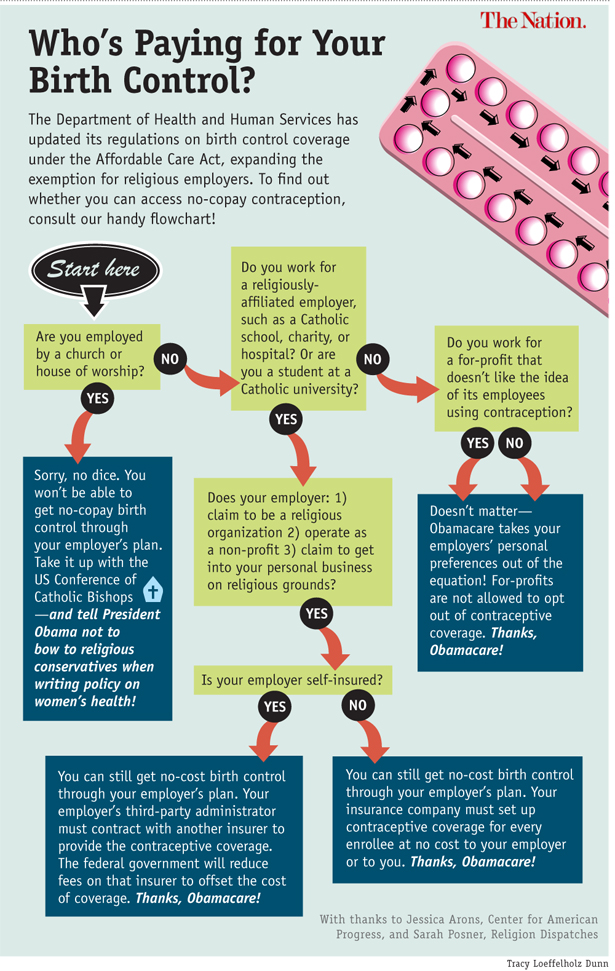
How to pay for your bith control

I guess I sound bitter, but I thought we already had this fight 40 years ago.  Contraception is supposed to be a routine option for women’s health care.

Why we need univeral health care

I’ve written about this before particularly when the Affordable Health Care Act (aka Obamacare) was in the works, but this is a really good example of why we need it.  Yesterday the New York Times had a long story about the hospital crisis in North Dakota.  This is the same North Dakota where we are having an oil boom and where there is no unemployment.  But there is a health care crisis.

The patients come with burns from hot water, with hands and fingers crushed by steel tongs, with injuries from chains that have whipsawed them off their feet. Ambulances carry mangled, bloodied bodies from accidents on roads packed with trucks and heavy-footed drivers.

The furious pace of oil exploration that has made North Dakota one of the healthiest economies in the country has had the opposite effect on the region’s health care providers. Swamped by uninsured laborers flocking to dangerous jobs, medical facilities in the area are sinking under skyrocketing debt, a flood of gruesome injuries and bloated business costs from the inflated economy.

These are men is mostly unskilled jobs without health insurance.

Hospitals cannot simply refuse to treat people or raise their rates. Expenses at those 12 facilities increased by 15 percent, Mr. Bertsch added, and nine of them experienced operating losses. Costs are rising to hire and retain service staff members, as hospitals compete with fast food restaurants that pay wages of about $20 an hour.

“Plain and simple, those kinds of things are not sustainable,” he said.

Many of the new patients are transient men without health insurance or a permanent address in the area. In one of the biggest drivers of the hospital debt, patients give inaccurate contact information; when the time comes to collect payment, the patients cannot be found. McKenzie County Hospital has invested in new software that will help verify the information patients give on the spot.

To their credit, public officials in North Dakota are trying to do something.

Mr. Kelly has pushed for the state, which has a surplus of more than $1 billion, to allocate money intended for the oil region specifically to health care facilities in the area. He has also asked for the state to grant low-interest loans so hospitals can borrow money for facility improvements and for the governor to convene a task force to study health care issues in the oil patch.

Aides to Gov. Jack Dalrymple say he is taking steps to bolster medical training in the state, proposing to spend $68 million on a new medical school building at the University of North Dakota and $6 million to expand the nursing program at Lake Region State College. Mr. Dalrymple, a Republican, has also increased Medicaid financing for the state’s rural hospitals.

US residents with employer-based private healt...

US residents with employer-based private health insurance, with self insurance, with Medicare or Medicaid or military health care and uninsured in Million; U.S. Census bureau: Income, Poverty, and Health Insurance Coverage in the United States: 2007 (Photo credit: Wikipedia)

If we had universal health care, every one of those men would carry a card.  If we had computerized records that were actually accessible the doctors would have a medical history.  Right now the best we can hope for is that some of them will get employer paid insurance next year as the ACA continues to be implemented.  In the meanwhile, the health care system will struggle.

The cramped housing camps where many oil workers live can add to health issues. On a recent afternoon at McKenzie County Hospital, a man limped into the emergency room complaining about a dry, red patch of skin on his leg. Dr. Gary Ramage, the hospital’s sole full-time physician, said it was a bite from a brown recluse spider, which had most likely nested under the trailer where the man lives.

But for now, Dr. Ramage, a gregarious Canadian who has worked here for 18 years, is left shouldering much of the load. Before the oil boom started a few years back, Dr. Ramage covered both the clinic and the emergency room. Now he mostly works at the clinic, while the hospital hires roving physicians to cover the emergency room. He is well known in the community, and people call him at home when they are sick. But now, he does not know many of the patients he sees.

“My work is no longer small-town work,” he said. “My work has now been transformed from that of a small family practitioner to basically an E.R. doc.”

Dr. Gary Ramage treating a patient at McKenzie County Hospital in Watford City, N.D. The hospital now averages 400 emergency room visits per month.

Photograph: Matthew Staver for The New York Times

Looking back at 2012 progressively

2012 was a pretty good year for those of a progressive/liberal political point of view and Winning Progressive has compiled a good summary.  You can read the entire article here, but I’ve pulled out some of my particular favorites – in my own order of significance.

First I have to talk about Mitch McConnell who not only lost his effort to make President Obama a one-termer, but last night voted to increase taxes.  (Although since it happened after we technically went off the cliff  at midnight, he will probably spin it as a decrease.)  I think he an John Boehner were the big losers last year, not Mitt.  Mitt is done with politics, but McConnell and Boehner have to continue to try to herd their Republican members and get re-elected.

President Obama re-elected

So now to some accomplishments.

* President Obama Re-Elected With A More Diverse and Progressive Congress– The November elections saw the re-election of President Obama and the election of four new progressive U.S. Senators – Mazie Hirono (D-HI), Elizabeth Warren (D-MA), Chris Murphy (D-CT), and Tammy Baldwin (D-WI).  In addition, Joe Lieberman (I-CT) is finally leaving the Senate!  On the House side, the Democrats elected in November will be the first major party caucus in US history that is majority female and people of color.  New House progressives will include Alan Grayson (FL-09), Jared Huffman (CA-02), Dan Kildee (MI-05), Ann McLane Kuster (NH-02), Grace Meng (NY-06), Patrick Murphy (FL-18), Rick Nolan (MN-08), Mark Pocan (WI-02), Raul Ruiz (CA-36), Carol Shea-Porter (NH-01), Mark Tacano (CA-41), Hakeem Jeffries (NY-08), and Kyrsten Simena (AZ-09).  On the flip side, tea party conservatives Allen West (FL), Chip Cravaack (MN), Bobby Schilling (IL), Roscoe Bartlett (MD), Ann-Marie Buerkle (NY), Francisco Canseco (TX), and Joe Walsh (IL) were all defeat and, hopefully, will never be heard from politically again.

* LGBT Equality– 2012 was, of course, a banner year for advancing LGBT equality.  For the first time in US history, equality was supported by a majority of voters facing ballot proposals approving marriage equality in Maine, Washington, and Maryland, and refusing to ban equality in Minnesota. The first openly lesbian U.S. Senator, Tammy Baldwin (D-WI) was elected in November as were a record seven openly-gay House members.  President Obama publicly supported marriage equality, and anti-equality forces in Iowa failed in their effort to recall a state Supreme Court justice who declared that state’s ban on marriage equality unconstitutional.  In February, a federal appellate court ruled California’s anti-marriage equality Proposition 8 unconstitutional, and two federal courts in 2012 did the same with the Defense of Marriage Act.

* Health Care Reform – In a decision that surprised many commentators, the U.S. Supreme Court upheld the Patient Protection and Affordable Care Act, aka “ObamaCare.”And while the GOP-controlled House has voted at least 33 times to repeal ObamaCare, President Obama’s re-election in November virtually guarantees that will never occur.   In implementing ObamaCare, the Obama Administration, standing up to strong opposition from conservative religious organizations, finalized rules requiring that contraception be included as a preventive health service that insurance policies must cover with no co-pay.  This will help millions of women afford access to birth control and also save money by reducing unintended pregnancies.

Those are my personal big three.

Yes, there is a lot left to do and a lot that happened that I didn’t particularly think was terrific, but on the first day of a new year, we should celebrate our successes!

Obama and Women’s Healthcare

While I was working on the last post about Akin, Ryan etc., I ran across this great summary of what the Affordable Care Act does for women.  In a column titled Obamacare(s) for Women, Katha Pollitt published in the Nation she provided this handy list of benefits.

Women will get a lot out of the Affordable Care Act. Here are just some of the ways:

1. As many as 10 million will get coverage in 2014 under Medicaid expansion, and by 2016, thanks to other provisions of the ACA, that number will grow to 13.5 million women.

2. By 2014, all plans sold to individuals will be required to cover maternity care. According to the National Women’s Law Center, 12 percent of those plans include that. Remember when Arizona’s Jon Kyl said he didn’t think his insurance should have to cover pregnancy and childbirth because he would never need it? The ACA destroys the mindset that care needed only by women is of no general concern.

3. More than 20 million women will get expanded coverage of preventive services—prenatal care, mammograms, pap smears, breast-feeding supplies, testing for sexually transmitted diseases, well woman checkups, immunizations, birth control and more.

4. Insurance companies will be barred from dropping women’s coverage when they become pregnant or sick.

5. Companies will be barred from denying coverage because of “pre-existing conditions,” like having had breast cancer, being pregnant (funny how that keeps coming up), having had a Caesarean or being the victim of domestic violence.

6. No more “gender rating”—charging women more for coverage just because they are women. This practice, already banned in some states but permitted in thirty-seven others, costs women a staggering $1 billion a year.

7. Older women will receive expanded preventive services through Medicare, like bone-density screenings for those at risk of osteoporosis.

8. The expansion of Medicaid will cover people who make up to 133 percent of the poverty line (about $31,000 a year for a family of four). True, enabled by the recent Supreme Court decision, at least eight red-state governors have said they will reject it. Let’s see how that works out for them.

9. The birth control provision is mammoth all by itself. Not only will it be costless to the patient; all methods must be covered. That means women will be able to choose the kind of birth control that works best for them, which means they are more likely to use it consistently. In particular, it means insurance must cover the most effective methods, including the IUD, which many plans exclude. At up to $1,000 upfront, it is too expensive for many women to shell out for, even though the IUD is one of the cheaper methods when you consider that it lasts for ten years or more. If anti-choicers really wanted to lower the number of abortions, they would be cheering this huge expansion of access to contraception. But no.

If Romney wins, women can wave goodbye to what Planned Parenthood has called “the single biggest advancement in women’s health in a generation.” Think about that next time someone tells you there’s no difference between the candidates. It’s just not true.

The President signs the Affordable Healthcare Act.  Photo by AP Photo/J. Scott Applewhite

Mittens the mean

Whether you are going to vote for him or not, Mitt Romney has kinda a nice but clueless rich guy image.  Don’t let that fool you.  Joan Vennochi reminds us of his history here in Massachusetts.

Massachusetts is where Romney first showed his appetite for running over any candidate who stands between him and political office. Here, it happened to be women.

When Romney decided to run against Ted Kennedy in 1994, Republican Janet Jeghelian, a former talk radio host, was in the race. Once Romney jumped in, he and the state GOP kept her off the primary ballot.

Jeghelian wasn’t a strong candidate, but she was a prescient one. After she was forced out, she predicted he would waffle on abortion rights. It took awhile, but he did.

Seven years later, Romney muscled out acting Governor Jane Swift, who had his pledge that he would not challenge her for the nomination. But fresh from running the winter Olympics, Romney jumped in, and without so much as a courtesy phone call, pushed out the politically weak Swift.

Realizing the delicacy of kicking aside the Bay State’s first female chief executive, Romney recruited another woman, Kerry Healey, to run as his lieutenant governor and vouch for his pro-choice credentials. Once elected, he relegated Healey to back channel roles, but she remains loyal and supports his presidential bid.

These tactics should be familiar to Rick Santorum and the other Republican candidates only there he did it with his super Pac and advertising.

Joan’s point is that all of this leads to a lack of trust which hurts him particularly among women.  And while he has flip-flopped on a number of issues two matter to women.  The first is his support of abortion rights during his Massachusetts Senate campaign.  And he has done a major flop on Massachusetts health care reform.

As Shannon O’Brien, the Democrat he defeated in 2002, points out, “The choice issue is just one glaring reason why women can’t trust Mr. Romney. The broader, more profound issue is about what he will do to protect and preserve family health care across the country. Where he had such promise as governor, setting the stage for using Massachusetts as a national model, now he’s saying he didn’t mean it, never said it, doesn’t want it. That’s the biggest flip-flop-flip that women should be concerned about.’’

Massachusetts Democrats are gleefully reminding voters of Romney’s singular role in health care reform. He pushed for the individual mandate. He personally escorted the first woman who signed up for Romneycare. At his request, his official State House portrait, which hangs in the reception area of the governor’s office, includes the artist’s rendition of Romney’s wife, Ann, and a stack of papers representing the state’s health care law.

Will he have his portrait replaced next?

Men and women run against each other with regularity these days.  Look at President Obama and Secretary of State Clinton.  The point is that Mitt doesn’t seem to care about the niceties.  He could have run in a primary against both Swift and Jeghelian and maybe he would have won.  Maybe it is just coincidence that the two candidates he ran over were women and we will never know whether he would have jumped in if they had been men.  I think he just would have competed in the primary and blasted his opponent with negative advertising.

So all of you fellow Obama supporters take heed:  this is not a nice guy and brace yourself for a negative campaign and he tries desperately to recapture the women’s vote he needs to win.  Luckily, I don’t think he can flip again on either abortion or health care as that flip will cost him his Republican support. 

We can only hope he stays perplexed.


Myths about the Health Care Law

I will likely be writing a lot about the health care law as the Supreme Court hears the case next week.   Walter Dellinger had a nice piece in today’s Washington Post dissecting five of the myths related to the Affordable Health Care Act or Health Care Reform.  I look at 3 of the myths.

Myth 1:  Everyone is forced to buy health insurance.  Dellinger writes

The law states that, beginning in 2014, individuals must ensure that they and their dependents are covered by health insurance. Taxpayers who do not meet this requirement will have to pay a penalty that the law calls a “shared responsibility payment.” It begins at $95 for the first year and never exceeds 21 / 2 percent of anyone’s annual taxable income.

A great majority of Americans, of course, have health insurance through their employers, Medicare or Medicaid and are already in compliance with this requirement. Given the relatively modest payment required of those who choose not to maintain insurance, no one is being literally forced to buy a product they don’t want.

The challengers argue that the mandate is a binding requirement that makes anyone who goes without insurance a lawbreaker. The government has determined, however, that those who pay the penalty, like those who are exempt from the penalty, are not lawbreakers. As a practical matter, the so-called mandate is just a relatively modest financial incentive to have health insurance.

Myth 3:  If the Supreme Court uphold the Affordable Care Act, Congress could force us to buy anything.

The health-care case is a test of Congress’s power under the Constitution to regulate commerce among the states. One way to defend the law is simply to say that a requirement to purchase insurance or any other product sold in interstate commerce is obviously a regulation of that commerce. President Ronald Reagan’s solicitor general, Charles Fried, and conservative judge Laurence Silberman have adopted this view.

The Obama administration is not relying upon such a sweeping argument, however, and its more limited claim would not justify any law that required Americans to buy products such as cars or broccoli.

Myth 5:  The Law is an extraordinary intrusion into liberty

Liberty is always said to be fatally eroded, it seems, when great advances in social legislation take place. The lawyers who urged the Supreme Court to strike down the Social Security Act of 1935 argued that if Congress could provide a retirement system for everyone 65 and older, it would have the power to set the retirement age at 30 and force the very young to support everyone else.

It was said that if Congress had the authority to create a minimum wage of $5 an hour, it would also be a regulation of commerce to set the minimum at $5,000 an hour. In 1964, critics argued that if Congress could tell restaurant owners not to discriminate on the basis of race, it could tell them what color tablecloths to use. None of these things happened.

Nothing in the health-care law tells doctors what they must say to patients or how those patients are to be treated. It only requires people to either have insurance coverage or pay a modest tax penalty.

I think this last is the argument you hear the most.  Change is always scary and many argue their fears.  One of the big arguments used against the Equal Rights Amendment by opponents was that it would require all bathrooms to be unisex.  In Virginia where I worked for the General Assembly to ratify the amendment, this was pretty potent especially with older women.  I think they envisioned a public rest room where men were lined up in full view using urinals!

How will the Court decide?  Hard to predict but there is one piece of hopeful new.  A moot court at the National Constitutional Center upheld Health Care Reform, 8 to 1.    The judges were:

Chief Judge: Timothy K. Lewis, Of Counsel at Schnader, Harrison, Segal & Lewis and former Judge, United States Court of Appeals for the Third Circuit

D. Michael Fisher, Judge, United States Court of Appeals for the Third Circuit

Thomas C. Goldstein, Partner, Goldstein and Russel, P.C., co-founder and publisher of SCOTUSblog

Kent A. Jordan, Judge, United States Court of Appeals for the Third Circuit

Theodore McKee, Chief Judge, United States Court of Appeals for the Third Circuit

Neil S. Siegel, Professor of Law and Political Science and co-director of the Program in Public Law at Duke University School of Law

Dolores K. Sloviter, Judge, United States Court Appeals for the Third Circuit

Patricia Wald, Judge, United States Court of Appeals for the District of Columbia Circuit

Richard C. Wesley, Judge, United States Court of Appeals for the Second Circuit

You can see video here.


Understanding Health Care Reform

Health Care reform is coming before the Supreme Court soon and in an effort to really understand what it is all about I picked up a copy of Jonathan Gruber‘s book “Health Care Reform

Health Care Reform: What It Is, Why It's Necessary, How It Works

It is a nifty graphic novel which does an excellent job of explaining why we need health care reformm what the reform will do and when, and how is will help reduce the deficit.  This last is the most complicated and I’m not sure I got it all in a single reading.

Gruber uses several characters in differing circumstances to illustrate the law’s impact.  On the whole, very nicely done and highly recommended if you want to understand what the Affordable Health Care Act is all about.  Gruber is an economist who worked first with Mitt Romney on reform in Massachusetts and then with President Obama and his team.

2012 Budget Talk

There are three budget proposals on the table that have been made public:  The President’s, Paul Ryan’s, and the Progressive Caucus.  So far all the talk is on Ryan’s cutting of Medicare.  It has defined the Republican politics.  Newt Gingrich found that out.  As I understand the President’s proposal it uses the 2008 budget as a baseline – a baseline we are already below. But no one is talking much about the Progressive budget.

The Progressive and Ryan budgets are good symbols of the world views currently held by many on the two sides.  The Democrats being democrats are not as monolithic and many will object to the severe defense cuts in the Progressive budget, but it seems to me that these proposals can be the end points that let everyone meet in the middle.

The National Priorities Project compares the two proposals.

  Congressional Progressive Caucus People’s Budget Rep. Ryan’s The Path to Prosperity
     
Underlying Philosophy Strengthens role of government in reducing income inequality and providing social safety net. Reduces deficit through combination of increased revenues and reductions in spending Relies on private sector to spur economic growth and employment using a trickle down approach. Reduces deficit solely through spending cuts
     
Revenues Shifts tax burden towards higher income earners and corporations Decreases taxes for wealthy and corporations
Individual Taxes Allows for the expiration of Bush era tax cuts Maintains the Bush era tax cuts
  Reverts highest individual tax brackets to 36% and 39.6% from 33% and 35% Cuts the top individual tax rate to 25% from 35%
  Enacts new tax brackets for high income earners (45%-49% for $1 million – $1 billion range Consolidates the current six tax brackets
  Taxes capital gains and dividends as ordinary income Eliminates $800 billion in tax increases imposed by the Patient Protection and Affordable Care Act
  Limits tax benefit of itemized deductions to 28%  
  Enacts progressive estate tax in which larger estates pay higher tax rates  
Corporate Taxes Imposes financial transaction tax on derivatives and speculative financial products Reduces corporate tax rate to 25% from 35%
  Repeals tax deductions and preferences for oil, natural gas and coal producers Eliminates loopholes and deductions that allow some corporations to pay no tax
  Taxes US corporate foreign income as it is earned instead of as dividend  
  Imposes tax equal to 0.15% of covered liabilities for banks with more than $50 billion in assets  
     
Investment Emphasizes public investment as engine for job creation and economic growth Believes that public investment crowds out private investment
  Rebuilds infrastructure – highways, railways, National Infrastructure Bank  
  Funds highway construction through increase in Gasoline Tax of 25 cents  
     
Health Care and Social Safety Net Maintains government role in providing vital public services and programs Limits government provision of social programs
  Maintains Medicare reimbursement rates for doctors Privatizes Medicare starting in 2022 for new beneficiaries
  Establishes public health care option in health care exchanges starting in 2014 Repeals Patient Protection and Affordable Care Act
  Negotiates drug prices with pharmaceutical companies Raises age of Medicare eligibility to 67 from 65
  Increases Social Security benefits based on higher employee contributions Converts Medicaid into block grants to the states
  Raises Social Security contribution limits, including employer contributions for high earners Converts SNAP (food stamps) into block grant to the states. Requires recipients to work or get job training
    Reduces Pell grants to 2008 levels
    Imposes time limits and work requirements for recipients of federal housing assistance (Section 8)
     
Defense Makes significant cuts in annual defense spending and ends the wars in Iraq and Afghanistan in FY2012 Largely exempts the military from spending cuts
Funding for Security Generates $2.3 trillion in savings compared to the CBO baseline over the FY2012-2021 period Provides real growth for “security” in each year through 2021, totaling $214 billion in new spending
Annual Pentagon Spending Reduces DoD baseline budget by $692.2 billion over 10 years compared to CBO, or $816.7 billion compared to the Obama Pentagon spending plan Reduces DoD waste by $178 billion. Reinvests $100 billion of this into key combat capabilities and uses $78 billion to reduce the deficit
Overseas Contingency Operations (Iraq & Afghanistan) Provides $161.4 billion for “Overseas Contingency Operations” (OCO) in FY2012 and withdraws U.S. forces from Iraq and Afghanistan. Provides no funding for OCO starting in FY2013, saving $1.6 trillion between 2013-2021 compared to the CBO baseline Continues Iraq and Afghanistan wars and provides $117.8 billion in FY2012. Anticipates over $1 trillion in savings from reduced costs of the “Global War on Terror” over the next decade by using the Pentagon’s $50 billion annual “placeholder” for OCO costs
     
Government Maintains size and role of government Reduces size and scope of government
  Provides percentage increases for discretionary programs Reduces size of government to 20% of GDP by 2015 and 15% of GDP by 2050
    Reduces non-security discretionary spending to pre-2008 levels
    Reduces public sector employment by 10% through attrition by 2014
    Institutes government pay freeze through 2015
    Increases federal employee contributions to retirement
    Privatizes Fannie Mae and Freddie Mac
    Decreases regulation of the energy industry
    Establishes a binding cap on total spending as a percentage of the economy
    Requires any increase in debt levels to be accompanied by spending reductions

I couldn’t find a chart that adds the President’s budget proposal, but here is a short summary.

Key Budget Facts

  • The Budget includes more than $1 trillion in deficit reduction – two-thirds of it from cuts — and puts the nation on a path toward fiscal sustainability so that by the middle of the decade, the government will be paying for what it spends and debt will no longer be increasing as a share of the economy.
  • The President meets his pledge to cut the deficit he inherited in half by the end of his first term.
  • Five-year non-security discretionary spending freeze will reduce the deficit by over $400 billion over the next decade and bring this spending to the lowest level since President Eisenhower sat in the Oval Office.
  • 10-year Deficit Reduction:  $1.1 trillion, excluding war savings and not extending 2001 and 2003 tax cuts for high-income earners. Two-thirds are from spending cuts.
  • 2011 Projected Deficit: $1.645 trillion, 10.9 percent of GDP; 2012 Projected Deficit: $1.101 trillion, 7.0 percent of GDP; 2015 Projected Deficit: $607 billion, 3.2 percent of GDP; 2017 Projected Deficit: $627 billion, 3.0 percent of GDP

The budget itself is composed of proposals made by federal agencies under guidelines from the White House budget folks, but it seems to be a timid version of the Progressive Budget.

The choices are pretty clear.  And the news this week – increased unemployment and no job creation – has everyone saying it is bad news for the President.  But with the layoffs of public employees is it surprising that unemployment is rising?  Wasn’t keeping the Bush tax cuts supposed to create jobs?  Where exactly are all these jobs?  The Republicans are all about not raising taxes on anyone and cutting the size of government and government benefits.  They don’t care about the widening gap between rich and poor but seem to be perfectly happy to accept tax payer paid benefits.   Like Congressman Woodall. (R- GA) who thinks we should all be self reliant except for him.

The bottom line:  We have two visions of American and the one that wins will determine our future.

Keeping the Faith

I’ve been thinking about the mid-term elections a lot recently.  With financial reform and health care reform passed, President Obama has kept two big promises.  Of course, neither bill is perfect.  But both are steps in the right direction.  So when his poll numbers go down anyway and the pundits think mid-term election disaster it is hard to keep the faith.  In this connection, I’m looking at a piece from last Sunday’s Boston Globe and Paul Krugman’s New York Times column from yesterday.

The Globe article by Joe Keohane in the Ideas section was titled “How Facts Backfire”  and the role factual information plays in a democracy.  It was pretty bleak and discouraging.

It’s one of the great assumptions underlying modern democracy that an informed citizenry is preferable to an uninformed one. “Whenever the people are well-informed, they can be trusted with their own government,” Thomas Jefferson wrote in 1789. This notion, carried down through the years, underlies everything from humble political pamphlets to presidential debates to the very notion of a free press. Mankind may be crooked timber, as Kant put it, uniquely susceptible to ignorance and misinformation, but it’s an article of faith that knowledge is the best remedy. If people are furnished with the facts, they will be clearer thinkers and better citizens. If they are ignorant, facts will enlighten them. If they are mistaken, facts will set them straight.

Maybe not. Recently, a few political scientists have begun to discover a human tendency deeply discouraging to anyone with faith in the power of information. It’s this: Facts don’t necessarily have the power to change our minds. In fact, quite the opposite. In a series of studies in 2005 and 2006, researchers at the University of Michigan found that when misinformed people, particularly political partisans, were exposed to corrected facts in news stories, they rarely changed their minds. In fact, they often became even more strongly set in their beliefs. Facts, they found, were not curing misinformation. Like an underpowered antibiotic, facts could actually make misinformation even stronger.

This bodes ill for a democracy, because most voters — the people making decisions about how the country runs — aren’t blank slates. They already have beliefs, and a set of facts lodged in their minds. The problem is that sometimes the things they think they know are objectively, provably false. And in the presence of the correct information, such people react very, very differently than the merely uninformed. Instead of changing their minds to reflect the correct information, they can entrench themselves even deeper.

“The general idea is that it’s absolutely threatening to admit you’re wrong,” says political scientist Brendan Nyhan, the lead researcher on the Michigan study. The phenomenon — known as “backfire” — is “a natural defense mechanism to avoid that cognitive dissonance.”

Paul Krugman wrote Friday about the Republicans proposed economic plan.  Basically tax cuts for the rich and nothing for the rest of us according to Krugman.

Republicans are feeling good about the midterms — so good that they’ve started saying what they really think. This week the party’s Senate leadership stopped pretending that it cares about deficits, stating explicitly that while we can’t afford to aid the unemployed or prevent mass layoffs of schoolteachers, cost is literally no object when it comes to tax cuts for the affluent

And that’s one reason — there are others — why you should fear the consequences if the G.O.P. actually does as well in November as it hopes.

For a while, leading Republicans posed as stern foes of federal red ink. Two weeks ago, in the official G.O.P. response to President Obama’s weekly radio address, Senator Saxby Chambliss devoted his entire time to the evils of government debt, “one of the most dangerous threats confronting America today.” He went on, “At some point we have to say ‘enough is enough.’ ”

But this past Monday Jon Kyl of Arizona, the second-ranking Republican in the Senate, was asked the obvious question: if deficits are so worrisome, what about the budgetary cost of extending the Bush tax cuts for the wealthy, which the Obama administration wants to let expire but Republicans want to make permanent? What should replace $650 billion or more in lost revenue over the next decade?

His answer was breathtaking: “You do need to offset the cost of increased spending. And that’s what Republicans object to. But you should never have to offset the cost of a deliberate decision to reduce tax rates on Americans.” So $30 billion in aid to the unemployed is unaffordable, but 20 times that much in tax cuts for the rich doesn’t count.

The next day, Mitch McConnell, the Senate minority leader, confirmed that Mr. Kyl was giving the official party line: “There’s no evidence whatsoever that the Bush tax cuts actually diminished revenue. They increased revenue, because of the vibrancy of these tax cuts in the economy. So I think what Senator Kyl was expressing was the view of virtually every Republican on that subject.”

The Republicans seem to be making it pretty clear that they want to go back to the old economic way.  Krugman continues

But we’re talking about voodoo economics here, so perhaps it’s not surprising that belief in the magical powers of tax cuts is a zombie doctrine: no matter how many times you kill it with facts, it just keeps coming back. And despite repeated failure in practice, it is, more than ever, the official view of the G.O.P.

Why should this scare you? On paper, solving America’s long-run fiscal problems is eminently doable: stronger cost control for Medicare plus a moderate rise in taxes would get us most of the way there. And the perception that the deficit is manageable has helped keep U.S. borrowing costs low.

But if politicians who insist that the way to reduce deficits is to cut taxes, not raise them, start winning elections again, how much faith can anyone have that we’ll do what needs to be done? Yes, we can have a fiscal crisis. But if we do, it won’t be because we’ve spent too much trying to create jobs and help the unemployed. It will be because investors have looked at our politics and concluded, with justification, that we’ve turned into a banana republic.

Krugman also looks at the facts

…But the real news here is the confirmation that Republicans remain committed to deep voodoo, the claim that cutting taxes actually increases revenues.It’s not true, of course. Ronald Reagan said that his tax cuts would reduce deficits, then presided over a near-tripling of federal debt. When Bill Clinton raised taxes on top incomes, conservatives predicted economic disaster; what actually followed was an economic boom and a remarkable swing from budget deficit to surplus. Then the Bush tax cuts came along, helping turn that surplus into a persistent deficit, even before the crash.

So the facts seem to be higher taxes on higher incomes results in lower deficits and more economic benefit for the rest of us.  But if we believe Joe Keohane, the facts don’t matter much to those that have settled beliefs.

…Most of us like to believe that our opinions have been formed over time by careful, rational consideration of facts and ideas, and that the decisions based on those opinions, therefore, have the ring of soundness and intelligence. In reality, we often base our opinions on our beliefs, which can have an uneasy relationship with facts. And rather than facts driving beliefs, our beliefs can dictate the facts we chose to accept. They can cause us to twist facts so they fit better with our preconceived notions. Worst of all, they can lead us to uncritically accept bad information just because it reinforces our beliefs. This reinforcement makes us more confident we’re right, and even less likely to listen to any new information. And then we vote.

This effect is only heightened by the information glut, which offers — alongside an unprecedented amount of good information — endless rumors, misinformation, and questionable variations on the truth. In other words, it’s never been easier for people to be wrong, and at the same time feel more certain that they’re right.

So how exactly do the Democrats combat all the Republican nonsense?  Not only the Kyl and McConnell quotes that Krugman mentions, but also statements that if the Republicans take over during the mid-terms they will repeal the health and financial reforms.  They know very well that if they try, there will be a Presidential veto and that they will not be able to keep that promise, but despite that fact, they will be believed.  Keohane discusses a number of studies and possibilities but the most immediate solution to this problem seems to be increasing self-esteem.

One avenue may involve self-esteem. Nyhan worked on one study in which he showed that people who were given a self-affirmation exercise were more likely to consider new information than people who had not. In other words, if you feel good about yourself, you’ll listen — and if you feel insecure or threatened, you won’t. This would also explain why demagogues benefit from keeping people agitated. The more threatened people feel, the less likely they are to listen to dissenting opinions, and the more easily controlled they are.

Increasing the self-esteem of the American electorate right now means creating jobs and making some radical moves on the economy.  Some of the benefits of the reforms will also begin to impact voters by fall.

The Democrats should take Eugene Robinson’s advice on Keith Olbermann’s Countdown last night. 

I mean it’s not like the Democrats don’t have something to run on this fall. So get out there and run on it.

Gene also said in a recent column in the Washington Post

One reason I’m not so confident of a Republican blowout in the fall is that while polls clearly show that the country is in an anti-incumbent mood, there’s also considerable evidence that people see the GOP as part of the problem, not part of the solution. A new Post-ABC News poll, for example, showed that 58 percent of voters have “just some” confidence, or even less, in President Obama’s leadership, and that 68 percent were similarly doubtful about the ability of congressional Democrats to lead. But 72 percent had little or no faith in congressional Republicans — which suggests to me that the GOP has work to do before its leaders start picking out new office suites in the Capitol.

Another reason for caution is that the Republican Party is out of step with the American public on so many issues. Americans want to see unemployment benefits extended. They want tougher financial regulation, complete with consumer protections. Even health-care reform, which the GOP succeeded in painting as the apocalypse, becomes more popular as the months pass and somehow the world does not end.

I have to believe that there is a large portion of the American electorate that can be swayed by facts.  And the ray of hope is in the slide that Olbermann showed with the results of the NBC/Wall Street Journal Poll which indicates that the majority would like more, not less regulation of Wall Street, big business, the health care industry and, by a big margin, the oil industry.  They won’t get that from the Republicans who want a moratorium on regulation.

The State of the Obama Presidency

All of our expectations were so high when Barack Obama took office 18 months ago.  He was going to fix the economy, end the wars in Iraq and Afganistan, give us health care reform, fix the schools, walk on water….

After 8 years of George W. and after the wasted Clinton years, we progressives were ready.  So where are we now?  This Doonesbury cartoon says its all.

We are like his kids and think he can do anything.  Unfortunately, there is the Senate to deal with and the fall elections which still look difficult for the Democrats.  I’m hoping they can just hang on to enough seats to keep control and Obama’s agenda has a fighting chance.