Rethinking budget priorities

In a recent op-ed column in the New York Times, Nicholas Kristof asks a simple question:  Prisons or Health Care?  We could expand that to ask the states, education or prisons?

At a time when there is no state that is not having trouble balancing its budget and cuts are being made to things like physical education and after school programs while class sizes are increasing, I haven’t heard anyone talk about cost we pay for incarceration.  And our prisons are also overcrowded.  There was a recent distrubance in the Middlesex County jail during which water pipes were destroyed leaving the prison uninhabitable.  We taxpayers will pay to reconstruct the jail, of course.

Why is no one talking about reducing the prison population as a way to save money?  We’ve known for a long time that the three strikes rule is great in baseball, but not so great when it comes to criminal justice, but I haven’t heard of anyone who has repealed their law.

To quote Kristof

It’s time for a fundamental re-evaluation of the criminal justice system, as legislation sponsored by Senator Jim Webb has called for, so that we’re no longer squandering money that would be far better spent on education or health. Consider a few facts:

¶The United States incarcerates people at nearly five times the world average. Of those sentenced to state prisons, 82 percent were convicted of nonviolent crimes, according to one study.

¶California spends $216,000 annually on each inmate in the juvenile justice system. In contrast, it spends only $8,000 on each child attending the troubled Oakland public school system, according to the Urban Strategies Council.

¶For most of American history, we had incarceration rates similar to those in other countries. Then with the “war on drugs” and the focus on law and order in the 1970s, incarceration rates soared.

¶One in 10 black men ages 25 to 29 were imprisoned last year, partly because possession of crack cocaine (disproportionately used in black communities) draws sentences equivalent to having 100 times as much powder cocaine. Black men in the United States have a 32 percent chance of serving time in prison at some point in their lives, according to the Sentencing Project.

I think Jim Webb is becoming one of my favorite Senators.

Senator Webb has introduced legislation that would create a national commission to investigate criminal justice issues — for such a commission may be the best way to depoliticize the issue and give feckless politicians the cover they need to institute changes.

“There are only two possibilities here,” Mr. Webb said in introducing his bill, noting that America imprisons so many more people than other countries. “Either we have the most evil people on earth living in the United States, or we are doing something dramatically wrong in terms of how we approach the issue of criminal justice.”

Opponents of universal health care and early childhood education say we can’t afford them. Granted, deficits are a real constraint and we can’t do everything, and prison reform won’t come near to fully financing health care reform. Still, would we rather use scarce resources to educate children and heal the sick, or to imprison people because they used drugs or stole a pair of socks?

Obama reversal on Defense of Marriage Act?

I have written about several of the lawsuits filed asking for repeal of the Defense of Marriage Act or DOMA.  One was filed by Massachusetts Attorney General Martha Coakley.  Then Bill Clinton came out and said it was time for repeal.  Now it appears that the Obama administration is taking some positive steps toward repeal. 

According to stories by Josh Gerstein for Politico.com and the Washington Post, the newest brief filed by the Obama Justice Department contains language that makes opposition explicit.

President Obama made clear Monday that he favors the repeal of the Defense of Marriage Act, and intends to ask Congress to repeal the 13-year-old law that denies benefits to domestic partners of federal employees and allows states to reject same-sex marriages performed in other states.

Obama has long opposed the law, which he has called discriminatory. But his Justice Department has angered the gay community, which favored Obama by a wide margin in last year’s election, by defending the law in court. The administration has said it is standard practice for the Justice Department to do so, even for laws that it does not agree with.

The Justice Department did so again Monday in its response in Smelt v. United States, a case before a U.S. District Court in California. But, for the first time, the filing itself made clear that the administration “does not support DOMA as a matter of policy, believes that it is discriminatory, and supports its repeal.”

According to Gerstein

In a brief filed Monday morning in a lawsuit challenging the validity of DOMA, the Justice Department put on the record that the administration favors repeal of the statute — a position that was omitted from a controversial legal filing the department made in June. DOJ also explicitly rejected arguments put forward by conservative groups that the importance of marriage for child rearing is a legitimate justification for DOMA’s ban on federal recognition of same-sex unions.

On the child-rearing issue, Simpson wrote:

The government does not contend that there are legitimate government interests in “creating a legal structure that promotes the raising of children by both of their biological parents” or that the government’s interest in “responsible procreation” justifies Congress’s decision to define marriage as a union between one man and one woman. … Since DOMA was enacted, the American Academy of Pediatrics, the American Psychological Association, the American Academy of Child and Adolescent Psychiatry, the American Medical Association, and the Child Welfare League of America have issued policies opposing restrictions on lesbian and gay parenting because they concluded, based on numerous studies, that children raised by gay and lesbian parents are as likely to be well-adjusted as children raised by heterosexual parents. … The United States does not believe that DOMA is rationally related to any legitimate government interests in procreation and child-rearing and is therefore not relying upon any such interests to  defend DOMA’s constitutionality 

This is a great development.  I hope that Obama does not wait too long for Congress to act before he issues a repeal by Executive Order.

The Madisons and Paul Jennings

James and Dolley Madison owned slaves.  One of those slaves, Paul Jennings, actually wrote a recently rediscoved memoir.  His story appeared in the New York Times.

In 1809, a young boy from a wealthy Virginia estate stepped into President James Madison’s White House and caught the first glimpse of his new home. The East Room was unfinished, he recalled years later in a memoir. Pennsylvania Avenue was unpaved and “always in an awful condition from either mud or dust,” he recounted.

“The city was a dreary place,” he continued.

His name was Paul Jennings, and he was an unlikely chronicler of the Madison presidency. When he first walked into the Executive Mansion, he was a 10-year-old slave.

But over the course of his long life, Mr. Jennings witnessed, and perhaps participated in, the rescue of George Washington’s portrait from the White House during the War of 1812 and stood by the former president’s side at his deathbed. He bought his freedom, helped to organize a daring (and unsuccessful) slave escape and became the first person to put his White House recollections into a memoir.

I grew up in Philadelphia and learned from an early age the story of Dolley Madison, the young Quaker girl who married out of the Meeting, but married a President.  I was taught that she became very worldly.  (I think this was a cautionary tale told to young Friends.) Later, living in Virginia and visiting Montpelier, it was brought home to me that she and James had owned slaves.  What I didn’t know was that she allegedly treated her slaves, including Mr. Jennings, very poorly, refusing to free him after the President’s death.

…In March 1848, the Liberator newspaper published a letter charging that Mrs. Madison had hired out Mr. Jennings to others and then kept “the last red cent” of his pay, “leaving him to get his clothes by presents, night work, or as he might.”The letter also said Mrs. Madison had refused to free Mr. Jennings, as her husband had wished. Instead, she sold him to an insurance agent, who in turn sold him to Senator Daniel Webster for $120. (He promptly set Mr. Jennings free and let him work off the debt as a servant in his household.)

Mr. Jenning left a 19 page memoir of life with the Madisons and at the White House.

In the 19-page memoir, Mr. Jennings, who served as a footman and later a valet to President Madison, recalled the chaotic escape from the White House hours before the British burned the building in 1814.

He described President Madison as a frugal and temperate man who owned only one suit, socialized with Thomas Jefferson and was so careful with his liquor that he probably never “drank a quart of brandy in his whole life.”

Mr. Jennings said he often served and shaved the president and recalled that his master was kind to his slaves. He was 48 when he finally bought his freedom, years after Madison’s death in 1836.

As a free man, Mr. Jennings worked in the government’s pension office, bought property and even helped support the former first lady Dolley Madison with “small sums from my own pocket” when she fell on hard times.

Mr. Jennings’ decendents will visit the White House together next week.  The visit will bring together the family of a slave who worked there in the house built by slaves and now occupied by by the first African American President.  How remarkable and wonderful is that?

The times they are a-changin’

(with apologies to Bob Dylan)

I spent a lot of years in Virginia as those of you who follow my blog may remember and I still try to follow the politics there as best I can from a distance.  This morning I ran across an interesting story in today’s Washington Post about Creigh Deeds.  So I went to the local Richmond paper and could find nothing to confirm the Post story, but did find some new poll numbers which may help explain the new Deeds tactic.

In an August 5th story, my old friend Jeff Schapiro wrote for the Richmond Times-Dispatch

For the second time in as many weeks, a published poll is showing Republican Bob McDonnell with a double-digit lead for governor over Democrat R. Creigh Deeds.

Public Policy Polling yesterday put McDonnell ahead of Deeds, 51 percent to 37 percent. Four weeks ago, the Raleigh, N.C.-based survey group reported McDonnell leading Deeds, 49 percent to 43 percent.

The poll suggests that McDonnell, a former state attorney general, is getting a lift from pushback among Virginians to President Barack Obama. Though he carried the state last year, his popularity is falling, apparently because of skittishness over the economy.

Jeff goes on to quote another old friends (and dissertation advisor), Bob Holsworth

Regardless, the new poll could stir concerns among Democrats — even in the depths of summer, when many voters aren’t focusing on politics — that Deeds, a state senator from Bath County, is in trouble, said analyst Robert D. Holsworth.

“At the moment, Republicans are far more enthusiastic about this elections than Democrats,” Holsworth wrote yesterday on his blog, VirginiaTomorrow. com.

“I still think there is plenty of time for the Dems to recover. But pulling the covers over your head and pretending that it’s still yesterday rarely works. The Democrats will have to recognize that the climate this year is vastly different than 2001, 2005 and even 2008.”

There are issues with the way the polls were conducted using the telephone push one if you are for McDonnell, two for Deeds method, but putting that aside it is what Creigh Deeds is doing to catch up that is most interesting.  According to the Post

Virginia Democratic gubernatorial candidate R. Creigh Deeds will launch a campaign this week to portray his opponent’s longtime efforts to restrict abortion as out of the mainstream, a potentially risky strategy for a Democrat in the once solidly conservative state.

Deeds (Bath), a state senator who supports abortion rights, said he will join female supporters in Annandale on Monday for the first of three events across the state where he will argue that Republican Robert F. McDonnell devoted too much of his 17 years in public office working to limit access to abortions. McDonnell has said he is against abortion in every instance, including rape and incest, except when the life of the mother is in danger.

There was a time when the politcally correct thing to say about abortion rights if you were a Virginia Democrat was that abortion was legal and the decision was a personal one to be made between the woman, her family and her doctor.

The early statewide pitch by Deeds is a bold gamble that the demographics and politics of Virginia have shifted so quickly and decisively that raising a divisive issue such as abortion, which Republicans attempted to use to their advantage for much of this decade, is now favorable to Democrats. Although advocates on both sides of the issue rank Virginia as one of the more restrictive states on abortion, a Washington Post poll in September found that 60 percent of Virginia voters said abortion should be legal in all or most cases, a number that has not changed significantly in recent years.

Deeds’s strategy is a departure from the approach that worked for the state’s past two Democratic governors, who generally played down touchy social issues and focused instead on the issues they said voters cared about more: traffic, schools and other quality-of-life issues.

Deeds said it’s important for voters to be aware of McDonnell’s deep commitment to antiabortion causes. As an example, he pointed to a speech McDonnell delivered to the National Right to Life Committee in Arlington County last year, in which the then-attorney general saluted “all you pro-life warriors for Virginia for all you’ve done to turn Virginia around and make it a pro-life state.”

I hope this works to motivate Democrats and women to vote.  As Bob Holsworth says there is plenty of time.  The economy is turning around and this gamble may do the trick for Deeds.

Beer, Politics and Race

I ‘m going with Eric Asimov  from the New York Times on this one.  Today in his blog “The Pour” he wrote

I’ll tell you what I would have done if I were President Obama. First of all, I wouldn’t give anybody a choice. I’d throw political symbolism out the door. Then, I’d import a keg of Guinness Stout directly from Dublin, because the kegs from Ireland are simply superior to anything out of a bottle or can. Then I’d import a Dublin publican to serve the Guinness because drawing a proper pint is an art that requires vast experience.

Then, I’d sit ’em down at a bar (because I’d bring in the actual pub – this is the White House, it can do anything). “Gates, you, over there. Crowley, you, here. Sit. Publican, draw us some pints!’’

And as that smooth, deep, dark stout begins to pour forth, and the publican perhaps tells a few stories in his rich Irish brogue, a feeling of calm brotherhood settles over the room. You cannot fight over the first Guinness. Add in 10 more pints and a rugby match and you’ve got a riot. But a pint of Guinness in a Dublin bar at the White House? Skip? Jim? I think this is the beginning of a beautiful friendship.

In the end, the two of them will be doing ads for Guinness.

A possible site of the gathering between President Obama, Henry Louis Gates, Jr., and Sgt. James Crowley.

No, Gates and Crowley won’t be doing Guinness ads but I see a PBS special on racial profiling in their future.  Crowley is, as evidenced by his press conference after the event, is an articulate guy.

And what I really want to know if why no one offered to take Professor Gates’ and Sergeant Crowley’s jackets.  It is July in Washington.

By the way, I had a Harp – out of the bottle.

Doing the Beer Run

Yesterday, amid all the release of the 911 tape, the radio chatter, and the arrest report (which appeared to show that the arrest report may not have been 100% accurate) came the big news :  The profiler, the profiled and the President will be having a beer and a chat at the White House on Thursday night.  I think this is an excellent thing and maybe some greater good will come out of it, if not for the country as a whole, but  for the City of Cambridge.  Perhaps Mayor Simmons can get Crowley and Gates to lead the public forum she is planning.

And according to Robert Gibbs’ discussion with a reporter at his briefing yesterday, he and the reporter will be doing the beer run.  This exchange reported in Politico.com

The planned reunion was the subject of light-hearted banter at Gibbs’ briefing on Monday:

Q: Okay. And another subject, Officer Crowley is drinking Blue Moon, we hear Professor Gates is drinking Red Stripe or Becks — what’s the President drinking?

 MR. GIBBS: The President had a Budweiser at the All-Star Game, so — why are you looking at me like that? That’s what he drank.

 Q: We’re talking Blue Moon, Red Stripe, Becks —

 MR. GIBBS: What’s wrong with Budweiser? Why do you hate Budweiser? (Laughter.)

 Q: Well, he could get —

 MR. GIBBS: Why do you hate Budweiser, Wendell? (Laughter.) Wendell, how about this — how about you and I, we’ll go pick out the beer, we’ll do the beer run. Uh-oh, hold, please. (Laughter.)

 Q: I’m happy to do that.

All joking aside, I think this is an important meeting and, as someone, maybe the President himself, said a teachable moment.

I’ll be having either a Harp or a Red Stripe.

The Police, Henry Louis Gates, Jr. and Racial Profiling

I know the controversy is just beginning.  Volumes will be written about the incident in Cambridge.  Both sides will defend themselves and blame the other side.  Everyone will play the race card.  People who already mistrust President Obama because of his skin color will use his remarks as proof they are right.

The best commentary I’ve seen on the incident so far is from Joan Vennochi writing this morning in the Boston Globe.  In her regular op-ed column Vennochi wrote

The arrest of Henry Louis Gates Jr. by a Cambridge police officer is playing out along racial lines. But it’s also about power and machismo – on both sides.

Machismo.  That’s the key.  Gates, whether true or not, felt he was being treated differently than a white man would be in his own home.  Years of disparate treatment combined with the ego that comes from being an important and respected person in your field, caused him to lose his temper.  The police sergeant, James Crowley, faced with a potential break-in and a tired angry man reacted, not by backing down, but by arresting him.

Gates was in his own home when a Cambridge police officer responded to a call about a possible break-in at that address. The professor had just returned home from filming a documentary in China. His front door was stuck shut and his taxi driver helped him pry it open. Then, Sergeant James Crowley appeared at his door and demanded to see identification. Gates provided it, although some facts about how and when are in dispute.

The police report states that Gates was arrested after exhibiting “loud and tumultuous behavior, in a public place, directed at a uniformed police officer who was investigating a report of a crime in progress.’’ Gates disputes some information provided in the police report, but does acknowledge that he responded with anger.

Human beings of all races have a tendency to react as Gates did, especially when they are tired, frustrated, and privileged. Police officers usually don’t like it. The question is whether this police officer responded more harshly because of skin color.

The answer isn’t obvious, but both men could use some sensitivity training. Gates shouldn’t have yelled at the police officer; still, what he did was irritating, not criminal. Once the officer determined Gates did live in the house, he should have left, no matter what the professor was shouting.

Harvey Silverglate, a criminal defense lawyer, civil liberties defender, and Harvard Law School graduate, believes Gates’s arrest should be investigated, but not only because of its racial implications: Was Gates arrested and held as a way to teach him a lesson? If so, asks Silverglate, “Is this acceptable, regardless of whether the citizen is white or black?’’

In an ideal world, no. When it happens to a black man, racism may be the easy explanation, but that doesn’t make it the only explanation. Life and power in 21st-century America are more complicated than that.

President Obama at his July 22 press conference offered this

Wednesday night’s press conference seemed to be a different deal as the president leaped into a highly charged controversy that has ignited passions across talk radio, the blogosphere and the old-fashioned water cooler.

But in fact, racial profiling was a major issue for Mr. Obama when he was in the Illinois legislature. He was the chief sponsor of a bill, which became law, that requires police to record the race, age and gender of all drivers they stop for traffic violations and for those records to be analyzed for evidence of racial profiling.

Mr. Obama, asked Wednesday what the incident said about race relations in America, noted up front that Professor Gates is a friend and that his comments might be biased. He said “words” had been exchanged and added:

“Now, I don’t know, not having been there and not seeing all the facts, what role race played in that, but I think it’s fair to say, number one, any of us would be pretty angry; number two, that the Cambridge police acted stupidly in arresting somebody when there was already proof that they were in their own home; and, number three, what I think we know, separate and apart from this incident, is that there is a long history in this country of African-Americans and Latinos being stopped by law enforcement disproportionately. And that’s just a fact.” He added later that the incident was “a sign of how race remains a factor in this society.”

He also used biting humor, grinning broadly as he imagined being in Professor Gates’s seemingly preposterous circumstance of being arrested after trying to get into his own home.

“Here, I’d get shot,” Mr. Obama said, referring to his new address of 1600 Pennsylvania Avenue.

The whole racial profiling question becomes curiouser and curiouser as we learn that the officer involved spent time at the police academy teaching racial profiling.

I heard a discussion this morning on MSNBC’s Morning Joe in which Joe Scarborough talked about the serious question of racial profiling and admitted that he would have probably had a similar reaction to Dr. Gates’ and likely would not have been arrested.  Perhaps what we need is a discussion of racial profiling and we can begin with a civil dialogue between Sergeat Crowley and Dr. Gates – an expert police profiler and one who has been profiled.  They both need to lose their machismo and have a serious talk.  No one would have to lose face and no one needs to apologize. Oh and yes, as Joan Vennochi suggested let’s throw in some sensitivity training.

Lessons from the Sotomayor Hearings

Over the weekend two very interesting pieces appeared.  One was Frank Rich’s column  in the New York Times, the other Melissa Harris Lacewell in the Nation.  Both approach the subject of Senatorial attitude toward a Latina woman.  One writer is a middle aged white male and former New York Times theater critic, the other a young, African American professor at Princeton. 

Here is Rich

Yet the Sotomayor show was still rich in historical significance. Someday we may regard it as we do those final, frozen tableaus of Pompeii. It offered a vivid snapshot of what Washington looked like when clueless ancien-régime conservatives were feebly clinging to their last levers of power, blissfully oblivious to the new America that was crashing down on their heads and reducing their antics to a sideshow as ridiculous as it was obsolescent.

The hearings were pure “Alice in Wonderland.” Reality was turned upside down. Southern senators who relate every question to race, ethnicity and gender just assumed that their unreconstructed obsessions are America’s and that the country would find them riveting. Instead the country yawned. The Sotomayor questioners also assumed a Hispanic woman, simply for being a Hispanic woman, could be portrayed as The Other and patronized like a greenhorn unfamiliar with How We Do Things Around Here. The senators seemed to have no idea they were describing themselves when they tried to caricature Sotomayor as an overemotional, biased ideologue.

And here Harris-Lacewell

The hearing was a performance of a broader set of social rules that govern race and gender interactions in American politics. Women, and most especially black and brown women, have to prove their fitness for public life by demonstrating the ability to endure harsh brutality without openly fighting back. The ability to bear up under public degradation is a test of worth. America’s favorite black woman heroine is Rosa Parks, a woman who is remembered as silently enduring the humiliation of being ejected from a public bus for refusing to comply with segregated seating.

Sotomayor passed the test. She met the Senators’ questioning with thoughtful responses. Her voice did not quiver. Her face did not scowl. Many women of all races feel inspired by her. But I wonder about this lesson that continues to teach women that we can only have space in the public realm as long as we control all emotion.

They are both describing what Harris-Lacewell calls “the politics of public humiliation.”  The practice of this kind of politics in the year 2009 says more about the Republicans than about Sotomayor – or the current status of women of color.

Rich ties the Republicans to the Class of  1994, the Class of the Contract with America, the Newt Gingrich class.

That the class of ’94 failed on almost every count is a matter of history, no matter how hard it has retroactively tried to blame its disastrous record on George W. Bush. Its incompetence may even have been greater than its world-class hypocrisy. Its only memorable achievements were to shut down the government in a fit of pique and to impeach Bill Clinton in a tsunami of moral outrage.

…Today the G.O.P.’s token black is its party chairman, Michael Steele, who last week unveiled his latest strategy for recruiting minority voters. “My plan is to say, ‘Y’all come!’ ” he explained, adding “I got the fried chicken and potato salad!”Among Sotomayor’s questioners, both Coburn and Lindsey Graham are class of ’94. They — along with Jeff Sessions, a former Alabama attorney general best known for his unsuccessful prosecutions of civil rights activists — set the Republicans’ tone last week. In one of his many cringe-inducing moments, Graham suggested to Sotomayor that she had “a temperament problem” and advised that “maybe these hearings are a time for self-reflection.” That’s the crux of the ’94 spirit, even more than its constant, whiny refrain of white victimization: Hold others to a standard that you would not think of enforcing on yourself or your peers. Self-reflection may be mandatory for Sotomayor, but it certainly isn’t for Graham.

Harris-Lacewell puts it this way

All Supreme Court nominees endure tough, ideologically driven questioning. It’s as true for white male conservative justices as for Sotomayor. But this public display took on different meaning as white men repeatedly asserted that Sotomayor was capable of making legal judgments based only on her personal experience and ethnic identity.

I was proud of Sotomayor’s restraint, but I also wanted her to counter attack, to punch back, to show anger. She couldn’t do so in part because she is bound by the rules of judicial decorum. She also couldn’t do so because of the racialized, gender rules of political engagement that allow white men, from senators to firemen, to express outrage, indignation, and emotion, but disallow those same expressions from women of color.

So what have we learned?  We have learned that maybe Lacewell-Harris is right when she compares Sonia Sotomayor to Little Rock Nine student, Elizabeth Eckford.

One of the most enduring images of the Civil Rights Movement is of Elizabeth Eckford. She is being harassed and taunted by a group of white students, parents, and police on her way to desegregate Central High School in Little Rock, Arkansas. On that morning Eckford missed connecting with the eight other African American students of the Little Rock Nine and their NAACP leader, Daisy Bates. Eckford was alone when the angry crowd surrounded and confronted her

Only now the mob is the composed of white, mostly southern, Republican Senators.

We have learned that women, regardless of race, regardless of how successful they may be,  still have to behave differently than men, that there is still a double standard.

We have learned, again, that the Republican Party is mostly clueless when it comes to race.  And I believe that their fear and dislike of Barack Obama will drive most of their behavior over the next eight years.

Virginia Sweet and Henry Allingham

Today, forty years ago, Neil Armstrong set foot on the moon.  In the last few days two pioneering pilots, one from World War I and the other from World War II have died.

VIRGINIA SWEET

Virginia Sweet’s obituary as published in the Boston Globe is short so here it is in its entirty.

Inspired by a story she read as a young girl about Amelia Earhart’s trans-Atlantic flight, Virginia Sweet became a pioneering female aviator in her own right.

She was a pilot with the Women’s Airforce Service Pilots, ferrying every imaginable type of military aircraft from factories to air bases during World War II to free male pilots for combat overseas.

Sometimes Ms. Sweet was assigned to fly shot-up, barely functional aircraft in for repair. Thirty-eight of her fellow female fliers were killed during duty.

After the war, when these Rosie the Riveters of the skies no longer were needed, the nation essentially turned its back on Ms. Sweet and hundreds of Women’s Airforce Service Pilots like her.

The longtime Schenectady resident died July 12 at 88, two weeks after President Obama signed a law that offered recognition and Congressional Gold Medals, the highest award Congress can give to a civilian, to the WASP fliers.

Ms. Sweet prided herself on a five-decade flying record without an accident

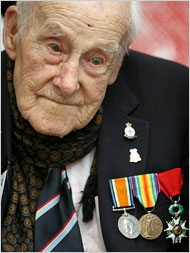
Henry Allingham was one of the few veterans of World War I still alive when he died at aged 113.  The New York Times obituary tells his story.

An iconic figure to many in Britain, Mr. Allingham did wartime service including stints on land, in the air and at sea. In 1915, he flew as an observer and gunner in the Royal Naval Air Service, hunting zeppelins over the North Sea. He was aboard one of the Royal Navy ships that fought in the Battle of Jutland in 1916, in which Britain lost 14 ships and 6,000 seamen.

Mr. Allingham was born in London in 1896. He lost his father to tuberculosis the next year. After his mother also died, he was raised by a grandmother. He became a trainee maker of surgical instruments before moving into the motor trade, training as a mechanic. After his wartime service, he worked until retirement for the Ford Motor Company. Judged to be too old to serve in combat in World War II, he was assigned to a project that sought to neutralize German magnetic mines.

The Associated Press  news account of Mr. Allingham’s death has this wonderful account

He spent the war’s first months refitting trucks for military use, but when his mother died in June 1915, he decided to join after seeing a plane circling a reservoir in Essex.

Only a dozen years after the Wright brothers first put up their plane, Allingham and other airmen set out from England on motorized kites made with wood, linen, and wire. They piled on clothes and smeared their faces in Vaseline, whale oil, or engine grease to block the cold.

“To be honest, all the planes were so flimsy and unpredictable – as well as incapable of carrying large fuel loads – at the start of the war that both British and German pilots would immediately turn back rather than face each other in the skies if they did not enjoy height supremacy,’’ Allingham would later write.

As a mechanic, Allingham’s job was to maintain the rickety craft. He also flew as an observer on a biplane. At first, his weaponry consisted of a standard issue Lee Enfield .303 rifle – sometimes two. Parachutes weren’t issued. He fought in the Battle of Jutland, the largest naval battle of World War I. He served on the Western Front.

We owe Virginia Sweet and Henry Allingham not only for their service during war, but for their part in advancing aviation.  As anyone who plays Sid Meir’s Civilization knows:  you have to have flight before you can get rocketry.