
Being new to twitter, I was amused by David Letterman’s top ten fake AP tweets. He was inspired by the tweet that cause chaos in the stock market. I guess I was on vacation then because I missed all but the aftermath.
Culture
Local Terrorism: the third wave
It is early days yet for both the investigation and the legal process but we are beginning to know bits and pieces about two brothers, graduates of Cambridge Rindge and Latin, the same school that produced Matt Damon and Ben Affleck, who decided to bomb the finish line of the Boston Marathon. Farah Stockman had a very thoughtful column in the Boston Globe this morning. She begins with a book written in 2008 by Mark Sageman, a former CIA psychiatrist, who predicted “The threat is no longer ‘foreign fanatics,’ but people who grew up in the West.” His book is “Leaderless Jihad” Stockman continues
We still don’t know how much support the Boston Marathon bombers had from overseas. Chechnya’s main militant group, Caucasus Emirate, denies any link to the brothers. Instead, the Marathon bombing appears to be the work of what Sageman describes as the “Third Wave” of terrorism. The Third Wave isn’t about Al Qaeda grooming recruits and dispatching them to do its bidding. It’s about young men who surf the Internet and decide on their own to write their names in history with a bomb. They get inspiration from Al Qaeda. In some cases, they even get training. But they are the ones that seek it out.
“Like Harvard, Al Qaeda did not have to recruit,” Sageman wrote. Young men came in droves, begging for an affiliation.
Sageman says the average recruit at Al Qaeda Central in the 1990s was nearly 30 years old. The average Third Waver is in his early 20s. The majority of Al Qaeda Central grew up in religious homes. About 75 percent of the Third Wavers had fairly secular childhoods.
So why would they turn to building bomb and other acts of terrorism.
For some, it was out of a warped romanticism for a homeland they barely knew; an act of rebellion against hardworking immigrant parents who brought them to the West for “a better life.” Others were US-born converts to Islam who found in terrorism a sense of camaraderie and purpose that had eluded them all their lives. A few became terrorists after years of gang-banging and drug dealing. It was an ideology that transformed their violent tendencies into something heroic. It made them feel they were on the side of the angels.
Both Tsarnaev Brothers were heavy smokers of marijuana and local police are now looking at a connection between them and the murder of the man Tamerlan once said was his only American friend. Brendan Mess was one of the victims of a triple homicide. The murders have never been solved.
Third Wavers “are basically trying to find out who they are,” Sageman said. “Their identities are very different from their parents. What they imagine their parents’ country to be never really was.”
That rings true of the Tsarnaev brothers, whose parents immigrated to the Boston area in 2002. The older brother, who dropped out of community college and was once accused of assaulting a girlfriend, might have been casting about for something to believe in. Searching the Internet for information about his troubled homeland in Chechnya would have yielded a trove of jihadi websites full of rhetoric about America’s “war against Islam.’’ As he became more radical, he may have dragged his more outgoing and successful younger brother down with him.
We will know much more in the days and months ahead, but I think that Sageman and Stockman are right: the time of terror from outside is over. Dzhokhar Tsarnaev is not the first local to be tried in Boston. Tarek Mehanna, from nearby wealthy suburb Sudbury was convicted in 2011 of conspiring to support Al Qaeda. He was sentenced in April 2012 to 17½ years in federal prison. His actions also surprised everyone who knew him.
These crimes may have been inspired by outside forces, but they are crimes in an ordinary sense and the voices, mostly Republican, clamoring for miliary tribunals and an end to immigration have it all wrong. I think part of the venom is because Boston is a symbol of what the right calls “liberal” America. And maybe we are. But Dzhokhar Tsarnaev is an American citizen and deserves to be tried as one. He is not an “enemy combatant”. And if Sageman is right, and he appears to be, we can expect to see more of these incidents and trials in our future. And as the right complains about unanswered questions, we have to remember that some information will be kept for trial and some questions we won’t know the answers to for a long time.

The moment of silence at 2:50 pm April 22, 2013. Copley Square.
The miracle for Boston is that there were only four people killed and close to 300 now reported as injured. All of the injured are now expected to live.
Photograph from the Boston Globe
Related articles
- Ex-CIA deputy director: Boston bombing ‘more like Columbine than al Qaeda’ (rawstory.com)
- 17 Unanswered Questions About The Boston Marathon Bombing The Media Is Afraid To Ask (conservativeread.com)
- Boston Bomb Plot: Planned, Carried Out By Suspects Alone, Authorities Believe (thehollywoodgossip.com)
- Something’s Rotten in Boston: Who’s Investigating the FBI Investigators? (conservativeread.com)
The Boston Marathon bombing
I was checking into a hotel in Philadelphia minutes after the bombs went off near the finish line of the Boston Marathon and learned what had happened from the desk clerk. For the next week, we followed the story mostly by reading the paper in the morning and sometimes catching a few snippets on television. I had made the decision not to do email or any social media while I was gone. I did have my cell phone on, mostly in case of a cat emergency at home or a Philly friend calling. It was strange to be away from home and hearing about familiar places.
Things got particularly weird for me late Thursday afternoon. The authorities had just released the video of the suspects and in the tape was a person walking who resembled me. I started getting text messages and calls from friends in Boston who wondered if it was me and if I were OK. It wasn’t, but when we turned on the TV and watched the endless loop, the other “me” was easy to spot. Blue jacket, ball cap, grey purse strap across the back. A short woman, a little stocky. As one of my friends said even after being reassured, “It really does look like you.”
I got home to a pile of papers and more information on the incident. It was interesting to see what people got wrong in the early days and it should get more interesting as the investigation continues. My husband and I were thinking that bombing like this are regular occurrences in other countries and in many ways we are lucky that our law enforcement can actually track the two kids who planted the bombs. We will bring the survivor to trial eventually, but as someone, I think it was Senator Elizabeth Warren, said these are the early days of the investigation and this is not NCIS where crimes get solved in an hour.
James Carroll wrote this morning in the Boston Globe about the Boston Marathon, the votes in Washington against any regulation of guns, and democracy. Here is some of what he said.
In 490 BC, the legendary runner brought urgent news to Athens of the Greek victory in Marathon over the armies of the Persian Empire. The Battle of Marathon secured a peace that ushered in the Athenian Golden Age, during which a vibrant democracy finally found the balance between the exercise of force and the fulfillment of human needs. Last week, as an American commemoration of the Battle of Marathon unfolded in Boston, that same democratic balance was dangerously stretched amid the Doric columns of Washington, where the Senate cast a tragic vote for violence.
Yet even our definition of “tragic” goes back to Athens, to the spacious imagination that flourished there — especially in the plays of Sophocles, who lived from about 497 to 406 BC. He taught us that every choice has its consequence, that character is destiny, that the exercise of power must always be measured by the health of the whole community. He also taught us that tragedy, when faced directly and bravely, leaves humans not diminished, but ennobled.
The traumas of Boston last week, culminating in the killing and pursuit of the men suspected of planting the bombs, were heartbreaking and repugnant, but they left the city whole. With all citizens commanded to “shelter in place” Friday while responsible officials conducted the manhunt, Boston was itself a character in the extraordinary drama. A vast ad hoc web of Internet users to whom law enforcement had appealed gave new meaning to the term “community policing.” The fugitives knew that an entire commonwealth had become their antagonist. This surely forced the drama’s denouement. There were no bystanders in Boston.
…
From Homer on, Greek culture honored competition (“agon” in Greek, which gives us the word “agony”). But in Athens, the philosopher Alasdair MacIntyre has explained, this spirit of contest was balanced by the politics of cooperation. The virtues of the first (discipline, bravery, self-actualization) meshed with the virtues of the second (empathy, humility, selflessness). Athenian democracy was the reconciliation of these opposites. Strength was joined to tenderness.
The Boston Marathon wonderfully embodies this balanced moral order, too: Every year the fiercely determined runners strive to be best (or for their personal best), while surrounded by multitudes whose cooperation makes the race so radically inclusive.
But death changes everything — a jolting transformation to which Greek tragedy itself gave first expression. “In the face of death,” as MacIntyre puts it, “winning and losing no longer divide.” Instead, competition drops away, and cooperation becomes the absolute mandate. That is precisely what happened in Boston, as the city held Martin Richard, Krystle Campbell, Lu Lingzi, and later Sean Collier in its heart.
Last week, a separate drama unfolded in Washington. “It’s almost like you can see the finish line, but you just can’t get there.” These words could have been spoken by thousands of Boston runners, but were said by the father of a shooting victim who witnessed the Senate vote on gun control.
We will, once again, show the world that we can have an investigation and fair trial. And we will one day enact some sensible gun safety measures. Watching the events unfold from a distance, I was proud of my fellow Bostonians, law enforcement and public officials particularly Mayor Menino and Governor Patrick.
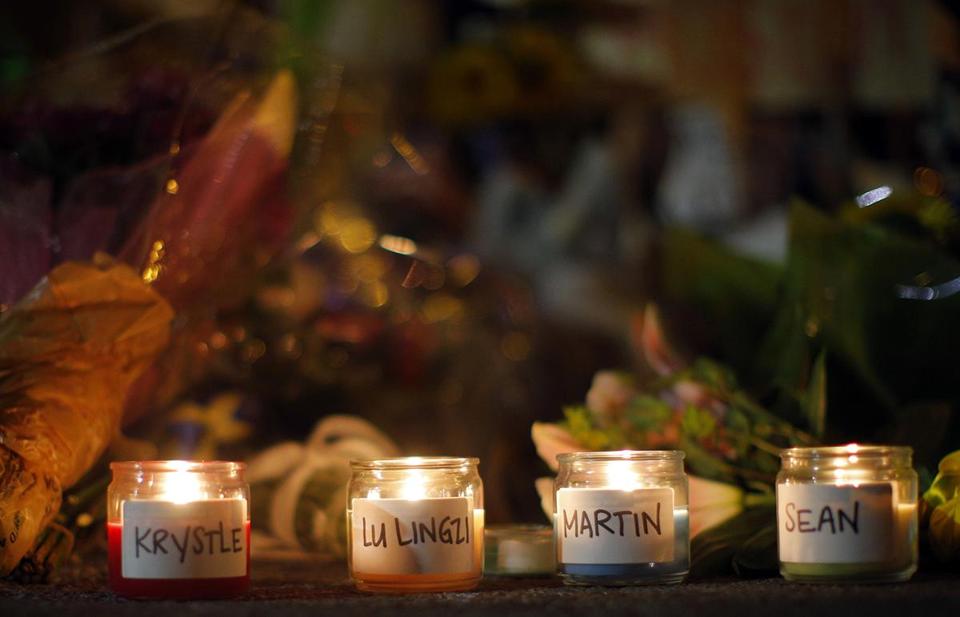
Candles for the victims.
Related articles
- Boston Marathon Bombing Reflection (tylatimes.com)
Guns and cars: the same or different?
That question is raised in the new Ruben Bolling cartoon.

Cars aren’t mentioned in the Constitution which does, as my husband has pointed out, make them different from guns, which does not mean we shouldn’t require rules for gun ownership like registration and insurance.
Just Sayin’…
As we who lived through those times know, they were very difficult and people made a lot of strange choices. But I will assume that Mr. LaPierre was NOT protesting the war with his requested deferrment.


H/t: The Platzner Post
Memo: With full knowledge that FaceBook has a way of exaggerating claims, I researched this and found that the term “mental condition” was indeed a slight exaggeration. Here’s what I found.
50 years since the submarine Thresher was lost
The Boston Globe had a story this morning about the Thresher submarine sinking off Cape Cod fifty years ago and it called to mind the Phil Ochs song on the subject.
For anyone who doesn’t remember the incident or is maybe too young, the Globe describes it this way.
The morning of April 10, 1963, was expected to be another round of rigorous but routine sea trials for the pride of the nation’s sub fleet. But what happened would jolt the nation: the worst submarine disaster in US history; the loss of all 129 crew, officers, and civilians on board; and a stinging blow to the American military at the hair-trigger height of the Cold War.
As the 278-foot-long Thresher began its descent that morning, only six months after the Cuban Missile Crisis, the unthinkable happened.
A pipe burst, electrical circuits shorted, nuclear propulsion shut down, and sailors on the USS Skylark, a trailing Navy ship, received these words from below: “Exceeding test depth.”
They heard little else from the crew, and the Thresher plunged more than a mile to the bottom of the North Atlantic. The Skylark, however, did hear the submarine’s death rattle: ominous hissing and groaning that preceded a devastating implosion that killed everyone on board within seconds.

The submarine Thresher the day before the dive.
There will be 50 year memorial service for the 129 men that were lost on April 10, 1063 at which at 129 foot flag pole, one foot for each man, will be dedicated at the Portsmouth Navel Ship yard in Kittery, Maine. (A note of geography: Kittery is across the Piscataqua River from Portsmouth, NH)
I doubt if anyone will sing the Phil Ochs song, which was an anti-war protest song.
In Portsmouth town on the eastern shore
Where many a fine ship was born.
The Thresher was built
And the Thresher was launched
And the crew of the Thresher was sworn.She was shaped like a tear
She was built like a shark
She was made to run fast and free.
And the builders shook their hands
And the builders shared their wine,
And thought that they had mastered the sea.
Yes, she’ll always run silent
And she’ll always run deep
Though the ocean has no pityThough the waves will never weep
They’ll never weep.
And they marvelled at her speed
marvelled at her depth
marvelled at her deadly design.
And they sailed to every land
And they sailed to every port
Just to see what faults they could find.
Then they put her on the land
For nine months to stand
And they worked on her from stem to stern.
But they could never see
It was their coffin to be
For the sea was waiting for their return.Yes, she’ll always run silent
And she’ll always run deep
Though the ocean has no pity
And the waves will never weep
They’ll never weep.On a cold Wednesday morn
They put her her out to sea
When the waves they were nine feet high.
And they dove beneath the waves
And they dove to their graves
And they never said a last goodbye.
And its deeper and deeper
And deeper they dove
Just to see what their ship could stand.
But the hull gave a moan
And the hull gave a groan
And they plunged to the deepest darkest sand.Now she lies in the depths
Of the darkened ocean floor
Covered by the waters cold and still.
Oh can’t you see the wrong
She was a death ship all along
Died before she had a chance to kill.And she´ll never run silent,
And she´ll never run deep,
For the ocean had no pity
And the waves, they never weep,
They never weep.[Alternate final verse from an early Broadside tape]
And it’s 8000 fathoms of the water above
And over 100 men below
And sealed in their tomb
Is the cause of their doom
That only the sea will ever know
The Thresher’s remains were actually found in 1985 by oceanographer, Robert Ballard.
Related articles
- Deadliest submarine disaster in US remembered (stripes.com)
- Deadliest submarine disaster in US remembered – Boston.com (boston.com)
- Deadliest submarine disaster in US remembered (cnsnews.com)
- 50 Years Later: The Legacy of USS Thresher (news.usni.org)
- The Thresher and The Scorpion (legalinsurrection.com)
- Flagpole dedicated to memory of Thresher victims (mysanantonio.com)
- USS Thresher sinking: Relatives gather to remember America’s worst submarine … – Daily Mail (dailymail.co.uk)
Sheep in the city
I live across the street from a city park and often say it is my front yard. But sometimes the lawn mowing gets to me, and even worse are those horrid leaf blowers which just blow dirt around. And small stones. I need to get working on a campaign to ban them in Boston. Maybe that will be my next retirement project. But on to the sheep.
In case you missed the story, Paris is experimenting with sheep to mow lawns. This short story from the Boston Globe caught my eye the other day.
PARIS — Will tourists soon see flocks of baahing sheep at the Eiffel Tower and bleating ewes by Notre Dame cathedral?
That could be the case, since Paris City Hall this week installed a small flock of sheep to mow the lawn at the city’s gardens, replacing gas-guzzling mowers. Four ewes — shipped in from an island off the Brittany coast — are munching the grass surrounding Paris Archives building.
‘‘I can imagine this very easily in London and New York . . . even Tokyo,’’ said Fabienne Giboudeaux, City Hall’s director of green spaces. ‘‘And why not have them at the Eiffel Tower?’’
Last year, two goats mowed the lawn at Tuileries, the city’s grand 17th-century gardens. A similar experiment outside Paris found that sheep droppings brought swallows back to the area. ‘‘It might sound funny, but animal lawnmowers are ecological as no gasoline is required, and cost half the price of a machine,’’ said Marcel Collet, Paris farm director. ‘‘And they’re so cute.’’

One of the Paris sheep.
I read this and wondered how they keep the sheep from wandering off. According to the Atlantic, they use an electric fence. I guess they would have to move it around to different grazing areas as they can’t keep the entire space blocked off. I think they should hire shepherds and a few dogs. Give some people jobs. They can use a portable pen at night.
As the Atlantic points out
It’s honestly a pretty sensible idea. For centuries, if not millennia, grazing animals like sheep and cows have been used both to trim and to fertilize fields. In fact, many of the oldest urban parks were originally populated by farm animals, sometimes just during the day when their owners went into to town to do business. A funny if only marginally related story about in-town grazing comes from Cambridge, Massachusetts, a former suburb of Boston that’s now very much a part of the city. Back in the early days of Harvard College, one of the perks of being a professor was that you were allowed to graze your cow in Harvard Yard. Back in 2009, retiring professor Harvey Cox actually exercised this privilege when he brought his cow Faith to school.
Actually, there shouldn’t be a lot of odor as sheep don’t do big patties like cows. And if they hire a shepherd she can rake it up – not with a leaf blower.
I hope this catches on. I like the thought of a couple of sheep with a shepherd on Fort Hill. Plus it lowers noise pollution and helps with climate change and could create some jobs.
Photograph from Reuters
Related articles
- Photos: Paris hires sheep to mow city lawns (metronews.ca)
- Paris hires sheep to mow city lawns (wxyz.com)
- Paris hires ‘lawnmower sheep’ to keep the city’s grass trim (news.nationalpost.com)
Killing off our public safety officials
With the recent murders of a DA and Assistant DA in Texas as well as the head of the Colorado prison system, it seems as if the rules are changing. Don’t like a prosecution? Kill the prosecutor. Don’t like what happened to you in prison? Kill the head of the prison system. This desire to kill public safety officials is not a new one, but we need to think more about why this sudden uptick.
There is much to write and speculate about in both of these instances. Were, particularly the Texas slayings, the work of white supremacists? And what about the fact that the DA McLelland was armed but unable to prevent his and his wife’s deaths?
The New York Times story begins
After the daylight assassination of his deputy two months ago, Mike McLelland, the district attorney in largely rural Kaufman County, responded with a flash of angry bravado, denigrating the perpetrators as “scum” and vowing to hunt them down.
A former Army officer who served in Iraq during Operation Desert Storm, Mr. McLelland carried a gun and refused to be intimidated, according to a friend and the local news media, even as his wife expressed unease, worrying that her husband, too, could be in danger.
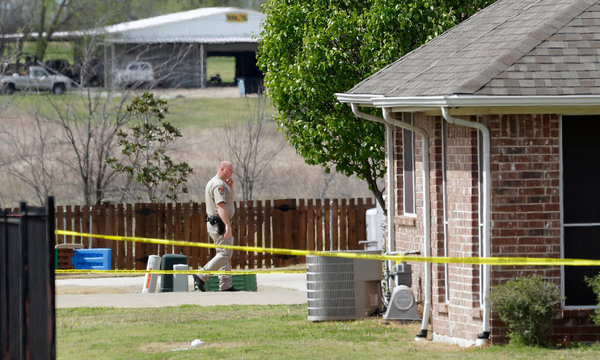
The home of Mike McLelland, the district attorney for Kaufman County.
Is it possible that his bravado and the common knowledge that he was armed goaded the murderer?

Ceremony at the State Capitol building in Denver.
The killing of prison chief, Tom Clements, does not appear to be caused by any white supremest leanings. The cause may be prolonged solitary confinement as Susan Greene wrote for the Colorado Independent.
In the weeks before his death, Evan Ebel, suspected killer of Colorado Department of Corrections Director Tom Clements, had broken ties with white supremacist prison gang 211 Crew and was debilitated by the transition from prolonged isolation to social contact, according to a friend and former fellow inmate.
In a series of interviews conducted with The Colorado Independent, parolee Ryan Pettigrew dismissed widespread media speculation that Ebel shot Clements as part of an orchestrated 211 Crew “gang hit.” He said that, over the course of the last few weeks, Ebel was growing increasingly agitated in his adjustment to life outside of prison and beyond the tiny “administrative segregation” cells in which he spent years deprived of regular human contact.
Ironically, Clements worried about the transition from solitary confinement.
In an exclusive interview last spring, Clements said that, immediately after Hickenlooper recruited him from Missouri to run the Colorado corrections department, he found disturbing “one very alarming statistic” he said kept him up at night — that 47 percent of Colorado prisoners being released from isolation were walking directly out onto the streets without help reintegrating into social environments and interacting with people.
Clements wanted longer transition periods and step-down programs before setting isolated prisoners free. As Pettigrew tells it, Ebel said he had little help making that transition. He said altercations during his brief period in a step-down program landed him back in isolation.
“You have to ask yourself the question – How does holding inmates in administrative segregation and then putting them out on a bus into the public, [how does that] square up?” Clements said.
“We have to think about how what we do in prisons impacts the community when [prisoners] leave,” Clements continued. “It’s not just about running the prison safely and securely. There’s a lot of research around solitary and isolation in recent years, some tied to POWs and some to corrections. My experience tells me that long periods of isolation can be counter-productive to stable behavior and long-term rehabilitation goals.”
All three acts of violence did involve guns. The gun used to kill Clements was purchased legally, but transferred to Ebel illegally as a “straw” purchase. Would the requirement for a background check on the private transfer have prevented Clements’ death? Probably not. Is that a reason not to require universal checks? No. There likely would have been no deterrent in this case, but it might just stop someone else.
Race may figure into Prosecutors McLelland and Hasse’s murders, but at least part of the motivation is the prosecution of a gang. The New York Times story continues
One of several angles investigators have been exploring is whether Mr. Hasse’s killing involved members of the Aryan Brotherhood of Texas prison gang. Prosecutors in Mr. McLelland’s office had assisted in investigations of the gang, including a recent case that had dealt a major blow to the group’s leadership.
In that case, federal authorities announced in November that a grand jury in Houston had indicted more than 30 senior leaders and other members of the whites-only gang on charges of conspiring to participate in a racketeering enterprise. Federal officials said the defendants were also charged with involvement in three murders, multiple attempted murders, kidnappings and assaults and conspiracy to distribute methamphetamine and cocaine.
The indictments stemmed from an investigation led by a multiagency task force that included Kaufman County prosecutors and three other district attorneys offices. In December, the Texas Department of Public Safety issued a statewide bulletin warning officials that the Aryan Brotherhood was planning retaliation against law enforcement personnel who had helped secure the indictments.
Mr. Hasse was shot the same day that two members of the Aryan Brotherhood of Texas — Ben Christian Dillon, also known as “Tuff,” of Houston, and James Marshall Meldrum, also known as “Dirty,” of Dallas — pleaded guilty to racketeering charges in Federal District Court in Houston
Boston had a similar murder in 1995 when Paul McLaughlin an ADA known for his prosecution of gang members was murdered as he left a commuter rail station. The man he was about to prosecute for the third time was convicted for the murder and is serving life.
It is a dangerous life working in the criminal justice system. The sheer number of guns out there doesn’t help. Neither does the criminal justice system itself.
Photograph of McLelland home Mike Fuentes/Associated Press
Photograph of Clements ceremony Matthew Staver for The New York Times
Related articles
- Killing of Texas prosecutor, wife, raises fear of wider plot against law … – The Seattle Times (seattletimes.com)
- Texas District Attorney And His Wife Shot To Death In Home (theobamacrat.com)
- Texas DA and Wife Killed, Possible Aryan Brotherhood Link (crooksandliars.com)
- Texas DA and wife killed in ‘targeted act’ two months after assistant’s death (guardian.co.uk)
A question for the Chief Justice
So, Mr. Chief Justice, where did you say you went to law school? That’s what I want to ask Mr. Roberts after yesterday’s hearing on The Defense of Marriage Act or DOMA.
Here is the relevant exchange as reported by the New York Times.
He expressed irritation that the case was before the court, saying President Obama’s approach — to enforce the law but not defend it — was a contradiction.
“I don’t see why he doesn’t have the courage of his convictions,” the chief justice said. He said Mr. Obama should have stopped enforcing a statute he viewed as unconstitutional “rather than saying, ‘Oh, we’ll wait till the Supreme Court tells us we have no choice.’ ”
The White House took umbrage at the remark and said the president was upholding his constitutional duty to execute the laws until the Supreme Court rules otherwise. “There is a responsibility that the administration has to enforce laws that are on the books,” said Josh Earnest, a deputy White House press secretary. “And we’ll do that even for laws that we disagree with, including the Defense of Marriage Act.”
The Chief Justice should know that the President has to enforce laws until they are declared unconstitutional by a court. Thus my question.
The situation, however, is a little bit more complicated. NPR explains it this way.
Has the Obama administration abrogated its responsibility by continuing to enforce DOMA, while refusing to defend it in court?
Justice Antonin Scalia: “And I’m wondering if we’re living in this new world where the attorney general can simply decide, ‘Yeah, it’s unconstitutional, but it’s not so unconstitutional that I’m not willing to enforce it.’ If we’re in this new world, I — I don’t want these cases like this to come before this court all the time. And I think they will come all the time if that’s … the new regime in the Justice Department that we’re dealing with.”
Deputy U.S. Solicitor General Sri Srinivasan: “Justice Scalia, one recognized situation in which an act of Congress won’t be defended in court is when the president makes a determination that the act is unconstitutional. That’s what happened here. The president made an accountable legal determination that this act of Congress is unconstitutional.”
Paul Clement, lawyer for GOP House leadership in defense of DOMA: “The House’s single most important prerogative, which is to pass legislation and have that legislation, if it’s going to be repealed, only be repealed through a process where the House gets to fully participate.”
Justice Kennedy: “Suppose that constitutional scholars have grave doubts about the practice of the president signing a bill but saying that he thinks it’s unconstitutional — what do you call it, signing statements or something like that? It seems to me that if we adopt your position that that would ratify and confirm and encourage that questionable practice because if the president thinks the law is unconstitutional, he shouldn’t sign it, according to some view. And that’s a lot like what you’re arguing here. It’s very troubling.”
Deputy U.S. Solicitor General Sri Srinivasan: “But my point is simply that when the president makes a determination that a statute is unconstitutional, it can follow that the Department of Justice won’t defend it in litigation.”
What should a President do in a situation like this one? Does he just continue to enforce the law while trying to get Congress to repeal it as Paul Clement seems to argue. Or does he do what he did: say he thought the law was unconstitutional while both appealing and enforcing it. I suppose that he could have issued an executive order to the IRS to accept joint tax returns from all legally married couples but that would have created an even bigger uproar that going to the Supreme Court.
My point, Mr. Chief Justice, is that yes, this may be an unprecedented situation, but the job of the Supreme Court and therefore your job is to make the ultimate decision on Constitutionality. So just do your job. And by the way, where did you go to law school?

Edith Windsor, the plaintiff in the DOMA case.
Photograph Christopher Gregory/The New York Times
Related articles
- Skim Milk, States’ Rights And Political Clout: The High Court And DOMA (npr.org)
- Scalia: ‘New world’ on enforcing DOMA (politico.com)
- DOMA Decision Likely to Be Close (hispanicbusiness.com)
- Justices Slam Obama During DOMA Arguments: ‘I Don’t See Why He Doesn’t Have The Courage Of His Convictions’ (patdollard.com)
- John Roberts Takes A Swipe At Obama Over DOMA (tpmdc.talkingpointsmemo.com)
- Justice Ginsberg: Doma creates ‘full marriage and skim-milk marriage’ (guardian.co.uk)
- Same-sex marriage & DOMA: 5 things we learned from oral arguments (fox6now.com)
Law and Order: Life imitates art – or is the other way around?
I am a major fan of Law and Order. The original not any of the spin offs. I still like to catch a re-run now and then and particularly like the older ones. Last week a story in the New York Times about Robert M. Morgenthau the retired DA from Manhattan reminded me of the show. Morgenthau is the model for the original DA, Adam Schiff, from the TV show. Morgenthau retired about three years ago at 90. He had been DA for 35 years.
Morgenthau is still practicing law.
Mr. Morgenthau, 93, and two other prominent former prosecutors are asking the United States Supreme Court to take up the case of William Ernest Kuenzel, who has been on death row in Alabama for 24 years.
Based on the testimony of two witnesses, Mr. Kuenzel was convicted in 1988 of murdering a convenience store clerk. Records that became available only in 2010 revealed that those two witnesses — one of whom admitted that he himself was involved in the murder — actually did not implicate Mr. Kuenzel when they first spoke with the authorities. In fact, they originally gave entirely different accounts from what they testified to at trial, but the defense lawyer was unaware that their stories had changed. So were the jurors.
Mr. Morgenthau learned about the case from Jeffrey Glen, a law partner of his late son-in-law. Their firm, Anderson Kill & Olick, was working on the appeal, along with David Kochman. To Mr. Morgenthau’s disbelief, the case was rejected by federal courts in Alabama, which ruled that the new evidence did not “refute the possibility that the defendant committed the crime.”
“It’s so wrong to say there’s presumption of guilt because he was convicted once — without the newly discovered evidence,” Mr. Morgenthau said. “I just thought that was off the wall.”
So Mr. Morgenthau contacted 2 other former DA’s and they have filed a friend of the court brief for the Supreme Court asking them to take the case on appeal.
He contacted Gil Garcetti, who served 32 years in the Los Angeles district attorney’s office, and E. Michael McCann, who was the district attorney of Milwaukee for 38 years, and they agreed to join him in a friend-of-the-court brief.
The opening lines explained why their views were worth hearing: They wrote “from the unique perspective of having overseen and been ultimately responsible for more than 7,000,000 criminal prosecutions.”
The concept of new evidence was what led to the reversal of the conviction of five teenaged boys for the attempted murder of a Central Park jogger. In 2009 Carlin DeGuerin Miller wrote for a CBS blog
But his tenure hasn’t been without its share of detractors and controversies,
one of the biggest being the wrongful convictions in the 1989 Central Park
Jogger case. In 2002, DNA evidence surfaced that incriminated someone else in
the rape and Morgenthau himself appeared in court to agree with the defense
request to dismiss the charges.
A good prosecutor knows when to cut his losses. According to the Times, Morgenthau said
“That was a matter of newly discovered evidence,” he said. “I had to act. This case reminded me of that.”
Law and Order lives on in re-runs and Robert Morgenthau is still fighting the good fight for real.

Robert M. Morgenthau is asking the United States Supreme Court to take on the case of a man who has been on death row in Alabama for 24 years.
Photograph Hiroko Masuike/The New York Times
 FortLeft