Thinking about the Supreme Court

I’m not going to speculate (at least in this post) on who President Obama will nominate in a few weeks, but I am going to talk about  two pieces discussing the Court itself and how decisions are made. The first by Geoffrey R. Stone in the New York Times, the second posted by William Forbath  this weekend on Politico’s Arena in response to Stone.

Stone begins

AS the Senate awaits the nomination of a new Supreme Court justice, a frank discussion is needed on the proper role of judges in our constitutional system. For 30 years, conservative commentators have persuaded the public that conservative judges apply the law, whereas liberal judges make up the law. According to Chief Justice John Roberts, his job is just to “call balls and strikes.” According to Justice Antonin Scalia, conservative jurists merely carry out the “original meaning” of the framers. These are appealing but wholly disingenuous descriptions of what judges — liberal or conservative — actually do.

As both Stone and Forbath remind us, the Constitution is an 18th Century document.  I believe that the vague yet sweeping language is why the Constitution is still a living and useful document.  The question addressed by Stone and Forbath is how one interprets it to meet the modern age. Neither thinks much of the way the current conservative majority uses the constitution.

Stone

Rulings by conservative justices in the past decade make it perfectly clear that they do not “apply the law” in a neutral and detached manner. Consider, for example, their decisions holding that corporations have the same right of free speech as individuals, that commercial advertising receives robust protection under the First Amendment, that the Second Amendment prohibits the regulation of guns, that affirmative action is unconstitutional, that the equal protection clause mandated the election of George W. Bush and that the Boy Scouts have a First Amendment right to exclude gay scoutmasters.

Whatever one thinks of these decisions, it should be apparent that conservative judges do not disinterestedly call balls and strikes. Rather, fueled by their own political and ideological convictions, they make value judgments, often in an aggressively activist manner that goes well beyond anything the framers themselves envisioned. There is nothing simple, neutral, objective or restrained about such decisions. For too long, conservatives have set the terms of the debate about judges, and they have done so in a highly misleading way. Americans should see conservative constitutional jurisprudence for what it really is. And liberals must stand up for their vision of the judiciary.

Forbath

… Conservative judges use history to claim that when they strike down a law, they are merely applying the “original understanding” or “intentions” of the framers of the Constitution. This is bunk. But it is reassuring. It enables conservatives on and off the Court to claim that what liberal judges do is something different and illegitimate. Liberals are “judicial activists.” When liberal judges strike down a law, they are “making up” new law. They are “betraying” the Founding Fathers. This is also bunk. Conservative and liberal judges alike bring their own present-day values and convictions to bear on interpreting and applying the Constitution. Conservatives are wrong to deny it. But they are right that appealing to history and “keeping faith with the past” is an indispensable part of our constitutional tradition – and one that helps mobilize popular support behind the constitutional commitments a judge, lawmaker, or citizen may prize. So, liberals need to get a better handle on the way to use history.

So what should the role of history be?  And how can liberal justices use it more to their advantage?  Stone points out that

So, how should judges interpret the Constitution? To answer that question, we need to consider why we give courts the power of judicial review — the power to hold laws unconstitutional — in the first place. Although the framers thought democracy to be the best system of government, they recognized that it was imperfect. One flaw that troubled them was the risk that prejudice or intolerance on the part of the majority might threaten the liberties of a minority. As James Madison observed, in a democratic society “the real power lies in the majority of the community, and the invasion of private rights is chiefly to be apprehended … from acts in which the government is the mere instrument of the major number of the constituents.” It was therefore essential, Madison concluded, for judges, whose life tenure insulates them from the demands of the majority, to serve as the guardians of our liberties and as “an impenetrable bulwark” against every encroachment upon our most cherished freedoms.

Conservative judges often stand this idea on its head. As the list of rulings above shows, they tend to exercise the power of judicial review to invalidate laws that disadvantage corporations, business interests, the wealthy and other powerful interests in society. They employ judicial review to protect the powerful rather than the powerless.

Liberal judges, on the other hand, have tended to exercise the power of judicial review to invalidate laws that disadvantage racial and religious minorities, political dissenters, people accused of crimes and others who are unlikely to have their interests fully and fairly considered by the majority. Liberal judges have ended racial segregation, recognized the principle of “one person, one vote,” prohibited censorship of the Pentagon Papers and upheld the right to due process, even at Guantanamo Bay. This approach to judicial review fits much more naturally with the concerns and intentions of people like Madison who forged the American constitutional system.

Where Forbath disagrees is with Stone’s reliance on James Madison and original intent.  He points out

So, judges today must attend to the text the framers gave us, the general principles it enshrines, the Amendments Americans have added, and the meaning and range of applications generations of judges, lawmakers and citizens have poured into them. And judges must consult their own conscience and experience as they sift through these materials that history provides and decide how best to keep faith with the past.

As long as they hew to this honest approach to history, liberals often draw compelling lessons from it. But lately, liberals are being drawn into the fictions and falsities of the “framers’ intentions” in order to sound just as “true” to the Founding Fathers as our conservative foes. When we liberals play the “framers’ intentions” game, however, we end up sounding silly and disingenuous.

Take for example constitutional scholar Geoffrey Stone’s important op-ed piece in last Wednesday’s New York Times. Looking ahead to President Obama’s soon-to-be-announced nomination of a new Supreme Court Justice, Stone urges “a frank discussion .on the proper role of judges in our constitutional system.” He laments that for thirty years or so, conservatives have dominated the national conversation about the Constitution and the Court, and he rightly points out that they have done so “in a highly misleading way” by claiming that conservative judges just “apply” the Constitution by enforcing the “framers’ intentions.” Stone goes on to contrast the kinds of laws that liberal judges strike down – laws that burden racial minorities, the poor and the powerless, with laws that conservative judges strike down – laws that “disadvantage corporations, business interests, the wealthy and other powerful interests in society.” And he suggests that liberal judges surely have a wiser vision of the role of judges in a constitutional democracy, since they wield the power of judicial review to safeguard people most at risk of being shortchanged in the ordinary political process, while the conservative judges conjure up new safeguards for those who already enjoy ample sway in the political arena.

So far so good. But along the way, Stone proves unable to resist the siren song of “framers’ intentions.” He tries to turn the table on the conservatives. He goes to some lengths trying to cloak liberal constitutional values and commitments in the mantle of James Madison’s “intentions.” Stone has dressed up James Madison as a Great Society liberal. Says Stone, the “intentions of people like Madison who forged the American constitutional system” was to safeguard minorities like African-Americans, undocumented immigrants and the Guantanamo detainees against the tyranny of the majority. That is what liberal judges do. Conservatives, Stone declares, stand Madison’s “idea on its head.” They wield judicial review to overturn affirmative action, gun control, and restrictions on corporate speech; they “tend to exercise. judicial review to invalidate laws that disadvantage corporations, business interests, the wealthy and other powerful interests in society.”

Stone’s James Madison is bunk too. The real James Madison was largely hostile to any kind of judicial review. More important: while Madison did craft the Constitution to safeguard minority rights against the tyranny of the majority, and while Madison, the wealthy slaveholder, was concerned about protecting religious minorities, he had no concern for the rights of “racial minorities,” and it was mainly the rights of the wealthy over against the majority of Americans of modest means that Madison hoped to protect! Thus, the conservatives on today’s Court have about as good a claim to Madison’s mantle as we liberals do.

I think Forbath is right about history and original intent.  As long as we argue about which view of original intent is correct, liberals will never prevail.  We need to move on to take into about all the history since 1787.  Forbath writes

History is on our side; but that has much less to do with James Madison and much more to do with the bloodshed of the Civil War and the Civil War and Reconstruction Amendments that made the Constitution a charter of equal rights for all Americans, including the former slaves. It was the Republicans of the Reconstruction Era, the New Dealers, the Civil Rights Movement, and the twentieth-century Court who gradually enlarged Madison’s original conception of minority rights and majority tyranny to make it a safeguard for the poor and vulnerable.

We do need “a frank discussion” on the Constitution and the proper role of judges, and we can’t be half-frank about it. There are good arguments why the liberals’ account is better. Stone offers a few. But wrapping ourselves in the mantle of the 18th century framers’ intentions as he tries to do is not one. Our constitutional commitments have emerged over two centuries of tumultuous change. The arc of constitutional history generally has bent toward a more inclusive and generous vision of rights-bearing membership in We, the People. Conservatives are bending it back. The 18th century framers might have agreed with them; but the Civil War, the Reconstruction Amendments, and much else have intervened in the mean time; and, in any case, the choice – about how to keep faith with our constitutional past – is ours.

We need a Supreme Court with Justices that are willing to grow, to learn and to change with the times.  President Obama could do worse that nominate someone in the Earl Warren or Justice Powell or Justice Brennan mold.  Those were men who learned to consider cases on their merits, who understood the need to connect decisions to real ordinary people.  They were men with empathy.

Bipartisan book buyer?

After his speech on health care in Iowa, President Obama stopped at a bookstore.  – an independent bookstore, Prairie Lights to browse and pick on some books for the kids.

I love this picture of the President holding books by Karl Rove and Mitt Romney taken by Doug Mills of the New York Times.

President Obama with books by Mitt Romney and Karl Rove.

The accompanying story in the Times by Sheryl Gay Stolberg reports some very amusing dialogue between Robert Gibbs and the President.  Here are some exerpts.  (This is based in part on reporting by the pool reporter.)

A few minutes later POTUS stepped up to the cash register with two books in his hands: “Journey to the River Sea” by Eva Ibbotson and “The Secret of Zoom” by Lynne Jonell for his daughters.

Obama pulled out five $20 bills to pay for the two books. Your pooler couldn’t hear the exact price but the two books didn’t cost that much.

Obama also bought a book for Gibbs, who was holding a large Star Wars pop-up book for his six-year-old son, Ethan.

“It’s a little expensive, sir,” Gibbs said to his boss as he handed it over.

POTUS showed the book to pool as the cashier rang it up for $37.44.

“I can handle it,” Obama said as Gibbs suggested he pay. “It’s for keeping his dad away for too many hours a day.”

“I need more books than that, sir,” Gibbs remarked.

Then after he left Prairie Lights

Nothing for Mrs. Obama?” Bloomberg’s Ed Chen asked.Obama paused to think for a second. “Thanks for getting me in trouble,” he replied.

We know that Obama used to visit a neighborhood bookstore in Chicago often.  I’m glad to see he still likes bookstores as they are among my favorite places.  And I never heard of another President who carried cash.  Obama buys shave ice in Hawaii, burgers in D.C. and now books in Iowa.  I also wonder how many copies of the books he bought will now be sold.  I know I will look into them for the grands.  Can we get the Obama girls to write some reviews?

Josephine Tey and Dick Francis

I had just finished re-reading Josephine Tey’s Miss Pym Disposes when I learned of the death of Dick Francis.  While they could not be more different, both are favorites of mine.  Josephine Tey specialized in elegant stories with very little violence and no blood while Dick Francis always had a “tough guy” hero who at some point gets beaten up (or injured somehow) and has to be nursed back to health, usually by the love interest.  Tey wrote only eight mysteries between 1929 (The Man in the Queue) and 1952 (The Singing Sands ).  Francis, on the other hand wrote more than 40 beginning in 1962 with Dead Cert.

Dick Francis was the Queen’s Jockey and famous in British racing circles before he turned to write mysterties.  According to his obituary in the New York Times

…Mr. Francis was already a celebrity in British sporting circles. Named champion jockey of the 1953-54 racing season by the British National Hunt after winning more than 350 races, he was retained as jockey to the queen mother for four seasons and raced eight times in the Grand National Steeplechase.When Devon Loch, the horse he was racing for the queen mother in the 1956 Grand National, collapsed in a spectacular mishap just before he would have won, Mr. Francis feared, as he put it in his autobiography, that he would be remembered as “the man who didn’t win the National.” This setback, along with the accumulated miseries of injuries, forced him into early retirement at the age of 36.

The New York Times published this well known picture of Francis on Devon Loch, the Queen Mother’s horse.

Drawing on his experiences as a jockey and his intimate knowledge of the racetrack crowd — from aristocratic owners to Cockney stable boys — the novel contained all the elements that readers would come to relish from a Dick Francis thriller. There was the pounding excitement of a race, the aura of the gentry at play, the sweaty smells from the stables out back, an appreciation for the regal beauty and unique personality of a thoroughbred — and enough sadistic violence to man and beast to satisfy the bloodthirsty.

Mr. Francis was a formulaic writer, even if the formula was foolproof. He drew the reader into the intimate and remarkably sensual experience of the world of racing. His writing never seemed better than when his jockey-heroes climbed on their mounts and gave themselves up to what he called “the old song in the blood.”

This self-contained world was, of course, a reflection of a broader universe in which themes of winning and losing and courage and integrity have more sweeping meaning. As the critic John Leonard wrote, “Not to read Dick Francis because you don’t like horses is like not reading Dostoyevsky because you don’t like God.”

Tey also created worlds.  Each of her eight mysterties is set in a different world.  Although little is know about Tey (Elizabeth Macintosh), she was born in Inverness and attended a physical training college in Birmingham.  Miss Pym Disposes is set at a similar sort of college where the students (all young women) study to teach phys ed and practice what we would now call physical therapy.

The writer, Natasha Cooper, wrote in a short essay on Tey

Until I started to think about this piece I had always assumed that my devotion to Josephine Tey’s novels had most to do with the age at which I first read them. As an impressionable twelve- or thirteen-year-old I revelled in the gentle, unusually rational decency of her good characters and found the domesticity of her settings appealing. The elegant simplicity of her style makes her work easy to enjoy at any age and some of the novels, particularly Brat Farrar with its predominantly young cast, might well have been written specifically for teenagers.

But once I started to reread some of the novels the other day, I realised that there was more to my delight in her work. Her obsession with the masks people wear and the truths they hide is one that I share. All crime writers must be concerned with the ways in which criminals disguise themselves and are found out by their investigators, but Tey’s interest went beyond that.

…In Miss Pym Disposes she plays with the idea of misread identity in several different ways in the characters of the heroine, an easily mockable spinster who happens to have written a brilliantly successful psychology textbook, and the three physical training students who provide the murderer, victim and chief suspect.Like most of Tey’s villains, Pamela Nash in Miss Pym Disposes is beautiful, successful, adored – and so full of vanity that she cannot conceive of anything (even someone else’s life) being more important than her own wishes…

I also first read Tey as a teenager by discovering Miss Pym and Brat Farrar. 

As the Grumpy Old Bookman said in his 2005 entry

Josephine Tey, the English crime writer, died in 1952; but if you go to Amazon.co.uk and type in her name, you get 172 results; and on Amazon.com you get 109. In other words, the lady is still in print, is still published in a wide variety of formats, still selling, and still being read. That being the case, it is worth having a look at her life and methods in order to see what might be learnt.

So celebrate Dick Francis by picking up one of his books (I particularly like the early ones) and rediscover (or discover) Josephine Tey both are well worth the time.

Virginia Sweet and Henry Allingham

Today, forty years ago, Neil Armstrong set foot on the moon.  In the last few days two pioneering pilots, one from World War I and the other from World War II have died.

VIRGINIA SWEET

Virginia Sweet’s obituary as published in the Boston Globe is short so here it is in its entirty.

Inspired by a story she read as a young girl about Amelia Earhart’s trans-Atlantic flight, Virginia Sweet became a pioneering female aviator in her own right.

She was a pilot with the Women’s Airforce Service Pilots, ferrying every imaginable type of military aircraft from factories to air bases during World War II to free male pilots for combat overseas.

Sometimes Ms. Sweet was assigned to fly shot-up, barely functional aircraft in for repair. Thirty-eight of her fellow female fliers were killed during duty.

After the war, when these Rosie the Riveters of the skies no longer were needed, the nation essentially turned its back on Ms. Sweet and hundreds of Women’s Airforce Service Pilots like her.

The longtime Schenectady resident died July 12 at 88, two weeks after President Obama signed a law that offered recognition and Congressional Gold Medals, the highest award Congress can give to a civilian, to the WASP fliers.

Ms. Sweet prided herself on a five-decade flying record without an accident

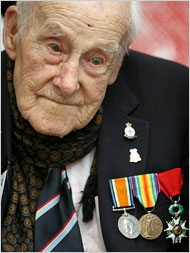
Henry Allingham was one of the few veterans of World War I still alive when he died at aged 113.  The New York Times obituary tells his story.

An iconic figure to many in Britain, Mr. Allingham did wartime service including stints on land, in the air and at sea. In 1915, he flew as an observer and gunner in the Royal Naval Air Service, hunting zeppelins over the North Sea. He was aboard one of the Royal Navy ships that fought in the Battle of Jutland in 1916, in which Britain lost 14 ships and 6,000 seamen.

Mr. Allingham was born in London in 1896. He lost his father to tuberculosis the next year. After his mother also died, he was raised by a grandmother. He became a trainee maker of surgical instruments before moving into the motor trade, training as a mechanic. After his wartime service, he worked until retirement for the Ford Motor Company. Judged to be too old to serve in combat in World War II, he was assigned to a project that sought to neutralize German magnetic mines.

The Associated Press  news account of Mr. Allingham’s death has this wonderful account

He spent the war’s first months refitting trucks for military use, but when his mother died in June 1915, he decided to join after seeing a plane circling a reservoir in Essex.

Only a dozen years after the Wright brothers first put up their plane, Allingham and other airmen set out from England on motorized kites made with wood, linen, and wire. They piled on clothes and smeared their faces in Vaseline, whale oil, or engine grease to block the cold.

“To be honest, all the planes were so flimsy and unpredictable – as well as incapable of carrying large fuel loads – at the start of the war that both British and German pilots would immediately turn back rather than face each other in the skies if they did not enjoy height supremacy,’’ Allingham would later write.

As a mechanic, Allingham’s job was to maintain the rickety craft. He also flew as an observer on a biplane. At first, his weaponry consisted of a standard issue Lee Enfield .303 rifle – sometimes two. Parachutes weren’t issued. He fought in the Battle of Jutland, the largest naval battle of World War I. He served on the Western Front.

We owe Virginia Sweet and Henry Allingham not only for their service during war, but for their part in advancing aviation.  As anyone who plays Sid Meir’s Civilization knows:  you have to have flight before you can get rocketry.

Nancy Drew, Cherry Ames, and Vicki Barr

Nancy Drew figured in the recent hearings for Sonia Sotomayor to become a judge.  It seems that Hillary Rodham Clinton, Ruth Ginsberg, and Sonia Sotomayor all read the series when they were growing up.  I have to say that I hated the Nancy Drew books.  Oh, I’ve read one or two when they were there and there was nothing else to read, but I much preferred Cherry Ames (the nurse who solved mysteries) or Vicki Barr (the flight attendant who did the same).

In her article in the New York Times, Jan Hoffman recounts the many successful women who read, enjoyed and consider Nancy Drew a role model.

Touchstone, pole star, reflecting pool. Often what women remember about the books speaks to who they were — shy girls seeking inspiration; smart girls seeking affirmation. The series even gave voice to girls who rebelled against the Girl Sleuth’s pearl-necklace perfection.

All told, the women’s recollections capture the impact of a formulaic, ghostwritten series approaching its 80th year.

Since its debut in 1930, the series has thrived in a germ-free bubble, scarcely brushed by time and social upheaval. Nancy Drew, 16 or 18, depending on the edition, is a daddy’s girl, living with her father, Carson, a lawyer — her mother conveniently died when she was 3 — and housekeeper, Hannah Gruen, in a comfortable home in River Heights where the words “Amber Alert” have never been heard.

With curiosity and confidence, she attacks mysteries and solves them, helped by her friends Bess, who is always “pleasingly plump,” and George, a slim tomboy. There’s a harmless boyfriend, Ned Nickerson, about whom the actress Ellen Barkin once snickered, “He was like her driver to me.”

But others feel the way I do about Nancy

“Nancy is too perfect,” said Laura Lippman, 50, who writes a popular series about Tess Monaghan, a detective with questionable taste in boyfriends and an aversion to rules. Even Nancy’s father “is helpless in front of her perfection. She requires Bess and George to constantly talk about her perfection. Bess is fat and George is unfeminine and they are not as fabulous as Nancy.”

In the very early days of the internet and email, I participated in a discussion group with a number of women.  The topic of Nancy Drew came up and I famously wrote that I didn’t like her because you never felt she ever used the bathroom.  This is the perfection Lippman is speaking about.

Vicki Barr and Cherry Ames were also mid-westerners with supportive families but they left those families to pursue their professions and dreams.  They had interesting friends and were not the center of their own universe although they were the center of their cicles. 

Cherry Ames became a nurse to serve during World War II.  The first six books, Student Nurse, Senior Nurse, Army Nurse, Chief Nurse, Flight Nurse, and Veterans’ Nurse specifically discuss the war, the war effort, and her role.  Her brother went to fight in the war.  I liked her because she actually did stuff. Instead of Ned Nickerson, Cherry had doctors and other professional men hanging around.  But Cherry also taught us that one has to study to achieve our goals.  The first two books are set during her nurse training days.

But my favorite is Vicki Barr.  The books are set just after the end of World War II when passenger flights were becoming more popular and less of a novelty.

She reads this ad and talks her way into the class as she in not quite old enough.  In fact, she has to get a letter from her parents giving permission.

“If you are twenty-one to twenty-eight, and single – if you are a registered nurse, or if you have at least two years of college or of business experience in dealing with people – then here’s the most appealing job in the world!  Apply tomorrow!”


Vicki Barr, like Cherry Ames. had a profession for which she had to be trained.  She lived in an apartment in New York City with other stewardesses as they were then called.  The first book is about their training which was quite extensive and talked about responsibility for passenger safety.  The women who were Vicki’s frends and roommates were diverse, if not racially than in background and even age.  She flew a lot of different routes and involved herself in the lives of her passengers which is how she came to solve mysteries.  Like Cherry, Vicki had cool boyfriends like the pilot, Dean, and newspaper man, Pete.  The boyfriends were always enlisted to help her solve the case, but not to rescue her.

I still read mysteries and I still prefer women sluths, but in response to Jan Hoffman’s question,  “And who was your Nancy Drew?”  I have to say Vicki Barr.  Besides, the first one was published the year I was born.

Reading Out of Time

I often read mysteries set in historical times.  Dorothy Sayers for example set her Lord Peter Wimsey/Harriet Vane stories during the time between the World Wars and into the Second.  But my recent reading has started me thinking about the differences in investigations before and now.

The economic crisis caused me to re-read some of the Annette Meyer “Smith and Wetzon” books.  They are set in the late 1980s and early 1990s.  No cell phones, just answering machines.  Early forensics help identify the bones of a dancer found in a trunk.  No 24 hour news cycles – just the New York Times and the Wall Street Journal delivered daily.  The books (Blood on the Street, These Bones Were Made for Dancing, and Murder: The Musical) seem more dated than Dorothy Sayers or what I am reading now, Anne Perry’s Buckingham Place Gardens which is set in Victorian England.

Why are stories set 20 years ago so old-school while Anne Perry and Dorothy Sayers are not?  Is is because therre is so much that is familar in Annette Meyer’s that the reader expects Law and Order, CSI or Bones?

Something to think about.  I will have to re-read some very early Robert Parker to see if I get the same feeling.

P.D. James, Jill Patton Walsh/Dorothy Sayers

While I’ve been sick, I read P.D. James’ newest book, The Private Patient.  I enjoyed it so much, I went back and reread The Murder Room and The Lighthouse.  James is one of the few mystery novelists I read with a dictionary near by. 

James generally sets her novels in limited community situations – a small museum, on an island, in a country house/clinic and we get to know the residents intimately.  Her descriptions of the interactions between the residents, the police and the physical setting of the story build the narrative puzzle.  When I’m reading, I jump in my mind from one guilty party to the next and don’t settle on anyone in particular until near the very end. 

I also reread the two Lord Peter Wimsey/Harriet Vane novels by Jill Patton Walsh.  As I did the first time I read it, I found Thrones, Dominations a fascinating portrait of two very different marriages.  It also provides a glimpse into what happened to Peter and Harriet after Busman’s Honeymoon.  A Presumption of Death is not as strongly plotted (maybe because Patton Walsh rather than Sayers outlined the story), but I love the descriptions of life in wartime England.

Lessons from FDR

Tony Badger had an interesting article in the January 26 print edition of the Nation which I have just finished reading.  The history lesson and the review of the politics FDR had to deal with are instructive, but the lessons he draws for President Obama are to the point and worth noting.

First, in an economic emergency, however distasteful it may be, you have to bail out the bankers and corporations. Second, any economic recovery package has to be bold–to create jobs, you have to spend a lot. Third, infrastructure investment works–as the New Deal’s public works programs showed in highways, education, cheap electrical power and flood control. Fourth, while you do not have to postpone much-needed reforms, you don’t have to get all your reforms passed at once. Finally, you cannot expect a recovery program, no matter how well prepared, to sail through unchallenged. You have to be nimble enough to accept some of the things Congress will insist on that you may not like. But there may be new and unexpected crises that can, as in 1933, offer opportunities to a president willing to take them.

Badger is the author of the new book FDR: the first one hundred days which I have not read yet, but I believe I heard or read somewhere that Barack Obama was reading it.

“Racing Odysseus”

Racing Odysseus: A college president becomes a freshman again is the story of one semester Roger H. Martin spends at my alma mater, St. John’s College in Annapolis, MD.(Class of ’69).  I have conflicting feelings about both about what he did and how he did it, but I’m happy for his conclusion about the value of a St. John’s education.

Mr. Martin was 61 when he began his adventure.  The same age I am now.  Last summer Bob and I returned to read the Iliad with 5 seminars over 4 days.  It was exhilarating and exhausting. So I have some sympathy for him and understand maybe why he limited himself, but I was disappointed that Mr. Martin seems to have only attended one lab session and no Greek or math tutorials.  At least, that is all he wrote about. He basically went to Seminar, maybe  lecture (he wrote about only one on Homecoming Weekend) and rowed.  So as a book about a peer surviving cancer and looking for new challenges both intellectually and physically, it is a good and interesting book.  Mr. Martin did not, however, become a freshman and did not really experience the St. John’s program.  He experienced one semester of seminar and some extra-curricular activities.

St. John’s College (Annapolis and Santa Fe) is the Great Books school.  Everyone reads pretty much the same books (the list does change and evolve – more women  and non-dead white male writers have been added since my time which is good) and studies the same Greek and French, math, science, and music.  It is a very small school with small classes – there is nowhere to hide if you aren’t prepared.  It is difficult to keep up and absorb everything and looking back, much of my time seems wasted.  One wonderful thing about St. John’s is that when one goes back as Bob and I did last summer and is in a seminar with alumni from many different classes rereading something we had all read before, there is an automatic common bond.

I’d be interested to talk to Chris Nelson (President of St. John’s) about what the deal was.  Mr. Martin did not talk in seminar and I gather that was part of the deal.  But he didn’t seem to know about the Freshman Chorus requirement until the very end.  Did Mr. Martin go to lecture every Friday night?   While he mentions a fellow student talking about Euclid in seminar, it is not clear he ever went to class.  Mr. Martin does capture the seminar experience pretty well including the fact that some night, seminar is horrible.

Mr. Martin mentions several times the analytical and leadership skills that students develop there.  I got one of my first professional jobs because the person interviewing me was fascinated by the school and the idea that there was actually a place where student have to learn to think for themselves.  As I tell people who are thinking about St. John’s:  for the right person, St. John’s is the right place – not the perfect place, but the right place. 

I hope Mr. Martin’s book serves as an introduction to some student who enrolls or more likely serves the purpose that the once famous Saturday Review article served for me.  My father read the article and told me and my sister that if we could get in, he would send us.  I took the challenge and have never regretted not going to a more conventional college.

Calvin Trillin Toasts Obama

NPR has started a series in which poets write an inaugural poem.  Here is Calvin Trillin’s:

Anticipating The Inauguration Of Barack Obama

Inauguration is the day
The nation’s hopes go on display —
When through one man we all convey
Our dream that things will go our way.
His résumé we can’t gainsay.
In politics, it’s clear, his play
Is worthy of the N. B. A.
He proved that in the recent fray,
Though he had help from Tina Fey.
And now this solemn matinee
Awards his country’s top bouquet.

First, Pastor Warren’s going to pray
For everyone who isn’t gay.
Obama then will stand and say,
“I take this oath that I’ll obey
The statutes of the U. S. A.”
In his address, he might portray
The dragons he intends to slay:
How Wall Street’s sky will turn from gray
To blue as blues are chased away,
How workers will collect good pay
For turning out a Chevrolet,
How in Iraq we’ll end our stay
With shortest possible delay,
How pay-to-play will be passé
So K Street suits will not hold sway.
Yes, how we’ll triumph, come what may:
And rise up like a good soufflé
‘Til life’s just like a caberet.

Obamacans will shout hooray
And toast their man with Chardonnay,
As commentators all make hay
Comparing him to JFK.
The Beltway types, those still blasé,
Might think that soon, with some dismay,
We’ll wonder if his feet are clay.
But that’s all for another day